
Uncovering the Real Cost of Employing Kitchen Staff
12 February 2026
Hiring a new chef seems pretty straightforward on paper, but their hourly wage is just the tip of the iceberg. The real figure—the true cost of employing them—is often 25-40% higher than the salary you agree on. It's a critical detail that catches a lot of hospitality venues out.
This gap comes from the hefty 'on-costs' that go way beyond the weekly payslip.
The Hidden Costs Beyond a Chef's Salary
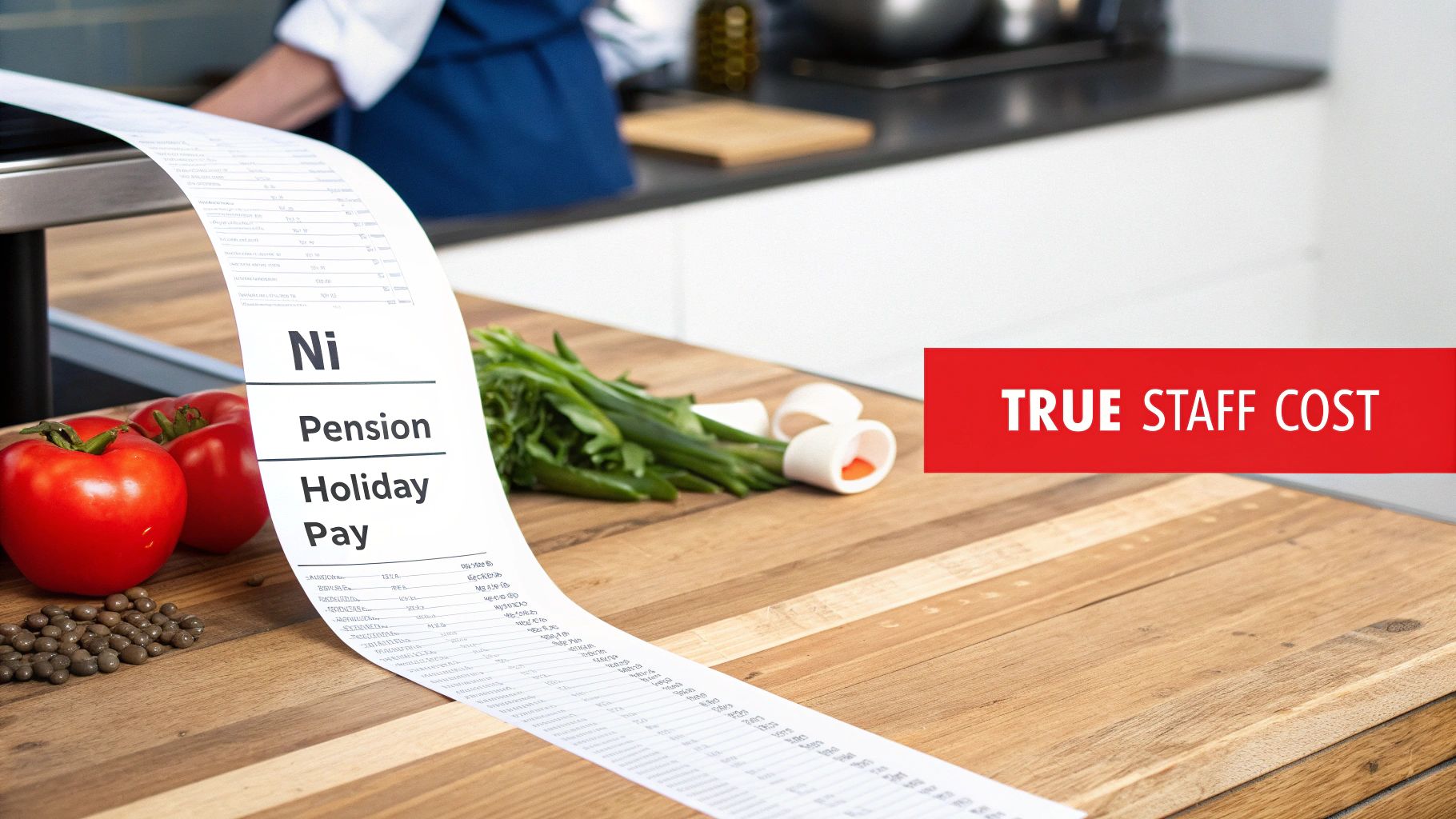
Think of a chef's salary like the price you see on a menu. It looks like the final amount, right? But once you've added drinks, sides, and a service charge, the final bill tells a very different story. The exact same principle applies here. The base wage is just the starting point of your financial commitment.
For every single team member you bring on board, there's a whole layer of mandatory expenses that many independent pubs, restaurants, and hotels completely underestimate. These aren't optional extras. They are legal requirements that form a huge chunk of your payroll.
Understanding On-Costs
The term 'on-costs' covers all the extra expenses you have to pay on top of an employee's gross wage. These are legally mandated, non-negotiable contributions that must be factored into your financial planning from day one.
For businesses running on tight margins—which is most of us in hospitality—ignoring these can cause serious cash flow problems down the line.
The main on-costs you have to account for in the UK are:
- Employer's National Insurance (NI) Contributions: This is a percentage of your employee's earnings that you, the employer, pay directly to the government.
- Workplace Pension Contributions: You have to contribute a minimum percentage to an employee's pension pot under auto-enrolment rules.
- Accrued Holiday Pay: Legally, every employee gets 5.6 weeks of paid holiday a year, and you're the one funding it.
- Statutory Sick Pay (SSP): While not a direct upfront cost, you need to be ready to cover payments if someone is off sick for an extended period.
The real challenge for venue owners isn't just paying these costs—it's accurately forecasting them. A failure to budget for these add-ons is a common reason why promising hospitality businesses end up struggling.
The Scale of the Problem
These costs are not small change. The Office for National Statistics (ONS) shows that UK labour costs, which include all these social security and pension payments, have been climbing steadily.
Let’s take a chef on a modest £12 per hour. Once you add the required 13.8% for National Insurance and 3% for pension contributions, their real cost immediately jumps to over £14.50 per hour. And that’s before you’ve even bought their uniform.
This guide will break down these expenses, giving you clear examples and practical steps to calculate the genuine cost of employing staff. Miscalculating these figures isn’t just a simple accounting error; it can be as damaging as the hidden costs of bad chef cover when you're left scrambling to keep service running.
Your Legal Employer Obligations: The Non-Negotiables
Once you’ve shaken hands on a salary, you’re on the hook for a whole raft of legal financial duties. These aren't perks or bonuses; they’re the mandatory costs of being an employer in the UK. Getting your head around them is the only way to figure out what a team member really costs your business.
Think of these costs as the foundations of your payroll. A chef needs to master the basics before they can get creative, and you need to master these numbers before you can build a profitable venue.
Each one bolts a fixed cost or a percentage on top of the gross wage you agreed, hitting your bottom line directly. Let’s break down exactly what they are and how they actually work.
Employer's National Insurance Contributions
The first and biggest on-cost you'll meet is Employer's National Insurance (NI). This is a tax you, the employer, pay on top of your employee's earnings. Don't confuse it with the Employee's NI contribution – that's a separate deduction that comes out of their wages. This one is all on you.
You pay this tax directly to HMRC. The rate is a percentage of what your employee earns over a certain threshold. For the 2024/25 tax year, the standard rate is 13.8% on earnings above what's called the Secondary Threshold.
In simple terms, for every pound an employee earns over that line, you owe HMRC an extra 13.8 pence. This money goes towards funding public services like the NHS and the State Pension.
Workplace Pension Auto-Enrolment
Since 2012, UK law has made it mandatory for employers to sign up eligible staff for a workplace pension. The goal is to get people saving for retirement, and you have a legal duty to chip in.
The current minimum contributions are simple:
- You (the employer) must pay in at least 3% of your employee's qualifying earnings.
- Your employee pays in 5%, bringing the total minimum pot to 8%.
These pension payments are a serious part of your employment costs. For a chef on £30,000, your minimum yearly contribution will be around £715, based on the qualifying earnings for 2024/25.
It’s not just a financial hit, either. It’s an admin job. You’re responsible for choosing a pension scheme, enrolling your team, managing the payments, and keeping all the records straight.
Statutory Holiday Pay
Every single employee in the UK is legally entitled to paid time off work. The statutory minimum is 5.6 weeks a year for anyone working full-time.
That means you have to pay your staff for 28 days (this can include bank holidays) when they aren’t even in the building. For part-timers, it's worked out pro-rata. When you're budgeting for the year, you must account for paying nearly six weeks of wages for every full-time employee without getting a single minute of work in return. This is a direct, unavoidable, and significant cost.
Statutory Sick Pay
This one isn't a guaranteed monthly cost, but it's a legal obligation you have to be ready for. If a team member is off sick for more than four days in a row, you're usually required to pay them Statutory Sick Pay (SSP).
For the 2024/25 tax year, the weekly rate is £116.75, and you have to pay it for up to 28 weeks. While you can sometimes claim a bit back from the government in certain situations, the money first comes out of your pocket, which can mess with your cash flow. Smart operators always budget a small contingency fund for sick leave – it stops a surprise absence from turning into a financial headache.
Calculating the Total Cost with Worked Examples
It’s one thing to know the individual cost components, but the real eye-opener is seeing them all stacked up. Let's move past the theory and walk through a couple of real-world calculations to uncover the actual cost of employing staff in your venue.
This is how you turn abstract percentages into hard numbers for your budget. We'll start with a basic wage and layer on each non-negotiable cost, step by step. You’ll see exactly how quickly a simple salary inflates into a much bigger financial commitment.
This diagram shows the core legal costs that get added on top of an employee’s gross pay.
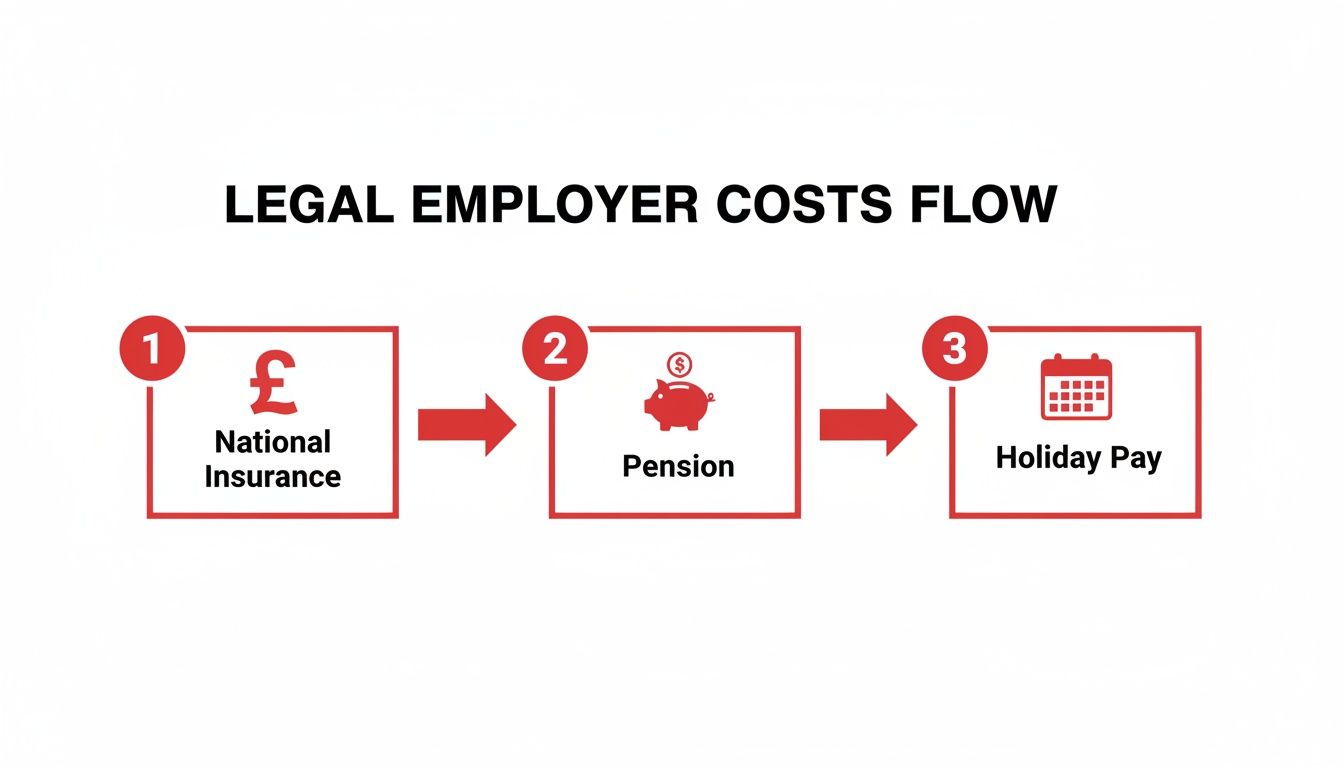
From National Insurance to pensions and holiday pay, each one is a mandatory expense that significantly bumps up the final figure.
Worked Example 1: Part-Time Catering Assistant
Let's start with a common entry-level role. You hire a catering assistant for 20 hours per week at £12.00 per hour. The numbers might look small at first, but the on-costs still make a real dent. If you want to know more about what this role involves, check out our guide on the job description of a catering assistant.
First, we need the annual gross salary.
- Gross Salary Calculation: 20 hours/week x 52 weeks x £12.00/hour = £12,480 per year.
Now, let's layer on the employer's costs, using the 2024/25 tax year rates.
Employer's National Insurance (NI): The starting point for paying Class 1 NI is £9,100 per year. So, you’ll pay 13.8% on any earnings above that.
- Calculation: (£12,480 – £9,100) x 0.138 = £466.44 per year.
Workplace Pension: Your minimum contribution is 3% on 'qualifying earnings', which fall between £6,240 and £50,270.
- Calculation: (£12,480 – £6,240) x 0.03 = £187.20 per year.
Holiday Pay Accrual: All employees get 5.6 weeks of paid leave. For a part-timer, the standard way to calculate this is 12.07% of their earnings.
- Calculation: £12,480 x 0.1207 = £1,506.34 per year.
Once you add these mandatory costs, that £12,480 salary tells a very different story. The real cost of this part-time assistant isn't their hourly wage; it's the full financial picture.
Total Annual Cost Breakdown:
- Gross Salary: £12,480.00
- Employer's NI: £466.44
- Pension Contribution: £187.20
- Holiday Pay: £1,506.34
- Total Annual Cost: £14,639.98
That's right. The actual cost is 17.3% higher than the base salary you offered.
Sample Annual Cost Calculation for a Full-Time Chef
To really see how these costs scale up, let's run the numbers for a full-time chef on a £30,000 salary. This table breaks down how the on-costs pile up, turning a straightforward wage into a much larger liability for the business.
| Cost Component | Calculation | Annual Cost (£) |
|---|---|---|
| Gross Salary | – | 30,000.00 |
| Employer's National Insurance | (£30,000 – £9,100) x 13.8% | 2,884.20 |
| Workplace Pension | (£30,000 – £6,240) x 3% | 712.80 |
| Holiday Pay (5.6 weeks) | (£30,000 / 52) x 5.6 | 3,230.77 |
| Total Employment Cost | Sum of all components | £36,827.77 |
As you can see, the on-costs add nearly £7,000 to the bill. This is a perfect illustration of why just looking at the salary figure can lead to some nasty surprises when you're doing your financial planning.
Worked Example 2: Full-Time Head Chef
Now, let's apply the same logic to a senior, full-time role. You bring in a Head Chef on a salary of £40,000 per year. The percentages don't change, but the cash figures get a whole lot bigger.
Employer's National Insurance (NI): We're still using the 13.8% rate on earnings above that £9,100 threshold.
- Calculation: (£40,000 – £9,100) x 0.138 = £4,264.20 per year.
Workplace Pension: Same deal here. The calculation uses 3% on qualifying earnings, which tops out at £50,270.
- Calculation: (£40,000 – £6,240) x 0.03 = £1,012.80 per year.
Holiday Pay Accrual: This is more straightforward for a salaried employee. You just need to fund their 5.6 weeks (28 days) of paid time off.
- Calculation: (£40,000 / 52 weeks) x 5.6 weeks = £4,307.69 per year.
Total Annual Cost Breakdown:
- Gross Salary: £40,000.00
- Employer's NI: £4,264.20
- Pension Contribution: £1,012.80
- Holiday Pay: £4,307.69
- Total Annual Cost: £49,584.69
In this case, the true cost of employing your Head Chef is almost £10,000 more than their annual salary—a whopping 24% increase. And that's before you even think about sick pay, uniforms, or training. These numbers prove why you have to look past the salary to understand your real financial obligations.
Factoring in the Indirect and Operational Costs

The true cost of employing a new chef goes far beyond the wage and the legal bits we've just calculated. Once you look past the payslip, a whole new layer of operational costs comes into focus. These are the real-world expenses of finding, preparing, and equipping someone to actually do their job.
It’s a bit like running a car. The salary and taxes are the fuel—the obvious, constant expense. But you still have insurance, MOTs, and repairs to keep it on the road. These indirect costs are just as vital for a functioning kitchen, and ignoring them is a classic mistake that blows budgets apart.
The Upfront Costs of Recruitment
Before a new team member even sets foot in your kitchen, you’ve already started spending. The hunt for talent is a serious, often underestimated, investment of both time and money. Good people don’t just appear; you have to go out and find them.
This process breaks down into a few key stages, and each one has a price tag:
- Job Adverts: Getting your vacancy seen on the big hospitality job boards isn’t free. A basic listing might only set you back a small fee, but a premium post designed to catch the eye of top-tier chefs can run into hundreds of pounds.
- Agency Fees: Using a recruitment agency? Their fees are almost always tied to the new hire's annual salary, typically costing you anywhere from 15% to 25%.
- Time Spent Interviewing: This is the massive hidden cost. Every hour your Head Chef or GM spends reading CVs, doing phone screenings, and holding interviews is an hour they aren't running service or pushing the business forward.
When you put a value on senior management's time, the cost of a long hiring process can easily spiral into thousands of pounds—and that’s before you’ve even made an offer.
Onboarding and Essential Training
So, you’ve found the right person. Great. But the spending doesn’t stop there. The onboarding phase is crucial for turning a promising candidate into a productive team member, and it comes with its own list of expenses.
Your initial outlays will almost always include:
- Uniforms and PPE: Branded chef jackets, aprons, and safety shoes are a direct, upfront cost for every new starter.
- Health and Safety Certifications: You’ll likely need to pay for or renew essential training like Food Hygiene Level 2, Allergen Awareness, or First Aid courses to stay compliant.
- Admin Setup: There’s a real administrative cost to getting someone on the payroll system, creating their HR file, and processing all the right-to-work paperwork.
It's easy to see how quickly these costs add up, particularly if you're bringing on a few new people at once.
Ongoing Operational and Soft Costs
The expenses don’t end after week one. Throughout an employee’s time with you, there are ongoing operational and "soft costs" that are all part of the total cost of employment. These are the recurring, often invisible, drains on your resources.
Soft costs are trickier to pin down but they have a real impact. Think of all the management time spent on weekly rotas, running payroll, doing performance reviews, and dealing with HR issues.
Then you have the cost of tools and equipment. This could be anything from a new set of knives for a commis chef to new stock management software that the entire brigade needs training on. All of it belongs in the complete financial picture of what it truly costs to employ someone.
Comparing Direct Hires vs Relief Chef Services
When a gap opens up in your kitchen rota, whether it’s a sudden sick call or a planned holiday, you’re at a crossroads. Do you kick off the long, drawn-out process of finding a permanent hire, or do you call in a relief chef service for immediate, flexible cover?
Each path has completely different consequences for your total cost of employing staff, and it’s a decision that impacts more than just your payroll.
Choosing a direct hire means you’re taking on the full financial weight we've already covered. You’re on the hook for their gross salary plus all the on-costs: National Insurance, pension contributions, holiday pay, and sick pay. This saddles your books with a long-term, fixed overhead, even when trade dips in the quieter months.
Using a relief chef service, on the other hand, flips that cost model on its head. It turns a fixed liability into a variable, operational expense. You pay a single, all-inclusive hourly or daily rate for the exact cover you need, precisely when you need it. That one simple transaction removes the entire complex web of employer obligations from your plate.
The Financial Transparency of Relief Services
The biggest advantage of using a relief chef partner is predictability. The rate you see is the rate you pay. Period. There are no hidden extras or nasty surprises when you run payroll at the end of the month.
That single payment covers everything, which means you instantly dodge:
- Employer's National Insurance: That 13.8% contribution is no longer your problem.
- Pension Auto-Enrolment: The mandatory 3% employer contribution is handled by the provider.
- Holiday and Sick Pay: Accruals for paid leave and statutory sick pay are completely off your books.
- Recruitment Overheads: You sidestep all the costs of job ads, agency fees, and the hours of management time spent sifting through CVs and conducting interviews.
A relief chef service essentially bundles all the complicated on-costs into one transparent figure. This simplifies your budgeting and turns a complicated HR function into a straightforward invoice, allowing you to forecast your labour costs with pinpoint accuracy.
This approach is a game-changer for managing the peaks and troughs of hospitality. Instead of carrying a fully-staffed permanent team through quiet periods, you can run a lean core brigade and bring in expert relief chefs to handle seasonal rushes, big events, or unexpected absences. You’re never paying for labour you aren’t using.
To see how this works for longer periods, you can learn more about how agency staff can cover long-term leave.
Direct Hire vs Relief Chef Partner Comparison
To make the right call for your business, it helps to see a direct, head-to-head comparison. The choice usually boils down to whether you need a quick, flexible solution for a temporary problem or a long-term addition to your core team.
This table breaks down the key financial and operational differences, helping you weigh the true cost and benefit of each option based on your immediate needs.
| Factor | Direct Employee | Relief Chef Partner (e.g., Relief Chefs UK) |
|---|---|---|
| Cost Structure | Base salary plus 25-40% in on-costs (NI, pension, holiday pay). | A single, all-inclusive hourly or daily rate with no hidden fees. |
| Financial Predictability | Variable, with costs like sick pay creating uncertainty. | Completely predictable. The quoted rate is the final cost. |
| Recruitment Costs | Significant investment in job ads, agency fees, and interview time. | Zero recruitment costs. The partner handles all sourcing and vetting. |
| Administrative Burden | Requires ongoing payroll, tax, pension, and HR management. | Minimal administration. You simply approve timesheets and pay an invoice. |
| Speed of Placement | The process can take weeks or even months to find the right candidate. | Fast. Vetted chefs supplied for temporary and emergency cover, subject to availability. |
| Flexibility | A long-term commitment with a rigid contract and notice periods. | Highly flexible. Book cover for a single shift, a week, or a full season. |
| Long-Term Suitability | Ideal for core, permanent roles that are essential year-round. | Perfect for short-term gaps, seasonal peaks, and project-based needs. |
Ultimately, the smartest approach is often a hybrid one. A strong, permanent team forms the backbone of your kitchen's culture and consistency. But having a reliable relief chef partner on call provides the agility and cost control you need to navigate the unpredictable nature of hospitality, protecting both your service standards and your bottom line.
Common Questions About Employing Kitchen Staff
Figuring out the true cost of employing staff can leave even seasoned hospitality managers scratching their heads. Get it right, and your budget stays healthy. Get it wrong, and you're in for a nasty financial surprise.
Here are the straightforward answers to the questions we hear most often.
What Percentage Should I Add for the True Cost?
As a solid rule of thumb, budget an extra 25% to 40% on top of an employee’s gross salary. This isn't just a guess; it's the realistic figure you need to forecast your finances accurately.
That number covers all the non-negotiable costs that come with legally hiring someone in the UK. The biggest chunks are:
- Employer's National Insurance: This is typically 13.8% on earnings above the threshold.
- Minimum Pension Contributions: You’re legally on the hook for at least 3% of their salary.
- Accrued Holiday Pay: Every full-time employee gets 5.6 weeks of paid leave, and you have to account for it.
So why the 40% buffer? That higher figure gives you room for the other essentials: recruitment agency fees, new uniforms, training courses, and a contingency for sick pay.
Is a Relief Chef Agency Cheaper Than a Direct Hire?
For short-term cover, seasonal rushes, or filling an unexpected gap, a relief chef is almost always the more cost-effective option. Yes, the hourly rate might look higher at first glance, but that figure is all-inclusive and completely transparent.
With a relief chef, all the hidden on-costs vanish. You don’t pay their NI, pension, holiday pay, or sick pay. The fee you’re quoted is the final price, giving you total cost certainty.
For permanent, year-round roles, a direct hire makes more sense financially over the long haul. But for flexible cover without the long-term baggage, relief chefs are the perfect solution.
How Can I Reduce My Overall Staff Employment Costs?
Bringing down employment costs is about being smart and strategic, not just slashing hours. The real wins come from boosting operational efficiency and holding onto good people—high staff turnover is one of the biggest cash drains in this business.
The biggest savings are found by optimising what you already have. Build a stable, efficient team and use flexible cover to handle the peaks and troughs. That way, you only pay for the labour you actually need, when you need it.
Here are a few tactics that work:
- Optimise Your Rota: Plan your schedules to match customer flow. This stops you from paying unnecessary overtime or having too many chefs standing around during quiet spells.
- Invest in Staff Retention: A happy, supported team doesn’t look for other jobs. High turnover means you're constantly bleeding money on recruitment and training.
- Use Flexible Staffing: Bring in relief chefs to handle your busiest periods. This stops you from bloating your core team and carrying heavy fixed labour costs all year round.
What Are the Biggest Hidden Costs of Hiring?
The biggest surprise costs when hiring a new chef are nearly always recruitment and training. It’s easy to forget that posting job ads, sinking management hours into interviews, and running trials all have a price tag.
Once they’re hired, the spending continues with onboarding, uniforms, and getting them certified for things like Food Hygiene. And finally, there’s the productivity cost—every new hire needs time to learn your kitchen’s quirks, menu, and processes before they’re fully up to speed.
Tired of navigating staff shortages and unpredictable costs? Relief Chefs UK offers a simple, reliable solution. We connect you with vetted, experienced chefs for temporary, emergency and permanent placements across the UK, subject to availability. Ditch the hidden costs and gain the flexibility you need.
Visit https://www.reliefchefs.co.uk to request cover today.
Built with Outrank
Call the team.
Office 01392 715474 · info@reliefchefs.co.uk