
In the fast-paced UK hospitality sector, the catering assistant is the backbone of a successful kitchen. While the title might suggest a simple support role, the reality is a dynamic position demanding a blend of culinary skill, organisational prowess, and an unwavering commitment to safety and efficiency. The responsibilities of a catering assistant go far beyond just chopping vegetables or washing dishes; they are integral to the seamless operation of kitchens in pubs, restaurants, boutique hotels, and even luxury yachts.
A skilled assistant ensures that service runs smoothly, standards remain high, and chefs, including temporary staff, can perform at their best. For establishments needing dependable kitchen support, especially at short notice, understanding the full scope of these duties is the first step in briefing relief staff and building a resilient, high-performing team. A great catering assistant anticipates needs, maintains impeccable standards of cleanliness, and provides the crucial foundation upon which memorable dining experiences are built.
This detailed guide explores the core responsibilities that define this crucial role, offering practical insights for both aspiring assistants and the venues that rely on them. We will break down everything from fundamental food preparation and sanitation management to stock control and compliance documentation, providing a clear blueprint for success in any professional kitchen environment.
1. Food Preparation and Mise en Place Setup
One of the most fundamental responsibilities of a catering assistant is the meticulous preparation of ingredients and the organisation of workstations, a process known in professional kitchens as mise en place (everything in its place). This foundational duty involves washing, peeling, chopping, and accurately portioning all food items according to the chef's precise specifications. A well-executed mise en place is the bedrock of an efficient kitchen, directly impacting the speed and quality of service.
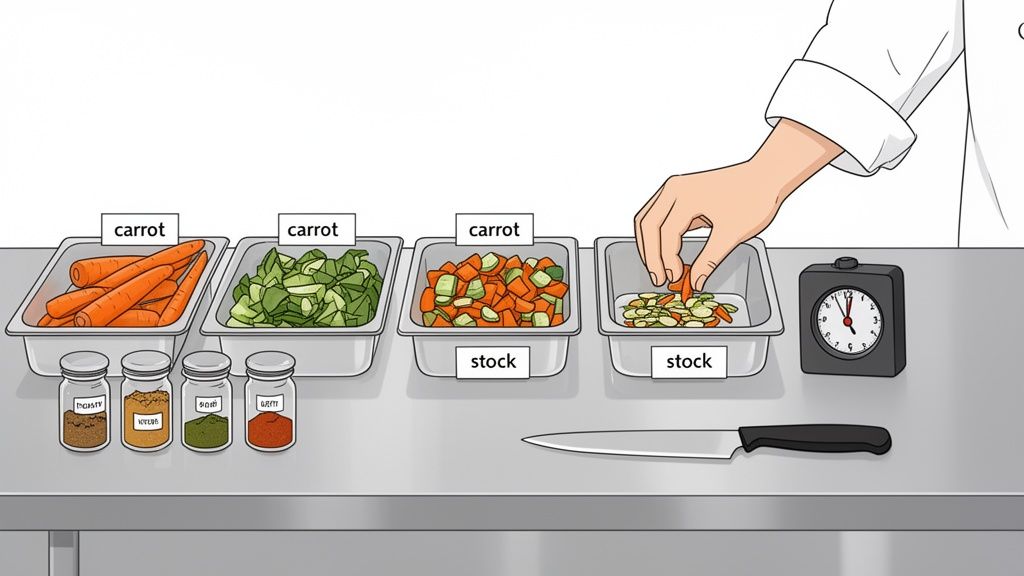
When every ingredient is prepped and ready, the head chef or sous chef can focus on cooking and plating, significantly reducing delays during busy periods. This organised approach is not just about efficiency; it's a critical component of food safety, minimising cross-contamination risks and ensuring ingredients are handled correctly.
Implementation Across Venue Types
The specific tasks will vary depending on the establishment:
- Pubs & Restaurants: This often involves dicing vegetables for soup bases, portioning meats for grill stations, preparing garnish trays, and setting up sauce stations for high-volume service.
- Boutique Hotels: Responsibilities might include prepping ingredients for both à la carte menus and function catering, such as portioning fish for dinner service and organising components for multiple breakfast covers.
- Yacht Catering: Assistants may prepare delicate canapé elements, organise dessert components, and prep fresh seafood, all within a compact galley environment where organisation is paramount.
For venues using temporary staff, a proficient catering assistant who masters mise en place is invaluable. Their work allows a relief chef to step into the kitchen and begin cooking almost immediately, ensuring a seamless continuation of service quality without disruption.
Key Takeaway: A well-organised prep station is a direct reflection of a well-run kitchen. It empowers senior chefs to perform at their best and is a non-negotiable part of a catering assistant's role. While many see it as a basic duty, its impact on service flow and food quality is immense.
Actionable Tips for Excellence
- Standardise and Label: Use uniform containers and clear, dated labels for all prepped ingredients. This prevents confusion and supports food safety protocols.
- Create a Checklist System: Maintain a prep list for each station or service. This ensures no task is overlooked, especially during staff changeovers or when briefing relief personnel.
- Brief Relief Staff Thoroughly: When a temporary chef arrives, immediately show them where prepped items are located, confirm quantities, and explain any venue-specific storage systems. This simple step can save significant time and prevent errors.
This level of structured preparation supports the entire kitchen brigade, mirroring some of the organisational duties handled by more senior roles. A strong understanding of mise en place is often a stepping stone for assistants looking to advance, as the principles are central to the duties of a sous chef and other leadership positions.
2. Kitchen Cleaning and Sanitation Management
Beyond food preparation, a core responsibility of a catering assistant is maintaining impeccable standards of kitchen hygiene and sanitation. This duty is non-negotiable and extends far beyond a simple wipe-down at the end of a shift. It involves a systematic approach to cleaning that includes daily sanitisation of all food contact surfaces, managing waste disposal, deep cleaning equipment, and ensuring the kitchen is compliant with UK food hygiene regulations.
Proper sanitation is fundamental to a venue's reputation, guest safety, and its ability to pass health inspections. A catering assistant’s diligence in this area directly prevents foodborne illnesses, controls pests, and creates a safe and professional working environment for the entire kitchen team. This is a critical part of the overall responsibilities of a catering assistant, safeguarding the business from the ground up.
Implementation Across Venue Types
The specific cleaning tasks will differ based on the kitchen's size, equipment, and service volume:
- Pubs & Restaurants: This often includes deep cleaning fryers and range hoods at the end of the week, daily sanitisation of high-traffic prep surfaces, and managing the segregation of general waste, food waste, and recycling.
- Boutique Hotels: Assistants may be responsible for post-service breakdown in the main kitchen, ensuring all stations are spotless for the next shift, and maintaining cleaning records for multi-site compliance if part of a larger group.
- Yacht Catering: Due to confined spaces, hygiene is paramount. Tasks include rigorous daily cleaning of the galley, adhering to strict equipment maintenance schedules, and managing waste in line with maritime environmental regulations.
For establishments bringing in relief staff, a well-maintained and clearly organised cleaning system is essential. It allows a temporary chef to operate safely and efficiently, confident that hygiene standards are already being met.
Key Takeaway: Kitchen cleanliness is a direct reflection of a venue's professionalism and commitment to safety. A catering assistant who excels in sanitation management is not just a cleaner; they are a guardian of the establishment's reputation and the well-being of its customers.
Actionable Tips for Excellence
- Implement Colour-Coded Systems: Use different coloured cloths, brushes, and chopping boards for different food groups (e.g., red for raw meat, green for vegetables) to instantly minimise the risk of cross-contamination.
- Create Laminated Checklists: Post clear, laminated checklists for daily, weekly, and monthly cleaning duties. This creates accountability and ensures that less frequent tasks, like cleaning drains or descaling machines, are not overlooked.
- Schedule Deep Cleans Strategically: Plan intensive cleaning tasks, such as cleaning behind heavy equipment, for quieter periods or during scheduled closures to avoid disrupting service.
- Train on Chemical Safety: Ensure all staff, including temporary assistants, are trained on the correct dilution, use, and storage of cleaning chemicals to comply with COSHH (Control of Substances Hazardous to Health) regulations. Document this training for compliance purposes.
3. Dish Washing and Pot/Pan Management
An often-underestimated yet vital responsibility of a catering assistant is the systematic management of dishwashing and pot/pan circulation. This duty extends far beyond simply cleaning; it involves operating industrial dishwashers, hand-washing delicate items, and organising all kitchenware to ensure a constant supply is available for chefs. During a high-volume service, the efficiency of the "pot wash" station directly dictates the kitchen's pace and prevents serious service bottlenecks.
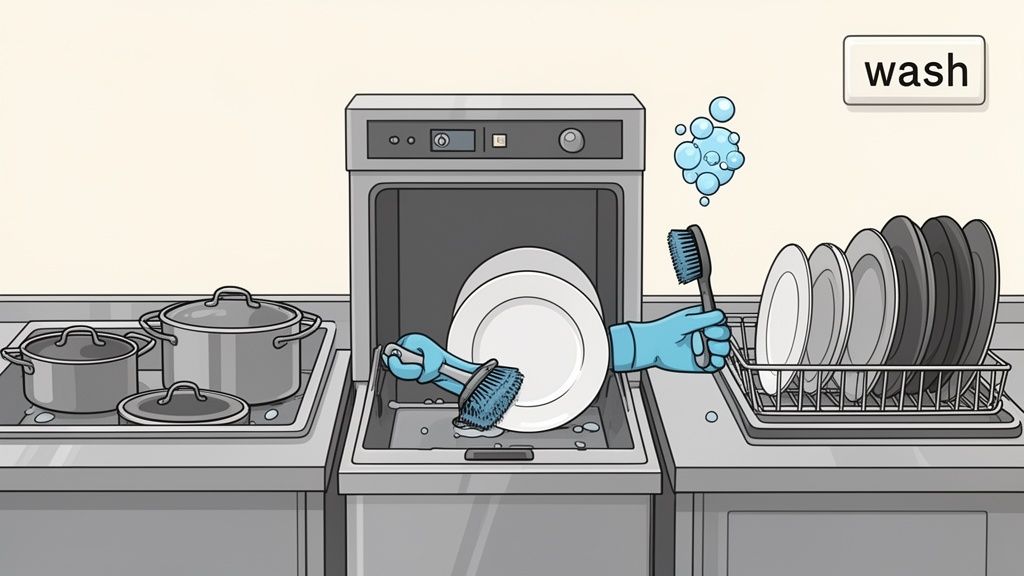
Without a well-managed dishwashing process, chefs run out of essential pans, plates, and utensils, causing a complete halt in production. This role is the circulatory system of the kitchen, ensuring the tools needed for cooking and plating are clean, organised, and ready for immediate use. A proactive approach to this task is a key trait of a dependable catering assistant.
Implementation Across Venue Types
The intensity and specifics of this role change significantly based on the environment:
- Pubs & Restaurants: This involves managing industrial pass-through dishwashers to handle 200+ covers during peak service, requiring rapid turnover of plates, cutlery, and glassware.
- Boutique Hotels: Duties often include a mix of machine washing standard items and carefully hand-washing fine china or delicate glassware used for private dining and exclusive events.
- Yacht Catering: In a tight galley space, assistants must perform quick-turnaround cleaning of pots and pans to facilitate multi-course meals, where space for duplicate equipment is non-existent.
For venues using temporary staff, a catering assistant who can independently manage the pot wash area is a massive asset. They allow the relief chef to remain focused on the pass, confident that a clean pan or plate will be available the moment it is needed.
Key Takeaway: The pot wash station is not a secondary task; it is the engine room of a busy kitchen. Efficient management prevents delays, supports hygiene standards, and enables the entire culinary team to function without interruption.
Actionable Tips for Excellence
- Establish a Pre-Rinse Protocol: Implement a mandatory scraping and pre-rinsing station before items enter the dishwasher. This prevents food debris from clogging the machine's filters and ensures a better clean.
- Organise for Accessibility: Keep high-use items like sauté pans, mixing bowls, and chopping boards in a designated, easily accessible location. Use a first-in, first-out system to ensure even wear.
- Load Dishwashers Strategically: Train staff on how to load dishwasher racks for maximum capacity and cleaning effectiveness, avoiding the need for re-washing.
- Schedule Preventative Maintenance: Regularly clean dishwasher filters, check salt and rinse-aid levels, and schedule professional servicing to prevent unexpected breakdowns during a busy shift.
4. Stock Rotation and Inventory Assistance
A core responsibility of a catering assistant is the diligent management of stock and inventory. This involves applying the FIFO (First In, First Out) principle, where older stock is used before newer deliveries to prevent spoilage and minimise waste. Assistants play a crucial role in receiving, checking, and correctly storing food deliveries, monitoring expiration dates, and organising storage areas such as fridges, freezers, and dry stores. This systematic approach is vital for cost control, food safety, and maintaining accurate inventory counts for the kitchen management team.
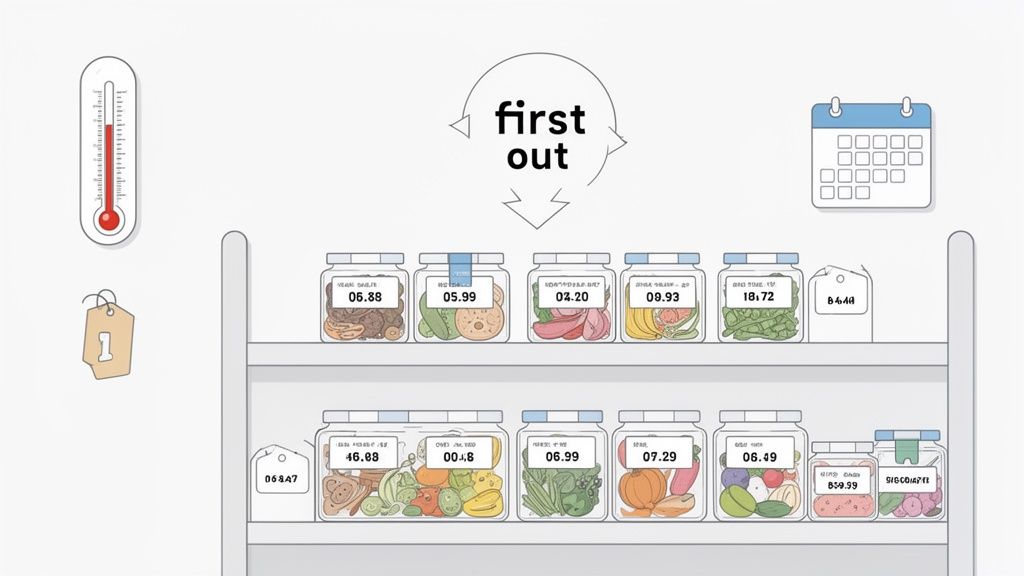
Effective inventory assistance ensures the chefs have access to fresh, high-quality ingredients at all times, preventing service disruptions caused by stock shortages or expired products. It’s a detail-oriented task that directly supports the kitchen’s profitability and reputation for quality. By keeping storage areas clean and organised, catering assistants also contribute significantly to workplace efficiency and hygiene standards.
Implementation Across Venue Types
The application of inventory management varies with the scale and style of the operation:
- Pubs & Restaurants: Assistants are often tasked with rotating fresh produce, dairy, and butchery items in walk-in fridges during daily prep, ensuring ingredients with the shortest shelf life are placed at the front.
- Boutique Hotels: This might involve organising frozen components for different service areas (e.g., breakfast, fine dining, room service) and managing the storage of high-value specialty ingredients.
- Yacht Catering: In the constrained space of a galley, the assistant’s ability to meticulously organise and monitor fresh provisions is paramount. Every item must be logged and stored to maximise its lifespan and prevent waste.
When a temporary chef is brought in, a well-managed inventory system is a game-changer. An organised storeroom and clearly labelled stock allow a relief chef to quickly find what they need and understand the kitchen’s pars, ensuring a smooth transition.
Key Takeaway: Proper stock management is more than just tidying shelves; it's a financial and safety-critical function. A catering assistant who excels in this area directly reduces food waste, cuts costs, and upholds the quality standards of the entire establishment.
Actionable Tips for Excellence
- Label Everything: Use clear, waterproof labels with the product name, delivery date, and use-by date on every item. This removes guesswork and enforces the FIFO system.
- Systematic Placement: When new stock arrives, physically move older items to the front and place the new delivery behind them. This simple habit is the foundation of effective rotation.
- Keep a Master List: Maintain a visible inventory list or whiteboard in the storage area for high-turnover items. This allows all staff to see stock levels at a glance.
- Brief Relief Staff: During induction, a catering assistant should walk any temporary chef through the storage layout, pointing out key sections and explaining any venue-specific labelling or ordering processes.
5. Food Service and Plating Support
Beyond initial preparation, one of the key responsibilities of a catering assistant is providing direct support during the critical moments of service and plating. This role bridges the gap between cooking and the final presentation, ensuring every dish leaving the pass meets the chef's visual and quality standards. Assistants prepare plates, carefully arrange garnishes, manage plate temperatures, and help execute service under direct supervision, maintaining consistency and timing.
This responsibility demands a keen eye for detail, a steady hand, and the ability to work swiftly and cleanly under pressure. The assistant's contribution directly affects the guest's first impression of their meal, making their role in plating a vital part of the kitchen's success.
Implementation Across Venue Types
The nature of plating support varies significantly depending on the service style:
- Pubs & Restaurants: This often involves garnishing high volumes of dishes with microgreens or sauces, plating appetizers on mise en place stations for quick dispatch, and ensuring every plate is wiped clean before heading to the dining room.
- Boutique Hotels: Support may be needed for intricate, multi-course tasting menus, requiring precise placement of delicate components and careful management of plate temperatures to ensure each course arrives perfectly.
- Yacht Catering: Assistants are crucial in supporting elegant plating for private dining events in confined spaces. This includes assembling canapés, adding finishing touches to main courses, and organising dessert presentations for a high-end experience.
In fast-paced environments, a catering assistant who can anticipate the chef's needs and work methodically through the plating process is essential. They act as an extra pair of hands for the senior chefs, allowing them to focus on cooking and quality control during the busiest service periods.
Key Takeaway: Consistent and beautiful plating is not just the chef's job; it's a team effort. A catering assistant’s support at the pass ensures every plate maintains the same high standard, reinforcing the venue's reputation for quality from the first dish to the last.
Actionable Tips for Excellence
- Create a Visual Plating Guide: Use a photo reference or a pre-plated example for each dish. This visual guide is invaluable for maintaining consistency, especially for relief staff or new team members.
- Organise the Pass: Arrange all garnishes, oils, and finishing salts in the order they will be used. This mise en place for the pass station speeds up the entire process.
- Master Temperature Control: Utilise heated plate cabinets or salamanders to warm plates for hot dishes and keep plates chilled for cold starters or desserts. This simple step makes a significant difference to the dining experience.
- Establish a Clear Hand-Off: Define a clear protocol for communication between the kitchen and front-of-house staff to ensure dishes are collected promptly, maintaining their temperature and presentation.
6. Receiving and Delivery Coordination
A crucial, often overlooked, responsibility of a catering assistant is managing the entire lifecycle of incoming deliveries. This involves more than just signing a form; it requires verifying orders against invoices, meticulously checking product quality and quantities, and directing all items to their appropriate storage locations. Accurate and efficient receiving prevents supply shortages, reduces costly waste, and maintains tight control over kitchen budgets.
When an assistant handles deliveries effectively, they act as the first line of defence for quality control and inventory management. By spotting discrepancies, rejecting substandard produce, or flagging short-dated items immediately, they safeguard the kitchen’s ability to execute its menu to the highest standard. This process ensures that chefs work with the correct, high-quality ingredients they expect.
Implementation Across Venue Types
The specific focus of delivery coordination changes based on the venue's needs:
- Independent Restaurants: This often involves receiving daily produce orders from local suppliers, verifying fresh meat deliveries against the chef's specific cuts, and ensuring dry goods are correctly stored to maintain freshness.
- Boutique Hotels: Assistants might process multiple deliveries daily, from fresh fish for the fine-dining restaurant to bulk beverage orders for the bar and event spaces. Verifying specialist ingredients and managing their storage is key.
- Yacht Catering: Space is at a premium, so assistants must check and immediately store provisions with extreme organisation. This could include verifying specialty imports and ensuring all items, especially perishables, are stowed correctly for longevity at sea.
For hospitality groups or venues using temporary staff, a clear and organised receiving process is vital. An assistant who can brief a relief chef on new stock, back-ordered items, or supplier issues ensures a smooth handover and prevents service disruptions caused by unexpected stock shortages.
Key Takeaway: Efficient delivery coordination is a cornerstone of a profitable and well-managed kitchen. It prevents waste, ensures quality, and directly supports financial control. An assistant who excels in this area is a significant asset to the entire operation.
Actionable Tips for Excellence
- Create a Standardised Checklist: Develop a receiving checklist for each key supplier. This should include temperature checks for chilled goods, quality markers for fresh produce, and a clear sign-off process.
- Document Discrepancies: Immediately photograph any damaged goods, incorrect items, or quantity shortfalls. This provides undeniable evidence when resolving disputes with suppliers.
- Keep Schedules Visible: Post a clear delivery schedule in a central location. This helps the entire kitchen team anticipate arrivals and plan their workflow accordingly, preventing bottlenecks.
- Build Supplier Relationships: Establishing a good rapport with delivery drivers and sales representatives can make resolving issues much faster and smoother. A quick phone call is often more effective than a formal email chain.
Mastering this part of the job is a clear demonstration of organisational skill and commercial awareness, making it one of the most important responsibilities of a catering assistant looking to progress in their career.
7. Support for Multiple Stations and Kitchen Flexibility
A dynamic kitchen requires staff who can adapt on the fly, and one of the core responsibilities of a catering assistant is providing flexible support across various stations. This role acts as the kitchen’s versatile floater, moving between sections like prep, sauces, pastry, and the cold station as directed by the chef. This duty requires a foundational understanding of multiple station setups and the ability to switch tasks quickly to meet the changing demands of service.
This adaptability is not just about being helpful; it's a critical function that keeps the entire operation running smoothly. When the grill station is overwhelmed, a flexible assistant can step in to replenish mise en place. If the dessert orders surge, they can pivot to help the pastry chef with plating. This fluidity prevents bottlenecks and ensures no single station falls behind during peak hours.
Implementation Across Venue Types
The need for flexibility manifests differently depending on the kitchen environment:
- Pubs & Restaurants: An assistant might start their shift on vegetable prep, switch to supporting the sauce station during the main rush, and then move to the pot wash area as service winds down.
- Boutique Hotels: This could involve assisting with breakfast prep in the morning, supporting the à la carte lunch service, and then helping plate desserts for a private function in the evening.
- Yacht Catering: In a compact galley with limited staff, the assistant must be a true all-rounder, helping with everything from canapé assembly and main course plating to clearing down and preparing for the next meal service.
For any venue, a catering assistant’s ability to seamlessly integrate into different sections is a massive asset. Their support enables specialist chefs to maintain focus on their primary tasks, directly contributing to consistent food quality and efficient ticket times.
Key Takeaway: Flexibility is the invisible lubricant in a high-pressure kitchen. A catering assistant who can anticipate needs and move between stations without constant direction is an invaluable part of the team, ensuring service remains fluid and organised.
Actionable Tips for Excellence
- Cross-Train on All Stations: Proactively ask chefs to demonstrate the basic setup and needs of each station during quieter periods. This preparation makes you more effective during a busy service.
- Use Clear Communication: During service, rely on clear verbal cues and confirmations like "Yes, Chef!" to acknowledge instructions. This minimises errors when moving between tasks.
- Establish a Priority Order: Learn the flow of orders to anticipate which station will need support next. For example, if a large table has just ordered mains, the grill and sauce stations will likely be the next pressure point.
- Debrief After Service: Participate in end-of-shift meetings. Discussing what worked well and where bottlenecks occurred helps the entire team refine its process for the next service.
Developing this adaptability is a key part of progressing in a culinary career. It provides a broad overview of how a kitchen functions, knowledge that is essential for more senior roles. It also makes you a more desirable candidate for both permanent positions and temporary placements found through dedicated hospitality jobs search agencies.
8. Health, Safety, and Compliance Documentation
Beyond cooking and cleaning, a core part of the responsibilities of a catering assistant involves upholding the venue's legal and ethical commitment to safety. This means actively participating in compliance procedures, from following strict food safety protocols to assisting with essential documentation. Assistants are the eyes and ears on the ground, playing a vital role in identifying hazards, maintaining safe working conditions, and ensuring all practices align with UK regulations like the Food Safety Act 1990 and HACCP (Hazard Analysis and Critical Control Point) principles.
This duty is non-negotiable and protects everyone – guests, colleagues, and the business itself. It involves meticulously recording data, such as daily fridge and freezer temperatures, and adhering to allergen management systems. A vigilant assistant helps prevent cross-contamination, flags potential equipment failures, and ensures a transparent, auditable trail of safety measures is maintained at all times.
Implementation Across Venue Types
The specific compliance tasks will differ based on the operational scale and environment:
- Independent Restaurants: This often involves diligently completing daily temperature logs for refrigeration units, checking and recording food delivery temperatures, and ensuring cleaning schedules are signed off.
- Boutique Hotels: An assistant might be responsible for reporting near-miss incidents (e.g., a slip on a wet floor that didn't result in injury), strictly following complex allergen matrices for diverse guest requirements, and participating in regular safety briefings.
- Multi-Site Groups: In larger organisations, assistants may assist with food traceability documentation for suppliers, ensuring a clear record of where ingredients originated, which is critical during a product recall or food-borne illness investigation.
For any venue, a catering assistant who is proactive about safety documentation is a huge asset. Their diligence provides management with the confidence that standards are being met consistently, even during the busiest service periods.
Key Takeaway: Compliance documentation isn't just paperwork; it's a tangible record of a kitchen's commitment to safety. A catering assistant’s accuracy in these tasks directly contributes to a safer environment and protects the venue's reputation and legal standing.
Actionable Tips for Excellence
- Create Quick-Reference Cards: Laminate small, durable cards detailing critical food safety procedures (e.g., temperature danger zones, sanitiser dilutions) and place them at relevant stations for easy access.
- Establish a No-Blame Culture: Encourage staff to report all hazards and near-misses without fear of reprisal. This proactive approach identifies risks before they lead to accidents.
- Schedule Regular Training: Organise brief, regular food safety refreshers (at least annually) to keep knowledge current and reinforce best practices. This is a key part of the formal job description of a catering assistant and their professional development.
- Maintain Organised Records: Keep all compliance documentation, from temperature logs to training certificates, in a clearly labelled and accessible file or digital system. This makes internal audits and external inspections far more straightforward.
8-Point Comparison of Catering Assistant Responsibilities
| Responsibility | 🔄 Implementation complexity | ⚡ Resource requirements | 📊 Expected outcomes | 💡 Ideal use cases | ⭐ Key advantages |
|---|---|---|---|---|---|
| Food Preparation and Mise en Place Setup | Medium — repetitive tasks with timing/accuracy needs | Basic tools, containers, labels, trained prep staff | Smooth service flow; consistent portioning and reduced delays | High-volume shifts; relief-chef integrations | Improves consistency, reduces waste, frees chefs |
| Kitchen Cleaning and Sanitation Management | Medium–High — scheduled tasks and chemical safety | Cleaning agents, PPE, time for deep cleans, checklists | Regulatory compliance; lower contamination risk; better equipment lifespan | Venues subject to inspections; multi-service kitchens | Prevents foodborne illness; protects reputation |
| Dish Washing and Pot/Pan Management | Low–Medium — routine but requires equipment competence | Industrial dishwasher, detergents, water, labor | Continuous availability of clean equipment; reduced service interruptions | High-cover services; quick-turnaround events | Keeps service running; prolongs cookware life |
| Stock Rotation and Inventory Assistance | Medium — attention to FIFO and tracking systems | Storage space, labels, inventory logs or software | Reduced spoilage; accurate stock levels; cost control | Multi-site groups; frequent deliveries; relief-chef handovers | Minimizes waste; improves traceability and sourcing |
| Food Service and Plating Support | Medium–High — precision, timing, and presentation standards | Plating tools, heated cabinets, prepped garnishes, trained staff | Consistent presentation; improved guest satisfaction; timely service | Multi-course menus; busy service periods; event catering | Enhances presentation and service tempo |
| Receiving and Delivery Coordination | Medium — verification, documentation, and temp checks | Checklists/scanners, scales, storage capacity, trained receiver | Accurate deliveries; fewer shortages; preserved cold chain | Venues with frequent or specialty suppliers | Prevents billing/quality issues; protects perishable goods |
| Support for Multiple Stations and Kitchen Flexibility | High — broad skills and rapid task switching required | Cross‑training time, clear communication protocols | Greater operational resilience; fewer station bottlenecks | Small teams, peak-season cover, relief chef deployments | Maximizes flexibility; reduces workload on chefs |
| Health, Safety, and Compliance Documentation | Medium — ongoing records and training upkeep | Logs/digital systems, training materials, PPE, time | Regulatory compliance; safer workplace; lower liability | All venues, especially inspected or insured operations | Protects guests/staff; reduces legal and financial risk |
Empowering Your Kitchen with a Competent Catering Assistant
The role of a catering assistant, as we have explored, is far more than just an entry-level position; it is the structural support upon which a successful kitchen is built. A well-defined understanding of the responsibilities of a catering assistant is not merely a box-ticking exercise for a job description. It is a strategic tool for operational excellence, ensuring every aspect of your kitchen, from the initial delivery to the final plate presentation, runs smoothly and efficiently.
When these duties are clearly communicated and consistently upheld, the entire kitchen team benefits. Head chefs and sous chefs are freed from routine tasks, allowing them to focus on menu innovation and quality control. The service flow becomes more coordinated, reducing wait times and improving the customer experience. A competent catering assistant acts as the kitchen's central nervous system, quietly managing the essential functions that allow the creative and high-pressure elements of service to shine.
Key Takeaways: From Responsibility to Impact
Moving beyond a simple checklist, it's vital to appreciate the tangible impact of each core responsibility. A proactive approach to these duties transforms a good catering assistant into an indispensable team member.
- Mise en Place & Prep: When a catering assistant masters their prep list, they are not just chopping vegetables; they are giving time back to the senior chefs. This allows for more refined cooking and less stress during peak hours.
- Hygiene & Sanitation: A spotless kitchen is non-negotiable. An assistant who takes ownership of cleaning schedules and HACCP documentation is directly protecting your business's reputation and your customers' health. This is a foundational, not a secondary, responsibility.
- Stock Management: Effective stock rotation and inventory assistance go beyond preventing waste. It ensures ingredient freshness, which is the cornerstone of flavour, and provides accurate data for cost control and ordering. This directly impacts your gross profit margin.
- Kitchen Flexibility: The ability to float between dishwashing, basic prep, and plating support is perhaps the most valuable trait. This adaptability prevents bottlenecks and keeps the service momentum going, especially during an unexpectedly busy service or when facing staff shortages.
A Strategic Investment: Investing time in training a catering assistant on the full scope of their responsibilities yields remarkable returns. It creates a culture of accountability, fosters professional growth, and builds a more resilient and self-sufficient kitchen brigade. A well-briefed assistant can seamlessly support a temporary head chef, ensuring continuity and high standards even when your core team is unavailable.
Actionable Next Steps for Venue Managers
To put these insights into practice, focus on clear communication and empowerment. Before your next shift, or when briefing temporary staff, consider these actions:
- Review and Refine Your Briefing Documents: Update your standard operating procedures. Create a simple, one-page document that clearly outlines the primary responsibilities of a catering assistant for your specific venue, including opening and closing checklists.
- Conduct a 'Walk and Talk' Induction: Don't just hand over a list. Walk new or temporary assistants through the kitchen, physically pointing out the cleaning stations, stock areas, and key equipment. Explain the 'why' behind each task, such as "we rotate stock this way to meet our food safety obligations."
- Empower with Ownership: Assign specific areas of responsibility. For example, make one assistant the point person for checking and signing off on daily temperature logs. This simple act fosters a sense of pride and accountability.
By thoroughly defining and respecting the responsibilities of a catering assistant, you are not just filling a role. You are strategically reinforcing the entire foundation of your culinary operation. This clarity ensures that everyone, from your head chef to a relief chef stepping in for a single weekend, can perform at their best, secure in the knowledge that the essential support systems are expertly managed.
Feeling the pressure of a staff shortage or need an experienced professional to lead your team through a busy period? Relief Chefs UK provides vetted, skilled chefs and kitchen support staff who understand these dynamics inside and out. We connect you with professionals who can integrate seamlessly into your kitchen, ensuring your high standards are maintained, no matter the circumstances. Visit Relief Chefs UK to find the flexible, expert cover your kitchen deserves.