
To really understand what it means to work in hospitality, you have to forget the old picture of just restaurants and hotels. The industry is huge. It’s everything from city pubs and indie hotels to private households and superyachts. It’s a job built on one thing: making an experience for someone.
What Working in UK Hospitality Really Looks Like in 2026
Think of any hospitality venue as a machine. Every single role, from the KP on the pot wash to the Head Chef running the pass, is a critical part. If one part fails, the whole thing grinds to a halt.
Success is about a team moving as one, whether you’re guest-facing on the floor or driving the engine in the kitchen. That shared drive is what gets you through a tough service.
But let’s be honest. The industry is facing huge staff shortages right now. For businesses, that’s a massive headache. For skilled, reliable chefs and front-of-house staff, it’s a golden opportunity.
The Modern Hospitality Landscape
The demand for good people means that if you have the right attitude and skills, you’re in a stronger position than ever before. This isn’t just about getting any job; it’s about getting the right job, on the right terms.
The current pressure has created real openings for:
- Real Flexibility: More venues now offer decent, flexible rotas to find and keep good staff.
- Better Pay: High demand, especially for chefs, gives you the power to negotiate better rates.
- Faster Career Growth: If you’re ambitious and prove you can handle the pressure, you can move up the ladder incredibly fast.
The hospitality industry is hard because it’s all about people and service. You have to have the patience, the passion and the willingness to do the job no matter what. With the right attitude, you’ll be successful.
A Career of Creativity and Connection
Yes, it's a demanding job. But hospitality gives you things other industries can't. You see the direct result of your work on a guest’s face, right there and then.
You also build a unique bond with your team. That bond is forged in the fire of a fully-booked Saturday night and the shared success of a clean service.
Deciding to work in hospitality is simple. You weigh the high-energy, high-pressure reality against the satisfaction of creating something, working in a tight team, and making people happy. This guide gives you the unvarnished truth on both sides, so you can decide if it's the right place for you.
The Different Worlds of Hospitality: More Than Just Restaurants
Thinking about a career in hospitality? The first thing to understand is that it’s not one single industry. It’s a huge ecosystem of different roles, each with its own rhythm and rules. It's not just about taking orders or cooking in one kitchen for years on end.
The easiest way to think about it is the classic split: Front of House (FOH) and Back of House (BOH). One is the stage, the other is the engine room. Both are essential.
Front of House: The Face of the Business
Front of House staff are the first and last people a guest interacts with. They set the tone and manage the guest experience directly. These roles are all about communication, patience, and the ability to read a room.
Common FOH roles include:
- General Manager: The boss. This person is responsible for everything from profit and loss to keeping the team motivated and the guests happy.
- Waiting Staff: The direct link to the customer. A great waiter doesn't just take orders; they guide the experience, anticipate needs, and solve problems before they escalate.
- Bar Staff: The masters of the drinks programme. They can set the entire vibe of a venue, whether it’s pulling a perfect pint or crafting a high-end cocktail.
- Host/Hostess: The gatekeeper. They control the flow of service, manage the booking sheet, and are the first friendly face guests see.
FOH is where the performance happens, but the script is written in the back.
Back of House: The Engine Room
The BOH is where the product is made. In most venues, this means the kitchen. It’s a high-pressure environment that traditionally runs on a strict hierarchy known as the Brigade de Cuisine. This system keeps the chaos organised.
For chefs, the career ladder is clear, and you have to climb it rung by rung.
- Kitchen Porter (KP): The most important job in the kitchen, period. KPs handle the washing, cleaning, and basic prep. It's brutal work, but it's where you learn the flow of a professional kitchen. No good KP, no service.
- Commis Chef: The apprentice. A Commis rotates through different sections—sauce, pastry, fish—learning the fundamentals under a senior chef. This is where you build your core skills.
- Chef de Partie (CDP): A station chef. Now you're in charge of a section. You're expected to run it, manage your prep, and deliver consistency under pressure. It’s a massive step up in responsibility.
- Sous Chef: The second-in-command. The Sous Chef manages the team day-to-day, handles ordering, and runs the pass when the Head Chef is away. This is a senior leadership role.
- Head Chef / Executive Chef: The leader. This job is as much about spreadsheets, staff management, and food costings as it is about cooking. They are responsible for the kitchen's entire output and profitability.
This traditional path offers stability and a clear route for progression. But it's not the only way. The modern hospitality industry offers far more flexible—and often more lucrative—options that break out of the single-kitchen model.
As this chart shows, your skills are transferable across hotels, pubs, and even private homes.
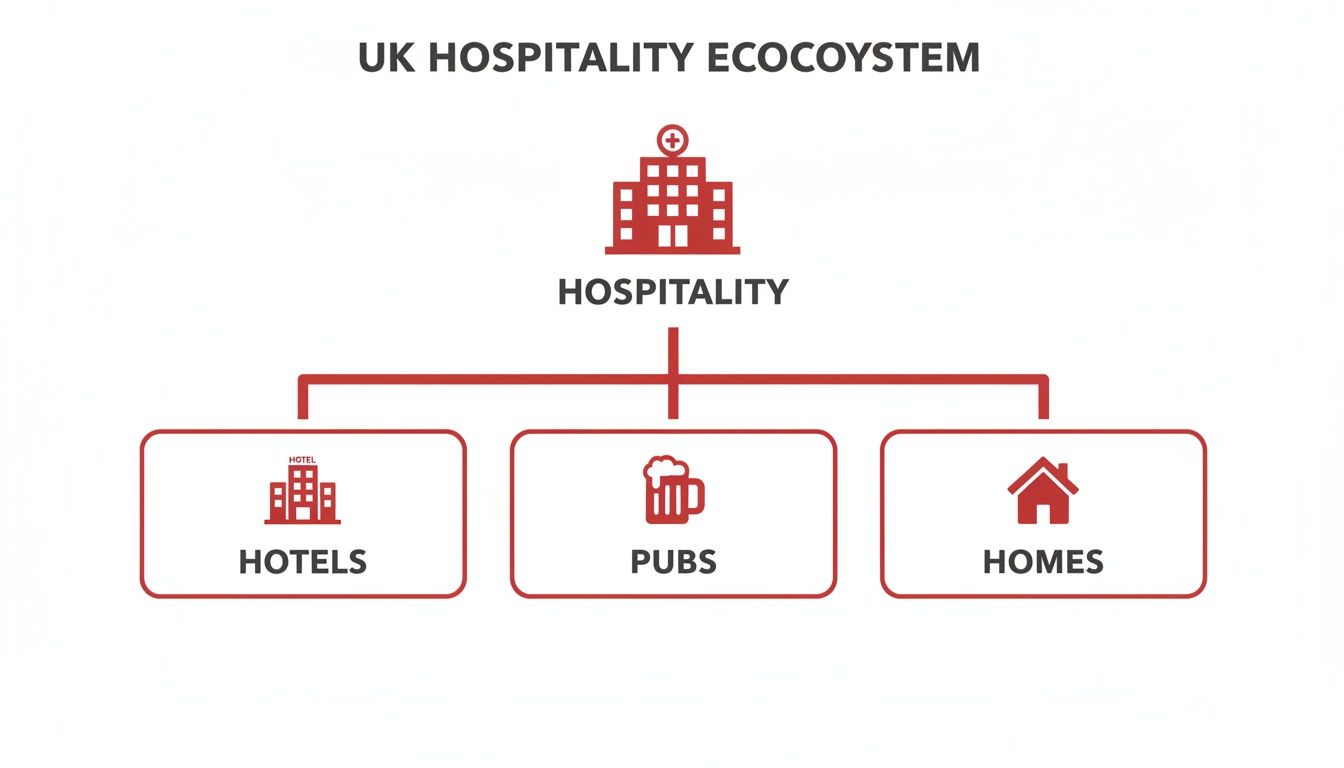
The skills learned in a traditional brigade are your ticket to these other worlds.
Alternative Paths: Agency, Private Homes, and Yachts
For experienced chefs, the old model of staying in one job for a decade is fading. New career paths offer more control, better pay, and a wider variety of work for those with the right skills and attitude.
These roles demand a high level of professionalism and the ability to adapt instantly. Here’s a look at how these specialist roles stack up against a traditional kitchen job.
Hospitality Role Comparison Traditional vs Flexible
| Role Type | Typical Environment | Key Responsibilities | Common Pay Structure |
|---|---|---|---|
| Permanent Chef | A single restaurant, hotel, or pub | Daily prep, service, menu consistency, stock control | Salaried (monthly) or hourly wage |
| Agency Relief Chef | Various kitchens (pubs, hotels, restaurants) | Quickly adapting to new teams, filling gaps, executing existing menus | Higher hourly rate, paid weekly |
| Private Household Chef | A private residence | Bespoke menu planning, shopping, cooking for a family/principal | High annual salary, often with accommodation |
| Superyacht Chef | A luxury yacht | Provisioning in foreign ports, high-end cooking for guests and crew | Very high salary (often tax-free), contract-based |
While the foundational cooking skills are the same, the environment, responsibilities, and pay couldn’t be more different.
Deciding to work in hospitality is just the beginning. The real choice is what kind of career you want to build—the stable structure of a permanent role, or the dynamic, challenging world of flexible and specialist work.
The Reality of Hospitality Shifts, Pay, and Career Growth
Before you jump into a hospitality career, you need to understand the reality of the job. This isn't a 9-to-5 world. It’s an industry with its own rhythm, its own language for pay, and a clear but demanding path for getting ahead.
It’s an industry that asks a lot of you. But for those who master its pace, the rewards are there for the taking. The first thing you need to learn is the language of the rota.
Understanding Hospitality Shifts
Forget a standard work week. Your schedule is built around the long hours a pub, restaurant, or hotel needs to be open.
A café might give you daytime hours, but a restaurant bar runs on a totally different clock. The two shift patterns you’ll see most often are:
- Straight Shifts: This is one solid block of work, like 2 PM to 10 PM. Many chefs prefer these. They're long, but you get a clean start and finish without unpaid gaps breaking up your day.
- Split Shifts: You work two separate blocks. Think 10 AM to 3 PM for lunch, then back again from 6 PM to 11 PM for dinner. They’re common, but they make for brutally long days and are a fast track to burnout.
Hours can be all over the place. A busy city pub means late nights and weekends. Fine dining often demands even more, especially for prep. The trade-off is usually the level of skill and creativity you get to use.
How You Get Paid in Hospitality
Hospitality pay is structured differently. While senior managers might be on a salary, most kitchen and front-of-house roles are paid hourly. This is especially true for relief chefs—you get paid for every single hour you work.
On top of your basic pay, you have to get your head around the tronc system. It's how most UK venues legally and fairly share out tips and service charges among everyone, from the kitchen porter to the waiting staff. A senior staff member, the 'troncmaster', runs a separate payroll to make sure the money is split transparently.
A good tronc system is vital for morale. It’s a recognition that great service is a team effort. The person who cooked the meal is just as important as the person who served it.
To get a real sense of what you could earn, use our tools to see how hourly rates add up. Our guide on the chef monthly salary calculator gives you a proper breakdown.
Charting Your Career Progression
One of the best things about hospitality is the career ladder. It's clear and based on merit. If you're good, reliable, and keen to learn, you can move up fast. The path from a junior peeling veg to running the whole kitchen is well-trodden.
A typical chef's career looks like this:
- Commis Chef: The starting point. You learn the basics, get fast, and become consistent.
- Chef de Partie: You take ownership of a section, manage your own prep, and learn to deliver under pressure.
- Sous Chef: You step up to lead. You’re the Head Chef’s right hand, managing the team, ordering, and controlling costs.
- Head Chef: You're the boss. You're responsible for everything: the menu, the team, and the profit.
Each step demands new skills. You move from just cooking to managing people and a budget.
Right now, however, the industry is in the middle of a huge staffing crisis. This changes things. A UKHospitality survey in May 2025 found 60% of businesses had to cut jobs, while 63% reduced staff hours just to manage rising costs. This puts immense pressure on venues, especially in busy seasons. You can learn more about the 2025 hospitality sector findings on mooreks.co.uk.
But this crisis has a silver lining for skilled chefs. With fewer permanent staff available, good, reliable relief chefs have never been more valuable. It’s a huge opportunity to take control of your career, earn better money, and get experience in different kitchens, speeding up your growth on your own terms.
Building Your Foundation of Essential Skills and Qualifications
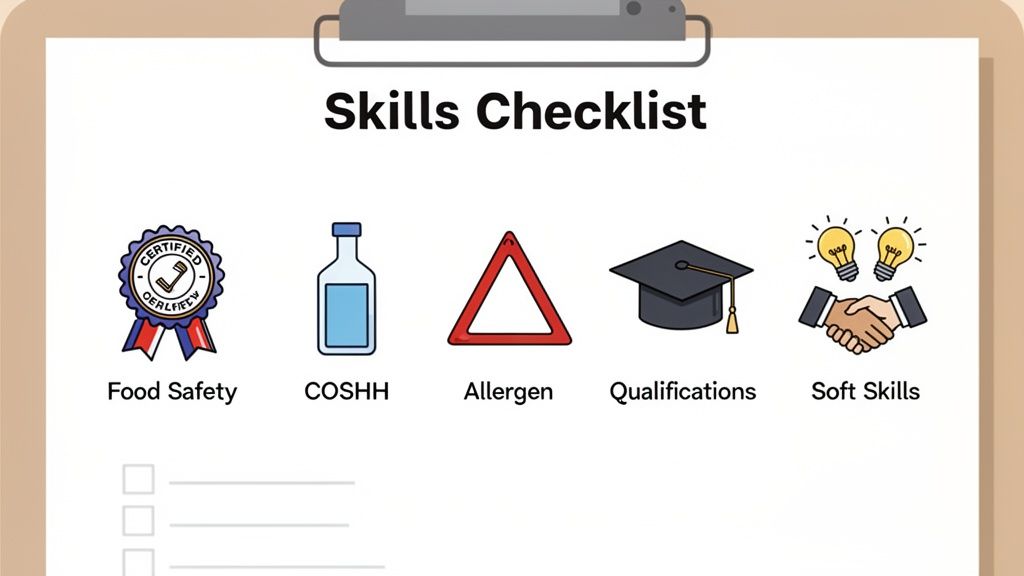
A great hospitality career isn’t built on passion alone. It’s built on a foundation of non-negotiable skills and qualifications.
These fall into two camps: the ‘hard skills’ proven by certificates, and the ‘soft skills’ that show how you act under pressure. To get hired and build a reputation, you need both. One without the other is a liability.
Before you can even think about working in hospitality in the UK, some skills are not just important—they’re mandatory. These are legal requirements. Without them, you can’t legally or safely step foot in a professional kitchen.
The Mandatory Hard Skills and Qualifications
Before a Head Chef cares how well you can cook, they need to see your certificates. These are your entry ticket. They prove you understand the basic rules of a safe kitchen.
The absolute baseline legal requirements are:
- Level 2 Food Safety and Hygiene: This is the bare minimum. It proves you know how to handle, store, and cook food to prevent poisoning and contamination.
- Allergen Awareness: With strict laws covering 14 major allergens, every chef must know how to prevent cross-contamination and give guests accurate information. A mistake here can be fatal.
- COSHH Training (Control of Substances Hazardous to Health): Professional kitchens use powerful chemicals. This training teaches you how to handle and store them safely, preventing accidents.
Formal culinary qualifications like NVQs are valuable, but many Head Chefs value hands-on experience just as highly. For a closer look at this, our guide covers the essential qualifications for a chef in the UK.
What Soft Skills Actually Look Like in a Kitchen
Hard skills get you the job. Soft skills are what allow you to keep it and progress. People dismiss them as buzzwords, but in a busy service, they have real, practical meaning. They are the difference between a team that flows and one that falls apart.
So what do these skills look like on a chaotic Saturday night?
Teamwork isn’t about being friends. It’s a commis chef having their section prepped properly so the Chef de Partie isn’t exposed mid-service. It’s the pot wash keeping pace so the line never runs out of clean pans.
Problem-solving is what you do when the fish delivery fails to arrive two hours before service. A good chef doesn’t panic. They adapt the menu, tell the front-of-house about the change, and create a new special with the ingredients they have on hand. Instantly.
Communication is everything. It’s the clear, loud call of “Yes, Chef!” It’s a waiter calmly explaining a delay to a table, or a Sous Chef giving direct feedback to a junior without causing a scene. This constant, clear dialogue is what keeps the entire operation running.
This mix of compliance and practical ability is what makes you a valuable asset, especially for high-level flexible roles where trust and professionalism are everything.
How to Find and Secure Your Perfect Hospitality Job
Knowing you have the skills is one thing. Landing the right job is another.
Securing the role you want, whether it’s a permanent post or flexible relief work, means you need a strategy. It's about looking in the right places and showing employers what they actually need to see.
Where to Look for Hospitality Roles
Forget scrolling through massive, generic job boards for hours. The best opportunities are rarely found there. You need to focus your energy where it counts.
A recent analysis of the UK hospitality market shows independent hotels hold a huge 57.28% market share. These venues constantly need skilled, agile staff to handle busy services, making them a massive source of work. You can read the full UK hospitality market analysis on mordorintelligence.com.
Effective places to find your next role include:
- Niche Industry Websites: Go straight to platforms built for hospitality. This is where serious employers post their best jobs because they know they’ll find serious candidates.
- Professional Networking: This industry is small. The chefs and managers you know are your best asset. A good word from a trusted contact is more powerful than any CV.
- Specialist Staffing Partners: For chefs, a specialist partner is a game-changer. Unlike a standard recruitment agency, a partner run by chefs actually understands the kitchen.
Working with a chef-run staffing partner means you’re speaking the same language. They know what a 150-cover service feels like and can match you with a kitchen where your specific skills will shine, not just fill a slot.
A chef-run partner gets you in front of the right people, faster. They vet you properly, pre-verify your right to work, and only put you forward for jobs that genuinely fit. It saves you time and stops you from wasting it on roles where you can't succeed.
Crafting a CV That Gets You Noticed
Your CV is not a list of your job duties. It’s your highlight reel. A Head Chef or manager will scan it for seconds, so it needs to be sharp, clear, and focused on what you achieved.
Don't just list what you did. Show the impact you made. Use strong verbs and add numbers to prove your value.
For example, don't write "Responsible for the grill section." It tells them nothing. Instead, write:
- Managed the grill section during a service executing 150+ covers nightly.
- Trained and mentored two Commis Chefs, improving section efficiency.
- Contributed to menu development, creating three new dishes for the A La Carte menu.
This small change transforms your CV. It moves from a passive list of tasks to an active demonstration of competence. It shows you understand the business, not just the cooking.
Nailing the Hospitality Interview
A hospitality interview, especially for a chef, is a practical test. The Head Chef isn't interested in generic answers. They want to know if you can handle pressure and fit into their team.
They won't just ask about your cooking style. Expect questions that test your real-world problem-solving skills, like:
- "Talk me through how you’d handle a large order for a table with multiple, complex dietary requirements."
- "What do you do if a key supplier fails to deliver an essential ingredient an hour before service?"
- "Describe a time you had a conflict with a colleague during a busy service. How did you resolve it?"
Your answers need to be calm, logical, and confident. They are testing your temperament just as much as your technical knowledge. Show them you’re a professional who can think on their feet, communicate clearly under pressure, and support the team. Do that, and you’ll get the job.
Why Flexible Work Is Redefining Hospitality Careers
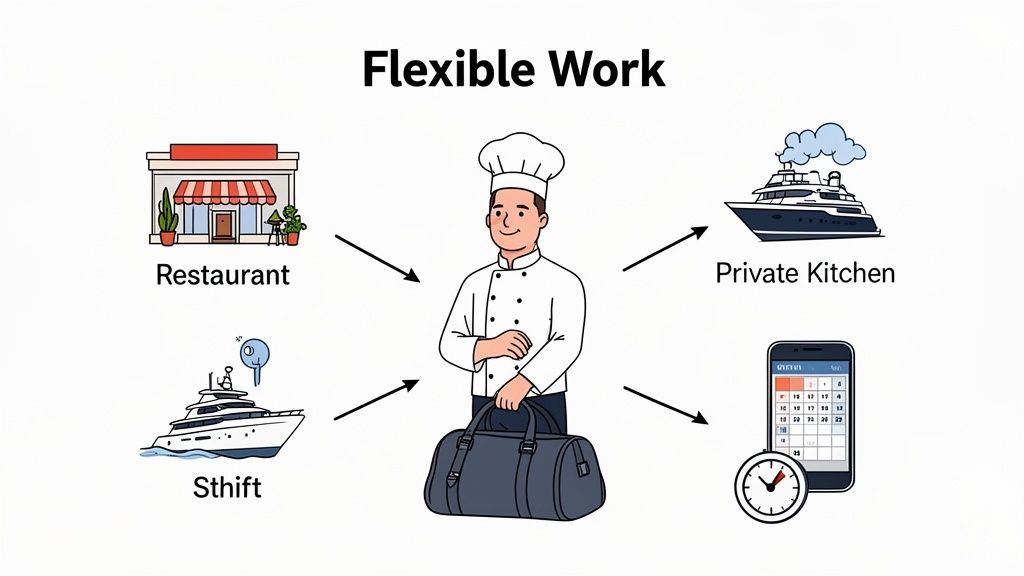
The old hospitality career path—being chained to one kitchen with brutal hours—is no longer the only way. A huge shift is happening, led by professionals demanding more control over their schedules and their sanity. They are ditching the rigid, salaried role for the freedom and variety of flexible work.
This isn't just about escaping burnout; it's a smart career choice. For many chefs, deciding to work in hospitality on their own terms means a better work-life balance, higher hourly pay, and the chance to build skills in different kitchens fast. It’s about making your career fit your life, not the other way around.
The Story of Chef Alex
Take Chef Alex, a solid Sous Chef at a well-regarded restaurant. The passion was there, but the relentless split shifts and 60-hour weeks were grinding them down. Alex was stuck, seeing no real reward for the sacrifice. The job was simply becoming unsustainable.
After switching to flexible work as a relief chef, everything changed. Alex now decides when and where to work, taking assignments in boutique hotels, gastropubs, and private events. The pay is better, calculated hourly, and adapting to new teams and menus every few weeks has become an incredible learning curve.
“I fell back in love with cooking. I have control over my schedule, my stress levels are down, and my skills have grown more in six months than they did in the last two years of my permanent job.” – A Relief Chef’s Experience
This story isn't a one-off. Thousands of chefs are making the same move, looking for a more sustainable and rewarding way to stay in the trade they love.
Why Venues Are Embracing Flexible Staffing
It’s not just chefs driving this change. Hospitality businesses are under huge financial strain. A May 2025 UKHospitality survey showed a shocking one-third of members were running at a loss, while insolvencies shot up by 29% in late 2024. In this climate, the fixed cost of a full-time salary is a massive liability. You can explore the full hospitality trends report on UKHospitality.org.uk.
As a result, more venues are using flexible staff to handle the ups and downs of trade. Bringing in a good relief chef for a busy weekend, to cover holidays, or to handle an unexpected staff shortage is just smart business. It lets them keep standards high without being locked into a permanent wage.
You can learn more by reading our guide on using agencies for temporary work. This creates a situation where everyone wins: venues stay lean and profitable, and skilled chefs get the freedom and control they’ve earned.
Frequently Asked Questions About Hospitality Work
Thinking about a career in hospitality? It’s a world of high energy and real rewards, but it’s smart to go in with your eyes open. Here are the straight answers to the questions we hear most often.
Can I Succeed Without Formal Qualifications?
Do I need a formal culinary degree to work as a chef in the UK?
No, not at all. Some of the best chefs I’ve ever worked with never set foot in a culinary school. They started at the bottom, learned on the job, and proved their worth through pure graft and skill.
That said, you absolutely cannot walk into a professional kitchen without a Level 2 Food Safety and Hygiene certificate. It’s a non-negotiable legal requirement. Formal qualifications like NVQs are great for building a foundation, but nothing beats hands-on experience.
How Can I Progress My Career Quickly?
What is the fastest way to progress in a hospitality career?
Simple: show up, work hard, and never stop learning. The chefs who move up fast are the ones who master their section, then immediately ask the Head Chef what’s next. They prove they can be trusted when the pressure is on.
Don’t just stick to what you know. Be the one who volunteers for the jobs nobody else wants and communicates clearly when things get chaotic. That’s what gets you noticed.
Working in different kitchens, including through flexible assignments, can also accelerate your learning curve. This exposure to various systems and menus makes you a more adaptable and valuable professional.
Is Flexible Work a Viable Career?
Can I really make a good living with flexible or agency chef work?
Absolutely. A skilled, reliable agency chef is worth their weight in gold, and they’re paid accordingly. The demand is huge, and good relief chefs often earn a higher hourly rate than many salaried staff.
It’s a trade-off, of course. You get better pay, full control over your rota, and a chance to sidestep the usual kitchen politics. For many chefs, it’s not just a viable career—it’s a much smarter way to work.
Ready to explore flexible chef opportunities that match your skills and schedule? Relief Chefs UK connects talented chefs with top independent pubs, hotels, and restaurants. Find your next assignment at https://www.reliefchefs.co.uk.