
Working at events isn't just a different job; it’s a completely different way of cooking. You leave behind the predictability of a single kitchen and step into a world where every shift is a new puzzle. It's project-based work that demands skill, speed, and a cool head under pressure.
The Exciting World of Event Chef Work
Forget mastering one menu. One week, you’re in a historic castle for a wedding. The next, you’re in a city centre venue for a corporate gala. The week after that, it could be a private estate for a high-profile party. This is the life of an event chef.
It’s about more than just cooking. It’s about walking into an unfamiliar kitchen, understanding a new menu, and integrating with a new team—fast. While a restaurant chef refines one system, an event chef becomes an expert at adapting to dozens. Every service is a fresh challenge, and that variety is precisely what draws so many professionals in.
The Growing Demand for Flexible Talent
The UK’s event industry isn't just growing; it's booming. Projections show the UK catering market is on track to hit a massive £1.4 billion by 2026, with weddings and corporate events driving the surge. This creates an enormous, and often urgent, demand for skilled chefs who can handle the pressure of peak seasons and big-ticket bookings. You can see how this trend affects staffing here.
For venues, this makes flexible staffing a non-negotiable part of their business model. Relying only on a permanent brigade isn’t enough to manage the unpredictable spikes in demand during wedding season or the Christmas rush without standards slipping.
For many venues, the ability to bring in a vetted, professional relief chef at short notice is the secret weapon that prevents service standards from dropping. It’s the difference between a stressed-out kitchen and a flawlessly executed event.
Bridging the Gap Between Venues and Chefs
This is where a specialist staffing partner becomes critical. They are the essential link connecting talented, adaptable chefs with venues that need them to protect their reputation. For a chef, it means access to premium work without the grind of finding it yourself. For a venue, it removes the risk and headache of sourcing reliable cover when it matters most.
Platforms run by hospitality veterans, like Relief Chefs UK, get this. They don't just find a chef; they ensure that person is vetted, reliable, and ready for the unique demands of working at events. This model lets venues:
- Cover last-minute staff shortages without panicking.
- Scale their kitchen team to match their event calendar.
- Protect their quality and their hard-earned reputation.
It's a relationship that allows both chefs and venues to thrive in the high-stakes, fast-paced world of event catering.
Key Roles You Will Play in an Event Kitchen
Stepping into an event kitchen is nothing like walking into a standard restaurant. Think of it as a culinary special forces mission. The rigid brigade system is gone, replaced by a structure built entirely around adaptability and clear, non-negotiable responsibilities.
Every person has a specific job, and the entire event's success hinges on each chef executing their part flawlessly.
While the titles might look the same on paper, the job itself is completely different. A Chef de Partie working a festival for 1,000 people has a much tougher, higher-volume job than their counterpart in a restaurant. When you're working at events, the pressure of that specific day defines your role entirely.
The type of event—from intimate weddings to massive corporate functions or public parties—shapes everything.
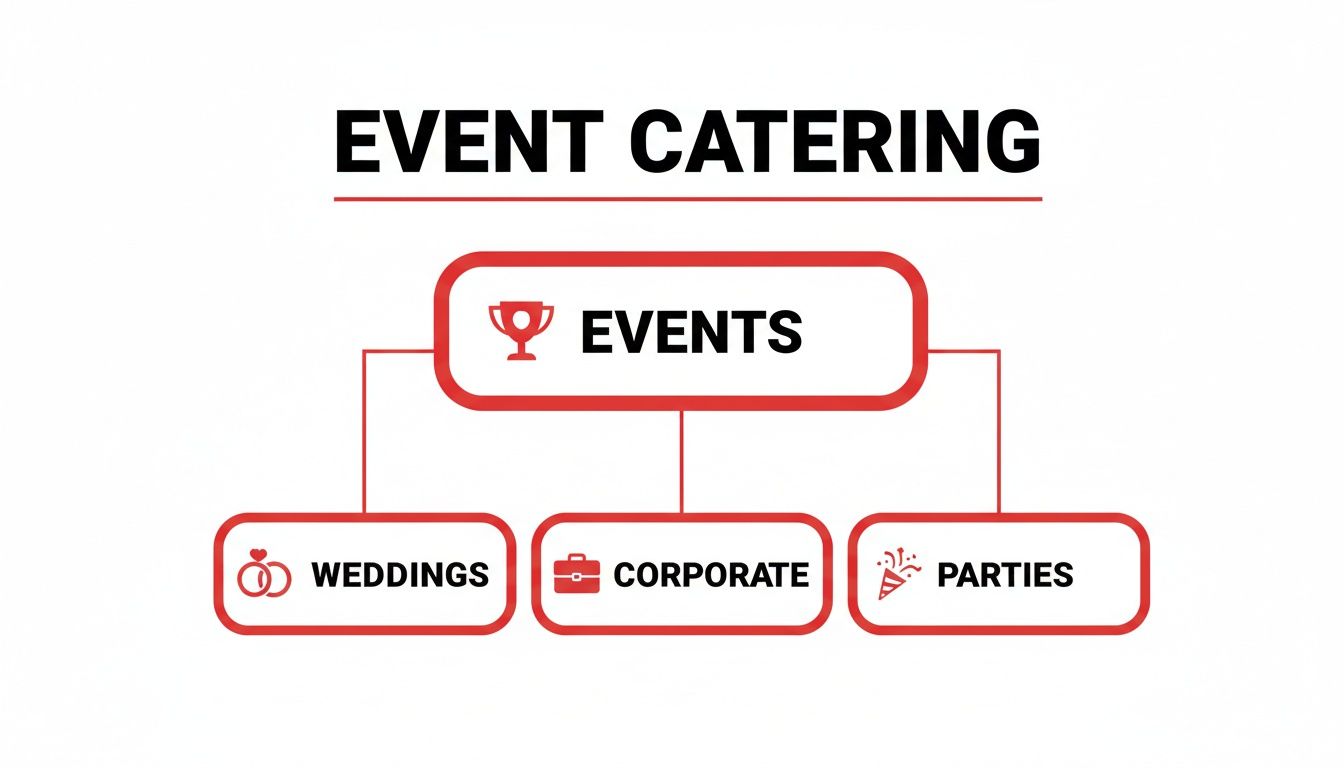
This structure dictates the menu, the service style, and the exact skills a venue needs from its kitchen team. Let's break down the key players and what they actually do when the pressure is on.
The Strategic Leaders
At the top, the Event Head Chef or Executive Chef is the mission commander. Their job isn’t just cooking; it’s orchestrating the entire culinary operation. They’re involved long before the first guest arrives, handling menu design, costing, logistics, and coordinating with the venue manager. On the day, they are the central command post, making sure every station runs on time and quality never, ever drops.
Right beside them is the Sous Chef, the on-the-ground lieutenant. They are the critical link between the Head Chef’s plan and the team’s execution. They often manage huge chunks of production, solve problems as they flare up, and ensure the pass runs like clockwork. This role demands serious organisational skills and a cool head when timings inevitably get thrown off. You can learn more about this vital position by reading about the duties of a Sous Chef in our guide.
The Sous Chef in an event setting is, more than anything, a 'fixer.' If a generator dies or a supplier delivers the wrong produce, they find a solution without letting it derail service. Their ability to adapt is everything.
The Section Specialists
The true engine room of any event kitchen is the team of Chefs de Partie (CDPs), or Section Chefs. Each CDP is a specialist who owns their station—be it grill, larder, or pastry. In a temporary or pop-up kitchen, this means they are responsible for everything from setting up their station and organising their mise en place to plating every dish and cleaning down.
Unlike in a restaurant, where a section might have lulls in service, an event CDP often faces a relentless tsunami of orders. For a wedding breakfast serving 200 guests, the main course station must push out hundreds of identical, perfectly cooked plates within a brutally short timeframe. This requires unbelievable focus and efficiency.
Finally, you have the Commis Chef, the essential support operative. They are the backbone of the sections, smashing through prep, keeping stations stocked with ingredients, and helping plate up during the rush. A great Commis thinks ahead, anticipating what their CDP needs before they even have to ask. It's one of the best training grounds for learning speed, organisation, and how to perform under intense pressure.
Here's a quick breakdown of how these roles function in a typical event environment.
Event Kitchen Roles at a Glance
This table simplifies who does what.
| Role | Primary Focus | Key Responsibilities |
|---|---|---|
| Event Head Chef | Strategic oversight and quality control | Menu planning, team leadership, client communication, final plating approval. |
| Sous Chef | Operational management and problem-solving | Overseeing production, managing the pass, troubleshooting issues, deputising for the Head Chef. |
| Chef de Partie | Section execution and consistency | Managing a specific station (e.g., grill, sauce), ensuring all plates from their section are perfect. |
| Commis Chef | Support and preparation | Assisting with mise en place, stocking stations, basic cooking tasks, supporting the CDPs. |
Each role is distinct, but they all depend on one another. When this team clicks, they can deliver an incredible dining experience, no matter the challenges.
Your Pre-Event Checklist for Perfect Execution
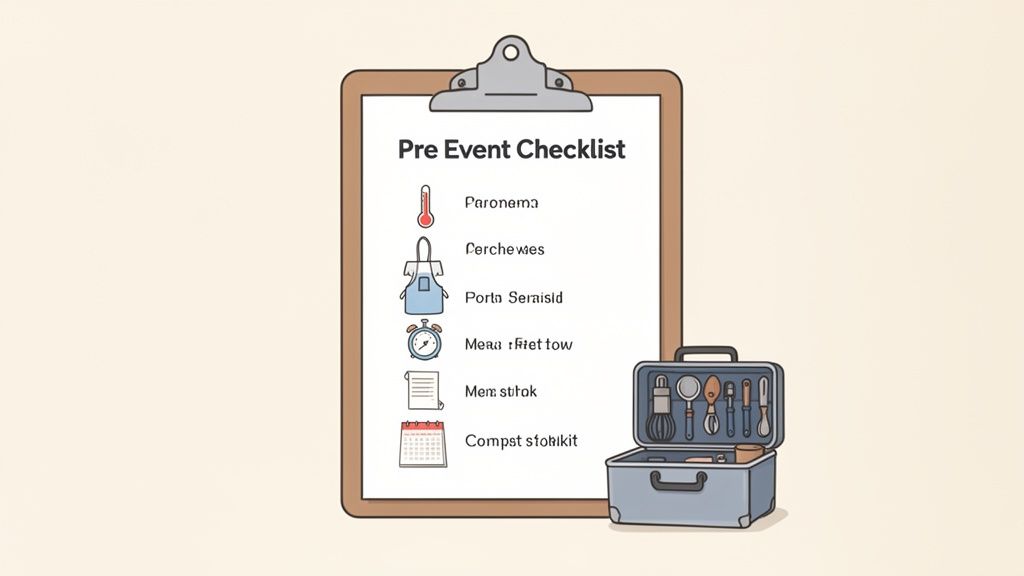
The battle for a perfect event service is won hours before a single guest arrives. Showing up prepared isn't just professional—it’s what separates the amateurs from the pros. A top-tier relief chef doesn't just clock in on time; they walk in ready to cook, fitting into the team without causing friction.
Think of it as your personal pre-flight check. It’s a simple system that cuts down on stress and helps you perform at your best, even when you’re in a completely new kitchen. This is especially true when working at events, where the layout, the crew, and the menu are all unfamiliar.
Mental and Digital Preparation
Before you even think about packing your knives, the real work begins in your head. A professional doesn't just read the function sheet; they treat it like a battle plan. Your first job is to absorb every detail and run the service in your mind.
- Break Down the Menu: Know every single component of every dish you'll be handling. Picture the cooking process, how it will be held, and what the final plate looks like.
- Study the Timeline: Pinpoint the key service times—canapés, starters, mains, dessert. Now, work backwards from there. Mentally map out your prep and production flow to hit those targets without a rush.
- Find the Vague Spots: Does the sheet say "seasonal veg medley"? Is the consistency of a sauce described? Make a note of anything unclear. These should be the first questions you ask when you get there.
Running this mental walkthrough helps you spot bottlenecks before they happen. You step into the kitchen with a clear idea of what success looks like, instead of trying to figure it out during the chaos.
Physical and On-Site Checks
Once you’re on-site, it’s time to confirm your plan in the real world. This is where you quickly get your bearings and understand the kitchen’s flow. Think of yourself as an operative, gathering critical intel.
Your first 15 minutes on-site are the most important. Use them to find your station, locate key areas, and ask smart questions. This shows the Head Chef you’re there to be an asset, not a liability.
Your on-site check should be methodical. Don’t just wander around; have a clear agenda for what you need to know right away.
- Check In: Find the Head Chef or Sous. Introduce yourself and mention you've already reviewed the function sheet. This immediately marks you as a professional.
- Do a Kitchen Walkthrough: Get eyes on the essentials. Find your station, walk-in fridges and freezers, the dry store, hand-wash sinks, and fire exits. Don't wait until you need something in a hurry to find out where it is.
- Inspect Your Station and Kit: Before you start, check that any equipment you've been given is clean and working. For your own tools, make sure your knives are sharp, your thermometer is good to go, and your essentials are within reach.
- Confirm Your Role and Mise en Place: Ask the Head Chef to confirm exactly what you'll be doing and the state of your prep. Find out what's already done and what your immediate priorities are.
This systematic approach takes the guesswork out of the equation. It turns an unfamiliar space into a functional one, letting you move from prep to execution without missing a beat.
How to Thrive in a High-Pressure Service
The peak of an event service is a controlled storm. To get through it, you have to be the calm at its centre. Staying organised isn't enough; you need solid techniques to handle the intense, focused pressure of a service with absolutely no room for error.
Staying composed isn't a personality trait—it's a skill you build. It’s about having a system for your station, your communication, and your own head. When the dockets fly, these habits are what separate the chefs who deliver from those who drown.
Master Your Station with the Circle of Work
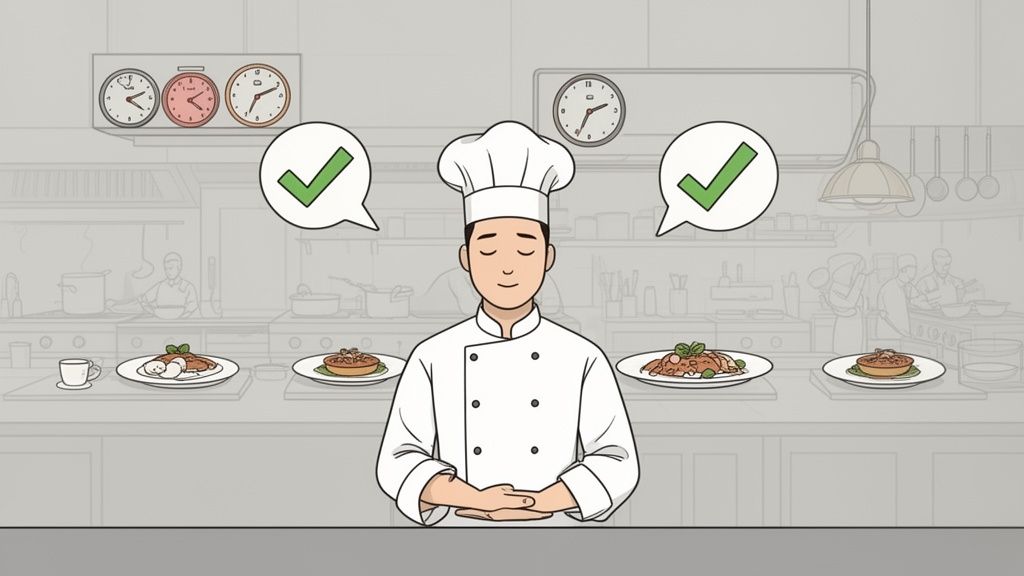
Picture your workspace as a clock face. This simple idea, known as the ‘circle of work’, is a game-changer for speed and efficiency. It forces you to lay out your mise en place and gear in a logical loop that follows your workflow, slashing wasted movement and mental load.
For a fish course, your station could be set up like this:
- 12 o’clock: Your hot pan or plancha.
- 3 o’clock: The prepped fish, ready to cook.
- 6 o’clock: All your garnishes, sauces, and finishing oils.
- 9 o’clock: Clean plates, ready to be built on.
This builds muscle memory. Your hands learn where to go next without you even thinking. When you’ve got to plate 150 identical dishes in 20 minutes, this methodical flow is what prevents chaos and keeps you focused on the food.
Eliminate Errors with Closed-Loop Communication
In the heat and noise of service, a single misunderstood word can be a disaster. Vague shouts lead to mistakes, wasted food, and lost time. This is exactly why top event teams live by closed-loop communication. It's a simple rule, and it's non-negotiable.
When you get an order, you repeat it back to the person who gave it. This closes the "loop," confirming the message was heard and understood perfectly.
So, instead of the Head Chef yelling, "Two more sea bass!" and you just nodding, the exchange becomes:
- Head Chef: "Chef, I need two more sea bass, firing now!"
- You: "Yes, Chef! Firing two more sea bass now!"
That tiny change confirms the instruction, the count, and the timing. It kills the expensive "I thought you said…" moments that can completely derail a service. It builds a network of certainty where everyone knows they're on the same page.
Build Mental Resilience for the Unexpected
No matter how tight your prep is, things go wrong. An oven dies. A key ingredient is running low. Service times suddenly get pushed forward. Your ability to stay calm and adapt is your single most valuable asset.
Seasoned event chefs use mental resets to stay grounded. One of the best is controlled breathing. When you feel the pressure building, take a quiet moment for three slow, deliberate breaths. Inhale for four counts, hold for four, and exhale for six. This simple action slows your heart rate and clears your head, letting you solve the problem logically instead of just reacting.
This isn't about ignoring the fire; it's about giving yourself the headspace to put it out properly. It's the tool that lets you stay the professional anchor for your section, no matter what the event throws at you.
How Venues Find Top-Tier Event Chefs
For any venue manager, the days before a big event are a tightrope walk. The business’s reputation, a client’s wedding, it all hinges on the kitchen team. When a key chef calls in sick or you land a booking that’s bigger than your payroll can handle, finding a quality event chef becomes a high-stakes emergency.
So, how do the smart venues solve this without dropping standards? The old methods still exist, but the industry’s volatility has forced a move toward more reliable, modern solutions.
The Old Playbook: Traditional Sourcing Methods
For years, the go-to was word-of-mouth. A manager would hit the phones, calling every contact they had, hoping a local chef or a former employee was free. This is a strategy built entirely on luck and personal connections. It’s slow, it’s unreliable, and it offers zero guarantee of professionalism.
The other route was generalist recruitment agencies. The problem? Their recruiters are HR people, not chefs. They’ve never worked a real service. They don’t understand the non-negotiable skills needed for working at events—that blend of speed, calm, and adaptability it takes to walk into a strange kitchen and just perform.
The result is often a chef who looks great on paper but falls apart during a 200-cover wedding breakfast. For a venue, a bad hire isn’t an inconvenience; it’s a direct threat to the event and their reputation.
The Modern Solution: Specialist Staffing Partners
To kill that risk, more and more venues now use specialist chef staffing partners. These aren’t generic recruiters. They are services built for hospitality, often run by people who are chefs themselves. That’s the entire difference. A partner who knows the rhythm of a kitchen can vet talent in a way a salesperson never could.
This is where services like Relief Chefs UK have become so essential. They offer a tight, dependable system built to solve the biggest staffing headaches venues face every day.
When you partner with a service run by chefs, you’re not getting a name from a database. You’re getting a professional vetted by people who know exactly what it takes to succeed in a high-pressure kitchen.
This shift is a direct response to a brutal market. Staffing shortages are a massive problem for UK hospitality, with major labour gaps hitting growth forecasts. On-demand relief has become a vital tool, with partners like Relief Chefs UK delivering fully vetted pros—sometimes within two hours of a call—to manage the chaos of no-shows and peak season rushes. You can read more on these industry challenges in this comprehensive market report.
The Game-Changing Advantages for Venues
Using a dedicated chef partner gives you powerful benefits that the old ways just can't touch. These advantages are all about reliability, speed, and quality control—the three pillars of any successful event.
- Rapid Response: A chef no-show two hours before service is a disaster. Specialist services offer incredibly fast turnarounds, confirming a vetted chef is on their way. They turn a catastrophe into a manageable problem.
- Guaranteed Quality: The chefs aren’t just names on a list. They are pros who have been properly interviewed, their skills checked, and their right-to-work status confirmed. This pre-vetting removes the gamble.
- Flexibility and Scalability: Venues can scale their brigade up or down to fit the event calendar. Book one chef for a single night or a whole team for a three-month festival season, all without the overheads of permanent contracts.
- A Built-in Safety Net: What if a relief chef isn't the right fit? A good partner offers a replacement guarantee. This provides peace of mind, ensuring that if there’s a problem, a new professional is sent quickly to keep the event on track.
For venues wanting to lock in reliable talent, understanding the benefits of specialist recruitment for events is the key to protecting service standards. It’s a strategic shift away from reactive panic-hiring toward a proactive, dependable system that secures the kitchen talent you need to deliver every single time.
Understanding Pay and Contracts in Event Work
Getting the finances right is just as crucial as nailing the service. In event work, you leave the fixed salary behind. Your earnings are based on the job, and understanding how pay and contracts work is the only way to build a serious career.
Most jobs are paid in one of two ways: an hourly wage or a flat day rate. The rate you can command comes down to your experience, the event's location, and its profile. A Chef de Partie at a high-end corporate launch in London will earn more than one working a local food festival. It's that simple.
Pay Structures and Business Setups
How you get paid determines your tax and legal setup. Most event chefs fall into one of three categories:
- Freelancer/Sole Trader: This is the most direct route. You are the business. You’re responsible for your own tax and National Insurance via Self Assessment. It’s clean and simple.
- Limited Company: This separates you from your business financially. It can offer better liability protection and tax options, but it also means more admin, like filing annual accounts.
- Agency (PAYE): Some agencies will put you on their payroll. Tax and National Insurance are deducted for you (Pay As You Earn), which makes your own admin much easier.
The best choice depends on what you want long-term and how much paperwork you're prepared to handle.
Your Contract Is Your Protection
Never, ever start a shift without a contract or a clear booking confirmation. This isn’t just a piece of paper; it’s a legal agreement that protects you and the client by making sure everyone is on the same page.
A contract isn’t about mistrust; it’s about clarity. A professional client will always provide one, and a professional chef will always demand one. It protects both parties and sets the foundation for a successful working relationship.
Before you sign anything, check these three things:
- Payment Terms: Does it clearly state the rate (hourly/daily)? More importantly, when will you be paid? Standard terms are usually 14 or 30 days.
- Cancellation Policy: What’s the deal if the client cancels at the last minute? A solid contract will include a fee to compensate you for the work you've now lost.
- Overtime: Events run late. It happens. Clarify if overtime is paid and at what rate. Don't leave it to chance.
Event catering is the largest part of the UK's USD 4.57 billion catering industry. With a projected 500,000 new jobs expected by 2027, the demand for skilled chefs is only going up. This makes fair pay and solid contracts non-negotiable for venues that want to attract good people. For more detail, check our guide on how much chefs can make.
Your Questions Answered About Event Chef Work
Stepping into event catering brings up a lot of questions. It’s a world away from a standard restaurant service, with its own unique pressures and rewards.
Here are the straight answers to the most common queries we hear from chefs and venues. Think of this as your field guide to navigating event work with confidence.
What Experience Do I Need to Start Working at Events?
Most professional agencies and venues will be looking for chefs at Chef de Partie level or higher. Technical skill is the baseline, but the real test is your adaptability.
You have to walk into an unfamiliar kitchen, absorb a new menu in minutes, and work seamlessly with a team you’ve just met. It’s all about performing under pressure. Experience in high-volume banqueting or large-scale catering gives you a massive head start.
How Can a Venue Best Integrate a Relief Chef?
Success starts before the chef even walks through the door. It’s all about clear, early communication. If you want a relief chef to hit the ground running, they need a solid briefing.
- Before They Arrive: Send over the full menu, a complete dietary list, and a detailed function sheet with exact timings.
- When They Arrive: Assign a core team member to give them a quick tour. Show them the kitchen, stores, and key safety points.
- Set Clear Expectations: Tell them which station they're running and what their exact priorities are for the service.
A properly vetted relief chef will ask for this information anyway. They are specialists who know how to get up to speed fast, without any drama.
What if a Booked Chef Is Not a Good Fit?
This is the biggest fear for venues hiring freelancers directly, and it’s a risk most can’t afford to take. When a chef doesn't meet the standard, the entire event is at risk.
A professional staffing partner provides the safety net you need. They should offer a replacement guarantee. If a chef isn't the right fit, one call to your account manager gets a replacement organised, often within hours.
This is about protecting your event and your reputation. It’s a level of security that direct, unvetted hiring simply cannot offer.
Is Event Work a Viable Long-Term Career Path?
Absolutely. For many chefs, working at events becomes a more fulfilling career than a permanent role. It offers better flexibility, more variety, and often, higher earning potential.
You're constantly learning in new environments—from massive stadiums to exclusive private estates—and building a powerful professional network. Many top-tier chefs build their entire careers on freelance event work. A good staffing partner ensures you have a steady stream of quality assignments, letting you build a sustainable career on your own terms.
When you need a professional chef you can count on, Relief Chefs UK delivers. We connect venues with fully vetted, experienced chefs who are ready to perform under pressure. Find reliable cover fast at https://www.reliefchefs.co.uk.