
Find Your Perfect Chef Agency Dorset Partner
1 May 2026

Friday evening. The terrace is full, the bookings sheet is tight, and then your sous chef rings in sick. Your head chef is already covering prep, service, ordering, and a KP gap. If you’re running a pub in Poole, a hotel near Bournemouth, or a coastal venue anywhere across Dorset, that situation doesn’t feel dramatic. It feels normal.
That’s why choosing the right Chef agency Dorset partner matters. Not because agencies sound convenient, but because kitchen instability hits service fast. Standards slip, the core team gets stretched, and one bad placement can create more problems than the original gap.
A good agency gives you cover. A serious agency gives you operational protection.
Why Your Dorset Venue Needs a Chef Agency Partner Now
Dorset hospitality lives with a hard contradiction. Demand rises quickly around holidays, events, weddings, weekend trade, and coastal tourism, but the local labour market doesn’t always move with it. Analysis shows that UK hospitality revenue in key coastal tourist areas like Dorset has grown by over 15% since 2022, yet chef job applications in the same regions have declined by 20%, creating a serious staffing gap for operators (coastal hospitality staffing analysis).
That gap shows up where it hurts most. Last-minute sickness. Burnt-out salaried chefs. Reduced menus. Cancelled functions. Owners stepping into the kitchen when they should be running the business.

Dorset pressure isn't just about summer
Many managers assume they only need agency support in peak season. That’s too narrow. Dorset venues often face pressure in waves. A busy bank holiday can be followed by weddings, private events, staff holidays, then autumn attrition. The pattern changes, but the risk stays.
In places like Bournemouth, Weymouth, Poole, and the wider county, the problem is rarely a single shift. It’s the knock-on effect of repeated staffing disruption.
- Service pressure: one missing chef slows the whole pass
- Team fatigue: your reliable people start doing too many doubles
- Standards drift: prep shortcuts become normal
- Commercial loss: you trim covers, shorten menus, or stop taking bookings
- Leadership drag: GMs and owners spend time firefighting instead of planning
Operational truth: most kitchen crises don't start with a full collapse. They start with one vacancy, one absence, and one week of hoping the team can carry it.
What a proper agency partnership changes
The wrong way to use an agency is to ring round in panic and ask who can start tonight. Sometimes you have no choice, but that approach usually gives you the weakest result. You need an agency that already understands your site, your menu level, your pace of service, and your absolute requirements.
That’s why many operators now treat agency support as part of resilience planning, not emergency spending. If you’re reviewing options in the South West, it helps to look at agencies already working in the region through dedicated agency chef support across the South West.
The real value is stability
Reliable cover protects more than one rota line. It protects guest experience, wage efficiency, and staff retention. Your permanent team stays steadier when they know one absence won’t push them into another brutal week.
This matters in independent pubs, boutique hotels, golf clubs, event venues, and private hospitality sites alike. The venues that cope best in Dorset usually aren’t the ones with no staffing issues. They’re the ones with a dependable plan when staffing issues hit.
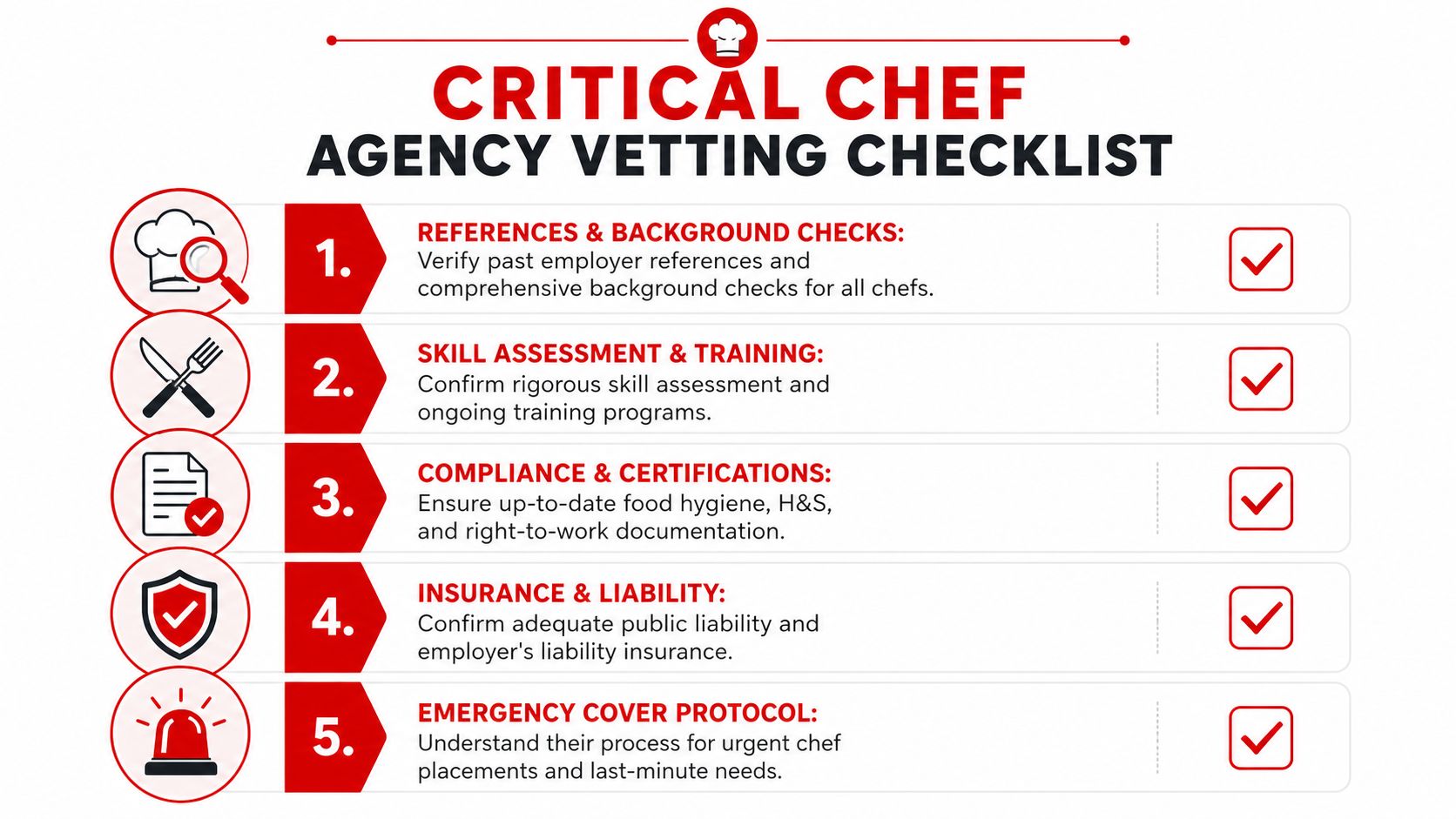
The Critical Vetting Checklist for Any Chef Agency
Most agencies sound good on the phone. That tells you very little. The quality gap appears in the checks they do before a chef ever walks into your kitchen.
If you only ask about availability and hourly rate, you’re missing the part that decides whether the placement helps or hurts. A poor kitchen hire doesn’t just cost a shift. A 2025 hospitality industry survey found that a single bad kitchen hire can cost a venue up to £10,000 in direct and indirect costs, including recruitment fees, service damage, and morale issues (hospitality bad hire cost survey).
Ask for the process, not the promise
A professional agency should be able to explain its vetting process clearly, in plain language, without hiding behind vague terms like “fully checked” or “high calibre”.
Use this checklist when you speak to any employment agency for chefs:
Right to work verification
Ask how they verify it. You’re looking for a real compliance process, not just a scanned passport held on file without proper review.
Recent verbal references
Written references alone aren’t enough. Ask whether they’ve spoken to recent employers and whether those references cover the level of kitchen the chef will be entering.
Food hygiene and core compliance
At minimum, the agency should confirm current food hygiene knowledge and hold up-to-date documentation relevant to placement standards.
Skills matching
A chef who works well in a contract catering unit may not suit a fresh-food pub. A banqueting chef may not be right for a tight à la carte pass. Ask how the agency assesses practical fit.
Insurance position
If the answer is woolly, that’s a warning sign. You need clarity on cover and liability before the first shift starts.
Red flags that usually lead to trouble
A weak agency often gives itself away quickly. Not with one dramatic failure, but with fuzzy answers.
| Warning sign | What it usually means |
|---|---|
| “We’ve got someone excellent” but no details | They’re selling speed without suitability |
| No clear reference process | Candidate quality is inconsistent |
| No questions about your menu or service style | They’re matching CVs, not kitchens |
| Unclear cancellation or replacement process | You carry the risk when things go wrong |
| They can’t explain chef seniority properly | They may not understand brigade structure |
If an agency can't tell you how it checks chefs, it probably isn't checking them well enough.
What good vetting looks like in practice
The strongest agencies vet like operators, not desk recruiters. They want to know whether a chef can run a section, handle pressure, work cleanly, communicate with the team, and adapt to your style of service.
That’s one reason chef-led staffing businesses tend to ask better questions. They understand the difference between a decent trial shift and someone who can hold a service together.
Relief Chefs UK was established in 2013 and is run by chefs with hospitality experience, which is relevant because kitchens don’t need polished sales talk. They need chefs who turn up, slot in, and work to standard.
Understanding Service Levels and Response Times
The agency can have good chefs on file and still fail you operationally. Response speed, communication, and fallback processes matter just as much as vetting.
When a manager says an agency was unreliable, they usually don’t mean the invoice arrived late. They mean nobody answered promptly, the update was vague, or the chef cancelled and no replacement appeared.
What to pin down before you need help
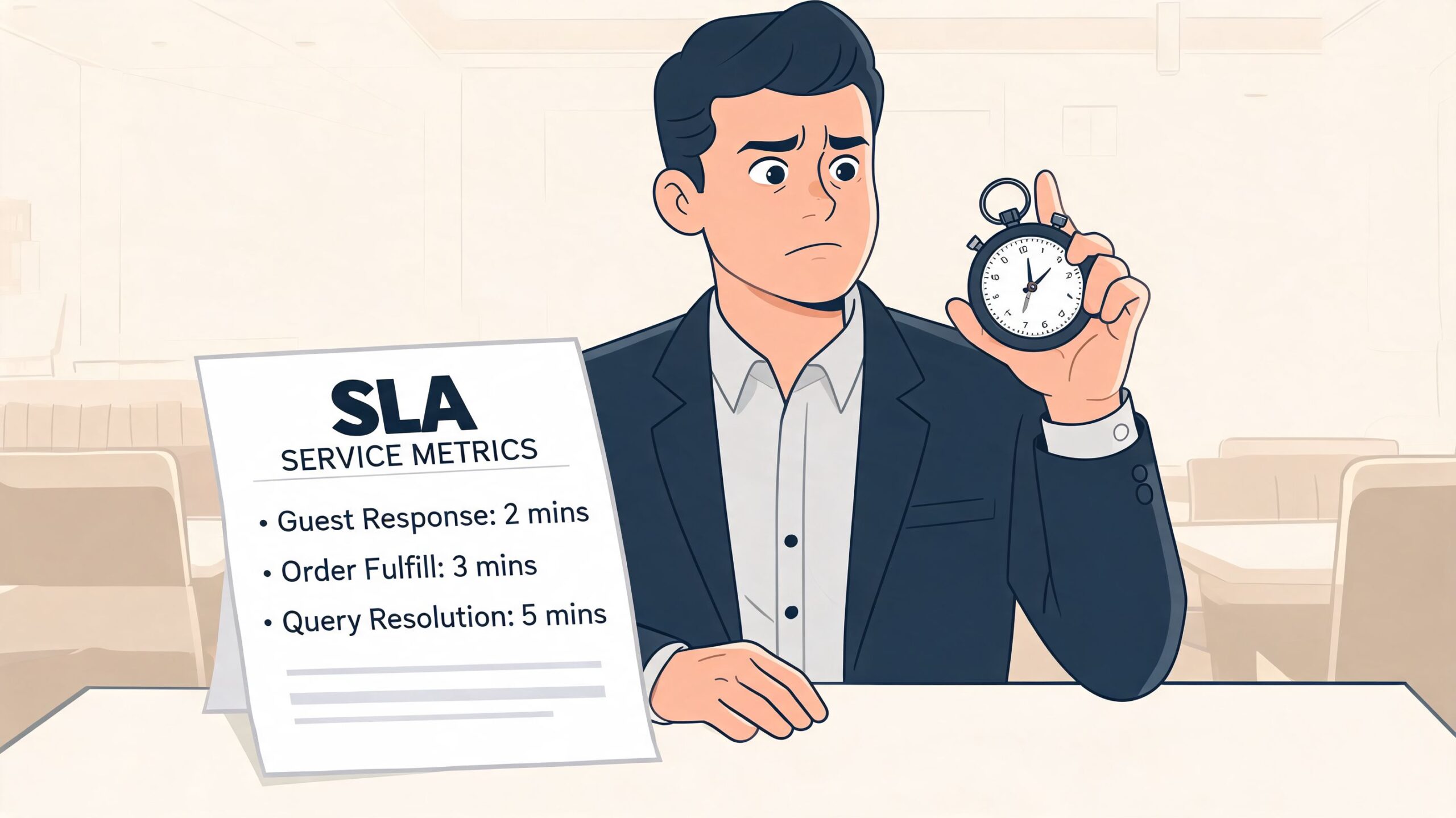
A useful service level isn’t a slogan. It’s a working agreement. Before you commit to any Chef agency Dorset provider, ask them to define these points:
- Initial response time: how quickly will a real person come back to an urgent request?
- Candidate presentation: will you get a profile, experience summary, or just a first name and ETA?
- Start window: how soon can a chef realistically be on-site?
- Out-of-hours cover: who answers if the problem lands at night or over a weekend?
- Replacement process: what happens if the chef is not right, or drops out?
Those details sound administrative until a wedding weekend, Sunday lunch service, or hotel breakfast operation is exposed.
Specific beats vague every time
Some agencies still sell “fast turnaround” and “rapid response”. That wording is useless if it isn’t backed by specifics. A meaningful benchmark is a team you can reach 24/7 that states its timings in writing and is honest that cover is subject to availability, because that gives managers something concrete to plan around.
A promise of “quick cover” has no value if nobody will commit to a response window, a start timeline, or a replacement procedure.
Here’s a practical way to compare agencies:
| Service question | Weak answer | Strong answer |
|---|---|---|
| How fast do you respond? | “As soon as we can” | Defined response window |
| How fast can a chef start? | “Depends who’s free” | Clear expected start range |
| What if the chef cancels? | “We’ll see what we can do” | Named escalation and replacement process |
| Who do I contact out of hours? | Generic voicemail or email | Direct support route |
Later in the conversation, ask them to talk through a real emergency scenario. A professional operator should be able to explain the chain of action without hesitation.
A short explainer on chef staffing expectations can also help frame the conversation:
Why this matters on the kitchen floor
When communication is clear, your team can prep properly, adjust sections, and protect standards. When communication is poor, your chef de partie waits for instructions, your head chef rewrites the plan mid-service, and your FOH team starts managing guest expectations before the shift has even settled.
Good service levels reduce chaos. They don’t remove pressure, but they stop pressure becoming disorder.
Decoding Chef Agency Pricing and Plans
Agency pricing frustrates operators when it’s opaque. It’s easier to make the right decision when you separate cost structure from operational value.
The main models are usually ad-hoc bookings and structured plans. Neither is automatically better. It depends on how often you need support and how predictable your staffing pressure is.
Ad-hoc cover suits occasional gaps
If your venue is generally stable and you only need help for the odd holiday, sickness gap, or event weekend, ad-hoc booking can make sense. You pay when you use the service. There’s no ongoing commitment.
That works well for some independents, especially smaller pubs and cafés. The downside is priority. If your staffing need is sudden and you’re not a regular client, you may have fewer options, slower matching, or less continuity in who gets sent.
Planned cover suits operators who need continuity
A structured plan is often a better fit for hotels, larger pubs, event-led venues, and multi-site groups. The practical advantage isn’t just budgeting. It’s access, planning, and consistency.
A sensible monthly arrangement may include things like:
- Replacement assurance: important if a placement doesn’t work out
- Dedicated contact: one account manager reduces repeat briefing
- Permanent recruitment support: useful if temporary cover is buying time while you hire properly
Compare the model against the risk
Here’s the simplest way to assess it:
| Venue type | Usually better fit | Why |
|---|---|---|
| Small café with rare gaps | Ad-hoc | Lower ongoing need |
| Busy pub with seasonal swings | Plan | Better continuity during pressure periods |
| Boutique hotel | Plan | Events, breakfast, banqueting, and leave cover create constant movement |
| Multi-site group | Plan | Central oversight and faster repeat fulfilment matter |
Commercial rule: the cheapest fee isn't always the lowest cost. If a lower-rate agency leaves you exposed on a key weekend, you haven't saved money. You've bought risk.
If an agency offers tiered plans, ask what changes at each level beyond price. Priority response, replacement terms, and account handling are usually more valuable than marketing extras.
The right pricing model should make staffing more predictable. If it still feels murky after a call, keep looking.
Case Study The Relief Chefs UK Difference in Dorset
A boutique hotel near the Jurassic Coast loses its head chef on a Thursday morning. Illness. No handover. The hotel has a full wedding on Saturday, residents in-house on Friday, and a small brigade already stretched by annual leave.
That’s the kind of problem that exposes whether your agency contact is real support or just another number in the phone.
What the hotel needed
This wasn’t a basic gap-fill. The hotel didn’t need “a chef”. It needed someone who could walk into a pressured kitchen, assess prep, steady the junior team, liaise with FOH, and deliver a wedding menu without ego or drama.
The operations manager called for Dorset chef staffing support and gave a proper brief straight away:
- current brigade structure
- event numbers and timings
- menu style and prep status
- equipment and kitchen layout
- who was still strong in the team
- where the pressure points were likely to land
That brief matters. Agencies perform better when clients give real operational detail, not just “need a head chef urgently”.
What happened next
The response was calm. A vetted chef profile came through with relevant background for hotel and event service, not a generic CV blast. The hotel knew who was coming, what level they had worked at, and why they were a fit for the site.
By Friday, the chef was in the kitchen, reviewing prep, reallocating sections, tightening ordering, and stripping out unnecessary risk from the weekend plan. A few menu decisions were simplified. Not downgraded. Simplified so the brigade could execute cleanly.
The best relief chefs don't try to impress the room. They stabilise the kitchen first.
Why the result worked
The wedding went ahead without the panic the team feared on Thursday morning. Guests saw smooth service. FOH had confidence. The remaining chefs felt supported instead of buried.
That’s the difference between filling a shift and solving an operational problem. In Dorset, especially in hotels, wedding venues, resorts, coastal restaurants, and private estates, the agency’s job isn’t only to supply labour. It’s to protect service when the schedule leaves no room for mistakes.
The same thinking applies whether you need a relief chef for two days, a permanent chef search, private household support, or specialist placements such as villa chefs and yacht chefs around Poole and Weymouth.
Your Questions About Chef Agencies Answered
How do you match a chef to my menu and venue style
A decent match starts with the brief you give and the questions the agency asks back. If they don’t ask about menu style, average covers, service format, brigade size, and the current pressure point, they’re guessing.
For example, a fresh-food pub in Dorset with strong Sunday lunch trade needs a different chef from a coastal seafood restaurant, a banqueting-led hotel, or a private household. The best agencies match by actual operating environment, not just job title. “Sous chef” on paper can mean very different things from one kitchen to another.
Give the agency detail on:
- Food style: pub classics, rosette level, banqueting, breakfast-heavy, private dining
- Service pattern: split shifts, straight shifts, events, weddings, high-volume weekends
- Kitchen reality: who’s in the team, who’s absent, what the weak section is
- Non-negotiables: allergen confidence, stock control, section leadership, pastry confidence, calm under pressure
The more precise the brief, the better the placement.
Can I hire a temporary chef on a permanent basis
Yes, often you can, but ask about the transfer terms before the booking starts. That should be part of the commercial discussion, not an awkward surprise later.
This route can work well if you’ve used temporary cover to protect service while you assess long-term fit. It’s especially useful when you’ve struggled to recruit directly and want to see how someone performs with your team first.
Check these points early:
- Transfer fee or introduction terms
- Minimum booking period before transfer
- What documentation carries across
- Whether the chef is actively seeking permanent work
For many venues, this is one of the smartest ways to recruit. You’re reducing hiring risk because you’ve already seen the chef in your kitchen, with your pace, your standards, and your team dynamics.
Can an agency provide specialist chefs like yacht chefs or villa chefs
Yes, but don’t assume every general hospitality agency can do it properly. Specialist placements need a different brief and often a different temperament.
Yacht chefs around Poole or Weymouth, for example, may need to work in tighter spaces, manage provisioning differently, and adapt to owner or guest preferences fast. Villa chefs and private household chefs also need stronger discretion, communication, and self-management than some mainstream venue roles.
That’s why it helps to work with an agency that covers more than standard restaurant shifts. If your operation crosses into private households, marine hospitality, estates, or seasonal residences, ask whether they handle yacht chefs, villa chefs, relief chefs, temporary chefs, permanent recruitment, and wider hospitality staffing support under one roof. It saves time and avoids briefing multiple suppliers.
What support should I expect outside normal office hours
At minimum, you need a clear out-of-hours contact route and a realistic escalation process. Problems rarely arrive neatly between nine and five. Chefs go sick at dawn before breakfast prep. Travel issues hit on Friday evenings. Event kitchens fall over when most offices are closed.
Ask direct questions:
- Who answers emergency calls out of hours
- How are cancellations escalated
- Will you speak to someone who can act, not just log a message
- What happens if the first option falls through
If your agency only works well during office hours, it doesn't really work for hospitality.
A proper support setup should also include practical communication. You need updates you can act on. “We’re trying” isn’t an update. “We’ve contacted two suitable chefs, one is confirmed pending travel, next update in twenty minutes” is useful.
Is a local Dorset agency always better than a nationwide one
Not always. Local knowledge helps, especially with travel times, seasonal patterns, and venue types. But local alone doesn’t guarantee standards, compliance, or depth of chef network.
A nationwide agency with strong South West coverage can often offer more flexibility, especially if your needs change between temporary cover, permanent chef recruitment, hotel staffing, private household work, or specialist placements. What matters is whether they understand Dorset operationally, not just whether they have a Dorset postcode.
What should I do before I ever need agency cover
Do the groundwork before the crisis.
Keep a short staffing brief ready with your address, kitchen setup, menu type, service style, uniform requirements, parking notes, and the strongest contact number for the shift. Decide in advance who signs off bookings and who the chef reports to on arrival.
That prep shaves time off the handover and reduces the chance of a poor first shift. In a pressure market like Dorset, the venues that recover fastest are usually the ones that prepared before they were desperate.
If your kitchen needs dependable cover, permanent recruitment support, or specialist staffing for pubs, restaurants, hotels, private households, yachts, or villas, contact Relief Chefs UK. You’ll get practical help from a chef-led team that understands service pressure, short-notice gaps, and what it takes to keep standards steady when the rota goes wrong.
Call the team.
Office 01392 715474 · info@reliefchefs.co.uk