
How to Read a CV for a Chef: A Manager’s Guide 2026
5 June 2026
You're probably reading this because service is looming, someone's gone off sick, the agency you tried last time sent the wrong level of chef, and you've got a pile of CVs that all say the same thing.
“Passionate about food.”
“Works well under pressure.”
“Team player.”
None of that tells you whether the chef can hold grill on a busy Saturday, take over a breakfast section in a hotel, control wastage, or walk into a pub in Devon, Bristol, Berkshire or Dorset and keep the kitchen stable from shift one.
A CV for a chef isn't a biography. It's a risk document. Read it properly and you reduce bad hires, service issues, wasted trial shifts and margin damage. Read it badly and you'll hire someone who interviews well, talks a good game, then folds when the tickets start flying.
Why Most Chef CVs Fail to Tell You What You Need to Know
Most chef CVs fail because they describe activity, not capability.
They list duties every chef should have done at some point. Prep. Service. Stock. Hygiene. Ordering. That's not hiring information. That's wallpaper. What you need is proof that the person can run a section, fit your operation and keep standards up when the pressure rises.
The market is crowded. The UK hospitality sector employed about 3.5 million people in 2024, and chefs sit at the centre of that workforce, which is exactly why employers expect clear evidence of section leadership, volume service and reliability rather than vague kitchen descriptions, as noted in this chef labour market overview. In plain terms, if a CV still reads like “assisted with kitchen operations”, it's not doing its job.
Treat the CV like an operational check
When you read a chef CV, ask three blunt questions:
- Can this person run a section without babysitting
- Can this person protect service when the kitchen is stretched
- Can this person do the job you need now, not the job they wish they had
If the document doesn't answer those quickly, move on.
Practical rule: A good chef CV should help you decide fit in under a minute. If you need to guess what level they really are, the CV is weak or the candidate is.
Short notice sickness, seasonal spikes, agency no-shows and chef shortages have changed the way managers should read applications. In pubs, hotels and restaurants, you're often not hiring for a dream brigade build. You're hiring to stop service from wobbling.
Generic claims are expensive
The worst mistake managers make is giving too much credit to confidence and not enough credit to specifics.
A chef who writes “managed a busy kitchen” may have worked in a demanding operation. They may also have plated pub desserts twice a week and covered fryer when needed. The CV has to prove scope.
Look for practical signals such as:
- Station ownership rather than “helped on all sections”
- Service volume rather than “busy environment”
- Team responsibility rather than “worked closely with others”
- Reliability cues such as availability, mobility and clean date history
If those signals are missing, you're not looking at evidence. You're looking at marketing copy.
The Anatomy of a High-Impact Chef CV
A strong chef CV is tidy, specific and easy to verify. That matters because kitchen recruitment in the UK has become more formal and more compliance-led, so dates, exact job titles, certifications and quantified achievements now carry much more weight, as outlined in this review of chef recruitment trends.
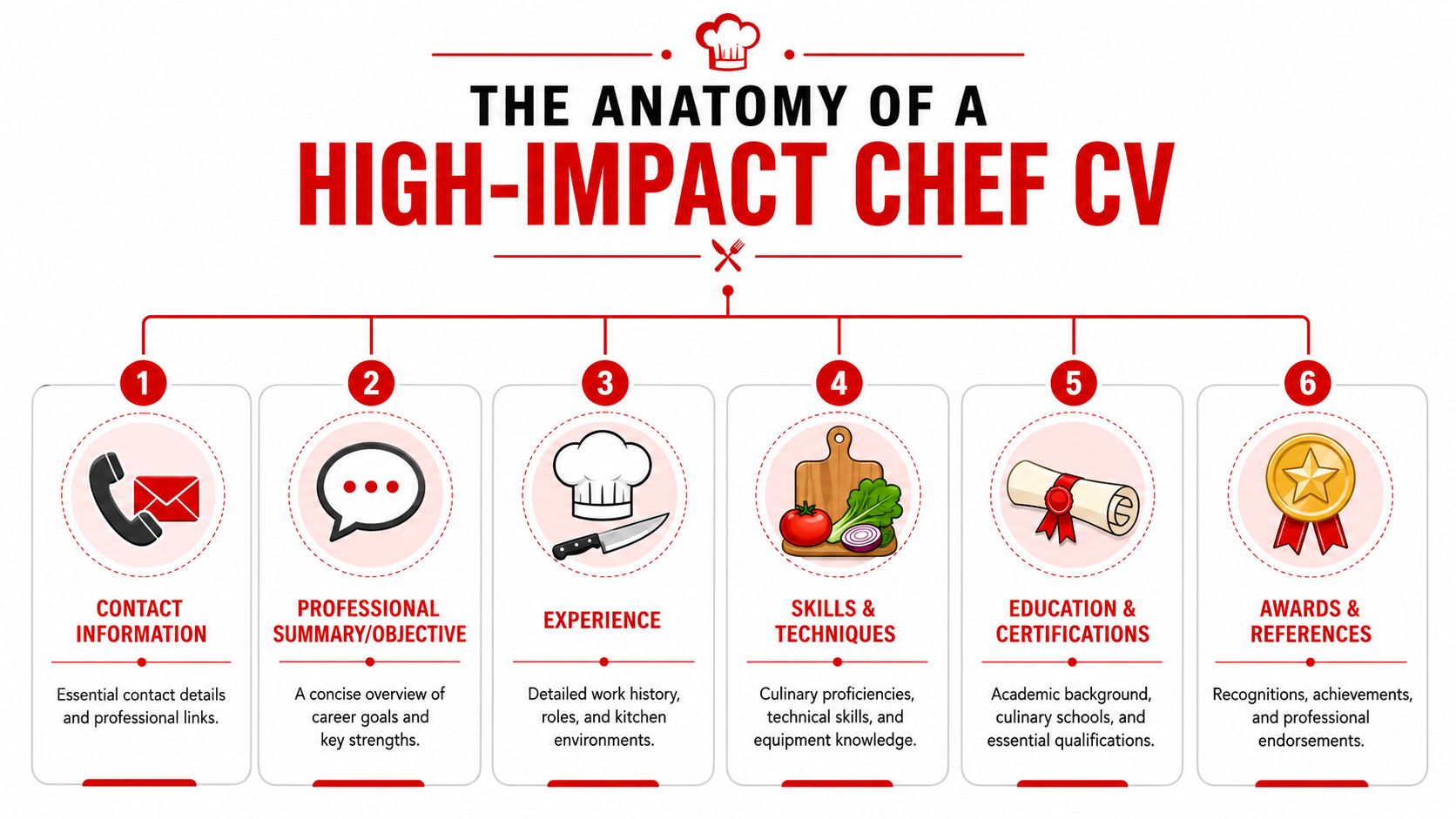
Use this visual as a quick checklist when scanning applications.
Start at the top and judge professionalism fast
The contact section tells you more than people think.
A proper mobile number, a sensible email address and a clear location help. If they're applying for relief work, it should also be obvious whether they can travel. If they've included links to a professional profile, fine. If they've filled the top third with fluff, photos and slogans, they're wasting space.
Then read the profile.
A useful personal summary is short and operational. It tells you level, environment and strengths. For example: sous chef with hotel and banqueting background, used to volume breakfast and evening service, confident with stock control and team supervision. That's useful. “Creative chef with a passion for excellence” tells you nothing.
Employment history should be clean and testable
Weak CVs often collapse at this stage.
Look for:
- Exact job titles such as Chef de Partie, Sous Chef, Head Chef
- Proper dates with month and year if possible
- Named venues or groups you can recognise or check
- Clear progression instead of random lateral moves with no explanation
If someone has worked in five kitchens in quick succession, don't reject them automatically. Relief chefs and contract chefs will often show movement. But the pattern has to make sense.
Here's a fast triage table:
| CV element | Strong signal | Weak signal |
|---|---|---|
| Job titles | Specific and consistent | Inflated or vague |
| Dates | Clear and sequential | Missing or patchy |
| Venues | Named and relevant | Unclear or generic |
| Achievements | Measurable | Duty-based |
| Certifications | Listed clearly | Missing or buried |
If a chef can't organise their own experience on paper, don't assume they'll organise your section in service.
Skills and certifications should support the story
The best CVs don't dump a long skills list with no context. They tie skills to work history.
If the CV says menu costing, GP management, pastry, rotas, HACCP or ordering, you should see where those were used. If not, it may be borrowed language.
Awards and references matter less than managers think. A reference line is fine. Fancy design is not. Clean structure beats clever layout every time in hospitality recruitment.
How to Spot Real Achievements Instead of Empty Duties
Managers usually waste time reading for tasks, because tasks are easy to spot.
That's the wrong approach.
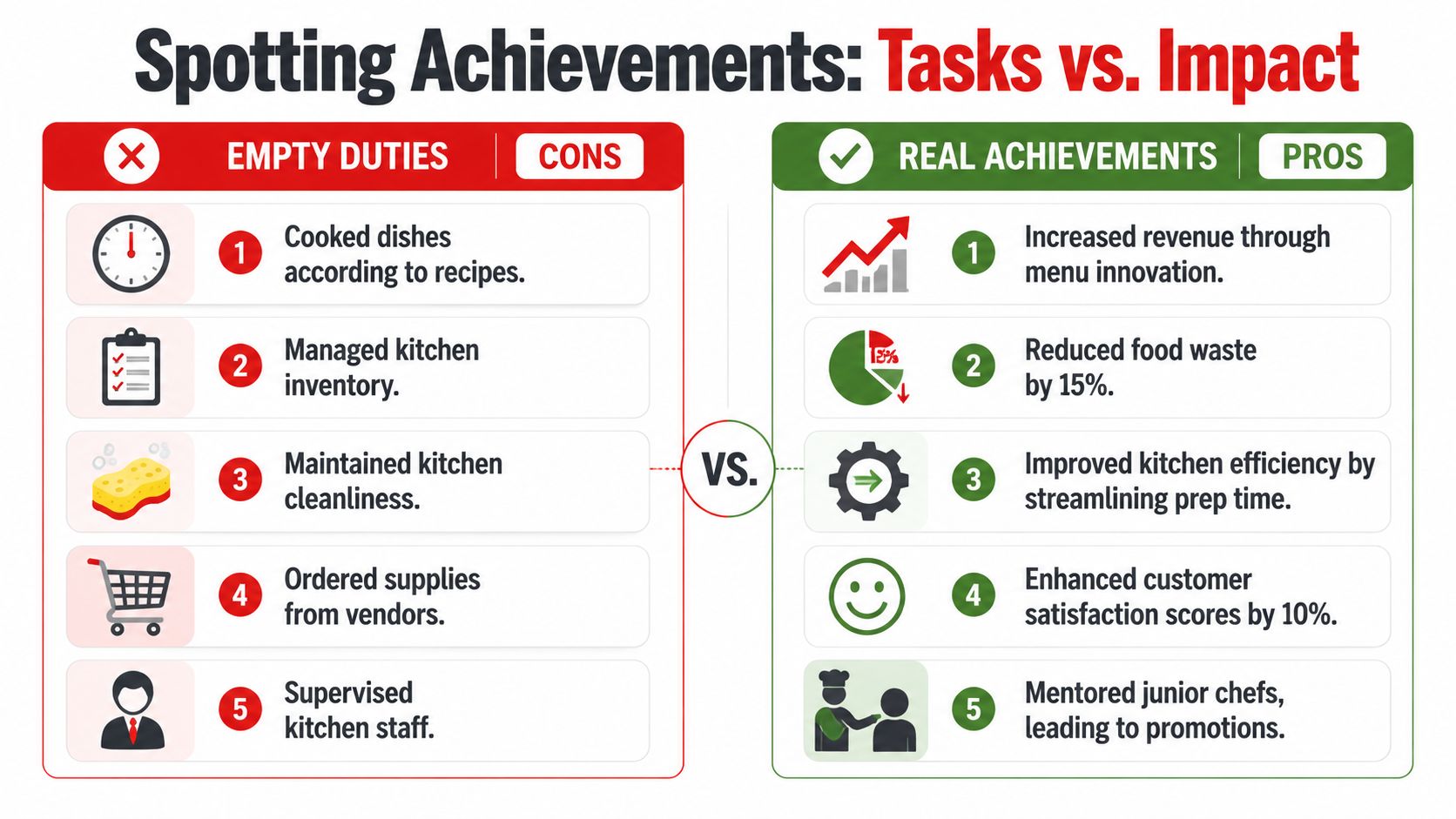
A strong CV for a chef should work like a competency evidence matrix. It should show measurable outcomes, current tools and real scope of responsibility, not just a list of duties, as explained in this piece on evidence-led CV structure.
Use the comparison below to train your eye.
Read for commercial output
A weak bullet says what they touched. A strong bullet says what changed because they were there.
Compare these:
Weak
Assisted with menu planningBetter
Updated seasonal menu and supported costing across starters and mainsStrong
Ran seasonal menu changeover, reduced wastage, improved handover across sections and maintained service continuity during peak trading
That final example works because it gives you operational value, even without a number.
Now compare another:
Weak
Managed kitchen stockStrong
Controlled ordering, reduced over-ordering, kept section stocked for service and supported cleaner weekly stocktakes
That tells you they understand control, not just administration.
Look for scope, pressure and responsibility
A chef who can run a section leaves clues on the page.
Look for mention of:
- Covers per shift
- Size of brigade supervised
- Sections owned
- Service style such as banqueting, a la carte, breakfast, events, gastro pub, hotel
- Cost control such as waste reduction, menu costing, portion control
- Compliance such as HACCP, allergy procedures, audit readiness
If you're hiring a sous chef, compare their CV against the duties of a sous chef. If the title says Sous Chef but the bullets read like junior prep support, you've found title inflation.
This short video is also a useful prompt for what stronger chef CV evidence should look like.
Use a simple pass fail filter
When scanning achievements, mark the CV against these three tests:
Did they own anything
A section, a team, a stock process, a menu area, an opening shift, a close-down routine.Did they improve anything
Waste, speed, consistency, handover, ordering, prep flow, training.Can I picture them in my kitchen
If you still can't tell after one page, the CV is too vague.
Don't reward polished language. Reward operational evidence.
The best chefs often write plainly. The weak ones often write grandly.
Decoding Certifications Right to Work and Essential Keywords
Plenty of attractive CVs are useless the moment compliance checks start.
If the candidate can't legally work, can't show the right food safety background, or doesn't understand allergy discipline, the rest of the CV hardly matters. In such situations, too many managers relax standards because they're desperate for cover. That's how kitchens create bigger problems.
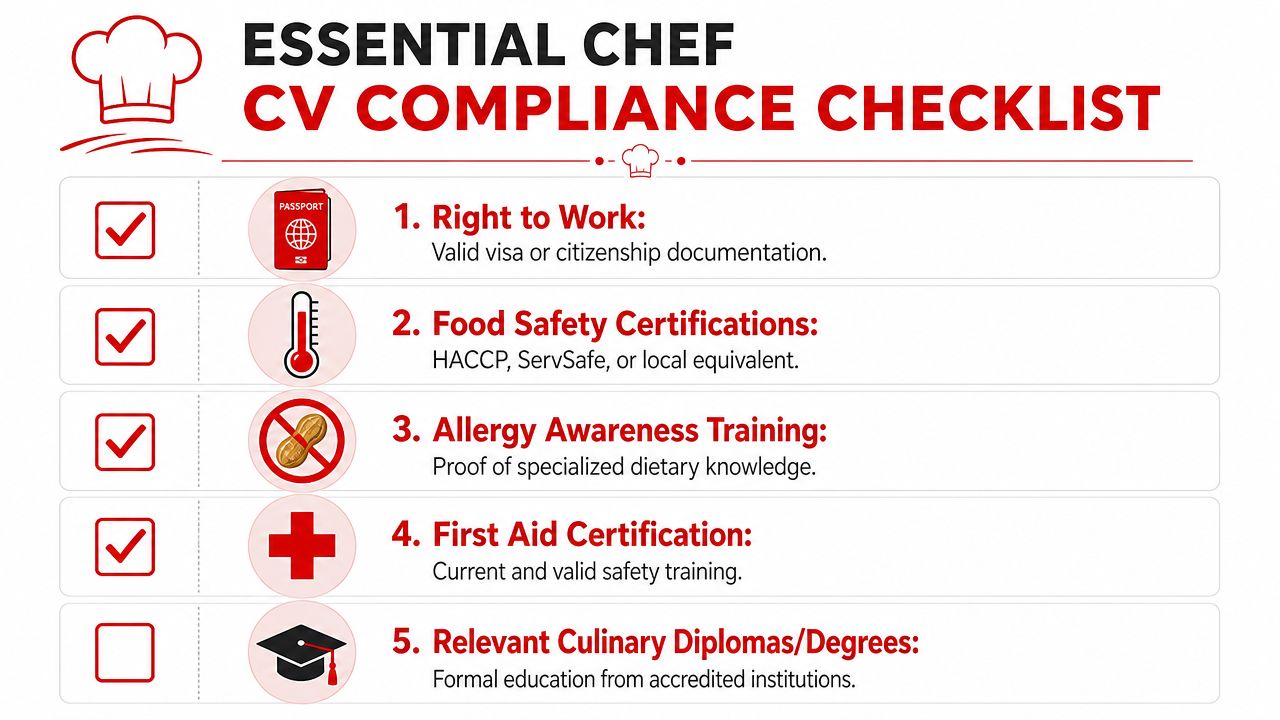
Use this as your baseline screen.
What should be visible on the CV
These items should be easy to find, not hidden at the bottom:
Right to work status
Especially important for urgent placements. If availability is immediate but work eligibility is unclear, you don't have a ready chef.Food safety training
If they've got training, they should state it clearly.Allergy awareness
A serious kitchen doesn't treat this as optional.Relevant qualifications
Formal training isn't everything, but current compliance credentials matter.
For a more detailed hiring benchmark, review the core qualifications for a chef. It helps separate what's essential from what's merely nice to have.
Keywords that actually mean something
Some terms on a chef CV suggest business awareness. Others are just padding.
Pay attention when you see:
- GP management
- Menu costing
- HACCP
- EHO audit
- Stock control
- Allergen management
- Rota support
- Section handover
- Multi-site support
These phrases matter only if they connect to real experience. Anyone can stuff keywords into a profile. The work history has to back them up.
A chef who understands compliance usually writes more clearly about systems, not just food.
A practical test is simple. If you asked them about an allergy process, a delivery check, or a fridge record failure, would the CV suggest they've dealt with it before? If not, be cautious.
Tailoring Your Search For Relief and Permanent Chefs
A relief chef CV and a permanent chef CV should not be judged by the same standard.
That's where many operators go wrong. They screen everyone as if they're hiring a long-term brigade member, then wonder why they miss strong short-notice chefs. In the UK, accommodation and food service had 85,000 vacancies in the three months to April 2024, which is exactly why shift readiness and low-friction onboarding matter so much when you need cover quickly, as highlighted in this discussion of hospitality CV relevance.
What matters in a relief chef CV
For relief cover, prioritise speed and adaptability over polish.
You want evidence of:
- Immediate or near-immediate availability
- Comfort across different kitchen types
- Short-term assignments that make sense
- Fast section handover
- Reliability under pressure
- Travel flexibility
A chef who has moved between pubs, hotels and events may be exactly what you need for emergency cover in Wales, Reading, Slough or Windsor. Don't misread variety as instability if the pattern shows useful adaptability.
If you're comparing options through employment agencies for chefs, judge them by how well they verify these points before sending a CV over.
What matters in a permanent chef CV
For permanent recruitment, the lens changes.
You want to see deeper roots:
- progression from one level to the next
- evidence of mentoring
- menu development that lasted
- standards carried over time
- fewer unexplained exits
A permanent head chef or sous chef should show more than kitchen survival. They should show leadership, consistency and commercial judgment.
Here's the side-by-side difference:
| Role type | Prioritise on the CV | Be cautious of |
|---|---|---|
| Relief chef | Availability, adaptability, varied sites, quick onboarding | Long vague profiles, no travel clarity |
| Permanent chef | Progression, retention, team building, stability | Repeated short stays without context |
| Yacht or villa chef | Discretion, flexibility, high standards, private service awareness | Restaurant-only mindset with no privacy awareness |
Specialist private roles need a different eye
Yacht chefs and villa chefs sit in another category.
You're not just hiring for cooking. You're hiring for discretion, flexibility, presentation, guest awareness and self-sufficiency. A strong private chef CV should suggest calm judgment and trustworthiness, not just luxury ingredients and fine dining names.
Relief Chefs UK, established in 2013, handles relief chefs, temporary chefs, permanent chef recruitment, yacht chefs, villa chefs and broader hospitality staffing support across the UK. That kind of model is useful when you need one hiring channel but different screening criteria for each chef type.
Build Your Kitchen Brigade with a Trusted Partner
Reading chef CVs properly takes time, judgement and a good memory for nonsense.
You need to spot inflated titles, vague achievements, poor compliance clues and role mismatch quickly. Then you still need to check availability, references, right to work and whether the person can function in your kitchen. Most operators don't have spare hours for that when they're already firefighting rotas, costs and service standards.
That's why the commercial reading of a chef CV matters. UK operators are under pressure from staffing shortages and higher costs, so CVs that show food-cost discipline, waste control and rota reliability are more useful than generic lists of cuisines, as noted in this review of hospitality hiring priorities.
If you need cover for a country pub in Dorset, a hotel in Bristol, a restaurant in Berkshire or a private role elsewhere in the UK, stop reading chef CVs like marketing documents. Read them like operating risk.
The right chef steadies service.
The wrong chef drains management time, damages consistency and costs you more than the fee ever would.
If you need vetted chefs quickly, contact Relief Chefs UK. They support pubs, restaurants, hotels, private households, yachts and villas with relief chefs, temporary chefs, permanent chef recruitment and wider hospitality staffing support across the UK.
Call the team.
Office 01392 715474 · info@reliefchefs.co.uk