
Land Chef Jobs in Scotland: Your 2026 Career Guide
6 June 2026

Scotland gives chefs and hospitality operators a market with real upside, but it doesn't give anyone an easy ride. One week you're planning around strong covers, weddings, golf traffic, touring groups, and local events. The next, a sous chef leaves, sickness hits the rota, and the only immediate question is who can step onto the section without slowing service.
That's why chef jobs in Scotland are rarely just about a vacancy or a wage. They're about geography, accommodation, pressure, standards, and timing. A city brasserie in Edinburgh doesn't recruit the same way as a Highland hotel, a coastal inn, or an events-led country house venue. The same applies to chefs. The right move isn't always the highest base salary. It's the role that fits your pace, your experience, and the reality of how you want to work.
An Introduction to Scotland's Dynamic Hospitality Scene
Scotland's hospitality scene has range. You've got fast-moving city kitchens in Glasgow and Edinburgh, destination dining in rural hotels, busy tourist routes through the Highlands, and seasonal coastal venues that can go from steady to flat out very quickly. For chefs, that creates opportunity. For operators, it creates constant staffing pressure.

A lot of the best kitchen careers in Scotland don't sit neatly inside a simple city-centre job search. Some are in established hotels with strong brigade structure. Some are in independent pubs and restaurants where one good chef can transform consistency, prep discipline, and pass control. Some are in remote venues where live-in support makes the role workable in the first place.
What makes Scotland different
Scotland mixes tradition with operational variety. A chef might work fine dining one season, events and banqueting the next, then move into premium pub food, private household work, or a live-in hotel role. That flexibility is attractive if you want to build experience quickly.
For employers, the difficulty is that demand doesn't disappear just because the talent pool feels tight. Guests still arrive. Weddings still run. Breakfast still has to go out on time. If a kitchen loses even one reliable chef, service standards can slip fast.
Practical rule: In Scotland, staffing problems are rarely just recruitment problems. They're usually recruitment, transport, housing, and retention problems happening at the same time.
Why both chefs and venues need a clearer view
Too much content about chef jobs in Scotland treats the market like a list of adverts. That misses what truly matters on the ground. Chefs need to know what kind of kitchen they're stepping into, whether the rota is realistic, and whether the location works in practice. Venues need to know whether they're offering a package that people can realistically accept and sustain.
That's especially true outside the central belt. A role can look attractive on paper but become difficult if travel is poor, accommodation is weak, or the kitchen setup asks too much from too few people.
For a more local breakdown of hiring conditions and staffing support, operators can review the broader chef recruitment market in Scotland.
The State of the Scottish Chef Market in 2026
The Scottish chef market remains active, but it isn't evenly distributed and it isn't easy to operate within. Demand sits across city venues, tourist-led businesses, hotels, pubs, event sites, and rural operations. What changes is the kind of pressure each venue faces. In cities, competition for experienced chefs is sharp. In rural areas, the issue is often whether the role is practical at all without accommodation or flexible cover.
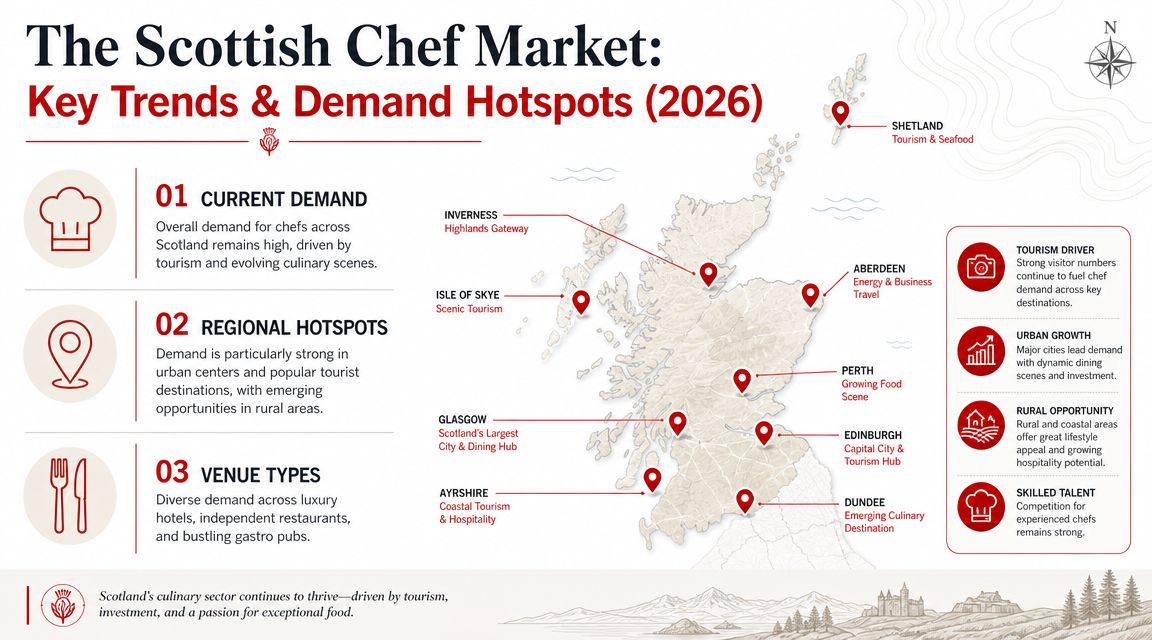
The wider UK shortage matters here. UKHospitality reported chef shortfalls of 10% for head chefs and 21% for production chefs in analysis based on 3,500 jobs distributed in 2023. Those are UK-wide figures, but any Scottish operator recruiting for mobile talent is competing in that same labour market.
Where the pressure shows up
The pain points are familiar if you run kitchens:
- Short-notice sickness: You can absorb one absence for a day or two. After that, prep slips, section coverage gets messy, and senior chefs start firefighting.
- Seasonal compression: A venue can look fully staffed in quieter trading, then become exposed the moment occupancy rises or events stack up.
- Permanent recruitment drag: Hiring the wrong chef costs time twice. First in onboarding, then again when you have to replace them.
- Agency inconsistency: Some venues don't avoid agencies because they dislike the model. They avoid poor agencies because the chef quality is unpredictable.
Hotspots aren't just the obvious cities
Edinburgh and Glasgow will always attract attention, but the stronger insight is that demand stretches wider than the major urban centres. Scotland's hospitality economy spreads into travel corridors, remote hotels, golf destinations, coastal businesses, and event-heavy venues where one weak rota can create weeks of disruption.
This short market overview is useful context for the wider conversation:
What chefs and operators should take from this
For chefs, it means there are real openings if you stay flexible on location, role type, and package structure. For operators, it means waiting for the perfect permanent hire isn't always the best immediate answer.
When the market is tight, the venues that fill kitchens fastest are usually the ones that define the role clearly, move quickly, and remove friction from the offer.
If you want a benchmark for what chefs are seeing elsewhere in the market, it helps to compare against broader pay guidance on how much chefs make.
Understanding Chef Pay Bands and Role Expectations
Pay matters, but in Scotland it only tells part of the story. The current benchmark from live chef listings shows an average salary of £26,999, with a typical advertised range of £22,999 to £32,499 according to current chef jobs in Scotland on Caterer.com. That £9,500 spread tells you something important straight away. Role level, venue type, and location all affect what a chef can realistically command.
The useful benchmark
For a commis chef, chef de partie, or sous chef, market positioning often comes down to pressure and responsibility rather than job title alone. A small brigade in a busy hotel may ask more of a chef de partie than a larger city operation does. Likewise, a sous chef covering recruitment gaps, ordering, rota support, and pass control will price differently from one working in a stable, fully staffed kitchen.
Here's a simple reference point built from the verified market range.
| Chef Role | Low End | Average | High End |
|---|---|---|---|
| Typical Chef Salary Bands in Scotland (2026) | £22,999 | £26,999 | £32,499 |
That table is a market baseline, not a promise by title. In practice, a commis chef, chef de partie, or sous chef may sit at different points in the range depending on venue complexity, live-in support, and local competition.
Why title alone won't price the job properly
One of the most common hiring mistakes is assuming the title does the work of the offer. It doesn't. Chefs read beyond the heading. They look at section ownership, split shifts, overtime treatment, tronc, accommodation, travel, and whether the business is organised.
A role can be underpaid even when the headline salary looks acceptable. It usually happens when the kitchen expects one person to carry too many operational gaps.
Consider what changes the value of the role:
- Live-in support: This can make a rural job viable where travel would otherwise put candidates off.
- Structured hours: A slightly lower base can still attract interest if the rota is sensible and service is controlled.
- Kitchen stability: Good chefs notice when a venue is replacing chaos with systems, not just plugging holes.
- Skill fit: A chef with banqueting, high-volume breakfast, or premium fresh food experience will judge the role against the section pressure they'll inherit.
Hiring note: If the advert only sells the salary, you'll attract price shoppers. If it explains the kitchen, brigade, standards, and package properly, you'll attract better-fit chefs.
What candidates should ask before accepting
Chefs looking at chef jobs in Scotland should press for specifics before saying yes.
Who leads service day to day
If that answer is vague, expect mixed standards and last-minute changes.What does the rota look like
Ask about busiest days, split shifts, and whether the team is covering open vacancies.What's included beyond base pay
Accommodation, meals on shift, bonus structure, and tronc can change the decision.Why is the role open
Growth is one answer. Burnout and churn are another.
How to Find and Secure the Best Chef Jobs
The best chef jobs in Scotland aren't always the loudest adverts. Some of the strongest roles get filled through referrals, repeat relationships, and specialist hospitality networks before the wider market gets near them. That's why chefs who rely on one method alone often miss better opportunities.
Start with the right channels
Big job boards still have value. They show volume, salary visibility, and the broad shape of the market. But they also create noise. You'll find duplicated adverts, vague job descriptions, and roles that have already shifted or changed by the time you apply.
Direct applications can work well when you already know the venue and want that kitchen specifically. They're less effective when you need guidance on whether the team is stable, whether the live-in offer is decent, or whether the role has been hard to fill for reasons the advert doesn't mention.
Specialist hospitality recruitment tends to work best when you want fit, not just access. The main advantage isn't only introductions. It's filtration.
Don't ignore rural and live-in roles
A lot of chefs still search as if Scotland begins and ends with Edinburgh and Glasgow. That's too narrow. Many Scotland listings are advertised as being “all over Scotland” and “outside of the major towns and cities”, often with live-in options. That changes the conversation completely. The issue isn't only demand. It's whether accommodation solves the geography.
For chefs open to movement, that creates opportunity. For venues, it means the advert needs to answer practical questions fast.
Useful checks before applying for remote roles:
- Ask for accommodation detail early: Don't settle for “live-in available” as a one-line promise. Ask where it is, whether it's shared, and how it fits the rota.
- Check transport reality: A role may be viable by car and unrealistic without one.
- Clarify contract type: Seasonal, temporary, relief, and permanent roles all suit different priorities.
- Understand peak pressure: A scenic location can still be a hard service environment.
Chefs looking at Glasgow-based temporary routes can also compare local options through a Glasgow temp agency for hospitality staffing.
What gets chefs shortlisted
A strong chef CV doesn't need theatre. It needs relevance. Head chefs and GMs want to know where you've worked, what volume you've handled, what style of food you know, and whether you can be trusted on section.
Keep it practical:
- Lead with role and level: State whether you're commis, CDP, sous, or head chef level.
- List operational strengths: Grill, sauce, pastry, breakfast, banqueting, prep leadership, ordering, GP awareness.
- Show continuity: If you've moved often, explain whether that was seasonal, relief, or contract work.
- Include logistics: Driving licence, live-in openness, relocation flexibility, immediate availability.
Trial shifts decide a lot
The trial shift still matters because kitchens hire on behaviour as much as skill. A chef who communicates, stays clean, moves with purpose, and listens properly will outperform a technically good chef who creates friction.
Turn up early, bring your kit, ask where the pressure points are, and work the section as if you're already on payroll.
What doesn't work is overselling yourself, criticising the setup on day one, or acting as if a busy service is beneath you. Scotland has plenty of strong kitchens, but most of them want steady professionals, not drama.
The Strategic Advantage of Relief and Temporary Chef Work
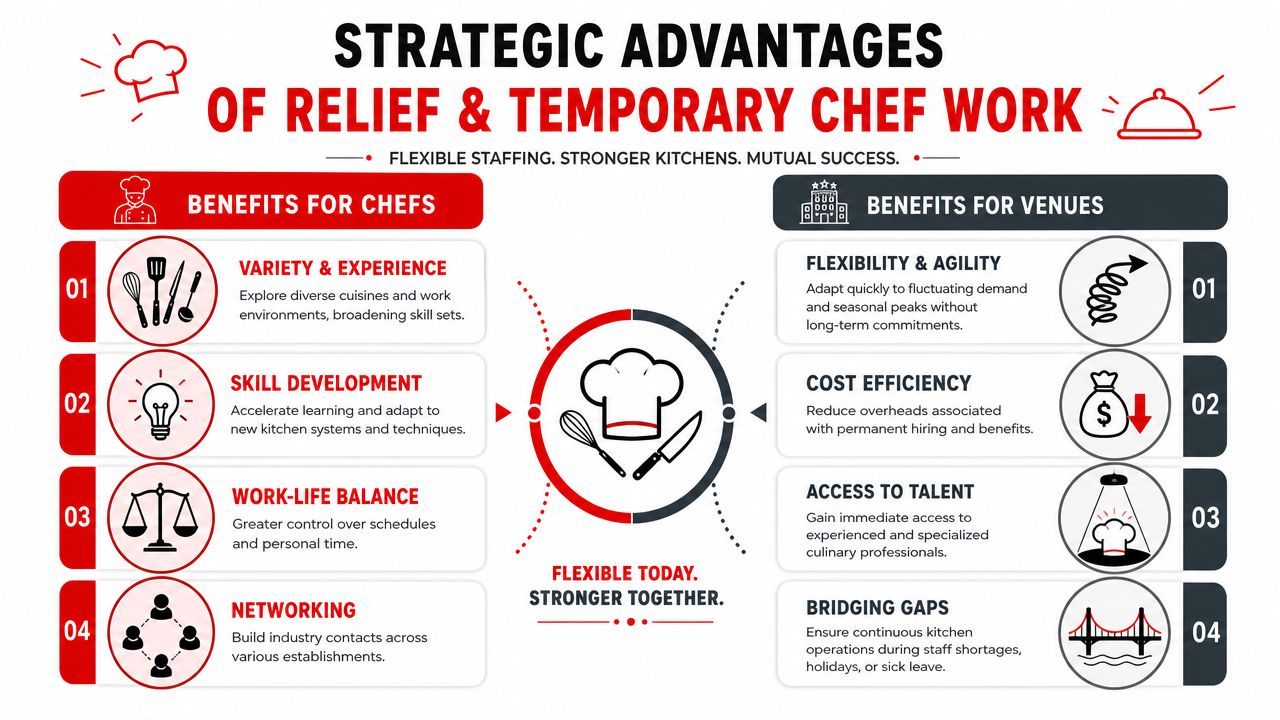
Relief and temporary chef work gets misunderstood. Some people still treat it like emergency cover only. In reality, it's one of the most practical staffing tools in hospitality, especially in Scotland where demand shifts quickly and geography can make permanent hiring slower.
Why chefs choose relief work on purpose
For chefs, relief work can be a career choice rather than a stopgap. It gives exposure to different systems, menus, standards, and leadership styles. That can sharpen judgement faster than staying too long in one limited kitchen.
It also suits chefs who want more control over where and how they work. Some prefer variety. Some want to avoid getting trapped in poor permanent setups. Some use temporary assignments to test whether a venue is worth joining long term.
A relief chef can gain practical advantages from:
- Range of kitchens: Hotels, gastro pubs, events operations, private households, yachts, and villas all build different strengths.
- Faster learning curve: Moving between brigades teaches adaptation, mise en place discipline, and system awareness.
- Professional network: Good relief chefs get remembered by head chefs who value reliable cover.
- Flexibility: Temporary work can fit around relocation, family needs, or a planned move into senior roles.
Why operators use temporary chefs well
The stronger operators don't wait until the kitchen is collapsing to think about cover. They use relief chefs to protect service, preserve standards, and stop burnout spreading across the brigade.
That matters in Scotland, but it matters across the wider UK too. A boutique hotel in the Highlands may need support for live-in cover. A pub in Devon may need a chef through holiday trade. A group in Berkshire, Windsor, Reading, Slough, Bristol, Dorset, or Wales may need a short-term bridge while permanent recruitment catches up. The logic is the same. If the kitchen can't staff to demand, the business needs flexibility.
Three common examples:
Sickness and emergency absence
The value here is speed. You need someone who can walk in, read the kitchen, and keep service moving.Seasonal demand
Temporary chefs let venues add strength without overcommitting when the peak passes.Permanent recruitment gaps
Relief cover buys time to hire properly instead of making a rushed permanent decision.
A good temporary chef doesn't just fill a shift. They reduce the operational cost of panic.
What doesn't work with flexible staffing
Temporary cover fails when the venue treats it as magic. If the spec is vague, the induction is poor, and the kitchen has no prep structure, even a capable chef will be slower to settle. Operators still need to brief properly, define service expectations, and put the chef where their experience fits.
It also fails when businesses chase the cheapest option rather than the safest one. A cheap shift can become expensive if standards drop, wastage rises, or the pass falls apart on a busy service.
For chefs, relief work doesn't suit everyone. If you want one team, one menu, and a long runway to build within one business, a permanent role may suit you better. But for many professionals, especially those moving through the Scottish market, temporary work is one of the most direct ways to stay employed, gain breadth, and avoid poor matches.
Why Venues Across Scotland Trust Relief Chefs UK
Hospitality businesses don't need more theory about staffing. They need working kitchens, stable rotas, and chefs who arrive ready to cook. That's why specialist support matters most when the pressure is highest. If a hotel loses a sous chef before a busy weekend, or a pub gets hit by sickness in the middle of strong trade, the cost of delay shows up immediately in service, team morale, and guest experience.

Relief Chefs UK has been established since 2013 and works as a chef staffing partner across the UK, supporting independent pubs, restaurants, boutique hotels, private households, yachts, and villas. The business is run by chefs, not generalist recruiters, which matters when a client needs someone who understands section pressure, service flow, and what a venue really means when it says it needs “strong cover”.
What operators usually need most
Venues rarely ask for help in perfect conditions. More often, they need one of these:
- Emergency kitchen cover: Short-notice sickness, walkouts, or holiday gaps.
- Temporary reinforcement: Busy periods, events, occupancy spikes, and seasonal trade.
- Permanent recruitment support: Replacing key chefs without weakening service in the meantime.
- Specialist placement: Yacht chefs, villa chefs, and broader hospitality staffing support where discretion and fit matter.
The difference with a specialist agency is judgement. Matching a chef to a rural live-in hotel is not the same as matching one to a city-centre restaurant. A high-volume breakfast and banqueting chef is not the same profile as a fresh food gastro pub sous chef. Good staffing depends on knowing the difference before the shift starts.
Why the model works
Relief Chefs UK offers 24/7 support, fully vetted chefs with right-to-work checks, available for temporary, emergency and permanent placements, subject to availability. That support helps operators regain control before the kitchen slips into damage-limitation mode.
The commercial value is straightforward:
| Venue problem | What specialist chef staffing helps protect |
|---|---|
| Last-minute absence | Service continuity and brigade morale |
| Seasonal pressure | Standards without over-hiring |
| Hard-to-fill permanent roles | Time to recruit properly |
| Rural staffing difficulty | Access to chefs open to location-specific work |
There's also a practical point many operators miss. The best staffing partner isn't just there for breakdowns. They help build resilience. That might mean lining up temporary chefs in advance for peak periods, using relief cover during recruitment, or securing permanent support only after the venue has properly defined the role.
Why this matters for chefs too
Candidates benefit from the same market knowledge. MyJobScotland listings show chef and cook roles at roughly £26.8k to £28.4k, while private-sector senior sous chef roles in Scotland can reach about £34k to £44k including bonus and tronc. That's why the right question isn't only salary. It's the total value of the role once accommodation, flexibility, pressure level, and progression are taken into account.
Some jobs look better after the full package is explained. Others look worse. A specialist agency should know the difference before making the introduction.
For operators and chefs alike, that's the advantage. Less guesswork. Better fit. Faster decisions that hold up under real service conditions.
If you need dependable chef cover, permanent recruitment support, or specialist placements for yachts, villas, hotels, pubs, and restaurants, contact Relief Chefs UK. They've supported hospitality businesses nationwide since 2013 and can help you secure relief chefs, temporary chefs, and long-term hires without the usual scramble.
Call the team.
Office 01392 715474 · info@reliefchefs.co.uk