
Staring at another empty spot on the rota? You’re not the only one. Finding a good hospitality staff agency in London is no longer just about filling a last-minute shift. It’s about finding a partner who gets the city’s unique pressures and can protect your service.
Confronting London's Hospitality Staffing Crisis
London's incredible hospitality scene is being held back by a severe, undeniable staffing crunch. From neighbourhood pubs to fine dining rooms, venues are struggling to find skilled, reliable people. The old way—post an ad, sift through CVs, run interviews—is too slow for the pace we all work at now. This isn't just an inconvenience; it's a real operational risk.
The numbers don't lie. The UK's hospitality sector has been hit harder than any other, shedding a massive 59,000 workers in the last year alone. While other industries grew, ours shrank. You can dig into the full labour crisis in recent reports, and the picture it paints is grim.
This problem is even worse in London. The high cost of living and the sheer intensity of service create a perfect storm. It’s exactly why so many managers now rely on a specialist hospitality agency. They aren’t just sending bodies; they’re providing a real solution to a crisis that isn't going away.
Why Traditional Hiring Is Falling Short
The old recruitment methods simply weren’t built for this market. Here’s why more and more managers are looking for a better way:
- It Takes Too Long: The whole process, from placing an ad to getting someone on the floor, can drag on for weeks. In this industry, you often need someone for tomorrow’s service, not next month’s.
- The Revolving Door: Hospitality has always had high turnover. You can spend weeks finding the right person, only for them to leave a short time later, putting you right back where you started and driving up the real cost of employing staff.
- The CV Doesn't Tell the Story: A CV can look perfect, but it can’t tell you if a chef has the speed for a busy pass or if a bartender has the right attitude for your front-of-house team. The skills mismatch is a huge gamble.
A good hospitality staff agency is your filter. They save you the time and money wasted on vetting candidates who aren’t right. They deliver pre-vetted, compliant, and ready-to-work professionals who can step in and get the job done from hour one. It takes the recruitment headache off your plate so you can focus on running your business.
Picking the right hospitality staffing agency in London isn’t just about filling a rota gap. It’s about finding a partner you can trust to protect your reputation, handle the legal paperwork, and actually understand the pressure of a busy service.
But with so many agencies out there, how do you tell the real experts from the risky ones? You need a solid vetting checklist.
Don’t get taken in by a slick website. What matters is what happens behind the scenes. Your goal is to find an agency with bulletproof systems for finding high-quality, legally compliant staff, every single time. This is your only defence against no-shows, underperformers, and the kind of legal headaches that can shut a place down.
The diagram below shows the all-too-common path London venues are forced down—from a shrinking talent pool to broken hiring methods, and finally, to relying on specialist agencies.
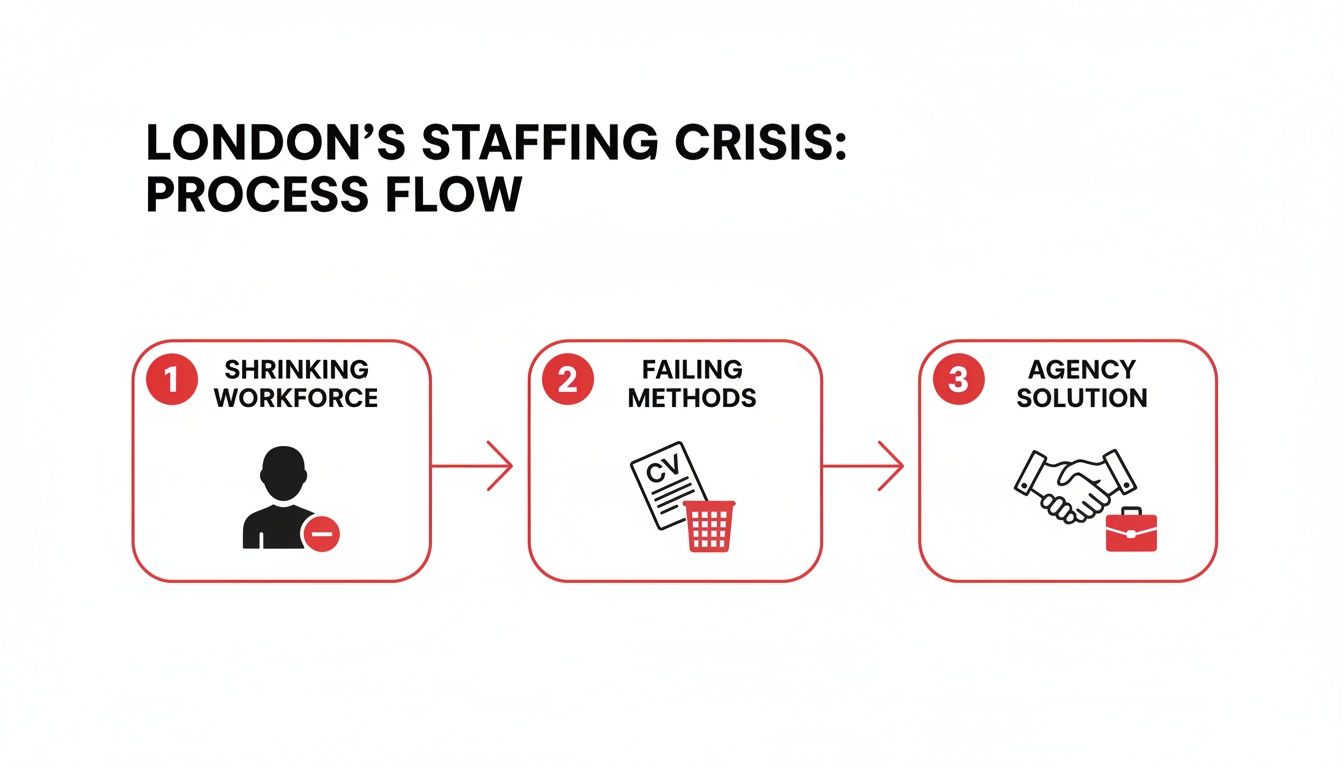
It’s clear that old ways of hiring just don’t work anymore. Good agencies have become a strategic necessity, not just a backup plan.
Go Beyond the CV: A Proper Vetting Process
A great chef’s real ability isn't on a two-page CV. A top-tier hospitality staff agency in London knows this and has a vetting process that proves it. They should be doing a lot more than just matching keywords on a piece of paper.
The first thing you should ask any potential agency is: "Walk me through your entire vetting procedure, step-by-step."
Listen for these non-negotiables:
- In-Depth Interviews: Are they conducting detailed, competency-based interviews? They should be asking tough questions about how a chef handles pressure, communicates with the front-of-house, and solves problems when a service is going sideways.
- Practical Skills Assessment: How do they actually check a chef can cook? This might be through practical trade tests, but it also includes deep-diving reference checks with former head chefs who can speak to their actual skills on the line.
- Real Reference Checks: A proper check isn't just confirming they worked somewhere. A good agency asks the hard questions: Were they reliable? What was their attitude like? How was their speed and cleanliness under pressure?
If an agency just scans a CV and makes a quick phone call, they aren't vetting. They’re just forwarding names. That’s a huge red flag.
The Deal-Breakers: Right-to-Work and Insurance
Compliance isn't optional. It’s everything. With operational costs soaring and post-Brexit rule changes making the labour market even tighter, getting compliance wrong is a risk you can’t afford. The penalties for a slip-up on right-to-work checks are severe enough to cripple a business.
When you’re talking to an agency, demand to see proof of their compliance process. They must be able to show you exactly how they verify that every single worker has a legal right to work in the UK. No excuses.
On top of that, ask for copies of their insurance certificates. Any professional agency must carry both Public Liability and Employers' Liability Insurance. This protects you, your business, and the chef if an accident happens.
If they hesitate or can’t produce these documents instantly, walk away. It’s a deal-breaker. It screams unprofessionalism and puts your entire operation on the line. For more on what separates a professional service from a risky gamble, check out our guide on what to look for when choosing employment agencies for chefs. An agency that gets compliance right is worth its weight in gold.
To make it easier, here's a quick scorecard you can use when talking to potential agencies.
Agency Vetting Scorecard Quick Reference
| Vetting Criteria | What to Look For (Good) | Red Flag (Bad) |
|---|---|---|
| Skills Vetting | Behavioural interviews and practical reference checks with former Head Chefs. | Only looks at the CV; calls to confirm dates of employment. |
| Right-to-Work | Shows a clear, documented process for checking every candidate. | Vague answers, no clear process, or says "the chef handles it." |
| Insurance | Immediately provides current Public & Employers' Liability certificates. | Hesitates, makes excuses, or cannot provide the documents. |
| Response Time | Answers calls/emails quickly; has a 24/7 contact for emergencies. | Slow to respond; only available 9-5, Monday to Friday. |
| Chef Briefing | Asks detailed questions about your venue, menu, and team before placement. | Sends any available person without understanding your specific needs. |
| Problem Solving | Has a clear policy for replacing a no-show or underperformer quickly. | "All bookings are final" or has no backup plan for failures. |
Use this as a mental checklist. A good partner will score well across the board, while a risky one will show red flags almost immediately. Trust your gut—if something feels off, it probably is.
Revealing Questions to Ask Any Potential Agency
Once you have your vetting list, it’s time to actually talk to the agencies. But a sales pitch is one thing; how an agency operates under real pressure is another. You have to lead the conversation with sharp, specific questions. It's the only way to get past the marketing fluff and see what a hospitality staff agency in London is truly made of.
Don't just ask if they vet their chefs. That's a 'yes' or 'no' question that tells you nothing. You need to dig deeper. The best way to do this is with scenario-based questions that force them to explain their entire process, from start to finish.
This tactic moves them away from rehearsed answers and shows you their real, day-to-day operational model. It’s in these details that the difference between a professional partner and a simple middleman becomes glaringly obvious.
How Do They Actually Find and Vet Chefs?
Start by drilling into their core function: sourcing and placing talent. Vague promises about "quality chefs" are useless. You need to understand the mechanics of their system.
Try asking this exact question:
"Walk me through your entire chef vetting process, from the moment a candidate applies to the moment they are cleared to work in my kitchen. What are the mandatory steps every single chef has to pass?"
A strong answer will be detailed and transparent. They should immediately talk about competency-based interviews, technical screening by experienced chefs, and at least two reference checks with former head chefs. A great agency will confidently explain how they verify skills, reliability, and attitude—not just scan a CV.
A massive red flag is a vague answer. If you hear, "We check their CV and call a reference," you're not talking to a serious outfit. That isn’t a process; it’s a box-ticking exercise that guarantees you’ll get an unsuitable candidate when you’re desperate.
How Do They Handle a Crisis?
Your partnership with a staffing agency isn’t truly tested when things go right. It’s tested when they go wrong. A no-show on a fully booked Friday night is the ultimate test of their worth. You need to know their emergency plan before you're in the middle of a kitchen meltdown.
Hit them with a high-pressure, real-world scenario:
- "It's 5 PM on a Friday. My sous chef for the evening service has just called in sick. We're a busy spot in Zone 2. What is your exact process for getting me a vetted, reliable replacement chef tonight?"
Listen carefully to their reaction. A top-tier agency won't even flinch. Their answer will be a calm breakdown of their emergency system, which should include access to a pool of on-call chefs and a genuine 24/7 contact number. They should also ask you clarifying questions about the role before promising the world.
If they sound panicked, tell you the office is closed, or can't give you a clear plan of action, run. They are not built for the realities of London hospitality. Their failure to handle a hypothetical emergency proves they will let you down during a real one. True partners are built for these moments.
Decoding Contracts, Costs, and Onboarding
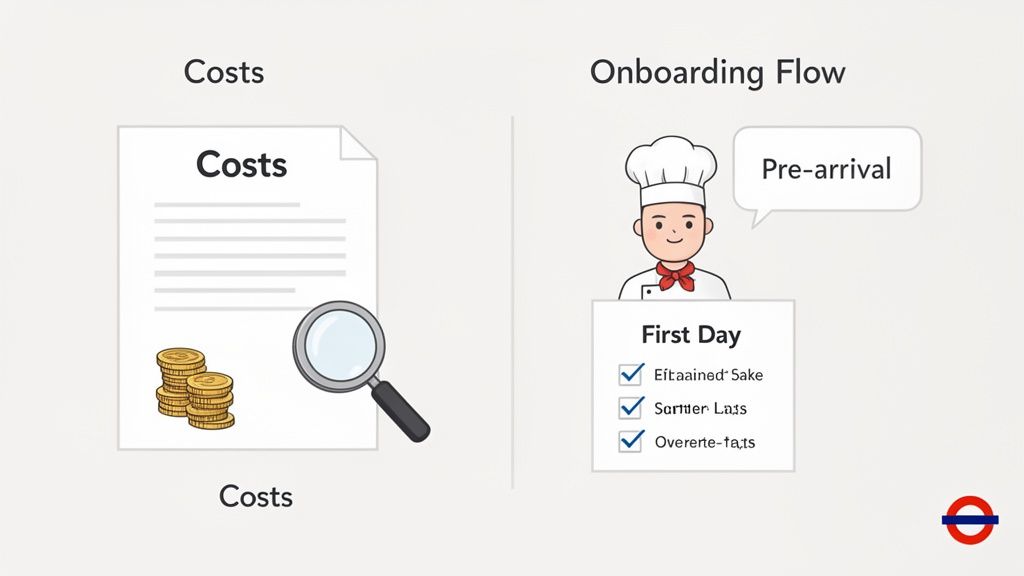
Let’s talk money and logistics. Getting the financials wrong when you hire a hospitality staff agency in London can eat into your margins before a chef even picks up a knife. The quote you get should be simple and final. No surprises.
Just as critical is how that temporary chef joins your team. A chaotic or non-existent induction sets everyone up to fail. Get the onboarding right, and a relief chef adds value from the moment they walk through your doors.
Understanding Agency Costs and Contract Models
Agency pricing can feel murky, but it’s usually just two parts: the chef’s pay and the agency's fee. A professional agency will be open about this. They should tell you exactly what slice of your hourly rate the chef takes home.
Find a provider who makes it simple. The best agencies give you one, all-inclusive hourly rate. This number should cover everything:
- The chef's wage
- Employer’s National Insurance
- Holiday pay accrual
- Pension contributions
- The agency’s fee for their vetting, insurance, and admin
Key takeaway: Insist on a fully-inclusive rate. If an agency quotes a price and then tries to add on payroll fees or travel costs, it’s a red flag for poor transparency. The price you're quoted is the price you should pay. Period.
Contracts also need to be flexible. The industry's staff churn is high—with 32% of staff looking to leave their jobs within two years. Rigid, long-term contracts just don't make sense for most venues. You need a model that lets you scale up for Christmas parties or scale down in a quiet January without being locked into fixed costs.
A Practical Checklist for Onboarding Temporary Staff
Once you’ve booked a chef, your job is to get them up to speed. Fast. A smooth onboarding isn't a nice-to-have; it's an operational necessity that lets them perform from their first minute in your kitchen.
Here's a no-nonsense checklist for every temporary hire.
Pre-Arrival Communication
- Confirm the Essentials: Send the full venue address, the name of the manager to ask for, and a mobile number in case they’re running late.
- Share the Basics: Give them a quick rundown of the menu style (e.g., "classic British pub," "modern European small plates"), expected covers, and any key dietary notes.
- Uniform and Knives: State your uniform policy clearly (e.g., "black chef jacket, black trousers, safety shoes") and confirm they're bringing their own knives.
First-Day Induction (The First 15 Minutes)
- Welcome and Walk-Through: Greet them. Give a quick tour of the kitchen, pointing out stations, dry stores, walk-ins, and fire exits. Don’t assume anything.
- Meet the Team: Introduce them to the head chef and the key people they'll be working alongside. A friendly face makes a huge difference.
- Station and Prep List: Show them where they’ll be working and run through the prep list. Point out the immediate priorities for that service.
- Health & Safety Brief: Quickly cover your core health, safety, and food hygiene rules. Every kitchen has its own way of doing things.
This structured approach turns a potentially stressful moment into a calm, productive one. It shows professionalism and helps the chef slot into your team, ready to deliver the quality you’re paying for.
To get a better handle on what you should expect to pay, a tool like our chef salary calculator can give you a solid baseline.
The Advantage of a Chef-Led Staffing Agency
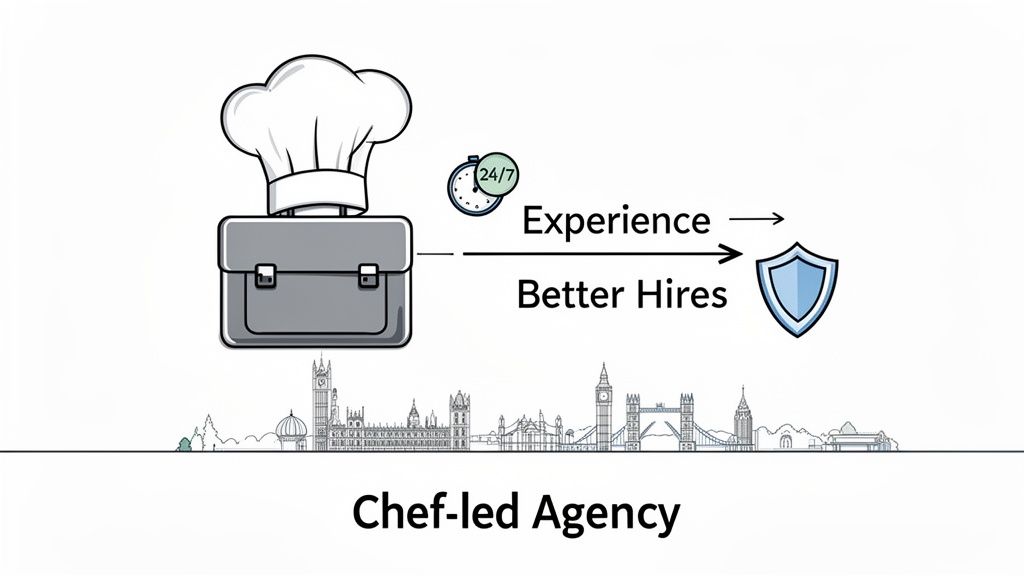
So, what really separates a decent hospitality staff agency in London from a genuinely great one? It comes down to who’s running the show. A general recruiter can match keywords on a CV, but an agency run by actual chefs understands the chaos, pressure, and rhythm of a kitchen from the inside out.
Frankly, it’s a totally different ball game. When the people vetting your emergency cover have decades of kitchen experience themselves, they bring an insight no recruitment consultant can ever match. They’re not just filling a vacancy; they're solving a problem they've had to fix themselves hundreds of times.
This first-hand knowledge is everything. They know a chef claiming "fine dining experience" needs to be grilled on their palate and plating, not just their knife skills. They get that the temperament needed for a heaving pub kitchen is worlds away from the focus required in a high-end hotel.
Beyond the CV: A Deeper Understanding
A chef-led team looks straight past the buzzwords on a CV. They can spot the difference between genuine expertise and a well-written story because they’ve lived it.
This practical experience leads to better vetting and, ultimately, chefs who can actually do the job you need them to do.
- Accurate Skill Assessment: They ask the questions that expose a chef's real capabilities. "Talk me through how you'd organise your section for a 150-cover service" is a question only a true peer can properly judge.
- Cultural Fit: They instinctively get the subtle but critical differences between venues. They know a hotel chef needs a different mindset than an event chef and match talent accordingly, saving you the headache.
An agency run by chefs knows exactly what to look for because they’ve been in your shoes. They’ve run the pass, written the rotas, and dealt with no-shows on a bank holiday weekend. That shared pain creates a level of trust and understanding a traditional recruiter just can't offer.
Tangible Benefits of Industry Experience
This deep industry knowledge isn’t just a nice-to-have; it delivers real, practical advantages for your kitchen. When you partner with an agency that gets it, you’re not just getting a temp worker. You’re getting a partner who can anticipate your needs before you even voice them.
The result is a service that's faster, more reliable, and simply more effective. You see it in their rapid response times for last-minute emergencies and their commitment to providing a guaranteed placement that actually fits your team.
Because they understand the stakes are high, they offer the genuine 24/7 support that London's non-stop hospitality scene demands. This isn't some offshore call centre; it's a team of professionals who know a kitchen crisis doesn’t stick to office hours. It's the most reliable solution because it’s built by chefs, for chefs.
Getting Straight Answers from a Chef Agency
When you’re under pressure and need staff, the last thing you want is a sales pitch. You need direct answers to a few critical questions. Any decent agency should be able to answer these without hesitation.
Think of it as a test. If they stumble or give vague replies, they aren’t the right partner for a high-pressure London kitchen. Here’s what you need to ask.
How Quickly Can You Get a Vetted Chef in My Kitchen?
This is usually the first question, and for good reason. For a planned gap or a standard booking, a reliable agency should place a fully vetted, compliant chef with you within 48 hours. This gives them time to find the right skill set, not just a warm body.
But what about a real emergency? A Friday night walk-out or sudden illness? A top-tier partner will have a pool of experienced chefs on standby and can often get someone to you the same day. Always ask them to confirm their emergency response times before you sign anything.
What Happens if the Chef Isn't the Right Fit?
It’s a reality of the kitchen. Sometimes a chef has the right skills on paper, but their work style or personality just doesn't mesh with your brigade. This is a crucial point to clarify upfront.
A professional hospitality staff agency must have a clear, no-quibble replacement guarantee. If a chef isn't working out within the first few hours or their initial shift, the agency must send a replacement quickly and at no extra cost.
This isn't a "nice-to-have"; it’s your insurance policy. It proves the agency is confident in its people and protects your service standards.
Are There Hidden Costs I Should Know About?
Cost transparency is non-negotiable. Some agencies lure you in with a low hourly rate, only to sting you with extra fees on the invoice. You must demand a fully transparent cost breakdown from day one.
Ask them to confirm, in writing, if their quote includes everything:
- National Insurance
- Holiday Pay
- Pension Contributions
- Any travel expenses
A trustworthy partner gives you a single, all-inclusive hourly rate. What you see is what you pay. This prevents budget blowouts and ensures there are no nasty surprises down the line.
Ready to work with a chef-led hospitality staff agency in London that stands by its chefs and offers total transparency? Relief Chefs UK delivers fully vetted, experienced professionals backed by a no-quibble replacement guarantee and 24/7 support. Request cover today and let us handle the staffing, so you can get back to running your service.