

Trying to answer "how much do chefs make?" is a bit like asking "how long is a piece of string?". It all comes down to the role, the location, and crucially, the chef's experience. A newcomer might start around £23,000, but a seasoned pro can easily clear £35,000 or more, with the average hourly rate hovering around £13 per hour.
UK Chef Salaries Explained: A 2026 Overview
For anyone running a pub, hotel, or restaurant, getting your head around the market rates for kitchen talent is make-or-break for your budget. Think of it as a ladder: a Commis Chef is on the first rung, and an experienced Head Chef is at the top. Every step up brings more responsibility, and the pay packet reflects that.
This isn't just about numbers; it's about acknowledging the value each chef brings to your business. If your offers aren't realistic, you simply won’t attract or keep the people you need. Let’s break down the financials for the UK’s culinary scene in 2026.
A Financial Snapshot Of Chef Earnings
So, what are chefs actually earning? Looking at the 2026 data, the average UK chef is pulling in about £13 an hour. On a full-time contract, that works out to a monthly wage of roughly £2,100.
Of course, that’s just the average. A junior chef just getting started will likely be on £11 per hour, while a senior chef with a solid track record can demand £17 per hour or more. Unsurprisingly, wages shoot up in high-pressure spots like central London, where good chefs are always in short supply. You can discover more insights about how earnings shift across different parts of the UK.
A chef's salary isn't just a number; it's a direct reflection of their skill, experience, and the value they bring to your kitchen. Understanding these benchmarks is the first step to building a strong, motivated team.
To give you a clearer picture, here’s a quick breakdown of what you can expect to pay for different chef roles.
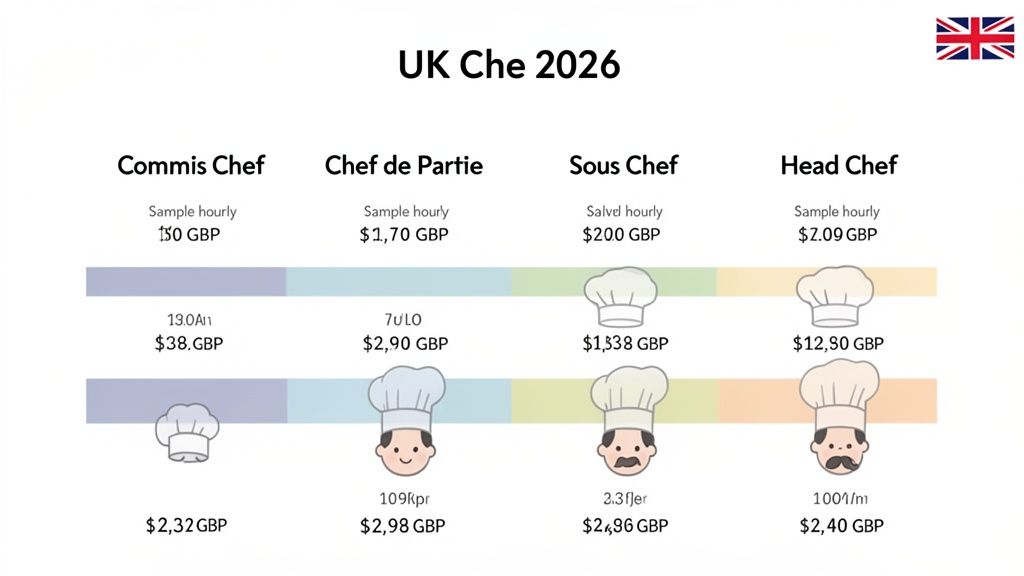
UK Chef Salary And Hourly Rates At A Glance: 2026 Averages
This table offers a practical, at-a-glance reference for the typical salary and hourly rates you'll see across the industry.
| Chef Role | Average Hourly Rate | Average Annual Salary |
|---|---|---|
| Commis Chef | £11.50 – £12.50 | £23,000 – £26,000 |
| Chef de Partie | £13.00 – £15.00 | £27,000 – £31,000 |
| Sous Chef | £15.50 – £18.00 | £32,000 – £38,000 |
| Head Chef | £19.00 – £24.00+ | £40,000 – £50,000+ |
These numbers are a solid baseline, but they’re just the starting point. The final salary you’ll need to offer will depend on a few other key factors, which we’ll get into next.
Why Experience Level Dictates Chef Pay
A chef’s salary isn't a random number. It’s a direct reflection of years spent on the line, mastering a craft under intense pressure. For any venue owner, grasping this is key to understanding why you pay a premium for a seasoned professional.
Think of it this way. A newly qualified mechanic can change your oil, but you’d only trust a master technician with 20 years’ experience to rebuild the engine. In a kitchen, the principle is identical. A junior chef is there to learn the ropes; a veteran chef steers the entire ship, guaranteeing quality and consistency through any service.
The Career Ladder and Earning Potential
The path from a Commis Chef to a Head Chef is a clear upward march in responsibility. Each step brings a justifiable pay rise.
A Commis Chef is an investment. They’re learning the fundamentals—from precise knife work to basic sauces—and their value lies in absorbing knowledge and following instructions perfectly.
Moving up to Chef de Partie (CDP), they take ownership of a specific section, like the grill or larder. They’re no longer just following orders; they are managing their own small domain. This added responsibility and specialist skill commands a higher wage.
The jump to Sous Chef is even bigger. As the Head Chef’s second-in-command, they are responsible for kitchen management, staff supervision, and quality control. They run the service when the Head Chef is away, making them indispensable. This is where leadership seriously starts to shape their salary.
Finally, the Head Chef is the operation’s creative and financial leader. They are accountable for everything: menu design, food costing, supplier negotiations, staff training, and the restaurant's reputation. Their experience drives profitability and excellence, justifying their spot at the top of the pay scale.
The Tangible Value of Experience
So, why does a Sous Chef with a decade of experience earn so much more than one with just two years? It boils down to a few critical, real-world advantages:
- Speed and Efficiency: An experienced chef moves faster and makes fewer mistakes. This saves time and directly reduces food waste.
- Problem-Solving: When an oven breaks mid-service or a key delivery fails to arrive, a seasoned pro finds a solution without panic. A junior chef might freeze.
- Mentorship: A veteran doesn’t just cook; they elevate the entire team by coaching junior staff, passing on skills that improve the kitchen’s overall quality.
- Consistency: They can replicate dishes to the exact same high standard, day in and day out. This is the bedrock of any successful restaurant’s reputation.
In short, you’re not just paying for an extra pair of hands. You are investing in years of accumulated knowledge, resilience, and the proven ability to deliver under extreme pressure. That peace of mind is what a higher salary buys.
Hard data confirms this sharp climb. Experience is the single most powerful factor driving chef salaries, with a steep upward curve over their career.
According to 2026 figures, a chef with 0-2 years of experience might earn around £23,700. This skyrockets to £64,600 for those with over 20 years in the game. The growth is significant at every stage, with a jump to £44,700 after just 5-10 years. You can read the full research about these salary progressions to understand the market better.
How Location Impacts Chef Salaries Across The UK
A chef’s postcode has just as much impact on their pay as their experience. For venue owners, understanding these regional differences is the only way to set competitive wages that actually attract talent.
Think of the UK as a patchwork of dozens of local hospitality markets. A city-centre hotel, a remote Cornish pub, and a quiet village restaurant all operate under completely different pressures. These local conditions dictate what you have to pay to get good chefs through the door.
The London Effect Is Real, But It’s Not the Whole Story
It’s no secret that London salaries operate in their own league. The sheer volume of high-end restaurants and hotels, plus the crippling cost of living, means chefs in the capital command the highest pay in the UK. A Head Chef in central London can easily earn 15-25% more than someone in the same role in Manchester or Bristol.
But focusing only on London is a classic mistake. Other regional hotspots are emerging, driven by tourism or strong local economies. Smart venue owners know that national averages are useless; the only number that matters is the going rate in your specific town or city.
Where Are the Regional Salary Hotspots?
Certain parts of the UK punch far above their weight, with chef salaries that can rival larger cities. These hotspots are usually created by a perfect storm of high living costs, fierce competition for staff, or a booming seasonal tourist trade.
For example, tourist magnets like the Lake District or coastal Cornwall see demand for skilled chefs explode during peak season. This drives wages up, especially for the flexible relief chefs needed to handle the summer rush.
When a location has high demand but a small local talent pool, chef pay always goes up. Ignoring these micro-markets is why so many venues struggle to fill their rotas.
Recent data shows this clearly. While the national average chef salary hovers around £46,357, some locations offer far more. In top-tier spots like Aberdeen, Ambleside, and Bridgwater, average salaries for experienced chefs can push towards an impressive £65,000. You can dig into the regional salary benchmarks to see how your own area stacks up.
This is a critical insight for an independent business. A pub owner in a popular part of Suffolk might be surprised to find that local rates in towns like Bury St Edmunds are closer to a major city than they think, especially when they need a reliable relief chef to cover a bank holiday weekend.
A Closer Look at Key Regions
To hire effectively, you need a feel for the general trends across the country.
The North of England: Major cities like Manchester and Leeds boast vibrant, competitive food scenes that keep salaries high. In contrast, rural parts of Yorkshire or Northumberland will be closer to the national average—unless it’s a major tourist hub.
The Midlands: Birmingham's central location ensures a strong, steady demand for chefs at all levels. Wages here are competitive but don’t usually hit the peaks you’d see in London or the South East.
Scotland and Wales: Edinburgh and Cardiff follow the standard city model of higher pay. The real story, however, is in remote areas like the Scottish Highlands, where huge seasonal demand from tourism creates temporary salary spikes that can rival the big cities.
At the end of the day, your location sets the market rate. Researching what similar venues are paying in your immediate area is the only way to make an offer that is not just fair, but strong enough to attract the chefs you need.
Understanding The True Cost Of Hiring A Chef
When you're working out how much chefs make, it’s all too easy to just look at the salary. But for a venue owner, that number is only the start of the story.
The advertised salary is the tip of the iceberg. The real cost of hiring a permanent chef is much higher once you add the mandatory, and often forgotten, employer on-costs. Thinking the salary is your only expense is like buying a car and forgetting about insurance, fuel, and tax. These extra costs aren't optional.
Beyond The Salary: The Hidden On-Costs
For every single employee on your payroll, you are legally responsible for several extra contributions. These typically pile an extra 25-30% on top of the gross salary you agreed.
Let's break down what they are:
- Employer's National Insurance (NI) Contributions: This is a mandatory tax you pay for each employee. For the 2024/2025 tax year, it’s 13.8% on earnings above the Secondary Threshold.
- Pension Contributions: Auto-enrolment laws mean you must contribute to your team's pension schemes. The current minimum is 3% of their qualifying earnings.
- Holiday Pay: Full-time staff are legally entitled to 5.6 weeks of paid holiday per year. That’s 28 days. You're paying them for almost six weeks when they're not even in the kitchen.
- Sick Pay: While you’re only legally required to pay Statutory Sick Pay (SSP), most businesses offer more to stay competitive. That, plus the cost of covering shifts for an absent chef, is another unpredictable hit to your budget.
This infographic shows just how much salaries can swing depending on the region, which directly affects how much these on-costs will set you back.
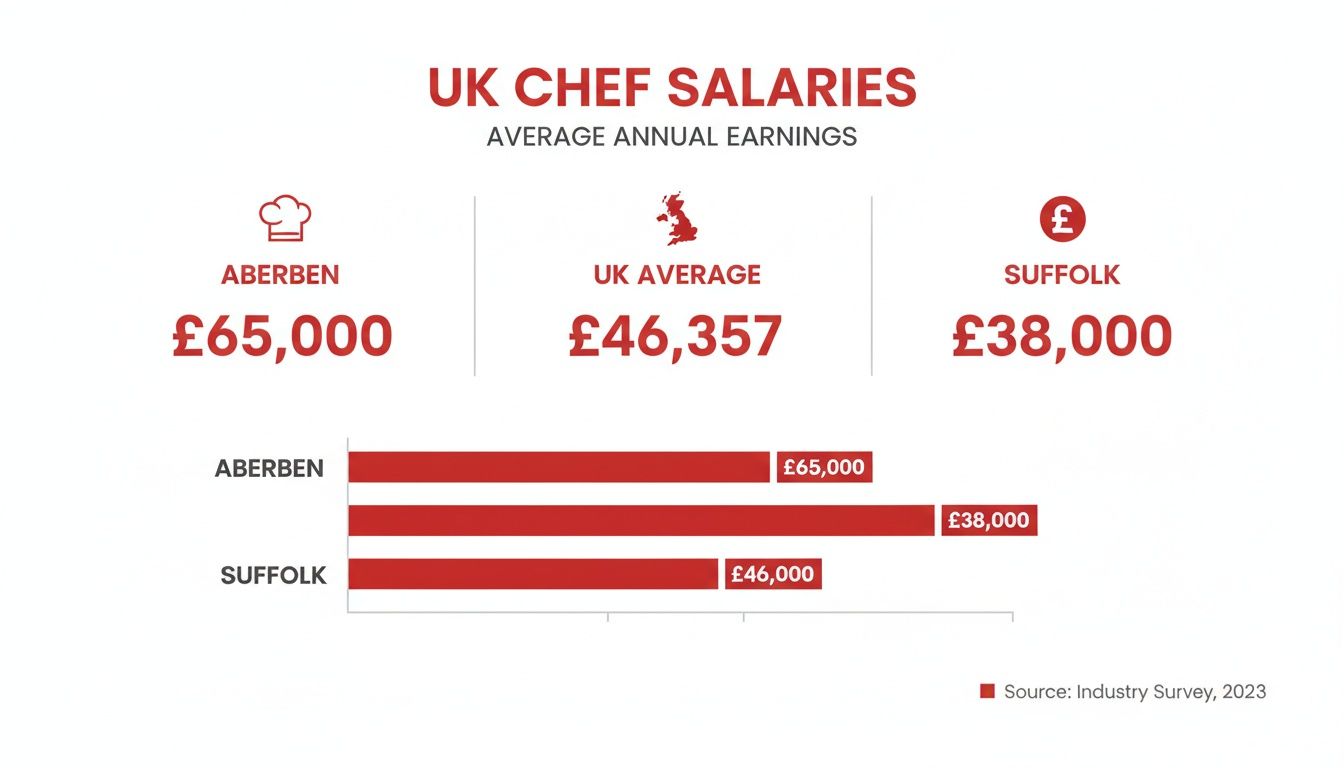
As you can see, a higher salary in a hotspot like Aberdeen means your on-costs will be proportionally much higher than in an area with more average pay.
A Practical Cost Breakdown
Let’s run the numbers. Say you hire a Sous Chef on what looks like a reasonable salary of £30,000 a year. What does that actually cost your business?
The true cost isn’t the salary you agree upon; it's the total amount that leaves your bank account annually. For a £30,000 chef, this figure is often closer to £38,000 when all is said and done.
This sample calculation shows the full financial weight of that one hire.
Sample Calculation: The True Annual Cost of a Salaried Chef
| Cost Item | Example Annual Cost | Notes |
|---|---|---|
| Gross Annual Salary | £30,000 | The baseline figure agreed with the employee. |
| Employer's NI (@13.8%) | ~£2,925 | Calculated on earnings above the NI threshold. |
| Pension Contribution (@3%) | ~£720 | Based on qualifying earnings for auto-enrolment. |
| Paid Holiday (5.6 weeks) | ~£3,230 | The cost of paying the chef while they are on leave. |
| Estimated True Cost | ~£36,875 | Over 22% higher than the initial salary. |
And this table doesn’t even factor in sick pay, recruitment agency fees, or training costs, which push the total even higher. For a more detailed look, our guide on the real cost of employing a chef breaks it down even further.
This calculation is an eye-opener. It shows the massive financial burden of a permanent hire—a fixed cost you have to carry whether your restaurant is fully booked or having a quiet Tuesday.
In contrast, hiring a relief chef is simple and transparent. Their hourly rate is all-inclusive, covering all those on-costs and saving you the administrative headache. You pay one clear, predictable figure for the cover you need, with no hidden surprises. This changes your financial model from a fixed liability to a flexible, on-demand operational expense.
Salaried Stability Versus Hourly Flexibility
Choosing between a permanent, salaried chef and flexible, hourly relief staff is one of the biggest financial decisions a venue owner makes. It’s a straight choice between the stability of a core team and the agility of on-demand cover.
A permanent chef brings consistency. They become part of your kitchen's DNA, absorbing the culture and building a stable, reliable team. This is perfect for venues building a unique culinary identity and wanting absolute predictability in their brigade.
But that stability comes at a fixed price. That salary, plus National Insurance, pension contributions, and holiday pay, hits your payroll every single month—whether your tables are full on a bank holiday or empty on a rainy Tuesday. For businesses with big seasonal swings, this can be a serious drain on cash flow.
Embracing Agility with Hourly Relief Chefs
The other side of the coin is the hourly model you get with relief chefs. This approach delivers pure agility. Think of it like a ‘Pay-As-You-Go’ phone plan versus a long-term contract; you only pay for exactly what you need, precisely when you need it.
This flexibility means you can scale your kitchen team to match demand perfectly. You can bring in extra hands for the Christmas rush, manage a surge in summer bookings, or cover an unexpected absence without the long-term financial burden.
The real power of using hourly relief chefs is turning a fixed payroll liability into a variable operational cost. This gives you precise control over your budget, protecting your profits during quiet periods while making sure you never miss out on revenue when you're busy.
For many independent pubs and restaurants, this is a game-changer. It kills the risk of paying for underused staff during slow months. A coastal hotel that’s quiet from November to March can avoid carrying the full cost of a large brigade, instead bringing in top-tier talent only when guest numbers demand it.
Comparing The Two Models Head-On
To see what's right for you, it helps to put the two models side-by-side. Each serves a different strategic goal.
Salaried (Permanent) Chef
- Pros: Builds team stability, consistency in quality, and helps create a strong kitchen culture.
- Cons: High fixed costs regardless of trade, significant on-costs (NI, pension, holiday pay), and zero flexibility for seasonal demand.
Hourly (Relief) Chef
- Pros: Total cost control by only paying for hours worked, perfect for managing seasonal peaks, and gives you instant cover for sickness or holidays.
- Cons: Can be less embedded in the core team culture if only used for very short, sporadic gaps.
Often, the smartest approach is a hybrid one. You maintain a core team of salaried chefs for stability and use a trusted relief chef partner to handle the unpredictable nature of hospitality. This blended model gives you a solid foundation with the power to adapt instantly.
By understanding the real financial impact of each choice, you can build a staffing plan that actually supports your business goals. For a deeper dive into the numbers, you might find our guide on how to calculate chef salaries useful. It will help you weigh the costs even more effectively.
Hiring The Right Chef Without The Headache
Finding a good chef is hard. Finding one when you’re in a tight spot feels almost impossible. The time you spend wading through CVs, chasing up references, and second-guessing someone’s skills is time you don't have. A gap in the rota is a direct threat to your service, your team’s morale, and your reputation.
What if you could just skip the most painful parts of that process? Imagine turning that chaos into a simple, predictable task. This is why smart operators use a specialist staffing service—not as a last resort, but as a core part of their strategy.

It’s about getting access to a pool of vetted, reliable professionals who can walk into your kitchen and get the job done from minute one. No drama. No guesswork.
What To Look For Beyond The CV
A chef’s real value isn't on their CV; it’s in how they handle pressure on a busy Friday night. When you’re desperate for cover, you can’t afford to gamble on someone who just looks good on paper.
A trusted staffing partner is your quality control. They do the essential checks you simply don’t have time for, making sure any chef they send is solid.
- Verified Experience: They check that the chef can actually do what their CV claims. You get the skills you’re paying for, not just a list of previous jobs.
- Right-to-Work Checks: All the legal paperwork is sorted. This removes a huge compliance risk from your shoulders.
- Professional Standards: Chefs are screened for reliability and their ability to slot into a new kitchen without causing friction. Can they adapt and perform? That's the real test.
This pre-vetting process doesn’t just save you time—it dramatically reduces the risk of a bad hire who could poison your service and demoralise your team.
Using a service that handles the due diligence means you're not just filling a shift. You're buying peace of mind and protecting your standards. It turns a crisis into a controlled, manageable solution.
Writing A Clear Brief For Your Staffing Partner
To get the right chef, you need to give your staffing partner a clear brief. Think of it like a prep list for a busy service—the more detail you give upfront, the smoother everything will run. Vague requests get you vague results.
Your brief must include:
- The Role: Are you looking for a Head Chef to lead the pass, a Sous Chef to run the engine room, or a Chef de Partie to own a section?
- The Cuisine: Be specific. Is it a classic gastropub menu, modern British dining, or high-volume event catering?
- The Dates and Hours: Give precise start/end dates and the hours you need covered. Don't leave it open to interpretation.
- The Environment: Describe your kitchen. Is it a small, calm team or a big, loud, high-pressure brigade? The chef’s temperament needs to match.
A detailed brief is the key to getting a chef who fits your kitchen’s culture and technical needs perfectly. If you want to understand the different types of providers out there, reading up on the top employment agencies for chefs is a smart move. Ultimately, clarity ensures your next hire is a success, not a liability.
Chef Salary FAQs: The Questions Every Owner Asks
Figuring out chef pay is a minefield. With so many variables, it’s easy to get it wrong. Here are the straight answers to the most common questions we hear from pub, restaurant, and hotel owners about hiring kitchen talent.
What Is a Fair Hourly Rate for a Relief Chef in 2026?
A fair hourly rate for a good relief chef in 2026 sits between £17 and £25+, but it all depends on the role and where you are.
For a standard Chef de Partie in a pub, you should budget around £18-£21 per hour. If you need a senior Sous or a Head Chef to run the entire kitchen, the rate will naturally head north to £22-£25 or more.
The key question to ask is whether that rate is all-inclusive. You need to know if you're going to be hit with surprise agency fees or employer on-costs later on.
Is It Cheaper to Hire a Permanent Chef or Use Relief Chefs?
If you're busy all year round, a permanent chef almost always works out cheaper in the long run. Their value is in consistency.
But for everything else? Covering seasonal rushes, staff holidays, sickness, or filling a gap after a walkout, relief chefs are far more cost-effective. You're not on the hook for the heavy on-costs of a permanent hire (pension, NI, holiday pay) and you only pay for the hours you actually need. It stops you bleeding cash during your quiet months.
How Do I Know a Relief Chef Is High Quality?
The only way to guarantee quality is to work with a specialist who properly vets their chefs. Trying to find someone on your own is a lottery. A professional service handles the entire screening process for you.
This includes:
- Verifying their experience and proving their skills.
- Checking their legal right-to-work status in the UK.
- Making sure they have the right attitude and a track record of reliability.
It takes all the risk and guesswork out of the equation. You get a professional who can walk in and get the job done from the moment they arrive.
The biggest mistake venue owners make is ignoring regional market rates and the true cost of employment. Offering a salary based on a national average without considering local demand or the additional 25-30% in on-costs (NI, pension, etc.) can leave you uncompetitive and severely under-budgeted.
Stop wasting time and money on risky hires. Relief Chefs UK provides fully vetted, high-quality chefs to cover any gap, any time. Get dependable cover fast by visiting us at https://www.reliefchefs.co.uk and let us keep your kitchen running smoothly.