
Net and Gross for Hospitality: What UK Managers Need to Know in 2026
31 March 2026

Trying to get a grip on your pub or restaurant's finances can feel like a losing battle. The terms ‘net’ and ‘gross’ are at the absolute heart of it, from payroll right through to your final profit. Misunderstanding them is a costly mistake that can undermine your entire operation.
Let's cut through the jargon. Gross is the big, top-line number before anything gets taken out. Net is what you’re actually left with after all the deductions have been made. Getting this wrong is a mistake your hospitality business cannot afford to make.
Your Quick Guide to Net and Gross in Hospitality
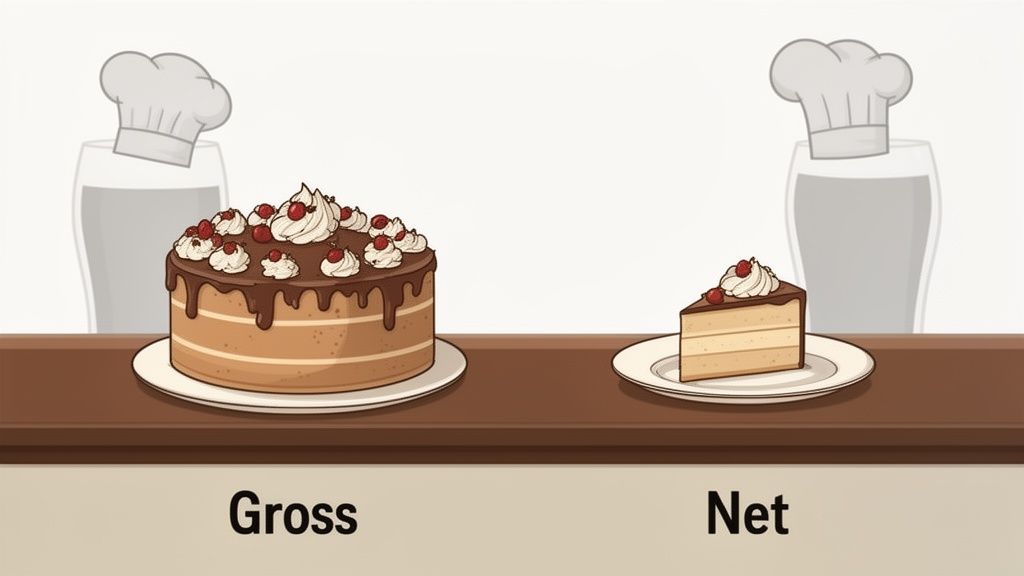
For any manager running a busy site, whether it's a pub in Bristol or a hotel in Devon, understanding net vs. gross isn't just an accounting task—it’s a survival skill. It's the difference between a healthy business and one that's constantly fighting fires, especially when dealing with chef shortages and last-minute staff sickness.
The best way to think about it is this: gross is the whole cake, and net is the slice you actually get to eat. We're going to apply that simple idea to the three areas where it matters most: staff payroll, supplier invoices, and your Profit & Loss (P&L) statement.
Why This Distinction Is Critical
Knowing the gap between your gross and net figures is fundamental to making smart decisions. If you run a bustling gastropub in Berkshire or a boutique hotel in Dorset, confusing these numbers leads to serious operational pain.
Here's where it hits you the hardest:
- Cash Flow Management: Budgeting based on gross revenue—without factoring in VAT, wages, and supplier costs—is the fastest way to a cash flow crisis. You're planning with money that isn't really yours.
- Staffing Costs: The gross cost of a chef is always much higher than their take-home pay. You must account for employer’s National Insurance, pension contributions, and any agency fees. Forget this, and your wage bill will shock you.
- Profitability Analysis: The UK restaurant industry’s average net profit margin hovers around a slim 10.66%. Mistaking your much larger gross profit for this number gives you a dangerously false sense of security.
- Supplier Payments: When a supplier invoice lands, the gross total (including VAT) is the figure that will leave your bank account. The lower, net figure is irrelevant for cash flow planning.
For example, when you’re hit with a sudden staff shortage, you need to budget for the gross cost of bringing in cover. A transparent agency like Relief Chefs UK gives you a clear, all-in price. The figure on the invoice is what you expect, so you can manage your budget without any nasty surprises.
This becomes especially important when you need to book temporary chefs with little warning. The stability of your kitchen depends on having accurate numbers you can rely on.
Getting net and gross wrong is a classic pitfall that can derail even a great business. Master this, and you gain the clarity to control your costs, forecast accurately, and build a more resilient operation. If kitchen stability is a constant headache, get in touch with Relief Chefs UK to see how our vetted professionals can support your team.
Unpacking Gross vs. Net Pay on Your Payroll
For any hospitality manager, payroll is the number one spot where the net and gross mix-up causes real headaches. When you agree a salary or hourly rate with a new chef, you're talking about their gross pay. But the actual money that hits their bank account—their net pay—is always less.
Getting your head around this is critical. It means you can answer pay questions from your team with confidence, and it helps you budget your real staffing costs, which are always higher than the salary you advertise.
The Journey From Gross to Net: A Real-World Example
Let’s walk through a common scenario. Imagine you’ve just hired a Sous Chef for your boutique hotel in Windsor at a gross salary of £35,000 a year. That top-line number is the starting point, not the take-home pay.
Here’s a breakdown of the standard deductions that shrink their gross pay down to their net pay under the UK’s PAYE (Pay As You Earn) system:
- Gross Pay: The total agreed wage before anything is taken out. In this case, £35,000 per year works out to roughly £2,916.67 per month.
- Income Tax: HMRC takes a slice of all earnings above the employee's personal allowance. How much depends on their specific tax code and income bracket.
- National Insurance Contributions (NICs): This is a mandatory deduction that both the employee and you, the employer, have to pay. It funds state benefits like the state pension.
- Pension Contributions: Auto-enrolment rules mean you and your eligible staff must both contribute to a workplace pension. This comes directly off their gross pay.
- Student Loan Repayments: If your chef has a student loan, repayments are taken automatically once their income crosses the repayment threshold.
After all that, the chef's monthly net pay—the cash they actually receive—will be quite a bit lower than their gross pay of £2,916.67.
Why This Piles on the Admin
Let's be honest: managing PAYE is a complex and thankless job. You are legally on the hook for calculating the right deductions for every employee, reporting it all to HMRC in real-time, and dealing with any pay queries that come up. Get it wrong, and you’re facing financial penalties and a demotivated team.
This admin burden becomes a nightmare when you're dealing with the usual kitchen chaos:
- Covering short-notice sickness for a key chef.
- Handling seasonal rushes in places like Cornwall or the Lake District.
- Finding temporary cover while you recruit for a permanent role.
This is where the simplicity of using a trusted chef agency becomes clear. When you work with Relief Chefs UK, you don't take on the PAYE burden. We handle all payroll, tax, and NI for the chef. You simply pay one clear, pre-agreed gross invoice.
The Relief Chefs UK Advantage: No Payroll Headaches
Picture this: your Head Chef in Reading calls in sick on a Friday morning before a fully booked weekend. You need cover, and you need it fast. Instead of scrambling to hire and set up payroll for a temp, you just make one call.
Since 2013, Relief Chefs UK has offered a straightforward fix. You tell us the problem, we send a fully vetted, high-quality relief chef, and you pay a single, simple invoice. No wrestling with tax codes, no pension maths, no HMRC reporting—just a stable kitchen. It frees you up to run the pass, not your payroll software.
To get a clearer picture of how salaries and deductions add up for your permanent team, you need a decent calculator. Take a look at our guide and explore our monthly salary calculator to help get your head around the numbers.
Ultimately, while managing PAYE is a must for your permanent staff, you don’t have to carry that weight for your temporary cover. Partnering with a reliable agency gives you the kitchen support you need, without the payroll headache.
Understanding Gross Profit vs Net Profit
Just like with payroll, your Profit & Loss (P&L) statement has its own story of gross vs net. But this time, it’s about the health of your entire business. Getting this right is the difference between thinking you’re making money and actually having cash in the bank.
For any hospitality leader in the UK, whether you're running a gastropub in Devon or a hotel in Windsor, these two figures are your most vital signs. They tell you exactly where your money comes from and, more importantly, where it all goes.
What Is Gross Profit? The Health of Your Core Operation
Gross profit is the first, simplest health check for your business. It tells you how much money you’ve made purely from selling food and drink, before you even think about paying for rent, staff, or the electric bill.
The formula is dead simple:
Gross Profit = Total Revenue – Cost of Goods Sold (CoGS)
Total Revenue is every pound that comes through the till from sales. Your Cost of Goods Sold (CoGS) is the direct cost of what you sold—the ingredients for your Sunday roasts, the gin for your G&Ts, the coffee beans for your morning rush.
This number is powerful. A healthy gross profit means your menu is priced correctly and you're keeping a tight rein on supplier costs. If it's low, it’s an immediate red flag: either your food costs are too high, or your menu prices are too low.
The Journey to Net Profit: Your True Bottom Line
If gross profit shows how healthy your menu is, net profit tells you how healthy your entire business is. This is the real bottom line. It’s the money left over after every single bill has been paid. It's the ultimate measure of whether you're winning or losing.
To get to your net profit, you have to subtract all your other operating expenses from your gross profit. This is where the reality of running a venue really hits. These are the costs that can sink a business, even one with a great menu.
Here’s a taste of what gets taken out:
- Staff Wages & Salaries: Usually your single biggest expense, covering your permanent brigade.
- Agency Staffing Fees: The cost of bringing in temporary chefs to cover sickness, holidays, or that unexpected summer rush.
- Rent & Business Rates: The non-negotiable cost of your four walls.
- Utilities: Gas, electricity, and water—all essential and all expensive.
- Marketing & Advertising: What you spend to get bums on seats.
- Repairs, Maintenance & Insurance: The ongoing cost of keeping the lights on and the doors open safely.
This is the exact same logic as a payslip. Your gross pay is the big starting number, but your net pay—what you actually take home—is what’s left after all the deductions.
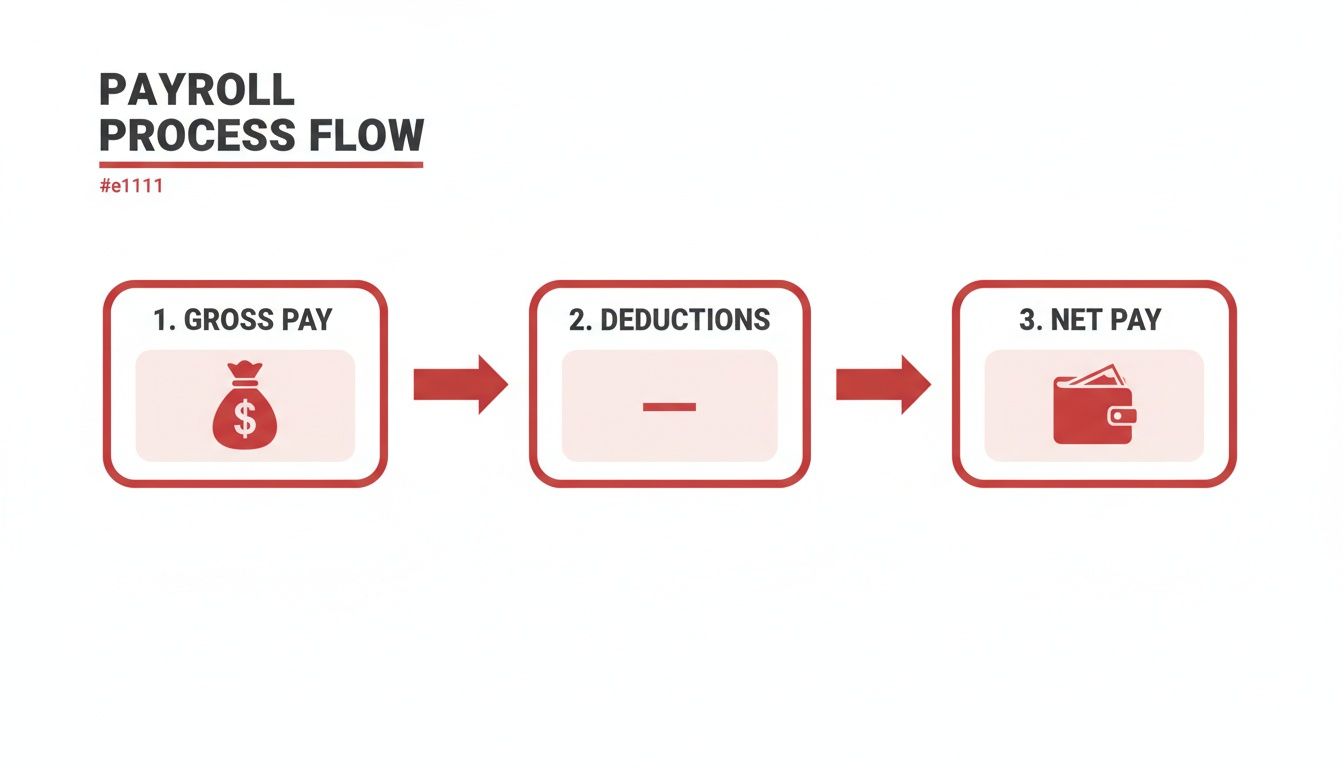
Just as deductions shrink gross pay, your operating costs eat into your gross profit. The final number is what truly matters.
Why Does This Matter for Kitchen Stability?
Grasping this difference is a matter of survival. The UK restaurant industry runs on notoriously thin margins, with an average net profit of just 10.66%. It is terrifyingly easy to have a strong gross profit but end up with nothing left because your operating costs spiralled out of control.
This is where staffing problems deliver a knockout blow. A sudden chef shortage forces you to book emergency cover. If that cost isn't managed and budgeted for, it can wipe out your net profit for the week, or even the month. You need to understand the hidden costs of poor chef cover because they hit your bottom line directly.
It’s why over 400 venues have trusted Relief Chefs UK since 2013. We provide transparent, reliable staffing support. Our clear pricing means you know exactly what cover costs, allowing you to factor it into your P&L accurately and protect that all-important net profit. When your kitchen is stable, your profitability is stable. It’s that simple.
Managing Invoices and VAT: Gross vs Net Costs
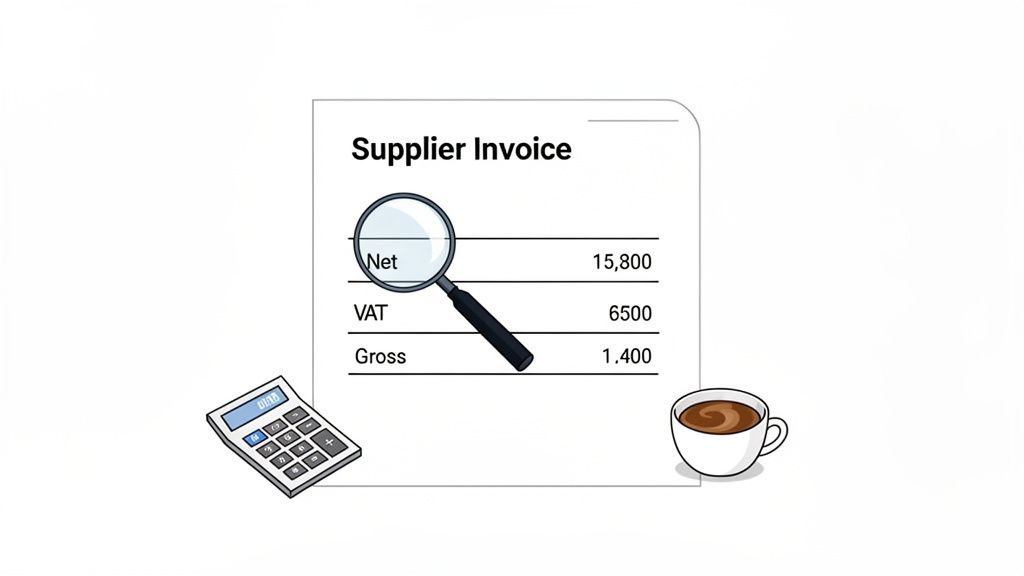
It’s not just payroll. Supplier invoices are the other place where the net vs. gross confusion can drain your cash flow without you even realising it. That delivery from your butcher or the bill from your linen company requires a sharp eye, especially when it comes to Value Added Tax (VAT).
Getting an invoice wrong is an easy but expensive mistake. The net cost is the base price for the goods or service. The gross total is what you actually have to pay. The gap between them? That’s almost always VAT.
Reading an Invoice the Right Way
Let’s be honest, you’ve got a stack of invoices on your desk. Take a typical one from your fruit and veg supplier for your restaurant in Wales. When you give it a quick scan, you’ll see three numbers that tell the whole story.
- Net Amount: This is the core price of the produce you ordered. Let's say it’s £500. This is your supplier's cost to you before tax.
- VAT (at 20%): On top of that net figure, the supplier has to add VAT. For a £500 net order, the VAT comes to £100.
- Gross Amount: This is the final bill, the total you actually owe. In this case, £600.
When it comes to cash flow, the gross amount is the only number that matters. That £600 is what will leave your bank account. If you budget based on the £500 net figure, you’re instantly £100 short, putting immediate and unnecessary pressure on your finances.
How VAT Works for Your Hospitality Business
For most VAT-registered pubs and restaurants, the process is a constant cycle. You charge VAT on your sales (the food and drink you sell) and you pay VAT on your purchases (your ingredients and services). You then pay the difference to HMRC. Simple enough. This means you can often reclaim the VAT you’ve paid on business expenses.
But here’s the catch: reclaiming VAT isn't instant. You have to pay the full, gross amount to your suppliers upfront and then wait until the end of your VAT quarter to get that portion back. This time lag can put a serious strain on your working capital, especially for small independents in seasonal hotspots like Dorset or Berkshire.
This principle is absolutely vital when managing your staffing costs, particularly when you’re looking at invoices from a temp agency. The cost of bringing in a chef to cover a sick call involves more than just their hourly rate.
Invoices for Staffing Agencies and Hidden Fees
When you bring in a chef from a recruitment agency, their invoice will also show a net cost, VAT, and a gross total. The problem is, many agencies bury extra charges that blow up the final bill, causing you unexpected financial pain. These could be anything from admin fees and payroll processing charges to travel expenses you were never quoted for.
This is why transparent pricing is non-negotiable. At Relief Chefs UK, we’ve always believed in absolute clarity. Since we were established in 2013, our promise has been simple: the price you are quoted is the price you pay. Our invoices are straightforward, with no hidden fees to ambush your budget.
Whether you need urgent hospitality staffing support to get through a crisis or are planning your permanent chef recruitment, you will always get a clear, gross cost upfront. This lets you budget accurately and protect your bottom line, giving you the peace of mind to focus on running your kitchen, not trying to figure out a confusing invoice.
Why This Matters for UK Hospitality Staffing
Getting your head around net and gross isn't just for the accountants. It's fundamental to surviving the brutal staffing crisis every UK hospitality manager is facing right now. The same logic of what you start with versus what you actually keep applies directly to the constant battle of building a stable kitchen team.
When you look at chef employment statistics through a ‘net vs. gross’ lens, a worrying story emerges. On the surface, the numbers can look good, showing high demand and plenty of jobs out there. But the reality on the ground—the one you live every day—tells a very different tale.
The Gross vs Net Reality of the Chef Shortage
The 'gross' number of chefs is like your gross revenue—it's the big, impressive figure before any deductions. It represents every single advertised chef role in busy hospitality hubs like Reading, Windsor, or Bristol. This number screams high demand, but it hides a critical weakness.
The 'net' number of chefs, just like your net profit, is what’s actually left after you take away the costs. For staffing, the biggest cost is turnover. The net figure is what remains after you account for the thousands of talented chefs who leave their jobs—or the entire industry—because of burnout and instability.
A recent report on the UK chef shortage laid this out perfectly. While the gross number of chefs and cooks in hospitality seemed to grow, the net picture was far less positive. High turnover rates, especially after chefs hit the 25-34 age bracket, are gutting the industry of its experienced core.
This ‘net’ loss is the pain you feel every day. It’s why you're constantly recruiting, why agency reliability is a constant headache, and why a stable kitchen feels completely out of reach. The ‘gross’ demand is there, but the ‘net’ supply of experienced, dependable chefs is shrinking fast.
Closing the 'Net' Staffing Gap
This is precisely where a dependable staffing partner stops being a luxury and becomes essential. You aren't just filling a vacancy on a rota; you are solving a ‘net’ deficit in your kitchen brigade. Since 2013, Relief Chefs UK has specialised in tackling this exact problem for hospitality businesses across the country.
We provide the stability the open market often can't. Our chefs aren't just temporary fixes to plug a gap. They are vetted, experienced professionals who bring calm and competence to your kitchen, whether it's to cover last-minute sickness or support you through a chaotic seasonal peak in Dorset.
By understanding the real difference between the gross demand for chefs and the net availability of reliable talent, it becomes much easier to justify investing in a flexible, quality staffing solution. You start to see the true cost of employing a chef versus the much higher cost of an unstable kitchen.
Don't let the chef shortage dictate your business's success. If you’re struggling with kitchen stability, high turnover, or unreliable agency staff, it's time to fix your 'net' staffing problem head-on. Contact Relief Chefs UK today to discuss how our relief chefs, temporary chefs, and permanent recruitment services can bring the stability your kitchen needs.
Common Financial Mistakes That Wreck Your Bottom Line
Even a small mix-up between net and gross can cause big problems. In hospitality, where every penny is accounted for, these mistakes don't just stay on a spreadsheet. They hit your cash flow, damage staff morale, and can even land you in legal trouble.
Here are the most common financial traps we see managers fall into, and more importantly, how to sidestep them for good.
Getting Tronc and Tips Wrong
This is a huge one. If you run a tronc system, where tips are pooled and paid out through payroll, you have to remember they are subject to National Insurance Contributions (NICs). That’s NICs for the employee and for you as the employer.
Forgetting to budget for your employer’s NICs on tronc payments is a classic mistake. It's a hidden cost that sneaks up on you at the end of the month, taking a serious bite out of your net profit when you least expect it.
Forgetting the True Gross Cost of a Chef
When you're hiring a new chef, their salary is just the starting point. Too many managers budget for the gross salary figure and stop there, completely forgetting the on-costs that make up the true gross cost of employment. These always include:
- Employer's National Insurance Contributions: This is a significant, non-negotiable percentage on top of their salary.
- Workplace Pension Contributions: Your mandatory contributions add another layer of expense.
- Holiday Pay & Sick Pay: You’re paying staff even when they aren't on shift, and this has to be factored in.
That £30,000 salary you budgeted for quickly becomes a much bigger real-world expense, completely torpedoing your wage forecasts.
Imagine a café owner in Slough who budgets for a new hire based only on their gross pay. At the end of the first month, the unexpected bill for Employer's NICs and pension contributions forces them to dip into cash reserves meant for a new coffee machine.
Underestimating VAT on Invoices
Cash flow is everything, and VAT can be a silent killer. When a supplier invoice lands on your desk, it’s easy to fixate on the lower, net figure. But it’s the gross total, including VAT, that will actually leave your bank account.
This is especially dangerous with big-ticket items. You’ve planned to spend £10,000 (net) on new kitchen equipment, but you need to have £12,000 ready to pay the gross invoice. Forgetting that extra 20% puts an immediate and serious strain on your working capital.
Misreading Agency Fee Structures
You've got a last-minute sick call on a Friday night and you need cover, fast. The last thing you need is a nasty surprise on the invoice. Some chef agencies will quote a tempting "net" hourly rate, only to tack on admin charges, payroll fees, or inflated travel costs later.
Your final bill—the gross total—ends up way higher than you were led to believe, making accurate budgeting impossible. This is why at Relief Chefs UK, we promise straightforward, all-inclusive pricing. The gross price we quote is the gross price you pay. No hidden extras. No surprises. It means you can manage your costs with absolute confidence, even in a crisis.
Don't let these common mistakes undermine your business. If you need a reliable partner who values transparency as much as you do, contact Relief Chefs UK today. We provide vetted, high-quality relief chefs and hospitality staffing support with the honesty your business deserves.
Straight Answers to Your Net & Gross Headaches
After years in this business, we see the same financial questions pop up again and again. Let's cut through the noise and give you the straight answers for managing the numbers that actually matter.
How Do I Correctly Account for Tips in Payroll?
Let’s be honest: handling tips and service charges is a minefield. If you're running a tronc system where tips are pooled and paid out via payroll, you have to treat that money as earnings. It's not just a bonus you pass on.
This means it's subject to National Insurance Contributions (NICs) for the employee, and crucially, for you as the employer. The single biggest mistake we see is managers forgetting to budget for their own NICs on these payments. That's a nasty surprise that eats directly into your net profit, so always build it into your wage cost forecasts.
Is It Better to Budget Using Net or Gross Figures?
Always, always budget using gross figures. No exceptions. Whether you’re forecasting your annual turnover, mapping out staff costs, or looking at a supplier invoice, the gross number is the real-world figure you have to account for.
Budgeting with net figures—like revenue after VAT or an employee’s salary before on-costs—gives you a dangerously skewed view of your cash flow. You end up building your plans on money you don't actually have, which is a fast track to a cash shortfall.
Agency vs. Self-Employed Chef Invoices: What’s the Difference?
When you get an invoice from a self-employed chef, it will just show their net fee. It’s on them to sort out their own tax and NI. An agency invoice is a different beast entirely. It shows a net rate for the chef’s time, but then adds VAT, giving you a gross total to pay.
The real difference here is about compliance and admin. Going direct with a self-employed chef opens you up to misclassification risks with HMRC—a headache you don't need. When you work with a trusted agency like Relief Chefs UK, we handle all the payroll, tax, and NI. You just pay one simple, gross invoice. It cleans up your accounts and kills the compliance risk stone dead.
How Does Relief Chefs UK Pricing Simplify My Cost Management?
Our pricing is built for one thing: total clarity. This makes your cost management simple and, most importantly, predictable. When you’re facing a crisis—say, your sous chef in Berkshire calls in sick on a Friday morning—you need to know exactly what the cover is going to cost you, right now.
We give you a single, all-inclusive gross price upfront. There are no hidden admin fees, no surprise travel charges, and no payroll costs to add on later. That transparency means you can budget with absolute confidence, protecting your net profit and keeping control of your finances, even when you need cover at the last minute.
Struggling to keep your kitchen stable while managing your costs? Relief Chefs UK offers a clear, reliable, and totally transparent solution. From relief chefs to permanent recruitment, we provide the expert support you need with no hidden fees. Contact us today to secure your kitchen's future.
Call the team.
Office 01392 715474 · info@reliefchefs.co.uk