

It’s a scenario every hospitality manager knows all too well: a key chef phones in sick on a bank holiday weekend, or a sudden wave of bookings leaves your kitchen stretched to breaking point. This is the moment a temporary agency chef stops being a “nice to have” and becomes a critical part of your operational strategy.
They’re not just a pair of hands; they’re immediate, skilled relief.
When You Need a Temporary Agency Chef

Knowing the right time to call for backup is half the battle. For many independent pubs, restaurants, and hotels, the decision to hire a temp chef is made under immense pressure. But it’s not a sign of failure. It's a proactive move that protects your service quality, your permanent team’s wellbeing, and ultimately, your revenue.
While a last-minute sick call is the most common trigger, the need for relief staff goes far beyond emergencies. There are plenty of other situations where a temporary chef makes perfect operational and financial sense.
Common Scenarios for Hiring a Temp Chef
Thinking beyond the immediate crisis allows you to plan properly and stay in control. It's smart to bring in temporary support for these common situations:
- Planned Staff Absences: Covering annual leave is essential, especially when it’s your Head Chef or Sous Chef. A reliable temp ensures the kitchen runs smoothly without a single dip in standards. You can find out more about how agency staff can cover long-term leave in our detailed guide.
- Seasonal Peaks: Your kitchen might run like clockwork for ten months of the year, but the Christmas party season or a summer tourist rush can overwhelm your core team. A temporary chef provides the extra horsepower needed to manage the increased volume without burning anyone out.
- Unexpected Resignations: When a chef leaves with little to no notice, the pressure to hire a replacement is huge. A temporary placement bridges that gap, giving you the breathing room to find the right permanent fit instead of making a rushed, costly mistake.
- Special Events & Functions: A big wedding, a corporate event, or a multi-day festival all demand more culinary muscle than your standard daily service. Bringing in a specialist event chef ensures everything runs flawlessly.
In every one of these cases, the objective is the same: to maintain absolute consistency and quality in your food. A good temporary chef isn’t just a stand-in; they are a professional brought in to uphold your standards when it matters most.
The demand for this kind of flexible support is a constant across the UK’s hospitality sector. Data from March 2026, for example, showed 71 available temporary agency chef jobs, reflecting the ongoing need for skilled, adaptable kitchen cover. This is a clear indicator that temporary staffing is a vital solution for pubs, hotels, and restaurants facing both planned and sudden staff shortages. By understanding exactly when to use a temporary chef, you turn a potential staffing crisis into a well-managed, routine task.
When your kitchen is under pressure, the knee-jerk reaction is to call the first agency that promises you a chef. That’s a mistake. The quality of your agency partner directly shapes the skill of the chef who walks through your door, and believe me, not all recruiters are created equal.
This choice has become even more critical amid the current staffing crisis. ONS figures showed the UK hospitality sector bracing for a loss of nearly 8,800 roles by December 2025. That pressure has pushed agencies to the front line, making them an essential lifeline for pubs, hotels, and restaurants just trying to keep their doors open.
Choosing the right partner means finding someone who genuinely gets the difference between a frantic pub lunch service and a meticulous fine-dining tasting menu.
Specialist Chef Agency vs General Recruiter
The single biggest mistake owners and managers make is treating a chef recruiter like any other staffing agency. A generalist might find you a decent warehouse operative, but they rarely have a clue what competencies are non-negotiable in a professional kitchen. They play a numbers game, focusing on volume, not expertise.
A specialist chef agency, on the other hand, is built from the ground up by people who understand the trade. Many, including ourselves, are run by ex-chefs. We’ve been in your shoes. We’ve worked the line. We know exactly what to look for in a great relief chef because we’ve had to rely on them ourselves.
This insider knowledge transforms vetting from a box-ticking exercise into a real assessment of skill, speed, and temperament. To see how different the players are, you can check out our guide on the best agencies for temporary work.
Here’s a quick breakdown of why this distinction matters so much.
Specialist Chef Agency vs General Recruiter
| Feature | Specialist Chef Agency | General Recruitment Agency |
|---|---|---|
| Vetting Team | Usually ex-chefs or hospitality pros | Generalist recruiters with no kitchen experience |
| Skill Assessment | Practical tests, scenario questions | Relies on CVs and basic keyword matching |
| Candidate Pool | Curated network of proven, reliable chefs | Broad database of mixed-quality candidates |
| Venue Matching | Considers cuisine, team culture, service speed | Focuses on location and basic availability |
| Industry Knowledge | Deep understanding of kitchen hierarchy & pressure | Superficial grasp of roles and responsibilities |
| Support | 24/7 support from people who get it | Standard office-hours support, limited crisis help |
The bottom line is simple: one is a partner, the other is a CV-forwarding service.
A general recruiter asks, "Does this person have a chef certificate?" A specialist agency asks, "Can this chef handle 150 covers on a Sunday, stay calm under pressure, and plate with precision?" The difference is everything.
When you’re vetting an agency, your goal is to find out if they truly speak your language. Do they understand what a flawless mise en place means for a smooth service? Or are they just looking to fill a slot?
Key Questions to Ask a Potential Agency
Before you sign anything, go in armed with a few sharp questions. Their answers will tell you everything you need to know about whether they’re a genuine partner or just another body shop.
Who Vets Your Chefs? Ask them straight: is your recruitment team made up of experienced chefs? An agency run by hospitality professionals will always have a tougher, more realistic vetting process. It’s a non-negotiable.
How Do You Verify Certifications? Confirm they actively check for Right to Work in the UK and a minimum Level 2 Food Hygiene certificate. Don’t settle for vague promises. Ask about their exact process for validation.
How Do You Match Chefs to Venues? A great agency won’t just send you the next person on their list. They’ll dig deeper, asking about your menu style, brigade size, and kitchen culture to find the right personality and skill set.
What Does Your Support System Look Like? What happens if a chef doesn’t show or isn’t the right fit? A reliable agency will have a 24/7 support line and a clear, simple replacement guarantee. You need to know they have your back so you're never left in the lurch.
Picking your agency is as vital as choosing a key supplier. A strong partnership gives you more than just a temporary chef; it delivers peace of mind and a dependable fix for one of the industry's most relentless challenges.
Breaking Down the Costs and Contract Terms
When you first see the hourly rate for a temporary chef, it’s easy to get sticker shock. But you’re not just paying for an extra pair of hands. You’re buying a hassle-free staffing solution that lets you sidestep the mountain of hidden costs tied to a permanent hire.
With an agency chef, what you see is what you pay. There are no surprise overheads. You’re not paying National Insurance contributions, managing pension schemes, or calculating holiday and sick pay. The agency handles all of that, taking a huge administrative weight off your shoulders.
Think of it like this: hiring a temporary chef is a pay-as-you-go service. You get the exact skill you need, for the precise hours you need it, without the long-term financial headache of a permanent employee.
This model is a direct result of the ongoing chef shortage in the UK. With skilled chefs in high demand, premium agency rates are now the norm. A Chef de Partie can command £15-£20 per hour, a Sous Chef £20-£24, and a Head Chef £25 or more. As industry analysts have pointed out, these rates often beat what permanent roles offer, making temp work incredibly attractive for top talent. You can see a full breakdown of why agency chefs command these rates and how it’s shaping the market.
What to Look For in a Transparent Contract
A clear, fair contract is the bedrock of any good agency partnership. It protects your business and sets expectations from day one, leaving no room for expensive mistakes. A reputable agency will always give you transparent terms with no hidden fees.
Before you sign anything, scan the document for these key clauses:
- Replacement Guarantees: What happens if the chef is a no-show or just can't cut it in your kitchen? A solid contract will guarantee a replacement, ensuring the agency finds another suitable chef fast—often within a few hours—at no extra cost to you.
- Insurance Coverage: The agreement must state that all chefs are covered by the agency’s public liability and professional indemnity insurance. This is non-negotiable. It’s a critical safeguard that protects your business from liability.
- Cancellation Policy: Things change fast in hospitality. Check the terms for cancelling a booking, both from your end and the agency’s. Look for a reasonable notice period and clear details on any fees.
Understanding the True Value
When you add up the time and money you save on recruitment, onboarding, and admin, the cost of a temporary chef often looks remarkably efficient. To really get it, you need to compare the agency fee against the full expenditure of a permanent hire. We break it all down in our guide on the true cost of employing a chef.
Ultimately, a good contract is more than legal protection; it’s peace of mind. By knowing exactly what you're paying for and what safety nets are in place, you can bring in a temp chef with complete confidence, knowing there won’t be any nasty surprises on the invoice.
When your kitchen hits a wall, the process for getting a relief chef in has to be watertight. It’s a fast-moving situation, from that first urgent call to the chef plating their first dish. A smooth booking depends entirely on sharp communication and you being prepared.
The second you pick up the phone, the clock is on. A quality agency gets it. You shouldn’t be left hanging for hours—look for a Service Level Agreement (SLA) that promises a response within two hours. That first conversation is everything. Be ready to give a tight, detailed brief: the exact chef level you need (Chef de Partie, Sous), the style of food, and the precise dates and hours you’re trying to cover.
Understanding Realistic Lead Times
In an ideal world, you'd have weeks of notice. In hospitality, you often get hours. While some agencies can pull off miracles and find a chef for service that same day, a realistic lead time is 24 to 48 hours. This gives the agency a fighting chance to contact their best-matched, available chefs and brief them properly.
Emergency, same-day requests are doable, but they shrink the talent pool. If you can give at least a day's notice, you'll always get a better result.
The financial side is just as straightforward. The process should be transparent, focusing on a clear temp rate without hidden overheads before you agree to anything.
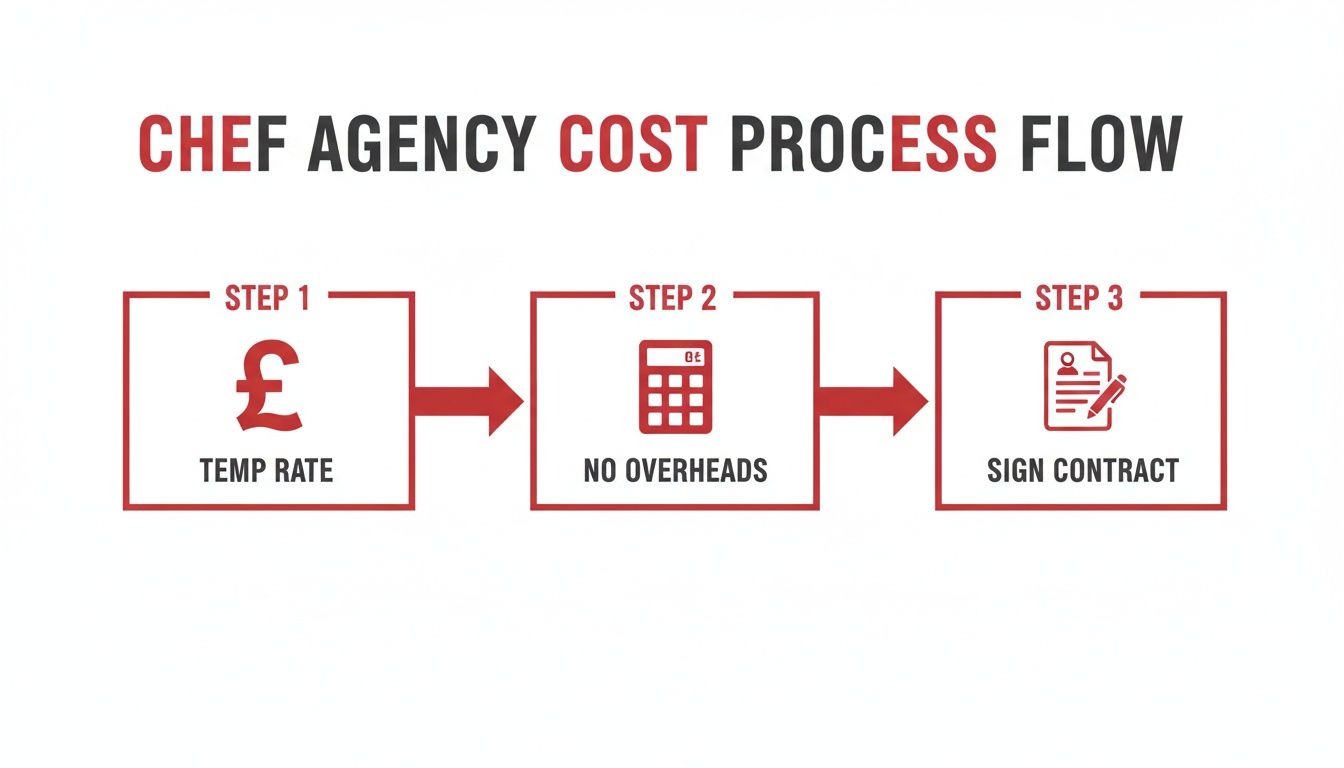
As you can see, it's simple: you agree on the rate, you skip the usual employment costs like NI and pensions, and you sign the terms. It keeps your budgeting clean and predictable.
The Power of a Comprehensive Brief
Once a chef is confirmed, your job is to set them up for a win. Pointing them to a station and hoping for the best is a recipe for chaos. This is where a rock-solid briefing checklist becomes your most important tool. A good relief chef can adapt to almost anything, but only if they have the right information.
A well-briefed chef is on the pass, integrated, and effective from minute one. A poorly-briefed chef spends their first two hours asking questions, slowing your whole team down and risking service. The five minutes you spend on a proper handover will save you hours of pain.
Your briefing checklist is the only thing that bridges the gap between your kitchen's standards and the chef's ability to execute them. It should be a live document you can fire over instantly.
To ensure your temporary chef has everything they need for a successful first shift, a detailed briefing is non-negotiable. This checklist template covers the essential information they'll need to hit the ground running.
Essential Chef Briefing Checklist Template
| Category | Checklist Item | Details to Provide |
|---|---|---|
| Kitchen & Team | Kitchen Tour & Layout | Location of walk-ins, dry stores, key stations, any quirky equipment. |
| Team Introductions | Head Chef, Sous, KPs. Who's who on the pass? | |
| Service & Prep | Menu & Specs | A copy of the menu, photos if possible. Their specific prep list. |
| Signature/Complex Dishes | Point out any high-risk or technical dishes they will be handling. | |
| Allergen Procedures | Where is the allergen matrix? What is the protocol for checks? | |
| Operations | Supplier & Ordering Info | Key suppliers, location of delivery notes (crucial for senior cover). |
| Timings & Breaks | Shift start/end times, break policy, team drink policy. | |
| Health & Safety | H&S Essentials | Location of first aid kits and fire extinguishers. Accident reporting. |
Taking a few minutes to run through these points ensures your temporary agency chef doesn't just fill a space. They arrive ready to contribute to a clean, successful service from the moment they tie their apron.
Onboarding Your Temporary Chef for Success
The agency confirms the booking. The chef walks through your door. What happens next separates a smooth, profitable service from absolute chaos.
Pointing a professional towards an empty station and expecting miracles is a classic mistake. It’s also the fastest way to waste your money and stress out your permanent team. A proper handover isn't a luxury; it's the bare minimum.
Think of those first 15 minutes as an investment. A proper welcome and a quick, smart tour shows the temp chef they’re joining an organised, professional kitchen—not walking into a panic. That small effort buys you competence and confidence for the entire shift.
Making the First Day Count
A great handover isn’t a long, drawn-out meeting. It’s about delivering clear, direct information that lets a skilled chef get on with the job. Your only goal is to eliminate the guesswork so they can focus on cooking.
First, give them a rapid but thorough tour of the engine room. Show them the walk-ins, dry stores, their section, the pass, and the pot wash. Never assume anything is obvious. Every kitchen has its own flow and its own quirks.
Next, make proper introductions to the team they’ll be working with. A simple, “This is Sarah, she’s on the grill with you today,” is all it takes. It builds an instant bridge. A kitchen runs on communication, and making the temp chef feel part of the brigade, even just for one service, is non-negotiable.
Your responsibility doesn’t end when the booking is made. The most successful placements happen when a manager actively integrates the temporary chef, setting clear expectations and creating a supportive environment from the moment they walk in.
Then, get straight to the point. Walk them through the prep list for their section and explain the flow of service. Point out any fiddly or complex dishes, run through your allergen protocols, and show them your kitchen's specific standards for plating. This clarity is what allows a temporary agency chef to meet your standards from their very first plate.
Managing the Shift and Handling Problems
Setting expectations is a two-way street. Be clear about break times, end-of-shift cleaning duties, and how you expect communication to run during a busy service. This isn’t micromanagement; it’s just professional respect, and it prevents a lot of friction later.
But what happens if it all goes wrong? What if, despite your best efforts, the chef just isn't the right fit? Maybe they’re too slow for your pace, or their attitude is creating friction. This is the moment you discover the real value of the agency you chose.
A top-tier agency partner will always have a replacement guarantee. If a chef isn't working out, you should be able to make one phone call and get a solution. The agency will handle the difficult conversation and work fast to send another vetted professional, making sure your service doesn’t miss a beat. That safety net is precisely why you pay an agency instead of hiring a random freelancer from a Facebook group.
Common Questions About Hiring Temporary Chefs
Bringing an outsider into your kitchen, even for a day, can feel like a gamble. It’s natural to have questions.
Here are the straight answers to the most common queries we get from pubs, restaurants, and hotels about using agency chefs. This is based on years of experience, not theory.
What Happens if the Chef Is Not the Right Fit?
This is the biggest fear for any manager, and it’s a valid one. Kitchen chemistry is everything. Sometimes a chef’s attitude or work ethic just doesn’t match your team.
A proper agency, especially one run by chefs, gets this.
Your contract should include a clear replacement guarantee. If the chef isn't up to standard, one phone call should be all it takes. A quality partner will have a replacement on the way, often within hours, ensuring service isn't compromised.
Always confirm this policy before you sign anything. If they hesitate, walk away.
Are Temporary Agency Chefs Covered by Insurance?
Yes. This is a non-negotiable that separates professional agencies from just finding a freelancer on social media.
Every chef supplied by a legitimate agency must be covered by comprehensive public liability and professional indemnity insurance. This is your safety net. It protects your business from liability if an accident happens or something goes wrong with the chef's work.
When you're vetting an agency, ask for their insurance certificate. Don’t just take their word for it.
Hiring through an insured agency means you're buying peace of mind, not just a pair of hands. It shifts the risk from your shoulders to theirs.
How Are Chefs Vetted for Quality and Safety?
The standard of the chef who walks through your door is a direct reflection of the agency's vetting process. A quick glance at a CV is a huge red flag. A serious agency digs much deeper.
A robust vetting process always includes:
- An in-depth interview, ideally with an experienced ex-chef who knows what to look for.
- Multiple reference checks from recent, relevant hospitality jobs.
- Mandatory verification of Right to Work in the UK. No exceptions.
- Proof of a minimum Level 2 Food Hygiene certificate.
For roles in schools, care homes, or other sensitive environments, some specialist agencies will also have chefs with current DBS checks ready to go.
Can I Hire a Temporary Chef for a Long-Term Role?
Absolutely. While agencies are known for plugging last-minute gaps, they are a fantastic resource for covering longer-term needs.
We regularly place chefs to cover maternity leave, extended sick leave, or to manage an entire busy summer season. It takes the pressure off your core team.
It's also a brilliant 'temp-to-perm' strategy. You get to trial a chef in your kitchen, under real-world pressure, before committing to a permanent contract. It dramatically reduces the risk of a bad hire.
Navigating staff shortages doesn't have to be a crisis. With the right agency, you get access to vetted, insured, and professional chefs exactly when you need them. Relief Chefs UK is run by chefs, for chefs, so we know the pressure you're under. We provide reliable chefs to keep your service running without a hitch.