
Filling Chef Jobs in Oxford: A Manager’s 2026 Guide
24 May 2026

It's Saturday at 5:30pm. One chef has called in sick, bookings are locked in, and your Head Chef is already covering prep, allergens, and the pass. If you're trying to fill chef jobs in Oxford, that situation is not an exception. It's part of the job.
Oxford is hard work from a staffing point of view. Colleges, hotels, pubs, visitor trade, care homes, contract catering, and events all pull from the same chef pool. The problem is not finding people who want kitchen work. The problem is finding chefs who can walk into a live service, hold standards, and stop your rota from collapsing.
Treat chef recruitment as an operations decision, not an admin task. A weak hire costs you twice. First in service disruption, then again in management time, waste, team frustration, and guest complaints. A good staffing partner reduces that risk because they understand the difference between emergency cover, a temp-to-perm test, and a permanent senior appointment.
You also need to screen for the basics properly. If your shortlist is weak on core standards, start with the key chef qualifications employers should check before hiring. It will save you time and bad trial shifts.
Use this guide properly. Match the agency to the staffing problem in front of you. If you need a chef tomorrow, choose for speed and kitchen-readiness. If you need stability for the next 12 months, choose for retention and fit. Managers who get that right keep service steady. Managers who do not stay stuck in a weekly staffing crisis.
1. Relief Chefs UK
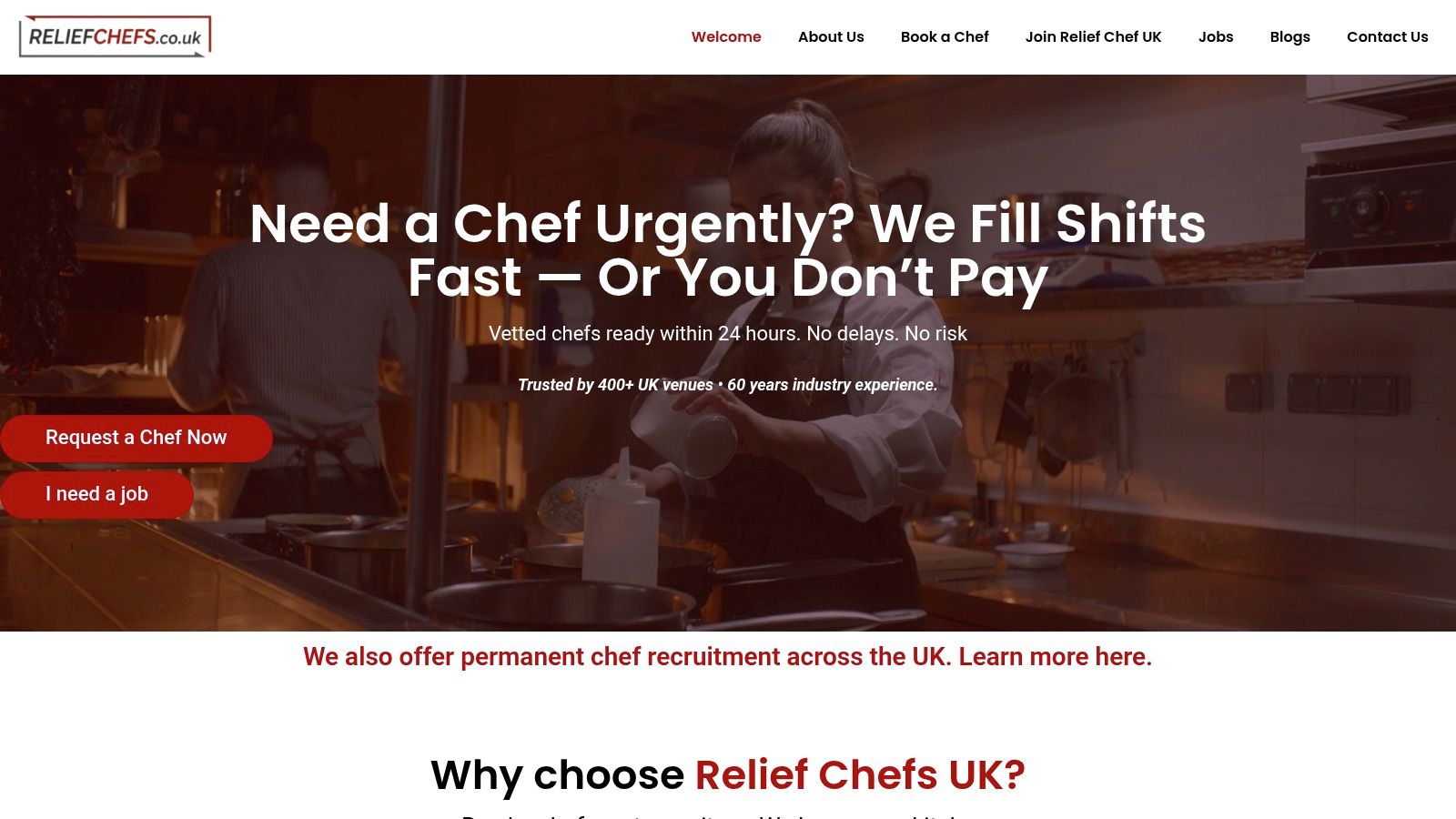
Friday lunchtime. One chef is off sick, another is already on notice, and your Head Chef is rewriting the prep plan to keep service alive. In that situation, Relief Chefs UK is the sort of partner that solves the immediate problem fast.
The reason is simple. They are set up for relief cover first, not generic hospitality recruitment dressed up as chef supply. The business has operated since 2013, is run by chefs, and supports a wide range of venues including pubs, restaurants, boutique hotels, yachts, villas, and multi-site operators. That operating background matters because Oxford managers do not need more CV traffic. They need chefs who can arrive ready for service and protect standards.
Relief Chefs UK suits two specific staffing problems better than most. First, urgent rota gaps that cannot wait until next week. Second, temp-to-perm or permanent hiring where you want to test capability in a live kitchen before committing.
Where Relief Chefs UK earns its place
Speed is the obvious advantage, but speed on its own is useless if the chef cannot handle the section. Relief Chefs UK responds quickly, with a recruitment team available 24/7, and can place vetted chefs at short notice, subject to availability. That is the value for Oxford sites dealing with sickness, events, college demand spikes, and holiday pressure.
Their model is strongest in situations like these:
- Emergency cover: A chef who can step into service with minimal hand-holding.
- Peak trading periods: Extra support before quality drops and overtime costs get out of control.
- Temp-to-perm hiring: A practical route if you want to assess fit before offering a permanent role.
- Specialist briefs: Support beyond standard line chef cover, including senior chefs and niche hospitality placements.
That makes this agency a practical operations tool, not just a recruitment option.
Relief Chefs UK also covers the risk controls managers care about. Chefs are vetted, right-to-work checked, insured, and backed by 24/7 support. Transparent pricing helps, especially if you are trying to stop agency spend from becoming a weekly argument with finance. Larger operators can also arrange regular cover across sites, which will appeal to groups with repeat gaps rather than one-off emergencies.
Best fit for Oxford venues
Oxford is a fast-moving hiring market. Good chefs disappear quickly, and weak applicants waste trial shifts, stock, and management time. If you are using relief cover as part of a wider hiring plan, build a tighter screening process around the chef qualifications worth checking before you hire. That saves a lot of avoidable pain.
The commercial case is straightforward. If your venue loses service quality every time one chef drops out, you need a partner built for continuity. Relief Chefs UK is a strong fit for independent restaurants, busy pubs, boutique hotels, event operators, and groups that cannot afford a slow response.
There is one obvious limitation. You will need to speak to them to price the brief properly. That is not a serious drawback. Any manager choosing chef cover on headline rate alone is usually buying the wrong thing.
Use Relief Chefs UK when the problem is urgent, repeated, or expensive to get wrong. In Oxford, that covers a lot of kitchens.
2. Blue Arrow Oxford Branch
Your sous chef resigns, the rota is already thin, and finance wants one supplier that can cover temps, process payroll, and support a permanent hire if the gap drags on. That is the kind of problem Blue Arrow is built to handle.
Blue Arrow suits Oxford managers who want operational control more than niche chef specialism. The Oxford branch gives you a local contact, and that matters when shift times, travel distance, and site type decide whether a booking gets filled or ignored. If you run schools, care settings, contract catering, hotels, or larger multi-site operations, that branch structure can save time.
Where Blue Arrow fits best
Use Blue Arrow when the staffing issue is broader than tonight's service. They are a practical option for managers who need one recruitment partner for temporary cover, temp-to-perm hiring, and permanent recruitment, with admin handled properly from the start.
That makes them a sensible choice for:
- Operations with regular staffing churn
- Groups that want one supplier across multiple hiring types
- Sites with tighter compliance requirements
- Managers who need predictable payroll and timesheet processes
The main selling point is process discipline. Right-to-work checks, weekly payroll, and standard agency admin are familiar territory for a business of this size. If your head chef is spending too much time chasing paperwork instead of running service, that matters.
The trade-off managers should be honest about
Blue Arrow is not the agency I would pick first for highly specialised chef briefs or last-minute kitchen rescue. A broad recruiter can cover a lot of ground, but broad coverage usually comes with less depth in chef-only networks. If you need a specific level of chef, in a specific style of operation, at speed, test their response time before you rely on them.
That does not make Blue Arrow a weak option. It makes them a better fit for planned hiring and steady volume than high-risk emergency gaps.
Pay expectations are part of that conversation. Oxford chef candidates know the market, and unrealistic offers waste interviews. If your managers need a clearer view of current earnings before signing off a permanent package, Relief Chefs UK's guide to how much chefs make in the UK is useful context.
You can review their local office through the Blue Arrow Oxford branch. My advice is simple. Use Blue Arrow when you want structure, consistency, and a supplier that can support several hiring routes. If the problem is a short-notice kitchen failure, use a chef-first specialist instead.
3. Jubilee Talent Oxford and Oxfordshire
Jubilee Talent is a strong choice when your staffing problem isn't just “we need chefs”, but “we need the right type of chef for the right service pattern”. In Oxford and the wider county, that matters. Daytime catering, event work, heritage sites, contract catering, and ad hoc bookings all run differently.
Jubilee's appeal is that it leans into that variety. If your business needs flexibility, or you want access to chefs who prefer daytime shifts, DBS-cleared environments, or events rather than standard restaurant rotas, this option deserves attention.
Best use case for Jubilee
This agency fits operators who need staffing flexibility around mixed trading patterns. Think school catering one week, event pressure the next, and daytime demand in between. Oxfordshire produces that sort of hiring profile more often than many markets.
That makes Jubilee a practical option for:
- Daytime and education-led operations
- Heritage, events, and visitor venues
- Ad hoc or rolling temporary bookings
- Temp-to-perm hiring where fit matters before commitment
There's also value in using an agency that understands chef preferences, not just venue demands. Chefs often choose shifts based on travel, schedule control, and work-life pressure. Agencies that recognise that can sometimes hold stronger candidate relationships.
What managers should watch
The risk with flexible staffing models is competition for the most attractive work. Daytime jobs and better-pattern shifts don't stay available for long. If your site expects the easiest hours but pays like a hard-service operation, you'll get beaten.
Oxford's market already supports formal, better-paid institutional roles. One example is Brasenose College at the University of Oxford, which advertised a Senior Chef de Partie role with a salary of £32,278 to £37,508 per year on a 42-hour week. That's the level of structure some candidates are comparing your vacancy against.
Better shift patterns are a selling point only if the rest of the offer holds up. Chefs still look at kitchen culture, volume, support, and whether your rota is honest.
Jubilee is a good match for Oxfordshire venues with varied service styles and realistic expectations. If your need is highly flexible rather than purely emergency-led, they're worth speaking to through Jubilee Talent's Oxford page.
4. Berkeley Scott
Berkeley Scott has reach. That's the main reason operators use them. They cover chef recruitment at multiple levels and work across temporary and permanent vacancies, which gives Oxford businesses a broader talent lane than a small local player can sometimes offer.
If you're recruiting beyond immediate relief cover, especially for branded sites, hotels, business and industry catering, or larger restaurant operations, Berkeley Scott can be a useful part of the mix. Their scale helps when your Oxford hiring challenge is tied to wider regional demand.
Where Berkeley Scott fits
Use Berkeley Scott when you need range. Commis through to senior chef appointments, short-term support, and longer-term recruitment all sit within their model. For operators who run more corporate systems or multi-unit structures, that can feel familiar and efficient.
A few reasons managers keep them on the list:
- Broad seniority coverage: Useful if you're hiring at multiple levels, not just one vacancy.
- Temporary and permanent desks: Better if your staffing problem keeps changing shape.
- Wide client network: Relevant when benchmarking candidate quality and market movement across regions.
For Oxford businesses competing with neighbouring hospitality hotspots such as Berkshire, Windsor, Reading, Bristol, Devon, Dorset, and Wales, that wider view can help. Good chefs move across regions when the package and lifestyle stack up.
Where they're less convincing
You won't get the same boutique, kitchen-floor feel that a chef-led specialist offers. Processes can feel more corporate, and Oxford coverage is handled regionally rather than through a prominent walk-in high-street branch.
That's fine if your team is organised and your brief is clear. It's less fine if you need a consultant who instinctively understands a collapsing Saturday service and acts like it matters.
If you're weighing wider agency models against specialist chef suppliers, Relief Chefs UK's overview of employment agencies for chefs is a useful comparison point.
Berkeley Scott is best when you need scale, broad job coverage, and a recognisable hospitality recruitment brand. Their current offering sits on the Berkeley Scott website.
5. Catering Services International Oxford
Catering Services International, often referred to as CSI, has a clear local angle that will appeal to Oxfordshire employers who want a branch presence and hospitality-specific recruitment rather than a generic labour supplier. For venues that need both front and back of house support, that wider hospitality scope can simplify staffing through one relationship.
This agency makes most sense for operators whose demand moves across different venue types during the year. Hotels, events, restaurants, education, and care settings don't all spike at the same time, so a recruiter serving several sectors can help smooth out availability.
Why CSI can work in Oxford
Oxford isn't one market. It's several markets layered together. Colleges hire differently from pubs. Care settings need different checks from event kitchens. Hotels need continuity, while event sites can turn urgent overnight.
CSI's Oxford positioning suits managers who want:
- Short-notice relief cover and longer bookings
- Oxfordshire-focused recruitment conversations
- Access to multiple hospitality sectors
- A supplier that understands local venue variety
This becomes more useful when your staffing issue keeps changing. One week it's agency support for a run of events. Next week it's a more stable booking because your Sous Chef has resigned and notice periods are dragging.
Where caution is needed
Sector breadth is helpful, but it can also mean fluctuating availability. Event-led work can be seasonal, and certain sites bring DBS requirements, split shifts, or travel issues that narrow the pool. Managers should pin down exactly what kind of chef they're asking for before briefing any agency.
Oxford remains a busy labour market. Earlier market evidence already showed sustained hiring pressure locally, so local focus alone won't guarantee supply. Your speed, rates, kitchen standards, and shift pattern still decide whether chefs accept.
A vague brief gets a weak shortlist. Tell the agency what section needs covering, what volume the kitchen does, and what the chef is walking into.
If you want a locally presented recruiter with mixed-sector hospitality reach, review CSI's Oxford branch page.
6. CJUK Chefs Jobs UK
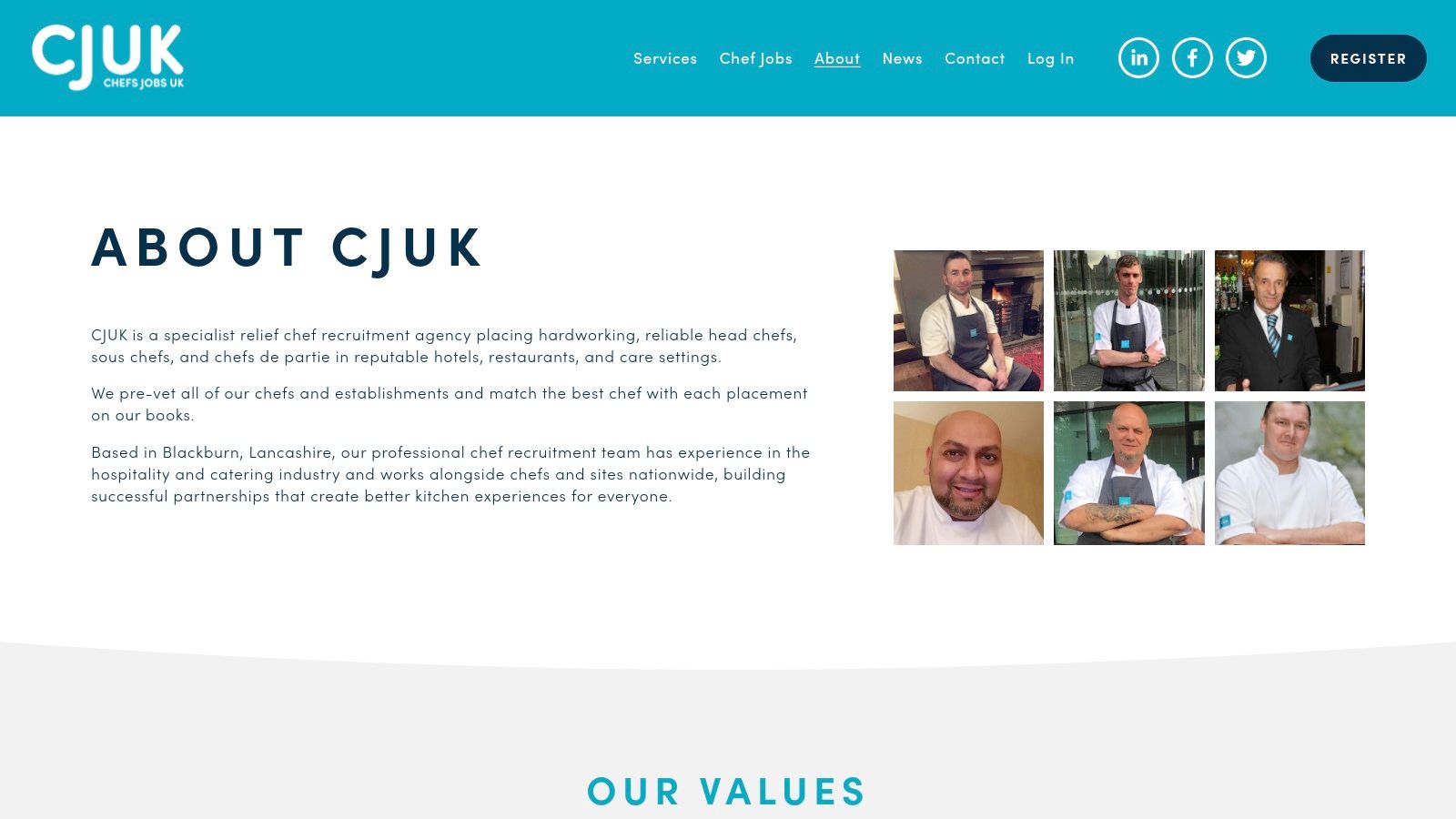
CJUK stands out because it stays close to one lane. Chefs. If you want a chef-dedicated agency rather than a broad recruiter with a catering desk attached, that focus is the selling point.
For Oxford employers, that can be useful when the primary issue is reliability. Plenty of agencies can send names. Fewer maintain a network of chefs who understand relief work, accept the realities of stepping into unfamiliar kitchens, and can adapt quickly.
Who should use CJUK
This is a good option for employers who care about standards and want a supplier that tends to work with experienced temporary chefs. Hotels, restaurants, and care settings usually value that because bad temporary cover often creates more pressure than the original vacancy.
CJUK is likely to appeal if you need:
- Relief chefs with stronger professional habits
- Chef-only recruitment conversations
- Longer-term temporary support
- Experienced levels such as Chef de Partie, Sous Chef, and Head Chef
That focus can also be helpful when your permanent team is already stretched. A relief chef who understands agency expectations usually arrives with a more realistic view of pace, prep discipline, and service pressure.
The trade-off
The more specialist the agency, the more selective onboarding tends to be. That can be positive for quality, but it may also mean premium bookings go first to seasoned relief chefs with stronger track records. If your site is difficult, disorganised, or pays below what the shift demands, specialist agencies will feel that quickly.
There's another commercial point to remember. Hiring pressure in food service isn't only about growth. The wider chef and head cook occupation is projected to see 7% employment growth from 2024 to 2034, with about 24,400 openings per year on average, and much of that demand is replacement driven. Operators who ignore churn always end up back in crisis mode.
CJUK is worth considering if you want a chef-only supplier with a reputation built around the temporary market. Their background is on the CJUK about page.
7. KSB Recruitment
Your senior sous resigns on a Thursday, the property sits 25 minutes outside Oxford, and the shortlist from city-focused recruiters is weak by Friday afternoon. That is the kind of gap KSB is better placed to handle. They are more relevant for Oxfordshire operators hiring into hotels, destination venues, premium pubs, and rural sites where the search area has to stretch beyond the city centre.
That matters because a lot of workable chef talent around Oxford is regional, not purely urban. Good candidates move between country-house hotels, food-led inns, estates, and multi-site hospitality groups. If your hiring brief is tied to postcode convenience instead of actual labour movement, you cut your own candidate pool too early.
Best fit for KSB
Use KSB when the staffing problem is permanent recruitment across a wider geography, not emergency shift rescue. They suit managers who need a consultant to manage the process properly, keep candidates engaged, and handle the friction points that kill offers late in the cycle.
KSB is a sensible option for:
- Country-house hotels and destination-led properties
- Rural Oxfordshire kitchens with thinner local labour supply
- Permanent chef vacancies that need active consultant handling
- Regional searches covering Oxford, the Cotswolds, and nearby counties
This is a practical choice if your role sells on reputation, progression, stability, or quality of life. Those factors can win strong chefs, but only if the recruiter presents them clearly and screens out candidates who will drop out once the travel reality becomes clear.
Where it's weaker
KSB would not be my first call for short-notice cover or last-minute brigade gaps. If service is at risk tonight, use a relief-focused supplier. If the issue is a hard-to-fill permanent vacancy in a less convenient location, KSB is closer to the mark.
Be blunt about geography as well. Rural Oxfordshire jobs fail when managers ignore transport, accommodation, split shifts, or late finishes with no practical route home. Pay matters, but logistics kill just as many hires.
The fix is simple. Write the brief like an operator, not like HR. State the commute, shift pattern, finish times, team structure, and whether there is any staff accommodation or relocation support. That gets you fewer applicants, but better ones.
For regional hospitality hiring beyond the immediate city core, review KSB Recruitment's catering and hospitality jobs page.
Oxford Chef Jobs: Top 7 Agency Comparison
| Provider | Process & Complexity 🔄 | Resource Requirements / Coverage ⚡ | Expected Outcomes / Reliability ⭐ | Ideal Use Cases 📊 | Key Advantages / Tips 💡 |
|---|---|---|---|---|---|
| Relief Chefs UK | Chef-run onboarding; 24/7 callback; dedicated account management for larger clients | UK-wide vetted chefs, public liability insurance required, cover quoted to your needs | High reliability, 24/7 responses; short-notice chefs, subject to availability; trusted by 400+ venues | Short-notice relief, seasonal reinforcement, multi-site pipelines, temp-to-perm conversions | Fast, chef-led service; contact for pricing; regional availability can vary at peak times |
| Blue Arrow, Oxford branch | Standard agency processes with local consultants and weekly payroll infrastructure | Oxfordshire-focused across education, care, hotels and events | Steady flow of shifts year‑round; clear onboarding and weekly pay | Chefs seeking regular, predictable shifts and weekly pay | Local office knowledge; larger multi-sector agency so chef-specific focus may be diluted |
| Jubilee Talent, Oxford and Oxfordshire | Chef-led consultants; temp, temp-to-perm and payroll handled | Local pipeline for events, contract catering, schools and heritage sites | Good flexibility and varied bookings; daytime and event shifts available | Candidates wanting flexible hours or event/heritage-site roles | Specialist chef focus; day shifts competitive in peak season |
| Berkeley Scott | Structured national recruitment with dedicated chef desks; corporate processes | UK-wide client base with regional teams covering Oxford/Oxfordshire | Broad opportunities from commis to executive; suitable for careers and seasonal cover | Permanent career moves, seasonal relief, senior-level placements | Strong brand recognition and breadth; processes can feel more corporate |
| Catering Services International (CSI), Oxford | Local branch procedures with short-notice and longer booking capability | Oxfordshire coverage across FOH and BOH in varied venues | Increased shift availability across sectors; hours can fluctuate by season | Local relief cover and longer bookings in Oxfordshire | Clear local focus; some roles seasonal or require DBS/split shifts |
| CJUK, Chefs Jobs UK | Chef-only agency with selective vetting and standards-based onboarding | Nationwide vetted chef network for hotels, restaurants and care settings | High standards and reliable placements; prioritises experienced chefs | Experienced relief chefs seeking reputable, consistent bookings | Strong reputation for supporting temps; selective entry may limit newcomers |
| KSB Recruitment | Consultant-led support with candidate care, training pathways and checks assistance | UK-wide roles with emphasis on Cotswolds and Oxfordshire country-house venues | Good match for rural hotel/resort roles; fewer ultra-short-notice shifts | Chefs targeting country-house hotels and rural venues; candidates needing support | Extra support for upskilling and documentation; some travel required |
Your Next Step to a Stable, Fully Staffed Oxford Kitchen
Choosing who helps you fill chef jobs in Oxford isn't an admin decision. It's an operating decision. Get it wrong and your managers spend their week covering sections, service standards dip, payroll gets messy, and guests feel the instability before your accounts team does.
Oxford is too competitive for slow, passive hiring. The city has hundreds of active vacancies across colleges, hotels, pubs, and care settings, and serious employers are already putting structured roles, clear pay bands, and better working patterns in front of chefs. If you're still relying on a rushed advert and a few calls around the trade, you're behind.
The right staffing partner depends on the pressure point. If you need broad process and local branch handling, Blue Arrow and CSI have a place. If your site needs flexibility across events, daytime, or mixed bookings, Jubilee is useful. If you want regional scale, Berkeley Scott is a credible option. If your focus is chef-only recruitment, CJUK is worth a look. If your hiring reaches into rural Oxfordshire or hotel-led regional roles, KSB can help.
But if your real problem is kitchen stability, not just vacancy management, Relief Chefs UK is the clear recommendation. They were established in 2013 to solve exactly the issues operators keep facing. Sudden sickness. Seasonal pressure. Agency unreliability. Permanent gaps that drag on too long. They support relief chefs, temporary chefs, permanent chef recruitment, yacht chefs, villa chefs, and wider hospitality staffing support across the UK.
That's the difference. This isn't just about finding somebody available. It's about getting a chef who can walk in, work properly, and protect service. That's what saves revenue, protects your team, and stops your Head Chef burning out.
If your venue is in Oxford, or you're also recruiting across Berkshire, Windsor, Reading, Slough, Bristol, Devon, Dorset, Wales, or other high-pressure hospitality markets, don't wait for the next no-show to force the issue. Build your pipeline now. Speak to Relief Chefs UK and sort the staffing problem before it hits the pass.
If chef jobs in Oxford are creating constant rota pressure, speak to Relief Chefs UK. Whether you need emergency relief cover, temporary chefs for a busy period, or permanent recruitment that sticks, they'll move quickly and give you a straight answer.
Call the team.
Office 01392 715474 · info@reliefchefs.co.uk