
Contract Employment Agencies: A UK Hospitality Guide
11 May 2026
Friday, 4pm. Two chefs are already down. The bookings sheet is full, the prep list is half-finished, and your sous chef has just told you they can't stay for the close. If you run a pub in Devon, a hotel in Windsor, or a restaurant in Bristol, you already know this isn't a rare event. It's normal hospitality life now.
That's why smart operators stop treating staffing gaps like a one-off emergency and start treating them like a commercial risk. Contract employment agencies exist for one reason. To keep your kitchen trading when your own rota can't.
Your Kitchen Staffing Problem Is Not Going Away
Short notice sickness. Holiday clashes. Walkouts. Seasonal surges. A wedding booking dropped on top of a busy Saturday. A senior chef who looked solid in interview but falls apart on service. These aren't unusual problems. They're built into hospitality.

In places like Dorset, Berkshire, Reading and Wales, the pressure gets worse when demand spikes. Coastal trade jumps. Events hit. Hotel occupancy lifts. Everyone wants chefs at the same time, and suddenly the local labour pool looks very small.
The mistake I see all the time is this. Owners assume the problem will settle down once they make one good permanent hire. It won't. Permanent recruitment matters, but it doesn't solve Friday-night sickness, emergency leave, or a chef who quits mid-week.
Practical rule: If your kitchen only works when every permanent team member turns up, your staffing model is broken.
The real issue is continuity
You're not only trying to fill a shift. You're trying to protect:
- Service standards: Guests don't care that your chef called in sick. They judge the plate in front of them.
- Revenue: If you reduce covers, simplify the menu badly, or shut a section, the till notices.
- Team morale: Good chefs leave when they're forced to carry weak or missing colleagues every week.
- Reputation: One poor weekend can trigger bad reviews, lost repeat trade, and awkward conversations with owners or investors.
That's where contract employment agencies come in. A decent agency gives you access to chefs who can step in fast, work professionally, and stop one staffing issue from turning into a full operational mess.
Stop firefighting and build cover into the business
The strongest hospitality operators already do this. They don't wait for the panic call. They keep an agency relationship ready before the crisis lands. That means when your head chef is suddenly off, or your seasonal team isn't enough, you aren't scrolling through old numbers begging for help.
If you've ever had to rewrite a menu at 5pm because nobody can run garnish, pastry or grill, you already know the cost of being unprepared.
What Exactly Is a Contract Employment Agency
A contract employment agency supplies staff to your business on a temporary, fixed-term, or contract-to-hire basis. In plain English, you get the chef. The agency handles the employment side.
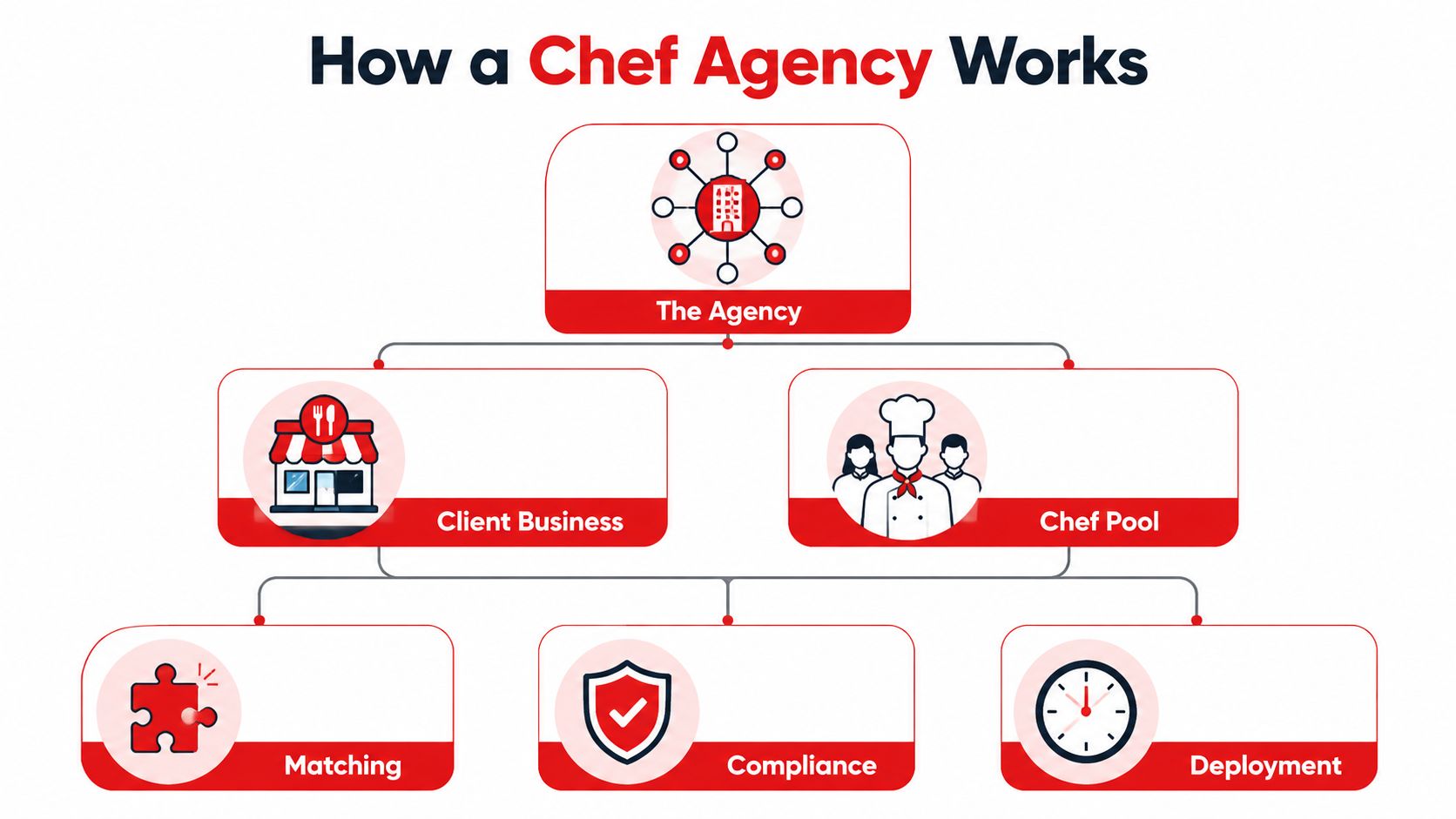
Consider this approach. If permanent recruitment is buying a van for long-term use, contract staffing is hiring the right vehicle when the job lands. You still need quality. You still need reliability. But you don't take on all the ownership admin for every short-term requirement.
The model isn't niche either. The UK employment services market generated approximately £185 billion in 2024, with temporary staffing making up the majority. Hospitality accounted for 12% of all UK temporary placements in 2023, with over 250,000 temporary contracts filled annually in food and beverage services according to Research and Markets reporting on the employment agency market.
The three models hospitality operators use most
Emergency relief cover
This is the classic agency booking. Someone is off sick, a chef has vanished, or you've been let down before a key service. You need a competent relief chef who can walk into a live kitchen and get through service without drama.
This matters most for pubs, busy restaurants, event venues, and boutique hotels where there isn't much slack in the rota.
Fixed-term contract cover
This works when the gap has a known timeframe. Maternity cover. Seasonal trade. Refurbishment reopening. Summer in Devon. Christmas in Bristol. A private household, villa or yacht season that needs experienced kitchen support for a defined period.
You get cover without rushing into the wrong permanent hire.
Contract-to-hire
This is the sensible option when you like a candidate but don't want to gamble on interviews alone. You bring them in on contract, see how they handle prep, pressure, hygiene, pace and team fit, then decide whether to offer something permanent.
A CV doesn't run a Saturday night service. A trial in your kitchen does.
Who employs the chef
This bit matters. In a standard agency arrangement, the agency is the employer during the assignment, not your venue. That usually means the agency handles payroll, employer costs, and core compliance administration, while you receive the labour you need for the agreed period.
Here's the simple version:
| Arrangement | Agency handles | Venue handles |
|---|---|---|
| Relief or temp cover | Pay, employment admin, assignment coordination | Induction, station brief, kitchen management |
| Fixed-term contract | Ongoing employment administration and cover management | Day-to-day supervision and service standards |
| Contract-to-hire | Initial employment arrangement and agreed terms | Assessment for long-term fit |
For operators using relief chefs, temporary chefs, yacht chefs, villa chefs, or permanent chef recruitment support, that split is the whole value. You stay focused on guests, GP, standards and service. You don't waste hours rebuilding payroll and hiring admin every time somebody drops out.
The Commercial Case for Using a Chef Agency
Most owners look at agencies backwards. They ask, “What does the chef cost me today?” The better question is, “What does it cost me if this kitchen isn't properly staffed?”

That's the commercial argument. A contract agency isn't just plugging a hole. It's protecting turnover, standards, and your ability to trade.
You buy continuity, not just labour
If your kitchen misses one key chef, the impact spreads fast. Prep slows. Ticket times stretch. The senior chef stops leading and starts rescuing sections. Front of house gets hammered. Guests wait longer. Complaints rise.
A reliable agency stops that chain reaction early.
As of 2025, there were approximately 28,000 employment agencies in the UK. In 2023, 42% of UK employers used staffing firms, and after a 25% drop during lockdowns, the sector rebounded with 18% revenue growth in 2021-2022 as venues relied on vetted, insured staff to manage shortages, according to IBISWorld's employment and recruiting agency market overview.
That rebound tells you something important. Operators didn't turn to agencies for convenience. They used them because they needed kitchens, hotels and venues to keep running.
The strongest benefit is speed under pressure
Hospitality decisions are rarely made with a neat two-week lead time. You need answers quickly, especially in hotspots like Slough, Reading, Bristol, Devon and Dorset where demand can jump and local availability disappears.
A good chef agency gives you three advantages at once:
- Faster access to available chefs: You're not starting recruitment from zero every time.
- Less admin at the point of crisis: You make one call, give the brief, and move.
- A ready-made bench of talent: That matters when your own network has already been exhausted.
If you're comparing providers, look at specialist employment agencies for chefs rather than generalist temp firms. Generic agencies often understand bookings and timesheets. They don't always understand sections, service pace, allergen discipline, stock pressure, or what happens when you put the wrong chef on a pass.
It gives you control over fixed costs
Permanent hiring is still essential. But not every staffing problem deserves a permanent salary commitment. If trade is lumpy, if your site is seasonal, or if you're opening new units gradually, contract staffing lets you buy labour when you need it instead of carrying unnecessary fixed cost.
That's especially useful for:
- Independent pubs: Covering holidays, sickness and peak food weekends
- Boutique hotels: Filling breakfast, banqueting and evening service pressure points
- Multi-site groups: Moving quickly when one site suddenly goes short
- Yachts and villas: Bringing in specialist chefs for defined guest periods or rotations
A quick explainer sits well here if you want the agency model broken down from another angle.
My blunt advice
Don't wait until your head chef is trying to run three sections and wash up. Vet your agency before you need them. The time to test response speed, chef quality and communication isn't during a live staffing crisis.
Understanding the True Costs and Potential Risks
Agency cost scares people because they compare the bill rate to an hourly wage and stop there. That's lazy maths.
The agency rate isn't just wages. In UK hospitality contract staffing, gross margins typically range from 18-28%, and that has to cover the chef's pay, employer National Insurance at 13.8%, pension auto-enrolment at 3%, and Employers' Liability Insurance, as outlined in this contract staffing margin breakdown.
What you're actually paying for
Here's the truth behind the invoice.
| Cost element | Why it matters to you |
|---|---|
| Chef pay | The obvious part. You need a rate that attracts capable chefs. |
| Employer on-costs | These sit in the background whether you notice them or not. |
| Insurance and compliance | This reduces risk if something goes wrong. |
| Vetting and coordination | Someone has to screen, brief, check documents and manage the booking. |
| Speed of supply | Fast cover has value when service is close and the rota is broken. |
That's why comparing an agency shift rate to a payroll hourly rate alone is nonsense. If you recruit directly, all those hidden costs still exist. They just sit in different places on your P&L and your time.
If you want a clearer view of the wider employer on-cost picture, review the cost of employing hospitality staff before deciding that agency cover is automatically “expensive”.
Cheap cover usually becomes expensive
The actual risk isn't paying an agency fee. That fundamental risk is paying for the wrong agency.
A poor supplier creates problems like these:
- Weak vetting: The chef can cook one style but not the food your site serves.
- Bad communication: Nobody confirms arrival, kit, uniform, or section suitability.
- Last-minute failures: You think cover is sorted until the chef doesn't show.
- No accountability: When things go wrong, you get excuses instead of solutions.
If an agency can't explain exactly what its fee covers, assume the problem will surface during service.
The same source notes that agencies with transparent pricing and fill times under 48 hours retain 15% more clients year-over-year because they reduce downtime. That makes sense. Operators stay with agencies that keep kitchens open and don't play games with pricing.
Risk sits on both sides of the deal
Even a good chef can be the wrong fit for a specific kitchen. A fine-dining background may not help much in a volume-led pub. A strong events chef might not suit a small owner-led site with a tight menu and a very particular way of working.
So be honest in the brief. Don't ask for “a solid all-rounder” if what you need is a breakfast specialist, banqueting chef, pastry support, or a senior chef who can steady a young brigade.
My advice is simple. Pay properly for the right level of cover. Then demand clarity, replacement terms, and honest communication.
Legal and Compliance You Cannot Ignore
A lot of operators assume the agency takes all the legal risk. That's a comforting idea. It's also dangerous.
Yes, the agency carries major responsibility on employment checks and documentation. But your venue still has a duty to use competent suppliers, keep proper records, and avoid obvious compliance failures. If you buy agency labour carelessly, you're still exposed operationally and reputationally.

Right to work is the first thing to check
Weak agencies get found out here. A 2025 REC report noted that 42% of hospitality staffing agencies faced right-to-work fines averaging £20,000 in the previous year because checks were inadequate. The same verified data shows 65% of independents reported staffing delays from verification issues.
That should tell you two things. First, compliance isn't paperwork theatre. Second, if an agency is vague about right-to-work checks, walk away.
Ask direct questions:
- Who completes the right-to-work check
- How is the check recorded
- How quickly can they verify a candidate
- What happens if status is unclear on the day of booking
If the answers sound woolly, don't use them.
Insurance and legal cover matter
A proper agency should be able to confirm its insurance position clearly. You should also know what your own venue policies cover. This isn't about being awkward. It's basic commercial discipline.
Check these points before chefs arrive on site:
| Area | What to confirm |
|---|---|
| Employers' Liability | The agency's cover for employed staff on assignment |
| Public Liability | Protection if an incident affects property or people |
| Documented checks | Right-to-work and identity verification process |
| Assignment terms | Rates, cancellation terms, duties, and reporting lines |
Your site still has obligations
Even when the agency is the employer, your venue still controls the kitchen environment. That means your managers must handle induction properly, brief the chef on allergens and site systems, and avoid unsafe rostering.
A chef can be legally supplied and still walk into a badly run site. That's on the venue, not the agency.
You also need to respect Working Time rules in practice. Don't bring in an agency chef to “save the day” and then bury them under a chaotic shift pattern with no proper break, no briefing, and no chance of success.
What good due diligence looks like
I'd keep it simple. Before first use, get written confirmation on checks, insurance, and terms. Keep the contact details of the duty manager who can fix problems quickly. Make sure your kitchen leadership knows who the chef is, what section they're covering, and who signs them in.
That level of discipline prevents most avoidable legal and operational headaches.
A Practical Checklist for Vetting Chef Agencies
Saturday, 11:30am. Your grill chef has called in sick, bookings are stacked, and the agency you chose because it was £2 an hour cheaper sends someone who has never worked your menu pace. That is how revenue gets burned. Agency vetting is not admin. It is service protection.
Price matters. Fit matters more. A chef specialist and a general temp desk do not solve the same problem, and treating them as interchangeable is how owners end up paying twice.
Compare agencies like an operator
Use this checklist before you open an account.
1. Specialist hospitality focus
A weak agency lumps every kitchen role together. That tells you they do not understand the difference between a breakfast shift, a high-volume pub service, a hotel banqueting section, or a private household brief.
Ask what chef roles they place every week. Ask what kinds of venues they cover. Ask how they judge whether someone can handle your pace, style, and standards. If the answers are vague, walk away.
You need people who understand brigade structure, section pressure, seasonal trading, live-in complications, and the difference between filling a gap and protecting a service.
2. Vetting depth
“We've checked them” is useless.
Get the agency to spell out its process. You want clear answers on right-to-work checks, references, recent kitchen history, and how they judge practical suitability. The good agencies will also explain how they match chefs to different environments, such as gastropubs, hotels, events, yachts, and private households.
If they cannot explain the match, they are guessing.
3. Response speed and replacement process
Every agency sounds organised on a calm Tuesday morning. A true challenge arises when someone drops out before dinner service.
Put these questions in writing:
- How quickly do you respond to an urgent request
- What happens if the chef cancels on the day
- Who covers out-of-hours calls
- How fast can you send a replacement
- What do you do if the chef is technically competent but wrong for the site
If the answer depends on one consultant, one mobile phone, and a bit of luck, keep looking.
4. Temp-to-perm clarity
A lot of owners use agency cover as a trial run for permanent hiring. Fair enough. It is a sensible way to protect service while you recruit properly.
That only works if the terms are clear from the start. Ask about transfer fees, qualifying periods, notice requirements, and whether the agency actively supports temp-to-perm hiring or just tolerates it. If permanent hiring is part of your plan, read more on recruitment in hospitality before signing terms you will regret later.
Ask for proof
Sales talk is cheap. Kitchen failures are expensive.
A decent agency should be able to show you how it works in practical terms. Look for:
- Clear terms: rates, minimum hours, cancellation charges, and transfer terms set out plainly
- Named contact: one accountable person who knows your site
- Relevant coverage: relief chefs, short-term cover, permanent recruitment, and specialist placements if your business needs them
- Regional understanding: evidence they know the hiring pressure in your area, not just London postcodes on a spreadsheet
- Problem handling: what they do when a placement goes wrong
Here is a simple benchmark:
| Question | Weak answer | Strong answer |
|---|---|---|
| What roles do you fill most often? | “All hospitality.” | Specific chef levels and venue types |
| How do you match chefs? | “We send who's available.” | Role, level, service style, location, and pressure fit |
| Can this temp become permanent? | “We'll sort that later.” | Clear transfer terms upfront |
| What happens after placement? | No follow-up | Active check-in and fast issue handling |
One more rule from hard experience. Ask for examples of recent placements that match your operation. A country pub, a boutique hotel, and a villa kitchen do not run the same way. Any agency that talks as if they do is a risk.
Good agencies do not just send bodies. They protect standards when the rota breaks.
My shortlist rule
Before you agree to anything, ask one question.
Would I trust this agency to protect Saturday night service if my strongest chef disappeared at noon?
If the answer is anything short of yes, do not sign.
The Right Partner Keeps Your Kitchen Open
A kitchen doesn't fail all at once. It slips. One weak shift. One no-show. One rushed hire. One weekend where standards dip because nobody had proper cover. Then guests notice, your team gets frustrated, and the business starts paying for a staffing problem that should've been controlled earlier.
That's why contract employment agencies matter in hospitality. The right one gives you options when the rota breaks, trade jumps, or recruitment drags on too long. The wrong one gives you another problem to manage.
If you run an independent pub, a restaurant, a boutique hotel, a private household, a yacht operation or a multi-site group, be ruthless about what you accept. Demand speed. Demand clarity. Demand chefs who can function in a live kitchen. Anything less is a false economy.
The goal isn't to use agency chefs forever. The goal is to protect service, revenue and reputation while you build a stable team.
If your kitchen needs reliable chef cover, permanent recruitment support, or fast help with short notice gaps, contact Relief Chefs UK and start the conversation before the next staffing crisis hits.
Call the team.
Office 01392 715474 · info@reliefchefs.co.uk