
Friday lunch is building, one chef has called in sick, and the person stepping in gets handed a stained notebook, a few shouted instructions, and someone else's memory. That's when kitchens come unstuck.
The damage starts fast. Prep gets missed. Allergens are left to guesswork. A fryer that needs a specific reset catches the incoming chef out. Stock is there, but nobody knows what's already allocated to functions, what's been prepped for the evening, or which supplier will answer the phone. Service slows, the pass gets tense, and management thinks they've got a staffing problem when they've got a handover problem.
In UK hospitality, that distinction matters. You can find cover and still lose money if the kitchen can't absorb that cover properly. A good chef walking into a bad handover will spend the first part of the shift decoding your operation instead of cooking in it.
The True Cost of a Bad Kitchen Handover
A poor handover usually looks small at first. Someone says, “It's all straightforward.” Someone else says, “The team will show you.” Then the relief chef starts and finds out the specials board hasn't been updated, one oven runs hot, the dessert prep is half-finished, and nobody has written down which menu items are off sale.
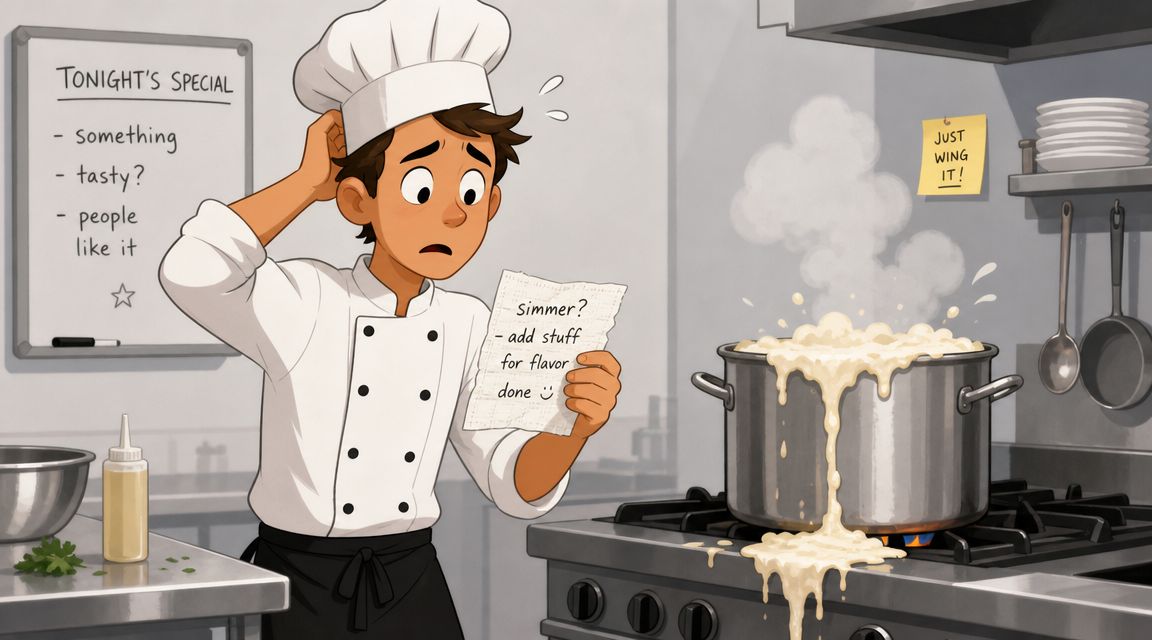
That's not admin gone wrong. That's revenue under pressure.
What bad handovers cost on the ground
In practical terms, weak handover documentation creates the same problems again and again:
- Delayed service: The incoming chef spends valuable time asking basic questions instead of getting organised for service.
- Waste and rework: Prep gets duplicated, mislabelled, or binned because nobody is certain what's usable.
- Menu inconsistency: Dishes go out differently depending on who guessed correctly.
- Compliance risk: Allergen controls become dependent on memory, which is the wrong place to keep critical information.
- Team friction: The permanent team gets frustrated because they feel they're carrying the incoming chef, even when the failure originates with the handover.
A verbal handover can work when the same tight team works the same kitchen every day. It falls apart when there's sickness, holiday cover, split sites, agency staff, or seasonal pressure.
Bad handovers don't just create confusion. They force your most expensive hours of the week to run on assumption.
Why this matters more in the current staffing market
The wider market changes the conversation. The UK hospitality labour shortage means managers don't have the luxury of waiting for ideal staffing conditions. The Office for National Statistics reported 88,000 vacancies in accommodation and food service activities in the three months to April 2026, which is why continuity now depends on bringing people in quickly and getting them productive fast. Clear notes on allergens, equipment, and local procedures protect that continuity far better than generic verbal briefings.
If you've ever had to make an emergency relief chef booking after bad cover exposed the real cost of kitchen disruption, you already know the pattern. The issue isn't only whether a chef turns up. It's whether your kitchen is ready to receive them.
The commercial view
Owners and GMs usually notice the obvious line on the P&L first. Agency cost. Overtime. Wastage. Refunds.
The more expensive part is harder to spot. A rough shift knocks staff confidence, guest trust, and management time. One poor handover can drag into the next day because prep plans, ordering, and cleaning standards all get distorted.
That's why handover documentation belongs in the same category as stock control, rotas, and allergen management. It protects the business when people change.
Why Solid Handover Documentation Is Non-Negotiable
A professional kitchen depends on clean transfers of responsibility. If nobody can say clearly what's happening, what's outstanding, and who owns what next, you haven't handed over anything. You've just passed stress to the next shift.
That's why handover documentation should be treated as an operating control, not a paperwork exercise.
Other high-pressure sectors already work this way
The strongest UK model comes from healthcare. The NHS uses structured handover principles because failures in information transfer are a known safety risk. The Professional Record Standards Body handover principles, published in 2018, set out that handovers should capture the purpose, clinical context, current situation, outstanding tasks, and named responsible people. That thinking sits inside a system employing about 1.6 million staff in England, which shows how seriously large shift-based organisations treat the problem. The same review also found handovers are often brief and variable, with 15 minutes reported as the most common duration by 44.9% of respondents, while 41.8% said the handover was verbal only, which underlines why written records matter when teams change quickly or work across sites, as outlined in this UK handover study discussing PRSB principles and NHS workforce scale.
Kitchens aren't hospitals, but the transfer problem is similar. One team stops. Another team takes over. If the information is weak, the risk moves straight into live service.
What proper documentation protects
A solid handover protects four things that GMs care about.
| Area | What the handover needs to prevent |
|---|---|
| Service consistency | Dishes changing because the incoming chef is guessing standards |
| Food safety | Allergen information living in conversation instead of written control |
| Margin | Waste, duplicate prep, missed stock issues, and poor ordering decisions |
| Team stability | Permanent staff being pulled off their jobs to explain basics mid-shift |
This is why I'd rather see a short, well-kept handover sheet than a long folder nobody updates. If it tells the next chef what matters now, it has value.
Practical rule: If the incoming chef has to ask three different people how your kitchen works, the handover has already failed.
What doesn't work
A lot of venues think they have a handover process when what they have is one of these:
- The memory method: One chef keeps everything in their head. Fine until they're off sick.
- The notebook graveyard: Useful notes buried in old diaries, prep books, and loose paper.
- The WhatsApp scramble: Critical decisions hidden inside message threads.
- The verbal rush: A quick chat at the door while both chefs are already under pressure.
Each one creates avoidable exposure. None of them gives management a reliable record of what was passed over, what was understood, and what still needs attention.
The commercial case is simple. Good handover documentation protects service, protects standards, and gives temporary or newly hired chefs a fair chance to perform properly from the start.
Building Your Kitchen Handover Document
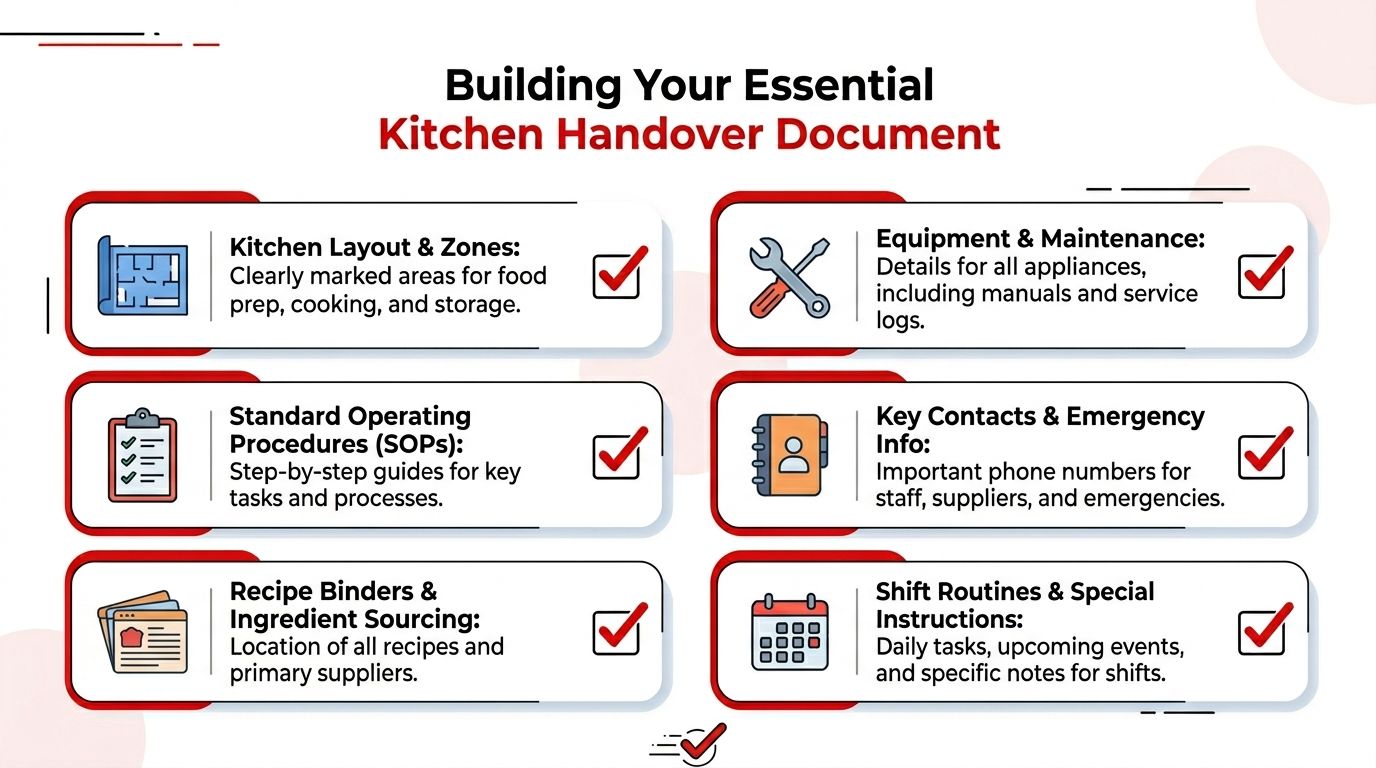
The best handover document isn't clever. It's usable. One place, one format, updated properly, easy to read on a busy shift.
The key principle is simple. Treat the handover as a controlled transfer of ownership. The useful version isn't scattered across texts, paper notes, supplier emails, and someone's memory. It sits in one structured record that covers status, access, contacts, and decision authority, which is the same single-source-of-truth approach recommended in this guide to project handover steps and best practices.
Start with what the incoming chef needs today
Don't write handovers like office reports. Write them for the chef who has just walked in and needs to run service.
Include:
- Shift context: What service is coming, what bookings matter, what events affect prep or timing.
- Current status: What's already done, what's in progress, what isn't started.
- Outstanding tasks: What must be completed before service, after service, or before the next delivery.
- Named contacts: Who signs off wastage, who approves substitutions, who handles front-of-house escalations.
If you need a useful benchmark for role clarity, a strong sous chef job description helps identify what should sit with the incoming chef and what should stay with management.
Document the kitchen as it actually behaves
A handover should reflect real operation, not ideal operation.
Equipment and maintenance
This section saves more stress than is often realised. Don't just list appliances. Record the quirks.
- Specific faults: “Combi oven door seal is weak. Check before pre-heat.”
- Reset routines: “Grill trips if extraction isn't started first.”
- Cleaning priorities: “Plancha must be closed down in this order.”
- Repair status: “Dishwasher engineer booked. Use backup rinse process.”
That sort of note is gold to a relief chef. It prevents the avoidable mistake that management later calls “a communication issue”.
Food, allergens and suppliers
This part must be sharp and current.
Include recipe location, allergen matrix location, key prep standards, supplier names, delivery cut-off times, and any product substitutions already approved. If your fish supplier is out of one line and the menu has been adapted, write it down. If one dessert contains a last-minute garnish change, write it down.
A handover note should answer the questions a chef shouldn't have to chase during service.
If allergen information only exists in the head chef's head, you don't have a system. You have luck.
Stock and purchasing position
The incoming chef needs to know what's tight, what's over, and what has already been ordered.
A simple layout works well:
| Item | Status | Action needed |
|---|---|---|
| Core meat lines | Adequate or low | Order, check, or no action |
| Dairy and produce | Delivery due or delayed | Follow up if not arrived |
| Dry goods | Running short | Approve substitute or amend prep |
| Function stock | Allocated | Do not use for general service |
No drama. Just clarity.
Include the people side
Kitchens go wrong when incoming chefs don't know who can make decisions.
List:
- Duty manager contact
- Head chef or regional chef contact
- Maintenance contact
- Supplier contact for urgent shortages
- Front-of-house lead for service coordination
Also note team strengths and limitations. Not as gossip. As operating context. If the KP is new, if a CDP is solid on garnish but weak on section organisation, or if front of house needs dishes called a certain way for a function, put it in plain language.
The finished document should let a competent chef step in, get orientated, and take control without chasing five separate sources of truth.
The Handover Process Workflow From Start to Finish
A good document on its own doesn't solve much. Plenty of kitchens have forms that nobody reads, folders nobody updates, and shared files full of old information. The value sits in the workflow.
For handover documentation to work, the process has to show that the kitchen is operationally ready, not merely documented. In facilities and operational environments, handover is only complete once there's a final walkthrough, the right records are transferred, and responsibility is formally accepted. The equivalent for kitchens is a handover pack covering equipment status, allergen notes, stock position, and a clear sign-off, as described in this end-to-end handover guidance focused on readiness and sign-off.
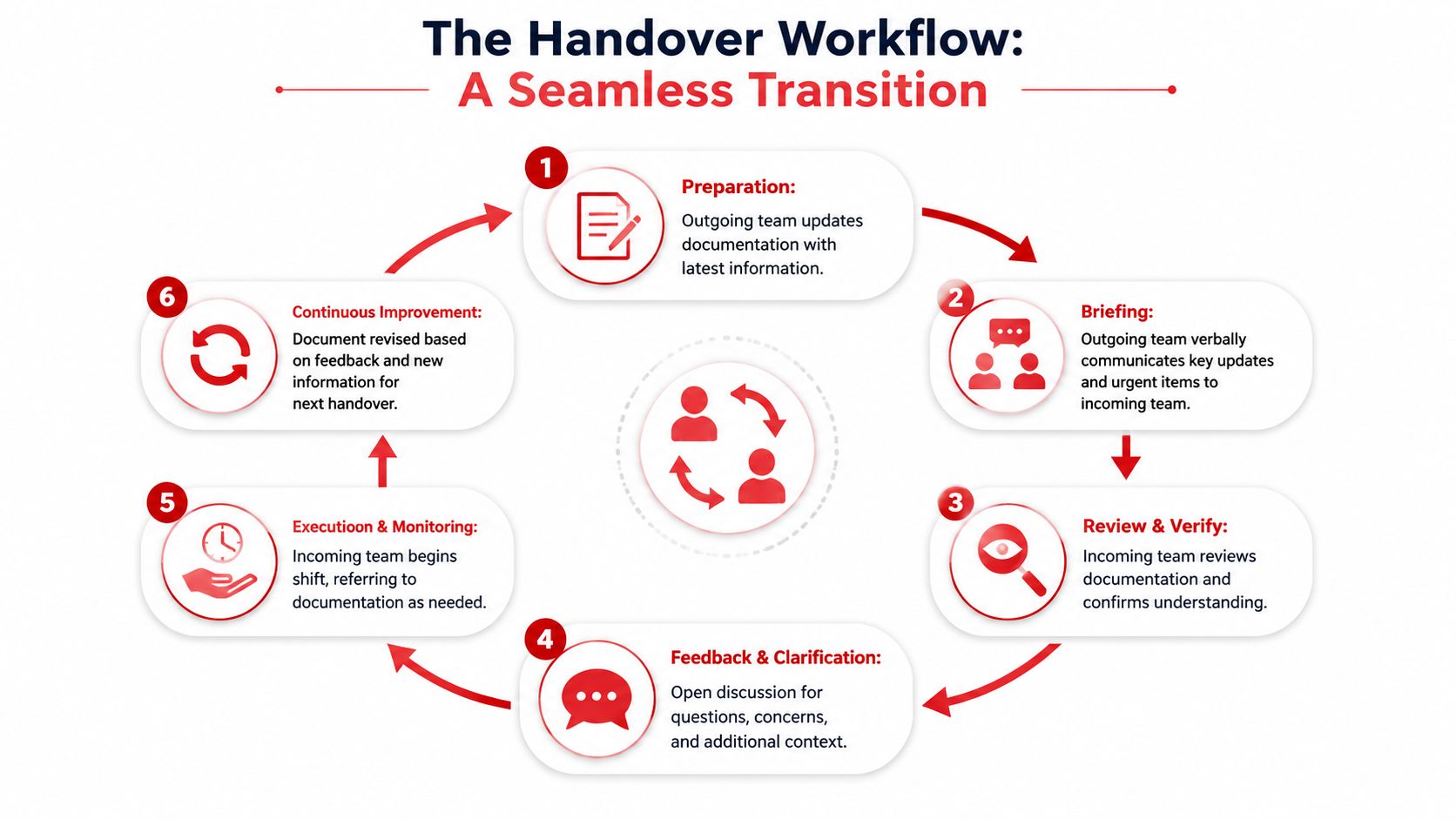
A simple workflow that kitchens can actually maintain
This works for a permanent hire, a weekend temp, or a chef arriving to cover sickness in Dorset, Wales, Bristol, or a hotel group site in Berkshire.
Update the document before the handover
The outgoing chef updates the current version at the end of the shift, not the day after. Live issues should still be fresh.Send it before arrival where possible
If the incoming chef can read the handover before stepping into the kitchen, they arrive with better questions.Walk the kitchen physically
The document and the kitchen must match. Show storage, prep flow, critical kit, cleaning points, and anything unusual.Clarify decision lines
Tell the incoming chef who can authorise menu changes, stock substitutions, and late purchasing.Confirm acceptance
The incoming chef should explicitly confirm they understand the status of the kitchen and what they are taking over.Revise after service if needed
If something was unclear, improve the document before the next handover.
What the walkthrough should cover
A proper walkthrough is short but deliberate. It should cover the areas where assumptions become expensive.
- Equipment readiness: What's fully operational, what's temperamental, what's out of action.
- Food safety controls: Allergen folder location, date labelling expectations, cleaning critical points.
- Stock reality: Not just what the stock sheet says, but what's useable now.
- Service pressure points: Functions, large tables, menu items likely to bottleneck.
- Support routes: Who answers if there's a supplier issue, maintenance issue, or management decision needed.
The handover isn't complete when the document is written. It's complete when the incoming chef can operate safely and confidently.
What sign-off looks like in practice
This doesn't need bureaucracy. It needs clarity.
A basic sign-off can include the date, shift, outgoing chef name, incoming chef name, and confirmation that key points were reviewed. If you're running multiple sites in Reading, Slough, Windsor, or Devon, this matters even more because management won't always be standing in the kitchen to spot gaps.
Without sign-off, disputes become guesswork. With sign-off, there's a clear line showing where responsibility changed hands.
Digital Tools and Templates for Efficient Handovers
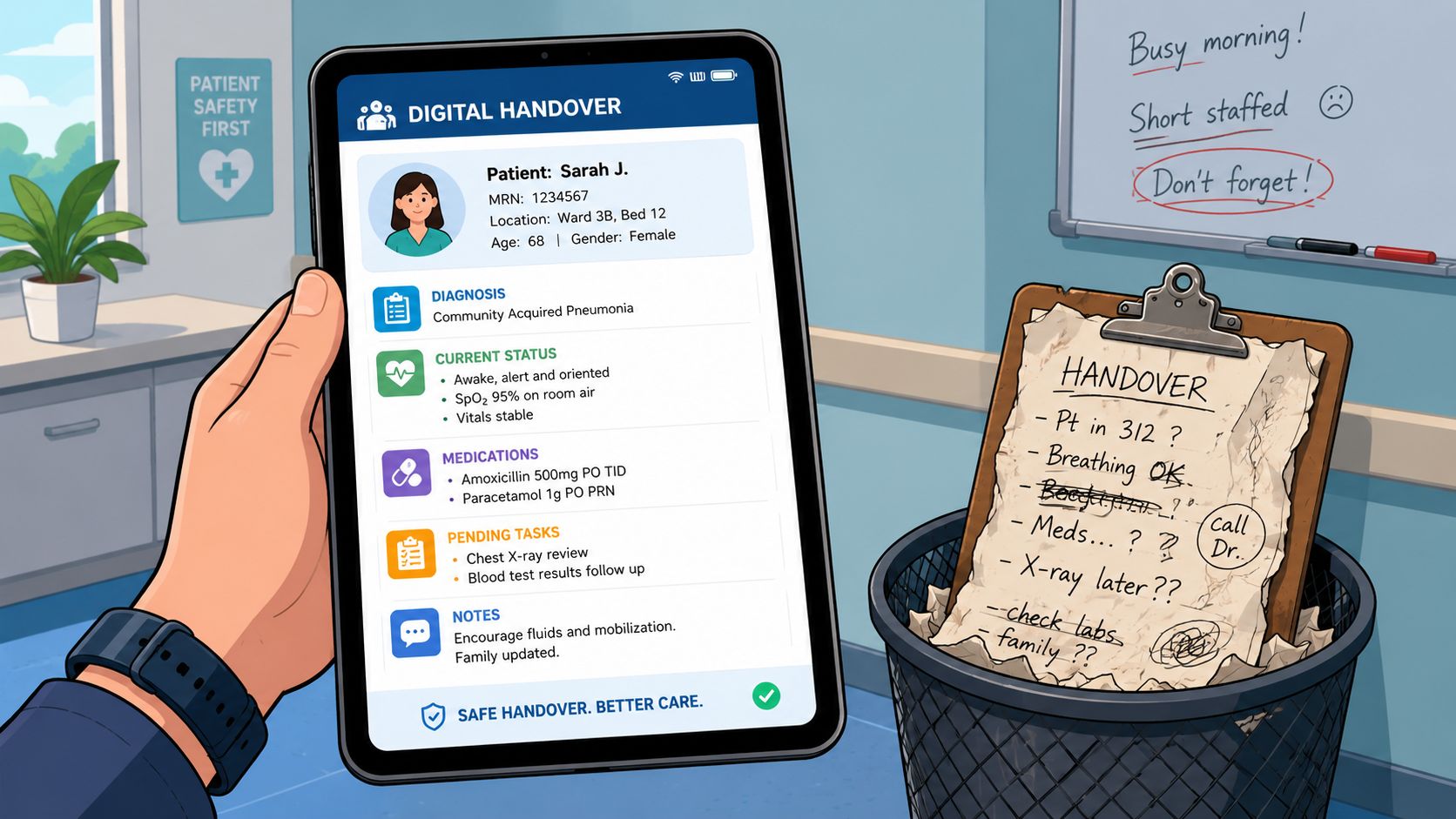
Friday lunch. Your sous chef has called in sick, agency cover is due in 40 minutes, and the last handover is on a grease-stained sheet clipped behind the pass. That is how kitchens lose money. The problem is not the temp chef. The problem is a kitchen that cannot pass on usable information quickly.
Paper still works for fast notes during prep, but it breaks down as a handover system. Sheets go missing. Old versions stay in circulation. Critical details end up in someone's pocket, on a fridge door, or buried in a group chat. In a market short on reliable chefs, that is a commercial risk. Good digital handovers give you a current record, reduce avoidable mistakes, and make the site easier for relief chefs to step into without losing the first hour to guesswork.
A healthcare study on handover quality found better completion rates once teams used a more structured approach, as reported in this BMJ Open Quality study on improved handover note completion. Kitchens are not hospitals, but the operational lesson carries over. Standard format beats informal memory every time.
What works best in hospitality
The best tool is the one your team will update during a live week, not the one that looks impressive in a demo. For most operations, a shared document or structured folder is enough if the format is fixed and access is controlled.
| Tool | Works well for | Watch out for |
|---|---|---|
| Google Docs | Single-site kitchens and quick updating | Version control slips if everyone edits casually |
| Microsoft OneDrive or SharePoint | Hotel groups and multi-site operations | Needs clear permissions and folder discipline |
| Kitchen management apps | SOPs, cleaning, tasks, and recipe storage | Becomes clumsy if nobody owns the upkeep |
| Time-sensitive alerts | Poor as the main record because key details disappear up the thread |
Chat should support the handover, not replace it. “Fish supplier delayed” belongs in a message. Allergen exceptions, broken kit, prep gaps, and service notes belong in a document that can still be found six hours later.
Operators reviewing their staffing model often find the handover standard matters just as much as who supplies the chef. This guide on working with temp chef agencies is useful if you are trying to reduce first-shift friction and get agency cover productive faster.
A simple digital template you can use
Keep the headings fixed across every shift and every site. That consistency is what makes the document useful under pressure.
- Date and shift
- Incoming chef and outgoing chef
- Service overview
- Prep completed
- Outstanding prep
- Equipment issues
- Allergen or compliance notes
- Stock shortages or substitutions
- Bookings, events, or VIP notes
- Supplier or maintenance actions pending
- Escalation contacts
- Sign-off
If you operate multiple venues, do not let each kitchen invent its own format. Site details will differ. The template should not. That is how you make the business relief-ready. A good temp chef can adapt to your menu and standards. They should not have to decode four different handover styles across four properties.
For teams that want a visual explanation of how to structure the process, this short video is useful:
Keep it accessible from anywhere
Access matters as much as format. A head chef covering two sites should be able to check the latest handover on a phone. A GM should be able to confirm what was passed on without coming into the building. A relief chef should be able to read the basics before walking into service.
That is where digital records earn their keep. They protect continuity when the rota changes at short notice, which is now routine in many UK kitchens. Used properly, handover documentation works like insurance against the chef shortage. It keeps the kitchen readable to incoming cover, protects service, and reduces the revenue loss that comes from confusion, waste, and preventable errors.
Making Your Kitchen Relief-Ready
Friday lunch service starts in 40 minutes. Your sous chef has called in sick, the senior CDP is covering two stations, and the relief chef walking through the door has never seen your kitchen before. At that point, handover documentation stops being admin. It becomes revenue protection.
A relief-ready kitchen can take a staffing hit without losing control of service, margins, or standards. In a market where chef shortages are now part of normal operations, that matters. Good documentation gives incoming cover a usable picture of the kitchen before the first ticket lands. That is what keeps a bad shift from turning into comped meals, wasted prep, stock errors, and a brigade that spends the rest of the week firefighting.
What relief-ready looks like in practice
You can spot it quickly.
The incoming chef knows where to start, who is in charge, what is off, what cannot change, and which problems are already in motion. They are not digging through WhatsApp messages, asking three people the same question, or finding out mid-service that the combi has a fault no one mentioned.
A kitchen that is ready for relief cover usually has:
- One current handover record that reflects the live position, not last week's
- Clear allergen, HACCP, and compliance notes that can be checked fast
- Accurate equipment notes with faults, temporary fixes, and anything unsafe to use
- Named decision-makers for service calls, stock substitutions, and customer issues
- Visible sign-off so everyone knows who handed over and who accepted responsibility
That standard matters because temporary chefs work best when the site is readable from the outset. Strong chefs can adapt to menu style, pace, and team dynamics. They should not have to reconstruct your operation from scraps.
Why this protects revenue
Poor handovers cost money in quiet ways first, then all at once.
A missing note about prep levels leads to over-ordering or emergency buying. Unclear allergen information slows service and raises risk. An undocumented equipment fault knocks out capacity at the worst time. If a relief chef spends the first hour guessing, the kitchen pays for it in labour waste, delayed tickets, stressed front of house, and avoidable refunds.
This is why I treat handover discipline as commercial protection. It gives professional temp chefs a fair chance to perform properly from minute one. In the current UK chef shortage, that is not a nice extra. It is the difference between using temporary cover well and burning cash while blaming the wrong problem.
Operators who want better results from cover shifts should understand how temp agencies work in hospitality and what makes temporary chef cover succeed on site.
A kitchen that can brief incoming chefs clearly is easier to staff under pressure and less likely to lose money when the rota breaks.
The standard to aim for
The test is simple. A competent relief chef should be able to arrive, read the handover, walk the kitchen, ask a few sharp questions, and take over service with confidence.
If they are piecing together stock position, equipment status, booking pressure, and house rules from fragments, the kitchen is still exposed.
Relief-ready kitchens do not depend on luck or memory. They depend on clear records and chefs who can step into that structure and keep service moving.
If you need relief chefs, temporary chefs, permanent chef recruitment, yacht chefs, villa chefs, or wider hospitality staffing support anywhere in the UK, contact Relief Chefs UK. Established in 2013, they support independent pubs, restaurants, boutique hotels, private households, and multi-site operators with vetted chef cover that can step into a well-prepared kitchen and keep service moving.