
Working with Temp Agencies: A Hospitality Manager’s Guide
15 May 2026
Friday afternoon. Full restaurant. Wedding party in-house. Terrace packed if the weather holds. Then your sous chef rings and says he can't come in.
That's the point where a lot of operators make the wrong decision. They either panic-book the first available chef, or they ask the team already on shift to “just push through”. Both choices usually cost more than the agency fee you were trying to avoid.
Working with temp agencies properly isn't about plugging a hole in the rota. In hospitality, it's about protecting service, keeping standards steady, and stopping one absence from turning into a bad weekend.
Why Temp Agencies Are Now a Core Kitchen Strategy
A busy hotel in Windsor doesn't get a quieter service because someone's gone off sick. A coastal restaurant in Devon doesn't get to pause bookings because the grill chef has walked. A pub in Dorset can't tell a bank holiday crowd that the kitchen is short and hope guests stay cheerful.
That's why temp cover has moved from emergency measure to operating model.
The UK temp market is not a fringe part of hiring. It's a long-established part of how employers keep trading. The staffing sector contributed around £38.7 billion to the UK economy in 2023, and hospitality employers continue to lean on flexible cover because vacancy pressure in accommodation and food service stays stubbornly high, as noted in this overview of UK temp staffing and labour-market demand.
What kitchen resilience looks like in practice
The mistake I see most often is treating agencies as a last resort. That mindset usually means no agreed rates, no preferred suppliers, no briefing template, and no plan for onboarding. By the time you need a chef, you're buying under pressure.
A better model is simple:
- Keep an agency bench ready so your team knows who to call when sickness hits
- Use temp chefs to absorb spikes such as race days, weddings, Christmas trade, summer volume, and staff holidays
- Protect permanent payroll instead of carrying excess headcount through quieter periods
- Stabilise service so the front of house team isn't firefighting a kitchen problem all evening
A rota gap is rarely just a staffing issue. It becomes a guest experience issue within hours.
For independent hotels, pubs, restaurants, yachts, and private households, the primary value is continuity. A capable relief chef gives you breathing room. You keep covers on the books, standards don't collapse, and your permanent team doesn't burn out trying to do two jobs each.
Operators seeking specialist hospitality cover usually begin with agencies that understand kitchens rather than general temp providers. That's the difference between receiving a chef who can contribute immediately and receiving someone who merely owns whites. If you're reviewing providers, start with agencies focused on hospitality staffing support rather than broad labour supply.
How to Vet Agencies and Avoid Costly Mistakes
Most agency problems start before the first shift. They start when a venue asks the wrong questions, accepts vague assurances, or assumes the agency has done what it says it has done.
A polished sales call means nothing if the chef arrives late, can't run the section, or has missing compliance documents.
Start with compliance, not personality
Before rates, before availability, before promises about “great people”, ask how the agency handles legal checks.
UK employers need a documented, multi-step compliance process for every hire, including temporary workers. Identity and right-to-work evidence must be collected and verified before the first shift, and relying on the agency's word without checking the evidence trail can expose the venue to civil penalties, as outlined in this guidance summary on right-to-work compliance workflows.
If an agency gets shifty on that point, end the conversation.
Questions worth asking before you book anyone
Use a short vetting script and listen carefully to how specific the answers are.
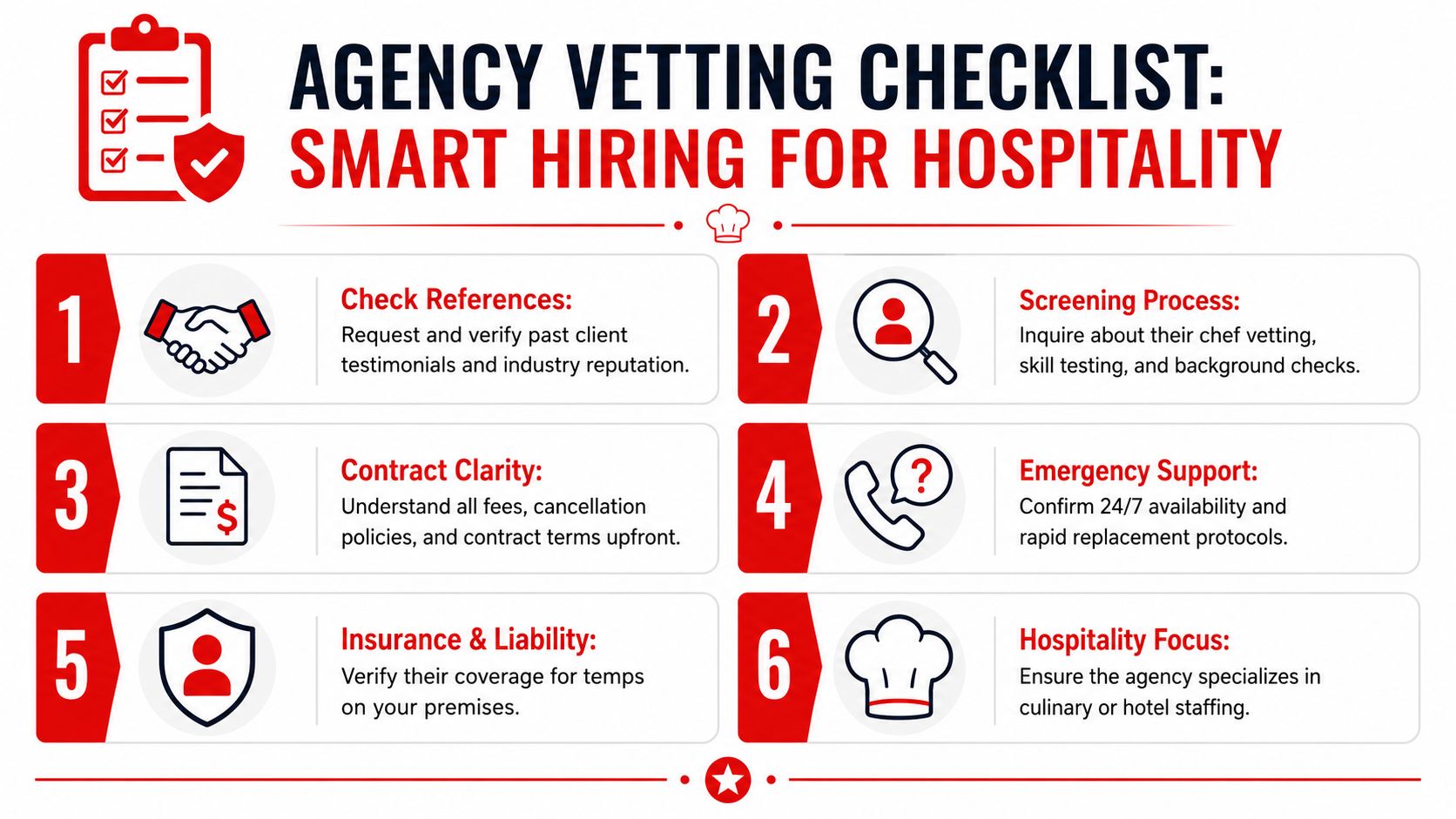
- How do you verify chef ability. Ask whether they assess section experience, service volume, food style, and level of independence.
- Who checks right to work and how is it recorded. You want a clear answer, not “we sort all that”.
- What insurance do you hold. Ask what cover applies while a chef is working on your site.
- What happens if the chef is a no-show. A serious agency should have an escalation path and a replacement process.
- Who do I call outside office hours. Hospitality problems rarely wait until Monday morning.
- Can you explain your replacement terms and cancellation terms plainly. If they need ten minutes to explain a basic booking, the contract probably favours them, not you.
Red flag: “We've got loads of chefs available” is not a useful answer. Ask what calibre, what background, and what sort of kitchens they've worked in recently.
Spot the body shops quickly
Some agencies sell speed and little else. They take the booking, ring around, and send whoever picks up. That isn't staffing. That's gamble-based procurement.
Watch for these warning signs:
Red flag: They can't describe the chef's recent kitchen environment in practical terms.
Red flag: They avoid discussing insurance, liability, or replacement responsibilities.
Red flag: They push for commitment before asking about your menu, section setup, equipment, team structure, or service style.
They should ask whether you need banqueting experience, fresh-food background, hotel breakfast volume, gastro pub pace, fine dining discipline, or private household discretion. If they don't ask, they can't match properly.
For buyers comparing providers for temporary work agency support in hospitality, the useful distinction is this. A recruiter sells availability. A proper staffing partner sells suitability, traceability, and accountability.
Why chef-led vetting matters
Chefs can usually spot kitchen exaggeration faster than recruiters can. That matters when someone says they can run sauce, pastry, banqueting, breakfast, and volume events with equal ease. Maybe they can. Plenty can't.
That's where a specialist model is more useful. Relief Chefs UK, established in 2013, works in chef staffing across relief cover, temporary chefs, permanent chef recruitment, yacht chefs, villa chefs, and wider hospitality support. The practical point is not branding. It's that a chef-led agency tends to ask sharper questions about service, section fit, and whether the person can genuinely hold the pass when things get busy.
Understanding Contracts and Negotiating Fair Prices
The cheapest quoted rate is often the most expensive booking.
That catches out a lot of operators, especially when they're trying to cover a weekend in Bristol, a seasonal push in Wales, or a string of shifts across a multi-site group. They look at the hourly figure, compare one agency against another, and stop there. The actual decision sits behind the quote.
Look at total landed cost
When you assess agency pricing, compare the total landed cost, including fees, payroll admin, holiday pay, and replacement guarantees, against the actual cost of a rota gap such as cancelled covers, manager overtime, and reputational damage, as discussed in this breakdown of temporary staffing cost trade-offs.
That comparison changes the conversation.
A more expensive chef who turns up, fits the brief, and gets through service cleanly can be better value than a cheaper booking that causes rework, comped meals, or a head chef dragged back in on a day off.
Where contracts usually hide the pain
Read these areas slowly. Margin leaks out from these spots.
| Contract point | What to check | Why it matters |
|---|---|---|
| Minimum shift length | Whether you pay a minimum even if service drops | Quiet midweek services can still trigger a full charge |
| Travel and accommodation | Especially for rural sites or hard-to-reach locations | Wales, Devon and remote countryside venues often need clarity upfront |
| Cancellation terms | Notice period and what happens if trade changes | Weather, events and function numbers move quickly |
| Replacement cover | Whether the agency credits, replaces, or shrugs | This matters more than a polished invoice |
| Temp-to-perm terms | Any transfer or introduction fee | Useful if a relief chef turns into a long-term fit |
| Payroll handling | What sits inside the rate and what does not | Avoid assumptions that create invoice disputes |
What fair negotiation sounds like
Good negotiation is not beating an agency down on rate. It's getting a clear commercial arrangement that works on both sides.
Ask for:
- A plain-English rate breakdown so you know what sits inside the charge
- Defined replacement terms for no-shows, skill mismatch, or early removal from shift
- Site-specific travel agreements where your property is hard to reach
- Clear invoicing rules so you can reconcile shifts against bookings without argument
- A sensible cancellation window that reflects how hospitality trading moves
If an agency wants trust, its contract should be readable by an operations manager at the end of a double shift.
For longer-term cover, contract staffing can make more sense than ad hoc panic buying. Buyers exploring contract employment agency options for chef cover should compare flexibility, replacement terms, and how easy it is to scale up or down by site and season.
Don't negotiate blind
If you're running a boutique hotel in Berkshire or a pub near Reading, calculate two numbers before you sign anything. First, what a missed shift really costs your operation. Second, what poor cover does to team morale for the next week.
That gives you an advantage. You stop buying a line on an invoice and start buying continuity.
Writing a Clear Request and Onboarding for Success
Most bad temp bookings start with a bad brief.
If your request says “need a chef ASAP”, don't be surprised when the match is hit and miss. Agencies can only place accurately when the brief reflects the actual conditions of your kitchen.

What a useful booking request includes
A proper request should tell the agency what success looks like on shift.
Use this structure:
- Role level. CDP, Junior Sous, Sous, Head Chef, breakfast chef, pastry chef.
- Section or service need. Grill, sauce, banqueting, breakfast, prep-heavy production, events.
- Dates and hours. Include start time, finish expectation, and whether there's a split shift.
- Venue type. Hotel, fresh-food pub, restaurant, private household, yacht, villa.
- Service style. A la carte, functions, tasting menu, high-volume brasserie, gastro pub.
- Menu profile. Seasonal British, fine dining, premium casual, wedding volume, private dining.
- Kitchen reality. Covers, team size, equipment limits, whether they'll work solo or in brigade.
- Uniform and kit. What you provide and what they must bring.
- Travel and parking. Especially important for remote venues.
- Non-negotiables. Allergens competence, banqueting confidence, breakfast speed, stock control, calm on the pass.
The more detail you give before the shift, the less drama you deal with during service.
A sample request you can actually send
Here's the level of detail that gets better results:
Need a Sous Chef for a boutique hotel in Windsor for Friday to Sunday. Mix of breakfast, lounge menu, and evening restaurant. Must be comfortable running service with a small team and stepping onto the pass if needed. Fresh-food background essential. Approximate shift pattern shared on confirmation. Smart whites and knives required. Parking on site. Kitchen is compact, so speed and organisation matter.
That brief tells an agency far more than “urgent sous chef needed”.
The first 15 minutes on site matter more than people think
Even a strong relief chef loses time if nobody shows them the basics. A rushed handover creates avoidable mistakes, especially in allergen-heavy environments or kitchens with awkward layouts.
Use a short arrival checklist:
- Confirm who they report to on this shift.
- Show the kitchen layout fast. Fridges, dry store, pass, wash-up, extraction controls.
- Run through allergens and critical safety points specific to your menu.
- Explain prep status and service pressure points.
- Set the section boundaries so they know what they own.
- Confirm break policy, staff food, and clocking process.
- Give one named contact for questions during service.
After the handover, this video is useful background for teams tightening up their staffing process and shift readiness:
Brief properly and treat temps like part of the brigade
No relief chef does their best work when they're treated like an outsider who's there to absorb blame. If you want a temp to settle fast, give them proper context, proper access, and clear expectations.
That applies whether you're bringing in relief chefs for one emergency dinner service, hiring temporary chefs for a month of holiday cover, or testing someone who may eventually suit a permanent chef recruitment brief.
Managing Performance and Building a Strategic Partnership
If every booking starts from scratch, you're wasting money and creating avoidable risk.
The operators who get the most from working with temp agencies don't treat it as one-off purchasing. They treat it as an ongoing supply relationship. That changes how cover performs over time.
Track the KPIs that actually matter
A lot of agencies talk about speed. Speed matters, but speed on its own tells you very little.
A better benchmark is to track time to fill alongside fill rate, because fill rate shows whether the agency staffs the work it agrees to take on. Agencies that monitor those numbers properly tend to run a more disciplined supply chain, which is especially important for hospitality venues that need dependable cover during peak service, as explained in this KPI guide for staffing agencies.
Use a simple review sheet after each booking.
- Response speed. How quickly did the agency confirm options after the request?
- Accuracy of match. Did the chef fit the section, level, and service style?
- Reliability on the day. Arrival, readiness, attitude, communication.
- Kitchen impact. Did they reduce pressure or add to it?
- Rebook value. Would you ask for that chef again?
Build a feedback loop, not a complaint trail
Poor agencies only call when they want another booking. Good ones want feedback while it's still useful.
If a chef was excellent on breakfast but less strong on banqueting, say so. If someone handled volume brilliantly in Slough but wasn't right for a finer dining setup in Berkshire, say that too. Those details help future matching.
Keep notes by chef, by site, and by service type. Memory gets selective when you're busy.
A practical system looks like this:
| Review area | What to record | Why it helps |
|---|---|---|
| Skill fit | Section strength and weak spots | Improves future placement accuracy |
| Behaviour | Calmness, teamwork, communication | Protects brigade culture |
| Service outcome | Whether the chef held up under pressure | Separates CV from reality |
| Site fit | Best suited to hotel, pub, restaurant, yacht, or private household work | Supports smarter repeat bookings |
Why repeat booking beats constant shopping around
The longer you work with one competent agency team, the better your outcomes usually become. They learn your menu style, your pain points, your start times, your standards, and who works well with your permanent brigade.
That's when the relationship becomes commercially useful. A relief booking today can become a permanent hire later. A temp chef who lands well in a restaurant may also suit a sister site, a seasonal coastal operation, or specialist work in private villas and yachts.
If you run multiple properties, ask for one point of contact and standard briefing formats across sites. It saves time and cuts confusion.
Common Pitfalls and Your Emergency Contingency Plan
The biggest mistake with temp cover is assuming the booking itself is the contingency plan. It isn't. It's only one layer.
Things still go wrong. A chef gets delayed. Someone arrives and isn't at the level promised. An agency stops answering the phone the moment there's a problem. That's why your backup plan needs to sit behind the booking.
The failures that hurt most
Unregulated providers can create very real risk. Agencies may offer a quick fix, but poor reliability, inconsistent quality, and even wage theft are all part of the potential dangers if you buy from the wrong supplier. Venues should do due diligence on insurance, compliance record, and replacement SLAs before engaging an agency, as discussed in this analysis of temp staffing risk and worker protection.
The common failures tend to look like this:
- No-show on shift start
- Chef oversold on skill
- No replacement process
- Poor communication once the booking is live
- Invoice disputes because terms were unclear at the start
Your emergency plan should assume at least one thing will go wrong at the worst possible time.
A practical contingency plan for live service businesses
Keep it operational, not theoretical.
Maintain a first-call list
Have your preferred agencies ranked before you need them. Not after.Set an internal escalation point
One manager owns the staffing issue. Not three people sending different messages.Create a reduced-service menu option
If cover fails, you need a version of service your team can still deliver properly.Cross-train where sensible
Good kitchens can absorb short shocks because prep, breakfast, and service basics aren't trapped with one person.Write down replacement expectations
If an agency can't explain what happens in the first hour after a no-show, assume there is no plan.
What good support looks like under pressure
The test of an agency isn't how friendly they are at enquiry stage. It's what they do when the chef calls with a motorway problem, when your function numbers jump, or when the original match clearly isn't right.
Process matters here. Fast response, a real out-of-hours contact, proper replacement terms, and clean communication are the controls that keep kitchens trading.
For operators who need nationwide cover across pubs, restaurants, boutique hotels, private households, yachts, and villas, Relief Chefs UK provides chef staffing support with a chef-led model, right-to-work-checked placements, transparent pricing, and 24/7 support. In practice, that's the standard buyers should expect from any agency they trust with service continuity.
If your kitchen is carrying vacancies, relying on manager overtime, or one sick call away from a compromised service, now's the time to tighten up how you handle temp cover. Contact Relief Chefs UK to discuss relief chefs, temporary chefs, permanent chef recruitment, yacht chefs, villa chefs, and wider hospitality staffing support across the UK.
Call the team.
Office 01392 715474 · info@reliefchefs.co.uk