
Top Hospitality Recruitment Agencies Leeds: Your 2026 Guide
3 June 2026

Friday lunch prep is under way. Deliveries are half checked in, bookings are healthy, and your senior chef texts to say they can't make service. In that moment, most Leeds operators don't have a recruitment problem. They have a trading risk, a wage risk, and a standards risk.
The wrong agency makes that worse. You pay panic rates, accept a weak brief over the phone, and end up with someone who can cook but can't slot into your kitchen. Service slows, the team loses confidence, and management spends the day firefighting instead of running the business.
That's why the discussion around hospitality recruitment agencies in Leeds needs to be more hard-headed. Speed matters, but reliability, compliance, and fit matter more. If a staffing partner can't prove how they vet chefs, confirm right to work, and reduce no-show risk, they're not addressing the core issue.
The Real Reason Leeds Hospitality Needs a Better Staffing Plan
A busy Leeds restaurant on a Friday doesn't get much margin for error. If a sous chef drops out in the morning, the issue isn't just covering a section. The issue is whether the pass still moves, whether prep gets finished properly, whether the junior team gets support, and whether guests notice the strain by 7pm.
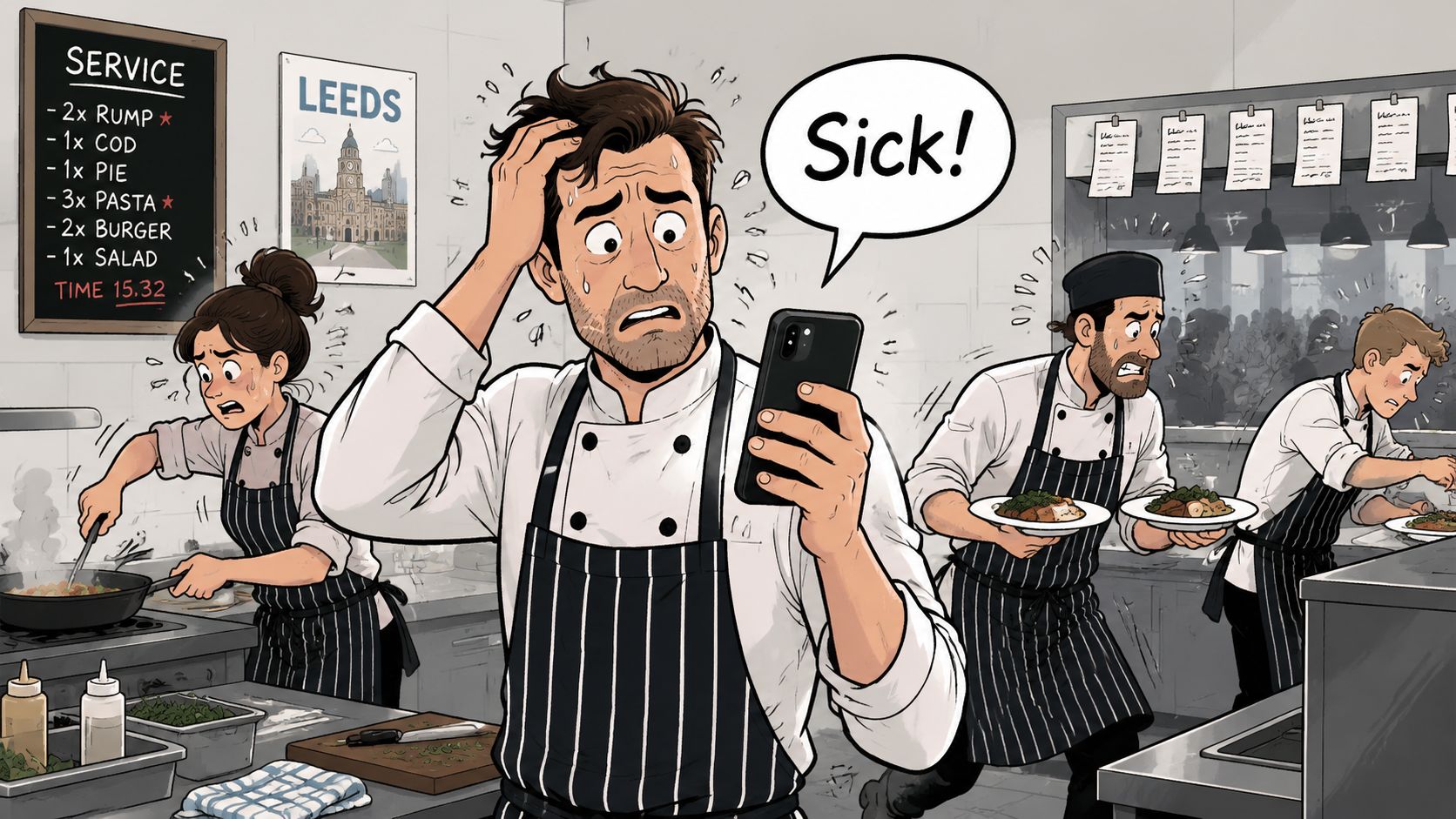
In practice, poor staffing decisions hit three places at once. They hit service quality, because rushed cover rarely understands your menu or pace. They hit labour control, because last-minute booking usually costs more than planned cover. They hit morale, because your reliable people end up carrying the shift.
The cost of panic booking
Operators usually know when they're gambling. They ring whoever answers first, accept broad assurances, and hope the chef who turns up can handle the section. Sometimes that works. Often it creates another problem by the middle of service.
Practical rule: If your agency process starts only when someone calls in sick, you're already late.
The wider market pressure hasn't gone away. The UK's hospitality sector has long faced high vacancy and turnover pressures, with roles repeatedly being among the hardest to fill, which is why agency support has become part of operating continuity for venues during peak periods and shortages, as noted by Berkeley Scott's hospitality recruitment overview.
What stable kitchens do differently
The stronger Leeds venues usually have a plan before they need it. They know which roles can be covered by relief chefs, which ones need longer temporary support, and which gaps point to a permanent hire problem.
That changes the conversation from “Can you send anyone?” to something much more useful:
- Urgent cover: Keep service running today without dropping standards.
- Seasonal reinforcement: Add kitchen strength for busy trading periods.
- Permanent replacement: Stop repeating the same staffing crisis every few weeks.
If you treat agency support as part of your operating system, rather than a distress purchase, you make better decisions under pressure.
Decoding the Leeds Hospitality Staffing Landscape
Leeds gives operators choice. That sounds positive, but choice also creates noise. If every agency promises fast chefs and reliable service, buyers need a better way to separate sales language from actual delivery.
The local market is busy enough to support specialist recruiters. According to Agency Central's Leeds catering recruitment listings, Leeds has at least 6 local recruitment agencies listed for the catering and hospitality sector within a national market of 274 agencies. That tells you two things. First, Leeds is an active local hiring market. Second, not every agency in that market will be equally useful to your venue.
Why local density is helpful and risky
A city with several specialist agencies should, in theory, make life easier. You've got more routes to chefs, more short-notice options, and more coverage across city-centre and outer areas. The same directory also shows listings across LS1, LS2, LS27, and LS12 postcodes, which suggests hospitality hiring activity isn't boxed into one patch of the city.
That matters if you run:
- A city-centre hotel: You need agencies that understand early starts, breakfast shifts, banqueting support, and presentation standards.
- An independent pub outside the centre: You need practical brigade cover and people who can work fast without layers of hand-holding.
- An events or contract catering operation: You need numbers, reliability, and quick confirmation.
Why generic recruiters often miss the brief
A generalist agency may be able to send CVs. That doesn't mean they understand the difference between a chef who can handle volume and one who only interviews well. It doesn't mean they know what “can run grill on a packed Saturday” actually looks like.
For Leeds employers hiring regularly, it helps to watch the local talent flow as well as the local vacancy flow. The Leeds hospitality jobs market gives a useful sense of the types of roles and pressures active in the city.
A crowded market doesn't remove risk. It shifts the job from finding an agency to choosing one with a process you can trust.
The practical takeaway is simple. Leeds has enough agency activity to give you options, but not enough certainty to let you skip due diligence.
First Define Your Brief Before You Recruit
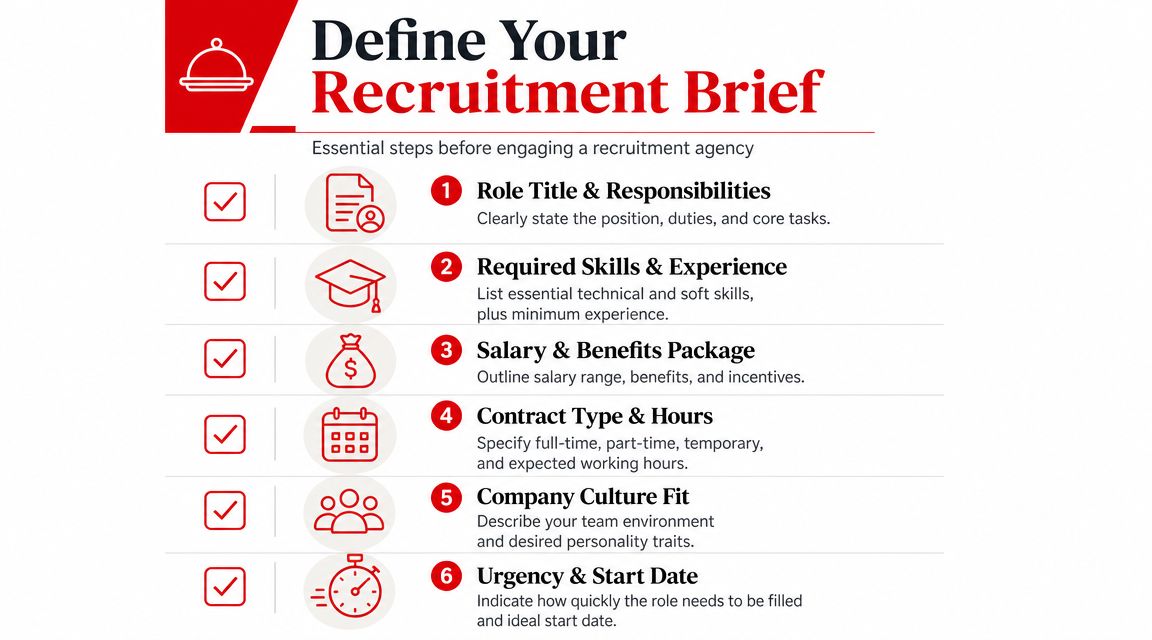
Most bad agency placements start with a weak brief. The venue says it needs “a chef urgently”, the agency fills the silence with assumptions, and the wrong person lands in the kitchen.
Start with the role, not the panic. If you need cover for tonight, say exactly what section is exposed, what service style you run, and what level the chef must operate at without support.
Three briefs that are not the same
An emergency relief booking, a seasonal temporary hire, and a permanent head chef search should never be briefed in the same way.
Emergency relief chef
You need someone who can walk in, read the kitchen quickly, and keep service stable. Menu complexity, section ownership, and shift timing matter more than long-term culture fit.Temporary chef for a busy period
This is about continuity. You need reliability across several weeks or months, not just one decent shift. Attitude, stamina, and consistency become more important.Permanent chef recruitment
Leadership style, food standards, labour awareness, and retention are critical. A strong trial shift helps, but the brief needs to cover more than technical skill.
A quick visual can help sharpen what you send to any agency.
What to include in the brief
A usable brief for hospitality recruitment agencies in Leeds should cover:
- Role level: Commis, CDP, Sous, Head Chef, pastry, breakfast, banqueting, private household, yacht chef, or villa chef.
- Kitchen reality: High volume pub, boutique hotel, fresh food restaurant, events, care, school, golf club, or private residence.
- Shift pattern: Days, evenings, split shifts, weekends, live-in, or seasonal rota pressure.
- Operational expectation: Running a section solo, stock control, ordering, prep management, allergen discipline, team supervision.
- Team fit: Calm under pressure, clean communicator, hands-on leader, low-ego operator.
The better your brief, the less time you lose reviewing chefs who were never right for the job.
If you're hiring across different needs, keep the routes separate. Use relief chefs for service protection, temporary chefs for planned flexibility, and permanent chef recruitment when you need a lasting fix.
The Non-Negotiable Vetting Questions for Any Agency
Most agency sales conversations stay too high level. “We can help quickly” isn't useful. “We've got great people” tells you nothing. The true test is whether the agency can explain its vetting process clearly, without dodging specifics.
That matters because most Leeds-focused agency pages rarely explain how they verify right-to-work, food-safety training, and insurance for short-notice cover. In a tight labour market, thorough vetting and rapid compliance matter more than generic speed claims, as highlighted by Adkins & Cheurfi's Leeds hospitality recruitment page.
Ask these questions before you book anyone
Use the call like an interview. If the answers are vague, move on.
How do you verify right to work in the UK?
You want a clear process, not “we check documents”. Ask who checks, when they check, and whether records are held before the chef is sent out.What food safety and compliance documents do you require?
A proper agency should be able to tell you what it asks for and how it keeps records current.What insurance position applies to temporary placements?
If the answer is fuzzy, that's a warning sign. You need to know where responsibility sits.How do you assess practical ability?
CV screening isn't enough. Ask how they judge section readiness, pace, and suitability for different kitchen styles.What happens if the chef isn't right?
Get the replacement process in plain terms before you need it.
Red flags operators ignore too often
Some warning signs sound harmless when you're in a rush. They aren't.
| Red flag | Why it matters |
|---|---|
| “We've got someone available now” with no detail | Availability isn't proof of suitability |
| No clear answer on compliance checks | You may inherit avoidable legal and operational risk |
| Heavy focus on CVs only | Hospitality performance is about service reality, not paper alone |
| No replacement procedure explained | You're exposed if the shift fails |
| Poor brief-taking | Weak input leads to weak matches |
What good agencies do behind the scenes
The better staffing partners ask awkward questions early. They want to know your menu, covers, section pressure, team size, and who the chef will report to. That usually means they're trying to reduce mismatch, not just fill a slot.
If you want a useful benchmark for what a stronger temporary staffing process should look like, the guide on working with temp agencies sets out the sort of operating detail buyers should expect.
If an agency can't explain its compliance and vetting process in plain English, don't trust it with your Saturday night kitchen.
Understanding Agency Service Models and True Costs
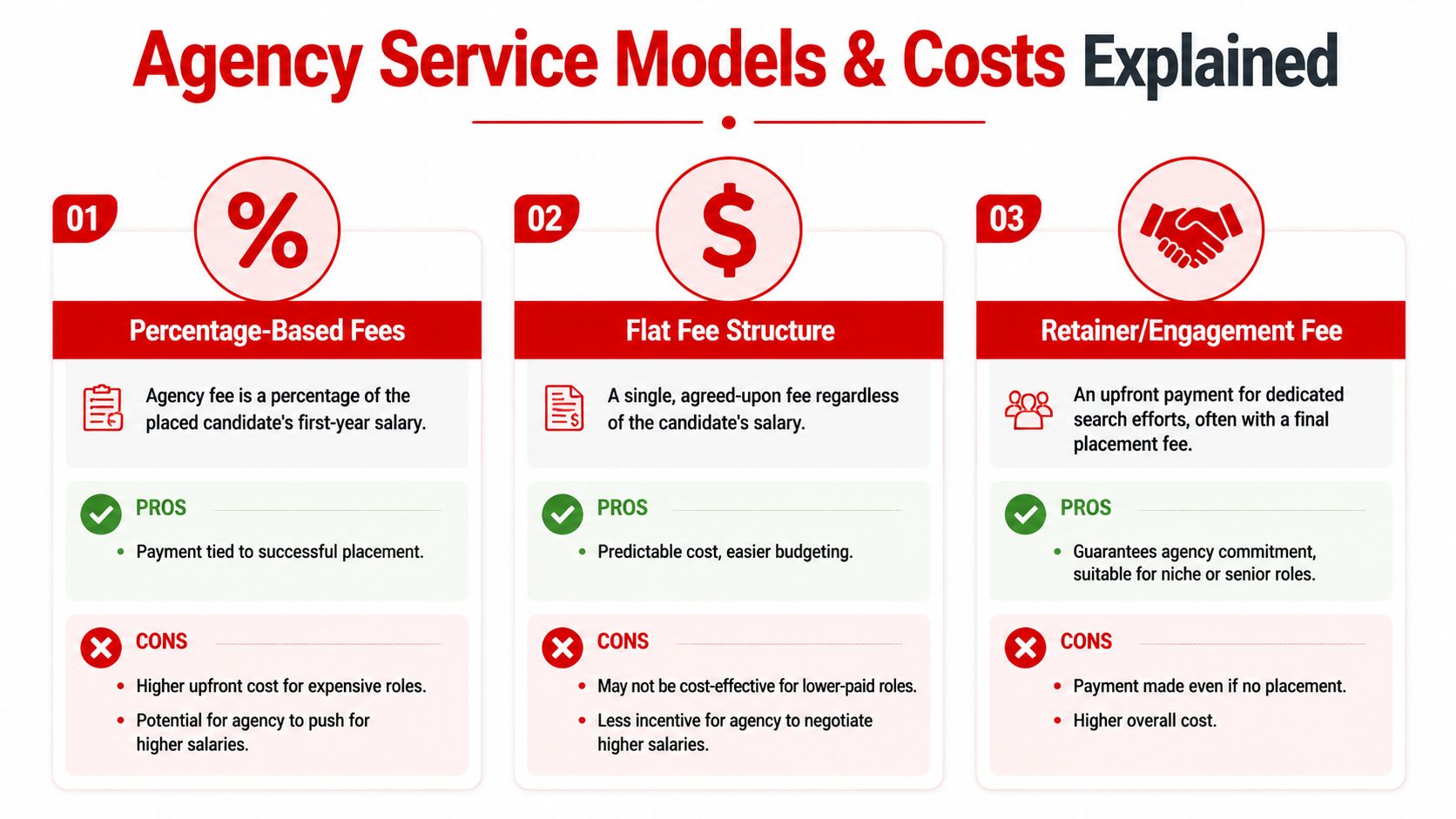
Agency pricing often looks simple until the invoice arrives or the placement goes wrong. The fee itself is only one part of the decision. The bigger issue is what protection, flexibility, and replacement support sit behind that fee.
Common models and where they fit
Hospitality operators usually come across three broad agency models.
| Model | Usually suits | Watch for |
|---|---|---|
| Percentage-based permanent fee | Permanent hires where the agency runs the search | Replacement terms and rebate detail |
| Hourly or shift-based temporary margin | Relief chefs and temporary kitchen cover | Minimum hours, cancellation terms, weekend rules |
| Retained or plan-based support | Regular hiring, multi-site groups, rolling staffing pressure | What service level is actually included |
A cheap-looking temporary rate can still cost you more if the chef is weak, late, or replaced badly. A permanent fee can be fair value if the brief is accurate and the guarantee is clear. Plan-based support can work well when your business has repeat demand and needs a dependable pipeline rather than one-off rescue calls.
Why temp-to-hire reduces mistakes
For a lot of Leeds venues, temp-to-perm is the sensible middle ground. A best-practice workflow is to use a 3–6 month temp-to-hire period to test a chef in real service conditions before making a permanent offer, which reduces mis-hiring risk by assessing reliability, skill, and team fit against measurable metrics rather than interview impression alone, according to Tri Search's hospitality hiring guidance.
That approach is especially useful when:
- A previous permanent hire failed quickly
- Your kitchen style needs practical proof, not just references
- You're replacing a key role and can't afford another miss
What to insist on in the agreement
Before signing anything, check the operational detail.
- Replacement terms: If the chef doesn't work out, what happens next?
- Notice rules: How much notice applies on both sides?
- Hidden extras: Are payroll, accommodation handling, travel expectations, or admin charges clearly stated?
- Conversion route: If you want to hire a temp permanently, what are the terms?
For employers comparing options, hospitality staff agency support is one example of a service-led model where the conversation goes beyond sending names and into matching the staffing route to the actual problem.
Why Leeds Venues Trust Relief Chefs UK
The agencies that perform well in hospitality usually share the same operating habits. They screen properly, take a detailed brief, keep a ready-vetted network active, and stay reachable when service pressure hits outside office hours.
That matters because passive outreach alone is weak. Direct outreach to busy hospitality professionals can generate response rates as low as 8–12%, so agencies need multi-channel pipelines rather than relying on one channel. The same source notes that a specialist approach uses structured screening, interviews, and a ready-vetted pool to move more quickly than passive adverts alone, as described by Mashd Recruitment's client guidance.
What that means in real operations
For a Leeds venue, a useful staffing partner should be able to support different pressure points without making you restart the process every time. That may mean relief chefs for emergency shifts, temporary chefs for a trading spike, permanent chef recruitment when the rota problem is structural, or broader hospitality staffing support around openings and peak periods.

Relief Chefs UK has operated since 2013 and provides nationwide chef staffing support across relief chefs, temporary chefs, permanent chef recruitment, yacht chefs, villa chefs, and wider hospitality staffing. For operators in Leeds, Bristol, Wales, Berkshire, Windsor, Reading, Slough, Dorset, and other busy hospitality markets, that kind of breadth is useful when one venue needs a same-week solution and another needs a longer staffing plan.
The buying decision is simpler than people think
You don't need the agency with the loudest promise. You need the one with the clearest process.
Use this short test:
- Can they explain vetting without hand-waving?
- Can they match the service model to your actual staffing issue?
- Can they support short-notice cover without creating new risk?
- Can they help stabilise the kitchen, not just plug a hole?
If the answer is yes, you've likely found a partner worth keeping close.
FAQs
How do I choose between hospitality recruitment agencies in Leeds?
Start with process, not price. Ask how they vet chefs, how they confirm compliance, how they handle replacement, and how they brief roles. Then judge whether they understand your type of operation.
When should I use a relief chef instead of recruiting permanently?
Use a relief chef when service is at risk now, when someone is off sick, when holidays create rota gaps, or when trade spikes suddenly. Use permanent recruitment when the gap is ongoing and the role needs long-term ownership.
Are temporary chefs suitable for boutique hotels and higher-standard kitchens?
Yes, if the brief is tight and the vetting is strong. The agency needs to understand your service style, guest expectations, and the level of independence the chef must bring on day one.
What should I ask about compliance?
Ask about right-to-work checks, food-safety documentation, insurance position, and how records are reviewed before a chef is sent to site. Don't accept vague reassurance.
Can one staffing partner cover different types of hospitality work?
Often yes. Many operators use one partner for relief chefs, temporary contracts, permanent roles, and specialist placements such as private household, yacht chef, or villa chef support, provided the agency understands those environments.
If your Leeds venue needs dependable chef cover or a stronger long-term staffing pipeline, contact Relief Chefs UK. Whether you need short-notice relief chefs, temporary seasonal support, permanent chef recruitment, or specialist placements for private households, yachts, and villas, the aim is the same. Keep the kitchen stable, protect service, and stop gambling on under-vetted cover.
Call the team.
Office 01392 715474 · info@reliefchefs.co.uk