
7 Offshore Catering Companies Hiring in 2026
29 May 2026
Your Next Move: A Chef's Guide to Offshore Catering Jobs
If you're a chef who's had enough of the same land-based problems, short-notice sickness, patchy rotas, seasonal swings, agency no-shows, and the constant push to deliver more with fewer hands, offshore work can look like a serious reset. It isn't easier. It is, however, more structured, more compliance-heavy, and often clearer in what employers expect from day one.
That matters in a market where the wider UK offshore energy sector directly and indirectly supports around 201,000 jobs and generated about £25 billion in economic value in 2023, with Aberdeen and the North East still central operational hubs. For chefs, stewards, camp support staff, and hotel services teams, offshore catering isn't a side market. It's tied into a large workforce ecosystem that still needs people who can cook well, work safely, and cope with remote living.
This is a career move, not a casual application. You need the right paperwork, the right attitude, and a clear idea of which employers are worth your time. Below are seven offshore catering companies hiring UK-based staff, plus the trade-offs that matter when you're deciding where to apply.
1. ESS (Compass Group UK & Ireland) – Energy & Offshore (North Sea)
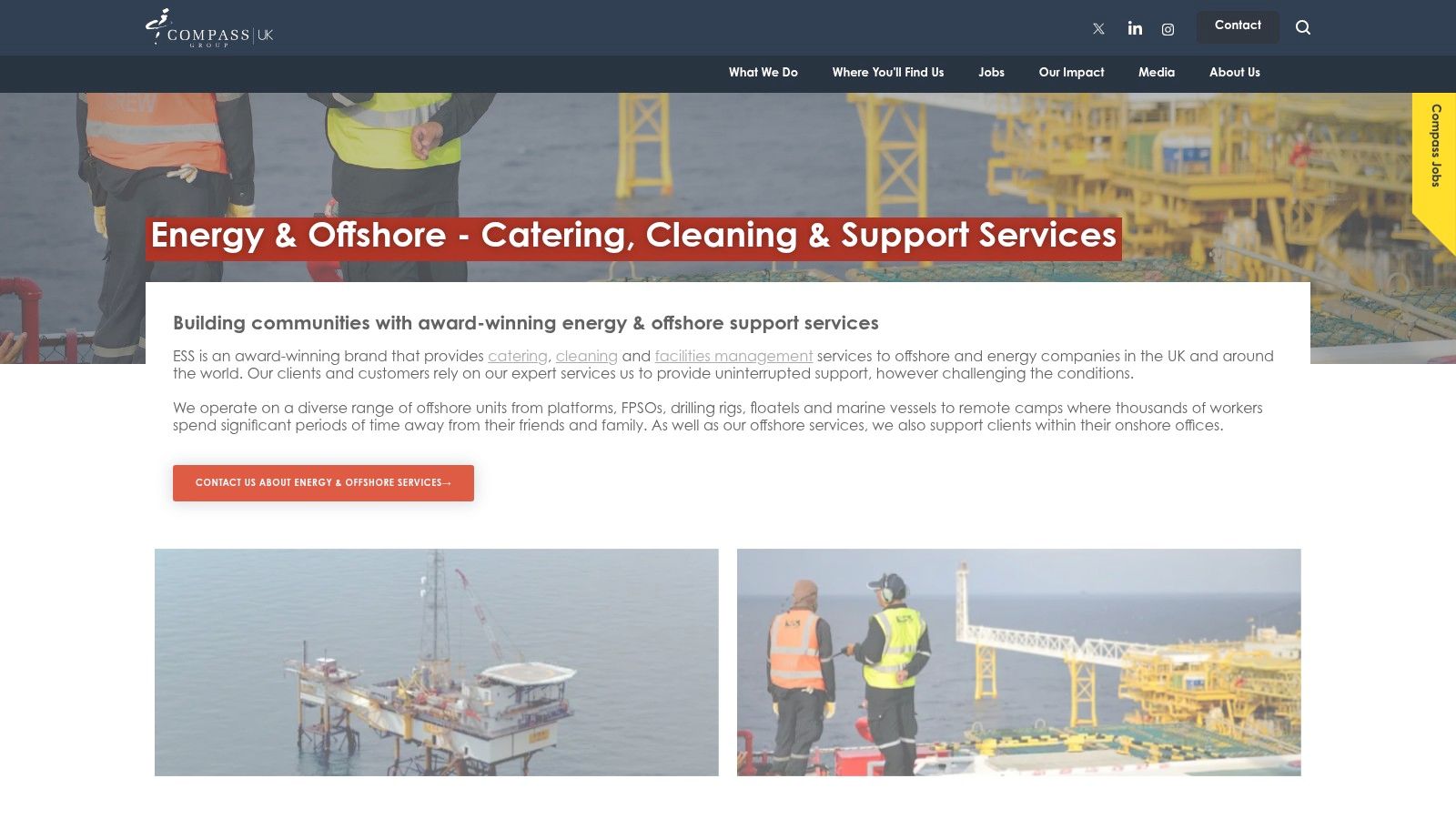
ESS Energy & Offshore is usually one of the first names serious applicants check, and for good reason. It sits inside Compass Group UK & Ireland, so you're dealing with a large operator that understands remote catering, accommodation services, and the practicalities of North Sea mobilisation.
If you want frequency of opportunity, ESS is often a sensible place to start. Bigger operators tend to have more moving parts, more client sites, and more need for rotational coverage when somebody drops out late or certificates are close to expiry.
What works well
ESS suits candidates who prefer a formal structure. Application routes are clear, job specs tend to be detailed, and the compliance culture is usually obvious from the start.
That helps if you're moving from hotels, contract catering, or busy pub kitchens and want a more defined route into offshore work than a loose CV-pool process.
- Best for entry into large-scale offshore operations: You get exposure to food service, housekeeping, and broader welfare support rather than just a narrow galley brief.
- Good fit for chefs who like process: Larger groups often have clearer onboarding, stronger safety procedures, and more obvious progression.
- Useful stepping stone for wider remote-site work: Experience with a brand like this can help if you later move into marine, renewables, or international remote catering.
Practical rule: If you're applying to ESS, don't send a generic restaurant CV. Rework it around volume feeding, dietary control, hygiene discipline, stock management, and living-site professionalism.
The trade-off
Big-company hiring can feel slow. That's the downside. Even when the role is real and urgent, approvals, document checks, and training requirements can stretch the timeline.
For chefs who are still exploring whether offshore life is the right fit, it's worth comparing this route with broader hospitality career paths and remote-site opportunities. Offshore rewards consistency, but it also expects you to arrive prepared, not hopeful.
2. Sodexo UK & Ireland – Energy & Resources (Offshore)
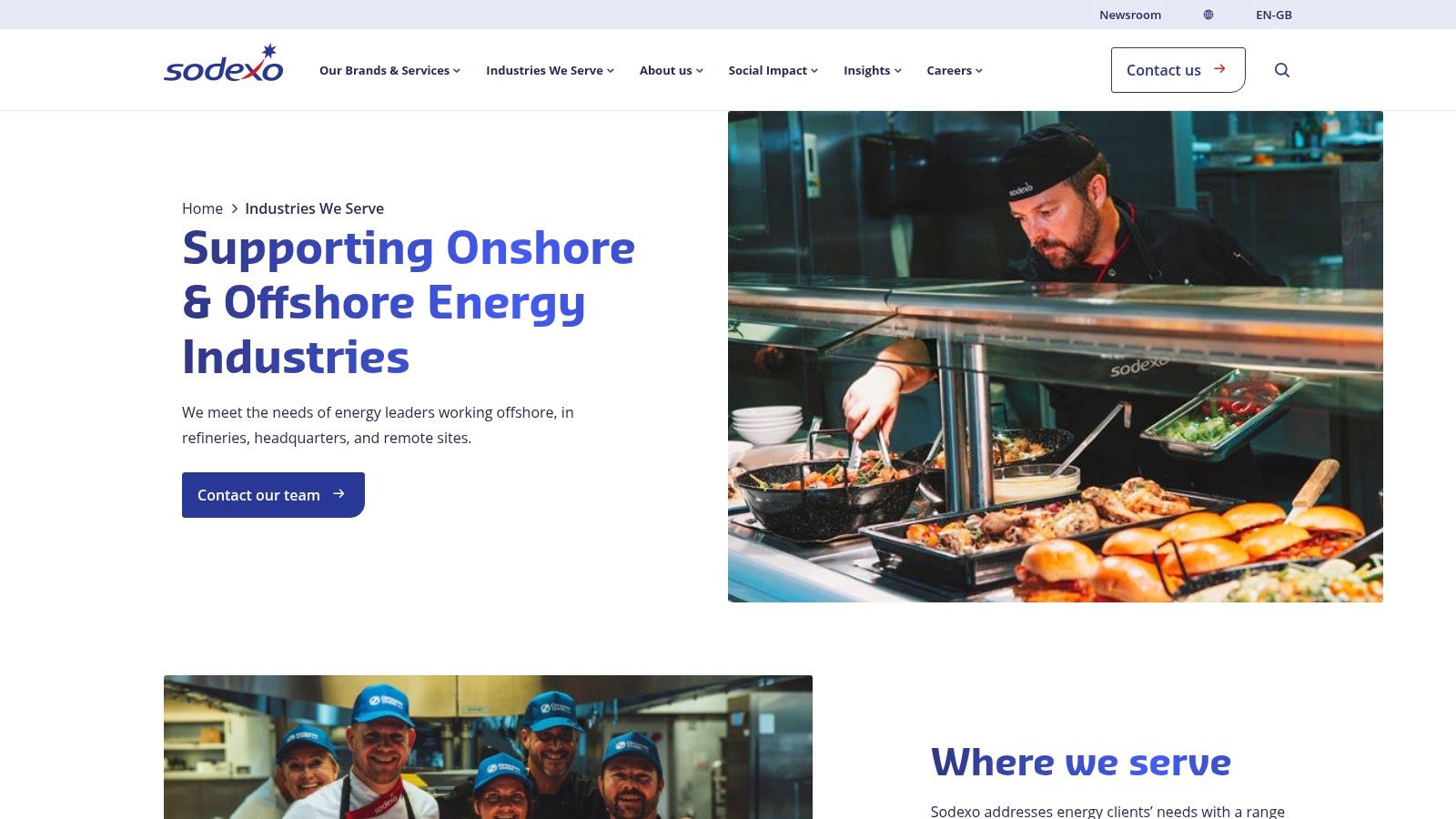
Sodexo Energy & Resources is another operator worth watching closely if you're targeting offshore catering companies hiring in the UK. Its offshore activity is tied into a wider facilities and welfare model, which tends to suit applicants who understand that offshore service is never just about the plate.
A lot of land-based chefs underestimate this. Offshore employers don't only want somebody who can cook. They want somebody who can function inside a safety-led environment where routines, housekeeping standards, welfare, and teamwork matter just as much as food quality.
Where Sodexo tends to suit candidates
Sodexo often makes sense for chefs, chef managers, and stewards who value brand stability. If you've worked in contract catering, staff feeding, accommodation sites, or high-volume hospitality, the operating model will feel more familiar than moving straight into a smaller specialist operator.
The practical advantage is mobility. Large businesses can open doors across multiple sites and service types if you prove dependable.
Offshore catering roles often move in waves. If you don't see the right vacancy this week, that doesn't mean the route is closed. It usually means the mobilisation cycle isn't aligned with your timing yet.
The drawback most applicants don't plan for
Portal sprawl. That's the issue. Large companies often route vacancies through several careers pages, subdomains, or campaign-specific listings, and applicants miss roles because they assume one page shows everything.
Keep your search disciplined. Save the main careers route, check Aberdeen-linked openings, and watch for steward, chef manager, welfare, and ad-hoc pool wording.
This matters in a niche market where live vacancy snapshots can look smaller than people expect. One search snapshot showed 35 offshore catering jobs on Indeed, which tells you this isn't mass recruitment. Roles are specialised, and timing matters.
3. Aramark – Offshore (Northern Europe)
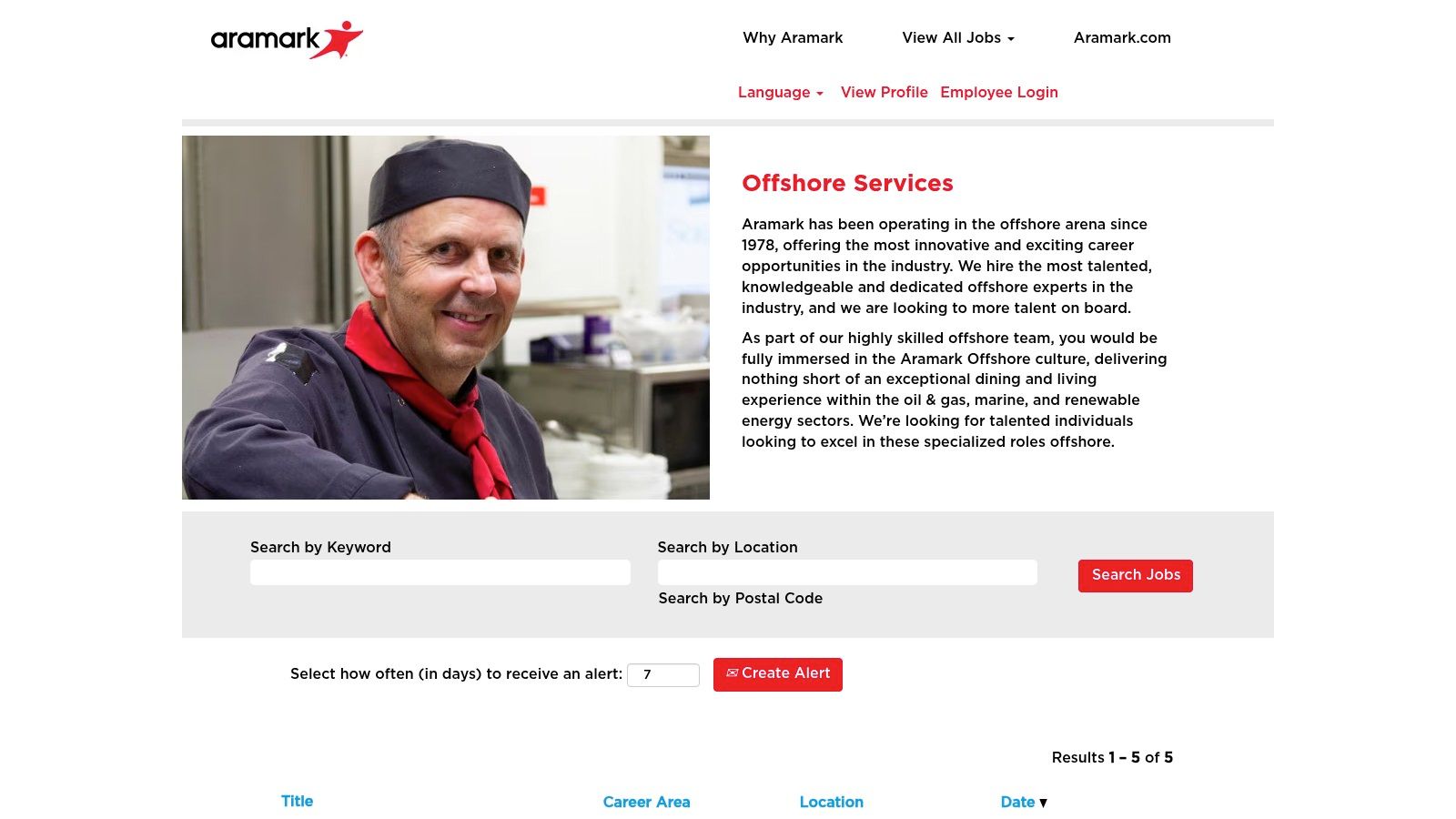
Aramark Northern Europe Offshore careers gives UK applicants something valuable. A defined offshore stream that doesn't force you to guess where the relevant roles sit. That sounds basic, but in offshore recruitment it saves time.
Aramark is a practical option for chefs who want exposure across oil and gas, marine, and renewables rather than tying themselves too early to one corner of the market. If your long-term plan is flexibility, that's useful.
Why Aramark is worth tracking
Some employers bury offshore roles inside broader hospitality recruitment. Aramark's dedicated route makes filtering easier, especially for applicants trying to move from mainstream catering into remote-site work.
That also helps support roles below chef level. If you're coming through as a galley hand, steward, or catering assistant and aiming to progress, it's worth understanding the ladder properly. Relief Chefs UK's guide to catering assistant duties and responsibilities is useful background because offshore employers expect candidates to understand service support, not just kitchen prep.
- Strong application route: UK and Northern Europe offshore openings are easier to identify than on many competing sites.
- Broad sector exposure: Marine, energy, and renewables experience can make your CV more resilient.
- Good for adaptable candidates: If you're happy with rotation, shared living, and mixed responsibilities, Aramark can be a credible route in.
Where people get caught out
Availability isn't always consistent. You may see good role flow for a period, then very little publicly visible for a while. That's normal in contract-led offshore hiring.
The mistake is assuming silence means no demand. Often it means active pools are full, contracts are between mobilisation phases, or hiring is being managed internally before public posting.
4. Entier Ltd (Remote Sites Global – RSG), Aberdeen
Entier Remote Sites Global appeals to chefs who prefer a business with a stronger food-led identity rather than a giant corporate feel. Based in the Aberdeen orbit, it's well positioned in the part of the UK where offshore hiring has always been concentrated.
That location matters. Aberdeen remains a core hub for offshore activity, and if you're serious about this market, you need to think geographically as well as professionally. Offshore catering companies hiring in the UK often orbit the same North Sea supply-chain centres, even when the work itself is far from shore.
Who Entier suits best
Entier is a good fit for chefs who want remote-sites exposure but don't necessarily want to disappear into a huge multinational structure. Independent operators can offer a more direct relationship with the business, and for some candidates that's a better cultural fit.
It can also suit experienced head chefs or sous chefs who are used to taking responsibility without a lot of hand-holding. Offshore life rewards people who stay calm, keep standards up, and don't become a management problem in confined living conditions.
A strong offshore chef isn't just technically solid. They're easy to mobilise, easy to live with, and easy to trust.
The realistic downside
Smaller operators often have fewer simultaneous openings. That's the trade-off. You may get a more personal route in, but you won't always see the same volume of live vacancies you'd expect from a giant group.
Keep your documents ready and your CV specific. When independent remote-site employers need someone, they often need someone who can move cleanly through checks and step into the job without drama.
5. Trinity International Services Ltd
Trinity International Services is one for chefs and hospitality professionals who prefer dealing with a UK-based operator that has a direct offshore catering and housekeeping focus. It has a clear North Sea presence and a straightforward service proposition around galley, stores, accommodation, and soft facilities support.
That matters because some offshore employers spread themselves across too many unrelated service lines. Trinity feels more targeted. If you're applying there, shape your CV around reliability, food production, stores discipline, and living-site professionalism.
Why Trinity deserves a place on your list
This is the sort of company that can suit applicants who are tired of applying into giant systems and hearing nothing back. Independent operators often rely more heavily on direct candidate pipelines and proactive CV submissions.
For experienced chefs, that's an opportunity. If your paperwork is current and your offshore suitability is clear, you can stand out faster than you might in a very crowded multinational portal.
- Useful for direct applications: Smaller hiring funnels can reward a sharper, better-targeted CV.
- Relevant for multi-skilled candidates: Housekeeping awareness, stock control, food safety, and accommodation support all strengthen your profile.
- Better for people who understand remote-site discipline: Offshore employers value low-maintenance professionals who can handle routine and pressure.
What can slow things down
Public advert volume may be lower than you'd expect. That's not necessarily weak demand. It often means the company is building a CV bank, filling contract-led gaps, or hiring against operational need rather than running constant public campaigns.
Many chefs often misjudge the situation. They judge demand by how many adverts they can see, when the actual issue is usually mobilisation readiness, not visibility.
6. Francois Offshore Catering (Northern Marine Group / Stena)
Francois Offshore Catering sits in a useful middle ground. It has specialist offshore catering credentials, but it also benefits from the backing of a wider marine group. For applicants, that can translate into better organisational support and wider deployment exposure.
If you're looking beyond fixed platforms and want the possibility of work across rigs, vessels, FPSOs, or offshore wind support environments, that's a practical advantage.
The real hiring issue isn't always the vacancy
In UK offshore catering, the hard part often isn't finding an opening. It's getting through the compliance stack quickly enough to be useful. The market is constrained by the need for security-vetted, right-to-work-verified staff under offshore safety expectations, and time-to-fill is often longer than in standard hospitality because of access checks, medical fitness, and competence assurance requirements, as outlined in this offshore catering market summary.
That's why candidates with partial paperwork often overestimate their readiness. A good chef with missing documents can still lose out to a slightly less polished candidate who is cleared and deployable.
Reality check: Employers don't hire the best-looking CV first. They often hire the safest candidate who can mobilise without delay.
Best use of this route
Francois suits candidates who already understand that offshore work is compliance-first. If you're organised, document-led, and realistic about vessel or installation life, this can be a strong name to add to your target list.
The main drawback is that vacancies can sit behind parent-group systems. That extra registration step puts some applicants off, but serious candidates usually just get on with it.
7. FOSS & ESG Catering
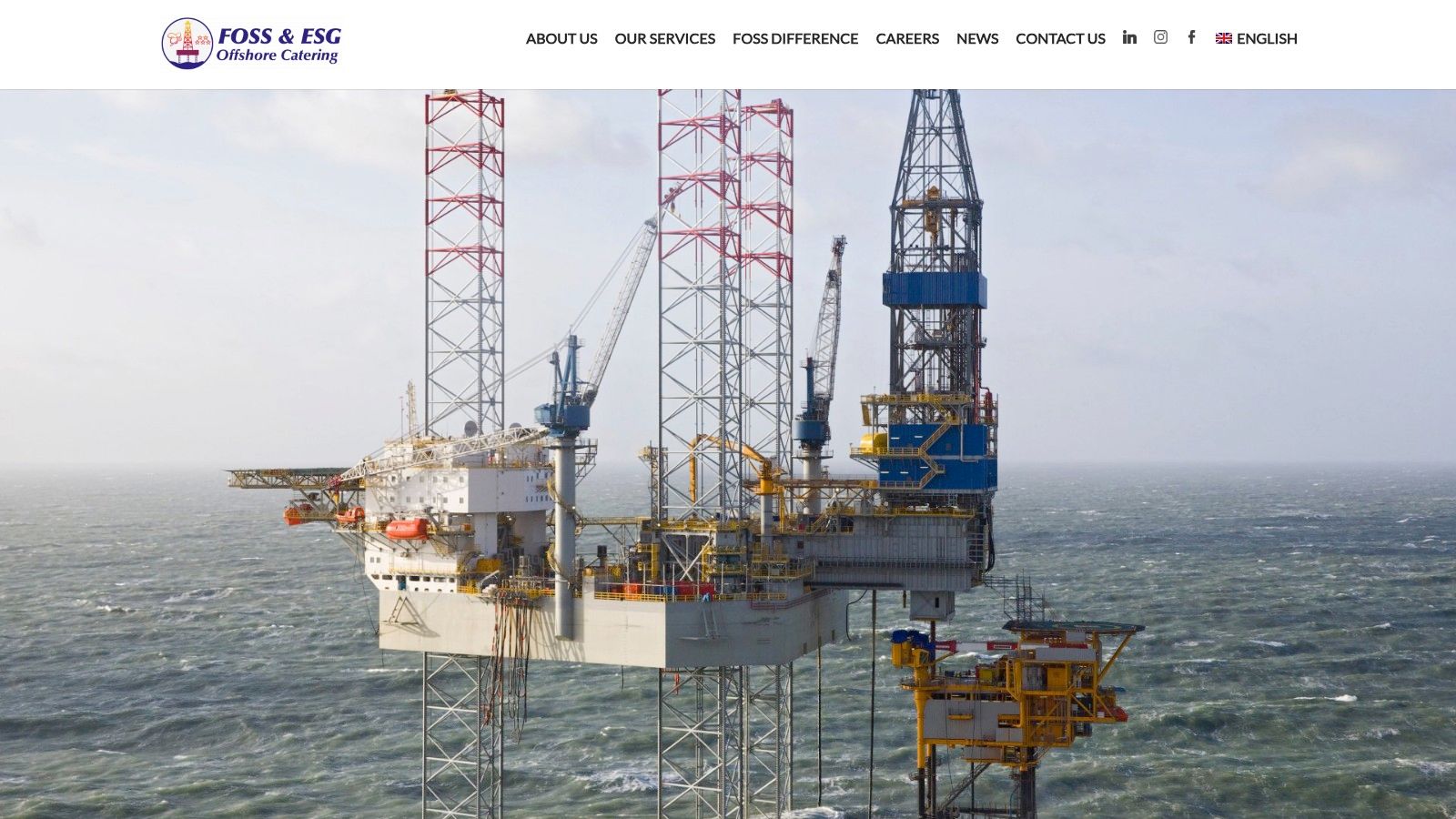
FOSS & ESG Catering is a specialist name worth watching if you want an offshore-only operator rather than a broad service giant. That narrower focus can appeal to people who want to work inside a business built around offshore realities, not one that treats offshore as one division among many.
Its profile across oil and gas, offshore wind, and maritime work also makes it relevant for chefs who want a career path that isn't tied to one asset type.
What stands out here
Training culture. Specialist offshore caterers often place more visible emphasis on onboarding, certification awareness, and role readiness because they know mobilisation delays cost time and create operational headaches.
That ties into a wider market issue. A major gap in offshore recruitment content is that many job pages still don't explain what employers require beyond kitchen experience. The better opportunity for applicants is understanding maritime certification, offshore safety training, medical fitness, and right-to-work checks before applying, which is exactly the gap highlighted in this industry hiring overview of offshore galley roles and progression.
Where this fits for UK chefs
If you're a chef currently bouncing between hotels in Berkshire, seasonal coastal work in Devon or Dorset, private households, or high-pressure restaurant jobs in Bristol and Wales, specialist routes like this can be worth a look. The mindset shift is the key part. Offshore employers want consistency, routine, and deployability.
For chefs also exploring premium remote roles outside the energy sector, it's smart to compare offshore pathways with specialist chef agencies for yachts and other high-end placements. The environments differ, but the common thread is readiness, trust, and the ability to perform in close-quarters professional settings.
Top 7 Offshore Catering Hiring Comparison
| Provider | Implementation Complexity 🔄 | Resource Requirements ⚡ | Expected Outcomes ⭐📊 | Ideal Use Cases 💡 | Key Advantages |
|---|---|---|---|---|---|
| ESS (Compass Group UK & Ireland) – Energy & Offshore (North Sea) | 🔄 High, formal, multi-step processes and strict compliance | ⚡ High, BOSIET/FOET, MIST, OEUK medical; rotational readiness | ⭐📊 Reliable North Sea postings, strong QHSE culture and progression pathways | 💡 Candidates seeking frequent rotations and structured training/progression | Backed by Compass Group resources; clear UK careers funnel |
| Sodexo UK & Ireland – Energy & Resources (Offshore) | 🔄 Moderate, structured but often hires in waves; multiple portals | ⚡ Moderate, standard offshore certs; Aberdeen coordination | ⭐📊 Stable mobility across sites; wellbeing and living-standards focus | 💡 Applicants wanting big-brand stability and wellbeing emphasis | Large client base; regular core/ad-hoc pools for stewards and chef managers |
| Aramark – Offshore (Northern Europe) | 🔄 Moderate, defined Northern Europe careers stream; contract-dependent | ⚡ Moderate, offshore certs required; rotational and multi-sector exposure | ⭐📊 Broad sector exposure (oil/gas/marine/renewables) supporting growth | 💡 Seekers of cross-sector experience with a clear UK application route | Longstanding global pedigree and a focused UK/Northern Europe funnel |
| Entier Ltd (Remote Sites Global – RSG), Aberdeen | 🔄 Low–Moderate, leaner, chef-led processes with local focus | ⚡ Moderate, standard certs; potential international mobilisations | ⭐📊 Good progression across remote/onshore roles; strong Aberdeen reputation | 💡 Chefs wanting chef-led culture and local employer recognition | Independent, chef-led ethos with documented North Sea experience |
| Trinity International Services Ltd | 🔄 Low, family-owned, direct and agile recruitment routes | ⚡ Moderate, offshore certifications; role availability tied to contracts | ⭐📊 Credible UKCS references and long-tenure client relationships | 💡 Candidates preferring direct hiring and UK-based operator | Agile UK operator offering end-to-end galley, stores and accommodation services |
| Francois Offshore Catering (Northern Marine Group / Stena) | 🔄 Moderate–High, structured HSEQ with parent-group routing | ⚡ High, HSEQ mobilisation, group registration and UK hub support | ⭐📊 Cross-sector deployments and large-group stability | 💡 Those seeking global mobility backed by a major marine group | Backed by Northern Marine/Stena; strong HSEQ and mobilisation frameworks |
| FOSS & ESG Catering | 🔄 Moderate, specialist offshore processes with CV-pool model | ⚡ Moderate–High, ISO-certified operations and formal training modules | ⭐📊 Specialist offshore placements with strong training/certification culture | 💡 Candidates prioritising certification-forward employers and offshore focus | Offshore-only specialist with ISO 9001/14001/45001/22000 and recognised training |
Your Next Step to a High-Stakes Career
Breaking into offshore catering is perfectly possible for a strong land-based chef, but only if you treat it like a professional transition rather than a quick application spree. The biggest mistakes are predictable. Sending a generic CV. Applying without checking whether your paperwork is in date. Assuming food skill alone is enough. It isn't.
You need a CV that shows volume service, hygiene discipline, stock control, pressure management, and the ability to live and work professionally in a confined environment. You also need to be honest with yourself. Some chefs love rotation, routine, and distance from the daily chaos of pubs, hotels, and restaurants. Others don't. Better to know that early.
The more strategic play is to target a shortlist of offshore catering companies hiring, keep your documents organised, and stay patient with timelines. In this sector, speed usually comes from readiness, not from how many jobs you apply for. Employers need people they can trust to mobilise safely and fit into life offshore without upsetting the wider operation.
That same principle applies onshore. Hospitality businesses across the UK still face the same staffing pain points every week. Sick calls before service. Seasonal demand surges. Agency chefs who don't match the brief. Ongoing shortages that leave head chefs firefighting instead of leading. In places like Windsor, Reading, Slough, Bristol, Devon, Dorset, and across Wales, kitchen stability is still one of the biggest commercial pressures any operator faces.
That's where a specialist staffing partner matters. Relief Chefs UK has been established since 2013 and supports hospitality businesses with relief chefs, temporary chefs, permanent chef recruitment, yacht chefs, villa chefs, and wider hospitality staffing support. If you run a pub, hotel, restaurant, private household, or yacht programme and need dependable chef cover, working with people who understand kitchens from the inside is more effective than relying on generic recruitment.
Whether you're a chef planning your next move or an operator trying to keep service standards steady, act before the pressure becomes expensive.
If you need reliable chef cover, permanent recruitment support, or specialist staffing for yachts, villas, hotels, pubs, and restaurants, contact Relief Chefs UK. They work nationwide and help hospitality businesses secure relief chefs, temporary chefs, and longer-term placements without the usual agency guesswork.
Call the team.
Office 01392 715474 · info@reliefchefs.co.uk