
Top Hotel Recruitment Agencies London: 2026 Guide
30 May 2026

Friday at 4:30pm is when weak staffing plans get exposed.
A chef calls in sick. Your occupancy is strong. A group booking has added pressure to breakfast tomorrow. Housekeeping is already stretched, and the last thing you need is a kitchen that starts service one person short. In London, that problem doesn't stay in the kitchen. It hits guest experience, team morale, wage control, and online reviews.
That's why hotel recruitment agencies in London need to be judged on operational outcomes, not polished sales language. If an agency can't protect service when the pressure lands, it isn't solving the core problem.
Why Your London Hotel Needs a Recruitment Partner Not Just an Agency

The first mistake many new General Managers make is treating recruitment as a purchasing task. It isn't. It's an operations risk.
A transactional agency takes a brief, sends CVs, and moves on. A staffing partner understands what the vacancy is really costing you. One missing breakfast chef can drag your Head Chef off prep, slow room service, and create complaints before noon. One unreliable temporary cover chef can unsettle the whole brigade for a weekend.
London complicates this because choice isn't the issue. Filtering is. One industry source says 31% of all UK recruitment agencies are located in London, and it estimates 30,035 recruitment agencies across the UK, making the capital the biggest and busiest recruiter market in the country, as noted in these UK recruitment agency industry statistics. A large market sounds helpful until you realise it also creates noise. Plenty of agencies can answer the phone. Far fewer can deliver dependable people who can work to hotel standards.
What a real partner does differently
A proper recruitment partner will ask better questions from the start:
- Service impact first: They'll want to know which shifts are commercially sensitive, not just what job title you need.
- Standards before availability: They'll ask about volume, menu style, guest profile, and team structure.
- Replacement planning: They'll already be thinking about fallback options if the first candidate drops out.
- Compliance as routine: Right-to-work checks, references, and role suitability should be built into the process, not handled as an afterthought.
That matters most in hotels because staffing decisions spill across departments. A poor kitchen hire affects banqueting, breakfast, bar food, and conference service. A rushed agency placement can create more management work than the vacancy itself.
Practical rule: If an agency only talks about “sending someone over”, you're buying labour. If it talks about continuity, standards, and contingency, you're closer to a real staffing partner.
The wrong agency costs more than the fee
Managers often focus on the rate card first. I'd focus on the failure points.
Ask yourself what happens if the chef arrives late, can't handle volume, or isn't suited to your section. Ask what support exists on a Sunday afternoon, not just at 10am on a Tuesday. Ask whether the agency understands a boutique hotel kitchen differently from a branded city-centre operation.
That's the difference between a supplier and a partner. One fills inboxes. The other helps you keep service intact.
The Realities of London's Hospitality Staffing Market
London hotels aren't struggling because they're badly run. They're hiring in a market that stays under pressure.
Hospitality is a huge employment sector. UKHospitality says it is the third largest employer in the UK, supporting 3.6 million jobs. At the same time, ONS vacancy data showed 953,000 job vacancies across the economy between May and July, a 43% increase on the same period a year earlier, with hospitality remaining one of the sectors under the most persistent strain, according to this ONS hospitality jobs dataset and labour market context.
That's the backdrop for every hotel trying to recruit chefs, kitchen porters, reception teams, housekeepers, food and beverage supervisors, and duty managers.
Why London feels harder than other markets
London compresses every staffing problem.
You've got high guest expectations, complex trading patterns, and constant competition for people who can perform under pressure. A chef who can handle a busy hotel breakfast, banqueting prep, and late bar food service is valuable anywhere. In London, several employers may be chasing that same person at once.
The city also punishes slow hiring. Good candidates don't wait around for a long approval chain, delayed interviews, or vague offers. If your internal process drifts, another operator will move faster.
The pressure isn't limited to London
You see similar patterns in Berkshire, Windsor, Reading, Slough, Bristol, Devon, Wales, and Dorset during seasonal peaks, event weekends, and holiday periods. The difference is scale. London has more employers, more agencies, and more movement in the market at any given moment.
That creates two practical consequences for hotel managers:
- You need speed with standards. Fast but poor hiring creates repeat vacancies.
- You need role-specific support. Generic hospitality staffing often works for lower-risk positions. It breaks down in specialist kitchen roles.
Unfilled shifts in a hotel don't stay isolated. They spread into slower service, team fatigue, and management firefighting.
What this means for your staffing model
The sensible response isn't to outsource everything. It's to decide what must stay in-house and what needs external cover.
Use your employed team for leadership, culture, and consistency. Use specialist support for volatility. That includes short-notice sickness, annual leave gaps, trial periods before a permanent hire, and periods when occupancy rises faster than your payroll can safely absorb.
In practice, resilient hotels build a staffing bench before they need it. They don't start ringing agencies only when service is already at risk.
Specialist Chef Agency or General Recruiter Which is Right for You
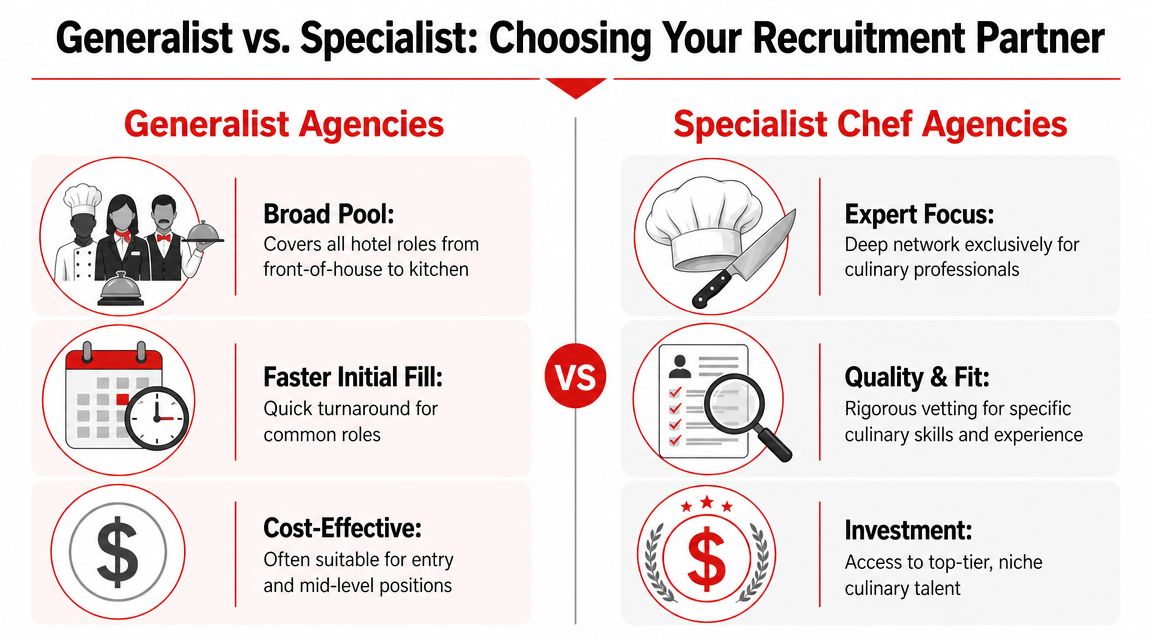
For front desk, housekeeping support, or broad hospitality hiring, a general recruiter can be useful. For kitchens, the trade-off is sharper. If the role affects food quality, pace, hygiene, or section leadership, specialism matters.
A lot of hotel recruitment agencies in London claim to cover chefs. That's not the same as understanding chefs.
Where general recruiters usually fall short
Generalists work across many job families. That gives them width, but not always depth.
They may know how to screen for attitude, availability, and presentation. They may be perfectly adequate for roles where training on site can close gaps quickly. Kitchens are less forgiving. If you send a chef de partie who can't organise a section, manage prep, or hold standards under pressure, the damage shows up during service.
Common failure points with general hospitality recruiters include:
- Loose role matching: “Chef” is treated as one category, when breakfast, banqueting, fine dining, pub volume, and gastro operation all require different strengths.
- Weak technical vetting: Recruiters who haven't worked in kitchens often miss warning signs in CVs and interviews.
- Limited fallback options: If the first candidate drops, the backup pool may be shallow.
- Poor operational understanding: They may not ask about menu complexity, prep systems, allergens, stock control, or brigade structure.
What a specialist chef agency brings
A specialist chef provider starts from kitchen realities. It should understand the difference between a chef who can survive a shift and one who can steady a service.
Here's the practical comparison:
| Area | General recruiter | Specialist chef agency |
|---|---|---|
| Role understanding | Broad hospitality view | Kitchen-specific judgement |
| Candidate screening | CV-led | Skills, fit, and service-readiness led |
| Brief quality | Often title-based | Section, style, volume, and team-based |
| Risk control | Limited replacement thinking | Contingency and continuity focused |
| Best use case | Broad hotel hiring | Relief chefs, temporary chefs, permanent chef recruitment |
That distinction matters even more when you need niche support. Yacht chefs, villa chefs, senior sous chefs for private estates, or experienced temporary chefs for seasonal hotels require a narrower network and better filtering than a broad agency model usually provides.
A kitchen isn't the place to buy generic labour. It's where technical mistakes become guest-facing problems within hours.
What works in practice
For hotels, the strongest model is usually mixed.
Use general recruiters where the role is easier to standardise and onboard. Use a specialist for chefs and other hard-to-replace operational hires. That gives you broader market reach without taking unnecessary risk in the kitchen.
One example in that specialist category is Relief Chefs UK, established in 2013, which provides relief chefs, temporary chefs, permanent chef recruitment, yacht chefs, villa chefs, and wider hospitality staffing support across the UK. The practical point isn't branding. It's model fit. A chef-specialist agency is usually better placed to support kitchen stability than a recruiter trying to cover every hotel role equally.
The question to ask yourself
If this hire goes wrong, where does the damage land first?
If the answer is “in the kitchen, during service”, use a specialist.
Your Vetting Checklist Critical Questions for Any London Agency
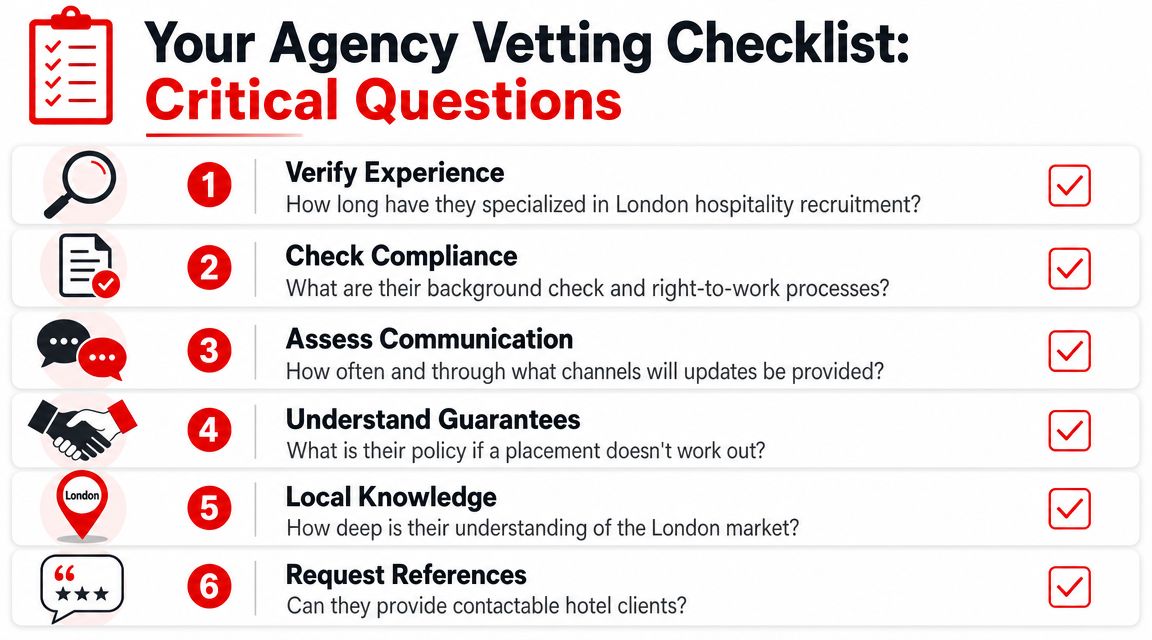
Most agencies sound competent in a sales call. The useful test is whether they can answer specific operational questions without dodging.
If you're comparing hotel recruitment agencies in London, use a checklist that exposes process quality, not marketing confidence. A good starting point is to review how agencies approach recruitment in hospitality and then push for detail that relates to your hotel.
Compliance and safety
Don't ask, “Are your checks thorough?” Ask what they do.
Use questions like these:
- Right-to-work process: What documents do you collect, who checks them, and when is re-verification required?
- Reference handling: Do you take references before adding a chef to the active pool, or only when a client requests them?
- Food safety awareness: How do you assess whether a chef is safe to place into a high-pressure hotel kitchen?
- Insurance position: What cover sits with the agency and what remains with the hotel?
If the answers are vague, move on. Compliance failures don't just create legal exposure. They create disruption when a shift has to be pulled at the last minute.
Speed and communication
Many agencies fail. They promise urgency but run a slow candidate funnel.
Hospitality hiring guidance based on Hireology data says applications with 5 to 7 fields or fewer are most likely to be completed, requiring a login can lose about 70% of traffic, and hotel operators should respond within 24 to 48 hours because 88% of candidates want interviews within a week, as outlined in this hotel hiring guidance using Hireology data.
That should change how you vet an agency.
Ask:
- Response method: How do you contact candidates the same day?
- Out-of-hours cover: Who handles urgent bookings on evenings and weekends?
- Client updates: Will I get progress updates proactively, or only if I chase?
- Short-notice process: What happens between my call and the chef arriving on site?
If an agency can't explain its speed clearly, it probably doesn't have one.
Quality and commercial accountability
At this juncture, you distinguish professional operators from hopeful middlemen.
Ask these questions directly:
What happens if the chef no-shows?
You need a replacement process, not an apology.What happens if the chef arrives and isn't suitable?
Define who you call, how quickly the issue is escalated, and whether a replacement is attempted immediately.How do you brief chefs before shift start?
A proper handover reduces failure on first shift.Can you provide hotel client references I can personally speak to?
Testimonials on a website are not the same as contactable clients.What roles are your strongest area?
Honest agencies know where they're sharp and where they're not.
A simple red-flag test
Walk away if you hear any of the following:
- “We cover everything.” Broad coverage often means shallow specialism.
- “We'll see who's free.” Availability alone is not recruitment.
- “Most clients don't ask that.” Serious buyers do.
- “We'll sort the details later.” That's how bad placements happen.
A credible agency should welcome scrutiny. You're not buying optimism. You're buying reduced risk.
Decoding Contracts Pricing and Service Guarantees
A weak contract leaves the hotel carrying most of the risk. That's why pricing should never be reviewed on its own.
The first thing to pin down is the charging model. Temporary staffing is usually charged differently from permanent recruitment, and temp-to-perm conversions often carry their own terms. None of that is a problem if it's clearly documented. It becomes a problem when key costs sit in the small print.
What to check before you sign
Read the commercial terms with an operator's eye, not just a procurement eye.
Look for:
- Rate clarity: Is the charge easy to understand by role type, shift type, or assignment type?
- Minimum booking terms: Are there minimum hours, cancellation windows, or premium periods?
- Conversion terms: If a temporary chef becomes a permanent hire, what fee applies and when?
- Additional charges: Confirm whether anything sits outside the quoted rate.
The cleanest agreements are boring. You should be able to explain the cost structure to an owner or finance manager in plain English.
For a useful benchmark, review how established providers describe contract employment agency terms for hospitality staffing. You're looking for transparency, not clever packaging.
Service guarantees matter more than the headline rate
A cheap rate is expensive if the chef doesn't turn up, turns out wrong for the section, or leaves your team firefighting through service.
Insist on contract language around:
- Replacement policy: What happens if the placement fails?
- Out-of-hours support: Who can authorise and coordinate a replacement outside office hours?
- Liability split: Where does agency responsibility end and hotel responsibility begin?
- Timesheet and approval process: Who signs off hours and how are disputes handled?
A serious provider won't resist these questions. It should already have standard wording for them.
Good contracts don't eliminate problems. They decide in advance who does what when problems happen.
Don't confuse flexibility with vagueness
Hotels need flexibility. Occupancy changes. Events move. Sickness happens. But flexible staffing terms still need discipline.
You want room to adapt bookings without stepping into uncertainty over charges, replacement obligations, or candidate status. If an agreement is loose on those points, the hotel usually absorbs the operational pain later.
The right contract protects service first. The agency should still make a margin, of course. But the agreement must reflect the fact that a failed chef shift costs more than an invoice line. It can affect breakfast delivery, conference catering, guest satisfaction, and team retention.
Onboarding Agency Chefs for a Seamless First Shift
Even the right chef can have a poor first shift if the handover is sloppy.
Hotels sometimes assume agency cover should walk in fully self-sufficient. That's unrealistic. A capable temporary chef can adapt quickly, but only if the site gives them the basics fast and clearly.
What to have ready before they arrive
Prepare the practical essentials in one place:
- Shift brief: Start time, finish time, dress code, entrance point, and named contact.
- Kitchen essentials: Menu spec, prep list, allergen process, HACCP expectations, and service style.
- Section reality: What station they're covering, what's prepped, what isn't, and where the pressure points usually hit.
- Key people: Who leads the shift, who signs timesheets, and who handles stock or supplier issues.
This shouldn't take long. It just needs to be organised.
A helpful framework for operators using temporary cover is to tighten your process around working with temp agencies in hospitality. Most first-shift failures come from poor briefing, not poor intent.
How to make the first hour count
Introduce the chef to the person running the pass or section. Don't leave them to figure out hierarchy by trial and error.
Then cover three things immediately:
- What must go right today.
- What this kitchen does differently.
- Where to ask for help without disrupting service.
That short briefing saves far more time than it costs. It also helps your employed team accept temporary support faster, because they can see the chef has been set up properly rather than dropped into the middle of chaos.
A temporary chef doesn't need a grand induction. They need a clean brief, a clear section, and a team that knows they're coming.
Protect the second shift as well as the first
After service, get quick feedback from both sides. Was the skill level right? Was the brief accurate? Would you book that chef again?
That turns one shift into useful staffing intelligence. Over time, you build a smaller, more dependable bench of people who already know your standards.
FAQ Finding the Right London Hotel Recruitment Agency
How quickly can a London agency fill an urgent hotel chef gap
That depends on the agency's live network, the role, and how specific your brief is. Emergency cover is possible when the agency already has vetted chefs ready for hotel work. The practical question isn't “how fast in theory?” It's “what happens from my call to arrival on site?”
Ask for the complete process, including out-of-hours handling and replacement steps if the first option falls through.
Should I use one agency for all hotel roles
Not always. That can simplify administration, but it can also dilute quality.
For broad hotel support roles, a generalist may be fine. For kitchens, specialist chef support is usually the safer option because the cost of a bad fit shows up immediately in service, hygiene, prep control, and team stability.
What's the difference between a temp chef and a relief chef
In practice, buyers often use the terms interchangeably, but there's a useful distinction.
A temp chef may be available for short-term work. A relief chef is usually brought in to stabilise service during absence, pressure periods, transitions, or recruitment gaps. That means you're not just buying availability. You're buying adaptability and operational cover.
Do hotel recruitment agencies in London handle permanent chef recruitment too
Some do, some don't. The better question is whether they can handle both short-term cover and permanent hiring without compromising either.
A hotel often needs both. You might need immediate shift cover this week and a permanent Sous Chef next month. If an agency can support the transition from urgent cover to long-term hire, that can reduce disruption and give you a more stable pipeline.
What should I demand in writing before agreeing terms
Get the essentials documented. That includes rate structure, cancellation terms, right-to-work responsibility, replacement process, out-of-hours support, and what happens if a placement is unsuitable.
If it matters operationally, don't leave it to a verbal assurance.
Are generic promises a warning sign
Usually, yes.
If the language is all “quality candidates”, “excellent service”, and “bespoke solutions”, but there's no detail on response handling, compliance checks, or replacement responsibility, you're hearing marketing, not process. London hotels need process.
What makes an agency worth keeping long term
Consistency. Fast communication. Honest role matching. Fewer surprises.
The agencies worth keeping are the ones your Head Chef and operations team trust when things go wrong, not just when things are quiet.
If your hotel needs dependable chef cover, permanent kitchen recruitment, or specialist support for seasonal pressure, short-notice sickness, yacht chefs, villa chefs, or wider hospitality staffing, contact Relief Chefs UK. Since 2013, they've supported hospitality businesses across the UK with vetted chef staffing built around real operational demands, not generic agency promises.
Call the team.
Office 01392 715474 · info@reliefchefs.co.uk