
Chef Jobs in Nottinghamshire: Find Your Next Role
28 May 2026
You're not searching “chef jobs in Nottinghamshire” because you fancy reading another job board roundup. You're searching because your kitchen is under pressure, somebody's called in sick, the rota is already stretched, and you need a chef who can turn up and work the section.
That's the issue across Nottingham, Newark-on-Trent, Mansfield, West Bridgford and the wider county. Owners, GMs, ops teams and head chefs keep getting dragged into recruitment when they should be running service, protecting margin and keeping standards where they need to be. Hiring chefs has become a weekly operational task, not an occasional management job.
If you're still relying on generic ads, last-minute social posts and whoever answers the phone first, you're making a hard market even harder.
Why Finding Chefs in Nottinghamshire is a Full-Time Job
Friday afternoon. Your second chef drops out before a busy weekend. You've got prep to finish, bookings on the diary, stock already in, and a front-of-house team expecting the kitchen to hold it together. That's the moment many Nottinghamshire operators end up typing “chef jobs in Nottinghamshire” into Google.
The problem isn't just the empty shift. It's what follows. The head chef gets pulled off the pass to interview. The GM starts calling old applicants. Someone from another site gets moved over. Standards slip, wage control gets messy, and morale drops because the same people are covering again.
That's why chef recruitment in hospitality can't be treated like admin. It's an operations issue.
Why the old hiring approach keeps failing
Most venues still hire reactively. They wait for a resignation, a sickness issue, a holiday clash or a sudden uptick in covers. Then they post an ad and hope. In this market, hope is not a staffing plan.
A generic ad doesn't tell you whether the candidate can handle your volume, your menu, your shifts or your kitchen culture. It only tells you they clicked apply.
Practical rule: If your first proper conversation with a chef happens after they've already applied, you're too late in the process.
Managers also underestimate the commercial drain of constant recruitment. Time spent chasing CVs, arranging trial shifts and replacing no-shows adds up fast. If you haven't looked hard at the cost of employing hospitality staff, you're probably underestimating what “cheap” hiring is costing you.
The real staffing problems behind the search
When operators talk about chef shortages, they usually mean one of these:
- Short-notice gaps: Sickness, walkouts, emergency leave and no-shows before service.
- Seasonal pressure: School holidays, events, bank holiday trade and Christmas build-up.
- Kitchen instability: Too many agency unknowns, too few reliable regulars.
- Slow permanent hiring: Good candidates disappear while you're still arranging interviews.
- Leadership strain: Head chefs end up covering management failures with extra hours.
That's why the smartest operators stop treating recruitment as one-off hiring and start treating it as kitchen continuity.
The venues that cope best in Nottinghamshire aren't always the ones with the biggest budgets. They're the ones with a staffing plan, a back-up plan, and somebody they can call when the rota breaks.
The Nottinghamshire Chef Market in 2026
If you want to win chefs, start by accepting the obvious. Nottinghamshire is an active, competitive hiring market.
As of May 2026, Totaljobs lists 124 chef jobs within 10 miles of Nottinghamshire, Glassdoor lists 365 open chef jobs in Nottingham, and Indeed shows 341 chef jobs in Nottingham NG1 plus 276 head chef jobs in Nottingham, as set out in the verified market data. That isn't a niche labour market. It's broad demand across different kitchen levels, employer types and service models.
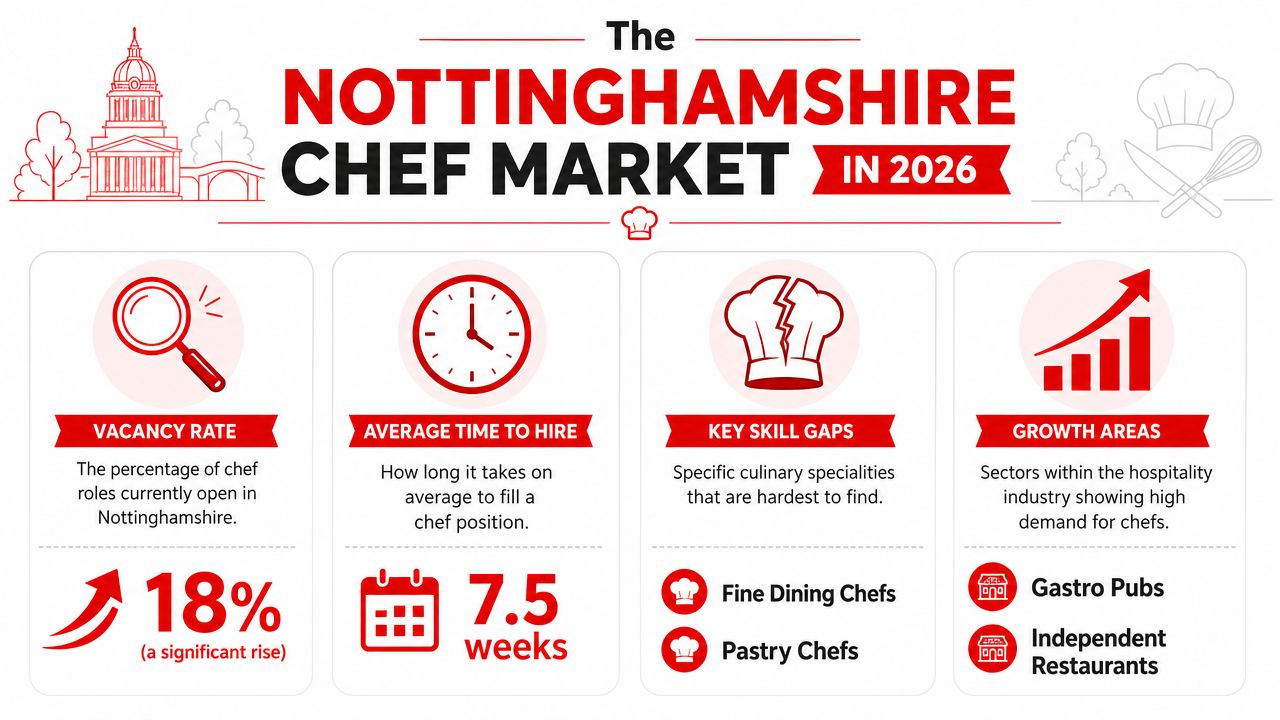
For an employer, that means one thing. Your vacancy is competing with a lot of other vacancies at the same time.
What the live adverts are telling you
The local ads aren't just numerous. They also show a market hiring at different pay structures. One Nottingham head or sous chef role was advertised at £26,000 to £31,000 a year. Another Nottingham sous chef role offered £13.70 an hour plus tronc and cash tips, with 35 to 45 hours per week, according to the Nottinghamshire chef listings on Totaljobs.
That matters because Nottinghamshire employers aren't all selling the same proposition. Some are competing on salary. Some are competing on hourly flexibility. Some are trying to win with service charge, tips or rota structure.
If your package is vague, slow or uncompetitive, chefs won't wait around while you decide what the role really looks like.
What this means for your budget and hiring strategy
Too many operators still set pay by internal comfort rather than external reality. That's backwards. The market doesn't care what your spreadsheet looked like last year.
Use this quick lens:
| Hiring question | What it means in practice |
|---|---|
| Are you selling annual salary or flexible earning? | You need to know which candidate profile you're targeting before you advertise. |
| Have you defined actual hours? | If the role lands at 35 to 45 hours, say so early. Don't bury it. |
| Is the role a growth move or just a rescue job? | Strong chefs can spot a panic hire immediately. |
| Can you hire quickly enough? | Delay gives other venues time to take the candidate. |
Nottinghamshire hiring is competitive enough that weak briefs, slow feedback and fuzzy rota details cost you candidates before the trial shift stage.
Why job seekers hold more leverage than many managers admit
A chef looking at jobs in Nottinghamshire has options. Standard chef roles. Senior kitchen roles. Hourly roles. Salaried roles. That changes behaviour.
Candidates compare more than money. They compare commute, shift pattern, kitchen reputation, team stability and whether the manager sounds organised. If your ad reads like a plea for help and your interview process feels chaotic, they'll move on.
That's why operators need to think like candidates for a minute. The best chefs don't just ask, “What are you paying?” They ask, “What am I walking into on day one?”
If the honest answer is burnout, poor structure and another promise that things will improve later, don't expect strong applicants to stay interested.
Permanent Hires vs Flexible Staffing Solutions
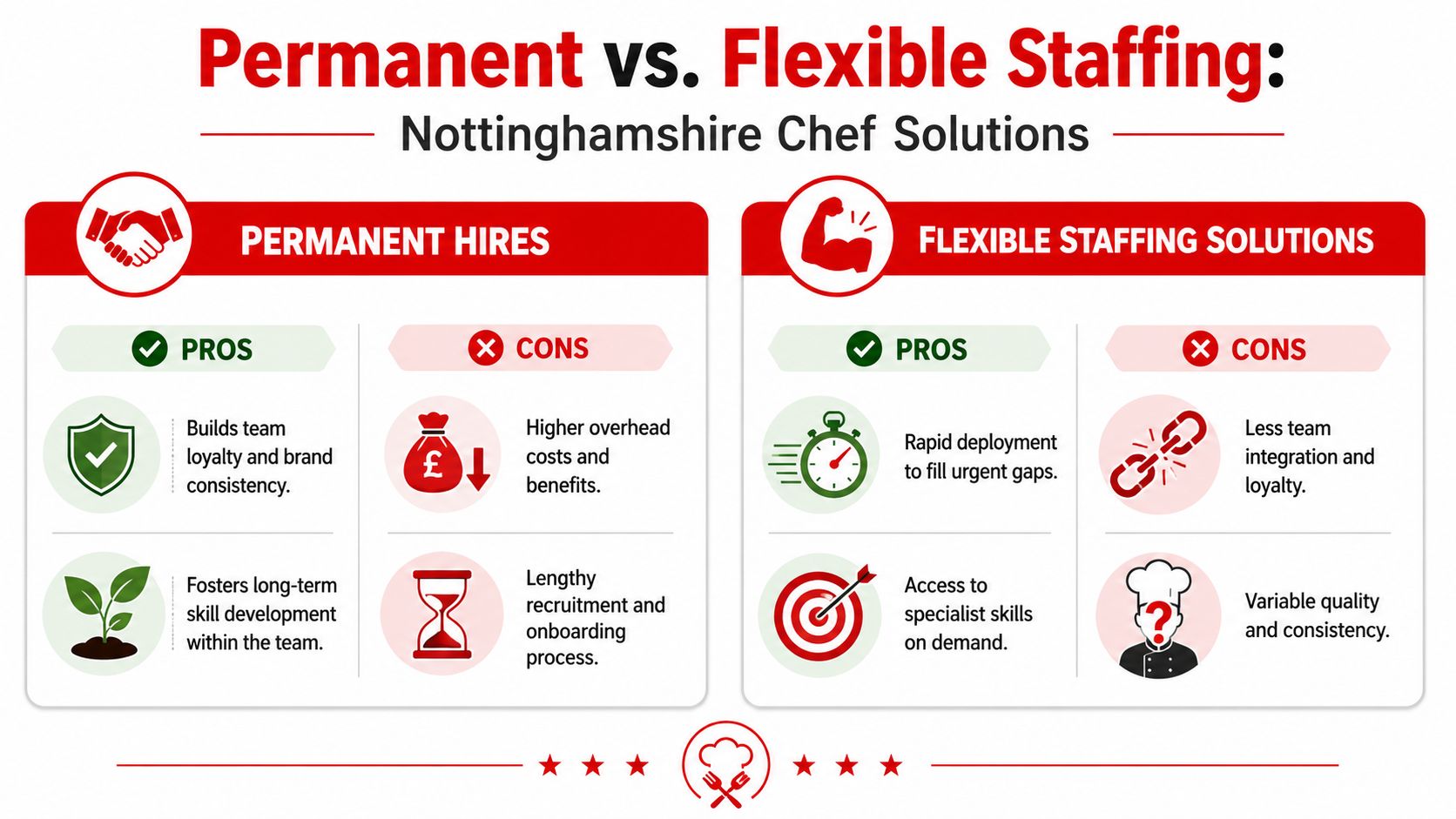
Permanent recruitment still matters. If you've got a stable site, a clear menu identity and a leadership gap to fill, you need proper long-term hires. But if you use permanent recruitment to solve every staffing issue, you'll keep getting caught out.
The simple truth is this. Permanent hiring is for building teams. Flexible staffing is for protecting service.
Where permanent hiring works well
A permanent chef makes sense when you need continuity, culture and progression built into the brigade.
That includes:
- Leadership roles: Head chef and sous chef appointments that shape standards and training.
- Core team building: Keeping knowledge in-house and reducing overreliance on short-term cover.
- Brand consistency: Especially important in boutique hotels, destination pubs and quality-led restaurants.
That said, permanent recruitment is rarely fast. You advertise, shortlist, arrange interviews, run trials, wait through notice periods and hope the candidate is as strong on week six as they were on day one.
Where flexible staffing wins
Flexible staffing solves a different problem. It keeps the kitchen operational when reality gets in the way of your ideal structure.
Use it when you've got:
- Urgent cover needs: Sickness, emergency leave, dismissals and sudden departures.
- Demand spikes: Events, busy weekends, summer trade, Christmas and private bookings.
- Skills gaps: You need somebody who can step into a section and work, not somebody you need to train from scratch.
- Breathing space: Your team needs support while you recruit properly.
Here's a useful comparison.
| Situation | Better fit |
|---|---|
| Replacing a long-term senior leader | Permanent hire |
| Covering a weekend sickness gap | Flexible staffing |
| Launching a new food offer | Blend of both |
| Holding standards during recruitment | Flexible staffing first, permanent hire second |
A specialist route tends to outperform generic temp supply because kitchen cover isn't just about availability. It's about competence, section readiness and reliability. That's the difference between a chef who saves service and one who adds to the problem. If you want a benchmark for specialist support, look at employment agencies for chefs with a hospitality focus.
Later in the decision process, it helps to see the model in action:
The blunt commercial answer
The best operators use both models. They don't pretend a permanent hire will solve tonight's service, and they don't use flexible chefs as an excuse to avoid proper recruitment.
A kitchen that relies only on permanent hires is slow to react. A kitchen that relies only on temps never settles. The sensible model is a stable core with flexible cover around it.
That applies in Nottinghamshire just as much as it does in other pressure markets such as Bristol, Berkshire, Dorset and Wales. Different locations, same operational maths. If the rota fails, the guest still expects a good plate.
What Top Chefs in Nottinghamshire Actually Want
If you want better applicants, stop writing vacancies from the manager's point of view only. Read them as a chef with options.
Strong chefs aren't looking for another chaotic kitchen with a vague brief and a manager who says, “We're like a family.” They want clarity, competence and a role that doesn't feel like a trap.

Skilled chefs know their own value
The local hiring criteria tell you plenty. One Newark-on-Trent head or sous chef role asked for 5 years' chef experience and a Level 2 Food Hygiene qualification, while a Nottingham sous-chef listing required 2 years' kitchen management experience, based on the verified local role details linked to the occupational background for chefs and head cooks.
That's not a trainee market. It's a ready-to-work market.
When employers ask for proven experience, management ability and qualifications, they're competing for candidates who can choose carefully. Those chefs aren't impressed by waffle.
The offer has to feel credible
The best chefs usually assess four things quickly:
- Kitchen leadership: Is there a proper structure, or is everyone firefighting?
- Rota honesty: Are the hours and weekends clear upfront?
- Standards: Does the business care about food, systems and consistency?
- Working life: Will they be respected, backed and communicated with properly?
Pay matters. Of course it does. But poor management burns through chefs faster than a weak advert ever will.
How to become easier to say yes to
Forget gimmicks. Most of the fixes are operational.
Start with these:
Write a clean brief
List the section, service style, shift pattern, expected standards and who the role reports to.Be upfront about pressure points
If weekends are required, say it. If the role includes ordering, stock control or team supervision, say that too.Don't oversell “progression”
If there's no real route to grow, don't promise one.Tighten communication
Slow replies make you look disorganised. Good chefs read that as a warning sign.
The fastest way to lose a serious chef is to make the job sound different at interview from how it looked in the advert.
The operators who attract better chefs usually run better kitchens. That's not a coincidence. Candidates notice prep discipline, staff meal standards, cleanliness, ordering systems and how the pass sounds during service. They're judging you as much as you're judging them.
The Smart Way to Hire Chefs and Protect Your Business
In a tight hiring market, speed without screening is reckless, but screening without speed is useless. You need both.
That's why the smartest hiring process is built around pre-qualification before interview, not after. In Nottinghamshire, live vacancy signals show a structurally tight market, and current listings commonly specify constraints such as 35 to 45 hours per week and weekend availability. The practical risk is applicant drop-off if those details come out late, which is why Indeed's Nottingham chef listings support pre-qualifying for rota fit, commute and certification before trial shifts.
What to screen before you waste time
If you're still booking interviews before checking the basics, tighten the process.
Screen these first:
- Rota fit: Can they work your busiest shifts?
- Commute radius: Will the travel work in reality, not just in theory?
- Section ability: Can they run the part of the kitchen you need covered?
- Certification status: If food safety matters to the role, check it early.
- Availability date: Immediate, notice period, or freelance cover only.
This isn't red tape. It's protection.
A practical hiring sequence that works
A lean process usually beats a bloated one.
Try this:
| Stage | What you need to confirm |
|---|---|
| Initial call | Availability, section, location, shift fit |
| Shortlist check | Experience level, management exposure, certification |
| Trial or placement decision | Service readiness and cultural fit |
| Booking confirmation | Hours, rate, dates, reporting line |
That approach matters even more when the kitchen is already stretched. Head chefs don't need more CVs. They need fewer, better-matched options.
Why specialist hospitality support makes sense
Generalist staffing tends to break down in kitchens because the margin for error is tiny. A poor warehouse temp slows a shift. A poor chef can wreck service, waste stock, flatten morale and trigger complaints.
That's why specialist hospitality support is the logical fix for many operators. Not because outsourcing is fashionable, but because chef hiring has become too operationally sensitive to leave to generic processes. The same applies whether you need relief chefs for short-term cover, temporary chefs during peak periods, permanent chef recruitment for a stable brigade, or more niche support such as yacht chefs, villa chefs and wider hospitality staffing support.
The same logic applies across other UK hospitality hotspots too. A hotel group in Windsor, a pub company in Reading, a restaurant in Slough, and a coastal operation in Devon all face the same core issue. Service can't wait for recruitment to catch up.
Your Nottinghamshire Chef Staffing Questions Answered
How quickly should I expect chef cover in an emergency
Fast. If you need to wait days just to get a meaningful response, your staffing route is wrong. Emergency cover only works when the person supplying it understands service pressure, rota urgency and kitchen hierarchy.
What's the difference between a standard temp and a specialist relief chef
A standard temp may fill a vacancy on paper. A specialist relief chef is there to protect service. That means they're expected to understand kitchen pace, section responsibility, food safety, handover discipline and how to slot into an existing brigade without drama.
That difference matters most on busy weekends and in small teams.
If the person arriving needs babysitting, you haven't solved the staffing issue. You've moved it.
Should I choose temporary cover or recruit permanently
Usually both. Temporary cover protects today's trade. Permanent recruitment protects long-term consistency. The sensible move is to use flexible support to stop the operation wobbling, then make permanent decisions without panic.
What should I fix before I start hiring again
Clean up the basics first.
- Define the role properly: Section, hours, leadership level and service style.
- Sort the rota reality: Be honest about weekends, doubles and peak periods.
- Tighten your process: Slow feedback and messy communication lose candidates.
- Know your essential requirements: Certification, commute, experience and section competence.
Do specialist staffing partners only help restaurants
No. Pubs, boutique hotels, event venues, private households, villas and yachts all run into the same issue. They need reliable chefs who can work to the right standard without lengthy onboarding.
Is Nottinghamshire different from other hiring markets
Yes and no. The local market is active and competitive, but the underlying problem is familiar across the UK. Good chefs have options, weak processes get exposed quickly, and kitchens need cover before service suffers.
If your current hiring method keeps leaving you exposed, it's time to stop treating chef recruitment like an occasional headache and start treating it as a critical part of operations.
If you need reliable kitchen cover or a longer-term hiring solution, Relief Chefs UK is the obvious next call. Established in 2013 and run by chefs, not recruiters, the business supports pubs, restaurants, boutique hotels, private households, yachts and villas across the UK with relief chefs, temporary chefs, permanent chef recruitment and wider hospitality staffing support. You'll get a commercially minded response, proper hospitality understanding and chefs who are vetted, right-to-work checked and ready to protect service when your kitchen needs it most. Contact Relief Chefs UK now and get your staffing problem handled before it becomes a service problem.
Call the team.
Office 01392 715474 · info@reliefchefs.co.uk