
Payroll Management Services for UK Hospitality Operators
24 August 2026

A Friday service is already in the weeds when a chef phones in sick. You find emergency cover, agree a different hourly rate, approve extra hours for the sous chef and then remember that payroll closes while the kitchen is still dealing with the dinner rush. By Monday, someone is asking whether the temporary chef is an employee, an agency worker or being paid through an umbrella arrangement. The answer affects records, deductions, pension handling and compliance.
That pressure is normal in UK hospitality. Seasonal demand, short-notice sickness, changing shift patterns and chef shortages mean your workforce rarely behaves like a fixed office team. Payroll management services give operators a controlled process for handling those changes, while recruitment partners such as Relief Chefs UK help keep the kitchen staffed when the rota changes without warning.
Why Payroll Complexity Is Breaking Hospitality Kitchens
A busy kitchen creates payroll problems in small increments. One chef stays late to finish a wedding breakfast. Another swaps a shift and works at a different rate. A casual worker covers a bank holiday, while a permanent employee takes statutory leave. Each change looks manageable on its own. Together, they create a payroll that depends on accurate time records, clear worker classifications and disciplined approval.

The scale is larger than many operators appreciate. HMRC's payrolled employment series recorded 32.2 million payrolled employments in December 2024, falling slightly to 32.1 million in December 2025, a 0.5% annual decline in the same series (HMRC payroll statistics). Those figures show why the UK's PAYE Real Time Information system matters. Employers submit payroll information regularly, and HMRC and the ONS use it to publish national pay and employment statistics.
Hospitality operators face a more volatile version of that national administration. A hotel in Windsor may add seasonal staff for events, a Bristol pub group may move chefs between sites, and a coastal business in Devon or Dorset may experience a sharp change in demand. A venue in Wales can face the same issue when sickness hits during a busy weekend, but with fewer local replacement options.
Where in-house processes fail
Spreadsheets don't know whether a chef's extra hours were approved, whether an agency worker belongs in the venue's payroll or whether a holiday calculation reflects irregular hours. They also don't chase missing timesheets reliably. The person processing payroll ends up asking chefs and duty managers for information after the shift has disappeared into the week.
That approach breaks most often when:
- Starters and leavers arrive together: Seasonal recruitment creates changes that must be entered correctly and promptly.
- Rates vary by shift: Night work, events, overtime and emergency cover can require separate approval and audit trails.
- Managers work operationally: A general manager dealing with a kitchen walkout or sickness crisis may not review payroll data until the deadline is close.
- Agency arrangements differ: Temporary chefs can be supplied, employed or paid through different structures, and the paperwork must match reality.
Practical rule: Treat payroll information as part of the daily service report. If a shift change matters to the kitchen, it matters to payroll before the pay run.
The cost of employing a chef shouldn't be judged only by the advertised rate. Employer National Insurance, workplace pension contributions, holiday pay and administration all affect the operating decision. A structured payroll process makes those costs visible before a venue commits to cover.
What Payroll Management Services Actually Cover
Payroll management services range from software access to a fully managed process. The difference is responsibility. Basic software may calculate pay after your team enters hours and rules. A managed provider can take responsibility for data checks, submissions, records and support, although the contract must specify exactly what it covers.
Payroll processing and worker data
The provider should collect approved hours, rates, allowances, deductions and absences, then calculate gross pay and net pay. For a restaurant with weekly casual shifts, that means converting signed-off timesheets into a consistent pay run. For a hotel, it may mean handling several departments, different contracted hours and changes during an event period.
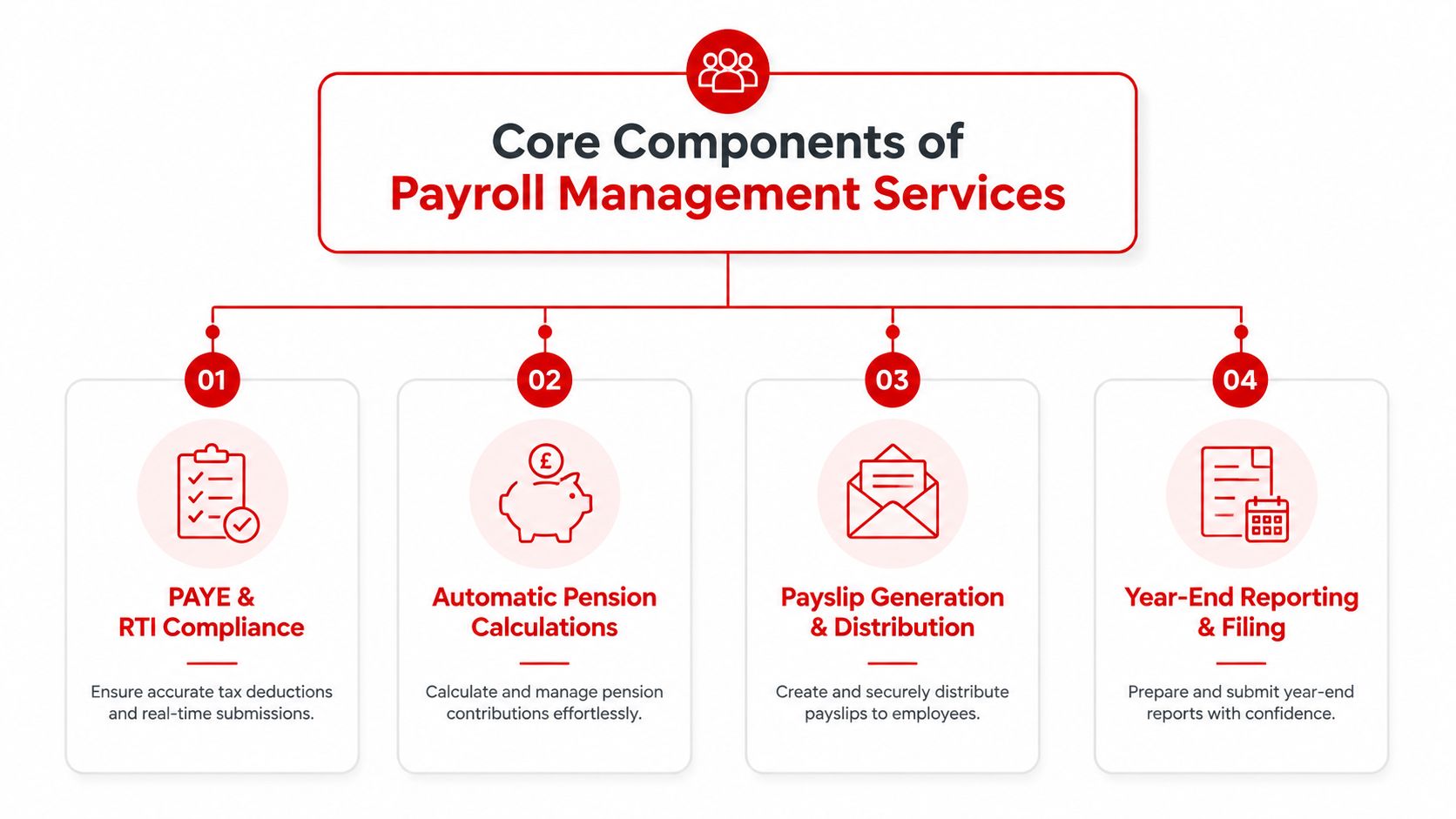
PAYE and RTI submissions sit at the centre of the process. The payroll system must send the right information to HMRC, retain evidence and identify exceptions before submission. National Insurance calculations, statutory payments and workplace pension deductions should follow the worker's actual status and pay data.
Classification and statutory obligations
Worker classification deserves attention before the first shift. A temporary chef supplied through an agency, a directly employed fixed-term chef and a worker paid through an umbrella company aren't interchangeable records. The provider should document the arrangement, identify who pays the worker and confirm which party handles deductions and reporting.
IR35 assessments may apply where a contractor arrangement is being considered. Payroll management services can support the administrative side, but the engagement decision still needs accurate facts about supervision, control, substitution and the working relationship. Don't let a label replace an assessment.
Payslips, pensions and reporting
Employees need clear payslips showing pay, deductions and relevant information. Managers need reports that expose labour costs by site, department or pay period. A good service should also support pension auto-enrolment, statutory pay calculations and year-end reporting rather than leaving those tasks in a separate spreadsheet.
For a chef moving from a temporary placement into a permanent role, records should carry forward cleanly. The same applies when a relief chef covers several periods at one venue. Duplicate records and incorrect starter information create confusion that can continue for months.
Use a UK chef salary calculator before agreeing a permanent package or comparing temporary cover. It can help you consider PAYE contract type, employer National Insurance, workplace pension contributions and holiday pay accrual alongside the headline salary. That comparison is more useful than looking at gross pay alone.
HMRC Compliance and the Real Cost of Payroll Errors
HMRC compliance is a calendar discipline, not a final check at the end of the month. The Full Payment Submission, or FPS, reports employee payments and deductions. An Employer Payment Summary, or EPS, records relevant adjustments and claims where applicable. Your process should assign ownership for both, retain approval evidence and escalate missing information before the submission date.
Late RTI filing penalties vary by PAYE scheme size. HMRC lists £100 for 1 to 9 employees, £200 for 10 to 49, £300 for 50 to 249, and £400 for 250 or more in its compliance guidance (HMRC late filing penalties).
HMRC late filing penalties by employer size
| Employees on PAYE | Monthly penalty | Annual cost if unresolved |
|---|---|---|
| 1 to 9 | £100 | £1,200 |
| 10 to 49 | £200 | £2,400 |
| 50 to 249 | £300 | £3,600 |
| 250 or more | £400 | £4,800 |
The annual figures in the table represent the same monthly penalty continuing for twelve months. They aren't a prediction of what every employer will pay, but they show how a recurring unresolved issue can become a material operating cost.
Compliance control: Don't wait for payroll day to discover that a temporary chef's hours or tax details are missing. Set an internal cut-off before the FPS deadline, then review exceptions separately from routine approvals.
PAYE payment timing creates another control point. HMRC's employer guidance sets the standard deadline at the 19th of the month after the tax month ends, or the 22nd when paying electronically (HMRC PAYE employer guide). Reconcile PAYE and National Insurance liabilities before payment, particularly when weekly payroll, monthly payroll and agency invoices overlap.
HMRC can apply further penalties when RTI returns remain outstanding for three months, and late PAYE amounts can attract additional time-based charges (RTI payroll guidance). A missing submission can therefore become a wider reconciliation problem rather than a single late task.
P11D administration also catches venues that focus only on wages. For the 2025/26 tax year, P11D(b) Class 1A National Insurance, expenses and benefits in kind had to be reported by 6 July 2026, with payment due by 19 July by cheque or 22 July electronically, according to HMRC's June 2026 Employer Bulletin (HMRC Employer Bulletin).
Holiday records need the same seriousness. From 6 April 2026, UK employers must retain detailed annual leave records for at least six years, including leave taken, carry-over, holiday pay received and the calculation used (holiday pay record-keeping guidance). That requirement matters particularly for hospitality businesses using seasonal and irregular-hours chefs.
Pricing Models and What Drives Your Payroll Costs
Payroll quotations often look cheap until you ask what happens when the rota becomes difficult. A venue with stable headcount may suit a fixed monthly package. A pub with frequent starters, leavers and casual shifts may need a tiered service that charges more for the work but gives better control.
Comparing the common models
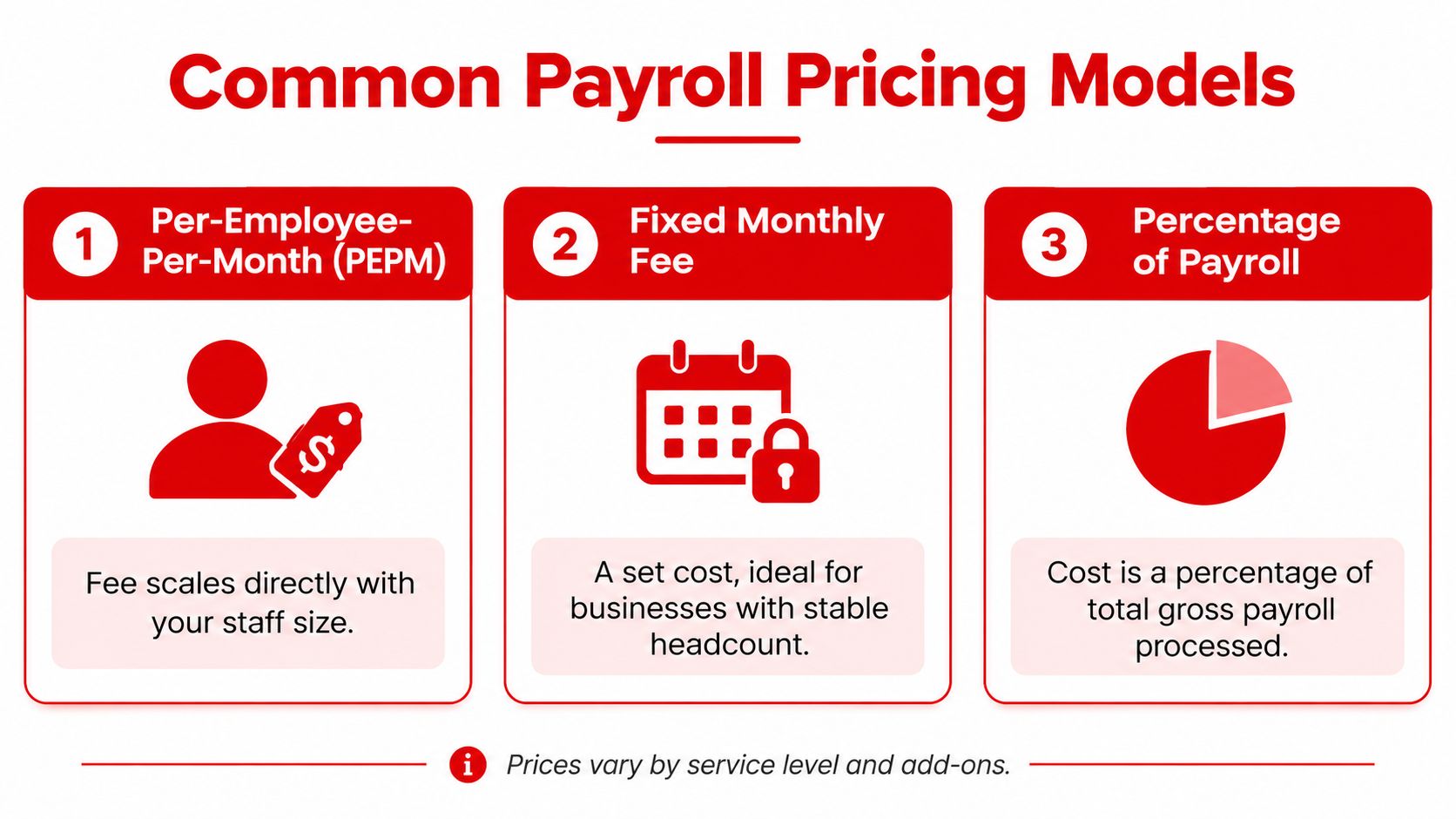
Per-employee-per-month pricing follows staff numbers. It can be straightforward for a small hotel, but casual workers and dormant records may create questions about who counts as an employee in each period.
Fixed monthly pricing offers a predictable bill. It works well where the workforce is stable, but the contract may limit pay runs, starter processing, amendments or support outside normal hours.
Tiered pricing reflects complexity rather than headcount alone. It may suit a multi-site operator processing different pay frequencies, pension arrangements and worker types. Ask whether seasonal increases move you into another tier.
Some providers use a percentage of payroll or combine a base fee with transaction charges. Prices vary by service level and add-ons, so compare the full schedule rather than the headline figure.
The cost drivers operators overlook
High turnover creates repeated onboarding and leaver administration. Variable hours require reliable time capture and approval. Multiple pay rates need clear earnings codes. Agency or umbrella workers require accurate classification and reconciliation. Pension auto-enrolment, statutory payments, year-end work and employee queries may sit outside the base fee.
A low-cost software package can work when one trained person owns payroll, timesheets are clean and the business has time to review exceptions. Managed payroll becomes more attractive when the general manager is also recruiting, handling guest complaints and covering the pass.
Commercial test: Ask the provider to price your busiest realistic month, not your quietest one. Include starters, leavers, emergency cover, amended hours and a late timesheet.
The latest Moorepay survey says outsourcing payroll to a provider continued to decrease in 2025, by 22%, while ONS data recorded 30.3 million payrolled employees in March 2025 (ONS payrolled employment release). That combination reinforces the decision. Outsourcing isn't automatically cheaper, and in-house software isn't automatically more controlled. Choose the model that can survive your busiest rota without relying on one exhausted administrator.
How Payroll Integrates with Temporary Chef Staffing
A chef calls in sick two hours before service. The replacement accepts the shift, but payroll has no agreed rate, approval route or worker status. That gap can turn emergency cover into an invoice dispute, an incorrect deduction or a compliance problem. Agree the payroll route before a temporary chef accepts work.
Record who engages the chef, who approves hours, who pays the worker and which organisation handles PAYE deductions. A relief chef supplied through an agency may follow a different process from a directly employed fixed-term chef. The staffing plan and payroll record must describe the same arrangement.
Payrolling umbrella company workers needs particular care. Reconcile the agreed rate, the agency or umbrella invoice and the worker's documented status. If the paperwork says one thing while the kitchen manages the engagement another way, the business creates avoidable classification and IR35 risk.

A practical hand-off for each placement
Before the chef starts, confirm:
- Placement details: Site, role, start date, expected finish and reporting manager.
- Rate and hours: Agreed pay basis, overtime treatment and approval route.
- Worker status: Direct employee, agency worker, contractor or umbrella arrangement.
- Evidence: Right-to-work checks, signed terms, timesheets and invoice requirements.
- Close-out: Final hours, expenses, holiday treatment and any replacement requirement.
Use one shared record for staffing and payroll. It keeps the placement decision separate from the payroll calculation while giving both teams the same facts. It also limits disputes when a chef covers breakfast, moves to a wedding event and finishes on a different date than planned.
Relief Chefs UK is a nationwide chef recruitment agency established in 2013. Its services include relief chefs, temporary chefs, permanent chef recruitment, yacht chefs, villa chefs and wider hospitality staffing support. For operators across Devon, Bristol, Wales, Berkshire, Windsor, Reading, Slough, Dorset and other UK hospitality areas, that range can support anything from short-notice sickness cover to a longer placement.
Relief Chefs UK works with operators of different scales, from small pubs and cafés to multi-site and hotel groups. Relief Chefs UK states that venues can request cover through a short form or by phone and meet vetted, right-to-work-checked chefs, subject to availability. Treat staffing arrangements and payroll obligations as connected controls. A chef protects service on the pass. Accurate records protect the business after service.
Your Payroll Provider Evaluation Checklist
A temporary chef can save a service, but the payroll record still needs to stand up after the shift. Start with the service agreement. Confirm who owns each task, what information managers must provide and what happens when a deadline is at risk. Automation has limited value if your team still chases every exception.
Ask these questions before signing:
- RTI ownership: Who prepares, reviews and submits the FPS and EPS, and what evidence will you receive?
- Deadline protection: What is the timesheet cut-off, and how are late submissions escalated?
- Hospitality capability: Can the system handle irregular hours, changing rates, weekly payroll and seasonal starters?
- Worker onboarding: How are agency, umbrella and directly employed temporary chefs recorded?
- Holiday calculations: How are irregular-hours leave, carry-over and required records handled?
- Pension administration: Who manages assessment, postponement, deductions and employee communications?
- Corrections: How are underpayments, overpayments and amended submissions investigated and approved?
- Data security: Where is payroll data stored, who can access it and how are GDPR controls supported?
- Support: Can a duty manager speak to someone knowledgeable during a peak period, rather than only submit a ticket?
What a useful service level agreement contains
Look for named responsibilities, response targets, payroll approval windows, escalation routes and a clear process for HMRC notices. The agreement should state fees for additional pay runs, amended submissions, year-end work, setup, leavers and historical data.
Test the provider before committing. Give them a scenario involving a sick chef, a late timesheet, a changed pay rate and an umbrella worker. A useful response identifies decision points, assigns responsibility and requests evidence. A weak response says the software handles everything without explaining who checks the result.
Check how the provider works with temporary staffing partners, too. The right arrangement keeps approved shifts, rates and payroll records aligned when cover is booked at short notice or extended during a seasonal rush.
Red flag: If nobody can explain the correction process, the provider is not ready for a high-churn kitchen.
Real Hospitality Payroll Challenges and How to Fix Them
A boutique hotel in Windsor adds seasonal chefs for events, but the managers record starters in separate spreadsheets. The fix is a single onboarding checklist linked to the payroll record, with start dates, status, approved rate and timesheet owner confirmed before the first shift. That approach also helps the hotel prepare the holiday records required for irregular-hours staff.
A pub group in Bristol misses RTI submissions while managers cover sickness and a kitchen walkout. Rather than treating each penalty as an isolated error, the group assigns one payroll owner, sets an earlier internal deadline and uses exception reports for missing hours and unapproved changes. The aim is to stop the same process failure recurring across sites.
A Dorset restaurant uses permanent chefs, temporary cover and umbrella workers. Its payroll problem isn't the range of workers by itself. The problem is inconsistent documentation. The restaurant separates each engagement route, reconciles supplier invoices to approved shifts and keeps the payroll provider informed when a temporary chef becomes a direct employee.
Operators in Devon, Wales, Berkshire, Reading, Slough and other busy hospitality areas face the same operational tension. Official hospitality labour data indicates around 69,000 to 71,000 vacancies in accommodation and food services, underlining the pressure created by short-notice sickness, seasonal peaks and difficulty keeping kitchens stable (hospitality labour data). Payroll management services won't solve a chef shortage on their own. They can, however, make flexible staffing safer to administer, easier to forecast and less likely to disrupt service.
Relief Chefs UK can support your operation with vetted relief chefs, temporary chefs, permanent chef recruitment, yacht chefs, villa chefs and wider hospitality staffing support across the UK. Visit Relief Chefs UK to request kitchen cover and discuss a staffing approach that keeps payroll information, compliance and service continuity under control.
Call the team.
Office 01392 715474 · info@reliefchefs.co.uk