
A supplier invoice lands on the desk after a difficult Saturday service. The chef is checking delivery notes against the menu, chasing a missing provenance document, and working out why waste has climbed while ingredient prices remain under pressure. At the same time, a sous chef has called in sick, the next bank holiday weekend is already heavily booked, and the team needs a menu that can be delivered consistently rather than merely described as sustainable.
That is the reality behind sustainable sourcing practices in UK hospitality. They aren't a branding exercise reserved for premium restaurants. Procurement decisions influence waste, margins, menu continuity, supplier risk and the standards a kitchen can maintain when staffing is tight. The challenge is making good decisions with incomplete information, seasonal availability and suppliers that don't all measure sustainability in the same way.
Why Sustainable Sourcing Matters for UK Hospitality Businesses
A pub in Devon, a hotel near Windsor and a restaurant in Bristol may have very different menus, but their procurement problems are familiar. Deliveries arrive late, a preferred ingredient becomes unavailable, a local supplier can't cover a sudden increase in demand, or a replacement product costs more than the original order. The kitchen then absorbs the disruption through substitutions, rushed prep and avoidable waste.
UK food waste makes that pressure commercially important. WRAP estimated that total food waste reached 10.7 million tonnes in 2021, with hospitality and food service contributing 1.1 million tonnes, or 10% of the total. The sector's food waste intensity was estimated at 18% of food purchased, costing the industry about £3.2 billion a year, according to the WWF catering report. Those figures make purchasing decisions directly relevant to gross margin, storage discipline and emissions across the supply chain.
Sustainability now sits inside everyday operations
Sustainable sourcing means choosing products and suppliers that fit the venue's environmental, social and commercial requirements, then checking whether those requirements are being met. A cheaper case price isn't necessarily cheaper if the product arrives with inconsistent sizing, short shelf life or poor yield. A nearby supplier isn't automatically the best option if deliveries are unreliable and the kitchen has to buy emergency replacements from a national wholesaler.
The UK food-service sector had already moved towards formal procurement commitments by the late 2010s. By 2018, food-service management businesses reported that over 70% procured more than half of their food from the UK, while 82% used locally sourced food and 82% used sustainably sourced palm oil ingredients or products, or were making progress towards doing so, as recorded in the Scottish Government review of sustainable procurement outcomes. The direction is clear. Sustainability has become part of mainstream supply-chain management.
Operational rule: Choose the sourcing model that keeps quality, availability and waste under control, not the option that sounds best on a menu.
The resilience question matters more than the label
Climate volatility and import dependence are affecting UK food security. A CIEH summary of Defra findings describes extreme weather hampering domestic production and increasing reliance on imports. For a busy venue, that risk shows up as a missing delivery, a sudden price change or an ingredient that can't be replaced without changing the dish.
The right question is therefore practical: can this supplier support the menu through a difficult trading period, and can the venue verify the claims being made? That matters in Dorset, Wales, Berkshire, Reading and other hospitality hotspots where local purchasing can be valuable, but continuity still determines whether service runs smoothly.
What Sustainable Sourcing Means in Practice
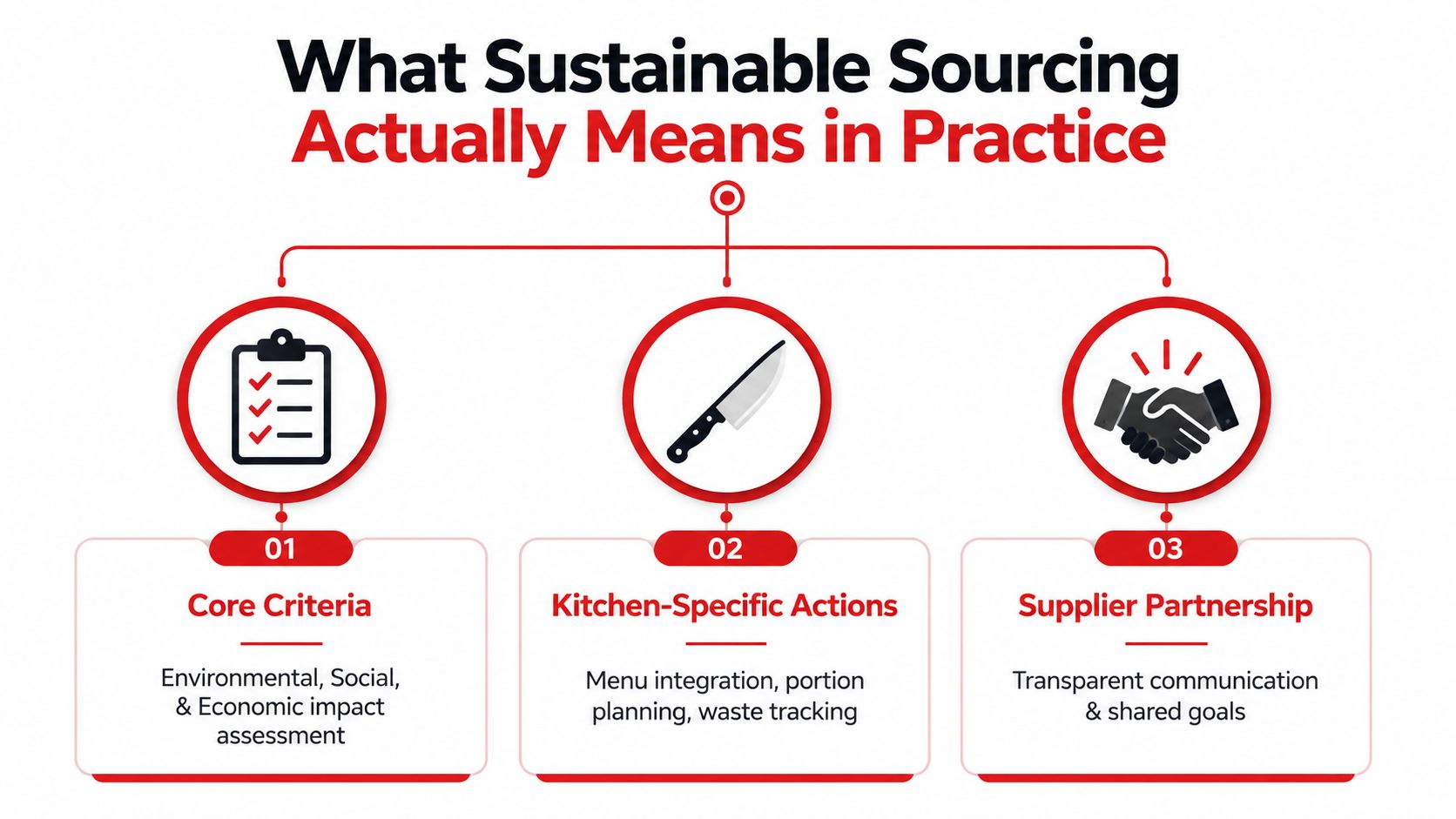
In a working kitchen, sustainable sourcing is a set of procurement controls. The assessment should cover environmental impact, social standards, commercial viability and the evidence available for checking each claim. The useful test is operational: can the information guide ordering, menu planning, stock rotation and waste reviews?
Start with evidence, not marketing language
Ask where the product was grown, processed and packed. Establish what the supplier can demonstrate about production standards, labour conditions, transport, packaging and waste. Terms such as “local”, “natural” and “responsibly produced” may describe a product, but they do not give a buyer enough information on their own.
The information gap creates a practical risk. A supplier may use credible language without holding the records needed to support it, leaving the venue unable to compare offers or defend a purchasing decision. Record the evidence supplied, the date it was checked and any areas where the supplier cannot provide data.
Soil health and biodiversity show why detail matters. WWF reported that, on average, 59% of UK-grown produce sourced by retailers in 2024 came from a strong scheme for biodiversity and soil health, according to its What's in Store for the Planet report. A hospitality buyer can apply the principle at a smaller scale by asking farms and producers which standards they follow, how those standards are checked and what documentation is available.
Translate policy into kitchen procurement
Central government provides a useful technical model. The Government Buying Standards are mandatory for central government departments and related organisations, setting a minimum, cost-effective threshold for applicable product categories. Their framework combines category specifications, whole-life cost, supplier requirements, product-level cradle-to-gate greenhouse-gas information and Carbon Reduction Plans for major contracts.
An independent hotel can use the same logic without running a government tender. Add clear requirements to supplier onboarding and review documents:
- Provenance: Record the country, region and production stage for key ingredients.
- Assurance: Request current certification or third-party verification where a claim relies on a defined standard.
- Environmental impact: Ask for available carbon, water, waste and packaging information, and record gaps.
- Social responsibility: Check labour policies, worker welfare controls and grievance procedures.
- Commercial performance: Compare yield, shelf life, delivery reliability, minimum order requirements and price stability.
The UK Food Security Report 2024 raises broader measurement gaps in the food supply chain. For hospitality, that includes information about packaging, logistics and outsourced catering, as well as ingredients. Treat missing evidence as a recorded procurement risk, then decide whether the uncertainty is acceptable for the menu, margin and service requirements.
How to Evaluate and Select Sustainable Suppliers
A supplier evaluation should be simple enough for a general manager to maintain and detailed enough to expose risk. Start by listing the ingredients and services that matter most to the menu, then ask every relevant supplier the same core questions. Consistency is more valuable than a complicated scoring model that nobody updates.
Request evidence before awarding regular business. Useful documents include certification details, product specifications, origin information, delivery terms, packaging information, allergen controls, labour policies and a clear explanation of how the supplier monitors environmental performance. If a producer can't provide a formal certificate, ask for a written description of its controls and record that limitation.
Use a repeatable scoring conversation
A Devon farm might offer excellent seasonal produce, short delivery routes and direct communication, but have limited backup capacity during a busy weekend. A national wholesaler might provide a wider range, consolidated deliveries and stronger substitution options, while offering less detailed farm-level information. Neither should win automatically.
Ask questions that expose the operational reality:
- What happens when the specified product isn't available? A controlled substitution process is safer than an unplanned replacement.
- How much notice does the supplier need? This matters for hotels, wedding venues and venues affected by seasonal demand.
- What information accompanies each product? Delivery notes should support the provenance and specification recorded at onboarding.
- Which claims are independently assured? Check the scope, expiry date and products covered by any certification.
- How does the supplier handle waste and packaging? The answer should cover collection, reuse, reduction or disposal rather than a general promise.
- Can the supplier share performance information over time? A partnership needs a way to review missed deliveries, substitutions, quality and data gaps.
| Criterion | Question to Ask | Strong Evidence |
|---|---|---|
| Provenance | Can you identify the production and processing origin? | Product specification, farm or producer records, delivery documentation |
| Environmental standards | Which soil, biodiversity, carbon or resource controls apply? | Current third-party assurance, audit summary or measurable supplier records |
| Labour practices | How do you check worker welfare and employment standards? | Policy documents, due-diligence process and relevant audit evidence |
| Reliability | How will you manage shortages, late deliveries and substitutions? | Service agreement, escalation route and recent performance records |
| Commercial value | What is the usable yield and expected shelf life? | Specification, pack details, agreed quality standard and waste review |
| Data quality | Which information is verified, estimated or unavailable? | Completed supplier questionnaire with named owner and review date |
Make the score reflect the venue's real priorities
Don't award a supplier on sustainability alone. Assess environmental assurance alongside reliability, quality, price, delivery capability and the supplier's willingness to improve its evidence. A venue may reasonably accept a supplier with incomplete data if the business has a clear improvement plan and the product is operationally sound. It shouldn't accept vague claims indefinitely.
Review the shortlist with the head chef, buyer and front-of-house lead. Chefs understand quality and yield, buyers understand terms, and front-of-house teams hear customer questions about provenance. That shared view prevents a procurement decision that looks good on paper but fails during service.
Balancing Local Sourcing with Supply Chain Resilience
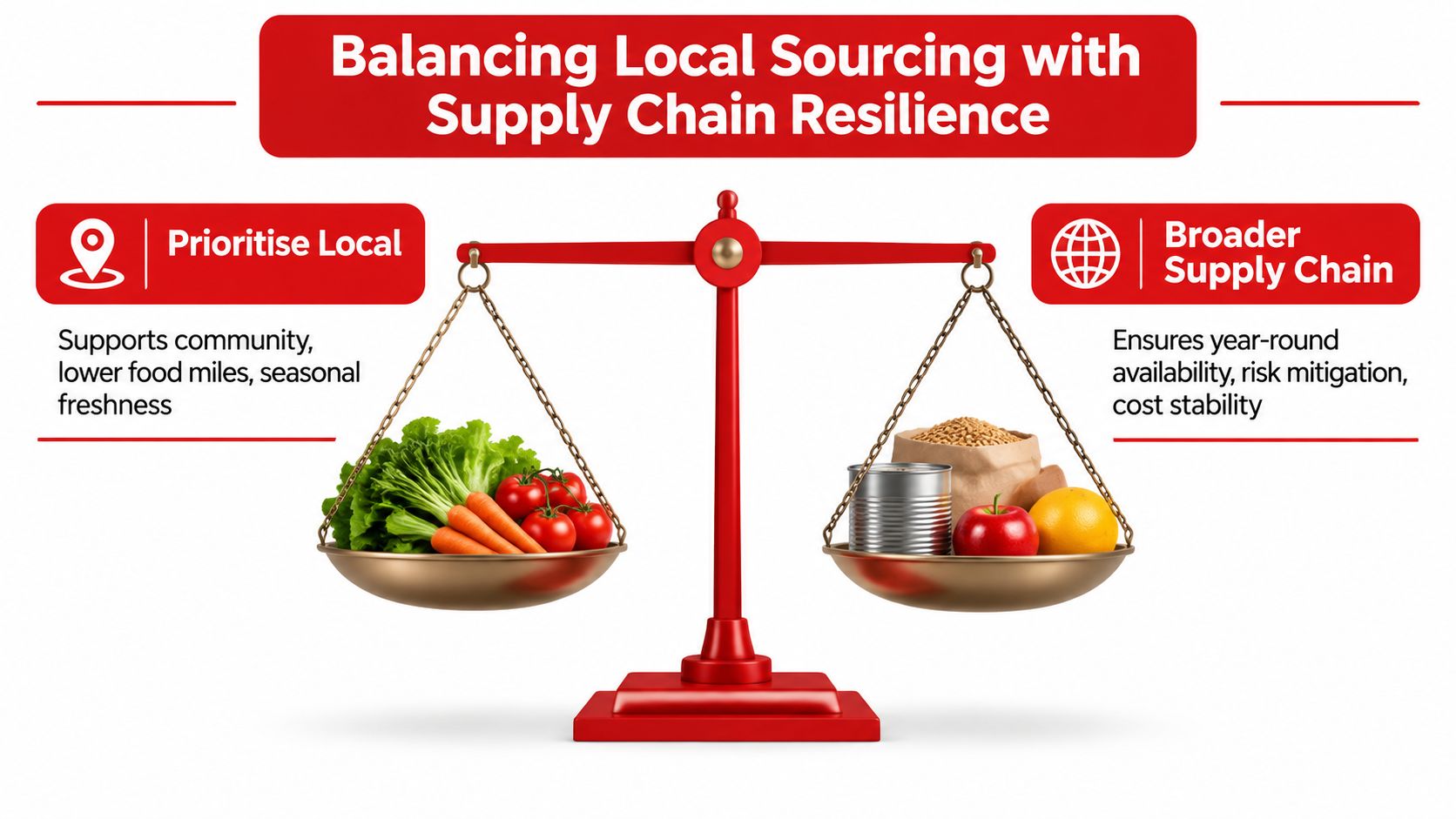
Local sourcing can strengthen relationships, shorten routes and give a venue better control over seasonality. It can also create exposure if one producer supplies a critical ingredient and can't meet demand. A broader supply chain may provide continuity and cost stability, but it can make provenance harder to verify and leave the venue dependent on longer, more complex logistics.
The sustainable choice depends on the ingredient, the season and the consequence of failure. A local Dorset producer may be the right source for a rotating vegetable special, while a national distributor provides a dependable base product for a high-volume menu item. A Welsh supplier may offer a strong relationship and clear provenance, but the venue still needs a contingency for a wedding weekend or a sudden group booking.
Compare the operating trade-offs
| Local and seasonal buying | Broader supply-chain buying |
|---|---|
| Stronger producer relationship and clearer regional story | Wider availability across changing demand |
| Menu can follow UK seasons and available crops | Greater consistency for core dishes |
| May require more frequent ordering and flexible specifications | May involve more complex provenance and transport |
| Can expose the venue to a single-supplier failure | Can reduce disruption through alternative stock |
| Works well for specials and changing menus | Works well for essential, high-volume ingredients |
A winter menu should make the decision visible. Keep dishes that depend on reliable core ingredients, then build specials around what local suppliers can deliver. If a producer expects a difficult harvest, adjust the menu before the shortage becomes an emergency purchase. That protects both the supplier relationship and the kitchen margin.
Build resilience deliberately
Use more than one approved route for ingredients that would stop service if they disappeared. Set substitution rules in advance, agree acceptable quality ranges and keep procurement records that show which products can be replaced without compromising the dish. service continuity planning supports sustainable procurement, because a resilient menu needs both supply options and a team capable of adapting them.
Bristol venues can face sharp demand around events and bank holidays. Windsor restaurants and hotels may see sudden changes from weddings, tourism or corporate bookings. A balanced plan lets the kitchen buy local when availability is dependable, while retaining a tested distributor for volume protection.
The most sustainable ingredient is not always the most local. It is the one the venue can use efficiently, source responsibly and replace sensibly when conditions change.
Seasonal Menu Planning That Reduces Waste and Protects Margins
A seasonal menu works best when procurement, recipe design and staffing decisions are made together. Buying ingredients that are plentiful and suitable for the time of year can simplify ordering, reduce overstocking and give chefs more flexibility. It only delivers those benefits if the menu can absorb changes in availability.
A Reading gastropub might keep a stable core menu and run daily specials from the supplier list. A boutique hotel in Slough might use the same approach for breakfast and banqueting, with a clear substitution plan for produce affected by weather or late deliveries. In both cases, the kitchen avoids designing every dish around an ingredient that must be imported or ordered in a fixed quantity.
Design for flexibility before the order is placed
Write menus with overlapping ingredients, sensible portion controls and recipes that use trim. A root vegetable can appear in a soup, side dish and staff meal, provided the preparation team understands the specification and storage requirements. Flexible garnishes and daily specials give the chef room to use stock that is safe and high quality rather than forcing a dish after the best window has passed.
Use a short menu meeting before each ordering cycle. The chef, buyer and front-of-house manager should review bookings, likely covers, current stock, supplier availability and recent plate feedback. That conversation connects purchasing to actual demand instead of relying on habit.
The food waste reduction guidance should sit alongside this process. Track what leaves the kitchen as spoilage, preparation waste, returned food and overproduction. Each category points to a different fix, such as smaller deliveries, tighter prep quantities, improved storage or a change to portion size.
Preserve the surplus that has a job to do
Preservation can extend the useful life of seasonal ingredients when the kitchen has a defined recipe and a safe process. Pickling, fermenting, preserving, freezing and cooking down can all support a flexible menu, but only when labelling, allergen controls, shelf-life checks and stock rotation are managed properly. A jar of preserved produce without an owner or date is not sustainability. It is future waste.
The team also needs a feedback loop from service. If diners consistently leave a side dish, the issue may be portion design rather than the supplier. If a special sells out early, the next order should reflect the demand while keeping a backup dish available.
Use the video below as a prompt for a team discussion about how menu choices affect kitchen waste and daily purchasing decisions.
Building Supplier Partnerships That Support Your Brand and Budget
Transactional buying encourages short-term price chasing. That can work for a commodity order, but it often fails when the venue needs reliable quality, flexible quantities or honest information about availability. A long-term supplier partnership gives both sides a reason to share forecasts, solve problems early and improve the evidence behind sustainability claims.
Independent venues have a useful advantage here. A restaurant in Devon or a hotel in Wales can often speak directly with a producer, visit the operation and agree a practical specification without passing every decision through a large central procurement team. That access should be used carefully, with written terms that protect both parties.
Put useful commitments into the agreement
A supplier agreement doesn't need pages of corporate language. It should state the product specification, delivery window, notice for shortages, substitution rules, packaging expectations, payment terms and review process. Add a commitment to share available provenance and environmental information, with a named contact responsible for updates.
Share forecasts rather than placing unpredictable orders. A producer can plan stock more effectively when the venue gives realistic information about bookings, seasonal demand and menu changes. In return, the venue may receive earlier warnings about shortages, better use of available produce and fewer emergency substitutions.
Commercial test: A partnership is working when it reduces surprises without forcing the venue to buy more stock than it can sell.
Site visits and joint menu planning can also improve quality. The chef learns how a product is grown, harvested or packed, while the supplier learns which formats the kitchen can use efficiently. That information can lead to better pack sizes, more useful grades or a seasonal special that uses produce the supplier has in abundance.
Supplier collaboration should still include performance reviews. Check delivery accuracy, quality, yield, substitutions, invoice issues and data completeness. If the relationship is strong but a recurring problem remains, agree a specific corrective action rather than allowing goodwill to hide operational costs. A structured operational cost reduction approach can help translate those reviews into margin decisions.
A compelling provenance story is a secondary benefit, not the reason to tolerate poor service. Customers may value a local producer, but the kitchen also needs dependable deliveries and a product that performs on the plate. The best partnerships support both.
Your Sustainable Sourcing Implementation Roadmap
Start with records you already have. A perfect procurement system is unnecessary at first. Clearer purchasing data, tighter menu control and direct supplier conversations reveal where cost, waste and continuity risks sit.
Put the controls in the right order
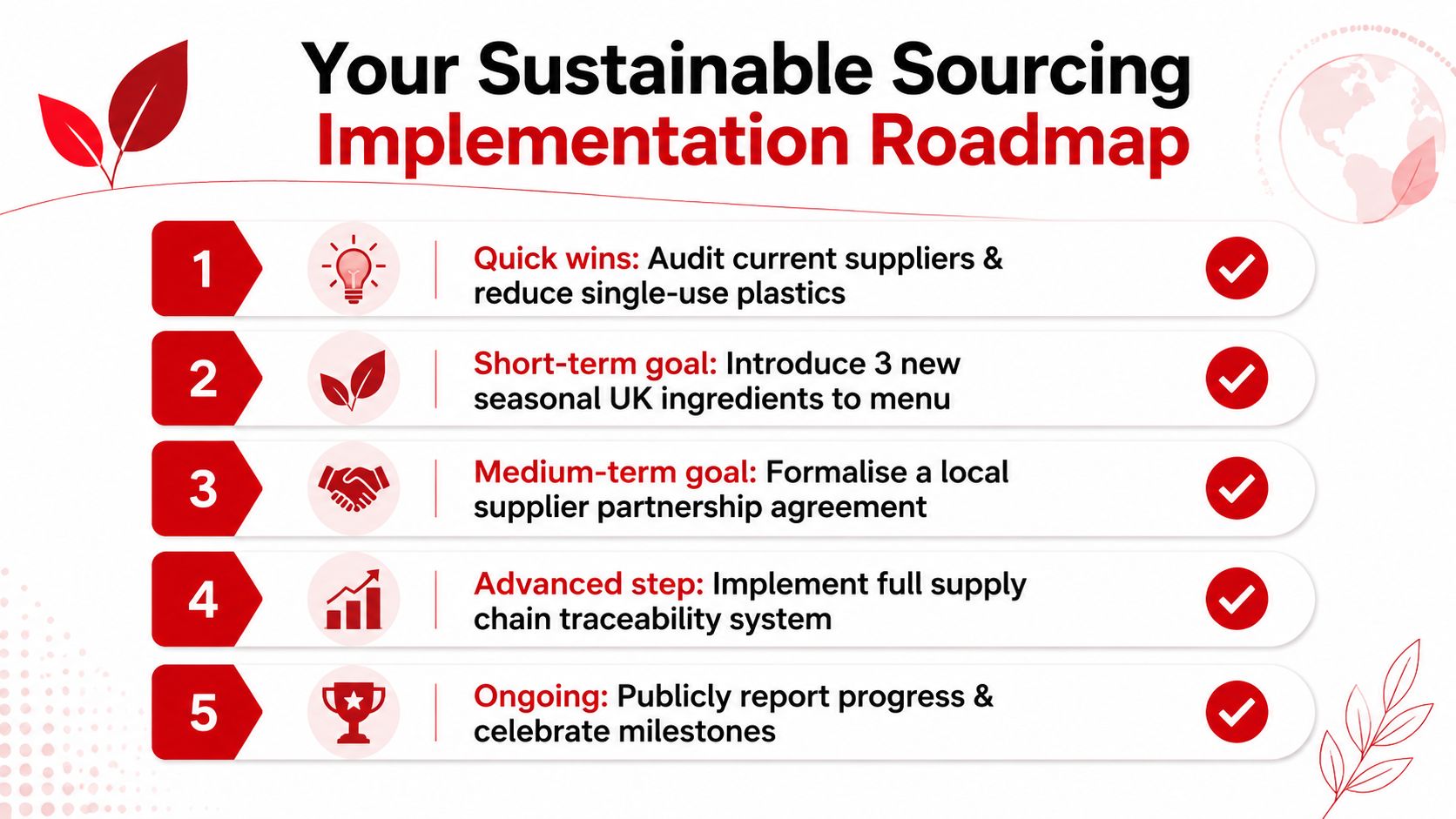
- Audit current suppliers: Record origin, certifications, delivery performance, packaging, quality problems and missing evidence. Supplier claims are only useful when the kitchen can verify them.
- Choose practical priorities: Start with high-volume ingredients, frequent waste items and products that could interrupt service.
- Adapt the menu: Build in seasonal flexibility, approved substitutions and recipes that use trim effectively.
- Formalise partnerships: Agree specifications, forecasts, review dates and corrective actions with priority suppliers.
- Track and train: Keep a monthly record of waste, substitutions, failed deliveries, supplier evidence and menu changes.
Keep the system usable. Store supplier details, prep standards and substitution rules where chefs can find them, then cover them during induction. Short-notice sickness, seasonal demand and chef shortages can leave temporary staff or a new brigade making purchasing decisions without the necessary context.
Training also protects margins. If inconsistent ordering causes poor stock rotation or rushed substitutions, the procurement plan fails during peak service. Set clear ownership for ordering, receiving and evidence checks, particularly across busy regions such as Devon, Bristol, Dorset, Berkshire, Windsor, Reading, Slough and Wales.
Staffing cover supports those controls. Relief Chefs UK provides relief chefs, temporary chefs, permanent chef recruitment, yacht chefs, villa chefs and wider hospitality staffing support. Cover during sickness, seasonal pressure and recruitment gaps helps managers maintain supplier standards instead of discarding them when service pressure rises.
If your venue needs dependable kitchen cover while improving sustainable sourcing practices, contact Relief Chefs UK for nationwide relief chefs, temporary staffing and permanent chef recruitment. Their team supports pubs, restaurants, hotels, private households, yachts and villas, helping procurement standards remain workable during difficult services.