

The text lands at 4am and you already know what it means. Your only chef de partie can't come in, the prep list is half done, the breakfast team is thin, and the first ticket is still waiting for someone to pick it up. By the time you've counted the gap, you've also counted the cost, service pressure, menu compromises, overtime, and the chance that a bad start to the morning becomes a bad day for the whole house.
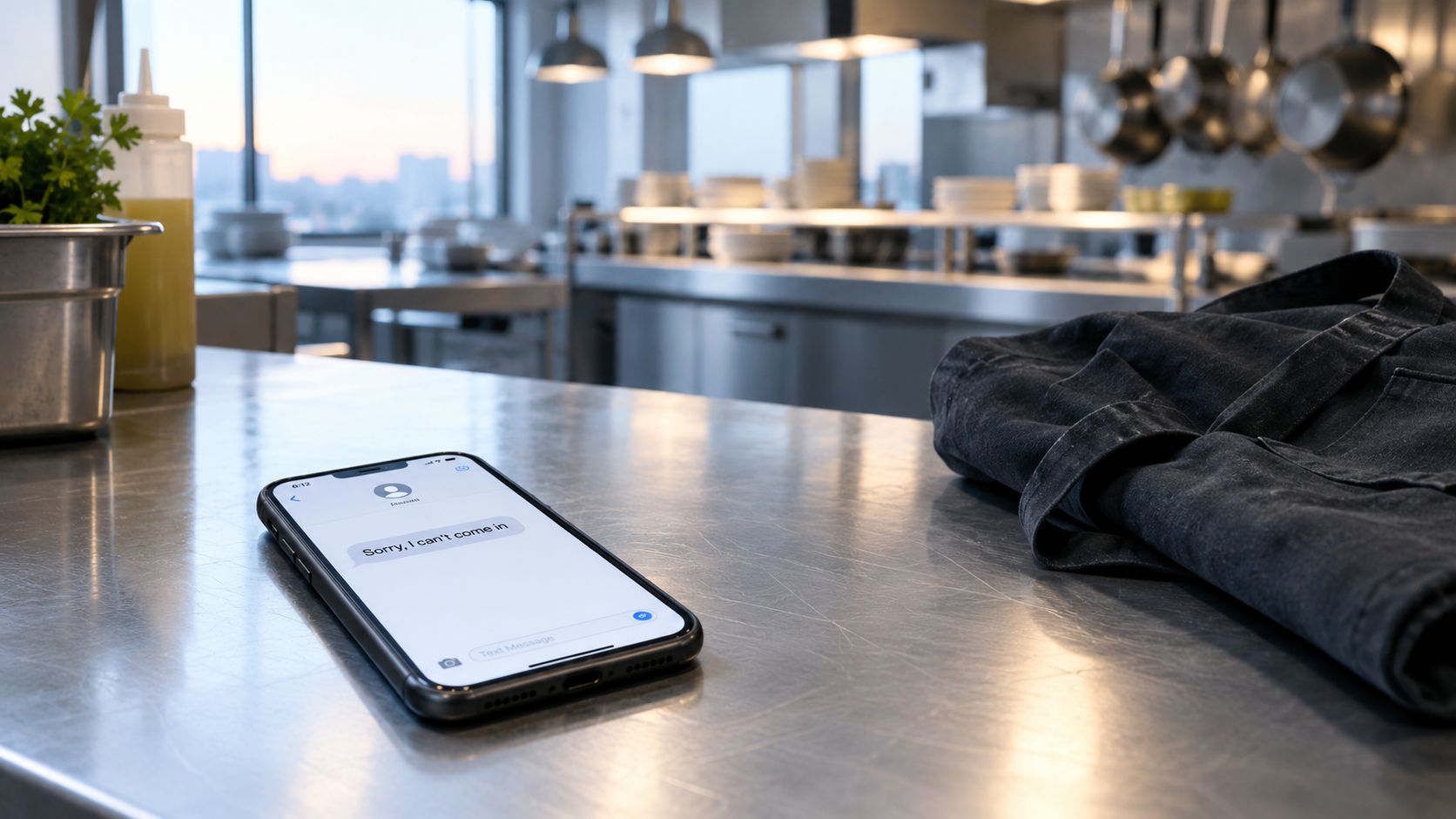
A proper relief chefs agency exists for that exact moment, and for the decisions that come after it. If you're running a pub, restaurant, hotel, yacht, or private kitchen, the question isn't whether staffing can go wrong. It's whether you've got a clean, fast, safe way to stop one missing chef from turning into a failed service.
The 4am Phone Call Every Operator Dreads
The worst part of a short-notice sickness isn't the message itself. It's what happens in the next ten minutes. The sous chef gets pulled off prep to cover the pass, the dining-room manager starts reshuffling covers, and the breakfast shift turns into damage control before the doors are even open.
One missing chef changes the whole room
In a well-run kitchen, every section depends on the one beside it. If the gap is in pastry, breakfast gets slower. If it's grill or sauce, the menu gets narrower. If it's the only strong senior hand on site, the whole brigade starts working reactively instead of running the pass with discipline.
A relief chefs agency is the service you call when you need trained kitchen cover without turning the venue into a recruitment project. Done properly, it gives you a vetted chef who can step into a live kitchen, take instruction quickly, and keep the business moving while you protect standards. That's why 7 kitchen disasters and emergency relief chef booking matters more than a generic staffing page.
The point is simple. You're not buying “a body”. You're buying time, continuity, and a chance to keep service intact while you solve the staffing problem properly.
Practical rule: if the absence affects service, safety, or revenue before lunch, treat it as an operational incident, not a hiring task.
What a Relief Chefs Agency Actually Does
A relief chefs agency matches venues with vetted chefs who can step in for short-term kitchen cover, sometimes at very short notice, and sometimes for a planned run of shifts. The right agency doesn't just send someone who says they can cook. It sends someone who can operate inside your menu, your pace, your equipment, and your standards.
Who books this kind of cover
Independent pubs use it for sickness, weddings, and weekend pressure. Restaurants book it when a senior chef quits, a section goes thin, or the booking book is too busy to let the kitchen wobble. Boutique hotels, yacht managers, and private households use the same model when consistency matters and downtime is expensive.
Relief Chefs UK is a useful example because it's a nationwide chef recruitment agency established in 2013, run by chefs rather than generic recruiters. It covers relief chefs, temporary chefs, permanent chef recruitment, yacht chefs, villa chefs, and wider hospitality staffing support. If you want the agency relationship in one line, it's this, a trained kitchen professional is booked into a venue to hold the line until the permanent team is back at full strength.
What good cover should solve
Good cover keeps the kitchen open, protects the permanent team from burnout, and stops the venue making bad trade-offs under pressure. That means the agency should understand section capability, not just job title. A chef who can run breakfast service may not be the right answer for a busy banqueting dinner or a pastry-heavy hotel breakfast room.
Temporary agency chef cover only works if the handover is tight. That means the chef arrives briefed, the venue knows what section is being covered, and someone on site is ready to supervise the first stretch of service.
A relief chef is only useful if they can absorb the rhythm of the kitchen fast enough to protect the pass.
Why UK Venues Still Need Cover Even When Vacancies Fall
Some operators look at lower vacancy headlines and assume the shortage has eased. That's the wrong read. Hospitality vacancies were still 112,000 at the end of 2023, up from 89,000 before the pandemic, and the sector was still carrying an 8% vacancy rate. Even when vacancies eased to 107,000 by the three months to April 2024, that was still above the roughly 93,000 recorded before the pandemic as reported in the ONS-linked analysis.
Lower totals don't mean easy cover
The shape of the problem has changed, not disappeared. In 2025, payrolled employees in accommodation and food services fell from 2,111,898 in April 2025 to 2,100,827 in May 2025, while vacancies also fell year on year from 98,000 in May 2024 to 79,000 in May 2025 Restaurant Online analysis. That doesn't tell you local cover is easy to find. It tells you some operators are shrinking, recruiting less, or still struggling to replace people who leave.
Seasonal pressure has also shifted. Online job postings for summer hospitality work were down 25% year on year in 2025 The Caterer coverage. In places like Devon, Dorset, Wales, Bristol, Reading, Windsor, and Slough, that matters because local labour pools aren't deep enough to absorb a sudden absence and a busy booking diary at the same time.
The operational lesson is blunt. A single resignation or sickness absence can still force menu simplification, overtime, or reduced opening. Relief cover remains a core operating tool because volatility hasn't gone away, it's just moved from headline vacancy numbers to the daily reality on site.
Permanent Hire or Temporary Cover
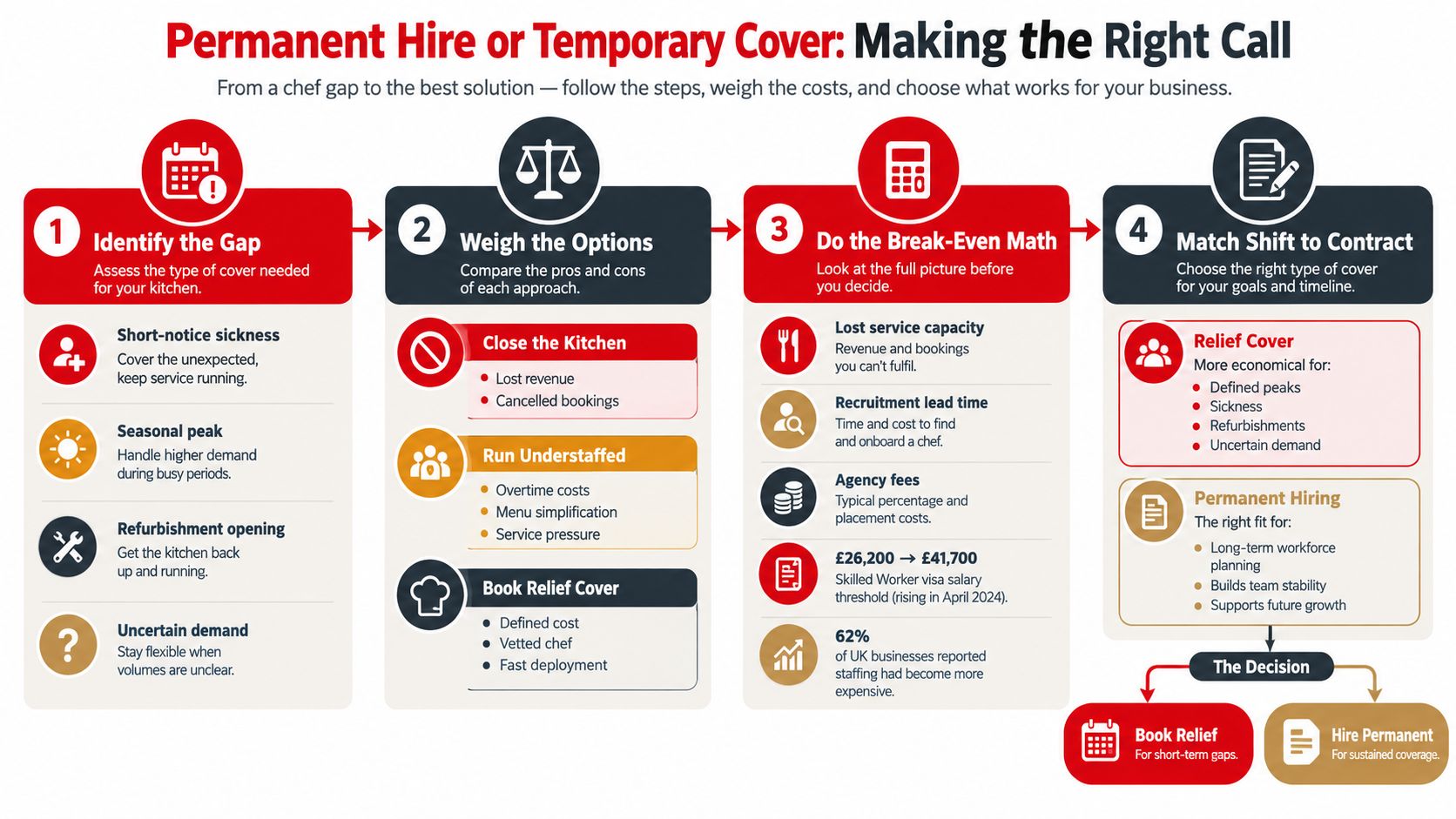
Operators need to stop guessing and do the maths. If you've got a sustained role to fill, hire permanently. If you've got a defined gap, use relief cover. If the kitchen is about to limp through service understaffed, that's usually the most expensive option of the three.
The break-even view that actually helps
Start with the cost of a failed service. Add the revenue you lose when you cut covers or close a section, the overtime you'll throw at the team, the recruitment lead time, and the cost of a permanent chef sitting idle during quiet periods. Then compare that against agency cover, which should be treated as the price of preserving trading capacity, not just the hourly rate on a spreadsheet.
The market is still pushing costs up. 62% of UK businesses reported staffing had become more expensive, with National Insurance the leading cost driver for 19% of respondents, and hospitality and catering vacancies were up 18.4% year on year in Q2 2026 while chef postings rose 83.4% year on year to 40,395 Craft Guild of Chefs. That means experienced chefs are still competing across venues, even if overall vacancy counts look softer.
If the shift is a one-off peak, book cover. If the gap is structural, recruit. If the kitchen is already underwater, you're paying for the problem twice.
When temp cover makes sense
Use temporary cover for sickness, holidays, weddings, festivals, refurb openings, and uncertain demand. Use permanent recruitment when the role is core to the business and must be filled week after week. Don't try to make one solution do the work of both.
The skilled-worker route has also tightened. A 2025 analysis reported the salary threshold rising from £26,200 to £41,700, with the required skill level increasing from RQF level 3 to RQF level 6, and chefs among hospitality roles affected by the revised rules Moore Kingston Smith. That makes your backup plan more important, not less.
What the Booking Process Looks Like Step by Step
A good booking process should feel boring in the best way. You call or send a short form, the agency asks the right questions, and you get a chef who already understands the basics before they hit the pass. If the process is messy, the cover won't be reliable.
How the handover should run
First, identify the exact gap. Not “need a chef”, but which section, which hours, which dishes, and what level of seniority. Second, confirm the practicalities, arrival time, dress code, parking, access, menu style, and who signs off substitutions.
Third, the agency should send someone who has been right-to-work checked and fully vetted. Fourth, the chef should be briefed on the venue's pace and handover needs before the shift starts. That's how you reduce the usual first-service wobble.
Relief Chefs UK says venues can request cover by phone or short form, get a response within two hours, and see a chef start within 48 hours where required. Its service menu includes relief chefs, temporary chefs, permanent chef recruitment, yacht chefs, villa chefs, and hospitality staffing support. For a busy operator, that matters because it turns one staffing problem into one controlled workflow instead of a chain of emergency calls.
The same structure works whether you run one site or several. A single independent hotel might need a one-off rescue booking. A multi-site group might need a rolling staffing relationship with priority support, replacement cover, and account oversight.
Matching the plan to the venue
A small pub can live on occasional cover. A hotel with constant turnover usually needs a deeper relationship. Multi-site operators should think about a monthly plan rather than treating every absence as a separate scramble.
| Relief Chefs UK Monthly Plans at a Glance | Best For | Response Time | Key Benefits |
|---|---|---|---|
| Starter | Small venues needing occasional cover | Fast response, based on booking need | Basic relief support, vetted chefs, short-notice cover |
| Growth | Venues booking cover more regularly | Priority handling over ad hoc enquiries | More consistent access, better continuity, stronger planning |
| Premium | Multi-site and hotel groups | Highest priority support | Replacement guarantees, dedicated account management, ongoing staffing support |
The Induction Most Venues Forget to Run
Speed is useful only if the chef can work safely inside your system. Temporary cover brings risk if you assume a familiar dish is being made the familiar way. Recipes change, supplier packs change, allergen handling changes, and a busy service leaves no room for guesswork.
What the venue must verify before service
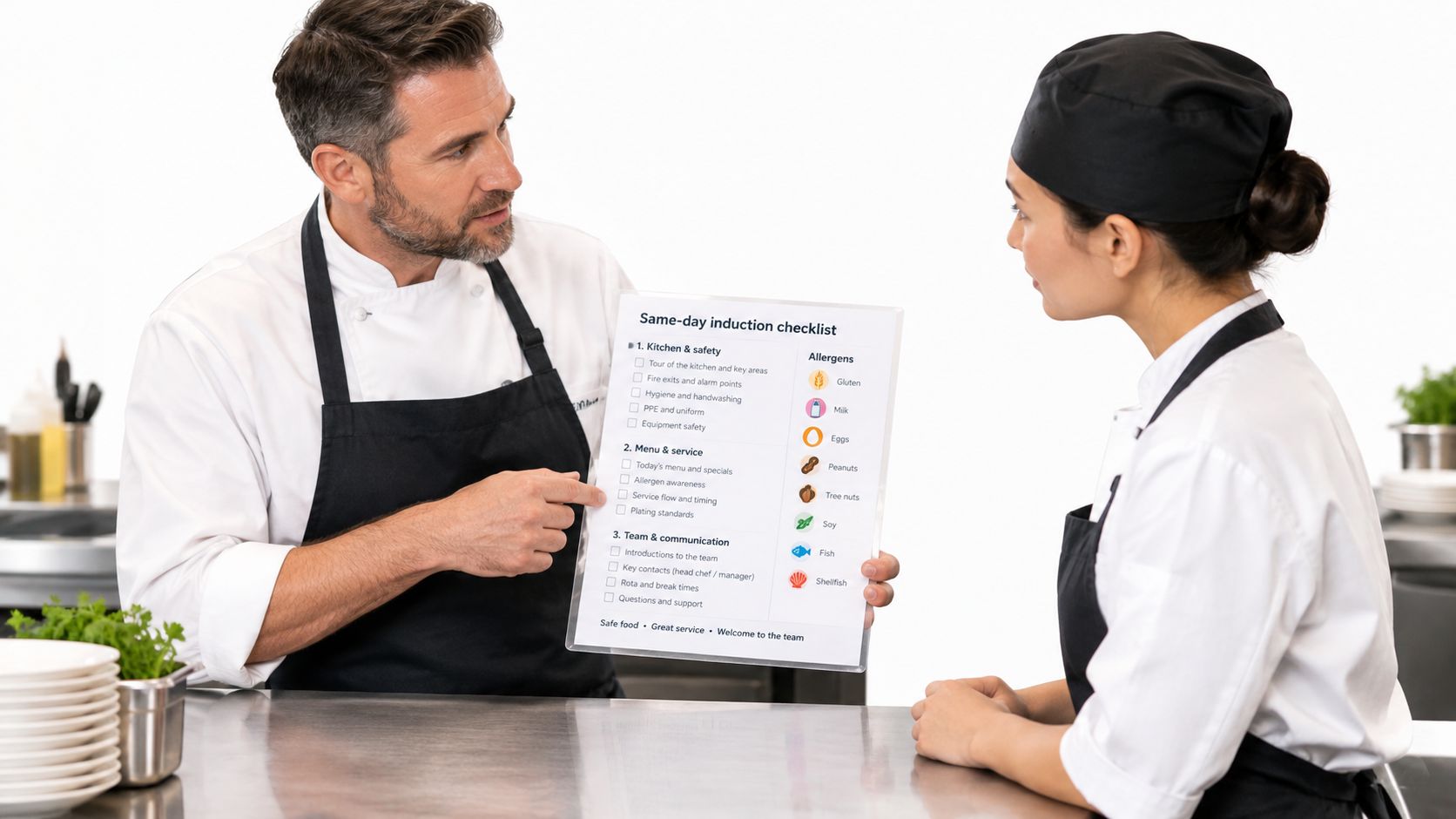
Food Standards Agency research found only 49% of food businesses had received formal allergen training, with lower uptake in smaller businesses Food Standards Agency. That makes the first briefing essential. A relief chef should be shown the current menu, the allergen matrix, the cross-contact controls, the substitutions policy, and the person who handles ingredient queries.
The chef should also be able to explain the kitchen's allergen controls back to you. Ask them to identify likely allergens in representative dishes, describe how utensils are segregated, and state who authorises any last-minute changes. If they can't answer those questions clearly, they shouldn't be left unsupervised on a live section.
Non-negotiable: don't treat a relief chef as a shortcut around food-safety discipline. Treat them as a professional who needs a tight briefing before they touch the pass.
Keep the handover auditable
Write the briefing down. Confirm the role, the supervision level, the allergen matrix, and any recipe or supplier changes on the day. That protects the venue, the guest, and the chef.
The Government's food-safety guidance also makes clear that part-time and casual staff still need to understand how to handle allergy enquiries. That means the safety standard doesn't drop because the shift is temporary. If anything, it needs to be sharper because the team hasn't worked together before.
How to Vet a Chef Staffing Partner Before You Sign
The wrong agency looks fine until the first no-show. The right one tells you exactly how it handles risk, replacement, and first-shift performance before you commit. If you're comparing agencies, look for a chef-led operation, not a sales team with a kitchen brochure.
What to check before you book
A serious partner should be able to answer these questions without bluster:
- Who vets the chefs: You want right-to-work checks, not vague promises.
- How fast they respond: If the operation is urgent, speed matters.
- What happens if the chef drops out: A replacement process should be clear.
- Whether the agency understands sections: Breakfast, pastry, banqueting, stock control, and allergen handling are not interchangeable.
- Whether support is available out of hours: Kitchens do not stop at 5pm.
Chef staffing agencies should also be judged on transparency. Hidden fees and vague rates are a bad sign. So is a partner that talks only about “availability” and never about whether the chef fits the venue.
Ask about the no-show process before you need it. If the answer is slow or slippery, move on.
Relief Chefs UK monthly plans at a glance
| Plan | Best For | Response Time | Key Benefits |
|---|---|---|---|
| Starter | Smaller sites with occasional cover needs | Fast handling of ad hoc bookings | Relief cover, vetted chefs, straightforward support |
| Growth | Venues needing more frequent support | Priority booking attention | Better continuity, stronger account handling |
| Premium | Multi-site, hotel, and higher-risk operations | Highest priority support | Replacement guarantees, dedicated account manager, deeper planning support |
The final test is simple. Ask how the agency measures success after the first shift. If it can't talk about pass rate, cancellation handling, or repeat booking, it's probably selling volume, not reliability.
Cover Tonight or Build a Long-Term Plan
If you need a chef tonight, book the cover and protect the service. If you're dealing with repeated gaps, build a plan that keeps the kitchen stable through sickness, seasonal spikes, refurbishments, and resignations. Those are different problems, and they need different answers.
Relief Chefs UK handles both the urgent booking and the longer staffing relationship, with response by phone or short form, vetted chefs, and support built around real kitchen pressure. If you want urgent relief cover or a monthly staffing plan that fits how your venue trades, contact the team now and get the next shift under control.
Need cover for a service gap, seasonal peak, or longer-term staffing plan? Relief Chefs UK supplies relief chefs, temporary chefs, permanent chef recruitment, yacht chefs, villa chefs, and hospitality staffing support across the UK. Visit Relief Chefs UK to arrange urgent cover or start a conversation about a better staffing setup for your kitchen.