
A kitchen usually doesn't fail on a clean, quiet Tuesday. It fails on a Saturday when the ticket rail is full, the grill is hot, and one chef has called in sick just before service. That's when safety rules at kitchen stop being wall posters and become staffing control, because the person stepping into the section needs to know the risks, the handover, and the standards before the first order lands.
That pressure is exactly why UK kitchens need more than common sense. The legal framework starts with the Food Safety Act 1990, which gave statutory powers over hygiene, premises, equipment, utensils, waste, and food-handler training, then moved through the Food Safety (General Food Hygiene) Regulations 1995 and the Food Hygiene (England) Regulations 2005 that came into force on 1 January 2006 legislation overview. In practice, that means a safe kitchen is the one with documented routines, trained staff, and a proper handover when cover walks in, not the one that hopes experience will fill the gaps.
What Safety Rules at Kitchen Really Mean for Your Brigade
A near miss in service tells you everything. A relief chef opens a fridge and cannot find the allergen matrix. A commis is wiping a prep surface in a hurry. The pass is pushing for faster plates while a buffet tray has already sat out too long. Nobody meant to create a problem, but the brigade is working from memory instead of controls.
Safety starts with continuity, not posters
Safety rules at kitchen are really a staffing-continuity problem first and a checklist second. Short-notice sickness, seasonal demand, and agency gaps leave a shift exposed if the incoming chef does not get a proper handover. The old belief that a good chef will “just know” is how shortcuts survive a busy service.
The UK framework makes the point clearly. Food premises must be kept clean and maintained in good repair, food handling must be hygienic at every stage, and staff health, equipment hygiene, storage, and cleaning all sit inside the same system legislation overview. If one part breaks, the whole service is exposed.
Practical rule: if a relief chef cannot find the temperature log, the allergen matrix, and the cleaning schedule in the first few minutes, the shift is not ready.
What goes wrong on an ordinary shift
Hospitality operators do not usually get hurt by exotic failures. They get hurt by ordinary ones, like a handwash missed before plating, a raw tray left too high in the fridge, or a temporary chef using the wrong board because nobody marked the section clearly. Those errors become expensive fast when they lead to complaints, enforcement action, or a guest reaction that should never have happened.
For a general manager, the commercial risk is obvious. Lost covers, poor reviews, and avoidable interruption are bad enough. Add the reputational damage of a food safety issue or injury, and the service problem turns into a business problem.
The right response is simple. Treat every shift like a controlled handover, with named responsibility, visible checks, and no assumption that familiarity equals competence. Relief Chefs UK, for example, sits in that gap as a nationwide chef staffing partner for temporary chefs, permanent chef recruitment, yacht chefs, villa chefs, and hospitality staffing support. The same approach matters whichever route you use. The kitchen needs a clean, documented operating standard before the first ticket prints.
Seven Everyday Controls Every UK Kitchen Must Run on Every Shift
A kitchen fails fastest when the shift depends on memory. A strong brigade runs the same controls every time, whether the team is full, short, or backed by relief staff. That is the difference between a service that holds together and one that slips when pressure rises.
1. Hand hygiene and clean uniforms
Hands need washing before prep, after raw food, after waste, after cleaning chemicals, and after any contamination risk. Uniforms matter too, because dirty sleeves and aprons carry more than bad habits. The latest FSA survey found only 70% of respondents said they always wash hands before preparing or cooking food, while 92% said they always wash after handling raw meat, poultry, or fish FSA consumer survey.
2. Cleaning that is logged, not guessed
Cleaning only works if someone owns it. Surfaces, handles, boards, probes, and sink areas need a written routine, because the hygiene rules expect the premises to stay clean and maintained even during the rush. If the log is missing, the standard is already slipping.
3. Waste removal and storage discipline
Overflowing bins, loose waste sacks, and rubbish held near prep space invite pests and cross-contamination. Waste needs to move on schedule, before it becomes part of the service problem. Do not leave that call to whoever notices the smell first.
4. Cross-contact control
Store raw and ready-to-eat foods separately, keep tools dedicated where needed, and clean and disinfect changeover areas before the next task. A colour-coded board system only works if every chef uses it properly every time. One careless swap can undo the rest of the shift.
5. Temperature control
Visual checks are not enough. Use a probe, record readings, and act on misses. Cold storage, hot holding, and cook checks need a log the head chef can review later, not a guess remembered after service.
6. Equipment checks
Before service, verify fridge door seals close cleanly, probe thermometers read correctly in ice water, and hot-holding units hold at 63°C or above on the display. Check switches, seals, and probes before the first ticket lands. If the kit is drifting, the kitchen is gambling with the pass.
7. Staff health and escalation
If a food handler's illness could contaminate food with pathogenic microorganisms, it must be reported and handled properly. A chef who pushes through sickness can spread the problem across the brigade, especially when cover staff are already working into an unfamiliar setup.
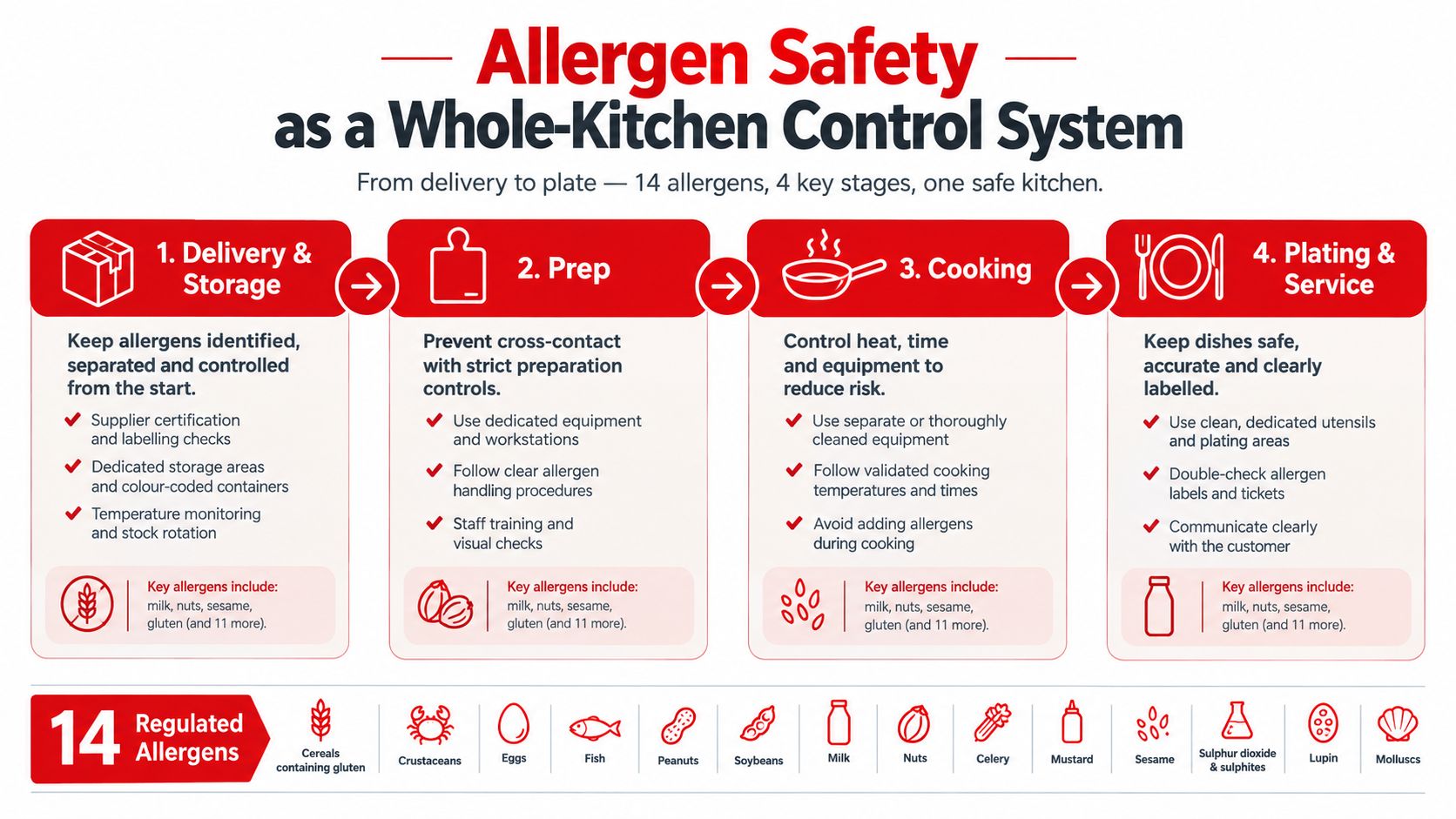
Allergen Safety as a Whole-Kitchen Control System
Allergen control fails when people treat it as a front-of-house script instead of a kitchen system. A guest's question only works if the brigade already has the recipe matrix, the labels, the storage rules, and the pass check in place.
Build the control before the order arrives
The safest method starts with a written matrix covering the 14 regulated allergens. Supplier labels have to be checked whenever ingredients change, because a familiar sauce or garnish can hide a new risk. Separate allergen-containing ingredients during storage and prep, clean and disinfect the work area, and make sure the chef handling the order confirms the dish against the matrix before it leaves the pass.
That matters because communication is still inconsistent. The FSA says 97% of food businesses report providing allergen information, but only 52% routinely ask customers about allergens FSA allergen findings. Written information is used by 94% of businesses, while 65% also communicate verbally, which means too many kitchens still rely on conversation when the safer control is written and checked.
If the menu, the label, and the prep tray don't match, the dish doesn't leave the kitchen.
Why the temporary chef is the weak point
The danger is the shift change. A relief chef, agency chef, or newly transferred senior sous might know cooking, but not your matrix, your substitutions, or your pass routine. That's where a whole-kitchen allergen system holds up, because the control belongs to the brigade, not one person's memory.
The biggest mistakes are predictable. Staff assume a brand is unchanged, confuse “gluten-free” with allergy-free, use a shared fryer, or forget to update records after a supplier swap. For a hotel in Windsor or a café in Reading, that's not a theory problem, it's a service problem.
A temporary chef should get the current recipe set, the allergen lead for the shift, and a stop-and-check rule before solo service. If there's any uncertainty, the answer is not a guess, it's a pause.
For teams building out that process, allergen awareness training belongs in the same conversation as prep control and handover.
Keep the front and back of house linked
A good kitchen doesn't let front of house carry the whole burden. Record the order, check the recipe, prepare on clean equipment, and communicate the final control back to the server. That loop is what turns allergen management from a promise into a system.
Temperature, Cross-Contamination and Probe Checks That Hold Up Under Pressure
A service falls apart fast when temperatures drift, a fridge runs warm, or a probe carries contamination from one pan to the next. In a kitchen with relief chefs, that risk rises because the person on the line may not know your holding points, your cleaning rhythm, or where the temperature log lives.
Use the numbers, not instinct
For chilled food, the FSA says 5°C or below is the practical target, while 8°C is the legal upper requirement in the cited setting FSA temperature guidance. The same guidance also shows why the paperwork matters, because 16% of settings reported chilled ready-to-eat food reaching 8°C, and 23% did not know the maximum temperature reached FSA temperature guidance.
Cooking checks need the same discipline. The FSA recommends 70°C for two minutes, and accepts equivalent time-and-temperature combinations, including 60°C for 45 minutes, 65°C for 10 minutes, 75°C for 30 seconds, and 80°C for six seconds FSA cooking guidance. Reheating is cooking again, not warming up, and food should be steaming hot throughout under the same FSA guidance.
Hot-held food normally has to stay at 63°C or above. If it drops below that, the FSA allows up to two hours before the food must be reheated until steaming hot and returned to hot holding, or cooled quickly to 8°C or below FSA hot holding guidance.
Cross-contamination has to be physically separated
Raw meat and poultry must stay separate from ready-to-eat food. Surfaces, chopping boards, and equipment need cleaning and disinfecting after raw use, and knives and utensils should stay separate unless they can be heat-disinfected in a commercial dishwasher FSA caterer guidance. If a prep area is shared, the handover has to be visible, not assumed. Use the controls in cross-contamination prevention guidance to keep the line clear when different chefs rotate through the same station.
Rule for the pass: if the probe, board, and tongs haven't been reset, the section hasn't been reset.
Table
| Stage | Legal Maximum | FSA Good Practice | Practical Note |
|---|---|---|---|
| Chilled storage | 8°C | 5°C or below | Check on delivery and during storage |
| Cooked food | 70°C for 2 minutes, or equivalent | Use a calibrated probe | Record batch, time, and reading |
| Hot holding | 63°C | 63°C or above | Time food out of controlled hold |
| Reheating | Steaming hot throughout | Reheat once only | Don't treat warming as reheating |
A Devon pub on Sunday lunch cannot let gravy, vegetables, and meat sit on a tired bain-marie while the team hopes service will catch up. The safer call is simple, log it, probe it, and act on the reading.
Slips, Trips, Fire Safety and PPE Failures You Can Prevent
A wet floor in a kitchen is never just a wet floor. Near a fryer, it becomes a slip hazard, a burn risk, and a staffing problem in the same moment.
Treat the floor check as a fixed step
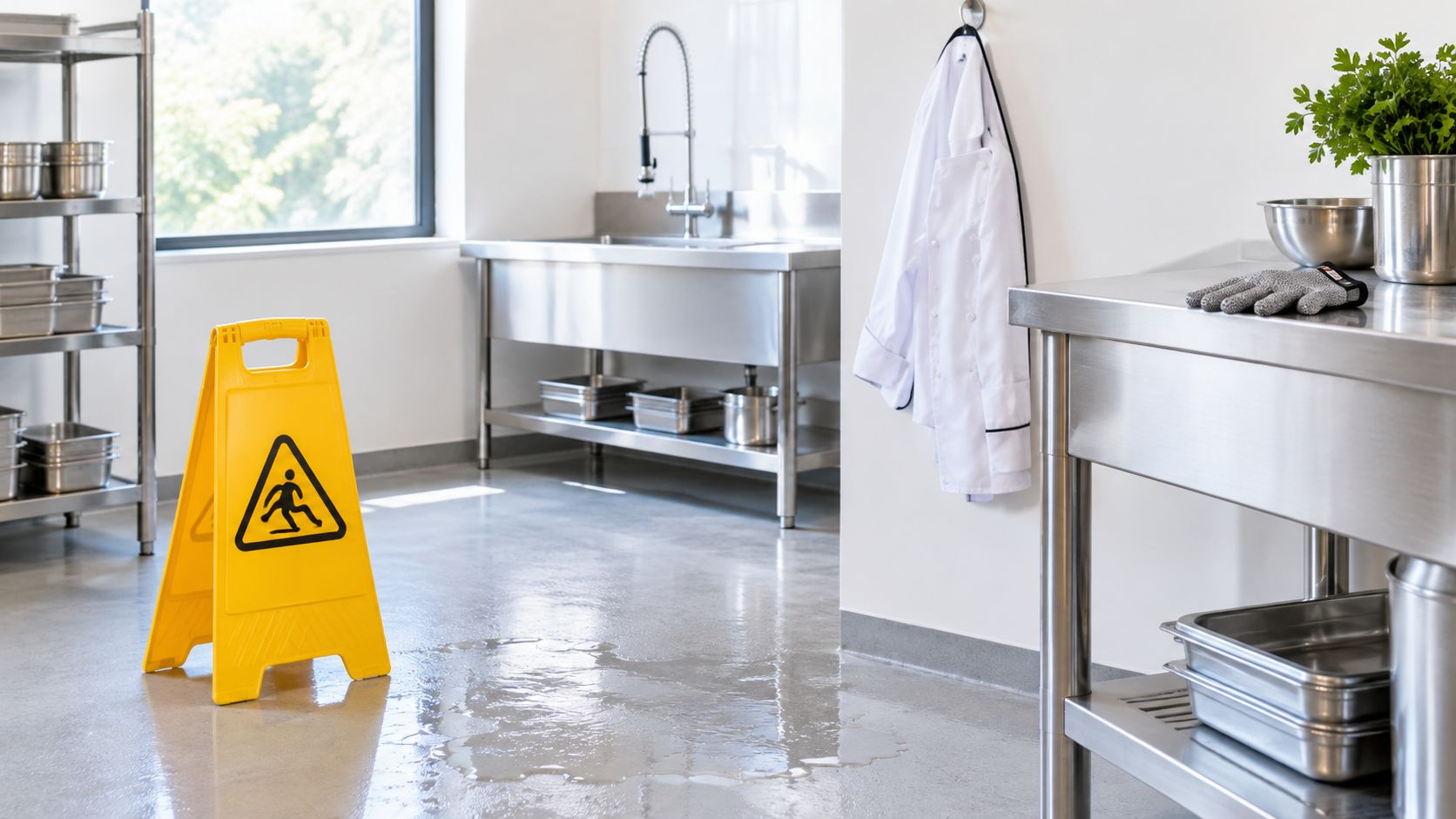
A spill only becomes an incident when someone walks past it and assumes the next person will deal with it. Contain it immediately, put the warning sign where staff will see it, clear walkways, and keep hoses and cables out of traffic before anyone carries hot equipment through the area.
Slip-resistant footwear still matters. Experienced chefs fall on greasy tiles when the floor is slick, the pace is high, and the team is under pressure. The right shoes reduce that risk, but only if the rest of the floor routine is being done properly.
Fire control is maintenance, not luck
Extraction cleaning, fryer checks, extinguisher readiness, and clear evacuation routes belong in the shift routine, not in a file that nobody opens. A blocked exit or a greasy hood does not wait politely for an audit. It becomes a fire problem first, then a staffing crisis when people cannot move safely.
That risk is the same in a pub, a hotel kitchen, or a city centre restaurant. If the route out is cluttered, the brigade is already behind.
PPE changes behaviour when it is enforced
Gloves do not replace care. They protect cuts and burns when used properly, but they still demand judgement around knives, steam, and hot pans. Eye protection during cleaning is part of the same discipline, because chemical splashes happen when people rush or mix badly.
The pattern is the same across slips, burns, and chemical injuries. The harm usually starts with a missed routine. A written floor check, a fryer check, and a clear PPE standard give a relief chef something concrete to follow the moment they step onto the line.
Inducting Relief Chefs Without Dropping the Standard
Short-notice sickness doesn't pause service. Seasonal demand doesn't wait for a perfect rota either. If the cover chef hasn't been briefed properly, the kitchen pays for it in speed, mistakes, and avoidable risk.
First shift needs a proper handover
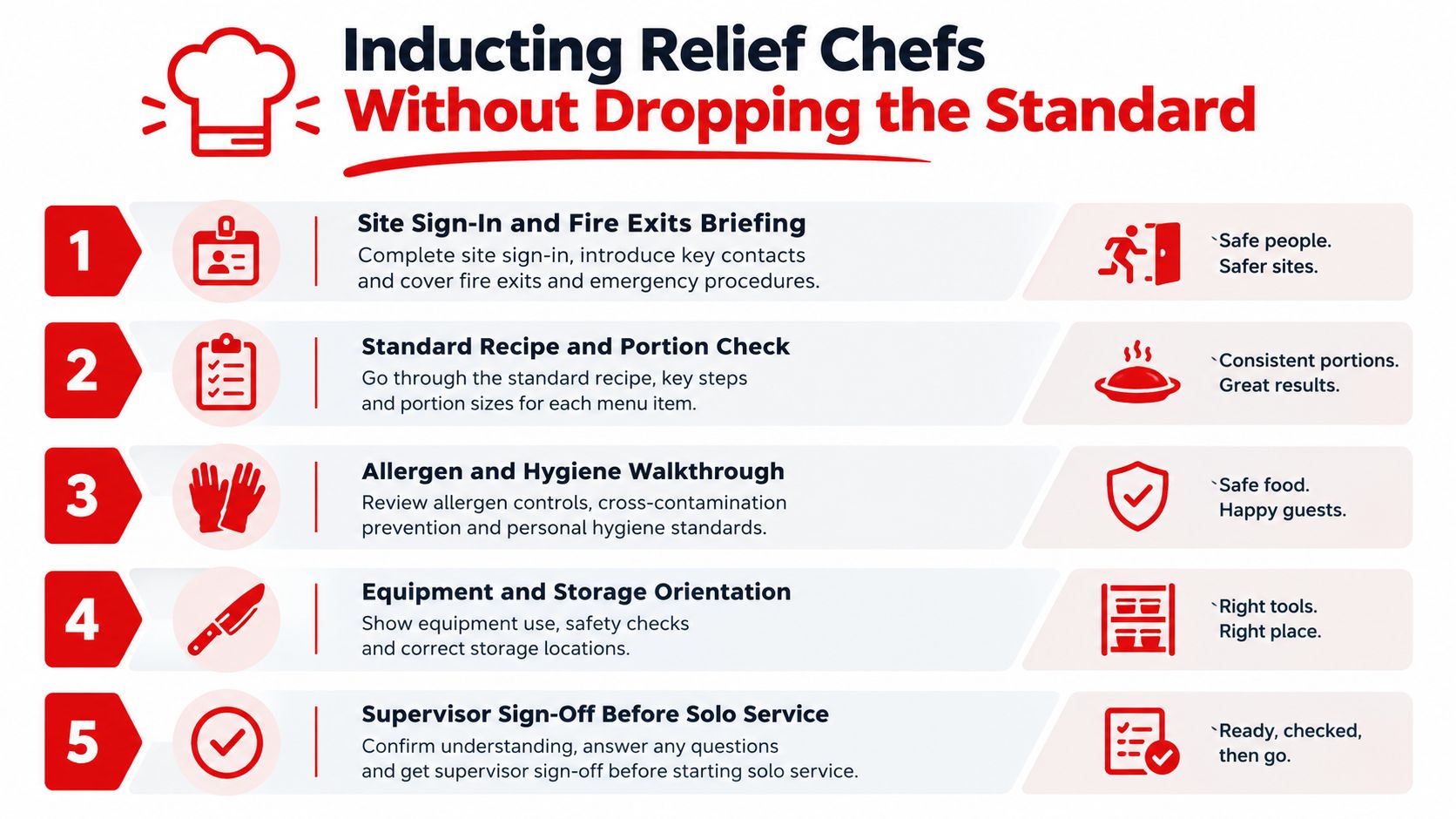
A new arrival should get the site sign-in, fire exits briefing, current recipe and portion notes, allergen and hygiene walkthrough, equipment and storage orientation, and supervisor sign-off before solo service. That sounds basic because it is, but basic is exactly where temporary cover goes wrong when the handover is rushed.
Relief Chefs UK's health and safety induction guidance fits neatly into that process because the relief chef needs the same site rules as the permanent brigade, not a separate version of reality.
What the incoming chef should know before service
The kitchen lead should show the current recipe matrix, the cleaning schedule, the probe target, the refrigeration checks, and any equipment quirks that matter on the pass or in prep. If substitutions have happened, the relief chef needs that spelled out immediately, not after the first allergen question.
A clean induction is what lets a temporary chef keep standards steady from day one. A poor one is how a busy kitchen ends up improvising under pressure, and improvisation is where most avoidable incidents begin.
Use the handover as a control, not a chat
The best managers don't treat induction as a courtesy. They treat it as a safety barrier. A chef who signs off the standards, understands the section, and knows who to ask when something changes can work quickly without lowering the level.
Keeping Your Kitchen Safe When the Team Changes
The kitchens that stay safest are the ones that make continuity visible. One person owns the probe calibration, another owns the refrigeration log, the shift lead does the start check, and the close-down review catches anything that drifted during service.
That handover loop matters because enforcement, allergen failures, and slip injuries usually show up when teams change and standards go unspoken. Keep the controls written, keep them short, and retrain fast after any deviation. That's how you protect guests, staff, and reviews when the rota changes at short notice.
If you need vetted chefs who can step in fast without dropping kitchen standards, Relief Chefs UK supports pubs, hotels, restaurants, cafés, yachts, villa kitchens, and multi-site groups across the UK with relief chefs, temporary chefs, permanent chef recruitment, and hospitality staffing support.
If you need reliable cover for short notice sickness, seasonal demand, or a busy reset after a near miss, contact Relief Chefs UK and put a properly briefed chef on site fast. Visit Relief Chefs UK to enquire about vetted relief chefs, temporary chefs, and ongoing staffing support for your kitchen.