
Friday night, the sous chef rings in sick, the function room is fully booked, and the head chef is already juggling prep for breakfast, banqueting and the weekend menu. That's the point where a recruitment agency hospitality partner stops being a nice-to-have and becomes kitchen insurance. If the rota is brittle, one absence can knock out service, damage reviews, and force the team into survival mode.
UK operators have been living with that pressure for years. The ONS recorded 30% of hospitality businesses saying vacancies were harder to fill than usual in late summer 2021, during a period when UK vacancies hit 1,034,000 and hospitality vacancies sat 59.1% above the pre-pandemic benchmark, which shows how quickly labour gaps can turn into operating problems, not just hiring problems. ONS hospitality vacancy pressure
For busy GMs and head chefs, the question is simple. When should you use temporary cover, when should you recruit permanently, and what should you expect from an agency before you trust it with your service? Relief Chefs UK, established in 2013 and run by chefs, works as a nationwide chef recruitment agency for relief chefs, temporary chefs, permanent chef recruitment, yacht chefs, villa chefs and wider hospitality staffing support. That matters because kitchen decisions are operational decisions, not admin tasks.
When Your Kitchen Is One Absence From Chaos
A Friday sickness call lands at 4.30 pm. The booking list is already full, the brigade is thin, and the owner is asking whether the tasting menu can still run at full pace. In that moment, you do not need recruitment theory, you need a deployable chef who can walk in, read the pass, and keep the evening moving.
Why the panic is so familiar
Hospitality labour has been tight for a long time, but the pressure changed shape again in 2025. Payrolled employees in accommodation and food services fell from 2,201,193 in May 2024 to 2,100,827 in May 2025, a drop of 100,366 and 4.6%, while vacancies fell from 98,000 to 79,000 over the same period. ONS-based hospitality employment trend
That does not mean the problem has gone away. It means many venues are carrying less labour while still needing to serve guests, manage sickness, and trade through peaks. In plain terms, the kitchen can look calmer on paper and still be one no-show away from a bad service.
Practical rule: if a kitchen cannot safely cover a section, a relief chef is often the cheaper risk decision than stretching the team until mistakes start stacking up.
Why Relief Chefs UK fits that moment
A proper recruitment agency hospitality partner should work like an emergency control room, not a CV inbox. Relief Chefs UK is set up for exactly that kind of pressure, with response by phone or short form, vetted chefs, and the ability to move quickly when the rota breaks. For independent pubs in Devon, boutique hotels in Berkshire, and restaurants in Bristol or Wales, that speed matters more than polished promises.
The point is not to replace permanent hiring. The point is to keep the kitchen open while you recruit well, interview properly, and avoid making a rushed permanent appointment under fire. That's the difference between firefighting and control.
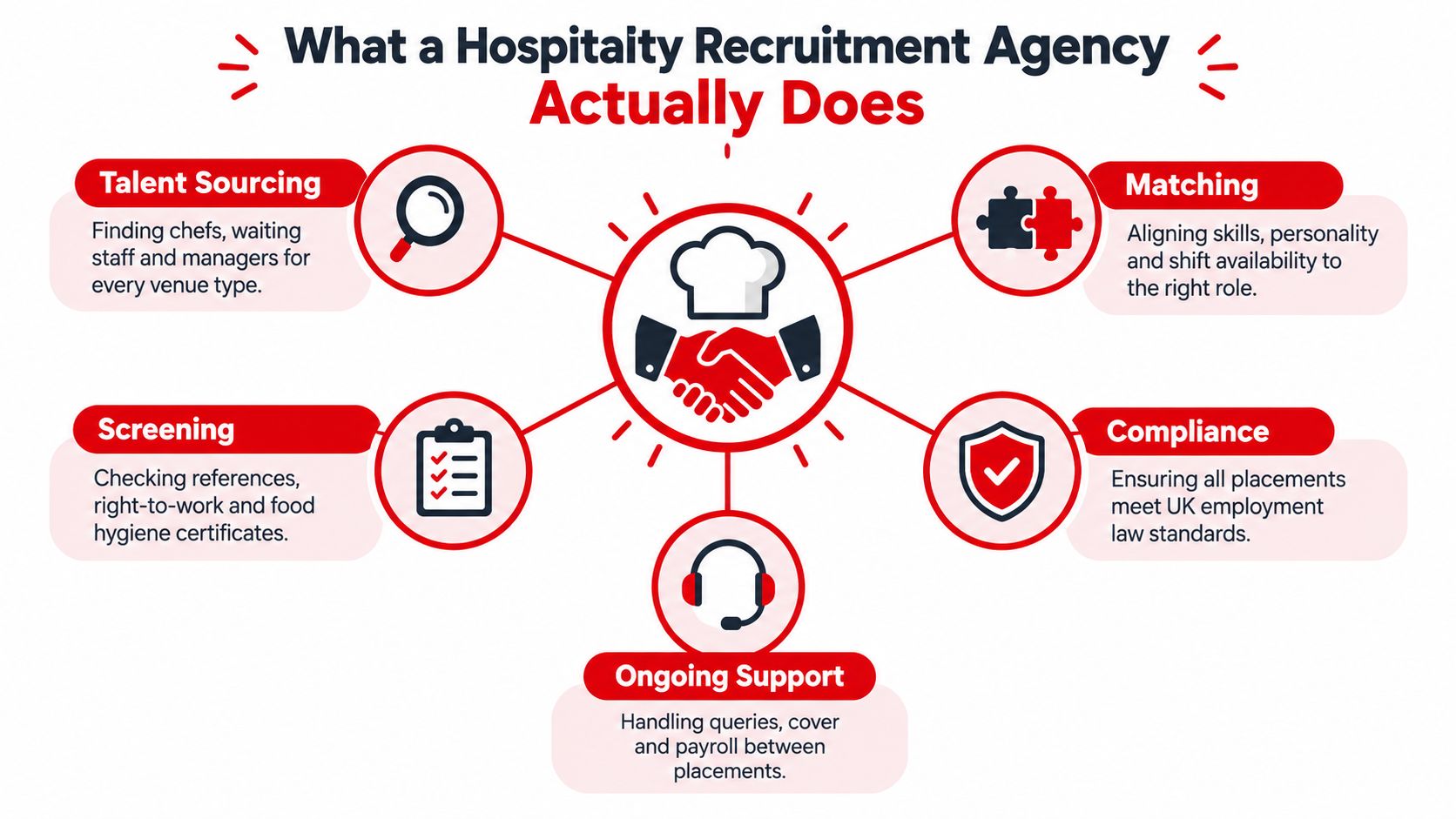
What a Hospitality Recruitment Agency Actually Does
A good agency does far more than forward a stack of CVs. In practice, it builds a pool of people the operator can use, then matches those people to the venue's service style, shift pattern, and standards. That is why specialist recruitment agency hospitality support matters more than generic labour supply.
Temp cover, permanent hires and specialist assignments
Relief chefs and temporary chefs solve immediate rota gaps. They are for sickness, holidays, resignations, event spikes, and those awkward gaps where the hiring process is still running but service cannot wait. In a busy kitchen, that means someone who already understands pace, sections, allergen discipline, and communication on the pass.
Permanent chef recruitment serves a different job. It is for roles that need continuity, team leadership, menu ownership, and long-term stability. If you hire permanently for every short-term problem, you end up overcommitted. If you use temp cover for every long-term gap, you never fix the structure.
Specialist support matters too. Some kitchens need yacht chefs, villa chefs, or hospitality staffing support for private households and unusual service formats. Those placements demand a stronger fit between environment, pace, discretion and menu style than standard restaurant hiring.
How the process works in real kitchens
The agency's job is to hold a live talent pool, check availability, and match by practical fit. A chef who thrives in banqueting may not suit a small brigade doing high-touch tasting menus. A chef who can step into a pub kitchen in Dorset may not be right for a fine-dining hotel in Windsor, and the reverse is just as true.
The other part is geography and timing. Operators in Windsor, Reading, Slough, Devon, Bristol, Wales, Berkshire and Dorset need different cover patterns, but the same logic applies, get the right person there before the rota collapses. That is why a solid agency should know the difference between filling a vacancy and protecting service.
An internal point of reference for how this type of service is framed can be found on the chef recruitment agency page.
What good support looks like
A reliable agency should leave you with fewer unknowns, not more. If you still have to second-guess the chef's availability, paperwork, or basic suitability, the agency hasn't done enough.
That is where the best agencies become operational partners. They answer quickly, understand the kitchen brief, and keep the replacement conversation alive before a miss turns into a failure. That's the practical value of a recruitment agency hospitality provider that knows the trade, not just the market.
How Candidate Screening and Compliance Keep Service Safe
A chef is only useful if they can safely start. That sounds obvious, but a lot of agencies still operate like they are filling chairs, not protecting service. Screening is where the difference between a dependable partner and a CV-forwarding service becomes obvious.
What deployable really means
A deployable chef needs more than availability. They need right-to-work checked, references confirmed, relevant experience, and a kitchen manner that will not unsettle a small brigade. They also need to understand practical basics like allergen handling, hygiene expectations and how to slot into a live service without creating more work for the team.
That matters in independent hotels and restaurants, where one poor placement can ripple through service, reviews and staff morale. The ONS recorded 148.9 million working days lost to sickness or injury in the UK in 2024, averaging 4.4 days per worker, which underlines why kitchens need an emergency staffing process that is ready before the absence happens. ONS sickness absence data
In the kitchen, the test that matters is not whether the chef looks good on paper. It is whether they can safely take the section, follow the house rules, and keep the pass moving.
What to ask any agency
Ask direct questions and expect direct answers.
- Right-to-work checks: confirm they are completed before deployment, not after.
- Reference checks: ask who spoke to previous employers and what was verified.
- Skills matching: check whether the agency screens for cuisine style, banqueting, breakfast, pastry or fine dining.
- Food safety and allergen awareness: make sure the chef understands service-floor realities, not just theory.
- Insurance and responsibility: find out who carries what, especially for temporary placements.
A competent agency should be able to answer without hesitation. If it cannot explain its vetting, it is probably not doing enough of it.
Why speed still matters
Relief Chefs UK says it can respond within two hours and place fully vetted chefs who can start within 48 hours. That kind of speed only works if the screening has already been done properly, because urgent cover is useless if the person cannot legally or safely step into service. A fast recruitment agency hospitality partner should be fast because it is prepared, not because it cuts corners.
For a closer look at how employment checks should be handled, see the employment verification guidance.
Treat compliance as kitchen risk management, it protects guests, reviews and the rest of the brigade.
Temporary Cover Versus Permanent Hires and What Each Costs
The wrong hiring choice usually costs more than the placement fee. Leave a kitchen understaffed and you may lose covers, stretch overtime, simplify the menu, waste food, or create service errors that hit repeat business. Hire permanently too soon and you can lock in payroll before demand justifies it.
Temporary cover for immediate control
Temporary chefs make sense when the problem is urgent and time-bound. Sickness, leave, a last-minute resignation, a seasonal spike, or a block of weddings all justify short-term cover if the alternative is a stressed team and a damaged service. This is especially true when the kitchen has already hit the point where the brigade can't safely absorb another absence.
The decision should be made shift by shift. If the cost of cover is lower than the cost of lost service, the choice is usually straightforward. That includes not just revenue loss, but the hidden cost of owner-manager burnout, rushed prep, and a team that starts cutting corners to survive.
Permanent hiring for structural gaps
Permanent chef recruitment is right when the role is central to the business and likely to remain open. That includes head chef succession, sous chef stability, or a long-term gap in a multi-site group that needs consistency. If you keep relying on temporary fixes for a structural vacancy, you're treating a staffing strategy problem like a rota problem.
The same logic applies if you're trading across the South West, Berkshire, or bigger commuter markets where recruitment cycles can drag. A temporary option buys time. A permanent appointment gives you continuity. Smart operators use both.
A simple decision aid
| Staffing option | When to use it | What to watch |
|---|---|---|
| Temporary cover | Sickness, holiday, events, seasonal peaks, urgent rota gaps | Fit for the menu, speed of arrival, handover quality |
| Permanent hire | Ongoing vacancy, leadership gap, long-term capacity need | Time to appoint, retention risk, salary commitment |
| Mixed approach | You need service protected now and a longer-term hire still in progress | Coordination between short-term cover and permanent search |
A lower vacancy count doesn't automatically mean lower operational risk. Venues can cut hiring because demand is softer, but the kitchen still needs competent hands on the section. That's where a recruitment agency hospitality partner becomes a commercial safeguard rather than an expense line.
Real Staffing Problems Agencies Solve Every Week
The best way to judge an agency is to look at the problems it solves on an ordinary week, not just in a pitch deck. Kitchens don't fail because of one dramatic event. They fail because too many small staffing problems land at once.
Short-notice sickness and the emergency handover
A breakfast chef calls in sick. The head chef is already prepping for a wedding and the KM is off-site ordering stock. If the venue has an up-to-date emergency pack, menus, allergen sheets, opening times and accommodation notes, a relief chef can step in with far less friction.
That's why the old advice to “just post an advert” misses the point. Vacancy advertising doesn't solve a same-day hole in a live service. A staffing partner does, provided the bench is already built.
Seasonal demand and event pressure
Summer tourism, weddings, outdoor dining, and Christmas party bookings all compress demand into the same windows. Many venues need cover at exactly the same time, which is why waiting until the week before is too late. Hotels in coastal Devon and Dorset, busy Bristol restaurants, and venues across Windsor and Slough feel this sharply because the work is concentrated and the team size is often limited.
Operational truth: seasonal cover works best when it's booked before the pressure starts, not after the first bad service.
Reliability failures and kitchen instability
A no-show from a bad agency is worse than no agency at all. It leaves the kitchen scrambling twice, once for the original gap and again for the replacement. The right partner should reduce those shocks by keeping candidate records current, confirming availability before dispatch, and handling substitutions fast.
For operators looking at practical short-term fixes, the staff shortage solutions page is a useful place to see how emergency kitchen cover is framed in service terms.
Why this matters to guests
Guests do not care that the rota was difficult. They care whether the meal arrives on time, the menu is available, and the team seems in control. A strong agency protects all three. That is why chef-led staffing support is so valuable in pubs, boutique hotels, restaurants and group sites that cannot afford a wobble in service.
How to Choose a Reliable Agency Without Getting Burnt
A good supplier should be judged on proof, not promises. If an agency talks only about “quality” and “speed” without telling you how it measures either, that's a problem. You want a partner that can show how it works under pressure.
What to ask before you sign anything
Start with response time. Then ask how quickly they can produce a qualified shortlist, what replacement guarantee is included, and who manages issues when a chef doesn't fit. If the answers are vague, slow, or constantly deferred to “the team”, move on.
You should also ask about insurance, right-to-work checks, references and total fees. Transparent pricing matters because hidden extras turn a straightforward booking into a budgeting headache. A reliable agency makes the cost and the responsibility clear from the outset.
Red flags worth taking seriously
- Vague vetting: if they can't explain what they check, assume not enough is being checked.
- Slow replacements: urgent cover loses its value if the backup arrives too late.
- No clear escalation route: if something goes wrong, you need a named contact.
- Fee confusion: if the quote keeps changing, the service probably will too.
- Poor sector fit: a generalist who doesn't understand brigade dynamics can create more work than value.
Relief Chefs UK's service model is built around 24/7 support, a dedicated account manager for plan-based clients, and trust from 400+ venues, which is the sort of operational consistency busy operators should look for when they compare suppliers. That matters more than slick sales language.
Why temporary cover still beats waiting for a sponsorship answer
If a role needs immigration sponsorship, the route involves eligibility, approval, and salary compliance under GOV.UK rules, with a standard minimum salary of £41,700 per year or the job's going rate, whichever is higher. Skilled Worker visa requirements That makes sponsorship a long-term recruitment move, not a way to fix tonight's rota.
So if you need cover now, compare agencies on their ability to deploy safely, not just their ability to talk about hiring. That's the difference between a service partner and a sales lead.
Keep Your Kitchen Covered Starting Today
A strong staffing plan combines both sides of the business, permanent hiring for the roles that need continuity, and temporary cover for the moments that can't wait. That mix keeps service stable, protects your team from burnout, and gives you room to hire properly instead of in a panic. For pubs, restaurants, hotels and multi-site operators, that's how you keep standards up when pressure hits.
The next move is straightforward. Put a reliable cover option in place before the rota breaks, then use permanent chef recruitment where the role needs a long-term hire. If you're handling a peak season, a sickness gap, or a wider staffing shortage, a responsive recruitment agency hospitality partner gives you the breathing room to keep trading properly.
Relief Chefs UK supplies relief chefs, temporary chefs, permanent placements, yacht chefs and villa chefs across the UK, with vetted cover designed to protect service when kitchens come under pressure. If your rota needs backup now, visit Relief Chefs UK to request support and get a chef in place before the gap turns into a service failure.