
Working at Festivals: A Chef & Manager’s UK Guide
7 April 2026
Friday lunch service is already heavy. Then the festival crowd starts landing.
If you run a pub near Somerset, a hotel around Reading, a restaurant in Bristol, or a venue serving traffic through Wales, you know the pattern. Bookings tighten, walk-ins rise, suppliers get pushed, and one sick call in the kitchen can turn a profitable week into a service you spend months apologising for.
Working at festivals looks exciting from the outside. In practice, it is about pressure, timing, stamina, food safety, and whether the people on shift can still deliver when the site is muddy, the queue is deep, and the prep fridge is not where anyone expected it to be.
The Festival Season Challenge and Opportunity
Festival season creates two very different conversations.
Chefs ask where the good work is, which gigs are properly paid, and which organisers run a professional kitchen. Venue managers ask how they are supposed to keep standards up when local labour has already been stripped out by the event itself.
The pressure is not anecdotal. In the UK festival industry, a severe staffing crisis has persisted since the pandemic, with 53% of European festival organisers, including many UK events, reporting shortages during the 2022 season, and over a quarter facing critical gaps of more than 25% below required staff levels, according to Ticket Fairy’s report on festival industry trends. That skills gap continued, leaving inexperienced newcomers on site and senior operators carrying too much weight.
Why this hits hospitality businesses so hard
A festival does not only affect traders inside the fence line.
It pulls chefs, kitchen porters, drivers, casual front of house staff, and agency workers out of the same local labour market that pubs, cafés, hotels and restaurants rely on. At the same time, nearby venues often get busier because guests stay over, eat earlier, return later, and expect speed all weekend.
That combination creates a familiar set of risks:
- Short-notice gaps: Sickness, no-shows and late dropouts become harder to replace because everyone nearby is already booked.
- Kitchen instability: Permanent teams get stretched across too many sections and standards slip.
- Commercial loss: You cap covers, reduce menu range, or close service periods you should be monetising.
- Burnout: Senior chefs spend the shift firefighting instead of controlling quality.
The busiest week of the season is the worst time to rely on hope, favours, or a last-minute social media post.
Why good operators still do well
The upside is just as real.
Festival season creates paid opportunities for chefs who can work cleanly, adapt quickly, and cope with volume. It also creates strong revenue opportunities for venues that plan early and protect kitchen continuity.
Managers who get this right do not treat working at festivals as a novelty. They treat it like peak-trading operations. They lock in cover early, simplify execution, and protect their core team from exhaustion.
Chefs who get this right do not chase every listing. They target serious operators, arrive documented, and make themselves easy to deploy.
For Chefs Finding and Securing Quality Festival Gigs
A lot of content about working at festivals blurs paid hospitality work with volunteer roles. That is where many chefs waste time.
There is plenty of festival work that is casual, loosely organised, or not suited to a professional cook who needs proper pay, clear shifts and safe working conditions. The stronger opportunities sit elsewhere, in paid kitchen roles for traders, hospitality units, production catering, nearby hotels, private accommodation, and off-site venues absorbing event traffic.
Know where demand sits
The shortage in paid food roles is not marginal. A key angle often missed is the shortage of qualified, reliable chefs for festival food stalls. The events industry faced a 20% staffing shortfall in 2025, with over 15,000 temporary food and beverage positions unfilled across major UK festivals, alongside a 40% reduction in EU chef availability since 2021, as outlined in the festival event industry career guide.
That matters because it changes your approach. If you are skilled, organised and available, you do not need to present yourself as a general pair of hands. You need to present yourself as low-risk kitchen cover.
Build a festival-ready chef profile
A standard CV is rarely enough.
Festival operators and nearby venues need to know whether you can function in a temporary or high-pressure environment. Put the practical points near the top.
Include:
- Volume experience: Banqueting, event catering, stadia, holiday parks, weddings, worker feeding, transport hubs, or any site that required fast throughput.
- Adaptability: Outdoor kitchens, mobile units, limited prep space, generator-backed equipment, or unfamiliar teams.
- Compliance: Food hygiene certificates, allergen awareness, HACCP habits, right-to-work documents and references ready to send.
- Availability: Exact dates, regions you can cover, whether you drive, and whether you can work split or extended festival patterns.
If you have done service where menu discipline mattered more than creativity, say so. That is an advantage in this market.
Avoid weak routes to work
The fastest route is not always the safest route.
A social media post asking for “a chef for the weekend” can mean anything. Sometimes it is a solid operator filling one final gap. Sometimes it means no proper paperwork, poor briefings, missing accommodation, and arguments over pay once the event is over.
A more professional route is to use a specialist channel that understands event work and pre-screens both sides. Chefs looking for event assignments can start with festival and event chef opportunities.
What good vetting looks like
If the booking is serious, expect checks.
That is not bureaucracy for its own sake. It is how a proper operator avoids placing the wrong person into a high-risk service.
You should expect some or all of the following:
- Right-to-work checks
- Food hygiene verification
- Reference checks
- Role matching based on level
- Clear rate and shift confirmation in writing
If nobody asks for any of that, be cautious.
Good festival work comes with more structure, not less.
Questions worth asking before you accept
Do not just ask the rate. Ask how the job runs.
Useful questions include:
- What style of operation is it? Street food stall, staff catering, hotel kitchen, private hospitality, or pop-up restaurant.
- What equipment is on site? Gas, electric, combi, refrigeration, extraction, handwash stations.
- Who is leading service? Trader-owner, head chef, production manager, event caterer.
- What are the shift expectations? Start time, finish time, breaks, prep day, live day, breakdown.
- What is provided? Accommodation, travel contribution, staff meals, parking, uniform expectations.
The best chefs are not difficult. They are clear. That makes them easier to place again.
For Venues Securing Reliable Festival Cover
If your venue is near a major event, waiting to see what happens is usually the expensive option.
By the time the problem is visible on the rota, your choices are already worse. The chefs who know the area, can drive, understand volume, and can slot into an existing brigade are often gone first.
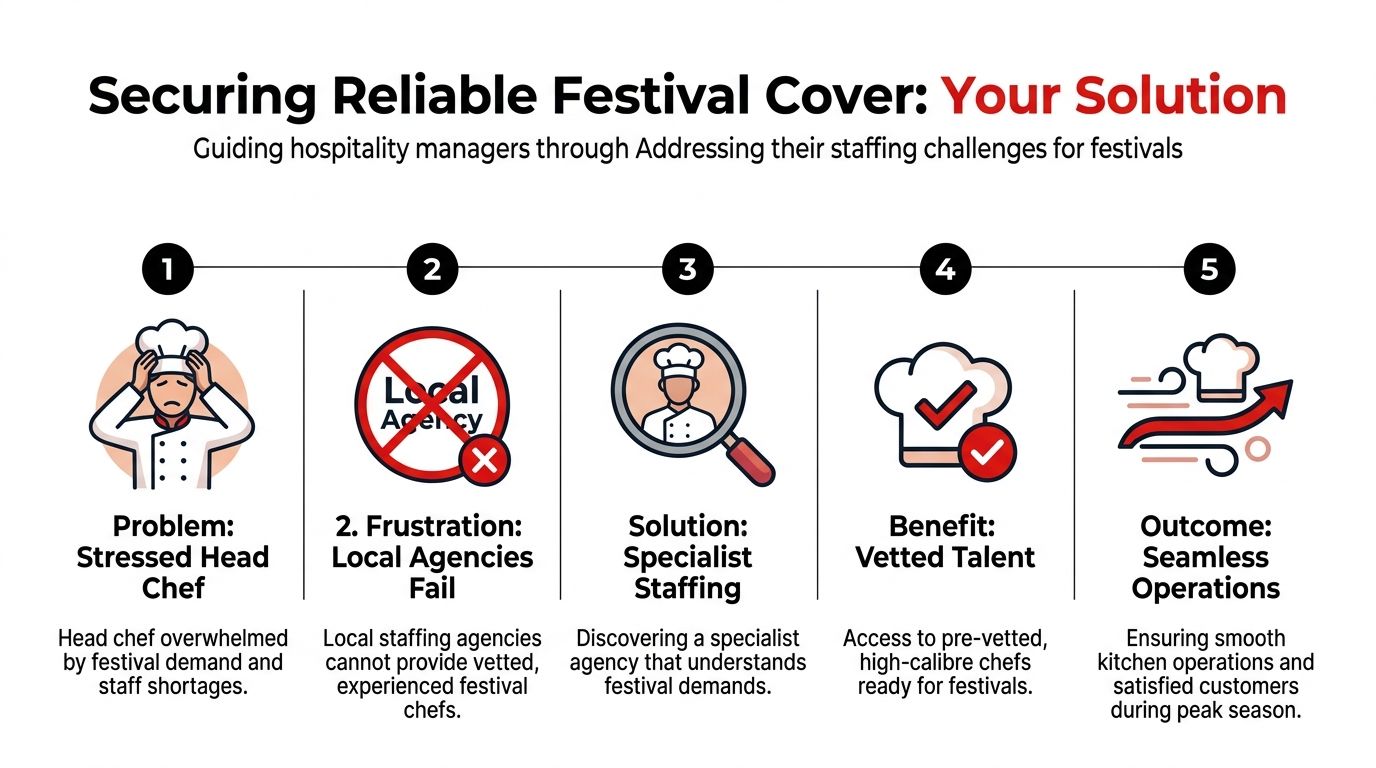
The wider market gives you the reason. The UK events industry supports 775,000 jobs and contributed £61.65 billion to the economy in 2023, while festivals in 2023 saw a 30% year-on-year increase in ticket sales, according to Quadrant2Design’s events industry statistics. For nearby hospitality businesses, that growth means more covers and more competition for labour at the same time.
The false economy of reactive cover
Managers often try one of three things first.
They ask the existing team to stretch. They ring around local contacts. Or they put a quick post online and hope someone suitable appears. All three can work occasionally. None of them is a staffing strategy.
The trade-offs are obvious once service starts:
- Overstretching the core team protects payroll for a day and creates fatigue for the week.
- Calling in unknown casuals fills a slot but can damage prep, portioning, hygiene and communication.
- Reducing the menu late may protect output but can frustrate guests and shrink spend.
For a boutique hotel in Berkshire, a busy pub in Dorset, or a multi-site operator near Windsor or Slough, the cost of unstable cover is not only labour. It is lost sales, lower guest confidence, and pressure on the team you most need to retain.
What reliable festival cover looks like
The right support is not just “a chef”. It is a chef who matches the job.
If you are running breakfast in a hotel near Reading during a festival weekend, you may need someone calm, organised and strong on volume and timing. If you are operating a food-led pub in Devon, you may need a chef who can switch between prep discipline and fast pass work. If you are taking private bookings around Bristol, the brief changes again.
A proper event staffing process should answer these points quickly:
| Issue | Weak approach | Better approach |
|---|---|---|
| Chef level | Ask for “any chef” | Specify section, menu style and service pressure |
| Availability | Start calling when the gap happens | Pre-book likely pinch points |
| Vetting | Assume experience from a phone call | Confirm references, right to work and suitability |
| Accountability | Hope the worker turns up | Use a structured booking process |
| Continuity | Different person every day | Build a repeat cover relationship |
What to line up before the rush
Strong managers reduce uncertainty before the first guest arrives.
That means having a staffing plan for likely pressure dates, but also having backup options for when things change. Festival trade is rarely neat. Weather changes patterns. Travel disruption changes arrival windows. One team member going off sick on Friday morning can alter the whole weekend.
Useful preparation usually includes:
- Mapping high-risk dates: Build your rota around event weekends, local concerts and county shows.
- Classifying roles: Decide which shifts need a senior chef, which need solid line support, and which can be covered by junior reinforcement.
- Protecting key services: Prioritise breakfast, functions, high-margin dinner periods, and anything tied to guest reviews.
- Using specialist support: Event-focused cover options can be explored through chef recruitment for events.
The best staffing decisions are made before the panic starts.
What works better than a generic agency search
Festival weeks expose weak supply chains.
Generalist agencies often know availability. They do not always know kitchens. That distinction matters when a chef needs to walk into your site, read the setup quickly, and hold standards with minimal hand-holding.
Specialist hospitality support tends to work better because the brief is operational, not administrative. You are not buying a body for the rota. You are buying continuity in service, food safety and team stability.
That matters as much for permanent hiring. If festival season exposes a recurring gap in your brigade, solve the underlying problem as well as the immediate shift.
The Ultimate Festival Preparation Guide
Most festival problems begin before the first pan goes on.
The fix is simple in principle and demanding in practice. Work backwards from the service date, identify what cannot slip, and remove avoidable uncertainty early. That is how serious event operators staff and prep fixed-date work.
Effective festival staffing uses critical path planning, working backwards from the fixed event date. A 24-48 hour onboarding window for temporary chefs is considered optimal, and analysis found that misaligned staffing in 2024 led to a 15% increase in last-minute cancellations. The same analysis found 22% of festival food service disruptions stemmed from staffing mismatches, with losses of £5,000 to £15,000 per day, based on Festival Pro’s project management analysis.
The chef's kit
Festival sites punish poor preparation.
If you arrive assuming the site has every small tool you need, you are relying on luck. Bring what protects your pace, accuracy and hygiene.
| Item Category | Essential Items | Notes |
|---|---|---|
| Knives and small tools | Chef knife, paring knife, peeler, microplane, tongs, fish slice | Label everything clearly |
| Temperature control | Probe thermometer, spare batteries, sanitiser wipes | Keep it accessible, not buried in a bag |
| Uniform and protection | Chef jackets, aprons, hat, non-slip shoes, waterproof outer layer | Weather changes faster than the rota |
| Storage and admin | Notebook, marker pens, labels, dry bag folder | Useful for prep labels and handover notes |
| Power and communication | Power bank, charging cable, phone, torch | Critical on sites with patchy charging access |
| Personal resilience | Refillable water bottle, snacks, basic first aid items | Supports pacing across long shifts |
Menu engineering for volume
Festival menus fail when operators try to serve restaurant complexity from an event setup.
The stronger approach is disciplined simplicity. Small menu. Tight mise en place. Good holding quality. Fast assembly. Clear allergen control.
Good festival menu planning favours dishes that:
- Batch well: Braises, sauces, pre-portioned proteins, dressed slaws, cooked grains.
- Travel through service well: Items that survive queue spikes without collapsing in quality.
- Share components: One prep base feeding several menu lines.
- Limit equipment dependence: Avoid dishes that fail if one fryer or hotplate drops out.
A poor menu creates stress long before guests complain. It slows tickets, confuses casual support staff, and increases waste.
If a dish needs constant finishing attention, it may belong on a specials board in a stable kitchen, not on a festival service line.
Site and safety briefings
The briefing has to be sharper than in a normal venue.
People are working in an unfamiliar environment. That means you cannot assume they know where the handwash station is, where deliveries enter, what the emergency route looks like, or who signs off allergens.
Cover these points before service:
- Site map and movement routes
- Fridge, freezer and dry store allocation
- Handwashing and waste points
- Allergen procedure and escalation
- Equipment faults and who to report to
- Break pattern and drinking water access
- Shift handover expectations
One of the quickest ways to lose control is to leave small operational questions unanswered. People then invent their own system.
Work backwards from the live date
A practical backward plan might look like this in real life.
Several days out, confirm labour, menu, prep list, deliveries, and transport. Closer to the event, check documents, issue briefings, and lock in arrival times. On the final day before service, verify kit, refrigeration, labels, and section ownership.
That rhythm matters whether you are a chef taking the booking or a manager building the team.
On-Site Survival Best Practices for Kitchen Teams
The first half hour on site tells you a lot.
You can spot the chef who will help the team and the one who will drain it. One walks in, finds the lead, checks the brief, sees the setup, and gets useful quickly. The other starts with complaints about the kit, the layout, or how their old place did it better.
Festival kitchens punish ego. They reward calm.
The first 30 minutes
A relief chef should aim to reduce friction immediately.
That means learning the pass, understanding what is already prepped, checking fridge organisation, locating allergen information, and agreeing the language of service. You do not need a long speech. You need clarity.
A solid opening routine looks like this:
- Report to one lead person: Avoid taking instructions from three people at once.
- Check the menu and service flow: Know what sells fastest and what causes delays.
- Inspect your section: Gas, electrics, extraction, pans, utensils, backups.
- Ask one smart question: “What usually goes wrong at peak?” often gets you the truth fast.
Communication under pressure
Festival service gets noisy. Radios crackle, generators hum, guests queue, and somebody always asks for a change at the wrong moment.
Use short language. Confirm what you heard. Repeat critical details back if the instruction affects safety or allergens.
Good communication sounds boring. That is why it works.
“Heard.” “Allergen check needed.” “Two minutes on that batch.” “We are out after this tray.” Clear language keeps a temporary team stable.
Pacing matters more than bravado
Some festival operators still run punishing patterns. A Bectu survey highlighted conditions including 18-hour workdays, and HSE data from 2025 reported that 28% of festival incidents were tied to staff fatigue, as noted in Event Staff’s discussion of festival staffing mistakes.
The practical lesson is straightforward. Pace your effort.
Do not sprint through the first push and fade later. Drink water when you can. Eat something with substance, not sugar. If you are leading, watch for the quiet signs of fatigue in others. Slower reactions, sloppy wiping, poor labelling, forgotten call-backs.
Solve problems without theatre
Typical festival kitchen failures are rarely glamorous.
The delivery is late. The fryer trips. The gazebo leaks. The prep list was written for a different site pattern. None of that is unusual. The value of an experienced chef is not that problems disappear. It is that they do not become chaos.
Three examples come up constantly:
- A delayed delivery: Re-sequence the menu around stock already on site and protect the fastest sellers.
- A section bottleneck: Remove low-value garnish steps and simplify the handoff.
- An equipment issue: Move to the nearest workable alternative and cut menu complexity early.
The weaker response is blame. The stronger response is triage.
One site is not the next site
Operators often make the mistake of lifting a plan from one event and dropping it onto another. That leads to unnecessary crew changes and working patterns that do not suit the location.
An urban site, a country showground, a hospitality marquee, and a pub near the gates all need different rhythms. Good teams notice that early and adjust before service punishes them for it.
Understanding Pay Contracts and Getting Paid
Good festival work should come with clear paperwork.
If payment details are vague before the booking starts, they get worse after the shift is done. Chefs should protect themselves by understanding how they are being engaged and what the booking confirmation says.
PAYE or self-employed
There are two common routes.
Some chefs are paid through PAYE, where tax and other deductions are handled through payroll. Others invoice as self-employed or through a limited company. Neither model is automatically better. The important point is that you know which one applies before you accept the booking.
If you are unsure how take-home pay differs between models, this guide to net and gross pay is a useful starting point.
What the booking confirmation should include
A proper confirmation does not need to be complicated. It does need to be specific.
Look for these basics in writing:
- Rate of pay
- Expected hours or shift pattern
- Overtime arrangement if applicable
- Payment terms
- Accommodation or travel agreement if provided
- Who you report to on site
- Cancellation terms
If any of those points are left hanging, ask before the event starts.
Common red flags
The red flags are obvious once you stop ignoring them.
You are told “we’ll sort the rate later”. Nobody can explain who signs timesheets. The organiser keeps changing the shift length but will not confirm how extra time is paid. Accommodation is mentioned casually but never confirmed.
Those are not minor details. They affect whether the job is commercially worth doing.
Chefs should spend their energy on service, not chasing invoices after the event.
Why structure matters
The best festival bookings feel simple because the admin was handled properly in advance.
That benefits venues too. Clear contracts reduce disputes, improve attendance, and make repeat bookings easier. If you want reliable chefs to say yes next time, pay clearly, brief properly, and close out paperwork promptly.
Your Next Step to Festival Staffing Success
Working at festivals can be excellent business or expensive chaos.
For chefs, it offers varied paid work, strong exposure to high-volume operations, and the chance to build relationships with serious hospitality operators. For managers, it can be one of the strongest trading windows of the year, but only if the kitchen stays stable when local staffing gets tight.
The dividing line is preparation.
If you are a chef, be easy to place. Keep your documents ready, present your experience properly, and ask the right questions before taking a booking.
If you run a venue, do not wait for the rota to break. Secure cover early, simplify your service plan, and work with people who understand kitchens, not availability lists.
Frequently Asked Questions About Working at Festivals
Is festival work mainly for freelance chefs
Not at all.
Festival work suits freelance chefs, but it also suits salaried chefs using annual leave carefully, chefs between permanent roles, and experienced cooks looking for short-term contracts during peak season. What matters is availability, documentation, and whether the role matches your skill level.
Do I need previous festival experience
No, but you do need transferable experience.
If you have worked banqueting, events, weddings, contract catering, holiday parks, busy breakfast service, or any kitchen where timing and volume mattered, you can often move into festival work successfully. The key is showing that you can stay organised in an unfamiliar environment.
What should venue managers brief before a relief chef arrives
Keep it practical.
Send the menu, service style, shift times, dress expectations, parking details, key contact, and any site-specific notes that affect setup. If allergens, breakfast volume, functions, or ticketed service are central to the business, say so early. A short accurate brief is better than a long vague one.
Are nearby pubs and hotels affected even if they are not inside the festival
Yes.
Many venues never trade inside the event but still feel the pressure. Guests stay nearby, eat around event times, and create demand spikes that look very different from a normal weekend. At the same time, the event pulls workers out of the same labour market. That is why local hospitality businesses often need temporary chefs even when they have no direct festival contract.
What makes a chef good at festival work
Reliability comes first.
After that, look for calm communication, strong food safety habits, decent speed, and the ability to work without fuss. The best relief chefs do not need constant supervision, but they also do not freelance their own system into someone else’s kitchen.
Can festival season expose a permanent recruitment problem
Absolutely.
If every event weekend leaves your kitchen vulnerable, the issue may not be seasonal alone. It may show that your brigade structure is too thin, your hiring pipeline is weak, or your menu depends too heavily on one or two people. Temporary support helps you trade through the rush. Permanent recruitment solves the pattern underneath it.
If you need dependable chef cover for festival season, short-notice sickness, peak trade, private households, yachts, villas, or long-term hiring, contact Relief Chefs UK. Established in 2013 and run by hospitality professionals, they support venues across Devon, Bristol, Wales, Berkshire, Windsor, Reading, Slough, Dorset and nationwide with relief chefs, temporary chefs, permanent chef recruitment, yacht chefs, villa chefs and wider hospitality staffing support.
Call the team.
Office 01392 715474 · info@reliefchefs.co.uk