
Responsibilities of a Head Chef: 2026 Career Guide
8 April 2026
Friday dinner service is booked. One chef has called in sick. Another is already talking about leaving. The pass is slow, food costs are drifting, and complaints start with small things like cold plates or long waits before they turn into poor reviews and lost repeat trade.
In that situation, many owners still ask the wrong question. They ask whether they need a stronger cook.
What they usually need is a stronger head chef.
The responsibilities of a head chef go far beyond running the stove or writing specials. In a pub, hotel, restaurant, private house or seasonal venue, the head chef protects margin, standards, staffing stability and guest confidence. When that role is weak, the kitchen becomes reactive. When that role is strong, the whole business feels calmer, tighter and more profitable.
For operators in Devon, Bristol, Wales, Berkshire, Windsor, Reading, Slough, Dorset and every other busy hospitality market, this matters more than ever. Short notice sickness, patchy agency cover, seasonal spikes and ongoing chef shortages all land in the kitchen first. The head chef carries the operational load when the pressure rises.
A capable head chef also makes temporary cover work. If the kitchen has structure, prep systems, ordering discipline and clear standards, a relief chef can slot in and keep service moving. If the kitchen is disorganised, every absence becomes a crisis.
More Than a Cook The Modern Head Chef's True Role
A head chef is not the most skilled person on the line. The role is closer to a business-critical operator who happens to lead through food.
In practical terms, the head chef controls three things owners care about most. Product quality, labour stability and gross profit.
A weak head chef often looks acceptable on a trial shift. Service gets through. Dishes look decent. The deeper problems show up later. Ordering is loose. Prep lists are vague. Junior chefs do not improve. The rota breaks down. Standards vary depending on who is on shift. That is when profit starts leaking.
A strong head chef runs the kitchen with intent. They know which dishes sell, which dishes drag service, which suppliers are slipping, which team member needs coaching and which shortcut will create a complaint later.
What owners usually see too late
By the time an owner realises the kitchen lacks leadership, the signs have usually been there for weeks:
- Inconsistent plates: The same dish goes out differently depending on who cooked it.
- Messy service: Tickets bunch up because sections are not organised properly.
- Poor handovers: Nobody knows what was ordered, what is missing, or what prep is left.
- Team churn: Good juniors leave because the kitchen feels unstable.
- Margin drift: Waste, over-portioning and rushed ordering become normal.
A head chef does not just produce food. They set the operating standard for the entire kitchen.
That is why the responsibilities of a head chef should be viewed as a strategic asset. If you are hiring permanently, you are hiring for stability. If you are bringing in temporary support, you need someone who understands those responsibilities from the first shift, not someone who only cooks their own section well.
The Three Pillars of Head Chef Responsibility
The easiest way to understand the responsibilities of a head chef is to stop treating them as one long job description.
The role sits on three pillars. Remove one, and the kitchen becomes unbalanced.
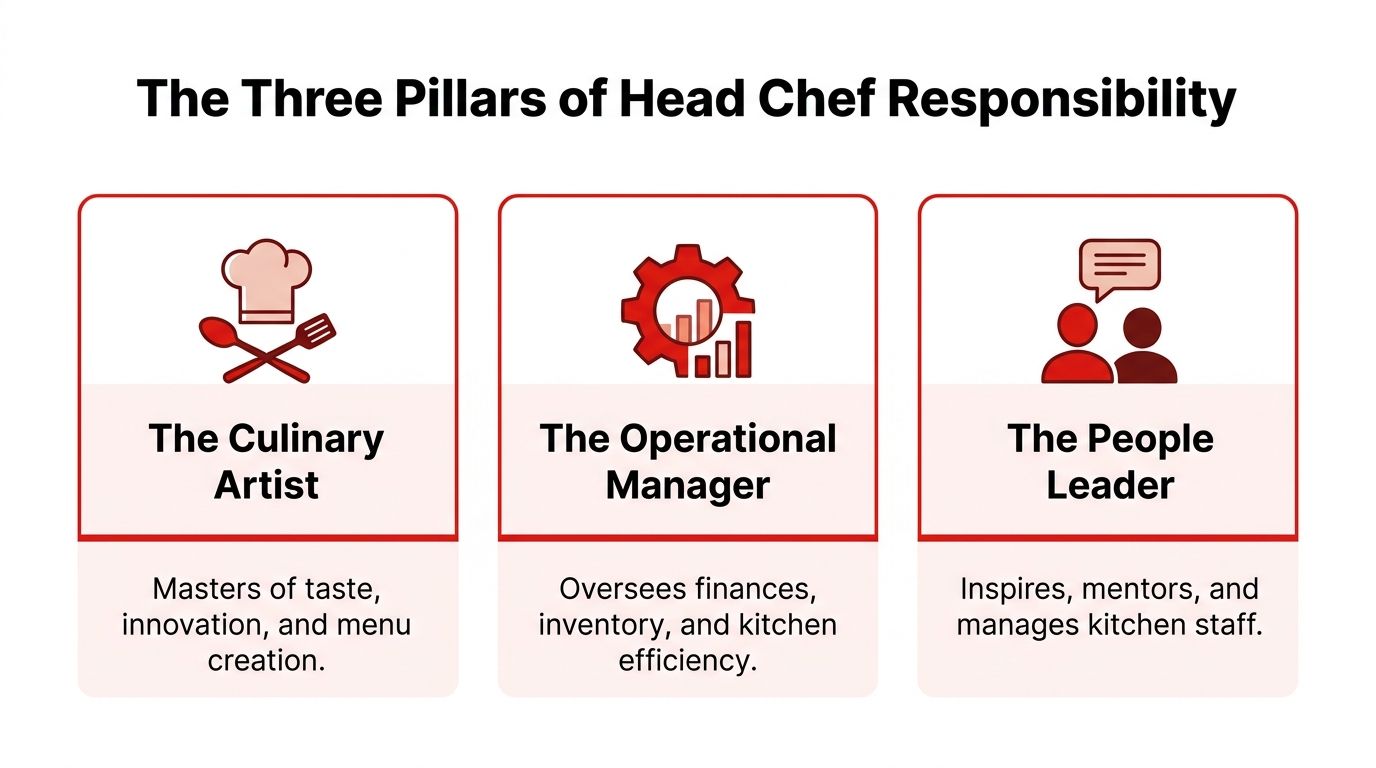
The culinary artist
This is the part many observe first. Menu planning, dish development, plating standards, specials, recipe consistency and quality control all sit here.
Good creativity is never just about flair. It has to fit the site. A coastal hotel in Devon needs a menu that works with local supply and holiday volume. A pub in Berkshire needs dishes that can be executed cleanly on a busy Sunday without breaking the line.
A head chef earns their keep when food is both appealing and repeatable.
The operational manager
This pillar decides whether the kitchen makes money.
Food ordering, stock rotation, supplier management, wastage control, recipe costing, prep planning and service flow all come under daily operational control. Owners often underestimate this side because it happens before service, after service and in the background.
Plenty of chefs can cook. Far fewer can run a commercially disciplined kitchen.
The people leader
A kitchen can survive a difficult weekend with a missing dishwasher or a delayed delivery. It struggles to survive poor leadership for long.
The head chef hires, trains, delegates, sets the tone and manages pressure. They decide whether junior chefs improve or stagnate. They influence whether the team pulls together in August or falls apart at the first call-out.
Why balance matters
Some head chefs are highly creative but weak on systems. Others are strong on cost control but cannot keep a brigade engaged. Some can hold a team together but never push food quality high enough.
Owners need all three pillars in view when they assess talent.
| Pillar | What good looks like | What poor looks like |
|---|---|---|
| Culinary | Consistent food, sensible menu design, strong standards | Erratic quality, overcomplicated dishes, weak execution |
| Operational | Clean stock control, planned prep, controlled spend | Waste, missing stock, rushed ordering, poor GP |
| Leadership | Stable team, clear training, calm service culture | Constant turnover, confusion, blame, fatigue |
If one pillar is missing, the business pays for it somewhere else.
Core Culinary and Creative Responsibilities
A head chef owns the food offer, but not in the romantic sense many people imagine. Creativity has to survive purchasing realities, staffing levels, allergens, service speed and guest expectation.
That means menu work starts with one question. Can this dish be delivered consistently in your kitchen, by your team, at your volume, on your equipment?
Menu development that fits the operation
The most profitable menus are not always the most ambitious. They are the ones built for the site.
A boutique hotel in Windsor may need a breakfast, lounge and dinner offer that shares prep and cross-uses stock intelligently. A pub in Bristol may need a core menu that handles walk-ins, weekend peaks and weather shifts without relying on one hard-to-replace specialist chef.
Strong head chefs think through:
- Ingredient crossover: Using one core product across several dishes to reduce dead stock.
- Section pressure: Avoiding menus that overload one station during peak service.
- Local relevance: Building around what guests expect in that area and venue type.
- Staff capability: Writing dishes the brigade can execute every day, not just on a good day.
Consistency matters more than novelty
Owners sometimes chase menu changes when the core issue is inconsistency.
Guests rarely complain that a menu is not inventive enough if the food is hot, well-seasoned, fairly priced and reliable. They do complain when they had a brilliant pie one week and a poor one the next.
That is why the head chef must standardise:
- Recipes
- Prep methods
- Plating guides
- Portion sizes
- Service checks
This applies just as much to breakfast in a Reading hotel as it does to evening service in a Dorset pub. A scrambled egg, burger or fish dish can damage your reputation if it swings in quality between shifts.
The best menus are built for repeat execution, not for one impressive service.
Seasonal planning without operational chaos
Seasonality is good business when it is controlled. It keeps menus fresh, supports provenance and can sharpen value if the chef buys well.
It becomes a problem when the kitchen changes dishes too often, introduces ingredients the team does not know, or builds specials that complicate mise en place for little return.
A disciplined head chef will use seasonal produce from places such as Welsh farms or the Devon coast, but they will only bring it on if the kitchen can handle it. That is commercial creativity.
Quality control at the pass
The pass is where standards become visible.
A strong head chef checks seasoning, heat, timing, garnish discipline and plate presentation, but they also watch patterns. If garnish is being missed, there may be a prep problem. If mains are waiting for sides, there may be a section communication problem. If the same dish comes back, there may be a recipe issue rather than a service issue.
Customer feedback is part of the job
Head chefs should not treat feedback as front of house noise. Complaints, comments and review themes can show where food is too rich, portions feel mean, wait times are stretching or menu descriptions are misleading.
The point is not to chase every opinion. It is to spot repeat operational truths and act on them quickly.
Essential Operational and Financial Duties
Most kitchen problems that owners call “bad luck” are operating problems. The responsibilities of a head chef include putting hard controls around stock, purchasing, portioning and waste before margin slips too far.
Food cost control is one of the clearest examples. In UK hospitality venues such as independent pubs and boutique hotels, head chefs typically target a food cost percentage of 28-35% of total food sales, while top operators maintain under 30% food costs by recipe costing every menu item before launch. Ingredient prices also increased by 7.2% year-on-year in 2024 according to the cited industry data in this head chef duties and hiring guide.
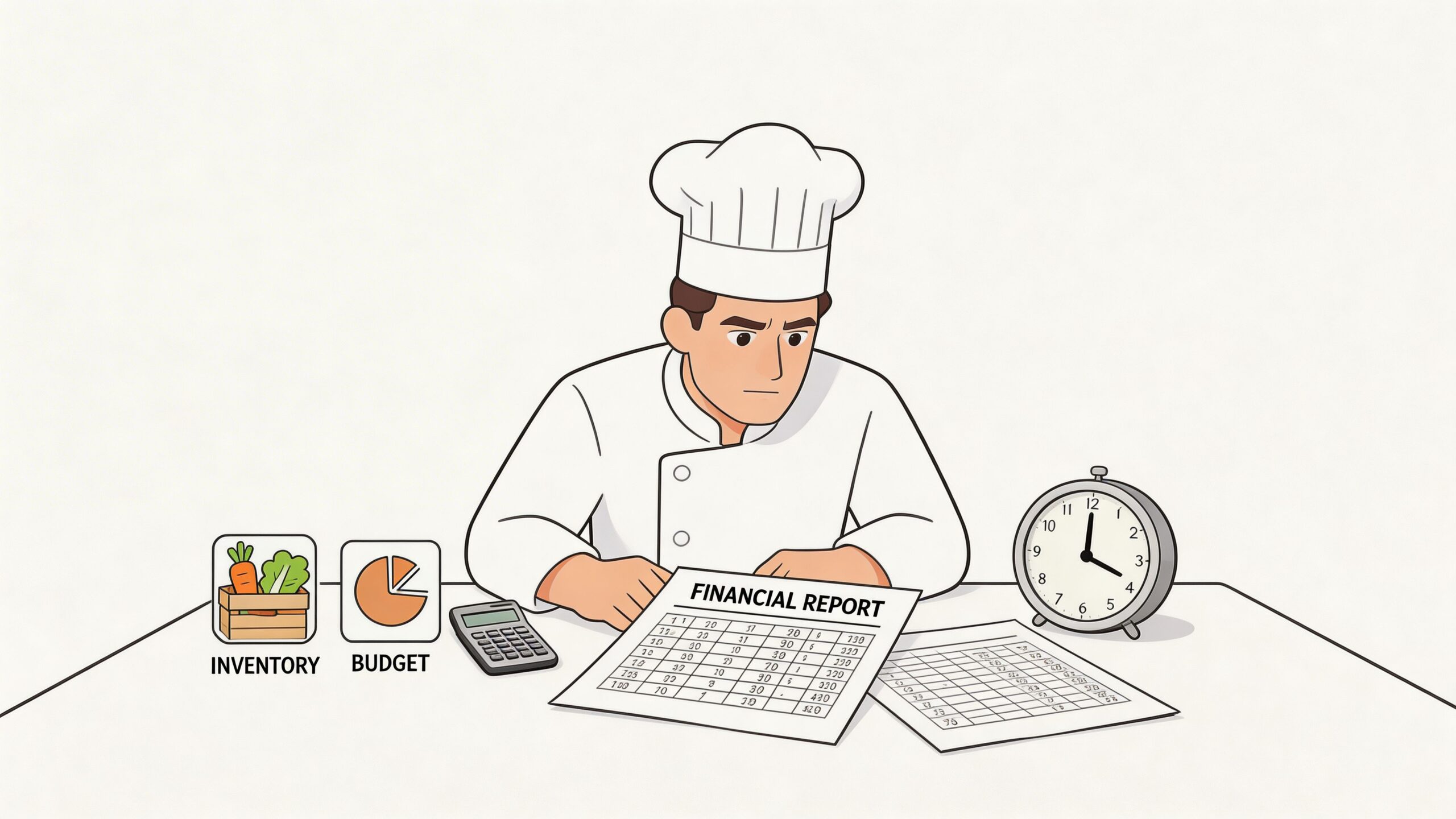
Where margin is won or lost
Many kitchens do not lose money on one dramatic mistake. They lose it in small, repeated habits.
A head chef has to control those habits every day.
- Portion discipline: If mains drift above spec, GP disappears.
- Ordering accuracy: Panic ordering and poor forecasting usually cost more than planned buying.
- Stock rotation: FIFO is not admin. It is margin protection.
- Recipe costing: If dishes are not costed before launch, the menu is guesswork.
- Yield awareness: Trim, shrinkage and preparation losses need to be understood, not ignored.
The benchmark matters, but behaviour matters more. A head chef who knows the gross profit report but does not challenge over-portioning will still lose money.
The practical systems that work
The kitchens that hold margin under pressure usually do a few basic things consistently.
| Control area | What the head chef should do |
|---|---|
| Daily stock awareness | Review key lines, check shortages early, stop over-ordering |
| Menu costing | Cost each dish before launch and review after supplier changes |
| Waste control | Track recurring spoilage, trim loss and unused prep |
| Supplier discipline | Compare delivered quality, challenge substitutions and keep alternatives ready |
| Weekly review | Use EPOS and GP reports to spot drift before it becomes normal |
One useful commercial reference for owners weighing staffing structure and overhead is this guide on the cost of employing, especially when comparing permanent recruitment with temporary cover during unstable periods.
What does not work
Three habits show up repeatedly in underperforming kitchens.
First, pricing dishes from instinct rather than proper recipe costing.
Second, carrying too many ingredients for a menu the site cannot support consistently.
Third, assuming a busy service covers poor controls. It rarely does. High volume can hide bad kitchen discipline for a while, but it does not correct it.
A full dining room does not guarantee a profitable kitchen. Only controls do.
A capable head chef will often spot cost issues before the owner sees them in the accounts. That is exactly why the role should be treated as a commercial position, not just a culinary one.
People Management and Kitchen Leadership
The kitchen can carry a weak menu for a while. It cannot carry weak leadership for long.
In the UK hospitality sector, staffing shortages affected 100,000 hospitality vacancies in Q3 2024, and 75% of hospitality businesses faced recruitment challenges according to the cited figures in this overview of chefs and head cooks. In that market, the head chef is not only running service. They are holding the team together while the labour pool stays tight.
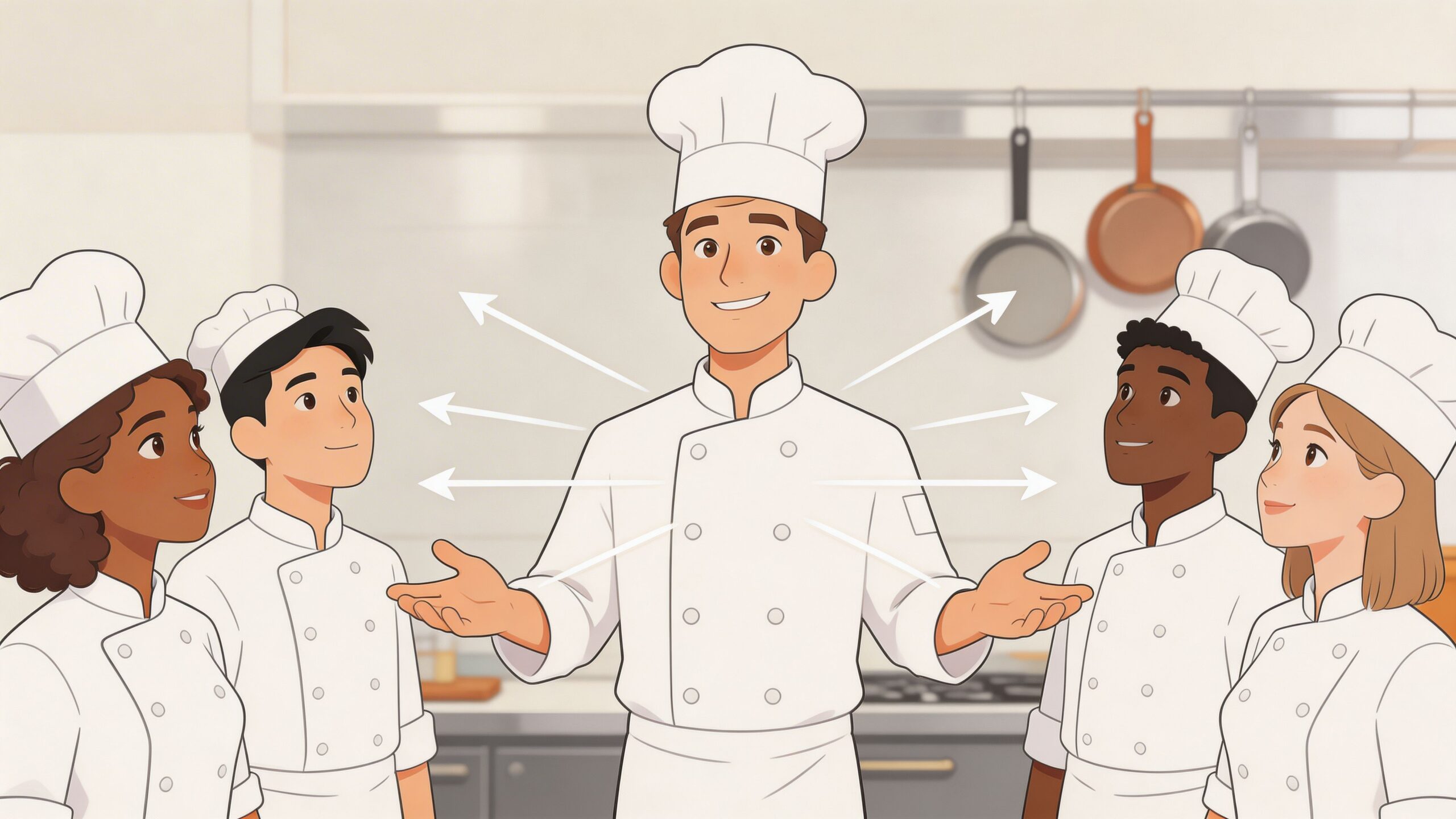
Recruitment is now part of daily operations
Owners often treat recruitment as a separate HR function. In kitchens, it rarely works that way.
The head chef usually decides whether a trial shift is viable, whether a candidate can handle volume, whether a commis has potential and whether a sous chef can manage pressure without destabilising service. When the market is short, those calls become more important.
This is also where many generalist agencies fall down. Sending a CV is not the same as sending a chef who can step into a live brigade and function.
Rota design and workload fairness
Poor rotas create more than complaints. They create resignations.
A good head chef balances skill coverage, prep time, service intensity and recovery time. They know who can open strongly, who can close reliably and where they need experience on the pass. They also know that constantly leaning on the same strong chef burns that person out.
For operators reviewing support structures below head chef level, this breakdown of sous chef responsibilities is useful because many kitchen failures start with unclear division between those two roles.
Training is not optional
The fastest way to reduce standards is to assume people will just pick things up.
Strong head chefs train actively. They show, test, correct and repeat. They document recipes. They reset standards after busy weekends. They explain why a dish is plated a certain way, why prep is labelled a certain way, and why shortcuts are not accepted.
A kitchen without training becomes dependent on whoever happens to be on shift.
This short video gives a useful visual reminder of how much kitchen leadership is about communication and demonstration, not just instruction.
What stable leadership looks like
A well-led kitchen usually shows the same signs:
- Clear prep ownership: Everyone knows what must be done before service.
- Calm communication: Problems are addressed early, not shouted about at the pass.
- Visible standards: Junior chefs know what “right” looks like.
- Fast onboarding: Temporary chefs are briefed properly and used intelligently.
- Accountability: Mistakes are corrected without creating a toxic shift culture.
Here, practical staffing support matters. Relief Chefs UK, established in 2013, provides relief chefs, temporary chefs, permanent chef recruitment, yacht chefs, villa chefs and broader hospitality staffing support across the UK. For owners dealing with short notice sickness, seasonal demand or an unreliable supply of agency chefs, that kind of support helps keep the kitchen open while a permanent solution is built.
Navigating Legal Safety and Compliance Obligations
A head chef carries legal responsibility in areas many owners only notice when something goes wrong.
Food safety, allergen control, sanitation, training records, workplace safety and waste handling are not side tasks. They sit inside the daily responsibilities of a head chef because a failure in any one of them can stop service, trigger enforcement action or damage the venue’s reputation quickly.
Food safety is a management function
The strongest kitchens do not rely on memory or good intentions. They work from systems.
That means the head chef has to make sure food handling, storage, labelling, cooling, reheating, cleaning and cross-contamination controls are followed every shift. It also means checking that standards are still being followed when the kitchen is busy, understaffed or using temporary cover.
If a kitchen only looks compliant when the head chef is physically present, the system is weak.
Allergen control has to be built into service
Allergen mistakes often happen at the handover points. Ordering. Prep. Labelling. Service communication. Last-minute substitutions.
A proper head chef closes those gaps with written recipes, clear product identification, disciplined prep separation and service briefings that front and back of house both understand. Natasha’s Law has made labelling discipline even more important for relevant pre-packed foods, but the bigger point is broader. If allergen information is unclear, trust collapses fast.
Sustainability is now part of the role
The legal and commercial side of sustainability is moving into day-to-day kitchen management. According to the cited Food Standards Agency reference point, the 2025 Environment Act includes a mandate for 30% waste reduction by 2027, broader food standards non-compliance can risk £10k+ fines, and 70% of UK diners demand sustainable menus in the referenced 2025 Mintel figure, all noted via the Food Standards Agency.
For operators, that means the head chef increasingly needs to manage:
- Waste reduction processes
- Supplier choices
- Menu planning that uses product fully
- Documentation and traceability
- Practical sustainability decisions that do not break service
Compliance is not a paperwork exercise. It is a trading requirement.
What owners should expect from a compliant head chef
A commercially reliable head chef should be able to show:
| Area | What you should see |
|---|---|
| Food safety | Clear storage, labelling, temperature control and cleaning discipline |
| Allergens | Accurate information, controlled substitutions, confident staff answers |
| Health and safety | Safer equipment use, cleaner walkways, fewer avoidable accidents |
| Waste and sustainability | Measured waste, sensible prep use, supplier awareness |
If your current kitchen cannot explain how it handles those areas, the risk is already there.
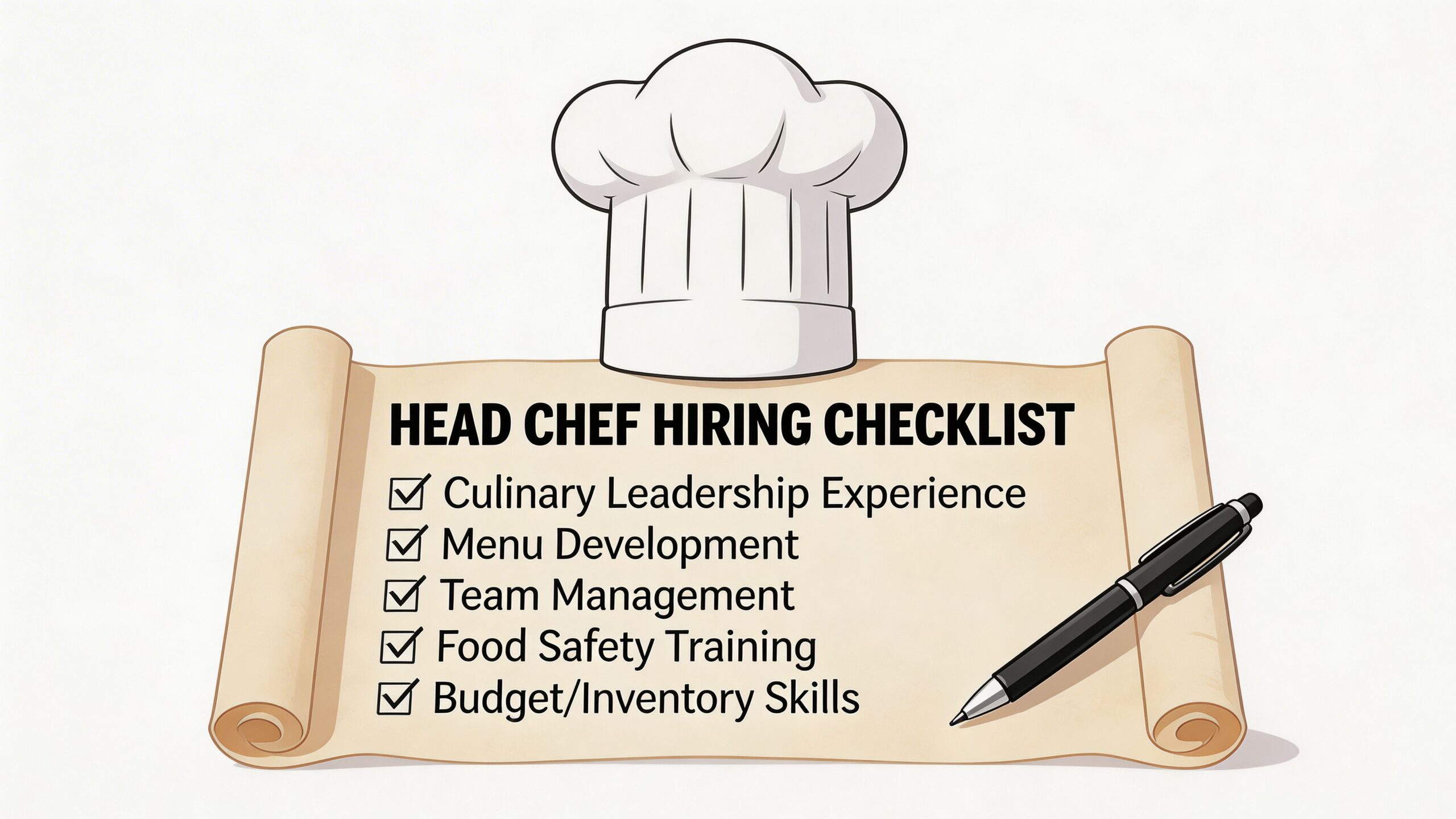
Finding Your Next Head Chef A Practical Checklist
Hiring a head chef under pressure is where many good businesses make expensive decisions. They hire for personality, reputation or a strong trial plate, then discover six weeks later that the candidate cannot cost menus, train juniors or stabilise a shaky rota.
A better approach is to assess the role exactly as the business experiences it. Food, margin, leadership and compliance all have to be tested.
A practical head chef job brief
A useful brief is concise and operational. It should state that the head chef is responsible for:
- Menu delivery and quality control
- Recipe costing and stock discipline
- Kitchen team leadership and training
- Rota planning and service organisation
- Food safety, allergen and compliance standards
- Supplier management and purchasing decisions
- Maintaining standards during peak demand and staff absences
That wording filters candidates better than vague phrases about passion or creativity alone.
Interview for the role
Ask questions that force candidates to show how they think.
Culinary judgement
- Menu fit: How would you adapt a menu for a pub with strong Sunday trade and limited prep space?
- Consistency: How do you keep standards steady when your stronger chefs are off?
- Guest relevance: How do you decide whether a special belongs on the board or not?
Commercial control
- Food cost discipline: How do you cost a dish before launch and what makes you remove one?
- Supplier management: What do you do when delivered quality drops but service still has to run?
- Waste control: How do you reduce waste without shrinking the menu too far?
Leadership and stability
- Short notice absence: What is your first move when a chef calls in sick before a fully booked service?
- Training: How do you bring a weaker junior up to standard?
- Culture: What behaviour do you not tolerate in your kitchen?
Use a working assessment, not just a trial shift
A single service can be misleading. Some candidates perform well for one shift and struggle with the admin, systems and people side of the role.
A better assessment includes:
| Checkpoint | What to test |
|---|---|
| Menu review | Can they read your menu and spot service or margin problems quickly |
| Stock mindset | Do they ask about suppliers, deliveries, wastage and storage |
| Team interaction | Do they communicate clearly with juniors and front of house |
| Service control | Can they stay calm and organised under pressure |
| Standards | Do they notice detail without slowing the kitchen unnecessarily |
If permanent hiring is dragging on
Many venues cannot afford to wait for the perfect permanent appointment while the kitchen underperforms.
In those cases, use temporary cover to protect service, then recruit properly. That is often better than rushing into the wrong long-term hire. If you need support with that process, this page on head chef recruitment is relevant for operators hiring into pubs, hotels and other hospitality venues.
The costliest head chef hire is not the expensive one. It is the wrong one.
Frequently Asked Questions About the Head Chef Role
What is the difference between a head chef and an executive chef
In many independent pubs, restaurants and boutique hotels, the head chef is the senior kitchen leader and handles both daily operations and strategic control. In larger groups or hotel structures, an executive chef may sit above several kitchens or several head chefs and focus more on oversight, planning and brand consistency.
In a smaller site, one person often covers both functions in practice.
How do the responsibilities of a head chef differ from a sous chef
A sous chef supports and runs the kitchen in the head chef’s absence, but the head chef carries final responsibility for menu direction, kitchen standards, staffing decisions, supplier oversight, compliance and financial performance. The sous chef executes leadership. The head chef owns it.
What should a relief chef take responsibility for on shift
That depends on seniority and brief. A senior relief chef should protect service flow, maintain standards, respect site systems and communicate quickly about risks. In a crisis weekend, the main value is stability. The best temporary chefs do not try to redesign the kitchen on day one. They get control of the shift, work cleanly and keep guests fed properly.
What KPIs should owners use for a head chef
Use a balanced view. Measure consistency of food quality, stock control discipline, rota stability, staff retention, waste levels, hygiene standards, complaint patterns and service performance. If you only measure sales, you can miss serious kitchen weaknesses. If you only measure cost, you can damage quality and team morale.
How long does it take to know if a head chef is right
You usually see the first signs quickly. The deeper answer takes longer.
In the first weeks, look at organisation, communication, ordering discipline and how the team responds to them. Over time, look at whether standards hold under pressure, whether juniors improve, and whether the kitchen feels more controlled rather than more dependent on one person.
Should owners recruit permanently or use temporary cover first
If the kitchen is already unstable, temporary cover can buy you time to make a better permanent decision. That is often the safer move in seasonal markets, during sickness gaps or when the previous head chef left without a handover. The key is to keep standards and service intact while you assess the long-term fit properly.
If your kitchen needs short-term cover, permanent chef recruitment, or support across pubs, hotels, yachts, villas and other hospitality settings, contact Relief Chefs UK. They work nationwide and can help you secure dependable chef staffing when stability matters most.
Call the team.
Office 01392 715474 · info@reliefchefs.co.uk