
Working for Temp Agencies: A Manager’s Chef Insight
13 May 2026
Saturday night. Two chefs down. Functions booked, covers stacked up, and your sous chef is already asking who's taking grill, who's on pass, and whether breakfast prep will roll into lunch service again.
That's the moment most operators start thinking about temp cover. Usually too late.
The problem isn't only the sickness call or the resignation that landed on payday. It's that the chef market has tightened, peak periods are harder to staff, and the old habit of “ring round and hope” doesn't protect standards any more. If you run a pub in Devon, a boutique hotel in Berkshire, a restaurant in Bristol, or a seasonal business in Dorset, you already know the pressure. One weak shift can upset service for days.
Most articles on working for temp agencies are written for chefs. Fair enough. But if you hire chefs, you need to understand that world as well. The managers who get the best agency cover are usually the ones who understand what agency chefs want, what agencies do, and where placements go wrong.
We've worked in kitchens long enough to know this isn't HR theory. It's operations. It's GP. It's guest feedback. It's whether your team finishes service with control or with damage.
Why You Must Understand the Temp Agency World
The market has changed. The days of assuming there'll always be a spare chef available nearby are gone.
According to ONS April 2026 hospitality vacancy reporting summarised in the verified data set, hospitality vacancies are at 142,000, up 12% year on year, and chef roles make up 22% of those vacancies. The same verified data notes an 18% drop in EEA migrant chefs since 2021, and a Recruit UK survey found 62% of independent pubs struggled with temp chef availability during peak periods.
That matters because your staffing issue isn't isolated. It's structural.
Staffing pressure is now operational risk
A temp chef shortage shows up in practical ways:
- Short-notice sickness hits harder because there's less slack in the market
- Seasonal demand bites earlier in tourist areas such as Devon, Dorset and Wales
- Good permanent chefs burn out when they keep covering holes in the rota
- Standards drift when you use whoever is available instead of who fits the kitchen
A lot of managers still treat agency labour as a last-resort purchase. That's often where the trouble starts. If you only think about agencies when the kitchen is already on fire, you'll make rushed choices. Rushed choices usually mean weak briefs, poor matching, and a chef walking into a service they were never set up to succeed in.
Practical rule: If agency cover is part of your operating model, build the relationship before the emergency.
Why the chef's view matters to the venue
The strongest temps are not “between jobs”. Many choose agency work because it gives them flexibility, variety, and control over the kitchens they step into. If you understand that, you can attract better people and get better output from them.
Managers who understand the temp agency world tend to do three things well:
| What they do | Why it works |
|---|---|
| Brief clearly | The agency can match skill, pace and style properly |
| Onboard quickly | The chef settles faster and service stays stable |
| Treat temps like part of the brigade | Better chefs come back, and the agency prioritises your shifts |
That's the actual value here. Understanding how temp chefs work doesn't just help you fill holes. It helps you keep the kitchen moving when the market is against you.
The Temp Agency Model A Manager's Overview
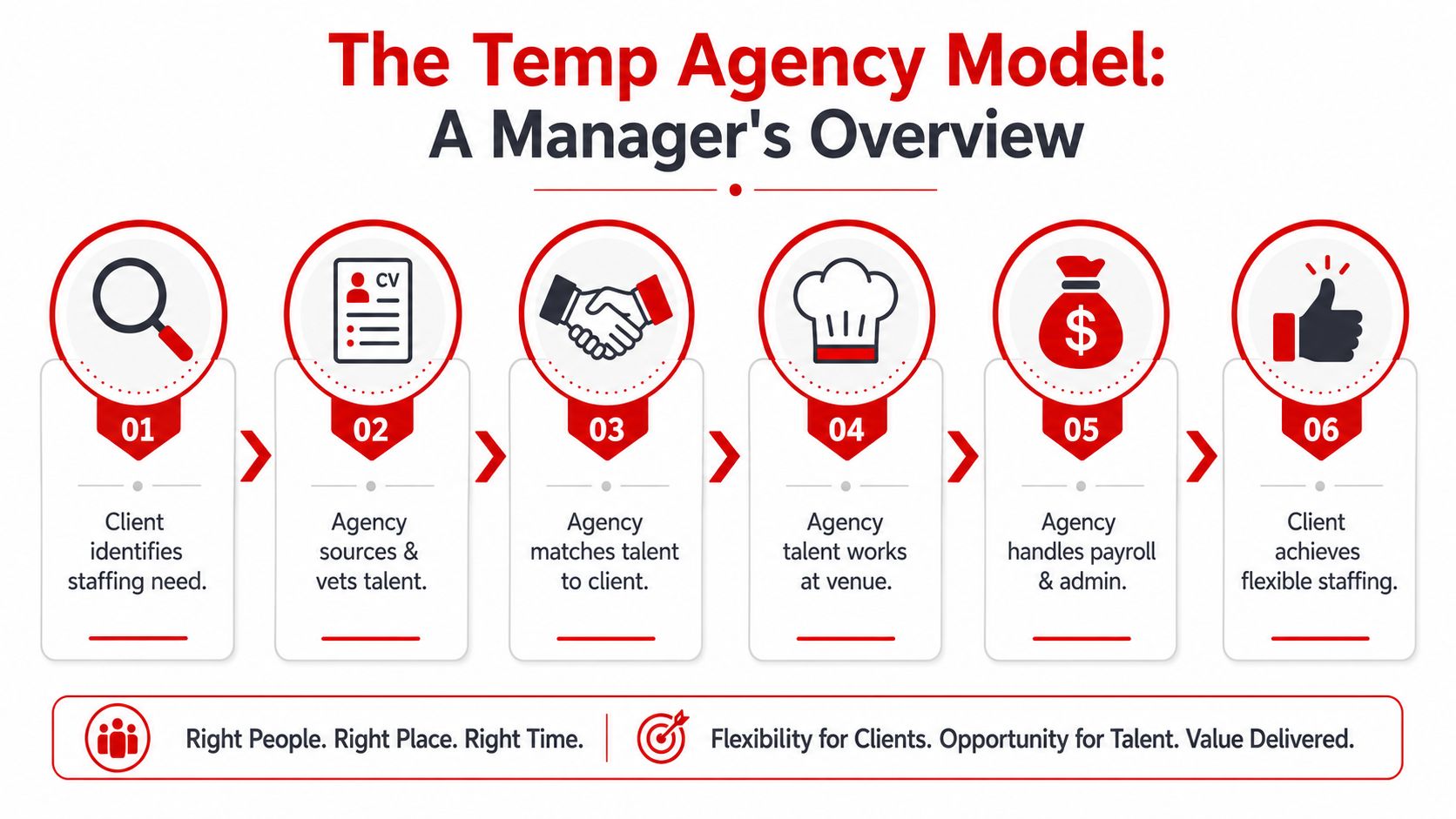
A proper temp agency model is simple when it's run well. You call with a staffing problem. The agency checks the brief, matches from an active pool, confirms availability, handles the employment admin, and supports the placement while the chef is on site.
That's the professional version.
The weak version is just a body shop. No real vetting. No proper skill check. No clear communication. No support when the placement wobbles. That model creates more work for the venue than it saves.
What a professional agency should do
A decent agency should act like an extension of your operation, not a message board.
The process usually looks like this:
- Clarify the brief. Not just “need a chef”. You need level, section strength, shift times, menu style, volume, accommodation details if relevant, and whether this is rescue cover or a calmer booking.
- Check suitability. A good agency won't send a fine-dining CV into a high-volume pub kitchen unless the chef can handle it.
- Verify the basics. Right to Work, experience, references where appropriate, and whether the chef can travel and start.
- Confirm the assignment details. Rates, dates, uniforms, kit, parking, sleeping arrangements if live-in, and who meets the chef on arrival.
- Support the placement. If the first shift exposes a mismatch, the agency needs to deal with it quickly.
- Handle payroll and admin. That includes the back-office side the venue doesn't want to be firefighting midweek.
For venues needing short-notice cover, temporary agency chef support is useful when it's built around those steps rather than a loose list of names.
What usually goes wrong
Most failed agency bookings come from one of three mistakes:
- The brief was vague. “Need a strong chef” tells nobody enough.
- The site oversold itself. If the kitchen is under pressure, say so. The right chef will still take it. The wrong one will leave.
- No one owned the arrival. Turning up to no induction, no passcode, no menu notes and no key contact is a bad start for any temp.
If you want agency staffing to work, stop treating the first shift like a test the chef has to pass alone. Treat it like a handover your business has to manage properly.
The difference between cover and stability
A strong agency relationship isn't only about plugging a gap on Friday. It's about building reliable access to relief chefs, temporary chefs, permanent chef recruitment options, yacht chefs, villa chefs and wider hospitality staffing support as your business changes.
When the process is structured, the chef arrives ready to work. When it isn't, you've just paid to import uncertainty.
What Motivates a Professional Agency Chef
Most good agency chefs aren't drifting. They're making a commercial decision about how they want to work.
Some want variety. One month they're in a country house hotel near Windsor, then a busy coastal operation in Devon, then a private household or yacht placement where discretion matters as much as cooking. Others want control over their diary because permanent rosters stopped fitting around family life, travel, or burnout.
That doesn't make them less serious. Often it makes them more selective.
Why experienced chefs choose agency work
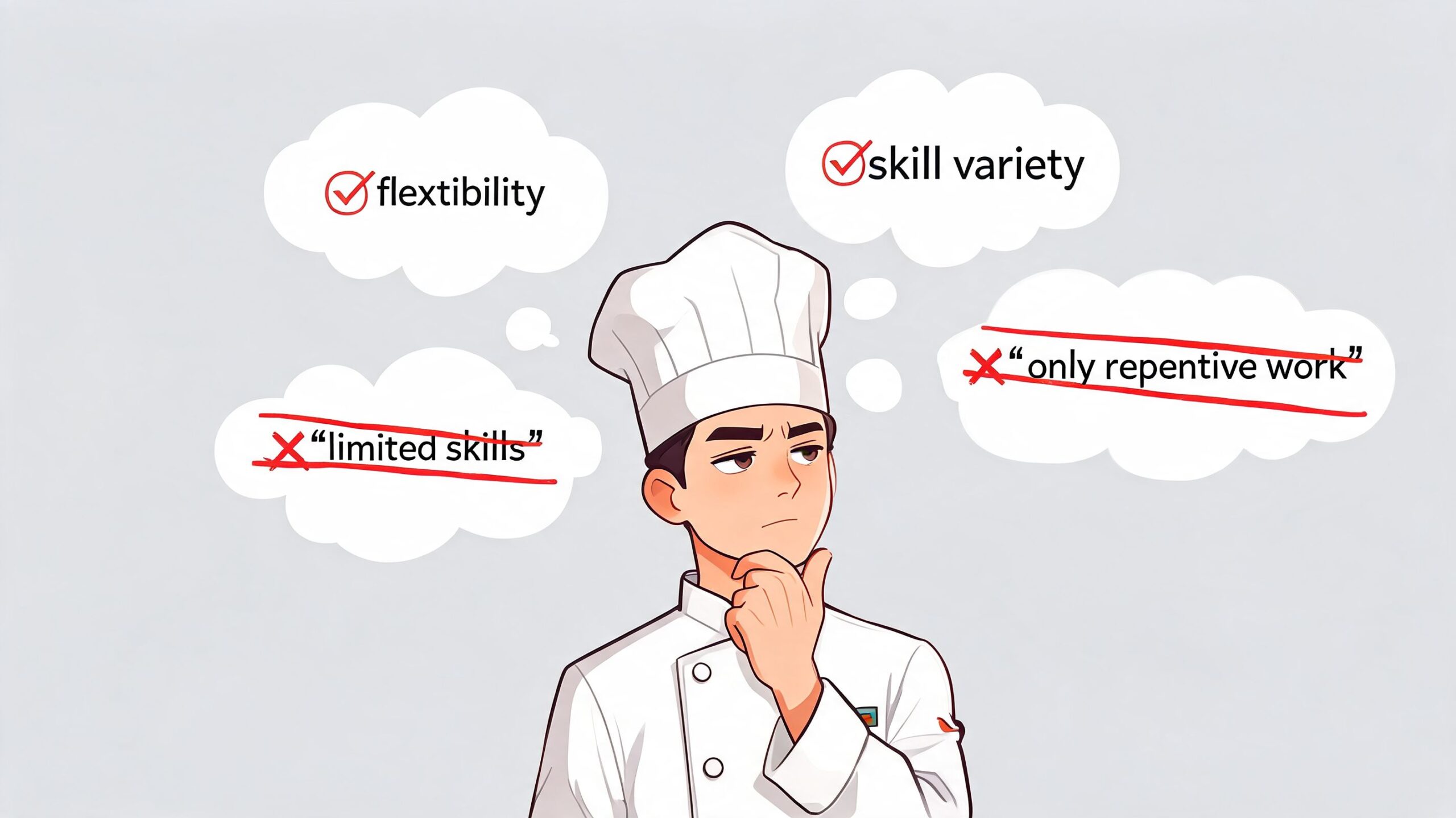
A professional temp chef usually values three things.
Control over shifts
They can choose when they work, what sort of kitchen they'll walk into, and whether a booking suits their skill set.
Variety without starting over
Agency work lets a chef build experience across pubs, hotels, events, private households and seasonal businesses without repeatedly going through a full permanent move.
Clearer short-term economics
Some chefs prefer hourly-paid agency work because it's easier to compare the value of a shift against travel, intensity, and personal time.
From a manager's side, that means the best temps aren't won over by panic calls alone. They respond to clear briefs, honest kitchens and placements where they can do proper work.
What puts agency chefs off a venue
The biggest myth is that a temp chef should just be grateful for the shift. That attitude loses good people.
In the verified data set, temporary agency chefs in UK hospitality have a 28% higher turnover rate than permanent staff, often due to irregular shifts and skill underutilisation. The same data notes that agencies with stronger vetting and matching can reduce role mismatch burnout by 35% and help temps reach 95% productivity on day one as summarised in the verified data for Fact 3.
In plain terms, chefs leave placements when the situation doesn't match the brief.
Here's what that looks like in kitchens:
- Booked as a senior pair of hands, used as a porter-plus
- Promised organised prep, walk into chaos
- Told it's fresh-food led, find a freezer-and-fryer operation
- Expected to run a section with no handover and no tickets explained
- Treated as disposable labour by the permanent team
A temp chef will forgive pressure. They won't forgive being misled.
The manager's advantage
If you understand what motivates agency chefs, you can shape a venue they want to return to.
That means:
- a realistic brief
- a named contact
- a proper start
- respect on shift
- fast decisions if there's a problem
Managers who do that get first refusal from better temps. In tight markets such as Bristol, Reading or Slough, that matters more than many realise.
Navigating Agency Worker Regulations in Your Kitchen
Legal compliance around agency chefs gets ignored until there's a dispute. By then, the paperwork suddenly matters a lot.
If you use agency chefs regularly, you need a working grasp of the Agency Workers Regulations 2010, especially the equal treatment point that applies after a qualifying period. You don't need to become an employment lawyer. You do need to know what your venue is responsible for, what the agency is responsible for, and where communication tends to fail.
A lot of hospitality operators assume the agency handles everything. It doesn't work like that.
The point managers miss about the 12-week rule
The verified data states that a 2023 ONS survey showed over 200,000 UK hospitality workers were agency temps, with 28% reporting denied holiday pay, and that only 15% knew their rights to equal treatment are triggered after 12 weeks of work under the AWR as summarised in the verified data for Fact 5.
That lack of awareness creates risk for everyone. If a chef works through an agency in the same role for long enough to trigger equal treatment rights, you need to be sure the information flowing between venue and agency is accurate.
The practical issue is simple. If dates, duties, breaks, pay comparisons or role descriptions are sloppy, problems build up.
Who handles what
This is the broad operational split in most agency arrangements:
| Area | Usually handled by |
|---|---|
| Payroll processing | Agency |
| Employment admin | Agency |
| Statutory pay administration linked to agency employment | Agency |
| On-site health and safety | Client venue |
| Site induction | Client venue |
| Day-to-day supervision during shift | Client venue |
That split is exactly why your internal systems still matter.
If a temp chef slips because the floor wasn't managed, that's not solved by saying, “They came through an agency.” If they aren't shown fire exits, allergen systems, fridge layout or who signs off wastage, you've created an avoidable problem on site.
For managers reviewing agency arrangements, contract employment agencies guidance can help frame the compliance questions worth asking before bookings start.
A simple compliance routine for busy kitchens
Keep it practical:
- Track assignment dates so you know when repeat cover is becoming ongoing cover
- Record actual duties rather than relying on old job titles
- Share site risks clearly before first shift
- Keep induction notes short but consistent
- Raise payroll or holiday concerns early with the agency rather than waiting for the chef to escalate
Compliance in agency staffing isn't paperwork for its own sake. It's what stops a useful staffing solution turning into a legal and operational distraction.
Becoming a 'Client of Choice' for Top Agency Talent
The best agency chefs talk. They tell agencies which kitchens are organised, which sites are honest, and which managers they'd happily work for again.
That reputation affects your access to talent. In difficult weeks, agencies will naturally lean towards venues where placements are likely to go smoothly.
The first 15 minutes matter most
A temp chef can usually tell within minutes whether the booking has been set up properly.
Use a short arrival routine:
- Meet them properly. Don't leave them waiting at reception or the bar.
- Show them the kitchen flow. Entry points, dry store, walk-in, pass, wash-up, bin route.
- Explain the menu pressure points. Which section gets slammed, what prep is fragile, what's already behind.
- Set the chain of command. Who calls tickets, who signs off prep, who they report to if something's wrong.
- Cover the basics. Allergens, cleaning standards, knives, uniforms, breaks, finish procedure.
That isn't mollycoddling. It's risk control.
What top temps actually notice
Managers often think chefs care most about rate. Strong temps do care about money, but they also notice whether the kitchen is workable.
They notice:
- whether the brief matched reality
- whether prep lists are readable
- whether fridges are labelled
- whether the team is hostile to agency staff
- whether the shift ends with a fair handover or a dump of unfinished work
A badly run kitchen repels agency talent fast. A calm, direct, well-briefed kitchen attracts repeat availability.
The easiest way to improve agency performance is to remove preventable friction before service starts.
Simple habits that make your venue easier to staff
These are the habits that usually separate a venue people return to from one they avoid:
Be honest about the shift
If the kitchen is under strain, say so. Good agency chefs can handle pressure. They just want the truth.
Don't treat temp chefs as outsiders
Introduce them to the team, give them the same respect, and don't use them as a shield for wider kitchen issues.
Give feedback quickly
If the chef was right for the site, tell the agency. If they weren't, explain why in practical terms.
Book ahead where you can
For race days, weddings, summer peaks, festive trade, and school holiday pressure, earlier planning always improves your options.
In competitive markets like Windsor, Berkshire and Bristol, becoming a client of choice gives you a real edge. The good chefs remember where they were set up to succeed.
Why Relief Chefs UK is Your Kitchen's Safety Net
There's a difference between buying cover and building resilience. The first gets you through tonight. The second protects service across the season.
That's where chef-run staffing tends to outperform generic labour supply. The verified data states that UK temp agency chefs have 18% higher placement success rates when agencies provide 24/7 support and replacement guarantees, and that chef-run agencies using experience-based matching achieve 92% first-fit success, while temp-to-perm pipelines can reduce venue hiring costs by an average of £4,200 per role as summarised in the verified data for Fact 4.
For operators, that matters because fit matters more than CV weight. A chef who suits your menu, volume and team dynamic is worth far more than a big title who doesn't settle.
What matters when you choose an agency partner
Look for practical safeguards:
- A live, reachable team when service pressure hits
- Replacement support if a placement fails
- Real matching based on kitchen type, not just postcode
- Options beyond short-term cover, including permanent chef recruitment and specialist placements
- Clear admin and communication so managers aren't chasing basics
Relief Chefs UK has operated since 2013 and works across nationwide hospitality staffing support, including relief chefs, temporary chefs, permanent chef recruitment, yacht chefs and villa chefs. For urgent gaps, emergency relief chef cover across the UK is one route venues use when a kitchen can't afford to wait.
Why this matters commercially
The right agency relationship protects more than the rota.
It protects:
- guest experience
- team morale
- food consistency
- manager time
- recruitment momentum when temp-to-perm becomes the right move
If you run an independent pub, hotel group, restaurant, private estate or yacht operation, agency staffing should support stability, not add another layer of uncertainty.
FAQs on Using a Temp Chef Agency
Are agency chefs only useful for emergencies
No. Emergency cover is the obvious use, but it's not the only one. Managers also use temporary chefs for holidays, maternity cover, project openings, menu transitions, busy event periods, and as a route into permanent hiring when they want to see how someone works in a live kitchen first.
How do I improve the quality of agency chefs sent to my venue
Start with the brief. Tell the agency what level you need, what the menu looks like, how many covers you run, what section is under pressure, and what sort of personality suits the brigade. Vague briefs produce vague matches.
Who pays the chef
In a standard agency arrangement, the agency usually handles payment and employment administration, while the chef works on site under your operational direction for the shift. That's one reason clear communication between venue and agency matters so much.
Can temp work lead to permanent recruitment
Yes. It often works well when both sides want a lower-risk way to assess fit. You get to see punctuality, section management, standards and team behaviour in real service, not just at interview.
What should I have ready before the chef arrives
Keep it simple:
- shift times
- named contact
- parking or access notes
- menu and section expectation
- uniform requirements
- allergen and safety basics
- who signs them in and starts the handover
What puts agency chefs off returning
Usually avoidable things. Poor communication, a misleading brief, hostility from the brigade, no induction, or a site pretending to be more organised than it is. Most good chefs can handle pressure. What they don't want is confusion they could have been warned about.
Is using an agency more expensive than hiring direct
That depends on what you compare it with. If the alternative is cancelled bookings, reduced menus, exhausted permanent staff, or repeated bad hires, agency cover can be the more commercially sensible option. The right question isn't “what's the rate?” on its own. It's “what does an uncovered shift cost the business?”
If your kitchen needs dependable cover, a steadier pipeline of chefs, or a temp-to-perm route that doesn't waste service time, speak to Relief Chefs UK. We work with pubs, restaurants, hotels, private households and yachts across the UK, and we'll talk through the brief properly before a shift becomes a crisis.
Call the team.
Office 01392 715474 · info@reliefchefs.co.uk