
Temping Agencies in Manchester: A Manager’s Guide 2026
14 May 2026

Friday evening. A chef rings in sick. The bookings are already on the board, prep is half done, and the duty manager is asking whether the reduced menu will be enough to get through service.
That's the moment most operators start searching for temping agencies in manchester. The problem is they usually start too late, call the wrong type of agency, and end up paying twice. Once for the shift. Again for the disruption.
In hospitality, a staffing gap isn't an admin issue. It hits covers, guest experience, team morale, wastage, and online reviews in one go. If the person sent can't run a section, can't work cleanly, or slows the pass, the whole operation feels it.
Why Manchester Hospitality Needs a New Staffing Strategy
Manchester gives operators plenty of choice on paper. In practice, choice is the problem.
The city has 2,749 recruitment companies, making it the second-largest concentration of recruitment agencies in the UK, while the wider UK temp market handled 25.7 million temporary and contract placements in 2022, up 15% year on year according to UK recruitment agency market data from New Millennia. That sounds healthy until you're the one trying to separate genuine kitchen specialists from general labour suppliers.

The old approach breaks under pressure
A lot of venues still handle staffing reactively. They wait for the problem, then work through old numbers, generic agency contacts, WhatsApp groups, and favours.
That can work once. It won't build a stable kitchen.
Manchester's hospitality scene is busy, competitive, and unforgiving when standards slip. Independent pubs in the suburbs, city-centre restaurants, event-led sites, and boutique hotels all need flexibility, but they don't need the same type of flexibility. A breakfast chef for a hotel isn't the same brief as a senior sous for a fresh-food pub or a strong CDP for a busy Saturday service.
Practical rule: Don't treat “chef cover” as one category. Define the section, service style, shift pattern, and level before you make a call.
A proper staffing strategy starts before the crisis. You should know which roles are hardest to cover, which shifts create the most risk, and which standards are essential. If your venue depends on a small core brigade, one absence can change the whole trading week.
What managers should put in place now
A sensible plan usually includes:
- Priority roles: Identify the kitchen positions that can't be left uncovered.
- Trigger points: Decide when you bring in temporary cover rather than stretching the team.
- Approved partners: Keep a shortlist of agencies that understand hospitality, not just recruitment.
- Recruitment support: Use a specialist partner for both emergency shifts and long-term hiring through a wider hospitality recruitment approach.
Managers who do this aren't over-planning. They're protecting revenue.
The venues that cope best with shortages aren't the ones with no staffing problems. They're the ones with a system.
The Risk of Using Generalist Temping Agencies for Your Kitchen
A common mistake is assuming any established agency can fill a chef shift.
It can't.
Large names often look reassuring because they cover many sectors, have visible offices, and answer the phone quickly. But breadth isn't the same as kitchen understanding. According to Reed's Manchester office overview and sector listings, major temping agencies in Manchester such as Reed and Blue Arrow list multiple sectors yet lack dedicated hospitality specialisms, which leaves a service gap for venues needing properly vetted chefs at short notice.
What generalist agencies usually miss
A kitchen role needs more than a CV and availability.
You need to know whether the chef can handle volume, jump onto the right section, respect allergens, follow systems, communicate with the pass, and work without upsetting the brigade. Generalist agencies often screen for attendance and generic work history. They don't always test whether someone can cope with your service.
That creates real operating risk:
- Wrong skill level: A candidate may have worked in food, but not at the level your kitchen requires.
- Weak section fit: Someone comfortable in prep may struggle on garnish, grill, sauce, or breakfast volume.
- Food safety blind spots: If HACCP habits are poor, your head chef inherits the risk immediately.
- Culture damage: One unsuitable temp can slow service and frustrate the permanent team.
If a recruiter can't talk confidently about sections, prep levels, menu complexity, and service pace, they're not really qualifying chefs.
The hidden cost isn't just the invoice
Managers often focus on the agency rate. The actual cost sits elsewhere.
A weak temp can force menu changes, overtime, extra supervision, and refunds. Senior chefs end up firefighting instead of leading. Front of house absorbs the consequences. The guest never sees “agency mismatch” on the bill. They just remember poor food and slow service.
This is why chef hiring needs to be handled differently from generic temporary staffing. Relief waiting staff, warehouse pickers, administrators, and chefs can't be recruited with the same process.
The right question isn't “Can this agency send someone today?” It's “Can this agency send someone who can protect service today?”
How to Find and Shortlist Specialist Chef Agencies
Most shortlists start badly because the search term is too broad.
If you search temping agencies in manchester, you'll pull up everything from office recruitment to industrial labour. That wastes time. Search with the problem in mind: relief chefs, temporary chefs, chef cover, emergency kitchen cover, hotel chef recruitment, or permanent chef recruitment.

Start with signs of actual kitchen knowledge
A specialist chef agency sounds different from a general recruiter. The language on the site should refer to sections, relief cover, service standards, right-to-work checks, kitchen fit, and availability windows. If the website talks broadly about “talent solutions” but says little about actual kitchen operations, move on.
Local speed matters too. Manchester-focused agencies close roles up to 12% faster than national chains by using pre-vetted local candidates, according to Manchester agency hiring data from Get Recruited. For a venue needing urgent kitchen cover, that local candidate pool matters more than a glossy national brand.
Use that speed advantage as a filter. Ask whether the agency knows the Manchester market properly, but also whether it can support outside the city if you operate across places like Bristol, Devon, Dorset, Wales, Berkshire, Windsor, Reading, or Slough.
One example in this space is chef employment agency support from Relief Chefs UK, which covers relief chefs, temporary chefs, permanent chef recruitment, yacht chefs, villa chefs, and wider hospitality staffing support across the UK.
Build a shortlist that can survive pressure
Don't keep a long list. Keep a usable one.
A good shortlist usually has three types of questions behind it:
Can they cover emergency shifts?
If the answer is vague, they're not set up for hospitality pressure.Do they understand role detail?
They should ask what level of chef you need, what section, what menu style, what hours, and who they'll report to.Can they help beyond today?
Temporary cover is useful. Ongoing support is better. The same partner should be able to help with seasonal peaks, holiday cover, permanent appointments, and specialist placements.
This short explainer is worth a look before you ring round agencies:
Strong agencies don't just fill gaps. They reduce the number of panic calls you need to make.
A shortlist is only valuable if it's built before the rota breaks.
Your Essential Checklist for Evaluating an Agency
Once you've found a few possible partners, stop listening to the sales pitch and start testing their operating standard.
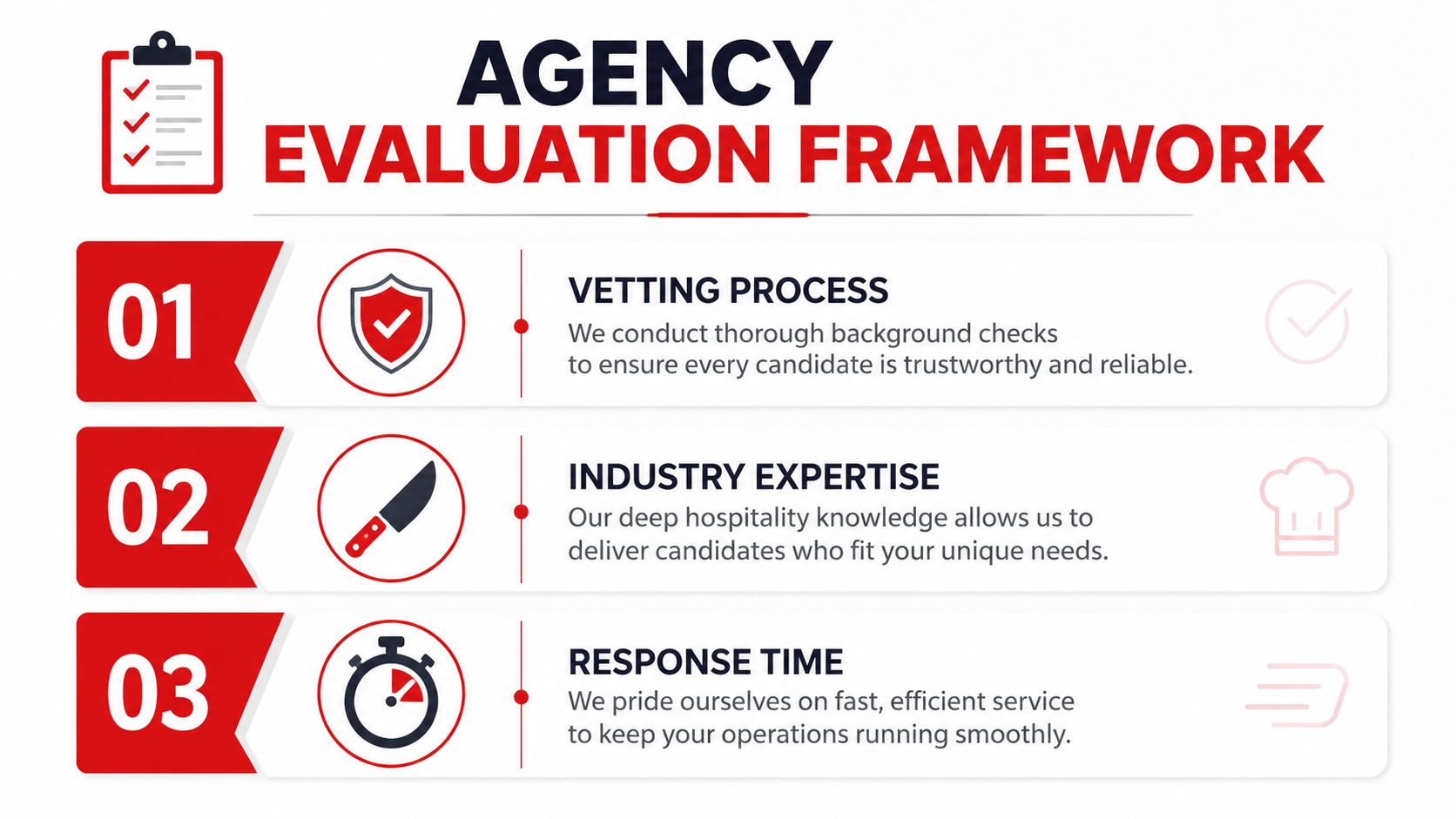
The easiest way to do that is to ask direct questions and insist on direct answers. High-performing agencies target a 96% fill rate, a 4.2-hour response SLA, and carry £10m in public liability insurance, while rushed vetting contributes to 22% of placements failing, with 12% linked to right-to-work issues, adding £1,200 per incident according to employment placement agency benchmark data from IBISWorld.
Ask about vetting first
Weak agencies are exposed in these situations.
If they can't describe their right-to-work process clearly, that's a red flag. If they gloss over references, background checks, or how they verify kitchen experience, assume the burden will land on your head chef and management team.
Use questions like these:
- Right-to-work checks: How do you verify eligibility before a chef is sent?
- Background screening: What documents and references do you require?
- Kitchen assessment: How do you decide whether someone is suitable for a particular role?
- Availability control: How do you confirm the chef is available and committed to the shift?
An agency that rushes this stage may still fill a vacancy. It won't necessarily protect your operation.
Test their understanding of hospitality
A recruiter doesn't need to be a Michelin-level chef. They do need to understand enough to match accurately.
If you ask for a breakfast chef, a banqueting chef, or a strong sous and they respond with generic language, keep digging. Ask how they differentiate one level from another. Ask what they'd want to know about your menu and service volume before recommending someone.
Operator check: If the agency spends more time talking about “database size” than kitchen fit, they're selling access, not judgement.
Demand service standards, not promises
Hospitality managers hear the same lines all the time. “We'll sort it.” “We've got someone.” “No problem.”
Those phrases mean nothing unless there's process behind them.
A useful evaluation table looks like this:
| Area | What to ask | What a strong answer sounds like |
|---|---|---|
| Response speed | How quickly do you respond to an urgent request? | Clear timescales and an escalation process |
| Fill capability | What happens if your first chef drops out? | Immediate replacement procedure |
| Insurance | What cover do you hold? | Specific confirmation of public liability cover |
| Shift follow-up | Do you check in after placement? | Post-shift feedback and issue resolution |
| Replacement policy | If the chef is wrong for the role, what then? | A defined replacement commitment |
Look at the agency's operating model
You're not just buying labour. You're buying judgement, speed, and accountability.
Chef-run businesses often perform better in this category because they understand how sections work, what standards matter, and why one bad placement can destabilise a full brigade. That's especially important if you need support across more than one service type, including pubs, boutique hotels, restaurants, private households, yachts, or villas.
Don't ask whether the agency is friendly. Ask whether it's dependable under pressure.
Decoding Pricing and Contracts to Avoid Hidden Fees
A cheap-looking rate can be the most expensive option on your rota.
One of the biggest frustrations in the Manchester market is that agencies often don't explain pricing properly. A review of agency listings highlighted by Manchester careers agency resources from the University of Manchester found little visible upfront detail on fee structures, replacement guarantees, or no-hidden-fee positioning. For hospitality businesses working to tight margins, that makes budgeting harder than it needs to be.

What to pin down before you book
Don't approve a shift until you know exactly what the invoice will include.
At minimum, ask for written clarity on:
- Hourly charge structure: What are you paying for the chef's time, and what sits inside that rate?
- Holiday pay and statutory costs: Are these already built in, or added later?
- Minimum shift terms: Is there a minimum booking period or call-out rule?
- Cancellation terms: What happens if trade drops or the chef is no longer required?
- Transfer and temp-to-perm clauses: What fee applies if you want to hire the chef permanently?
These aren't legal niceties. They affect margin.
Compare pricing models properly
Not every contract suits every operation.
A single-site pub with occasional gaps may prefer straightforward ad hoc hourly cover. A hotel group or multi-site operator may be better served by a monthly plan that gives priority access, replacement support, and a clearer budgeting model. If your need is regular, ask whether the agency can support scaling rather than quoting every shift as a one-off emergency.
You should also look at the wider employment picture. A useful benchmark when comparing agency spend against direct hiring costs is the broader cost of employing hospitality staff.
Clear pricing is part of quality control. If an agency is vague about costs before the shift, expect disputes after the shift.
The contract should protect service, not just the agency
Watch for contracts written entirely around agency protection.
You want balanced terms. That means clear invoicing, a practical replacement route if a chef is unsuitable, and no ambiguity about what happens if standards aren't met. If the contract is hard to understand, ask for it in plain English. If the agency won't explain it, don't use them for a critical kitchen role.
The best pricing structure is the one your operations team can forecast and your finance team can trust.
Your Solution to Manchester Chef Staffing Starts Here
If you're weighing up temping agencies in manchester, the decision should come down to three things. Can they send the right chef quickly, can they vet properly, and can they price transparently.
Everything else is noise.
For hospitality businesses, the safest route is to work with a chef-specific staffing partner that understands section fit, service pressure, compliance, and the commercial reality of keeping a kitchen open. That applies whether you need short-notice relief, short-term holiday cover, seasonal support, permanent chef recruitment, or specialist placements such as yacht chefs and villa chefs.
Relief Chefs UK has operated nationwide since 2013 and works across independent pubs, restaurants, boutique hotels, private households, and wider hospitality businesses. The model is straightforward: chef-led knowledge, vetted candidates, temporary and permanent support, and practical help when the rota goes wrong.
If your kitchen is exposed, don't wait for the next sickness call to sort out your supply line. Get your agency shortlist in place now, test it properly, and only keep partners who can protect service.
If you need reliable chef cover or recruitment support, contact Relief Chefs UK. Whether you need relief chefs, temporary chefs, permanent placements, or specialist hospitality staffing support, the team can help you secure vetted kitchen professionals quickly and keep service moving.
Call the team.
Office 01392 715474 · info@reliefchefs.co.uk