
Working for Temp Agency: UK Chef’s Guide 2026
27 May 2026

It usually starts the same way. A chef calls because they're done with the broken rotas, the unpaid extra hours, or the promise that “things will calm down next month”. Or a venue calls because the sous has walked, the CDP is off sick, and Saturday service is already half-booked.
That's where agency work gets misunderstood.
A lot of people still talk about temping as if it's a stopgap. In a professional kitchen, it isn't. It's a working model. For chefs, it can mean control over your diary, better exposure to different standards, and a cleaner line between your graft and your pay. For operators, it's a way to keep the pass moving when permanent recruitment can't move fast enough.
What Working for a Temp Agency Really Means for a Chef
Working for a temp agency as a chef means you're not just filling shifts. You're solving urgent operational problems for kitchens that can't afford a weak service.

One week that might be covering a sick head chef in Bristol. The next, it could be supporting a coastal hotel in Devon through a busy run of functions, or stepping into a country house operation in Berkshire where the brigade is short and standards still need holding. Good agency chefs learn to walk into unfamiliar kitchens, read the setup quickly, and get productive without drama.
That's why the old idea that temp work is somehow second tier doesn't hold up. The UK labour market already relies on temporary work at scale. The Office for National Statistics reported 1.58 million temporary workers in the UK from October to December 2024, representing about 5.0% of all employees, which shows temporary staffing is an established part of the employment system rather than a niche option for a small minority of workers, as referenced in this ONS-based labour market note.
You are not a spare pair of hands
The chefs who do well in agency work aren't passengers. They're usually the ones who can do the following well:
- Stabilise a section fast when prep is behind and service is coming.
- Protect standards when a venue is trying to trade through shortages.
- Slot into different teams without bringing ego into someone else's kitchen.
- Handle pressure calmly whether the site is a pub, boutique hotel, restaurant, yacht, or private villa.
Agency chefs aren't there to be carried. They're there because the client needs someone who can land, organise, cook, and keep the kitchen steady.
There's also a career point that younger chefs often miss. Temping gives you a wider view of the trade. You see what good operations look like, what poor ones cost, and which employers you'd want to work for long term.
For chefs who want flexibility without leaving the industry, that matters. For businesses facing chef shortages, short notice sickness, and seasonal pressure, it matters even more.
The Business of Temping How Chef Agencies Work
The mechanics are simple once you strip away the jargon. There are three parties involved. The chef, the agency, and the client venue.
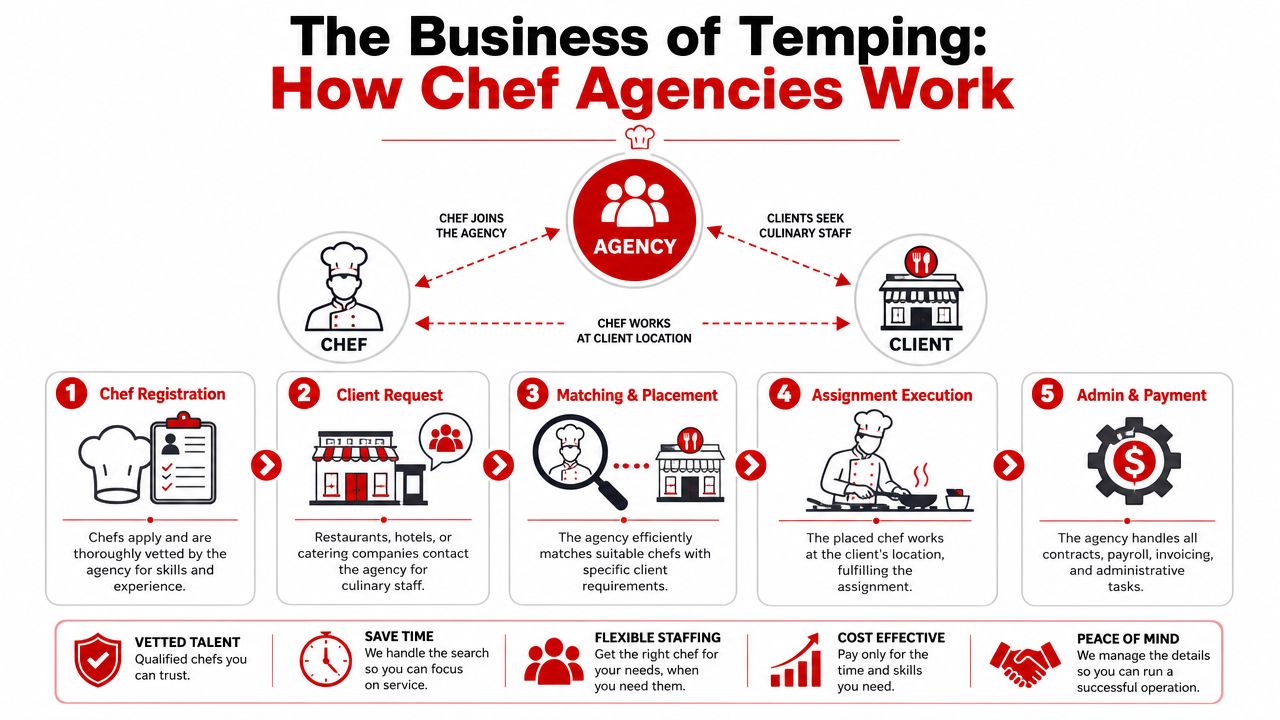
The chef does the work on site. The client needs cover. The agency sits in the middle and handles the matching, the checks, the admin, and the payment process. If that middle part is weak, everything becomes harder than it needs to be.
ONS data show temporary employees accounted for about 6% of UK employment in 2024, which is why many operators use agency cover as a short-cycle capacity buffer to deal with spikes in demand, sickness absence, and rota gaps without changing permanent headcount, as discussed in this temporary employment overview.
What the workflow looks like in practice
A proper chef agency process usually runs like this:
Registration and vetting
You send your CV, work history, references, documents, and right-to-work proof. A decent agency won't skip this. If they're casual at this stage, expect problems later.Availability and preferences
You tell them where you can travel, what level you work at, which kitchens suit you, and when you're free. Be honest. Saying yes to work you can't do is the fastest way to get dropped.Client brief and match
The venue says what it needs. That might be a breakfast chef for a hotel in Windsor, a strong all-rounder for a pub in Dorset, or senior cover for a multi-site operation in Reading.Booking confirmation
You get the shift details, rate, location, start time, dress code, and who you report to. If any of that is vague, ask before you leave home.Timesheets and pay
You work the assignment, the hours are signed off, and the agency processes payroll.
Why operators use agencies at all
Hospitality businesses don't bring in temps for the fun of it. They do it because service doesn't pause while they recruit.
Common triggers include:
- Short-notice sickness when a key chef drops out on a Friday.
- Seasonal surges in holiday areas such as Devon, Dorset, and Wales.
- Chef shortages where permanent ads produce weak applicants or none at all.
- Kitchen resets after resignations, menu changes, or a new opening period.
Operational reality: Most clients aren't looking for a long speech. They want to know whether you can arrive on time, work cleanly, and hold the section.
If you're looking at agencies from the chef side, it helps to understand that clients are buying risk reduction as much as labour. That's why specialist firms tend to outperform general recruiters in hospitality. If you want to see what a chef-specific route looks like, employment agencies for chefs gives a useful example of a sector-focused model.
Your Money A Guide to Chef Agency Pay and Contracts
The money side of working for a temp agency needs to be clear before you accept regular bookings. Not after.
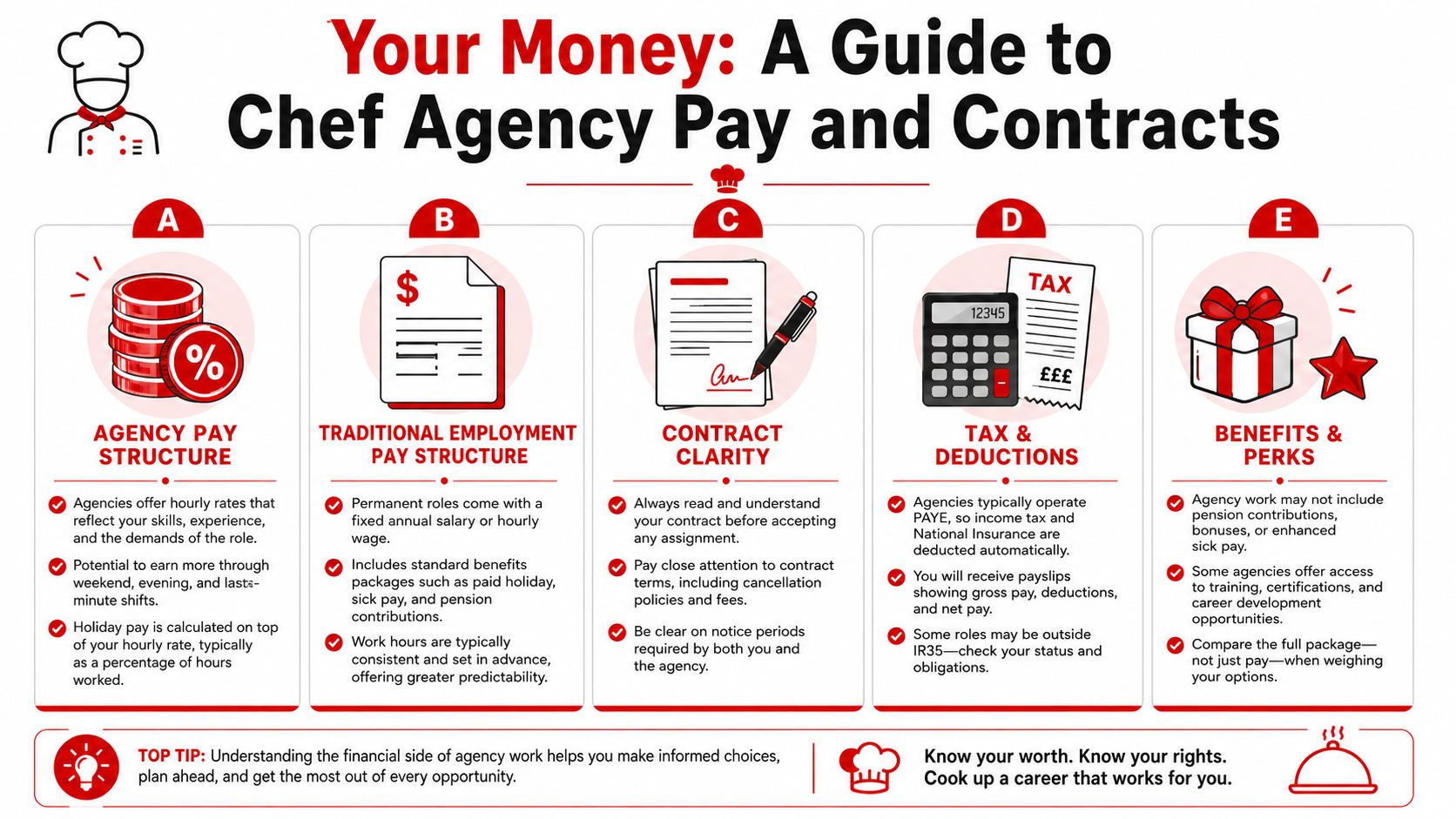
Chefs usually ask the same practical questions. How am I paid. What happens with holiday pay. Do I get paid between assignments. What changes if I stay in the same place for a longer stretch. Those are the right questions, because the weak point in temp work isn't usually the shift itself. It's income consistency and contract understanding.
A key concern for temp workers is income volatility, and one of the most important UK-specific issues is that rights to equal pay can change after 12 weeks in the same role under the Agency Workers Regulations framework, which is especially relevant on longer placements, as outlined in this guide to working for a temp agency.
PAYE, Ltd company, and what chefs need to ask
Most chefs will be paid through PAYE by the agency, or they'll work through another arrangement depending on the agency's model and the engagement terms. What matters is not sounding clever about tax status. What matters is knowing what lands in your account, what deductions are made, and who is responsible for what paperwork.
Ask these questions before your first shift:
- What is the agreed rate and is it the same for every site?
- How is holiday pay handled and when can you claim it?
- What happens if a shift is cancelled after you've kept the day free?
- When are timesheets due and what delays payment?
- Are pension contributions handled through payroll if you are on PAYE?
If an agency dances around those questions, that's a warning sign.
A lot of chefs also make the mistake of budgeting as if agency income is the same as salaried income. It isn't. You are paid for assignments worked. Between assignments, you may not be paid. That means your weekly cash flow needs to be managed like a professional, not guessed at after a busy month.
The 12-week point matters more than many chefs realise
If you stay in the same role long enough, your rights can change under the Agency Workers Regulations. That's not abstract legal talk. It can affect pay parity and conditions.
Practical rule: If you're on a long booking, keep your own record of start dates, sites, shifts, and role details. Don't assume everyone else is tracking it perfectly.
Use a calculator and track what you're earning across different patterns of work. If you want a quick way to sense-check take-home expectations, the chef salary calculator is a practical starting point.
Contract clarity beats vague promises
A good agency agreement should make these points plain:
| Pay issue | What to check |
|---|---|
| Holiday pay | How it accrues, how it is shown, and how it is paid |
| Assignment gaps | Whether there is any payment between bookings |
| Cancellation terms | What happens if the client pulls the shift late |
| Timesheets | Who signs them and when they must be submitted |
| Longer placements | How the agency tracks AWR qualifying periods |
The chefs who last in temp work aren't always the ones with the loudest CVs. They're usually the ones who understand contracts, protect their cash flow, and don't confuse a good run of shifts with guaranteed income.
The Pros and Cons of Agency Chef Life
Agency chef life suits some people brilliantly. Others hate it after a month.
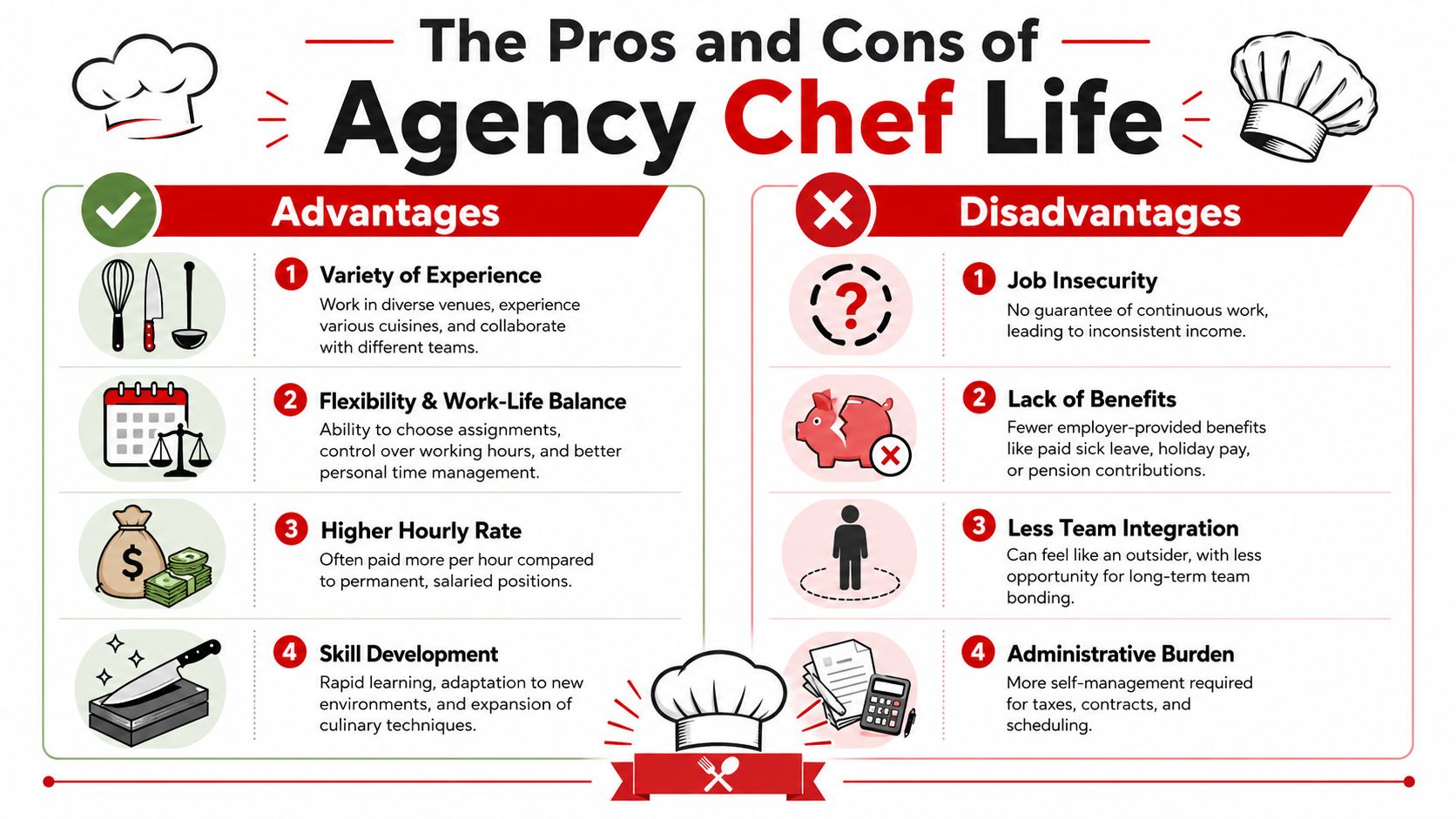
The upside is freedom. The downside is that freedom comes with responsibility. If you need the same team, the same routine, and the same wage every month, permanent work may suit you better. If you like variety, can adapt fast, and don't need hand-holding, temping can work very well.
Where agency work helps
The strongest benefit is range. You can work in a city-centre restaurant one week, a country pub in Berkshire the next, then move into hotel banqueting, private households, yacht chefs, or villa chefs if your level and conduct are right.
That does a few useful things at once:
- Builds speed because different kitchens force you to adapt.
- Sharpens judgement because you see different food standards and management styles.
- Expands contacts with owners, GMs, head chefs, and operations teams.
- Creates options if you want temp work now and a permanent move later.
Many chefs ask whether temp work can still lead to something stable. In practice, assignments through a reputable agency often do convert into permanent roles because both sides get a proper look at each other before committing, which is one reason temp-to-perm remains attractive despite wider uncertainty in the labour market, as discussed in this overview of temp agency work.
Here's a short video that touches on the experience of temporary work from the worker side.
Where agency work catches chefs out
The weak side of temping is rarely cooking ability. It's lifestyle management.
Common pressure points look like this:
- No guaranteed weekly pattern if bookings fluctuate.
- Constant adaptation to new kit, new teams, and different prep systems.
- Less attachment to one brigade which can feel isolating for some chefs.
- More self-management around travel, invoicing details, and diary control.
The chefs who struggle most with agency work are often good cooks who are poor organisers.
There's also the emotional side. Some kitchens welcome relief chefs properly. Others treat them like an inconvenience until service starts and they realise they'd be in trouble without cover. You need a thick skin, but you also need standards. If a site is unsafe, chaotic, or dishonest about the brief, remember that flexibility cuts both ways.
How to Choose an Agency and Maximise Your Bookings
Not all agencies are equal. Some understand kitchens. Some understand paperwork. You want one that can do both.
The simplest test is this. Does the agency speak clearly about role fit, pay, location, compliance, timesheets, and client expectations, or do they just chase bodies to fill shifts? If it's the second one, you'll feel it quickly.
A key sign of a reputable agency is its focus on compliance. The Agency Workers Regulations 2010 require equal treatment after a qualifying period, so an agency that properly manages right-to-work checks, pay parity, and working-time records is protecting both chefs and clients from avoidable risk, as noted in this agency worker compliance discussion.
What to look for before you sign up
Use this as a practical filter:
Sector specialism
A chef agency should know the difference between a banqueting brief, a gastro pub brief, and a high-end private household brief. If they can't qualify the job properly, they can't place you properly.Clear communication
You should know the site, rate, level, shift pattern, and reporting line before accepting. Vague briefs create bad bookings.Proper vetting
Good agencies check documents, references, and work history carefully. That protects you as much as the client.Realistic matching
A solid agency won't send a breakfast chef into a role that needs strong fresh-food volume service, or send a junior chef to run a pass alone.
One option in this space is agencies for temporary work, where the service is built around temporary hospitality cover rather than generic recruitment.
How to become the chef who gets called first
This part is blunt. Reliability beats flair in agency work.
If you want the better bookings, do these things consistently:
Answer quickly
Agencies fill urgent work fast. If you always reply two hours later, someone else gets the shift.Turn up early
Not exactly on time. Early. Enough time to get changed, meet the head chef, and understand the section.Travel Realistically
Don't say yes to a site in Wales or Slough if you're already half-resisting the journey. Late arrivals kill trust.Leave the ego outside
You're there to support the kitchen, not to redesign it in one shift.Keep your availability updated
The best-booked chefs make it easy for the agency to place them.
If a client asks for you back, your value goes up. If a client asks never to see you again, word travels just as fast.
Chefs who consistently handle pressure, communicate well, and avoid last-minute dropouts tend to get offered the stronger assignments. That can include longer placements, better sites, and more specialist work.
Common Questions from Chefs About Agency Work
The questions below come up constantly, especially from chefs moving out of permanent jobs for the first time.
Straight answers that matter on the ground
| Question | Answer |
|---|---|
| Do I get paid between assignments? | Usually, agency chefs are paid for work completed on assignment. If you are between bookings, don't assume income continues unless your agreement says so clearly. |
| Who pays me, the venue or the agency? | In most agency arrangements, the agency pays you and the client pays the agency. That's why timesheets, rates, and payroll cut-offs need to be clear. |
| What should I take to a first shift? | Chef whites if required, safety shoes, knives if requested, identification, and the booking details on your phone. Also take a notebook. Every kitchen runs differently. |
| Can I work with more than one agency? | You often can, but manage your diary carefully. Double-booking yourself is one of the quickest ways to lose trust. |
| What happens if a client cancels me? | It depends on the agreement. Ask about cancellation terms before accepting regular work. Never assume late cancellation will be compensated. |
| How does holiday pay work? | It depends on the arrangement and payroll setup. Ask how it accrues, where it appears on payslips, and how it is requested or paid out. |
| What if I am on a long placement? | Keep your own records of dates, shifts, and role details. Longer assignments can affect your rights, so don't rely only on memory. |
| Can agency work lead to a permanent role? | Yes, it often can. A booking lets both you and the venue assess fit before making a longer-term decision. |
| Do I need to adapt my CV for agency work? | Yes. Put your level, sections covered, cuisines handled, volume experience, and whether you've worked relief before. Agencies need quick clarity. |
| What makes a client ask for a chef back? | Punctuality, clean service, calm attitude, strong prep, and the ability to fit in without creating extra management work. |
The questions chefs should ask but often don't
A lot of problems can be avoided if you ask better questions on day one.
Ask about:
- Shift expectations so you know whether you're covering prep, service, or both.
- Accommodation or travel realities if the job is outside your normal patch.
- Kitchen setup including fresh food, banqueting, pub volume, or fine dining expectations.
- Who signs hours off because pay delays often start there.
Red flags worth noticing early
Some warning signs are small but telling:
- The brief keeps changing after you've agreed.
- Nobody can explain pay clearly.
- The site level is misrepresented.
- You're pushed to accept work without enough detail.
- Communication goes quiet once the shift is done and you're chasing payment.
A good booking feels organised before you arrive. A bad booking usually shows signs long before service starts.
If you're new to working for a temp agency, treat your first few assignments like a trial period in both directions. The client is assessing you, but you should be assessing the agency as well.
Your Next Step Towards a Flexible Chef Career
Agency chef work isn't a shortcut and it isn't a fallback. Done properly, it's a commercial way to work. You get flexibility, broader experience, and access to kitchens you might never reach through standard job adverts. In return, you need discipline, reliability, and a clear grip on your money.
For chefs, the decision comes down to fit. If you like variety, can settle into a new brigade fast, and want more control over when and where you work, this route makes sense. If you need certainty every week, permanent employment may still be the better option.
For hospitality businesses, the equation is just as practical. When a chef goes sick in Bristol, a hotel in Devon hits a busy patch, or a restaurant group in Windsor needs to steady multiple sites, the problem isn't theory. It's service. Temporary chefs, relief chefs, and permanent recruitment support all have their place when kitchens need stability quickly.
Relief Chefs UK has been established since 2013 and works across the UK with relief chefs, temporary chefs, permanent chef recruitment, yacht chefs, villa chefs, and broader hospitality staffing support. The difference is simple. The business is run by chefs, so the conversation stays grounded in what kitchens actually need.
If you're a chef looking for more flexibility, better-fit bookings, or a route into stronger kitchens, contact Relief Chefs UK. If you're a hospitality operator dealing with short notice sickness, seasonal demand, chef shortages, or a fragile rota, get in touch to discuss temporary cover or permanent recruitment support.
Call the team.
Office 01392 715474 · info@reliefchefs.co.uk