
The Job Spa Manager Role: A UK Hospitality Hiring Guide
26 May 2026
You've seen the pattern. The spa looks impressive on the website, the treatment menu is polished, the robes are folded properly, but revenue is flat, retail is weak, therapist rotas are chaotic, and one absence throws the whole day off. In a hotel or leisure business, that usually isn't a facilities problem. It's a leadership problem.
The job Spa Manager role gets misunderstood because too many owners treat it as a senior therapist post with admin attached. It isn't. In practice, it sits much closer to an operations manager role with direct influence over revenue, labour control, guest retention, compliance, and brand standards. If you hire lightly, you pay for it twice. First in underperformance, then in churn.
For hospitality leaders dealing with labour shortages, short-notice sickness, weekend pressure, and rising wage expectations, this role needs tighter thinking. A strong Spa Manager protects standards and grows income. A weak one creates silent losses through missed bookings, poor scheduling, stock waste, inconsistent service, and unhappy teams.
Why the Spa Manager Is Your Most Commercial Role
A spa can look busy and still underperform. Full treatment rooms don't always mean a healthy department. If the booking mix is wrong, retail conversion is weak, no one is driving repeat visits, and labour is scheduled badly, the spa becomes an expensive amenity instead of a reliable profit centre.
That's why the Spa Manager should be viewed as one of your most commercial hires, not merely the person who opens the spa, checks the rota, and deals with guest complaints.
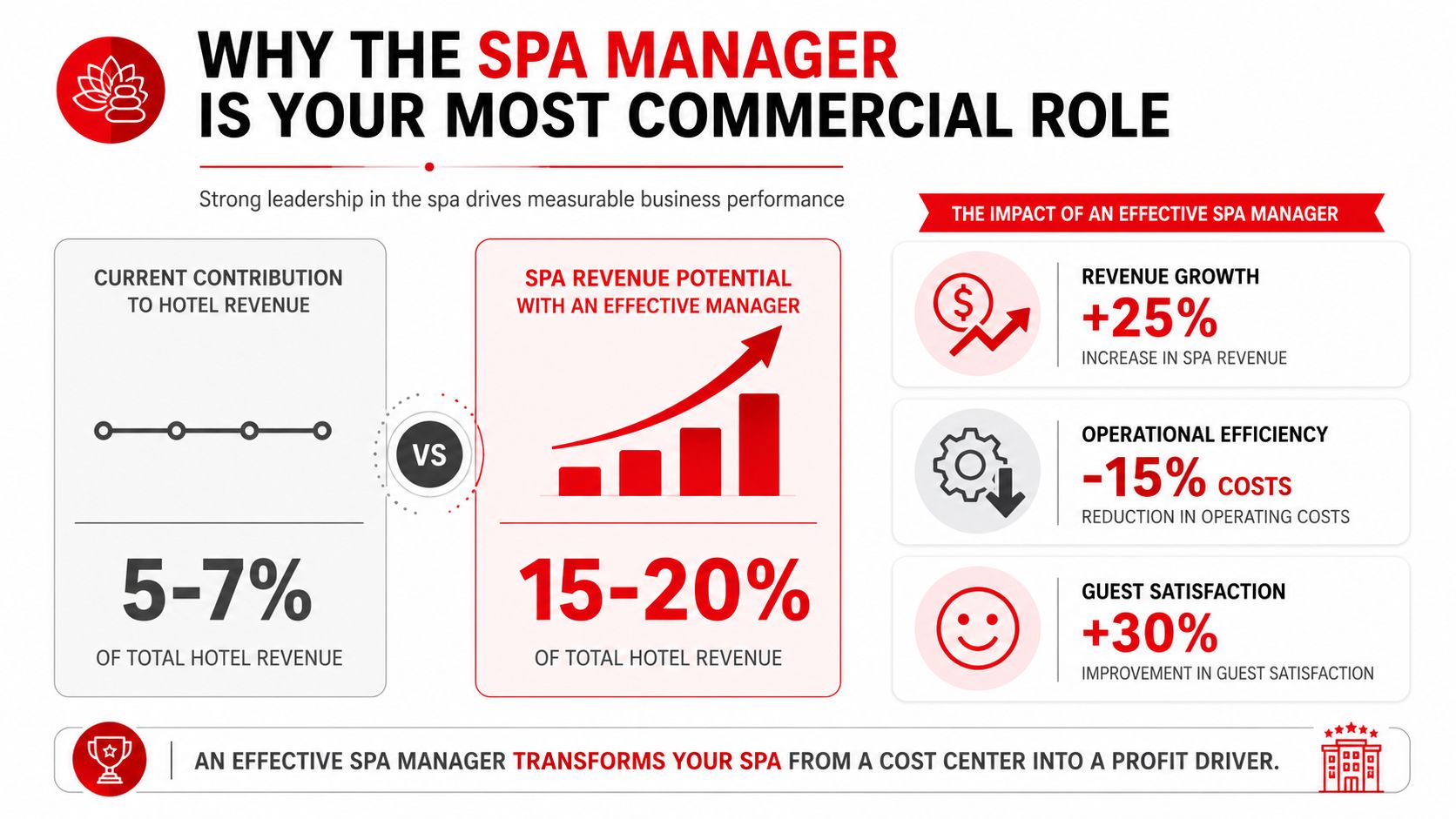
The wider market is large enough to justify that mindset. The British Beauty Council's 2023 report estimated the UK beauty and personal care sector contributed £30.4 billion in GVA in 2022, supported 550,000 jobs, and saw consumers spend £27.2 billion in the category, which shows the scale of the market spa operators are trading inside, as summarised in this UK spa manager job market overview.
Commercial control, not cosmetic oversight
A serious Spa Manager watches the numbers behind the ambience. They know which treatments generate the best return, which shift patterns create dead hours, which therapists are strongest at rebooking, and where stock margins are leaking away.
In a hotel setting, they also need to work across departments. If reception sells spa packages badly, housekeeping turns rooms late, or food and beverage teams don't understand wellness guests, the spa feels disjointed. The manager has to join those dots.
Practical rule: If your Spa Manager can't explain last week's revenue performance, labour pressure, no-shows, and repeat booking trends in plain English, they're supervising a department, not managing a business.
Where owners usually get it wrong
The common mistake is promoting the best therapist into management without checking whether they can lead commercially. Great treatment skill doesn't automatically translate into budgeting, forecasting, rota design, or service recovery.
Another mistake is measuring the role too narrowly. Owners often judge the spa on cleanliness and guest comments alone. Those matter, but they don't tell you whether the department is financially healthy or operationally resilient.
For any hospitality business dealing with staff instability, this role deserves the same rigour you'd apply to a Head Chef, Restaurant Manager, or Rooms Division leader.
The Three Pillars of a Spa Manager's Responsibilities
The role is broad by design. A Spa Manager typically covers daily operations, staffing, scheduling, inventory control, budgeting, health-and-safety compliance, marketing, customer retention, and financial performance, which makes it a true management post rather than a front-line service role, as outlined in this spa manager responsibilities guide.
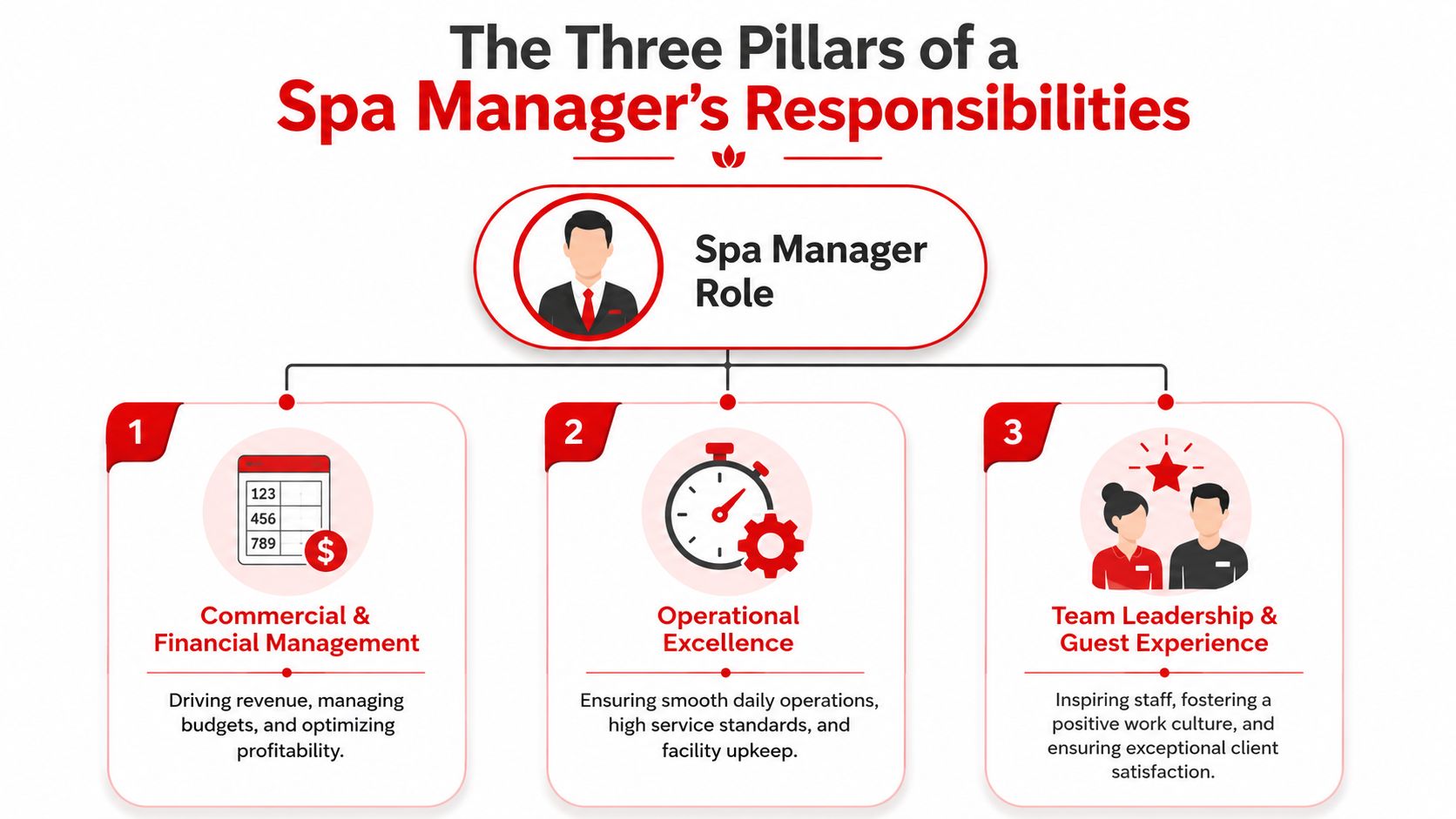
Commercial and financial management
This is the part many businesses underweight. The Spa Manager should own the department's commercial rhythm.
That means checking treatment performance, spotting gaps in therapist utilisation, controlling product spend, and understanding whether promotional activity is bringing in profitable business or just discounted demand.
A normal working week often includes:
- Reviewing revenue mix by treatment type, package, membership, and retail.
- Checking labour against bookings so the team isn't overstaffed midweek and stretched on peak days.
- Managing stock discipline so premium products aren't over-ordered, expired, or disappearing through weak controls.
- Supporting repeat business through rebooking prompts, membership follow-up, and local marketing.
A good Spa Manager doesn't just ask, “Was it busy?” They ask, “Was it productive?”
After the morning checks, this kind of operational reality is worth seeing in action:
Operational excellence
This pillar decides whether the guest experience feels effortless or chaotic. Spas fail operationally in small ways first. Late starts. Missing products. Untidy back-of-house areas. Incomplete checks. Treatment rooms not turned around fast enough.
The manager's job is to stop those small failures becoming visible to paying guests.
Typical responsibilities include:
| Operational area | What strong management looks like |
|---|---|
| Opening and closing | Checks are completed, rooms are ready, standards are consistent |
| Scheduling | Rotas match demand, breaks are sensible, cover is planned |
| Facility management | Saunas, pools, treatment spaces, and guest areas are monitored properly |
| Compliance | Hygiene, health and safety, and record keeping are routine, not reactive |
Team leadership and guest experience
A spa team can become brittle quickly. One resignation, one sickness call, or one interpersonal issue can knock service quality off course for days.
A capable manager recruits carefully, sets standards clearly, coaches weaker staff early, and deals with friction before it reaches the guest. They also know that guest recovery matters as much as guest delivery. If a treatment starts late or a room isn't ready, the response has to be calm, commercial, and fast.
The best Spa Managers don't spend all day firefighting. They build systems that reduce the number of fires.
The Essential Skills That Separate Good from Great
A decent Spa Manager keeps the department running. A strong one improves it. The difference usually comes down to skill balance. Businesses often hire for spa background alone, then wonder why forecasting is poor, rotas are inefficient, or standards wobble under pressure.
The role needs both hard skills and soft skills. If either side is weak, performance stalls.
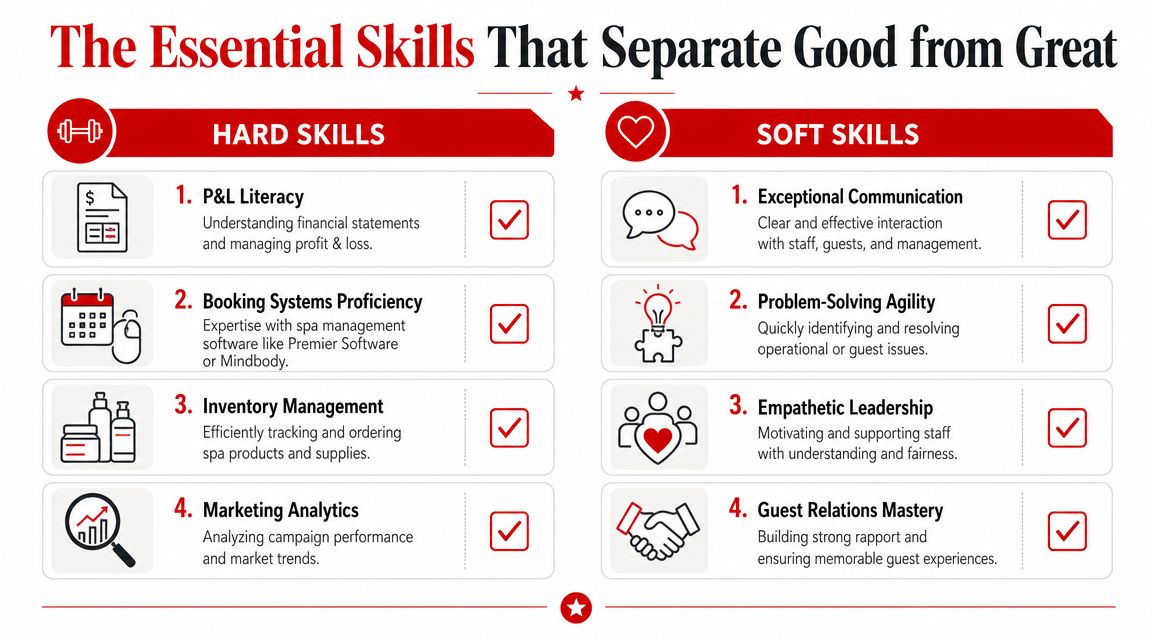
Hard skills you can test
You should be able to verify these directly through a CV, systems discussion, or interview task.
- P and L literacy. They don't need to be a finance director, but they do need to understand budgets, wage pressure, margin, and where costs are moving.
- Booking system fluency. Ask which systems they've used and how they use reporting, availability control, and booking rules. Generic answers usually mean shallow ownership.
- Rota design. This is a core management skill in hospitality. The candidate should understand peak trading periods, therapist utilisation, annual leave planning, and what to do when someone calls in sick at short notice.
- Stock control. Better managers know how to order sensibly, protect cash, and stop operational waste.
- Marketing awareness. They should understand promotions, local partnerships, package selling, and rebooking discipline.
In a Windsor hotel spa, for example, commercial pressure often comes from premium guest expectations and strong local competition. In Dorset or Devon, the pressure may be more seasonal, with heavier swings between quiet periods and peak leisure demand. The skills are the same. The operating context changes.
Soft skills that protect the business
Hard skills keep the department controlled. Soft skills keep it stable.
A Spa Manager spends large parts of the week handling emotion. Staff frustration, late arrivals, complaints, missed expectations, rota disputes, and pressure from senior management all land on this desk.
Look for these signs:
- Composure under pressure. They don't become erratic when the day goes wrong.
- Service recovery ability. They know how to listen, respond, and retain trust when a guest is unhappy.
- Credible leadership. The team follows them because they're clear and fair, not because they raise their voice.
- Commercial communication. They can explain operational issues in business terms to a GM or owner.
- Coaching instinct. They improve average performers instead of relying only on their strongest staff.
What great looks like in practice
The best candidates usually sound specific. They talk about decisions, not vague intentions. They can explain how they changed a rota, handled a poor review, improved retail conversations at reception, or tightened standards after a busy weekend.
A polished personality isn't enough. In this role, calm leadership and commercial grip have to show up in the same person.
If you're hiring in Bristol, Berkshire, Reading, Slough, or Wales, this matters even more. Labour pools differ, but every market punishes weak management. Standards slip faster when recruitment is already difficult.
UK Spa Manager Salary Benchmarks and Market Outlook
Employers need the unvarnished version. The role carries real responsibility, but pay doesn't always match what candidates assume.
For UK health and beauty service managers and proprietors, median annual pay is around £30,000, with lower quartiles around £23,000 to £26,000. Regional pay differences matter as well. In April 2024, London's median weekly pay was £789, compared with £660 across the UK, which helps explain why premium London properties often have to pay more to secure strong management talent, as summarised in this UK salary guide for spa manager roles.
That gap changes hiring strategy. A hotel in Berkshire may be competing with London wage expectations without being able to offer London upside. A coastal operation in Devon or Dorset may find candidates interested in lifestyle, but still lose them if workload is heavy and progression is unclear.
A practical salary guide
The table below is a market-positioning guide, not a statement of official pay bands. It uses the verified salary context above and reflects how many operators think about the role by region and seniority.
| Region | Junior/Assistant Manager | Experienced Manager | Senior/Luxury Hotel Manager |
|---|---|---|---|
| London | Above lower quartile expectations is often necessary to compete | Around or above median expectations is commonly expected | Premium packages are often required |
| Berkshire, Windsor, Reading, Slough | Competitive with strong benefits usually matters | Often needs to reflect proximity to London | Luxury properties may need London-aware packages |
| Bristol and South West | Mid-market packages can attract good operators if work-life balance is credible | Stability and autonomy can strengthen offers | High-end sites still need a strong total package |
| Devon, Dorset, Wales | Lifestyle can support attraction | Seasonal pressure should be reflected in the package | Destination properties need strong retention thinking |
Salary is only part of the offer
Good candidates look at the full deal. They want to know who they report to, how many late and weekend shifts are expected, whether they have authority to manage the team properly, and whether progression is realistic.
If you're benchmarking pay, this hospitality salary calculator is a useful starting point for wider market thinking. It won't solve the spa brief on its own, but it helps frame how compensation sits inside your broader staffing model.
What doesn't work is offering average pay for a role that carries operational ownership, guest accountability, and constant availability. That's how businesses end up rehiring every year.
How to Write a Job Advert That Attracts Leaders
Most spa job adverts read like duty lists copied from old HR templates. They attract applicants who are looking for the next title, not people ready to run a department.
The advert needs to signal ownership, standards, and commercial accountability. If you only describe tasks, you'll get task-focused candidates. If you describe outcomes, decision-making authority, and business expectations, you'll attract stronger operators.
What the advert should do
A good advert should answer four questions quickly:
- What does this person own
- What sort of environment are they walking into
- How much authority will they have
- Why is the role worth taking
For reference, the same principle applies across hospitality hiring. A sharper role profile nearly always improves applicant quality. Even outside spa recruitment, this barman job description example shows how much clearer role framing improves relevance.
A practical Spa Manager job advert template
Job title
Spa Manager
Location
[Hotel or site location]
Role summary
We're looking for a Spa Manager to lead daily operations, protect service standards, and drive commercial performance across our spa business. This is a hands-on management role with responsibility for team leadership, guest experience, scheduling, retail performance, compliance, and financial control.
What you'll own
- Department performance through daily oversight of bookings, therapist utilisation, retail activity, and service delivery
- Team leadership including rotas, standards, coaching, recruitment support, and performance management
- Guest satisfaction through strong service recovery, attention to detail, and a consistent premium experience
- Commercial discipline across budgeting, stock control, cost awareness, and repeat business
- Operational compliance including hygiene, health and safety, and site procedures
What we're looking for
- Experience leading a spa, wellness, or guest-facing hospitality team
- Confidence with scheduling, reporting, and day-to-day operational control
- Strong communication with senior management, front-line staff, and guests
- A calm approach under pressure
- Evidence of improving standards, team performance, or commercial results
Working pattern
This role requires flexibility, including weekends, peak periods, and operational support when the business needs it.
Why join us
You'll have the chance to lead a visible part of the guest experience, shape team culture, and make a clear impact on departmental performance.
Why this wording works
“What you'll own” is stronger than “responsibilities” because it pushes the candidate to think like a leader. It also helps filter out applicants who want title progression without accountability.
“Evidence of improving standards, team performance, or commercial results” matters because it asks for proof, not personality. That one line often separates capable managers from polished talkers.
Don't oversell a difficult operation. If the spa has staffing gaps, ageing facilities, or weekend pressure, say so honestly and explain the support available.
The best adverts are clear about the challenge and clear about the backing behind the role.
Screening CVs and Nailing the Interview
Busy operators don't have time to interview five polished but unsuitable candidates. A tighter screening process saves weeks of wasted management time and reduces the chance of a costly mis-hire.
The first pass should focus on evidence, not titles. “Spa Manager” on a CV means very little on its own. In one site it may have meant full operational ownership. In another it may have been a front desk and rota role with limited authority.
What to look for on the CV
Use a shortlist filter that checks for operational depth.
- Commercial ownership. Look for signs they handled budgets, stock, retail, membership sales, or performance reporting.
- Team leadership. Check whether they led therapists only, or also reception, attendants, and cross-department coordination.
- Systems competence. Booking software, reporting tools, scheduling systems, and structured administration all matter.
- Stability. Frequent moves aren't always a deal-breaker, but you need to know whether they were leaving weak businesses or creating the instability.
- Context. A candidate from a boutique hotel spa may be stronger for your site than someone from a larger brand where functions were more divided.
If you recruit regularly across departments, this broader guide to recruitment in hospitality is useful for tightening your process beyond CV keywords.
Interview questions that reveal real ability
Ask behaviour-based questions that force specifics.
- Tell me about a week when you were short-staffed. How did you protect service without damaging the team?
- Describe a time when a guest complaint exposed an operational weakness. What did you change afterwards?
- Talk me through how you build a rota for a busy weekend. What factors do you weigh first?
- Give an example of a stock or cost issue you had to get under control. What action did you take?
- Tell me about a team member whose standards weren't good enough. How did you handle it?
- When bookings are strong but retail is weak, what do you review first?
- Describe a difficult conversation you had with a senior manager about unrealistic expectations or under-resourcing.
- What reports or KPIs do you check most often, and why?
What strong answers sound like
Good candidates answer with sequence. They explain the situation, their decision, what changed, and what they learned. Weak candidates stay vague, blame others, or answer in theory.
A practical test helps too. Give them a sample scenario: two therapist absences, a full Saturday diary, one VIP guest, and low stock on a key product line. Ask what they do in the first hour.
If a candidate can't prioritise under pressure in the interview, they won't suddenly become decisive on a live trading day.
Retaining Top Talent and Ensuring Business Stability
Losing a strong Spa Manager rarely hurts in one clean moment. The damage spreads through the operation. Team discipline softens, bookings get handled less sharply, guest complaints rise, and the department starts leaning on whoever is available rather than whoever is right.
Retention matters because these managers carry skills that transfer well across hospitality. In a volatile UK labour market, spa managers bring useful strength in operations, roster management, and customer experience, which makes them valuable well beyond the spa itself, as reflected in this discussion of spa manager career transferability.
What actually improves retention
Most employers know they need progression, but they leave it vague. That's not enough.
Use practical retention levers:
- Give a visible pathway into wider hotel operations, cluster wellness leadership, or broader guest experience management.
- Protect authority so the manager can effectively run the department instead of seeking approval for every staffing and standards decision.
- Invest in development through finance exposure, coaching, and cross-department learning.
- Manage workload realistically because constant weekend cover and endless availability will drive good people out.
Stability beats constant replacement
When the same manager stays in post, the team becomes easier to schedule, easier to coach, and easier to trust. Standards settle. Repeat guests recognise consistency. Senior leadership gets cleaner reporting and fewer surprises.
That's what business stability looks like in hospitality. It isn't glamorous. It's controlled delivery, fewer avoidable problems, and a manager who can carry pressure without passing chaos down the line.
Frequently Asked Questions
Does a Spa Manager need to be a qualified therapist
Not always. Therapy experience can help, but the role is first and foremost a management post. If the candidate can lead teams, control operations, manage the commercial side, and protect standards, they may be stronger than a therapist promoted too early.
What's the biggest hiring mistake with the job Spa Manager role
Hiring for personality and treatment background without properly testing commercial ability. Many weak hires interview well because they understand guest language, but fall apart on rotas, stock discipline, and team accountability.
Should this role sit under rooms, leisure, or general management
That depends on the business model, but the reporting line should give the manager access to someone who understands labour, revenue, and service standards. If the role sits too low in the structure, commercial decisions get delayed and accountability becomes blurred.
If your hotel, pub, restaurant, private household, yacht, or villa operation is dealing with staffing gaps, short-notice absence, seasonal pressure, or long-term hiring problems, Relief Chefs UK can help. Established in 2013, they support hospitality businesses nationwide with relief chefs, temporary chefs, permanent chef recruitment, yacht chefs, villa chefs, and practical hospitality staffing support that keeps service stable when the pressure is on. If you need dependable cover or want to strengthen your team properly, contact Relief Chefs UK and get the right people in place quickly.
Call the team.
Office 01392 715474 · info@reliefchefs.co.uk