
Agency Chefs Devon: Secure Your Kitchen Talent
14 April 2026

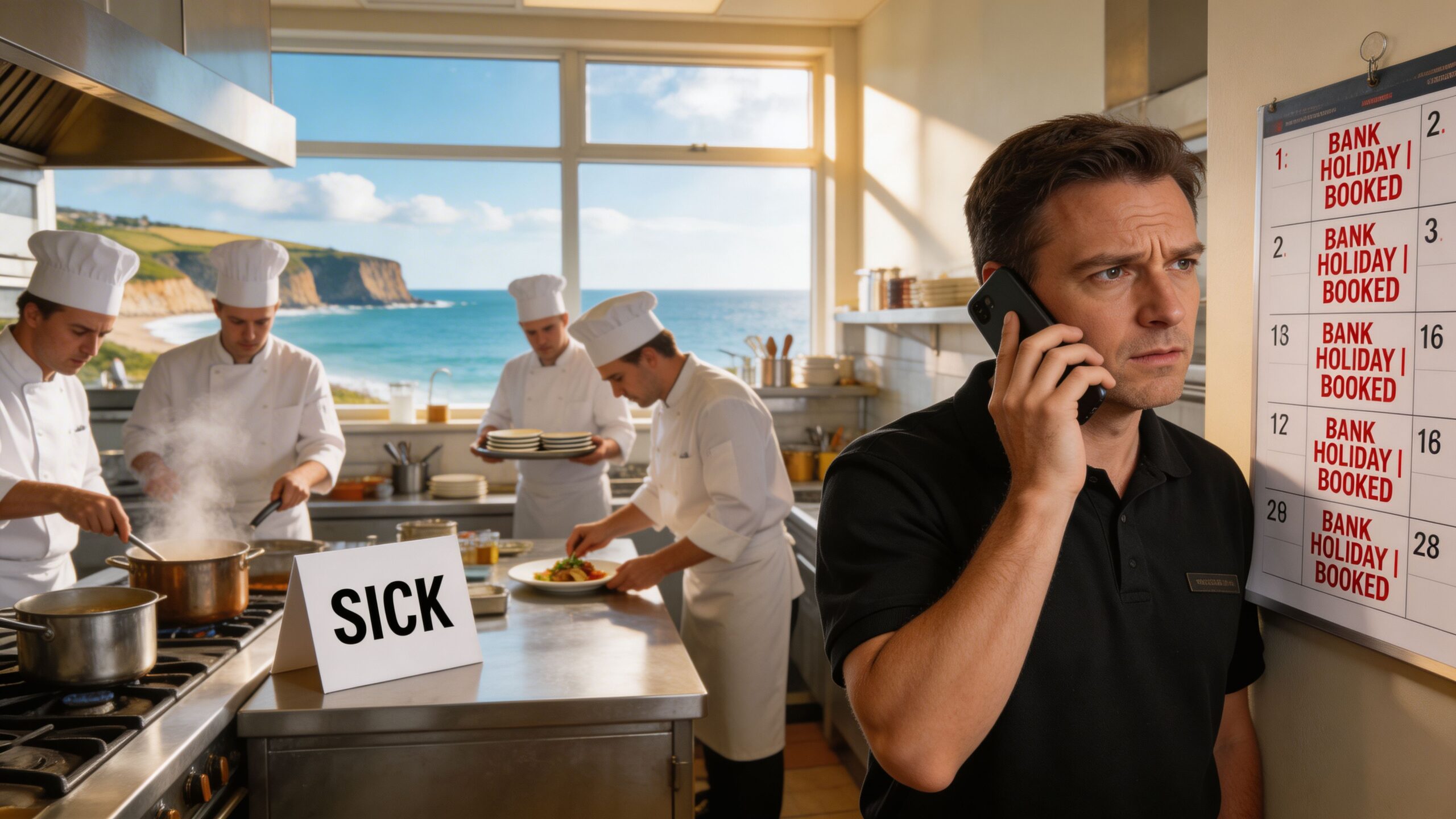
Bank holiday weekend. Full bookings. Functions stacked across lunch and dinner. Then your sous chef rings in sick at 8:15am, your KP is already covering another section, and your head chef is one more absence away from walking.
That’s the point where most Devon operators discover whether they’ve got a staffing plan or just optimism.
Agency chefs Devon searches usually happen when the problem is already expensive. Service is at risk, standards drop fast, and the wrong temporary chef can do almost as much damage as having nobody at all. I’ve seen pubs lose a whole weekend’s momentum because they brought in a body instead of the right chef. I’ve also seen hotels keep service tight because they had a proper agency relationship in place before the crisis landed.
If you run a pub, restaurant, boutique hotel, private household, yacht, or multi-site hospitality group in Devon, this is a risk-management issue first and a recruitment issue second. Treat it that way.
Why Finding Good Agency Chefs in Devon is a Strategic Move
A lot of operators still talk about agency cover as if it’s a last resort. That’s old thinking.
In Devon, flexibility isn’t a luxury. It’s part of operating properly. You’re dealing with tourism swings, weather-led trade spikes, weddings, private events, school holidays, and the usual run of resignations, sickness, and burnout.
The depth of demand tells you this isn’t a niche issue. Over 100 agency chef jobs are often listed in Devon on Caterer.com, and the wider visitor economy is substantial. In the South Hams alone, visitor spend generated £481.8 million in business turnover in 2022, supporting over 38,000 jobs across direct, indirect, and induced employment, which is exactly why kitchens need flexible cover built into their operating model, not bolted on as an afterthought (agency chef jobs in Devon on Caterer.com).
The real cost of doing nothing
When a key chef drops out, the damage isn’t limited to labour gaps.
You get:
- Menu compression that annoys guests and crushes average spend
- Prep shortcuts that increase mistakes
- Head chef overload that leads to poor decisions
- FOH tension because the pass becomes unpredictable
- Reputation drift when service slips on the busiest days
A stable permanent brigade matters. But a fixed team without backup is fragile. That’s the problem.
Practical rule: If one chef absence can force you to cut service, your kitchen isn’t fully staffed. It’s understaffed with no buffer.
Agency cover should protect margin, not just fill a rota
The right agency chef doesn’t just stop a disaster. They preserve output.
For a coastal pub, that might mean keeping Sunday roast service intact. For a boutique hotel, it means breakfast, afternoon tea, and dinner all landing without your executive chef firefighting every section. For a yacht or villa booking, it means maintaining discretion and consistency where there’s no room for error.
That’s why serious operators build relationships with specialist chef staffing partners before they need them. Relief Chefs UK, established in 2013, works in that space across Devon and wider UK hospitality, covering relief chefs, temporary chefs, permanent chef recruitment, yacht chefs, villa chefs, and broader staffing support. That’s a practical operating decision, not a vanity purchase.
How to Find and Shortlist Reputable Chef Agencies
Most managers waste time here. They search, ring three agencies, compare hourly rates, and think they’ve done due diligence.
They haven’t.
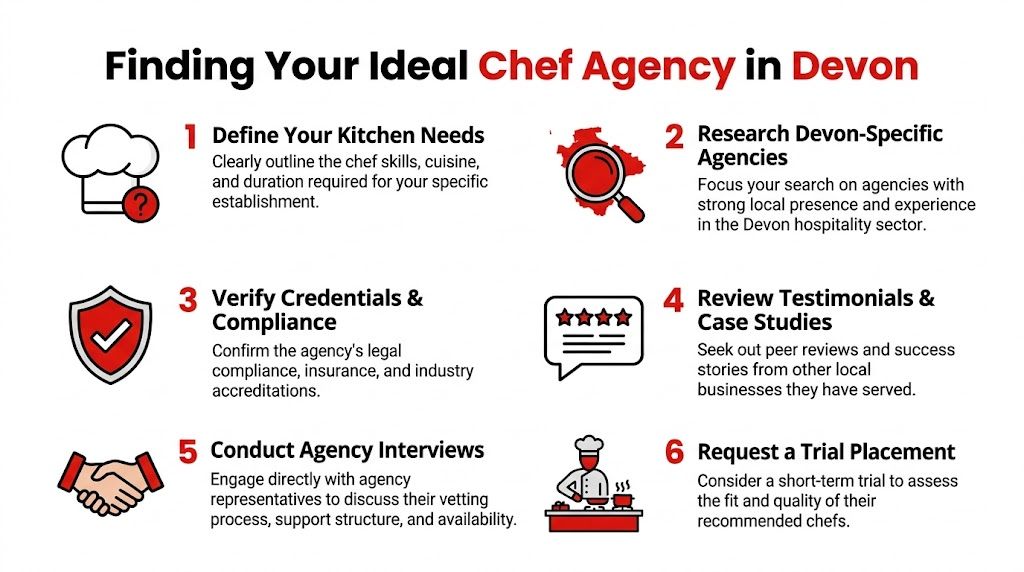
The wrong agency in Devon creates operational risk in four places at once. Skills, compliance, reliability, and communication. You need to screen agencies like suppliers who can either protect service or wreck it.
Start with specialism, not size
A generalist temp agency that also supplies warehouse staff and reception cover is rarely the answer for a pressured kitchen.
You need to know whether the agency understands:
- Section pressure in a live service
- Menu fit between venue and chef
- Kitchen hierarchy and reporting lines
- Speed of deployment when a chef calls off the same morning
- Regional realities such as rural travel, split shifts, and seasonal spikes
A specialist chef agency should be able to talk in operational terms. If the salesperson sounds like they’ve never stood on a pass, move on.
Build a shortlist with these checks
Use a simple filter. If an agency fails any of these, don’t shortlist it.
Clear chef focus
Their website should make it obvious they place chefs and hospitality staff, not every temp role under the sun.Visible compliance language
If there’s no mention of right-to-work checks, vetting, references, hygiene standards, or insurance, assume the process is weak.Easy contact routes
You want phone, enquiry form, and a clear promise on response times. If it’s hard to reach them before a booking, it’ll be worse when there’s a problem.Devon relevance
They don’t need to be tiny and local-only, but they do need to understand Devon venues, from Exeter to Salcombe, Torbay, Dartmouth, and rural country house operations.Service clarity
You should be able to tell whether they cover short-notice relief, seasonal reinforcement, permanent chef recruitment, and specialist assignments like yacht chefs or villa chefs.
Ask questions that expose weak operators
Don’t ask, “Can you send a chef?”
Ask better questions:
- What’s your process when I need short-notice or next-day cover?
- How do you match chefs to pub food, hotel dining, events, or private households?
- What happens if the chef is late, unsuitable, or doesn’t turn up?
- Who answers the phone out of hours?
- Do you have chefs who understand coastal seasonality and high-volume service?
Weak agencies answer with broad promises. Good agencies answer with process.
According to benchmark data tied to a Devon-specific staffing methodology, top-tier agencies achieve a 95% success rate in filling short-notice shifts within 48 hours, with a process built around right-to-work checks, DBS vetting, and skills matching. That benchmark also outperformed a 78% national agency average in the cited material, which tells you process matters far more than agency sales talk (Devon staffing methodology benchmark).
Spot the red flags quickly
Here’s what should make you pause:
- Vague service pages with generic recruitment language
- No real detail on chef vetting
- No clear replacement policy
- No mention of support outside office hours
- No sign they understand food-led businesses
- Pressure to book fast without proper role discussion
If an agency can’t explain how it checks suitability, it’s not matching chefs. It’s forwarding CVs and hoping for the best.
Compare local-only agencies with broader specialist coverage
A local-only agency may know nearby venues well. That can be useful.
But don’t assume local automatically means stronger. In busy periods, a small local supplier can run out of chefs quickly. A nationwide specialist with proper hospitality depth often gives you broader access to talent while still placing chefs who fit local trading conditions.
One useful starting point is this page on employment agencies for chefs, which helps clarify what a chef-specific agency should provide.
Keep the shortlist short
You don’t need ten agencies. You need two or three credible ones.
Then test them with a real conversation. Explain your menu, service style, average covers, kitchen setup, and likely pressure points. The agency that asks sharp questions and speaks plainly is usually the safer bet.
Your Non-Negotiable Chef Vetting and Compliance Checklist
A lot of agencies say their chefs are “fully vetted”. That phrase is meaningless unless you know what sits behind it.
You’re not buying a shift. You’re taking responsibility for a person working in your kitchen, around your food, your team, your guests, and your reputation. If the agency cuts corners, the fallout lands with you.
What proper vetting looks like
At minimum, an agency chef should arrive with verified legal status, relevant food safety standards, and enough background checking to give you confidence they can operate safely and professionally.
For specialist placements such as boutique hotels, yachts, and private households, the bar is higher. Reliability, discretion, and insurance matter more because the operating environment is tighter and the guest expectation is less forgiving.
The benchmark cited for high-stakes Devon placements puts long-term agency chef reliability at 98%, supported by CL3 insurance coverage, alignment with UK Maritime and Coastguard Agency catering standards, and 1% downtime in the source material. Whether you’re staffing a yacht galley or a high-end coastal hotel, those are the sort of safeguards you should be asking about (benchmark for boutique hotels and yachts in Devon).
Essential Agency Chef Vetting Checklist
| Compliance Check | Why It's Critical | Agency Red Flag |
|---|---|---|
| Right to Work verification | Protects you from illegal working exposure and avoidable disruption | Agency gives vague assurances but no clear process |
| Food Hygiene certification | Reduces food safety risk and proves baseline operational knowledge | No mention of current hygiene training |
| Employment references | Helps confirm recent performance, reliability, and role level | “We know them personally” instead of formal checks |
| DBS check where relevant | Important for private households, some hotel settings, and sensitive environments | Agency treats DBS as optional in obviously sensitive roles |
| Insurance cover | Protects venue and chef if something goes wrong | No clear statement on cover levels or responsibility |
| Role-specific competence | Confirms the chef can handle your menu, pace, and equipment | Agency says “a chef is a chef” |
| MCA awareness for yacht chefs | Essential for galley operations and specialist marine compliance | No understanding of yacht or maritime requirements |
Ask for evidence, not reassurance
Managers often get talked around this. Don’t let that happen.
Ask the agency:
- How do you verify right to work before placement?
- What food hygiene level do your chefs hold?
- How recent are your references?
- What insurance sits behind the booking?
- Do you screen for role-specific experience, not just job title?
- If I need a yacht chef or villa chef, what specialist checks are in place?
If the answer is slow, confused, or defensive, that’s your answer.
Match matters as much as compliance
A compliant chef who can’t cook your menu still costs you money.
A pub serving roasts, fish specials, and brisk brunch turns needs a different profile from a fine-dining country house, a wedding venue, or a yacht doing private guest service. Good agencies understand section fit, pace fit, and culture fit. Bad agencies hear “Chef de Partie” and send the nearest available person.
That’s why qualifications need to be read in context. This guide to qualifications for a chef is useful because it frames certification as one part of capability, not the whole story.
Operational test: Ask the agency to explain why the specific chef suits your menu, your service style, and your team structure. If they can’t do that in plain English, don’t book.
Don’t inherit the agency’s shortcuts
Owners and GMs often get caught in this situation. They assume the agency’s process is sound because the website looks polished.
A polished website doesn’t stop a kitchen incident. A real process does.
If you’re hiring agency chefs Devon wide, vetting is not admin. It’s protection.
Decoding Agency Chef Contracts and Pricing
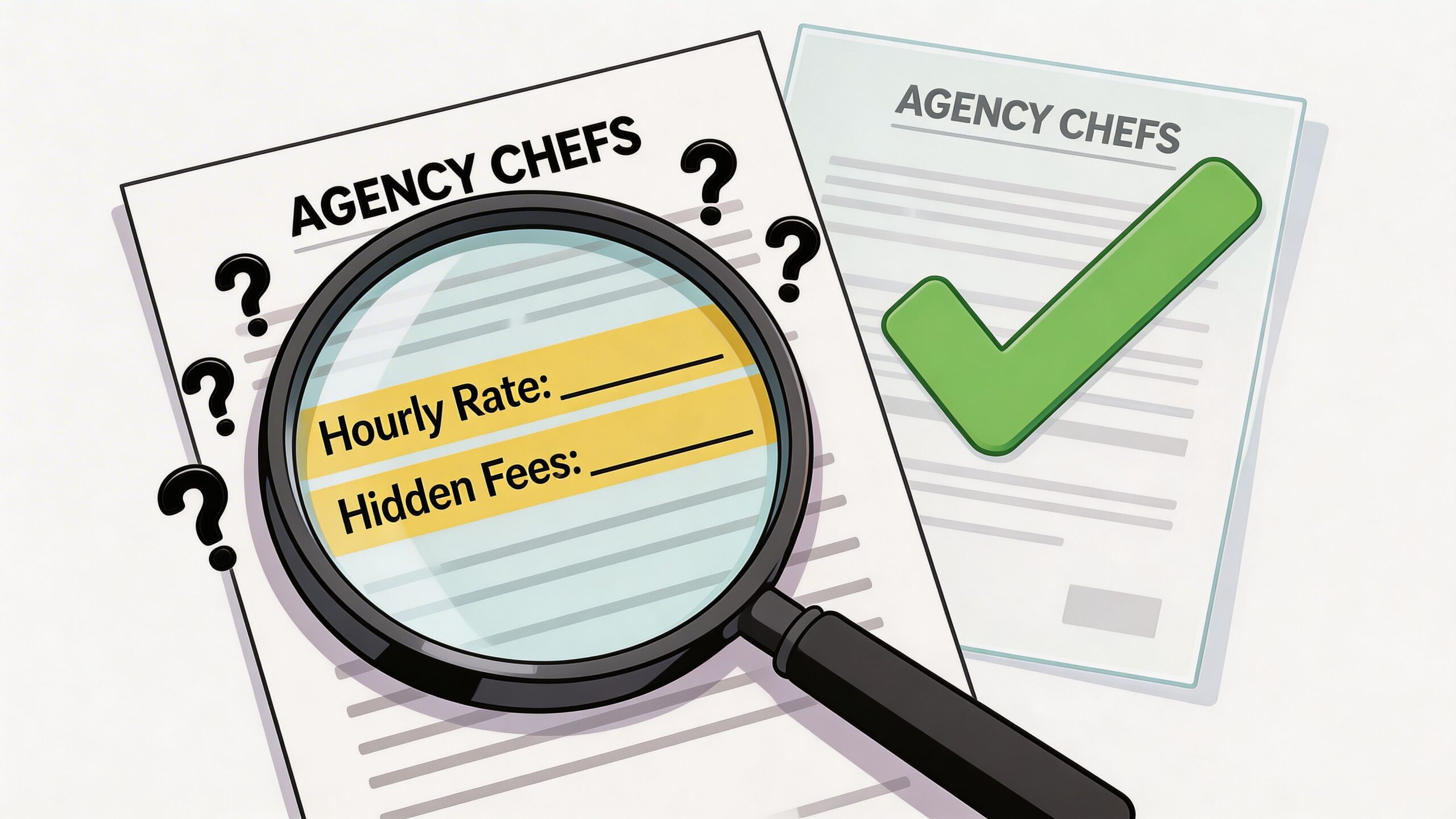
The hourly rate is never the full story.
That’s where plenty of operators get stung. They compare one number, ignore the booking terms, and only discover the actual cost when the invoice lands or the chef fails to show and nobody answers the phone.
What to read before you agree anything
A chef agency contract should answer five basic questions clearly.
What are you paying for
Is the quoted figure just the chef’s hourly charge, or does it include the agency margin, payroll handling, and support?What sits outside the quoted rate
Travel, accommodation, parking, meals, and late changes need to be clear up front.What’s the minimum booking
A short emergency shift may still trigger a minimum charge. That can be fair, but it needs to be visible.What happens if you cancel
Cancellation windows matter, especially in weather-sensitive or event-led Devon trade.What happens if the chef is unsuitable
The replacement process should be written down, not verbally implied.
The dangerous phrase is “competitive rate”
That phrase usually means nothing.
A cheaper hourly quote can become a worse commercial decision if:
- The chef arrives underqualified
- The agency adds extras later
- There’s no replacement backup
- The admin burden sits with your team
- The booking falls apart out of hours
I’d rather pay a clear rate for a chef who turns up, fits the kitchen, and protects service than save a few pounds on paper and lose a Saturday night in practice.
Read the support terms properly
Operators skim this bit and regret it later.
When an agency says it offers support, pin down what that means:
- Is there genuine out-of-hours cover?
- Can they replace a chef fast if there’s a problem?
- Will you deal with one account contact or a call centre?
- Who handles disputes about timesheets or performance?
Don’t buy availability. Buy accountability.
Transparency usually beats clever pricing
The best commercial model is the one you can understand quickly.
If a quote is padded with vague extras or unexplained conditions, walk away. Hidden costs don’t just affect margins. They make planning harder for head chefs, ops managers, and finance teams.
This matters even more if you’re using temporary chefs regularly across multiple sites. You need consistency in booking terms, predictable invoicing, and a reliable replacement policy. If you’re reviewing labour economics more broadly, this guide on the cost of employing helps put agency pricing into the wider context of recruitment, payroll, absence, and retention.
Use a simple contract test
Before signing off, ask yourself:
- Can I explain this deal to my owner or finance lead in one minute?
- Do I know the total likely cost, not just the headline rate?
- If the chef no-shows, do I know exactly what happens next?
If the answer to any of those is no, the contract needs work.
A Strategic Approach to Seasonal Staffing in Devon
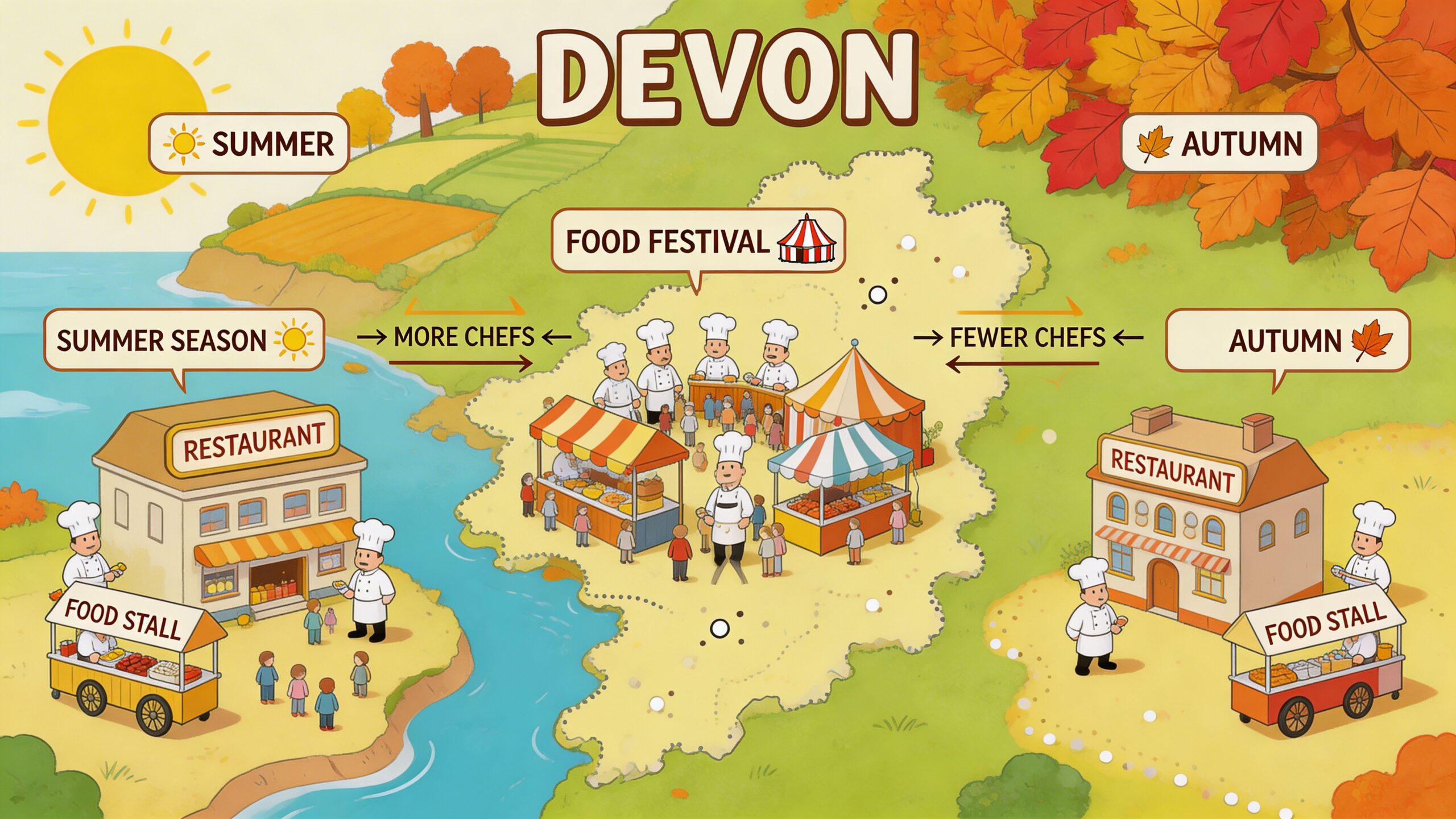
Devon doesn’t reward reactive staffing. It punishes it.
If you wait until the season is on top of you, you’re already competing for the same chefs as every pub, hotel, and coastal restaurant that left planning too late. That’s when standards slip, rates get messy, and desperate bookings lead to bad hires.
Build around your pressure points
Every Devon business has its own peak pattern.
A Salcombe site may need stronger summer reinforcement. An Exeter operation might feel pressure from events, graduations, and weekend trade. A country hotel can get hit by weddings and holiday occupancy at the same time. Yachts and villas bring another layer where dates are fixed and guest expectations are absolute.
Map your pressure points early:
- School holidays
- Bank holidays
- Local regattas and festivals
- Wedding blocks
- Christmas and New Year trading
- Known staff leave windows
Seasonal recruitment is getting harder at the lower end
A live seasonal example in Salcombe advertised a Chef de Partie role from £13 per hour with a 40-hour week, accommodation deduction, and meals on shift. Set against UK earnings data, hospitality-related service occupations saw 7.1% median earnings growth in the cited period, which shows why venues relying on low flexibility and last-minute hiring keep struggling for decent seasonal talent (seasonal chef role in Salcombe and earnings context).
That’s the practical takeaway. If your offer is basic, your planning must be better.
Two staffing lanes work better than one
Smart operators run two parallel plans.
Planned reinforcement
This covers known peaks. You forecast likely need, secure temporary chef support ahead of time, and build a small bench of people who can return.
That might mean:
- bringing in an extra CDP for the summer terrace menu
- adding breakfast cover at a boutique hotel
- lining up event chefs for a wedding-heavy month
- securing yacht chefs ahead of charter movement
Emergency cover
This is your damage-control lane. It’s for sickness, walkouts, accidents, family emergencies, and sudden occupancy spikes.
These bookings only work when the agency already understands your business. Waiting until the first crisis to explain your menu, kitchen layout, and standards is inefficient.
The kitchens that cope best in peak season usually aren’t calmer. They’re better prepared.
Keep your brief tight
When you book seasonal or relief support, don’t just ask for “a chef”.
Send a concise brief:
- Role level required
- Menu style
- Section expectations
- Average covers
- Shift patterns
- Accommodation or travel constraints
- Who the chef reports to on arrival
That one discipline improves placement quality immediately.
Devon operators need local understanding with wider reach
Many businesses make mistakes here. They choose either an agency that knows Devon but has no depth, or one with depth but no feel for local trade.
You need both. Coastal seasonality, rural travel, and mixed-format hospitality make Devon a specific staffing market. The agency must understand that a chef who works in a city-centre branded kitchen may not automatically suit a remote gastro pub, a Dartmoor hotel, or a yacht assignment on the coast.
If you get this right, seasonal staffing stops being a yearly panic and becomes a controlled operating plan.
Your Kitchen Is Ready How to Book Your First Relief Chef
Once you’ve done the agency checks properly, booking your first relief chef should be straightforward.
Keep it simple. Be clear on the role, honest about the pressure, and organised before the chef arrives. The smoother your handover, the faster that chef becomes useful.
Readiness checklist
Menu and prep list ready
Don’t leave a temporary chef guessing what matters on that shift.Section allocated
Decide whether they’re covering garnish, grill, larder, breakfast, pastry, or broader service support.Point of contact assigned
One named person should meet them, brief them, and answer questions.Kitchen access sorted
Uniform expectations, start time, parking, staff entrance, and security access should all be confirmed.Allergens and standards explained
Give the chef your essential requirements early.Team briefed
Temporary chefs land better when the brigade knows who’s arriving and why.
A relief chef should reduce pressure, not create confusion. If your team spends the first hour hunting for labels, stock, equipment, and service notes, you’ve wasted the booking.
If you need cover in Devon, or in other busy hospitality markets such as Bristol, Dorset, Berkshire, Windsor, Reading, Slough, or Wales, move early. Phone calls are still the fastest route when the rota is already under strain, and an online booking form works well when you’re planning ahead.
The serious mistake is waiting until service is already compromised.
Frequently Asked Questions About Agency Chefs in Devon
Are agency chefs actually cost-effective for Devon venues
Yes, if you measure the full operating cost instead of fixating on the shift rate.
The hidden cost in hospitality is disruption. According to the cited market summary, Devon’s pubs and restaurants averaged £15,000 in annual staffing disruption costs in 2025, while some agencies were described as charging 20 to 25% markups. The same source also states that transparent managed plans from specialist providers can reduce chef turnover by 30%, which is why the right agency arrangement can be commercially stronger than repeated direct-hire failures and rota chaos (Devon agency market and disruption cost summary).
If a chef booking protects service, prevents overtime burnout, and stops menu cuts on a busy week, that’s not a cost problem. That’s margin protection.
What’s the biggest mistake operators make when hiring agency chefs in Devon
They buy on rate instead of risk.
A low quote looks attractive until the chef is wrong for the menu, arrives late, needs hand-holding, or disappears after one shift. Then your head chef absorbs the cost in stress, standards, and labour inefficiency.
The better question is this: will this booking keep service stable?
Can agency chefs work for longer placements, not just emergency cover
Yes. That’s often where agency support becomes more useful, especially for hotels, private estates, villas, yachts, and businesses between permanent hires.
Longer placements work when the agency understands fit, not just availability. You want continuity, standards, and a chef who can settle into the structure without constant correction.
What should yacht and villa operators ask for specifically
Ask for role-specific experience and tighter vetting.
A yacht chef is not the same as a pub chef with good knife skills. Galley work, discretion, provisioning discipline, guest interaction, and working in compact high-pressure environments all matter. Villa chefs also need judgement around privacy, flexibility, and direct client expectations.
If the agency talks about these assignments as if they’re standard kitchen shifts, it doesn’t understand the brief.
How can multi-site groups use agency chefs better
Stop booking site by site with no shared plan.
Group operators get better results when they centralise standards. Use one agency framework, one booking process, one escalation route, and one set of quality expectations across the estate. That gives you consistency and makes it easier to move quickly when one site comes under pressure.
It also helps you spot patterns. If one venue needs repeated emergency cover, that’s usually a management issue, a retention issue, or a bad rota design issue. Agency support should expose those problems, not hide them.
Is there still a place for permanent chef recruitment
Absolutely.
Relief cover solves immediate pressure. It doesn’t replace the need for a stable core team. The best operators use both. Temporary chefs protect service now, while permanent chef recruitment fixes structural gaps over time.
That combined approach usually works better than forcing a rushed permanent hire because the kitchen is in trouble.
If you need dependable chef cover, seasonal reinforcement, yacht or villa chefs, or permanent kitchen recruitment support, contact Relief Chefs UK. They work with independent pubs, restaurants, boutique hotels, private households, and hospitality groups across Devon and the wider UK, with short-form enquiries and fast response for urgent bookings.
Call the team.
Office 01392 715474 · info@reliefchefs.co.uk