
Agency Work East London: Top Chef & Venue Guide
16 May 2026

Friday lunch is booked solid. One chef calls in sick. Another texts to say they're stuck and can't get in. You've got prep half done, deliveries arriving, and front of house asking whether the reduced menu is going up.
That's when individuals often search for agency work east london or a chef agency in East London. Some are chefs looking for flexible shifts. Some are operators trying to stop service from falling apart. Both sides run into the same problem. There are plenty of names in the market, but not every agency understands what keeps a kitchen moving.
The difference isn't who can send a CV fastest. It's who can put the right chef on the right section, on time, briefed properly, and ready to work without drama.
Navigating the East London Hospitality Agency Market
East London has always been a pressure cooker for hospitality. Shoreditch wants speed. Canary Wharf wants polish. Hackney wants flexibility. Stratford can swing hard on events, weekends, and seasonal trade. That creates constant movement in kitchen staffing.

The wider London market explains why agency staffing is so visible here. London accounted for almost one-third (29%) of all permanent placement agencies in the UK in 2023, according to the Recruitment & Employment Confederation industry status report. That concentration matters because more agencies in one city means more choice, faster movement, and more noise.
More agencies doesn't mean better cover
A crowded market helps when you need options quickly. It doesn't guarantee standards.
Some agencies are built around volume. They'll fill phones and inboxes, but they won't always ask the questions that matter in a live kitchen:
- What section is the chef covering
- Is this banqueting, brasserie, fine dining, or pub food
- What's the service pressure
- Do you need someone to run the pass or just hold garnish steady
- Is there accommodation, parking, or an early prep start
If they don't ask those questions, they're guessing. Kitchens pay for guesses.
Practical rule: In East London, fast cover only works when the brief is sharper than the panic.
That's why operators often move away from job boards and broad agencies and towards specialist partners with hospitality experience. If you're hiring in the capital, it helps to start with a London hospitality recruitment agency that understands kitchen cover, not just recruitment admin.
The market works differently on each side
For chefs, agency work east london can be a solid route into varied kitchens, better scheduling flexibility, and repeat bookings.
For venues, it's rarely about “extra hands”. It's about protecting service. You need somebody who can hit the ground running, respect the brigade, and not vanish before evening prep.
That's the real split in this market. Plenty of agencies can send bodies. Fewer can help you avoid the body that creates more work than they save.
A Chef's Guide to Securing Top Agency Work
If you're a chef looking at agency work east london, treat it like a professional lane, not a stopgap. The chefs who do well aren't usually the loudest. They're the ones who are reliable, honest about their level, and easy to place twice.

The old idea that agency work is random and short-lived doesn't hold up well. In the UK Government's 2021 Agency Worker Survey, 48% of agency workers said they had an ongoing relationship with a single agency, which tells you repeat agency work is common when the fit is right, as shown in the official agency worker survey report.
What serious agencies want from chefs
Registration should feel thorough. If it feels rushed, that's usually a warning sign.
A decent hospitality agency will want to know where you've worked, what level you handle, and what environments suit you. There's a big difference between being useful in a volume pub kitchen and running a hotel breakfast operation smoothly.
Bring the basics properly sorted:
- Updated CV: Keep it simple. Role, venue, dates, style of food, and what you did.
- Documents ready: Right to work, references, food safety, and anything else requested. Delays here lose shifts.
- Your real section strength: Say whether you're strongest on grill, sauce, pastry, prep, breakfast, banqueting, or all-round CDP work.
- Travel honesty: If you can't do a 6am start in Canary Wharf from the other side of London, say so early.
How chefs become requested by name
The first shift is the interview. The second shift proves whether you're worth keeping on the books.
A chef gets requested again for simple reasons. They turn up early. They're clean and organised. They don't need hand-holding. They don't spend half the shift telling everyone how the last place did it.
Turn up with knives, safety shoes, clean whites, a pen, and the attitude that you're there to make the team's day easier.
East London venues remember agency chefs who settle quickly into busy services. That matters in Shoreditch restaurants, Hackney pubs, event sites around Stratford, and corporate-heavy kitchens near Canary Wharf. If you want consistent agency work, aim to be useful before you aim to be impressive.
A lot of chefs also use short-term work to test kitchens before committing longer term. That's one reason summer temp jobs in London often lead to repeat bookings or permanent offers when the relationship works on both sides.
A quick look at the practicalities of temp chef work helps.
What doesn't work
Chefs usually damage their own agency prospects in predictable ways:
Overselling their level
Calling yourself sous when you're really a solid CDP gets found out by the first service.Poor communication
If you're delayed, call early. Silence kills trust quickly.Acting like a visitor
Agency chefs who wash down, label properly, and leave the section clean get remembered.Picking only the easiest shifts
Flexibility gets you in the good books. Once trust is there, the better jobs tend to follow.
A Venue's Playbook for Finding Reliable Chef Cover
Most kitchen staffing problems aren't caused by one bad week. They come from churn. People leave. Standards slip. The team covers too much ground for too long, then another person burns out.
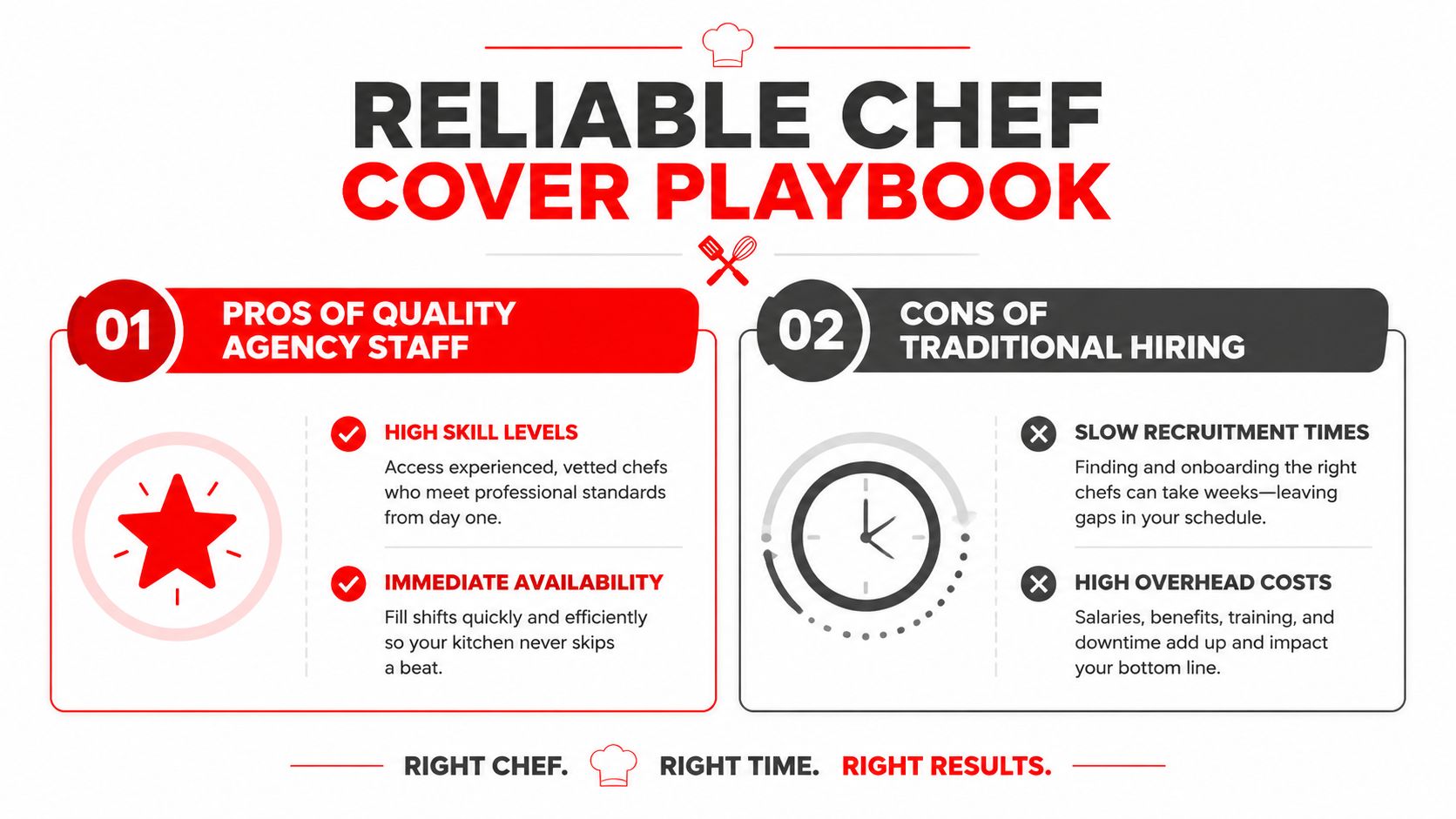
That's why temporary cover matters more than many operators admit. The accommodation and food service sector had an annual turnover rate of 51.8% in 2024, according to the labour data referenced in this hospitality hiring context page. In practice, that means gaps are normal. Running without a backup plan isn't.
Generic hiring routes leave too much to chance
A job board gives you applicants. It doesn't give you assurance.
When you need someone for tonight, this week, or a rough patch over several weekends, your real concerns are usually these:
- Will they show up
- Can they work the section claimed
- Have they been vetted properly
- Will they fit the pace and standards of the site
- Who fixes it if the shift falls apart
That's where specialist chef cover beats broad recruitment every time. You're not buying a stack of CVs. You're reducing risk.
What to ask before booking any agency chef
Operators often ask about hourly cost first. Fair enough. But cost without context is a trap.
Ask these questions instead:
| Question | Why it matters |
|---|---|
| What level is the chef genuinely working at | Titles vary wildly between venues |
| Has right to work been checked | Basic compliance isn't optional |
| What references have been taken | Reliability matters as much as skill |
| Who handles replacements if needed | Service can't wait for office-hours excuses |
| What information does the chef receive before arrival | Better briefing means a better shift |
A relief chef should reduce pressure within the first hour, not create a new management problem.
The operators who get the best results brief properly
Even a strong chef can struggle if the brief is poor. Don't just say, “Need a chef ASAP.”
Say what the service looks like. Covers. Style. Equipment issues. Whether the menu is tight or sprawling. Whether there's support on KP, prep, pastry, or breakfast. If accommodation is available, mention it straight away. This matters not just in London but in pressure areas such as Bristol, Devon, Dorset, Berkshire, Reading, Slough, Windsor, and across Wales where travel and staff availability can decide whether a booking works.
For temporary cover, hospitality temp staff support is most useful when it's treated as part of kitchen planning, not a last-minute punt after every other option has failed.
What works in practice
A specialist model tends to work best when it includes proper vetting, clear rates, a named point of contact, and realistic matching. Relief Chefs UK is one example of that type of service. It provides chef staffing support for short-term and permanent needs, including relief chefs and wider hospitality cover.
Managers should also think in layers. Use relief cover to stabilise service first. Then fix rota design, recruitment gaps, and retention issues behind the scenes. Agency cover is strongest when it protects standards while you sort the deeper problem.
Decoding Pay Rates and Contracts in East London
Pay in East London moves with pressure, skill, timing, and how difficult the shift is to fill. Anyone giving you one neat figure for all agency chefs is oversimplifying the market.
There is one useful benchmark from outside hospitality that still tells you something important about the local market. In East London contract recruitment, some specialised roles requiring “Stakeholder Map” skills had a median daily rate of £498 in the six months leading up to 24 April 2026, according to IT Jobs Watch market data for East London contract roles. Different sector, yes. Useful signal, also yes. East London pays for scarce skill and immediate availability.
What that means for chef bookings
In hospitality, rates usually rise when one or more of these are true:
- You need someone at short notice
- The shift is antisocial
- The role carries responsibility for ordering, rota control, or leading service
- The site is difficult to reach
- The venue has a reputation for hard services or weak support
Chefs should understand that agencies price risk and fill difficulty, not just job title. Venues should understand that the cheapest quote often comes with the biggest unknowns.
Typical Agency Chef Pay Rates in East London 2026
The table below is a practical guide, not a fixed card. Actual rates depend on service style, booking length, and employment status.
| Chef Role | Typical Hourly Rate (PAYE) | Typical Hourly Rate (Self-Employed/Ltd) |
|---|---|---|
| Commis Chef | Varies by venue and shift pattern | Varies by venue and shift pattern |
| Chef de Partie | Varies by venue, section, and notice period | Varies by venue, section, and notice period |
| Sous Chef | Varies by leadership responsibility and shift pressure | Varies by leadership responsibility and shift pressure |
| Head Chef | Varies by operational scope and site demands | Varies by operational scope and site demands |
PAYE or self-employed
PAYE suits chefs who want simplicity. Tax and National Insurance are handled through payroll, and there's less admin after the shift.
Self-employed or limited company arrangements can suit chefs who prefer managing their own accounts and invoicing structure, but only if the setup is legitimate and properly understood. Don't choose a payment route just because somebody says it sounds better on paper. Choose the route that matches how you work and what you can manage cleanly.
If the rate sounds strong but the terms are vague, ask more questions before accepting the shift.
For venues, the key point is transparency. Ask whether quoted rates include the full agency charge, payroll treatment, and any extras. For chefs, ask when you're paid, how timesheets are approved, and who signs off hours. Confusion around contracts causes more bad feeling than the work itself.
Why Venues and Chefs Choose Relief Chefs UK
The best staffing partnerships in hospitality are built by people who understand what a bad service feels like. That's the difference when an agency is run by chefs rather than people who've only worked from a desk.

Relief Chefs UK has been established since 2013, and that matters because hospitality clients usually want calm handling, not sales talk. A chef-led agency tends to ask better questions about menu style, section pressure, handover, and whether a booking needs a safe pair of hands or a stronger leader.
What operators and chefs usually want
Some clients need emergency relief chefs to keep service running after sickness or walkouts. Others need temporary chefs for a season, a launch period, or a rota gap that won't close quickly. Some need permanent chef recruitment because patching over the issue every week costs more in the long run.
The same goes for specialist placements. Yacht chefs, villa chefs, and private hospitality roles need a different sort of screening and matching than a busy East London gastropub or boutique hotel.
Why the model suits busy hospitality businesses
The practical appeal is simple:
- Chef-led judgement: bookings are assessed by people who know kitchen realities
- Broad support: relief chefs, temporary chefs, permanent placements, yacht chefs, villa chefs, and wider hospitality staffing
- National reach: useful for operators with sites in London and seasonal pressure points elsewhere
- Flexible plans: suitable for independent venues and larger groups alike
If you're running a pub, restaurant, hotel, or private hospitality operation, the question isn't whether you can find cover. It's whether the cover helps or hurts the shift.
Frequently Asked Questions About Agency Work
Is East London good for agency chef work
Yes. East London has enough variety to suit different levels and kitchen styles. You'll find work across pubs, hotels, events, corporate sites, casual dining, and higher-end operations. The chefs who do best are the ones who stay flexible on location, shift pattern, and section.
Can temp work lead to a permanent chef job
Absolutely. A temporary booking often works like a live trial for both sides. The venue sees how you handle pressure. You see what the kitchen is really like when the tickets start coming in.
What's the difference between a temp chef and a relief chef
A temp chef fills a gap. A relief chef should do more than that. They should steady the shift, slot into the brigade quickly, and help maintain standards when the kitchen is under pressure.
The best relief chefs don't need the whole day explained twice. They read the room, ask the right questions, and get on with it.
When is demand strongest
Demand usually tightens when rotas are stretched, sickness picks up, holidays overlap, or trading spikes. In East London, that can mean anything from busy weekends and event periods to sudden staffing gaps in sites already running lean.
Is the agency market still growing
The wider market is still substantial. IBISWorld forecasts UK employment placement agency revenue to grow at a compound annual rate of 6.9% through 2025-26, reaching £24 billion, according to its UK employment placement industry outlook. For chefs and operators, that means agency staffing isn't fading away. It's becoming a more established part of how hospitality covers risk, handles demand, and keeps kitchens trading.
What should a venue prepare before a chef arrives
Keep it practical. Confirm start time, address, contact name, dress code, parking or access details, section, menu style, and who the chef reports to on arrival. A clear handover in the first few minutes often decides whether the shift runs smoothly.
If you need dependable chef cover or you're a chef looking for serious agency opportunities, contact Relief Chefs UK. They support independent pubs, restaurants, boutique hotels, private households, yachts, and multi-site operators across the UK with relief chefs, temporary chefs, permanent chef recruitment, and wider hospitality staffing support.
Call the team.
Office 01392 715474 · info@reliefchefs.co.uk