
Duties and Responsibilities of a Chef de Partie Explained
17 May 2026
Friday evening. Full book. The grill section is dragging, garnish is waiting, the pass is backing up, and the Head Chef has stopped calling orders and started firefighting. That sort of service collapse rarely starts with the whole kitchen. It starts with one section losing control.
That's why the duties and responsibilities of a chef de partie matter far more than many operators realise. A good Chef de Partie keeps one part of the kitchen stable enough that the rest of service can keep moving. A poor one turns a single station into a bottleneck that hurts ticket times, consistency, waste, staff morale, and guest experience.
For owners, GMs, hotel managers, and Head Chefs, this role isn't just about cooking skill. It's about operational control. If you run a pub in Devon, a hotel in Berkshire, a restaurant in Bristol, or a seasonal site in Dorset, the value is the same. A reliable CDP protects standards when trade is heavy and stops avoidable problems becoming expensive ones.
Why the Chef de Partie Is the Backbone of Your Kitchen
In UK kitchens, a chef de partie is a station manager within the brigade, sitting below the sous chef or executive chef and taking responsibility for a defined section such as pastry, sauces, meat, fish, or garnish. UK job descriptions consistently show that the role combines production, supervision, and standards control, including supervising junior chefs, coordinating daily tasks, checking stock rotation, monitoring food quality, and enforcing hygiene rules, as outlined in this chef de partie role overview.
That definition matters because it changes how you hire and manage the role. If you treat a CDP as just another pair of hands, you'll usually get a cook who waits for instruction. If you hire properly, you get someone who owns a section and prevents disorder before it reaches the pass.
What owners often miss
A weak CDP creates the same pattern every time:
- Prep falls behind and the section starts service under pressure.
- Standards drift because nobody checks portions, garnish, seasoning, or plating discipline.
- Junior staff lose direction and keep interrupting senior chefs with avoidable questions.
- Waste increases because ordering, handling, and stock rotation aren't under control.
Practical rule: If one station can't run without constant intervention, the kitchen doesn't have a Chef de Partie on that section. It has a dependency problem.
Why this role matters commercially
Hospitality is labour-heavy, and kitchen leadership matters because service businesses rely on people showing up ready to perform. The Office for National Statistics reported that accommodation and food service activities employed around 2.0 million people in the UK in 2024, which underlines how central kitchen management roles are to keeping operations running at scale, as shown in the ONS employment data for accommodation and food service activities.
In practice, the CDP is the person who makes sure one section can deliver a full service on time. That includes training, discipline, communication, quality checks, and keeping their area calm when pressure rises. If that sounds basic, it isn't. Most kitchen chaos comes from basic controls failing at the wrong moment.
Defining the Chef de Partie's Place in the Brigade
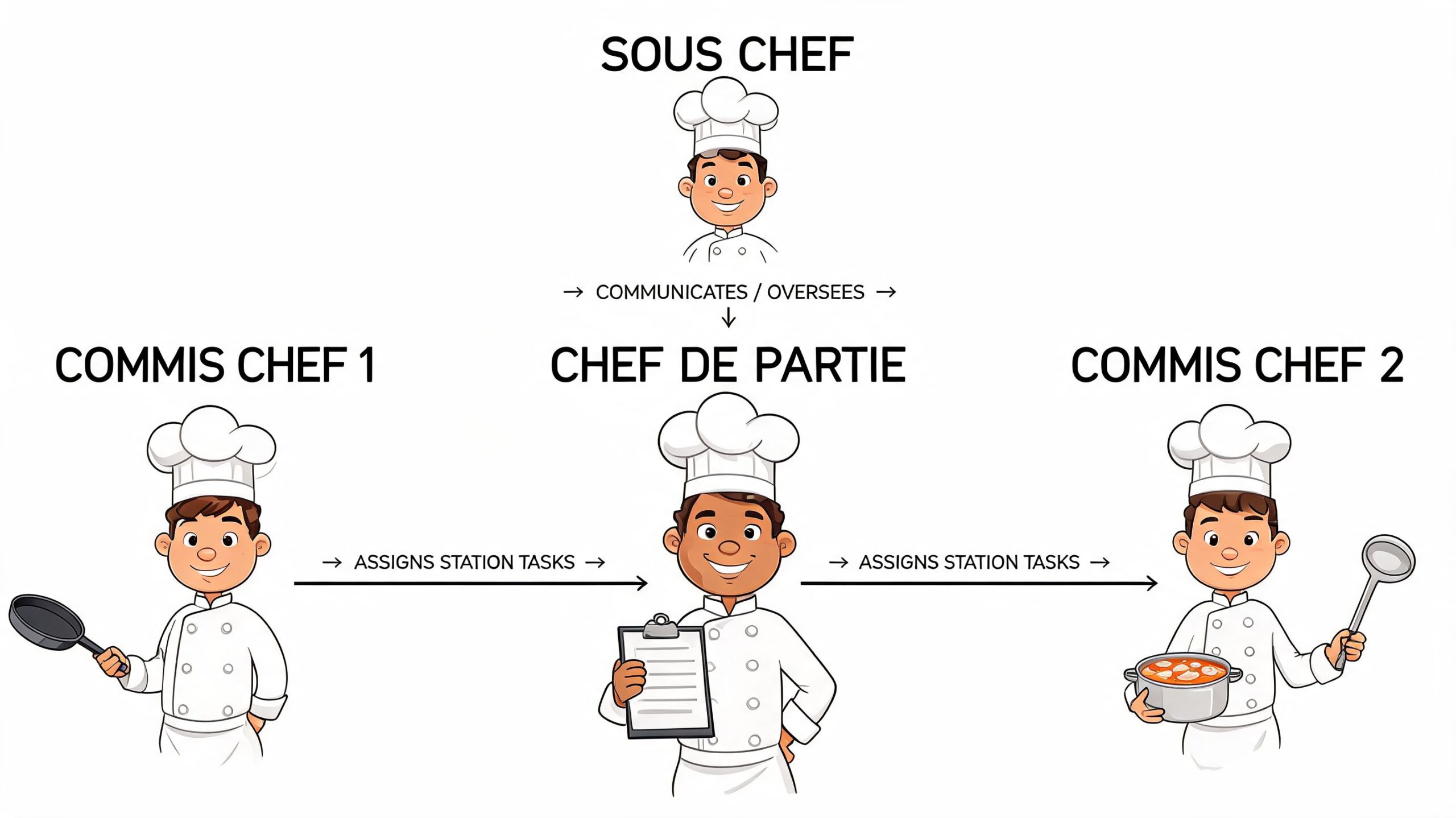
A chef de partie sits in the middle of kitchen management. The Head Chef sets direction. The Sous Chef coordinates the wider operation. The CDP runs a section. Commis chefs and junior staff support that section.
That middle layer is where many kitchens either become reliable or unstable.
The CDP as a section owner
In UK kitchens, the chef de partie's core duty is station control. They are responsible for a defined section and must handle prep, cooking, plating, stock monitoring, and hygiene for that station. Job descriptions consistently frame the role as ownership rather than simple task completion, which is why delays at that level create bottlenecks across the pass, as described in this station-based chef de partie job description.
That's the shift in thinking. A CDP doesn't just cook dishes. They control output from a production point inside the kitchen.
If you want a simple comparison, think of them as a team leader on a production line. If their line is well organised, stocked correctly, and staffed sensibly, service flows. If it isn't, the whole operation slows down.
Who they report to and who they lead
A competent chef de partie should be able to take instruction from the Sous Chef and convert it into organised action for their own station. They should also be able to direct junior chefs without causing friction.
That means the role has pressure from both sides:
- From above they must meet standards, specs, and service pace.
- From below they must give clear direction, correct errors, and keep juniors useful.
- Across the line they must coordinate with other sections so dishes land together.
If your team needs a clearer picture of that chain of responsibility, this guide to the duties of a sous chef helps show where the CDP fits underneath broader kitchen control.
A kitchen usually doesn't fail because every chef is poor. It fails because nobody owns the sections properly.
What this means for business output
Owners usually notice the visible issues first. Slow tickets. Cold plates. Missing components. Staff stress. Complaints from front of house.
The root cause is often less dramatic. A section wasn't ready. The fridge wasn't checked. Garnish ran short. Prep wasn't labelled properly. A junior was left without direction. One CDP can stop all of that.
That's why the duties and responsibilities of a chef de partie should be measured against outcomes, not just effort. Busy kitchens don't need more movement. They need tighter station management.
A Breakdown of Daily Duties and Station Specifics
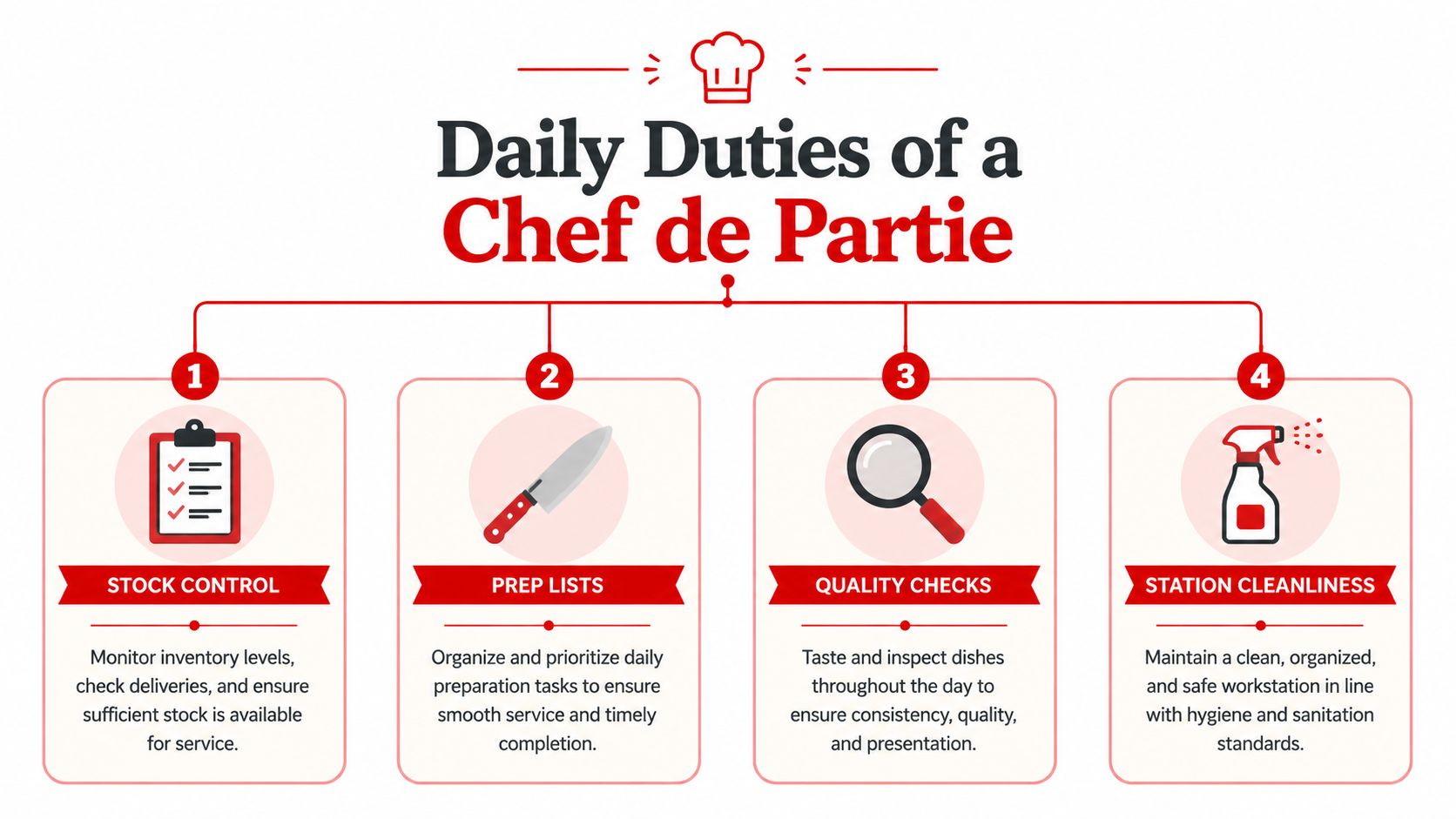
The day-to-day value of a CDP is simple. They stop preventable problems. They make sure the section is ready before service, controlled during service, and left in a condition the next shift can work with.
This visual sums up the daily rhythm of the role.
Core duties every CDP should cover
A chef de partie's responsibilities in the UK are heavily shaped by food safety and stock control systems, especially HACCP-style procedures and FIFO rotation. Job descriptions commonly require them to check deliveries, reject inferior goods, rotate stock, and complete safety checklists, in line with the Food Standards Agency's food safety expectations, as reflected in this UK chef de partie job description PDF.
On a normal shift, that usually means responsibility for:
- Opening the section properly by checking fridges, prep levels, labels, allergens, and equipment.
- Running mise en place so the station is service-ready and not relying on last-minute prep.
- Controlling stock through rotation, date checks, sensible usage, and accurate communication on shortages.
- Checking quality by tasting, verifying consistency, and refusing to send food that misses spec.
- Maintaining hygiene through cleaning schedules, safe storage, and disciplined handling.
- Managing junior support so commis chefs and assistants know what to do and when to do it.
What doesn't work is leaving these tasks to chance. If ordering is casual, portions are guessed, and labels are incomplete, margin leaks steadily all week.
On a busy section, stock control is service control. If the station runs out, over-orders, or uses poor product, the problem lands on the guest.
A useful training aid for junior managers is this service clip, which helps show the pace and discipline expected on a professional section.
What station responsibility looks like in practice
Different sections change the detail, but not the principle. Every CDP owns timing, standards, and section readiness.
Saucier
The sauces section often tells you how serious a kitchen is. A strong saucier controls reductions, stocks, holding quality, seasoning consistency, and pickup timing. A poor one sends split sauces, inconsistent texture, and dishes that vary from one table to the next.
Commercially, that matters because sauces hide waste badly. Over-reduced product, poor batch control, and weak portion discipline all hit margin.
Poissonnier
On fish, precision matters. Storage, prep timing, careful cooking, and clean handling are absolutely essential. If the fish station is disorganised, the losses show up fast through spoilage, overcooking, and remakes.
A solid fish CDP also keeps communication tight with garnish and sauce sections. Fish ready too early is just as much a problem as fish late.
Garde manger
Cold starters, salads, and plated cold prep can look simple until the restaurant fills up. This section needs speed, clean presentation, exact prep, and disciplined organisation.
What often goes wrong is complacency. Teams treat cold work as low-risk, then lose time through poor setup and inconsistent plating. The best CDPs know this section wins on detail.
Pâtissier
Dessert and pastry need accuracy, planning, and consistency. A pastry CDP has to think ahead because many failures happen long before service starts. If set desserts, pastry elements, or garnish prep are wrong, there's no rescue during a full push.
The margin link owners should watch
The best CDPs protect profit in ordinary ways:
- Portion control keeps specs steady and reduces overuse.
- Waste reduction starts with careful prep and proper rotation.
- Accurate ordering prevents both shortages and dead stock.
- Section discipline reduces rework and comped dishes.
None of that is glamorous. All of it affects the P&L.
The Skills That Define an Outstanding Chef de Partie
Every CV says the candidate can work under pressure. That line means very little on its own. The difference between an average CDP and an outstanding one shows up in how they behave when prep is short, the docket machine won't stop, and a junior chef is close to panicking.
Advanced chef de partie responsibilities often include food safety adherence, temperature recording, and training junior staff. They may also work with senior chefs on menu development and seasonal dishes, which means the role blends execution with a level of culinary development, as outlined in this industry view of the chef de partie role. That combination is what makes the role commercially useful.
Technical skill gets them in the door
You still need the basics. Knife work, section prep, timing, seasoning, organisation, cooking accuracy, and clean plating all matter.
But most hiring mistakes happen because operators stop there.
A technically decent chef who can't lead a section will still create friction. They'll need too much supervision, react badly under pressure, and pass stress down to juniors.
The skills that actually stabilise a kitchen
The best CDPs usually share the same working traits:
- Composure: They don't spread panic. They reset the section and prioritise.
- Communication: They call shortages early, answer clearly, and don't go silent when service gets rough.
- Leadership: They direct junior chefs with clarity instead of sarcasm or noise.
- Judgement: They know when to fix a problem themselves and when to escalate it.
- Discipline: They follow systems even when the kitchen is busy, tired, or short.
A strong CDP makes fewer things urgent. That's one of the clearest signs you've hired the right person.
Training ability matters more than many chefs admit
A CDP who can train commis chefs properly creates a significant advantage. The Sous Chef gets fewer interruptions. The Head Chef spends less time correcting basics. The section becomes easier to staff because juniors improve faster.
That's why qualifications and experience should be reviewed alongside behaviour and section ownership. If you're benchmarking candidates, this guide to qualifications for a chef is useful background, but it shouldn't replace a practical assessment of leadership and control.
Menu input matters too. The better CDPs don't just execute. They notice waste points, flag prep inefficiencies, and contribute ideas that work operationally, not just creatively.
Your Toolkit for Hiring and Managing a Chef de Partie
Most operators lose time hiring CDPs because the brief is vague. They advertise for “an experienced chef” when what they need is a section leader who can run service with limited supervision.
Start by writing the role around outcomes.
A practical job description template
Use wording like this and adapt it to your site:
Chef de Partie
Responsible for running a designated kitchen section to company standards. Duties include section prep, service execution, stock rotation, quality control, hygiene compliance, and supervision of junior chefs. The role requires calm service management, accurate communication with senior chefs, and consistent delivery during busy periods.
Then add the specifics that matter to your venue:
- Section requirement: Grill, sauce, pastry, larder, breakfast, banqueting, or all-rounder.
- Service style: Fresh food pub, hotel restaurant, events, rosette-level dining, volume trade.
- Shift pattern: Split shifts, straight shifts, weekends, breakfast cover, seasonal peaks.
- Operational expectation: Can open and close a section without constant direction.
If you need wider support for direct hiring or longer-term team building, chef recruitment support is one route operators use alongside in-house hiring.
Interview questions that reveal the truth
Don't ask whether they can handle pressure. Ask for evidence.
Try questions like these:
Tell me about a service that went wrong on your section. What did you do first?
Good candidates talk about prioritising, communicating early, and resetting mise en place.How do you check a section is ready before service starts?
Look for method, not vague confidence.How do you deal with a commis chef who keeps making the same mistake in service?
You're listening for coaching, not ego.What would make you reject a delivery or flag stock immediately?
This shows whether they understand standards beyond cooking.How do you manage consistency when covers build quickly?
Strong answers mention setup, sequence, and communication.
What to inspect on a trial shift
A trial isn't just about whether the food tastes good. Watch the habits.
- Set-up quality: Is the section organised, labelled, clean, and logically laid out?
- Working style: Do they move with control, or do they create clutter and noise?
- Communication: Do they call issues early and work well with the pass?
- Standards: Are portions, seasoning, and plating stable across the shift?
Chef de Partie Shift Handover Checklist
| Check Item | Status (OK / Action Needed) | Notes for Next Shift |
|---|---|---|
| Fridges checked and stock labelled | ||
| FIFO rotation completed | ||
| Prep levels updated against next service | ||
| All wastage recorded and explained | ||
| Equipment cleaned and working | ||
| Temperature logs completed | ||
| Allergens and specials briefed to next shift | ||
| Section shortages communicated to senior chef |
The handover tells you a lot about the chef. A tidy handover usually comes from a tidy section.
KPIs worth tracking
Keep the measures simple and relevant to the section:
- Waste patterns by product type and shift notes
- Section readiness before service
- Remakes and returns linked to that station
- Hygiene compliance on checks and logs
- Ability to train juniors without repeated escalation
The duties and responsibilities of a chef de partie become much easier to manage when expectations are visible and repeated consistently.
The Constant Challenge of Finding Reliable CDPs
The hardest part isn't writing the job spec. It's finding someone who can do it on a wet Tuesday, a packed Saturday, and a holiday weekend when two other chefs are off.
That's where many UK operators get squeezed. One short-notice sickness in Windsor or Reading can leave a section uncovered. A summer rush in Devon or Dorset can expose how thin the bench really is. A city-centre site in Bristol can trade hard all week and still struggle to secure dependable temporary cover.
Why the staffing gap hurts more than it looks
Running short on a key section never stays contained. It spreads.
- The Sous Chef gets dragged off broader control to rescue one station.
- Senior chefs lose planning time because they're filling operational gaps.
- Juniors get overexposed and confidence drops.
- Front of house takes the heat for delays they didn't create.
The worst decision is pretending you can absorb it. Some managers try to save money by stretching the existing team. For one service, maybe. For several shifts, it usually means tired staff, lower standards, and avoidable turnover.
Agency frustration is real
Plenty of businesses have had the same bad experience. A promised chef arrives late, lacks the right level, doesn't fit the section, or needs too much supervision to be useful. That's not cover. That's another management problem.
If a temporary CDP creates as much work as they solve, the venue hasn't bought stability. It's bought disruption at agency rates.
This is especially sharp in areas with seasonal demand and patchy labour supply. Hotels in Wales, pubs in Berkshire, coastal venues in the South West, and private operations needing villa chefs or yacht chefs all face versions of the same issue. You don't just need availability. You need someone who can slot in, read the section fast, and keep service moving.
Secure Vetted Chef de Parties On Demand with Relief Chefs UK
When a CDP gap opens, operators usually have three choices. Stretch the current team. Cancel part of the offer. Bring in temporary support.
The right answer depends on the shift, but for many businesses the practical route is fast, vetted cover from a specialist that understands kitchen reality rather than just filling a rota line.
Relief Chefs UK has been established since 2013 and provides nationwide chef staffing support for independent pubs, restaurants, boutique hotels, private households, yachts, and villas. Its service covers relief chefs, temporary chefs, permanent chef recruitment, yacht chefs, villa chefs, and broader hospitality staffing support. The business states that venues can request cover by phone or form, with an experienced recruitment team available 24/7 to help them access fully vetted, right-to-work-checked chefs, subject to availability, through Relief Chefs UK.
When this kind of support makes sense
It's useful when:
- A CDP calls in sick and tonight's service still has to go ahead.
- Seasonal demand jumps and your permanent team can't absorb the extra volume.
- Holiday gaps stack up and key sections are exposed.
- You're hiring permanently but need stable cover in the meantime.
For owners and managers, the benefit isn't just labour. It's continuity. If the replacement can run a station competently, the rest of the brigade can stay in role and standards are easier to protect.
What to ask before booking any chef cover
Keep the questions practical:
- What section has this chef covered before?
- Can they work at the level this menu requires?
- Have right-to-work checks and vetting been completed?
- How quickly can they start?
- What happens if the fit isn't right?
Those questions matter whether you need a breakfast CDP in Slough, a banqueting chef in Windsor, a pub all-rounder in Devon, or private staffing support for a yacht or villa booking.
If your kitchen is one absence away from losing control, that's already a warning sign. Section leadership is too important to leave to luck.
If you need practical kitchen cover or want to strengthen your chef pipeline, contact Relief Chefs UK. Whether you need a relief CDP for a difficult week, temporary chefs for peak trade, permanent recruitment for long-term stability, or specialist support for yachts, villas, hotels, and restaurants across the UK, the fastest step is to get in touch and brief the role properly.
Call the team.
Office 01392 715474 · info@reliefchefs.co.uk