
Two weeks before Royal Ascot, the rota looks manageable until a chef reports sick, a hotel confirms an extra function and three casual workers discover they can't travel to Windsor for the required training. The general manager is left with a service plan, a fixed event calendar and no spare people.
That's the reality behind Ascot races jobs. Race-week work may look like glamorous casual employment from the outside, but the operation behaves more like surge staffing in a high-volume hospitality business. Candidates need to commit to fixed dates, long shifts and practical travel arrangements. Venues need to recruit, vet and train before demand arrives, not search for a replacement after the first no-show.
This guide sets out how the model works for chefs, front-of-house candidates and hospitality managers across Berkshire, Windsor, Reading and Slough. It also explains when specialist temporary chef cover makes commercial sense for race meetings, hotels, restaurants, pubs and event venues elsewhere in the UK.
Why Ascot Races Jobs Are a Surge Staffing Problem
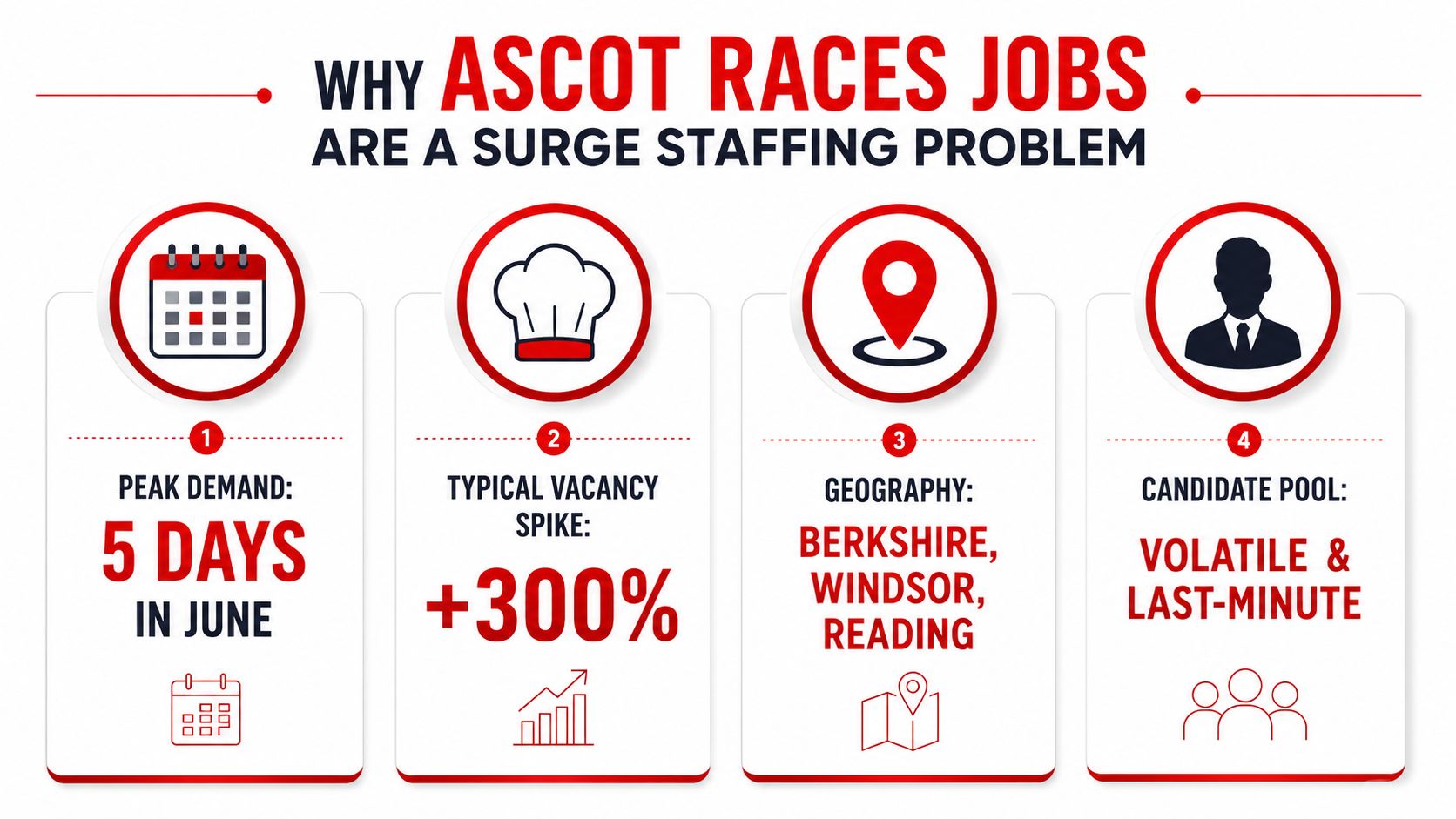
A standard hospitality rota can absorb a little movement. Race meetings cannot. Service dates are fixed, visitor demand arrives in a narrow window, and kitchens, bars, dining rooms and stewarding points must operate at full pace together.
The economic footprint shows why this is more than casual event labour. Research from the University of Reading on Ascot Racecourse's contribution to the UK economy estimates that the racecourse supports 3,903 full-time equivalent jobs across the UK and contributes about £264.5 million in GVA. Royal Ascot alone accounts for roughly 1,930 jobs and around £140 million in GVA.
The local effect is concentrated around the venue. Year-round activity supports about 1,360 local FTE jobs across Berkshire, Buckinghamshire and Oxfordshire, while Royal Ascot supports 625 local FTE jobs, according to the same research. That concentration puts chefs, waiters, bar staff, cleaners, stewards, porters and supervisors in direct competition across the surrounding labour market.
The rota problem is predictable
Treating Royal Ascot like an ordinary hospitality booking creates avoidable gaps. A manager may forecast food volume accurately, then still fall short because recruitment, site training and transport were not planned backwards from the fixture dates.
Ascot's event recruitment information separates permanent, temporary and raceday roles. Royal Ascot recruitment requires availability across all five event days, alongside mandatory training days. Large casual teams may also need accommodation, transport, uniforms, expenses and pay checks arranged before service begins.
A workable staffing sequence is straightforward:
- Forecast the fixture: List every race meeting and hospitality booking affecting the rota.
- Set the headcount: Include chefs, kitchen porters, front of house, supervisors and contingency cover.
- Recruit before pressure builds: Shortlist candidates, complete right-to-work checks and confirm availability.
- Train before service: Do not expect someone to learn the site during the first breakfast or lunch rush.
- Plan the failure route: Decide who receives a sickness call and who can authorise replacement cover.
Practical rule: A role requiring fixed attendance and mandatory training is a short mobilisation project, not a casual shift.
Venues can combine direct racecourse hiring, local job boards and an existing relief-chef network with event staffing recruitment support. Candidates should apply early and state the dates they can work. That pattern explains Ascot races jobs: chefs, FOH candidates and managers are planning against a fixed calendar, with little room to recover from late recruitment or a missed shift.
What Race-Day Demand Actually Looks Like
Race-day staffing at Ascot behaves like a fixed-date surge operation. The venue must absorb a sharp increase in guests, service points and temporary workers within a narrow calendar window, then stand the operation down quickly after the meeting.
Ascot has operated beyond the scale of a conventional racecourse for years. An older Ascot facts and statistics brief recorded 70 full-time employees across the year, with Royal Ascot employment rising above 5,000. The same brief described around 225,000 visitors over four days and 24 races.
The more recent comparison is larger. Royal Ascot week has been described as welcoming 300,000 racegoers across five days, with more than 6,500 temporary staff added to a 163-person full-time team, according to Ascot's published facts and statistics. The staffing model therefore differs from a normal hotel or restaurant rota. A venue needs enough people for peak service, but also enough supervisors, preparation staff and contingency cover to keep several areas working at once.
Race-day staffing at a glance
| Metric | Year-round | Royal Ascot peak |
|---|---|---|
| Ascot full-time team in the published comparison | 163 | 163 plus more than 6,500 temporary staff |
| Employment scale in the older Ascot brief | 70 full-time workers | Above 5,000 during Royal Ascot |
| Visitor demand in the older brief | Not stated | Around 225,000 over four days |
| Published Royal Ascot schedule in the older brief | Not stated | 24 races over four days |
The wider labour market adds pressure. UK Hospitality evidence submitted to Parliament described sector vacancy rates of at least 10% and potentially as high as 16%, representing about 210,000 to 336,000 unfilled roles. Serving staff, chefs, housekeeping and security were among the sharpest shortages, while vacancies stood at 49% above pre-pandemic levels, according to the UK Hospitality written evidence to Parliament.
Chef recruitment is especially competitive around major events. An industry analysis reported 40,395 chef postings in Q2 2026, up 83.4% year on year, compared with 23,103 postings, as summarised by the Craft Guild of Chefs summary of CV-Library data. Ascot venues are competing for the same cooks as hotels, pubs, restaurants and contract caterers.
Where candidates should search
Candidates should start with the Ascot Racecourse careers pages, then search across Berkshire, Windsor, Reading and Slough. Useful alerts include Royal Ascot, the Ascot Gold Cup, raceday hospitality, event chef, kitchen porter, catering assistant and stewarding roles.
Agency shortlists can reduce delay when a venue needs workers who have completed checks. Word of mouth also helps, particularly for chefs with evidence of high-volume service. It does not replace written confirmation of pay, reporting location, shift length and contract terms.
Apply before race week. Recruitment follows the fixture calendar, so shortlisting, recruitment sessions and training must happen first. A candidate available for all five event days and the required training is easier to deploy than someone offering only one Saturday.
Operators should use seasonal demand forecasting for hospitality to map expected covers, production volume and staffing gaps before recruitment becomes urgent. Candidates should check travel, availability and documentation at the same stage. Red flags include vague employer details, missing shift information, unclear pay treatment, upfront fees and intermediaries unable to explain right-to-work or payroll arrangements. Reliable listings make the practical commitment clear.
A Realistic Day in the Life of Race-Week Staff
An “event chef” call can mean arriving before breakfast, passing security, attending a briefing, preparing for several service points, and closing down after guests leave. There is little tolerance for a missed connection, incomplete uniform or uncertain travel plan. Race-day work is fixed-date surge staffing, with pressure concentrated into a short operating window.
Ascot-facing recruitment information lists shifts that may run from about 06:00 to 00:00, depending on the role and operation. A relief chef might begin with breakfast preparation, move into production for hospitality suites, support a rapid lunch service, then finish with close-down and stock checks. The long day is part of the commitment, not an exception.
Front-of-house staff carry a different workload. They remain on their feet, move between tables and service stations, manage guest expectations and reset spaces quickly. Uniform, identification, punctuality and presentation matter because the guest experience is public and immediate. A quiet period can disappear quickly when several areas need attention at once.
The five-day commitment
Royal Ascot roles commonly require availability for all five event days, plus mandatory training days, according to Ascot's working-at-events information. Candidates who can cover only one day may be unsuitable, even with strong hospitality experience. Managers need a dependable block of cover, not isolated availability that leaves gaps in the rota.
Travel must be checked before accepting work. Someone travelling from Reading, Slough or Windsor may have a workable local route. A worker coming from Bristol, Devon, Dorset or South Wales needs to calculate the complete journey, the earliest arrival and the route home after a late finish.
Travel check: Do not confirm a shift until you know how you will reach site for the earliest call time and get home after the latest finish.
Accommodation or transport may need arranging in advance. Candidates should also ask who supplies uniform, whether meals are provided, where to report and how breaks work. The guide to working at hospitality events helps candidates judge whether fixed-date event work fits around their normal employment. For venues, these questions should be answered before deployment, because unclear practical details become late arrivals and avoidable staffing gaps.
Application Checklist Candidates Can Run This Week
A strong application answers the manager's first questions before the interview. Can this person legally work, arrive on time, handle volume and stay for the whole commitment? A polished CV helps, but it won't compensate for unavailable dates or unreliable transport.
Start with the paperwork. Keep clear digital copies ready and check that names and dates match across documents. Then prepare a CV that leads with relevant evidence, not a long list of every job ever held.
The working checklist
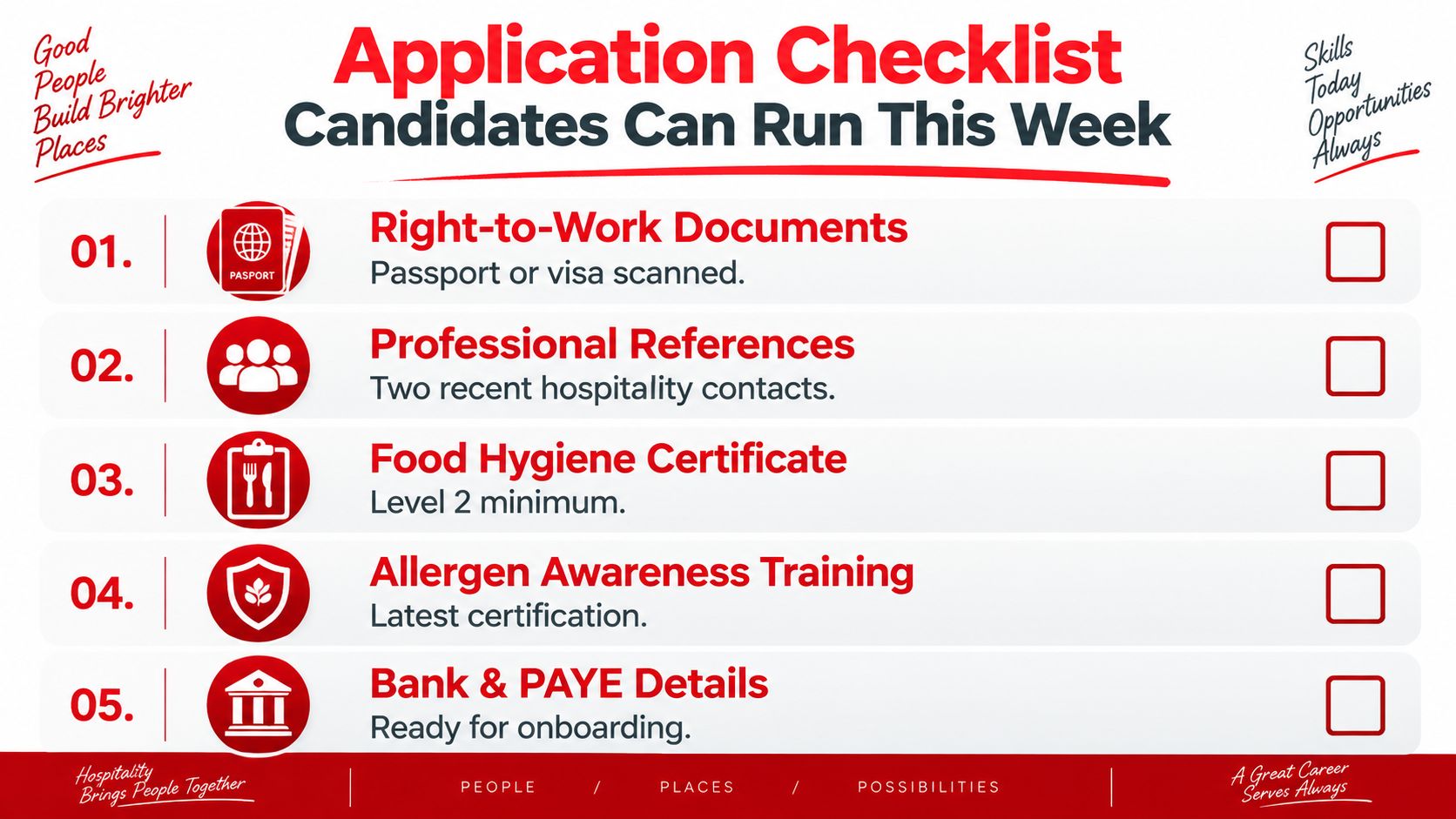
- Right-to-work documents: Have your passport or visa scanned and ready for checking.
- Professional references: Prepare two recent hospitality contacts who can speak about attendance, conduct and performance.
- Food hygiene certificate: Keep a relevant Level 2 certificate available where the role requires it.
- Allergen awareness training: Make sure your latest certification is easy to send.
- Bank and PAYE details: Have onboarding information ready so payroll doesn't delay deployment.
A chef applying for race-day work should put high-volume breakfast, banqueting, plated service, production cooking and section leadership near the top of the CV. A front-of-house candidate should show covers handled, service style, till or booking-system experience and any work in formal hospitality settings.
Interview preparation should be practical. Expect questions about fixed availability, long shifts, food safety, allergens, working under a section chef, guest complaints and what happens if transport fails. Give direct answers. “I can do the week but not the training day” may be a valid limitation, but it needs to be known before shortlisting.
Relief Chefs UK is a chef-led staffing partner established in 2013, supporting candidates and venues with relief chefs, temporary chefs and permanent chef recruitment. Its wider service range includes yacht chefs, villa chefs and hospitality staffing support, which can help a chef build a career beyond one race meeting.
The most useful preparation is a realistic rehearsal. Set the alarm for the proposed arrival time, test the route, check uniform and shoes, and make sure the five-day commitment won't clash with another booking or permanent job.
Pay, Contracts and How Cover Actually Works
Race-day work needs a clear money conversation before the first shift. Some Ascot-facing event roles have been benchmarked at around £15.08 per hour inclusive of holiday pay, while stewarding roles have been advertised at £13.45 per hour, including recruitment for 100 positions. Rates depend on the role, employer, responsibility and contract. Confirm whether holiday pay is included, because the headline figure may not be the basic rate.
PAYE, umbrella and limited-company arrangements produce different payslips and deductions. Ask who employs you, how holiday pay appears, whether pension deductions apply, and who authorises overtime or extra hours. A direct racecourse contract may give a straightforward reporting line. Agency work can provide access to other venues and repeat bookings, though the terms need checking each time.

What candidates should confirm
Get the role title, hourly rate, holiday-pay treatment, shift times, break arrangements, location, uniform requirements and payroll date in writing. If a daytime service could become a late close, establish how extra hours are approved and paid before accepting the booking.
For venues, the practical choice is direct recruitment, a general temp platform or a specialist staffing partner. Direct hiring gives the venue control, but its team must handle advertising, screening, compliance, payroll and replacement cover. A general platform may supply volume, while the manager still has to check kitchen capability, availability and suitability for the section.
A chef specialist maintains a relevant candidate network and understands section capability. Relief Chefs UK states that it offers 24/7 support, transparent pricing and no hidden agency fees, with Starter, Growth and Premium plans for different venue sizes. Its published model includes a two-hour response window and chefs who can start within 48 hours, subject to suitability and checks, as described on the Relief Chefs UK service site.
Commercial question: Ask which section the chef can cover, when checks were completed and what happens if the booked person becomes unavailable. A name on a rota is not the same as confirmed cover.
A Manager's Short-Notice Cover Plan for Race Week
A fragile race-week rota needs a named process. Waiting for a sickness call before deciding who to contact leaves the duty manager negotiating under pressure, while a pre-agreed plan gives the operation options.
The chef market is already tight. UKHospitality reports 132,000 vacancies, 48% above pre-pandemic levels, and cites chef shortages ranging from 10% for head chefs to 21% for production chefs, as set out in its workforce campaign evidence. The BBC has also reported a hospitality shortfall of about 188,000 workers, with chefs and front-of-house staff in particularly acute demand, in its coverage of hospitality labour shortages.
Four decisions before the first fixture
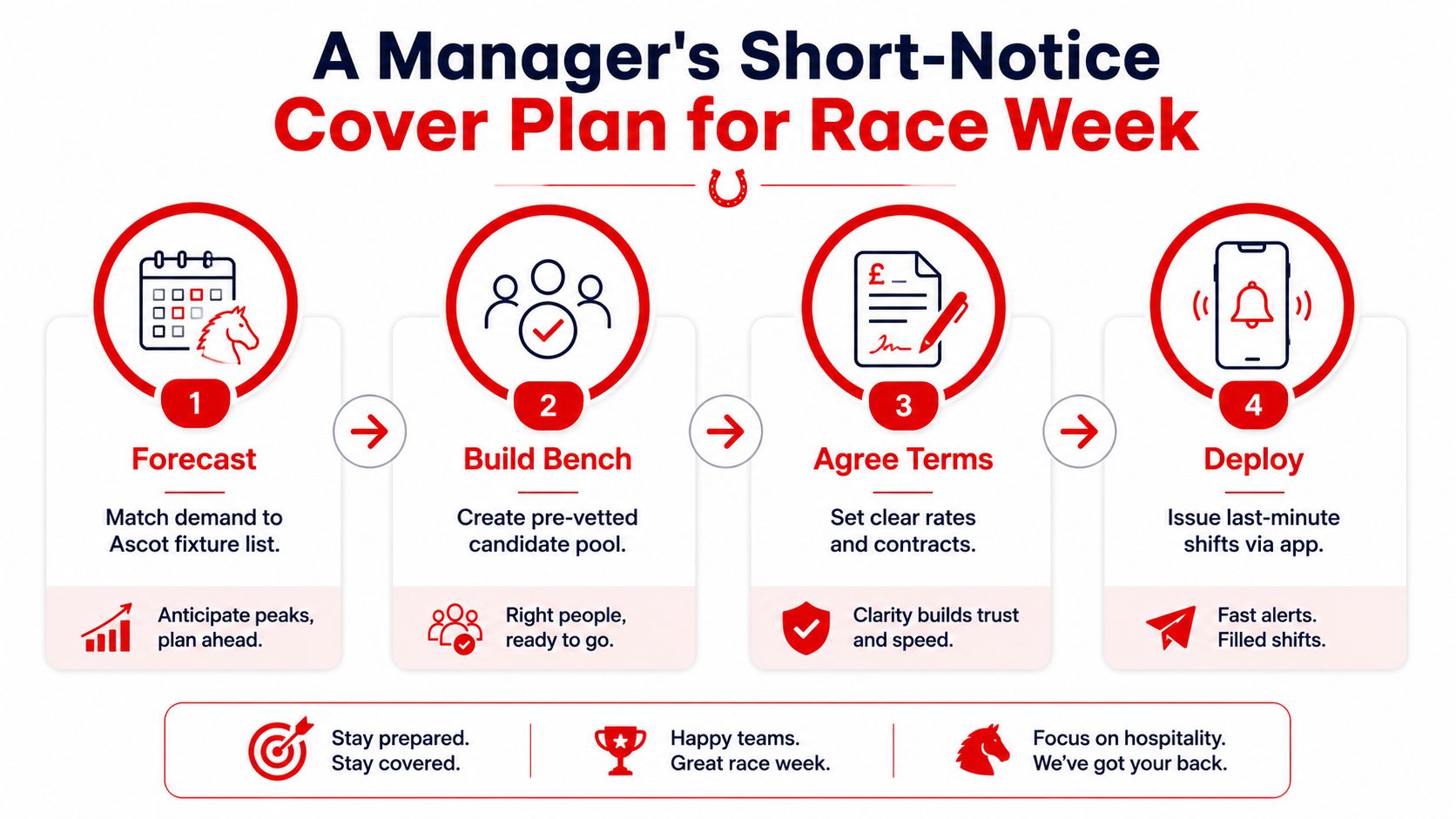
Forecast: Match expected covers, menus, hospitality suites and opening hours against the Ascot fixture list. Include preparation and close-down, not just guest-facing service.
Build the bench: Create a pre-vetted list of chefs by section. Separate pastry, breakfast, banqueting, larder, grill and senior kitchen leadership rather than keeping one undifferentiated contact list.
Agree terms: Confirm rates, PAYE or other arrangements, minimum shift information, cancellation terms, transport expectations and the authority required to approve emergency cover.
Deploy: Decide who sends the shift, who confirms acceptance and who updates the kitchen team. Run a dry rehearsal, including a no-show, so the team knows whether the first call goes to the agency, the standby chef or the operations manager.
Short-notice cover is not only about filling a body. A chef who arrives without the right experience can slow the pass, increase pressure on the sous chef and destabilise the team. The better question is whether the replacement can perform the required work with the available equipment, menu and supervision.
A specialist agency can also become a pipeline rather than a single-use emergency contact. Relief Chefs UK's monthly plans are designed to support small pubs and cafés as well as multi-site and hotel groups, allowing managers to combine relief chefs with temporary and permanent recruitment as their staffing needs change.
Frequently Asked Questions About Ascot Races Jobs
How quickly can a chef be mobilised for sickness cover during race week?
Contact the staffing partner as soon as an absence is confirmed. Provide the shift time, venue, kitchen section, menu style, dress requirements and expected finish. Early notice improves the chance of matching the right skill set instead of accepting the first available chef.
Relief Chefs UK states that venues can receive a response within two hours, while vetted chefs may start within 48 hours, subject to checks and suitability, according to the company's published service information. Same-day cover depends on local availability and request timing. It should support race-week planning, not replace it.
Does Ascot event experience translate into yacht and villa chef work?
It can strengthen a candidate's profile. Race meetings test stamina, organisation, food-safety discipline, communication and consistent service under pressure. Those skills matter when guests expect accurate work through several demanding service periods.
Yacht and villa roles require more than race-day pace. Candidates may need private-household awareness, discretion, travel flexibility and greater independence with menu planning. A race-week booking supports the application, but it does not by itself prove suitability for private or maritime work.
Which UK regions can Relief Chefs UK cover?
The service operates across the UK. Berkshire and Windsor venues can use it alongside local sourcing, while venues in Reading, Slough, Bristol, Wales, Devon and Dorset can also enquire about chef cover. Availability still depends on the required section, dates, travel and candidate suitability.
Relief Chefs UK says it supports more than 400 venues across the UK, offers 24/7 support, and provides transparent pricing without hidden agency fees, as stated on its company website. That wider pool can help when race-week demand coincides with staffing pressure in other hospitality areas.
What's the simplest way to start a conversation?
Send the venue location, service dates, role, kitchen section, shift times and whether the requirement is emergency, seasonal or permanent. A phone call helps when several shifts are exposed or the manager needs to discuss a broader staffing plan.
Candidates should provide an updated CV, right-to-work documents, references and genuine availability. Clear information lets a staffing partner assess fit quickly, including whether the chef can handle the menu, equipment and level of supervision available.
Relief Chefs UK provides relief chefs, temporary chefs, permanent chef recruitment and wider hospitality staffing support for race meetings, hotels, pubs, restaurants, yacht operations and villa placements across the UK. If Royal Ascot or another fixture has left the rota exposed, contact Relief Chefs UK with the dates, location and kitchen requirement so the team can discuss practical cover.