

A Saturday service can expose the difference between a modern cooking technique that supports a kitchen and one that undermines it. A relief chef arrives in a Bristol hotel with a missing section chef, finds vacuum-packed beef already cooking, and discovers that nobody has recorded the batch start time or checked the probe. In another kitchen near Devon, the same controlled process has short rib portioned, labelled and ready to finish, allowing a reduced team to serve consistently through a busy evening.
That distinction matters in pubs, restaurants, boutique hotels, private households and yacht galleys across the UK. Modern cooking techniques aren't automatically valuable because they look advanced. They earn their place when they improve consistency, yield, safety or handover quality while staffing is tight.
The practical test is simple. Can a chef who doesn't know the kitchen walk in, check the equipment, understand the batch sheet and deliver the dish during a split shift? If the answer is no, the technique hasn't been operationalised. The following methods are judged through that test, with particular attention to kitchens in Bristol, Devon, Berkshire, Wales, Dorset, Reading, Slough and Windsor.
When a Modern Technique Saves the Night and When It Bites Back
At 6.15pm on a Friday, a pub kitchen has one chef off sick and a wedding party arriving at the hotel next door. The head chef has planned a sous vide beef dish, with portions sealed, labelled and cooked to a documented process. The relief chef checks the bath, verifies the probe, confirms the batch sheet and finishes each portion to order. The technique has bought the team something more useful than theatre, it has bought repeatability under pressure.
The following Saturday, a different kitchen has invested in the same equipment. The bags are poorly sealed, the cooking times are written on a whiteboard, and nobody knows whether the product was chilled quickly enough after cooking. At 9pm, the bath is full, the pass is waiting and the chef is opening bags to identify portions. The equipment hasn't failed. The handover has.
The working definition
A modern cooking technique is any controlled process that changes how a kitchen manages heat, time, moisture, acidity, smoke, pressure or texture. That includes sous vide, fermentation, reverse searing and low-temperature combi-oven work, but it also includes disciplined batch cooking with reliable records.
The important question isn't whether a technique is fashionable. It's whether the method survives:
- A handover: another chef understands the process without relying on memory.
- A probe check: the equipment and food temperatures can be verified.
- A split shift: prep and service remain connected when different chefs take over.
- A busy pass: the final action is clear, fast and repeatable.
Practical rule: If the method needs one particular chef to interpret it, it isn't yet a kitchen system.
A gastropub in Devon may gain more from controlled braising and reverse searing than from elaborate gels. A Berkshire hotel may benefit from batch consistency during banqueting, while a yacht chef needs methods that work in a compact galley with changing crew. The right technique is the one that protects standards when the rota doesn't.
The Core Techniques and How They Work in Practice
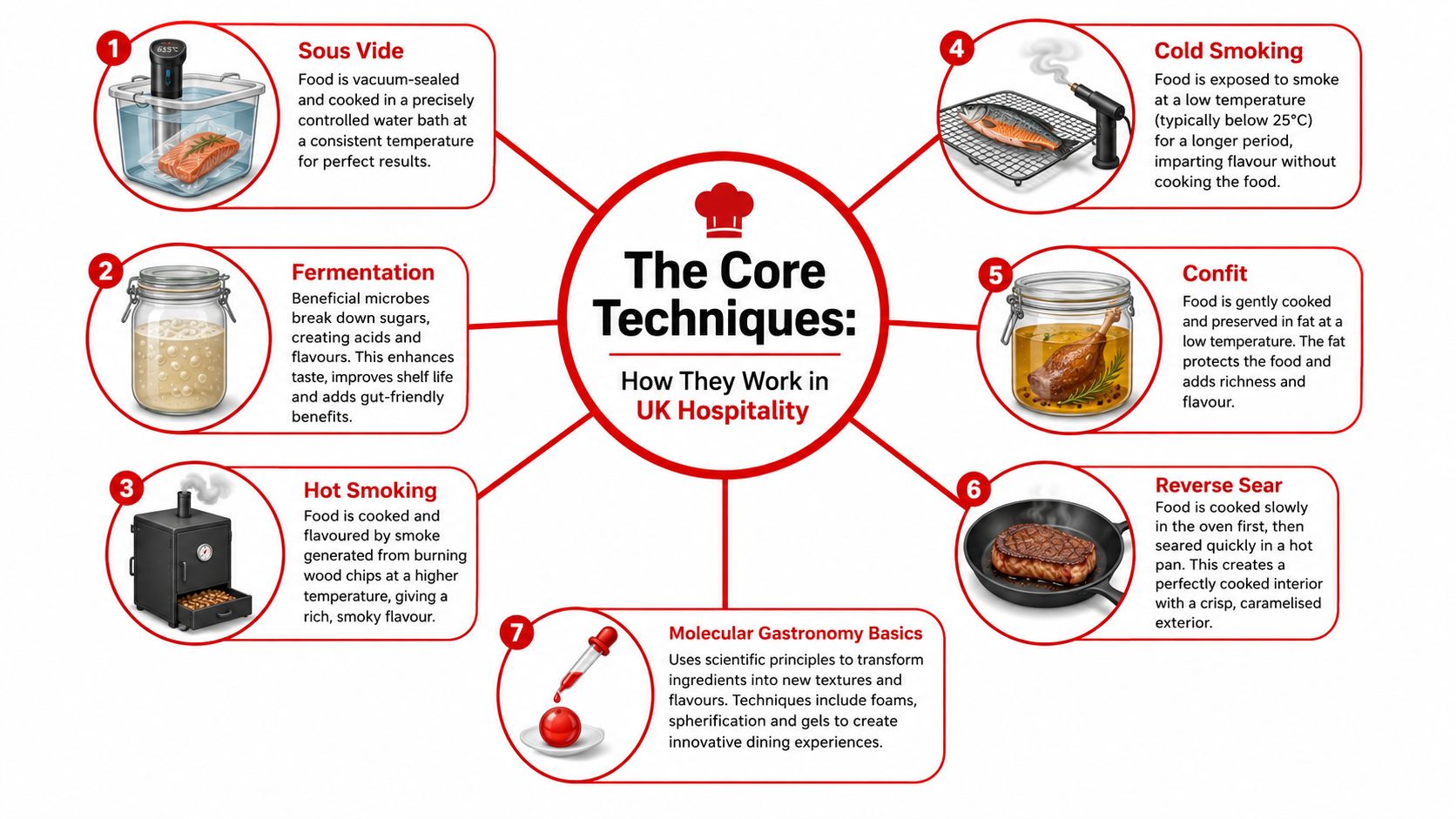
A relief chef has 48 hours to make an unfamiliar kitchen dependable. Every technique below must survive a handover, a probe check and a split shift. If the process depends on one person's memory, it is not ready for service.
Sous vide seals food in a vacuum bag and cooks it in a controlled water bath. Water transfers heat evenly, allowing the centre to reach a predictable temperature without overcooking the outside. The method rewards accurate time and temperature records, but exposes weak labelling, sealing and chilling procedures quickly. Great British Chefs traces sous vide's professional UK development, while East Suffolk Council's sous vide guidance explains the controls operators must document.
Fermentation uses beneficial microbial activity to change flavour, acidity and texture. Salt, temperature, time and oxygen exposure determine whether a ferment develops cleanly or spoils. A kitchen must manage each variable explicitly, with labelled vessels, clear dates and an assigned person responsible for checks. It can give a restaurant a distinctive condiment range, but it is a poor fit for a team that cannot maintain records across shifts.
Hot smoking combines heat and smoke, cooking food while depositing smoky compounds on its surface. Cold smoking adds smoke without cooking the product, so a separate safe cooking or curing process is required. Both methods depend on airflow, condensation and internal temperature control. A fish smoker, smoke gun or enclosed cabinet can add character, but equipment alone does not make the process repeatable.
Confit cooks food slowly in fat, limiting moisture loss and softening connective tissue. Duck leg is the familiar example, though vegetables and other proteins can work when the recipe and food-safety controls are clear. It suits batch preparation because the cooking method is forgiving, but holding, storage and portioning still need written instructions.
Reverse sear cooks a thick portion gently before finishing it with intense surface heat. Separating doneness from browning gives better control of the centre and makes the final sear faster during service. It works well for banquet steaks and large cuts, provided portions are consistent and the finishing station knows exactly what arrives from the oven.
Molecular gastronomy basics use spherification, foams, vacuum infusion and gelling agents to alter texture or carry flavour. Vacuum pressure can draw liquid into ingredients, while gels create a defined structure. These methods can sharpen a tasting-menu course or drink, but they bring extra weighing, preparation and storage steps that a relief chef must be able to teach quickly.
Finally, low-temperature combi-oven work combines controlled heat and humidity. It can roast, steam, regenerate and hold with less guesswork than a conventional oven, provided programmes are labelled and loads remain consistent. That consistency matters more than the novelty of the equipment at a busy pass.
| Technique | Typical UK fit |
|---|---|
| Sous vide | Premium pubs, restaurants, banqueting and yachts |
| Fermentation | Small restaurants and modern cafés |
| Smoking | Gastropubs, hotels and seafood menus |
| Confit | French-led menus and batch preparation |
| Reverse sear | Hotels and events |
| Molecular basics | Tasting menus, cocktails and yacht service |
| Low-temperature combi work | Multi-section hotels and high-volume kitchens |
Matching Techniques to Your Menu and Equipment Budget
The wrong first question is, “Which technique looks impressive?” Ask instead whether the method fits the menu format, equipment available, training burden and service speed. A technique that produces an excellent plate but creates uncertainty for the next shift is an expensive complication.
| Technique | Best Menu Fit | Equipment Cost | Training Burden | Energy Profile |
|---|---|---|---|---|
| Sous vide | Premium proteins and batch-controlled menus | Medium | Medium to high | Higher than conventional cooking |
| Fermentation | Condiments, vegetables and drinks | Low | Medium | Low, with space and monitoring needs |
| Hot smoking | Meat, fish and robust vegetables | Medium | Medium | Medium to high |
| Cold smoking | Fish, dairy and finishing flavours | Low to medium | High | Low to medium |
| Confit | Batch-cooked meat and vegetables | Low to medium | Low to medium | Medium |
| Reverse sear | Thick steaks and banqueting | Low to medium | Low | Medium |
| Molecular basics | Tasting menus and drinks | Low to medium | High | Low to medium |
| Low-temperature combi work | Hotels, banqueting and regeneration | High | Medium | Efficient control, but electricity demand depends on use |
A gastropub in Devon might compare a combi oven with a larger vacuum sealer. If the menu already depends on roast meats, regeneration and predictable holding, the combi may solve several problems at once. If the kitchen has a strong premium-protein offer and enough chilled storage, vacuum packing may deliver a clearer return. The answer depends on the menu, not the equipment catalogue.
A Bristol restaurant with a small prep kitchen can start fermentation with labelled jars, dedicated storage and a narrow product range. A lacto-fermented chilli sauce may be easier to control than several ambitious ferments competing for space and attention. The chef should assign ownership, record preparation dates and remove any batch that fails its specification.
A boutique hotel in Berkshire may use reverse sear for banquet sirloin because the method separates the slow cook from the final finishing step. That gives the events team a more predictable plate when several sections are firing together. It also means the relief chef can understand the process quickly, provided the batch sheet states the cut, target finish, holding method and searing instruction.
Start with the method that removes the most decisions from the busiest service, not the method that adds the most novelty to the menu.
Food Safety HACCP and Documentation You Cannot Skip
A technique that works during prep can still fail at 9pm on a Saturday if nobody can confirm its controls. Every process needs a written record covering the hazard, critical control point, responsible person, corrective action and verification. Keep that record beside the equipment, where a relief chef can use it during a handover and a split shift.
Sous vide controls
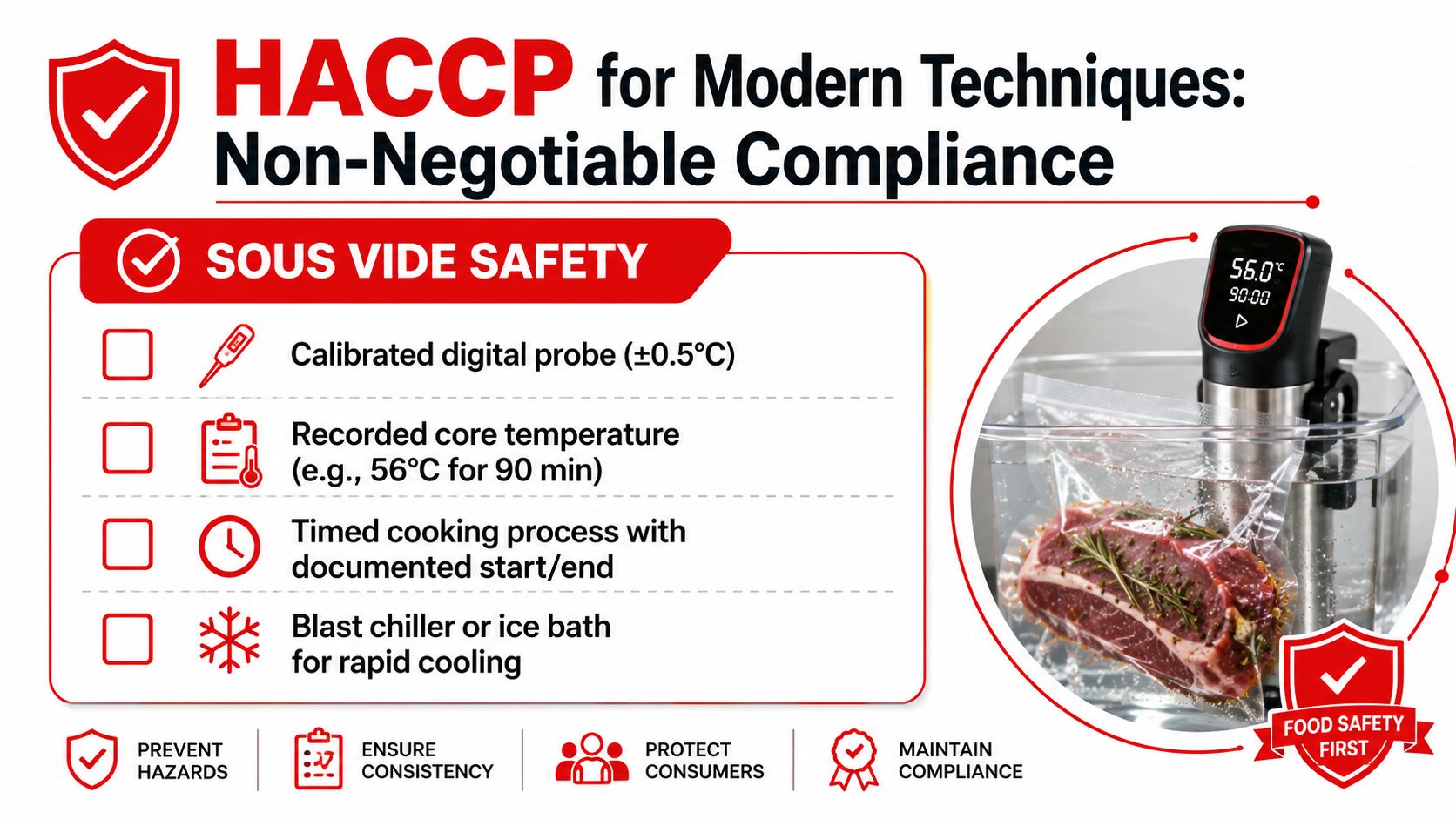
UK guidance identifies validated equivalents for vacuum cooking, including 60°C for 45 minutes, 65°C for 10 minutes, 70°C for 2 minutes, 75°C for 30 seconds, or 80°C for 6 seconds. Measure the core temperature at the thickest point. Food intended for holding should be chilled to below 3°C within 90 minutes, and vacuum-packed sous vide food should stay within a 10-day use window unless a longer shelf life has been validated. These controls appear in UK sous vide food-safety guidance.
Set the water bath about 2.5°C above the target core temperature to allow for heat transfer. The batch sheet should include the calibrated probe check, batch number, start time, finish time, core reading, cooling record and use-by date. If a relief chef cannot find those details quickly, the process is not ready for service.
Fermentation and smoking
Fermentation needs a defined product specification. Record the ingredients, salt or starter process, vessel, preparation date, storage conditions, checks and disposal decision. Check pH where acidity controls the process, and track allergens across cultures, sauces and added ingredients. A narrow, clearly labelled range is easier to hand over than several batches with different rules.
For hot smoking, record the internal cooking temperature and time. Cold smoking requires a separate curing or cooking control because smoke does not replace safe cooking. Manage condensation, airflow and storage, particularly for fish, dairy and ready-to-eat items.
For foams, gels and spherification, record hydrocolloid ingredients and allergens, then set holding temperatures and service life. A one-page handover should state:
- Product: name, batch and portion size.
- Process: equipment setting, time and temperature.
- Checks: probe, pH, seal, appearance and corrective action.
- Storage: container, location, date and use-by instruction.
- Service: finishing step, holding limit and responsible chef.
Use the health and safety compliance guidance for hospitality kitchens to keep operational and documentation requirements together. Clear paperwork speeds the pass because the team can confirm whether a batch is safe to serve.
What Modern Techniques Really Cost in an Understaffed Kitchen
Walk into an unfamiliar kitchen with 48 hours before service stabilises, and the purchase price is rarely the first problem. The cost is training time, storage, electricity, packaging, probe checks and management attention. A technique earns its place when it reduces shrink and removes repeated judgement calls. It becomes a liability when only one chef can run it.
Chef shortages make that distinction practical. CV-Library's quarterly hospitality analysis recorded postings rising from 23,103 to 40,395 in a single quarter, with vacancies up 74.8% on the previous quarter and 83.4% year on year. A relief chef cannot assume the next shift will have the same technical confidence, so each process must survive a handover and a busy split shift.
Consumer familiarity does not guarantee reliable execution. 65% of UK households own an air fryer, while research found that nearly half of 18 to 24-year-olds could cook only one or two meals from memory and 22% could manage two dishes or fewer without a recipe, as reported in consumer research on air-fryer cooking instructions. The operational test is simple: can a chef follow the method correctly at 9pm on a Saturday?
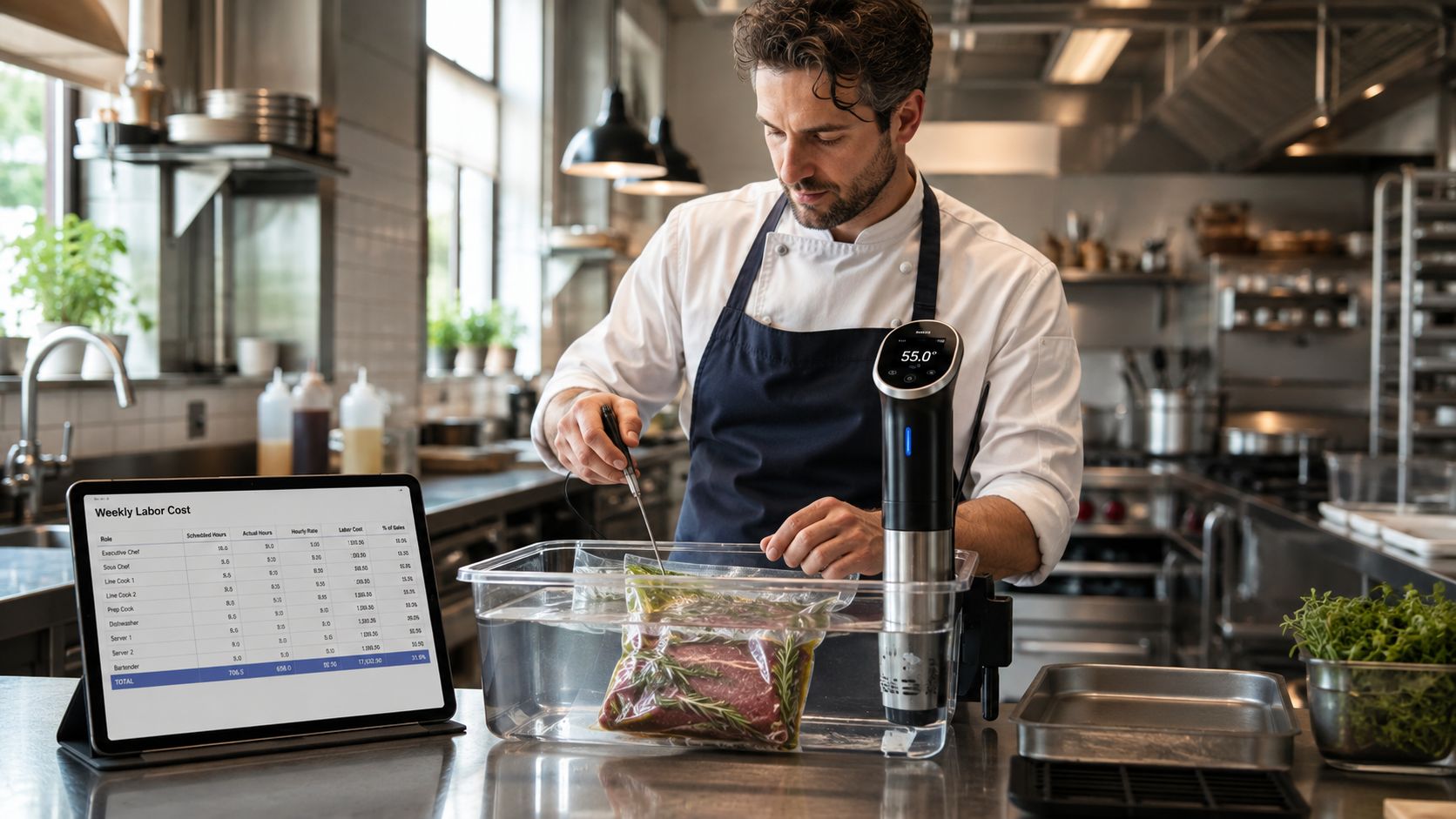
Where the hidden cost sits
- Probe calibration: A faulty reading can invalidate an otherwise sound process.
- Water-bath cycling: Preheating and long residence times increase electricity demand.
- Fermentation storage: Jars need labelled, clean, temperature-appropriate space.
- Daily prep: Portioning, sealing, labelling and recording consume labour before service.
- Training and handover: Every chef must understand the same critical points. See our guide to the cost of employing chefs for the wider staffing calculation.
A peer-reviewed review describes sous vide as capable of preserving nutrients and reducing waste, while also requiring more energy than traditional cooking. A controlled poultry study found total energy consumption with preheating was approximately five to ten times higher than traditional methods, as discussed in the review of sous vide cooking. The stronger business case is therefore premium menu work, banqueting and yacht galleys, where yield and consistency can outweigh utility demand. On a tiny à la carte menu, a dependable classic method may cost less and hand over more cleanly.
A 48 Hour Rollout Plan for Relief Chefs and GMs
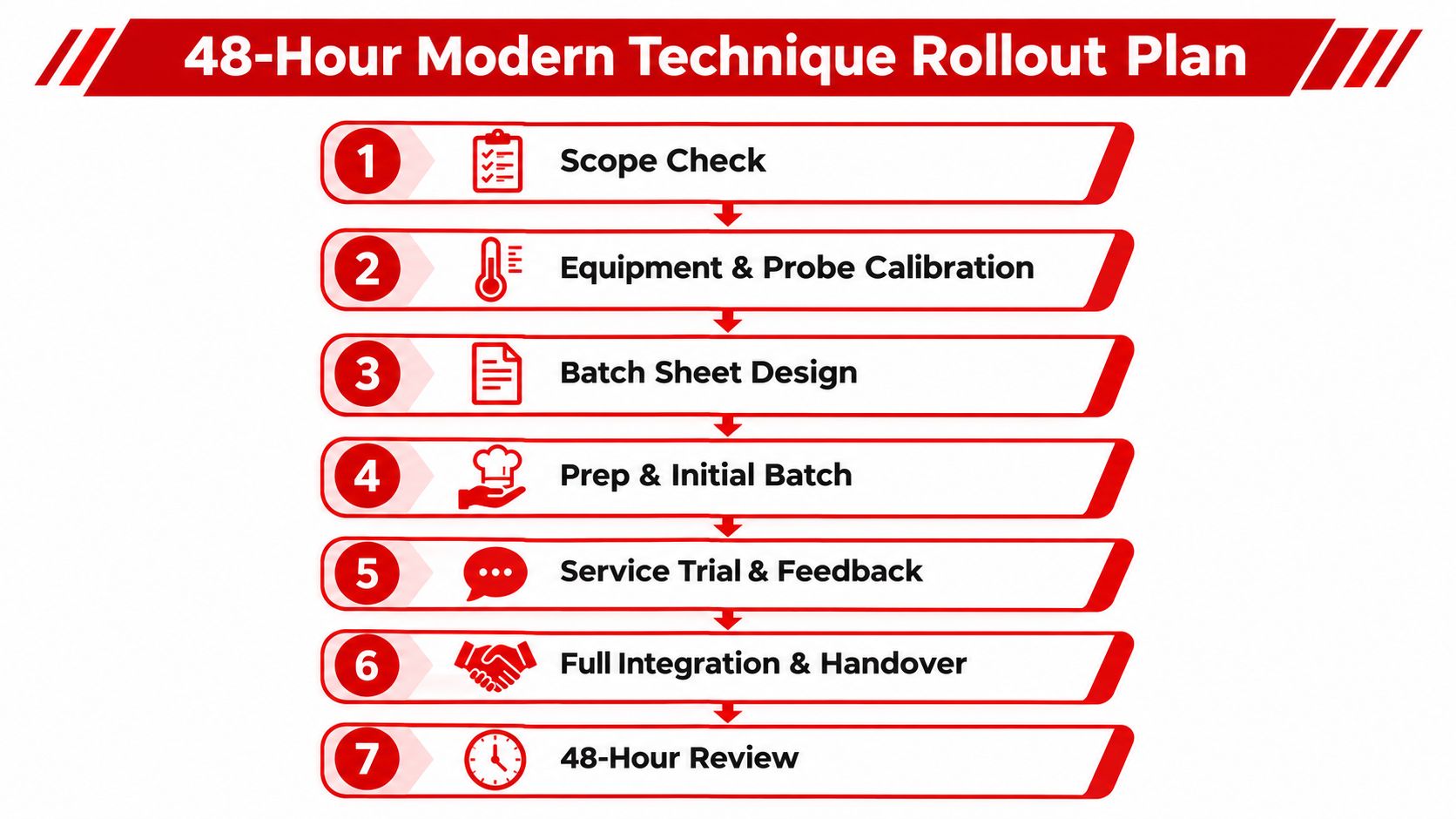
A new technique doesn't need a long project plan. It needs a tight scope, visible controls and a handover another chef can follow. This seven-step process works for a GM in Slough, a relief chef in Dorset or a yacht chef rotating into an unfamiliar galley.
Scope the dish. Choose one product and one service outcome. Don't introduce fermentation, sous vide and smoking at the same time. Write down the portion, target finish and maximum holding period.
Check the equipment. Confirm the bath, oven, smoker, sealer and storage area are clean and working. Test the probe in iced water, record the reading and compare it with the kitchen's accepted calibration process.
Create the batch sheet. Include ingredients, portion size, bag or container format, equipment setting, start and finish times, core temperature, cooling action, label and corrective action. A relief chef should understand the page without asking who designed it.
Prepare a controlled first batch. Keep the quantity modest enough to inspect every portion. Check seals, weights, labels and the product's appearance before committing it to the full service.
Run a low-risk service trial. Put the dish on a section with a simple finish. Ask the chef to time the final action, identify where tickets queue and note whether the equipment blocks another task.
Debrief before close. Record what broke at the pass, which label was unclear and what the next shift needs to know. Don't rely on a verbal “it was fine”.
Sign off the handover. The outgoing chef signs the batch and the incoming chef repeats the critical controls. If the process can't be explained in a short morning briefing, simplify it before expanding.
A good relief chef doesn't just cook the batch. They leave the next shift with a process that can be checked.
This is the type of handover supported by relief chef cover in Devon, where the incoming chef needs to protect service quickly without rewriting the whole kitchen.
Menu Ideas That Put the Techniques to Work
A technique earns its place through the menu it supports. These examples show how I would brief the dish, the service risk and the chef profile needed to run it.
Gastropub short rib in Bristol
Cook a portioned short rib sous vide, chill it correctly, then finish it with a reduced jus and hard sear. For a Bristol pub running one chef down, this keeps the main protein consistent while the relief chef concentrates on garnish, sauce and pass control. The right cover is a confident temporary chef who can read batch labels and manage a fast finish.
Berkshire wedding hotel duck
Hot smoke duck breast for flavour, confit the legs for the main course and use the same bird across a wedding menu. The hotel gains a coherent preparation plan during a busy weekend, but only if the batch sizes, holding rules and finishing instructions are written down. A banquet-experienced relief chef can work across sections and protect portion control.
Yacht cocktail service
Use spherification for a gin and tonic garnish, prepared before service and held according to the recipe. On a yacht, the technique should remain a small accent rather than a production burden. A yacht chef familiar with compact-galley organisation can prepare the garnish, brief the service team and keep the core menu moving.
Small restaurant condiments
Lacto-fermented hot sauce and koji-aged butter can give a modern identity to a small restaurant without adding a new main-course section. Start with one batch of each, label every container and give the incoming chef a taste and appearance specification.
Hotel banquet sirloin
Reverse sear thick sirloin before service, then finish portions rapidly to order. This suits a hotel where two sections must produce a consistent plate, provided the holding and finishing instructions are unambiguous.
Café grab-and-go
A low-temperature kombucha or controlled fermented drink can support a café trial, but it needs the same attention to dates, storage and product checks as a restaurant preparation. Keep the range narrow until the team can maintain it through holidays and rota changes.
Keeping Kitchens Stable When Staffing Cannot Wait
A modern technique only improves a kitchen when the team can operate it consistently. That is difficult while venues manage short-notice sickness, seasonal demand, unreliable agency cover and vacancies across the whole site. UKHospitality reports 132,000 sector vacancies, 48% above pre-pandemic levels, with chef shortages ranging from 10% for head chefs to 21% for production chefs.
The pressure isn't limited to chef roles. UKHospitality's written evidence to Parliament recorded sector vacancy rates of at least 10% and potentially as high as 16%, representing 210,000 to 336,000 unfilled roles. Its member survey found vacancies across front of house, chef roles, kitchen porters, assistant managers and housekeeping. When one missing person forces the head chef onto a different section, even a well-designed modern process can become difficult to control.
Questions operators ask
Which technique pays back fastest in a small pub?
Usually the simplest method that reduces service decisions, such as reverse searing, controlled braising or a carefully scoped sous vide dish. Start with the menu item that creates the most pressure, then measure prep time, finishing speed, yield and handover clarity. Don't buy equipment before identifying that bottleneck.
Is sous vide worthwhile without a designated HACCP-trained chef?
It can be, but not without documented controls, calibrated equipment and a person responsible for checking each batch. If nobody can own the records, choose a simpler technique or arrange appropriate staffing and training before introducing it.
How quickly can a relief chef pick up an in-house technique brief?
A competent relief chef should be able to work from a clear batch sheet and practical handover. A written process should cover the equipment setting, critical temperature, timing, storage, finishing and corrective action. Relief Chefs UK provides relief chefs, temporary chefs, permanent chef recruitment, yacht chefs, villa chefs and broader hospitality staffing support for venues that need cover without losing kitchen stability.
For operators in Devon, Bristol, Dorset, Berkshire, Wales, Reading, Slough, Windsor and other UK hospitality hotspots, the staffing decision often needs to happen before the next rota gap becomes a failed service. Relief Chefs UK is a nationwide chef recruitment agency established in 2013, offering vetted, right-to-work-checked chefs, a two-hour response window, 48-hour starts, transparent monthly plans and 24/7 support.
Contact Relief Chefs UK when you need a relief or temporary chef who can understand your modern cooking processes and protect service at short notice. Whether you're covering sickness, preparing for seasonal demand or building a permanent chef recruitment pipeline, explain your menu, equipment and handover requirements so the right chef can be matched to your kitchen.