
Seasonal Demand Forecasting for Hospitality
15 July 2026
Friday bookings look light on Monday. By Thursday, the phone starts going. A coach party appears in the diary, the weather turns, the terrace fills, one chef calls in sick, and the rota that looked sensible suddenly isn't. Most hospitality operators know that feeling far too well.
That's why seasonal demand forecasting matters. Not as a head office exercise. Not as a spreadsheet for its own sake. As a way to protect service, cash flow, team morale, and your margin when demand moves faster than your kitchen can.
The mistake many venues still make is forecasting guests without forecasting whether they can staff the pass. In the current UK market, that gap is where a major source of pain sits.
Why 'Guesswork' Is Costing Your Hospitality Business Dearly
Hospitality businesses don't usually fail because managers don't work hard enough. They get caught by poor planning, thin rotas, and demand swings that hit faster than labour decisions can keep up.
That's become more dangerous because the market is moving. The UK hospitality market is projected to grow substantially, with inbound tourism supported by a weak GBP acting as a key tailwind for demand surges, according to Mordor Intelligence's UK hospitality market analysis. Growth sounds positive. In practice, it means more pressure on independents to get staffing right during peaks.
Where guesswork hits the P&L
If you under-forecast, you feel it in service first. Tickets back up, prep gets rushed, standards slip, and guests don't come back because they remember the wait, not your staffing excuse.
If you over-forecast, the damage manifests subtly. Too many paid hours on a soft Tuesday. Senior chefs covering dead shifts. Overtime later in the week because the wrong labour was used at the wrong time.
A rough forecast usually creates all of these problems at once:
- Labour waste: Too many hours scheduled for weak demand periods.
- Lost revenue: Covers turned away because the kitchen can't cope.
- Kitchen instability: Good chefs burn out when every peak becomes a rescue job.
- Panic buying of labour: Last-minute cover gets booked reactively, often with less control over fit and consistency.
- Poor manager time use: GMs and head chefs spend hours firefighting instead of leading service.
Practical rule: If your staffing decisions start only when the rota breaks, you're already late.
The real issue isn't just demand
Most operators still treat forecasting as a sales exercise. Last year's covers. This year's local events. Maybe a weather check if the site has outside space. That's useful, but it's incomplete.
The core operating question is simpler. What level of demand can your available kitchen team deliver well?
That changes how you plan. A boutique hotel in Berkshire, a busy food-led pub in Devon, or a coastal site in Dorset might all have strong demand signals. None of that matters if the kitchen can't field a stable team for the dates that pay the bills.
There's a reason labour control and kitchen resilience have to sit together. If you're trying to cut costs while constantly using overtime to patch holes, you're not really controlling labour. You're shifting the problem. A better starting point is to tighten forecasting and reduce avoidable premium hours before they build, which is exactly the discipline behind reducing overtime costs in hospitality kitchens.
Good forecasting doesn't remove uncertainty. It stops uncertainty from running the business.
Gathering Your Essential Forecasting Data
Most bad forecasts fail before the maths starts. The issue isn't the formula. It's missing inputs, messy records, and no shared view of what drives demand at site level.
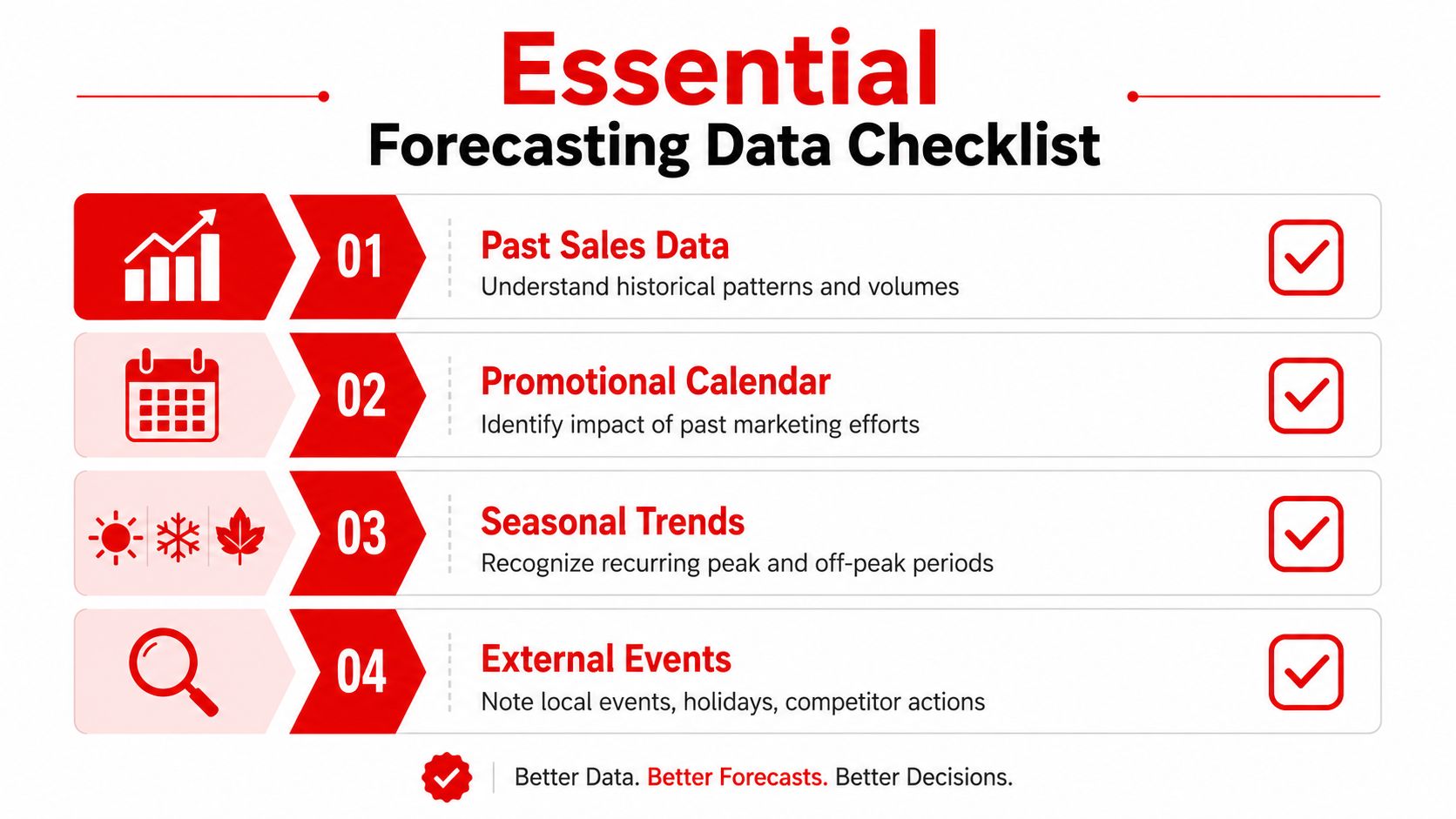
Build your forecast from operating data you already have, then layer in the external triggers that move covers, spend, and staffing pressure.
Start with the numbers your venue controls
For most pubs, restaurants, and hotels, the core data set should be simple and repeatable.
Use one spreadsheet or one reporting view that tracks:
- Covers by service: Lunch, dinner, breakfast, Sunday roast, events, private dining.
- Average spend per head: Useful because full dining rooms don't always mean strong revenue.
- Booking lead times: Early bookings and late bookings tell you different things about confidence and demand shape.
- Walk-ins versus reservations: Important for city sites like Bristol or Reading where last-minute trade can swing quickly.
- Labour cost by shift: Not just weekly payroll. You need service-level visibility.
- Actual rota versus worked hours: This shows where the plan regularly breaks.
- Cancellations and no-shows: Especially important for premium dates and weather-sensitive sites.
If you run bedrooms as well, add occupancy and meal uptake alongside food sales. If you run multiple revenue streams, split dine-in, events, bar food, room service, and delivery. Broad totals hide the detail that matters.
Add the local demand triggers
A proper hospitality forecast also needs context. A Windsor hotel near race or visitor traffic behaves differently from a neighbourhood restaurant in Slough. A pub in Wales with strong bank holiday trade has different lead times from a corporate-heavy site in Reading.
Track external drivers in the same file:
| Demand driver | What to log | Why it matters |
|---|---|---|
| Local events | Festivals, sports, concerts, race days, graduations | They can distort normal trade patterns |
| School holidays | National and local holiday periods | Family trade and tourism shift around them |
| Weather notes | Heat, rain, wind, storms | Outdoor and coastal trading changes fast |
| Promotions | Offers, menu launches, live music, themed nights | Internal activity can create false “seasonality” if not labelled |
| Competitor movement | New openings, closures, refurbishments | Nearby supply changes your demand pattern |
The cleaner your labels are, the easier it is to tell the difference between a real seasonal pattern and a one-off trading anomaly.
Review it on a rhythm, not when things go wrong
Forecasting only works if it's updated often enough to stay useful. Operators need to update labour versus revenue variance forecasts weekly during peak periods and at least fortnightly during stable phases, with a rolling 13-week cash flow forecast and real-time updates when opening hours or menus change, as set out in Veritus Consultancy's guide to seasonal cash flow management.
That rhythm matters because demand doesn't wait for month-end reporting. If a menu change slows ticket times, or a function booking lands on a soft midweek date, staffing needs move immediately.
For hotels and mixed-use venues, a practical benchmark is to align kitchen forecasting with operations planning, not just finance reporting. In this context, a more joined-up hotel staffing guide for operational planning becomes useful. It forces labour, occupancy, and service reality into the same conversation.
Simple Forecasting Methods That Actually Work
You don't need a data science team to build a usable forecast. Most sites can get much sharper results with a few practical methods done consistently.
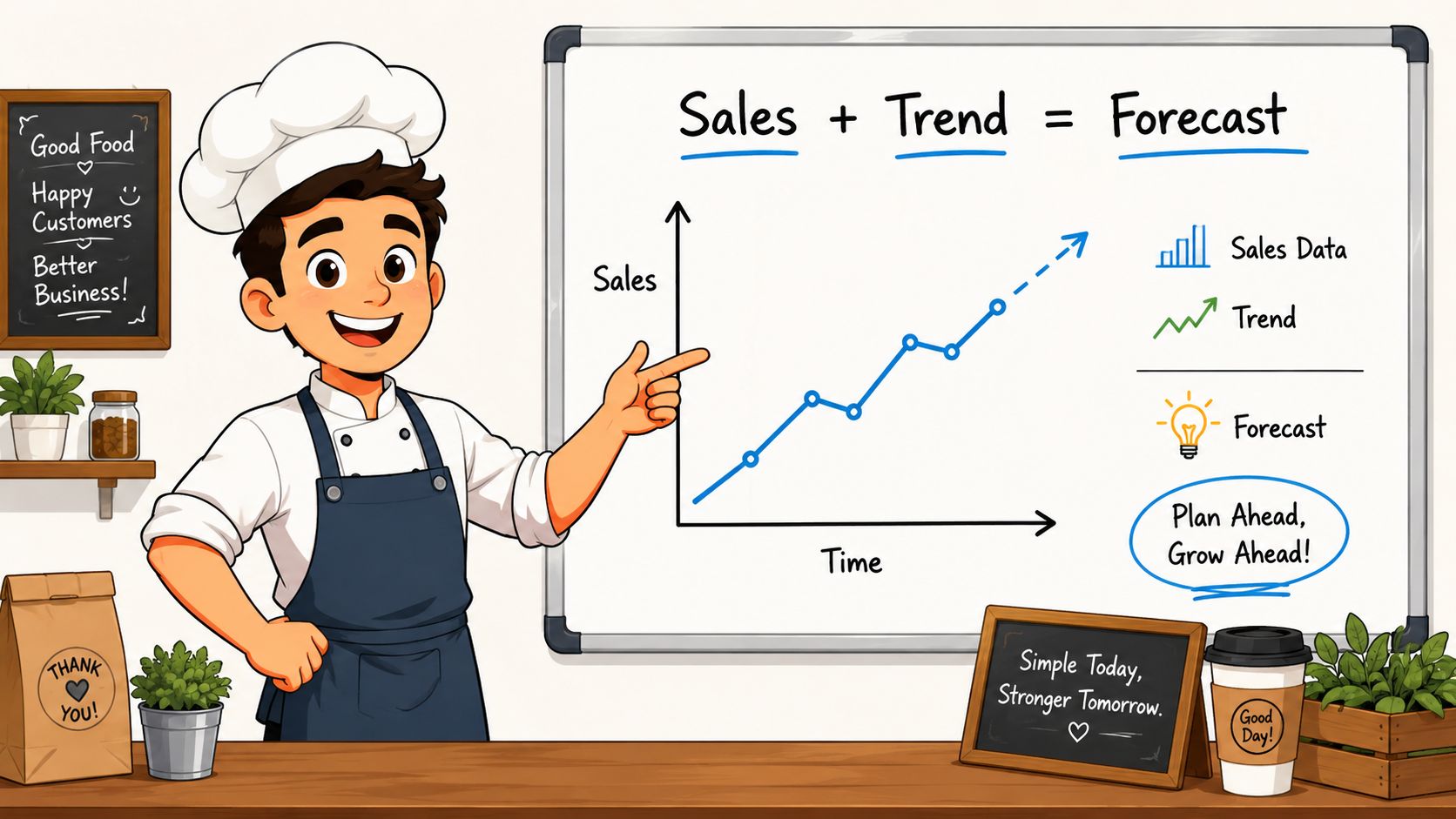
Start with one baseline method, test it against actual trading, then add adjustments. That's better than building an overcomplicated model nobody updates after two weeks.
Use year-on-year as your first anchor
Year-on-year comparison is the quickest place to start. Pull the same week last year, check covers, average spend, booking pace, and any obvious event differences, then set an initial view for the coming week.
This works well for stable patterns such as:
- Friday dinner in town-centre restaurants
- Sunday lunch in destination pubs
- Summer breakfast trade in boutique hotels
- Event weekends in places like Windsor or Bristol
It breaks down when last year included unusual factors such as closures, chef shortages, roadworks, or weather disruption. That's why year-on-year should anchor the conversation, not finish it.
Smooth the noise with moving averages
A moving average helps when weekly trade bounces around and you want the underlying pattern. In plain terms, you take a small run of recent periods and average them to reduce random spikes.
A simple example is a four-week moving average for Friday lunch covers. If one week was hit by heavy rain and another by a local event, the average gives you a steadier baseline than taking either week on its own.
This is useful for:
- Sites with patchy walk-in trade
- Venues reopening quieter dayparts
- Properties testing new menus
- Operations where one-off events skew the diary
Don't use a moving average to explain a real pattern away. Use it to remove noise, not local knowledge.
Link demand to causes
The next step is basic regression thinking, even if you never call it that. Ask what repeatedly changes demand at your site. Then track it.
Examples are straightforward:
- Rain suppresses beer garden trade.
- Warm evenings lift terrace covers.
- Graduation weeks push hotel F&B.
- A festival in Devon changes lunch and late-night demand.
- A wedding-heavy weekend increases prep and breakfast labour even if restaurant covers look normal.
You're not trying to build a university-grade model. You're trying to spot repeatable cause and effect.
For operators who want a stronger statistical method, there is a more advanced route. The Holt-Winters exponential smoothing method is identified as the statistically optimal technique for venues with clear seasonal patterns, achieving a 12.4% mean relative accuracy error for daily occupancy and chef cover demand in Boston University's hospitality forecasting analysis.
That matters because it confirms something operators already know in practice. Seasonal sites perform better when trend and seasonality are handled together, rather than guessed from memory.
A useful explainer sits below if you want to see forecasting basics in a more visual format before building your own spreadsheet model.
What actually works in real operations
The best method is the one your team will maintain. For most independents, that usually means:
| Method | Best use | Main weakness |
|---|---|---|
| Year-on-year comparison | Quick weekly baseline | Misses structural changes |
| Moving average | Smoothing inconsistent trade | Can hide sharp shifts |
| Cause-and-effect tracking | Event and weather sensitivity | Depends on disciplined logging |
| Holt-Winters | Strong seasonal venues with enough history | Less practical if nobody on site updates it |
If your team can keep one forecast accurate and current, that's stronger than building four reports nobody trusts.
Adjusting Your Forecast for Events and One-Offs
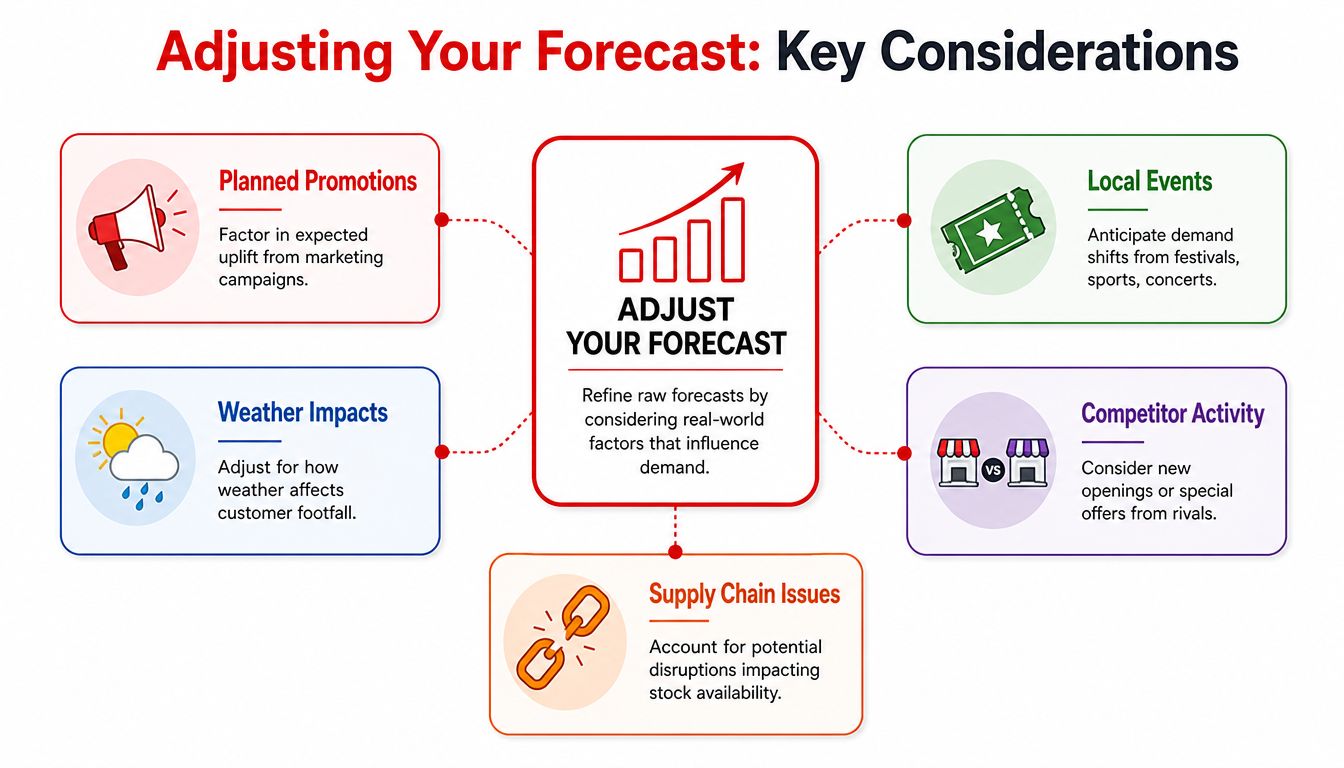
A base forecast is only half the job. Real trading gets moved around by things your historic numbers can't fully anticipate.
That's where managers either sharpen the plan or ruin it. Some adjust every figure based on instinct and create noise. Others refuse to adjust at all and get caught by obvious local factors.
Look for what changed, not just what happened before
Suppose you run a coastal venue in Dorset. Last year's August Saturday looked huge, so the instinct is to copy the labour plan. But if this year's weather is unsettled, or your outdoor seating is partially unavailable, that historical comparison can mislead you.
Recent climate modelling predicts a 6.27% to 9.09% increase in Hospitality Climate Index scores for urban and heritage properties, shifting demand from traditional summer peaks to more erratic, weather-driven micro-peaks, according to research published by Taylor & Francis Online. For hospitality operators, the practical implication is simple. Weather sensitivity is becoming more operationally important, not less.
Build adjustment rules your team can follow
The easiest way to handle one-offs is to create a short set of trigger rules. Not dozens. Just the few that repeatedly affect your site.
Examples:
- If a major local event lands within walking distance, increase likely late bookings and prep demand.
- If a hot weekend is forecast, review terrace staffing, prep, and dessert or cold section capacity.
- If heavy rain is expected, reduce outdoor assumptions and reassess no-show risk.
- If a menu change increases complexity, add labour even if cover numbers stay flat.
- If booking pace is behind the same point last week for a key date, pause aggressive rota expansion.
Good managers don't “feel” their way through adjustments. They write the rules once, then apply them consistently.
Watch booking pace like a live signal
Static forecasts miss the most useful clue in the building. Booking pace. If your Saturday dinner is usually near full by Wednesday and it isn't, that matters. If a Thursday lunch suddenly surges after a local event announcement, that matters too.
This is especially relevant in places with mixed demand drivers such as Bristol, Berkshire, or Wales, where corporate, tourism, and leisure trade can overlap unevenly through the week.
A practical review can be as short as this:
- Compare current bookings to the normal pace for that date.
- Check what changed locally or internally.
- Adjust labour only when the change is supported by evidence.
- Review the result after service and keep the note.
That last step is where forecast quality improves. If you never review your adjustment decisions, you don't really have a model. You have a series of hunches.
Building Your Chef Demand and Trigger Model
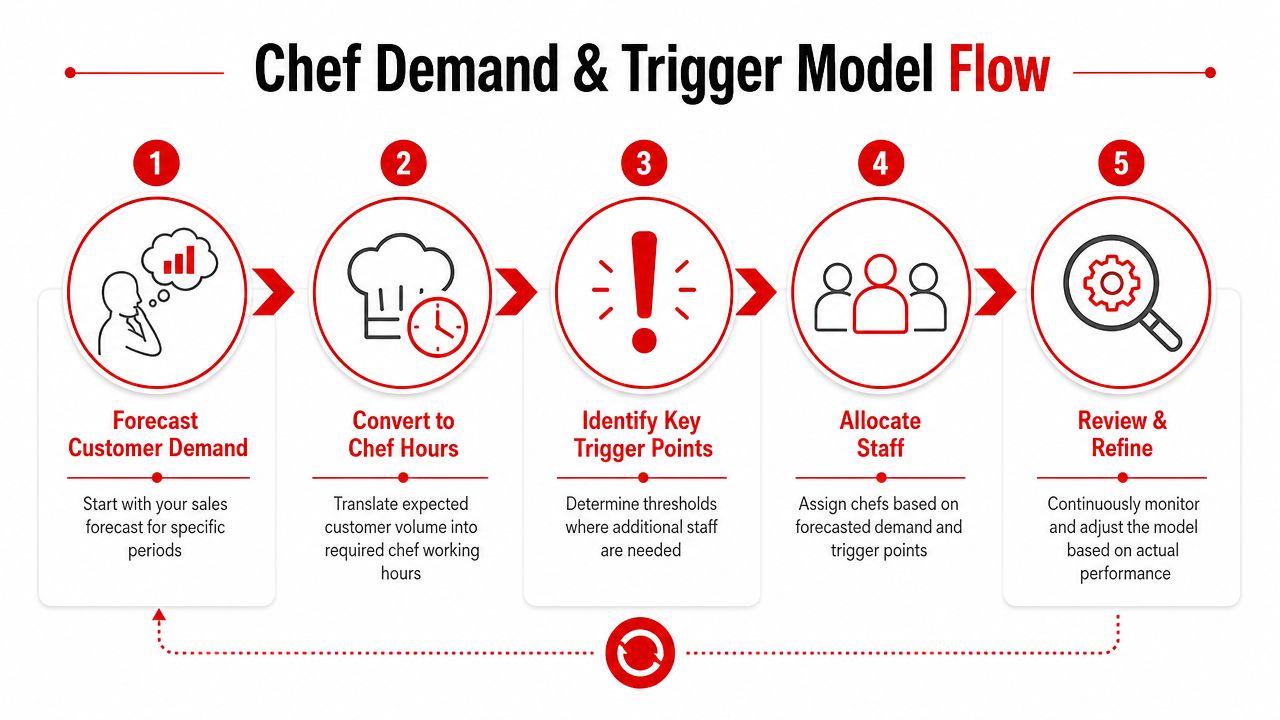
Most forecasts either become useful or stay theoretical at this stage. You can predict covers accurately and still lose money if you can't translate them into chef demand.
A full diary doesn't automatically mean a staffed kitchen. In today's market, that assumption is risky. Chef vacancies remain among the hardest roles to fill in UK hospitality, with specialist shortages contributing to approximately 132,000 open roles nationwide, and experienced staff who left the sector haven't returned, according to UK hospitality staffing trends analysis. That's why forecasting has to be built around labour reality, not customer optimism.
Convert covers into chef hours
Start with the forecasted service demand, then convert that into production and service labour. The exact ratio differs by site because menus, prep style, section layout, and skill mix all change the answer.
A practical model usually includes:
| Input | Example of what to assess | Operational purpose |
|---|---|---|
| Forecast covers | Lunch, dinner, breakfast, events | Sets expected volume |
| Menu complexity | Fresh prep, pastry, banqueting, specials | Changes labour intensity |
| Service pattern | One long peak or staggered bookings | Affects overlap and handover needs |
| Team skill mix | Senior chef, CDP, breakfast chef, KP support | Determines what labour is usable |
| Existing rota strength | Annual leave, sickness risk, weak shifts | Shows where gaps are likely |
Don't just ask how many chefs are on. Ask whether the chefs on shift can execute the menu for the forecasted demand at the standard your guests expect.
Build trigger points before the week starts
A trigger model is a pre-agreed point where action happens. It stops every staffing gap becoming a debate on the morning of service.
Examples of workable triggers:
- If Saturday dinner exceeds the current rota's comfortable production level, book additional cover.
- If one key chef is on leave and a second risk appears, secure backup before the weekend.
- If an event booking lands inside the normal lead time for rota changes, move to temporary cover rather than stretching the core team.
- If bookings rise faster than prep capacity, add support to the section that creates the bottleneck, not just any available pair of hands.
Labour shortages don't always manifest as empty shifts on a rota. Instead, they appear as weak handovers, reduced prep, delayed tickets, and head chefs carrying too much of the service on their own.
A kitchen rarely collapses because one number was wrong. It collapses because nobody acted when the warning signs were obvious.
Forecast achievable demand, not fantasy demand
This is the part many guides miss. You shouldn't only forecast how many guests may want to book. You should forecast what your site can realistically deliver with the kitchen labour available.
That's especially relevant in high-pressure seasonal areas. A pub in Devon, a wedding-heavy hotel in Berkshire, or a waterfront operation in Wales may all have strong demand periods but limited local chef supply. If the labour market is tight, your top-line forecast has to reflect that constraint.
Use a simple decision ladder:
- Forecast likely demand by service
- Translate that into chef hours and skill mix
- Check against the committed rota
- Mark any service where the gap creates risk
- Trigger external cover early, before the market tightens further
This is also where operators need to be honest about the kind of support they need. Some gaps are short-notice sickness. Some are seasonal reinforcement. Some are signs that a permanent hire is overdue. Others need specialist cover across private households, yachts, villas, or premium hospitality settings where the chef profile has to match the environment.
The point is simple. Temporary staffing should sit inside the forecast model, not outside it. When that's done properly, relief chefs stop being an emergency spend and become a planned operating tool that protects revenue and kitchen stability.
Gain Control with Proactive Hospitality Staffing
Forecasting won't remove pressure from hospitality. It will stop avoidable pressure from landing all at once.
A strong model does three things. It gives managers a clearer read on demand, it turns labour planning into a routine instead of a scramble, and it creates decision points early enough to do something useful about them.
What changes when the model is proactive
The shift is practical, not theoretical.
Instead of reacting to short notice sickness on a fully stretched rota, you've already identified the vulnerable services. Instead of hoping a peak week in Windsor, Bristol, or Dorset will somehow “work itself out”, you've already marked where kitchen support may be needed. Instead of carrying too many paid hours all month to guard against uncertainty, you can flex with more control.
That matters because labour is getting more expensive. Increased labour costs, driven by rising national insurance and minimum wage, continue to restrain profitability and push operators towards flexible monthly staffing plans rather than permanent overcommitment, as reported by Restaurant's coverage of hospitality employee cost pressures.
What doesn't work anymore
Some habits need to go:
- Waiting for the rota to fail: By then the best options have usually narrowed.
- Using monthly averages alone: They're too blunt for service-by-service staffing decisions.
- Treating all chef cover the same: A breakfast gap, banqueting gap, and senior sous gap are not interchangeable.
- Assuming permanent recruitment will solve every peak: It won't, especially when demand is seasonal and uneven.
Forecasting only matters if it changes decisions. If the rota stays the same regardless of what the forecast says, the process has failed.
The strongest operators now treat flexible labour as part of planned capacity. Not because they like agencies. Because kitchen stability, margin protection, and service consistency depend on having a backstop when the forecast meets real life.
That's why a proper staffing framework needs both precision and flexibility. A venue may need relief chefs for immediate cover, temporary chefs for a seasonal push, permanent chef recruitment for long-term stability, or specialist support for yacht chefs, villa chefs, and wider hospitality staffing demands. A rigid labour plan can't handle all of that. A flexible one can, especially when it's built around flexible staffing solutions for hospitality teams.
Seasonal demand forecasting isn't about being perfect. It's about being ready.
If your kitchen is tired of firefighting, it's time to plan staffing the same way you plan revenue. Relief Chefs UK has supported hospitality businesses nationwide since 2013, providing trusted relief chefs, temporary chefs, permanent chef recruitment, yacht chefs, villa chefs, and wider hospitality staffing support for pubs, restaurants, boutique hotels, private households, and multi-site groups across the UK. Run by chefs, not recruiters, they understand the operational reality behind short notice sickness, seasonal demand, agency reliability issues, chef shortages, and the need to keep kitchens stable. If you need a dependable staffing backstop that turns your forecast into an executable plan, contact Relief Chefs UK and get the right cover in place before the next busy week catches you short.
Call the team.
Office 01392 715474 · info@reliefchefs.co.uk