
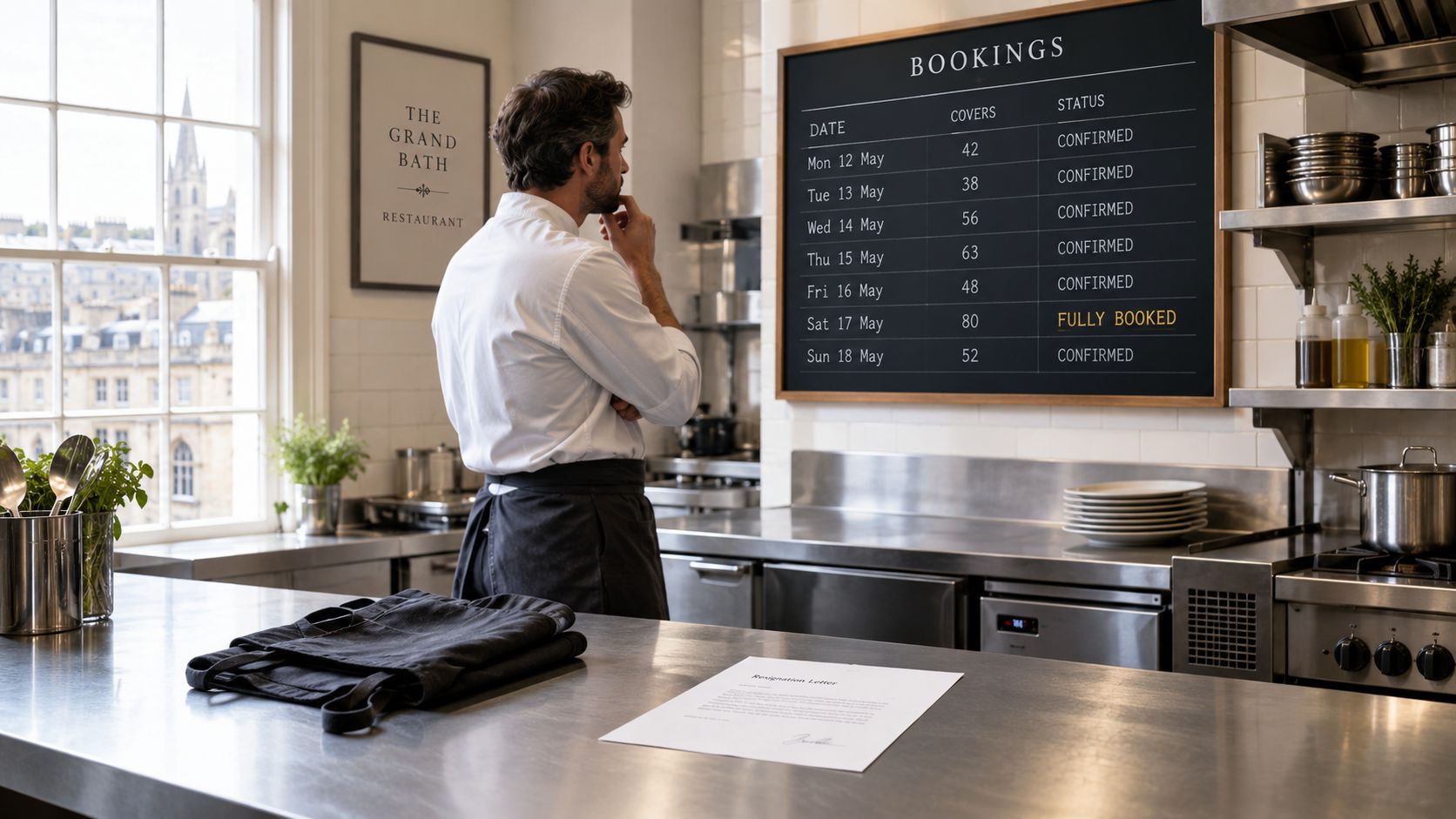
The booking list is full, the kitchen is already running lean, and then a chef calls in sick just before service. In Bath, that can mean more than a difficult shift. It can mean a reduced menu, disappointed guests, exhausted managers and a team wondering how long the pressure will continue.
A Bath recruitment agency should therefore be judged on more than how quickly it sends a name. The test is whether it can provide properly vetted cover, protect kitchen standards and help you avoid the cost of operating short. That means checking response times, compliance, replacement arrangements and seasonal resilience before an emergency arrives.
Relief Chefs UK is a nationwide chef recruitment agency established in 2013, offering relief chefs, temporary chefs, permanent chef recruitment, yacht chefs, villa chefs and wider hospitality staffing support. The right partner won't fill a rota. It will help you keep service open when sickness, resignations or demand spikes threaten kitchen stability.
When a Bath Venue Loses a Chef Mid-Service
At 4pm on Friday, the sous chef hands in notice. The head chef is already off the rota, Saturday bookings are full, and the kitchen is expected to feed a busy Georgian dining room and bar. The duty manager has roughly an hour to decide whether to merge sections, call sister sites, strip dishes from the menu or close part of the operation.
That decision is operational, not administrative. One missing chef can force a capable brigade to work beyond its limits, especially when the service includes separate prep, grill, pastry and pass responsibilities. Calling every former employee, posting in a group chat and waiting for cold applications rarely solves a Friday-night problem.
The first hour matters
A manager facing the gap should make three decisions quickly:
- Protect the pass: Identify the station that will create the biggest bottleneck and place the strongest available chef there.
- Reduce complexity: Remove labour-heavy dishes before service, not after tickets start backing up.
- Escalate early: Contact a pre-vetted South West chef staffing service before the shortage becomes a cancellation problem.
A pre-vetted agency changes the options available. Instead of asking whether the restaurant can survive with fewer people, the manager can assess which chef matches the menu, equipment and service pattern. That distinction matters in Bath, where a venue may be serving hotel residents, tourists, private dining guests and local regulars in the same trading period.
Practical rule: Don't wait until the rota is broken to find out whether an agency can reach Bath.
Recruitment becomes a survival skill
Bath has an established recruitment market. One local directory lists 9 recruitment agencies in Bath and more than 9,000 recruitment agencies across the UK, while recording an employment rate of 78.4% in Bath and North East Somerset, more than 10,000 students resident in the district, and 41.4% of residents qualified to NVQ level 4 or above. These local labour-market figures point to a skilled, education-rich area, but they don't guarantee that the right chef will be available for your Saturday service.
Organised recruitment has also operated in Bath for decades. Reed states that its Bath office traces back to 1960, while another Bath-facing firm says it has recruited for hundreds of organisations in the city since January 2000. Bath's recruitment history shows that agencies are part of the city's employment infrastructure, not a novelty reserved for crisis hiring.
Your objective is simple. Build a reliable hiring pipeline before the next resignation, sickness call or sudden booking surge.
Why Bath Hospitality Hiring Has Gotten Harder
Bath venues compete for chefs in a labour market that has little spare capacity. The city attracts visitors, students, events and residents, while employers across Bristol, Wiltshire, Somerset, Gloucestershire and the wider South West draw from overlapping talent pools. A chef may live outside the city and face a difficult commute, or choose a role nearer home rather than accept an attractive position that becomes impractical during early starts and late finishes.
The local economy has also shifted towards publishing, software and service-based industries, alongside its established tourism and hospitality base. That gives skilled workers more alternatives and makes it harder for a restaurant to rely on casual advertising alone. Experienced chefs often move through personal networks, previous colleagues and specialist recruiters rather than responding to every job-board advert.
The national pressure reaches Bath
UK hospitality recorded about 4.5 vacancies per 100 workers in the three months to January 2024, compared with 3.5 across the national economy, according to UKHospitality's response to labour-market data. The same source describes shortages as particularly difficult in London and regional tourism markets, a useful comparison for operators competing in a visitor-led city such as Bath.
The pressure hasn't disappeared. Accommodation and food services still had 77,000 vacancies in the rolling quarter to November 2025, with a vacancy rate of 3.0 per 100 workforce jobs, compared with 2.3 economy-wide, according to the UK hospitality labour-market review. Chef vacancies were reported at 40,395 in Q2 2026, after rising 83.4% year-on-year, while hospitality and catering vacancies reached 237,601 postings, up 18.4% year-on-year, in CV-Library data cited by the Craft Guild of Chefs.
Bath hospitality hiring pressure at a glance
| Indicator | Bath / UK context | Implication for venues |
|---|---|---|
| Recruitment footprint | One directory lists 9 agencies in Bath and more than 9,000 across the UK | Compare specialist coverage rather than choosing the first generalist supplier |
| Local labour profile | Bath and North East Somerset has a 78.4% employment rate, more than 10,000 students and 41.4% qualified to NVQ level 4 or above | The market contains skilled people, but they may not be immediately available for kitchen shifts |
| Hospitality vacancies | About 4.5 vacancies per 100 workers, compared with 3.5 nationally, in the three months to January 2024 | Generic advertising may not deliver quickly enough for hard-to-fill roles |
| Current sector pressure | Accommodation and food services recorded 77,000 vacancies in the rolling quarter to November 2025 | Retention and contingency planning matter as much as initial recruitment |
| Chef demand | Chef vacancies reached 40,395 postings in Q2 2026, after an 83.4% year-on-year rise | Keep both temporary cover and permanent recruitment options open |
A generic Bristol provider may treat Bath as a satellite patch. A specialist agency should know whether it can reach the city centre, surrounding villages and quieter areas such as the Chew Valley, and whether its database includes chefs suited to hotels, gastropubs, high-volume restaurants and private events.
Vetting a Bath Recruitment Agency Before You Sign
Don't choose an agency because its website promises speed. Choose it because you can verify how that speed is produced.
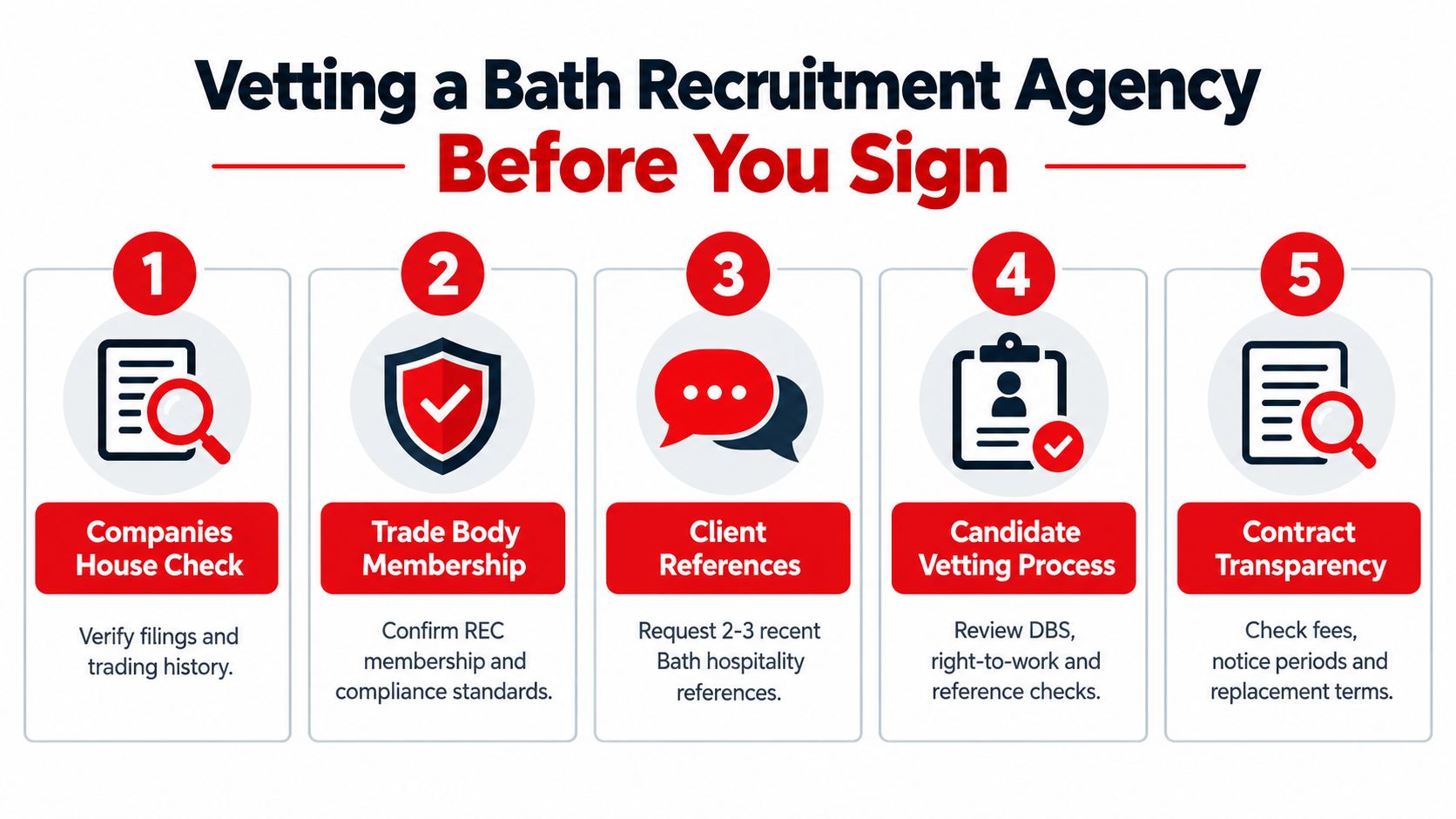
Start with desk research. Check the agency's Companies House record, trading history and published business details. Look for professional memberships, including the Recruitment and Employment Confederation, then read Google and Glassdoor reviews for repeated patterns. A single complaint may reflect a difficult placement. Several comments about poor communication, late arrivals or unclear invoices indicate a process problem.
Ask questions that expose weak coverage
Use the discovery call to test the agency's actual operating model.
- How are chefs vetted? Ask whether the agency completes identity checks, right-to-work checks, references and relevant food-safety verification before a chef accepts a shift.
- How are skills matched? A chef who can manage a pub menu may not be suitable for pastry, butchery, fine dining or high-volume banqueting. Ask how the recruiter validates those skills rather than relying on a CV.
- What happens if the chef cannot attend? Get the replacement process, escalation route and response expectation in writing.
- What will I pay? Request a clear pay rate, agency margin, overtime treatment and cancellation terms. Don't accept a vague hourly figure that makes comparison impossible.
- What is the Bath coverage? Ask how many active chefs the agency can realistically reach within thirty minutes of your venue, and how it handles rural locations beyond the city centre.
Right-to-work compliance is a firm requirement. GOV.UK employer guidance states that UK employers have a legal duty to prevent illegal working and must complete prescribed checks before employment begins. Your agency should explain who performs those checks, what evidence it retains and how it handles changes in a worker's eligibility.
Score finalists instead of trusting a sales call
Put two or three agencies into a simple matrix. Score coverage, vetting, communication, replacement terms, pricing transparency and hospitality references. Ask each finalist for recent Bath or South West venue references and test the response outside office hours if your business trades late.
Ask for proof, not reassurance. A dependable agency can explain its checks, its escalation process and its limits without hiding behind broad promises.
Temporary Cover, Permanent Hires, and On-Demand Relief
Bath venues need different staffing models at different points in the trading calendar. A wedding venue may need extra chefs for a run of events. A gastropub may need one reliable relief chef while a permanent sous chef search runs. A boutique hotel may need a recurring pipeline that supports breakfast, banqueting and evening service.
Temporary agency cover suits a defined absence. Use it for sickness, annual leave, notice periods, refurbishment reopenings or a short seasonal rush. The brief should state the exact shift, menu style, equipment and expected covers. A chef arriving for a single service needs useful information before they walk through the back door.
Permanent chef recruitment is the better route when the gap reflects a lasting role. It gives the agency time to assess leadership, culture, kitchen discipline and retention fit rather than filling a shift. Keep temporary cover running while interviews take place, or the permanent search may create additional pressure on the existing brigade.
On-demand relief sits between those models. It works when the venue needs speed and flexibility, but it still requires proper matching. Don't use an instant booking process as an excuse to skip questions about allergen controls, station capability, service pace or communication.
Staffing models compared
| Model | Best for | Notice window | Cost profile | Risk profile |
|---|---|---|---|---|
| Temporary agency cover | Sickness, annual leave and short-term vacancies | Short notice to planned bookings | Higher per shift than a direct hire, but flexible | Lower operational exposure when vetting and replacement terms are clear |
| Permanent chef recruitment | Long-term vacancies and brigade rebuilding | Longer search and interview process | Recruitment cost linked to a lasting appointment | Risk sits mainly in selection and retention fit |
| On-demand relief | Sudden gaps, peak weekends and flexible trading | Same day or near-term requests | Pay for the cover you use | Fast response can be valuable, but poor matching creates service risk |
The right choice depends on notice window, venue type, cuisine, equipment, service hours and budget tolerance. A seasonal venue near the Roman Baths may combine all three. A rural pub near the Chew Valley may value local reach and repeat availability more than a large national database.
The Real Cost of Going Without Cover
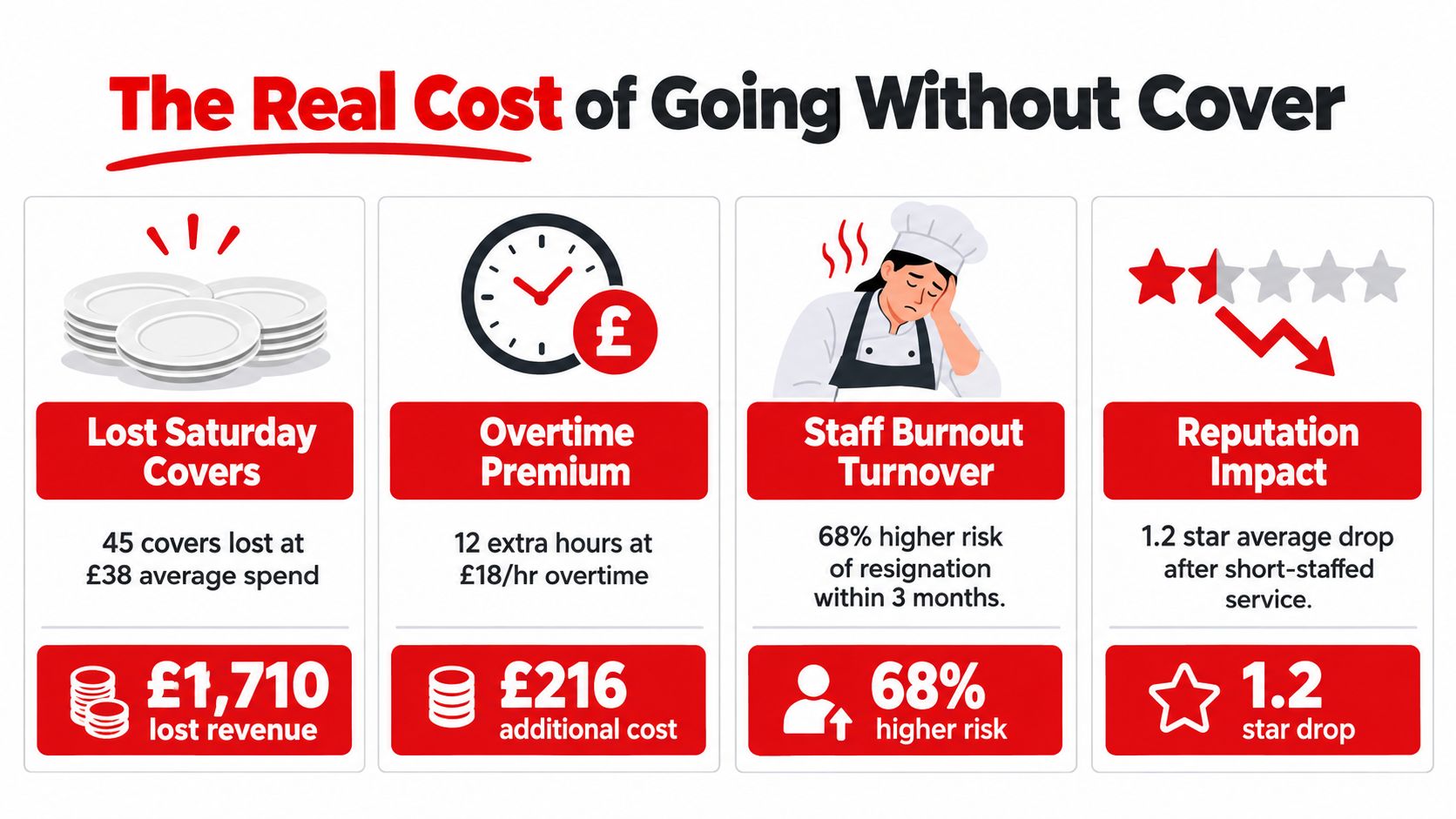
The cheapest-looking option is often doing nothing. In practice, a missing chef can reduce the number of covers you accept, increase manager overtime, force menu cuts and make the remaining team question whether the operation is under control.
Take an 80-cover restaurant as a planning exercise. You don't need to invent a margin percentage to understand the exposure. If the kitchen can't safely produce the planned menu, the venue may turn away bookings, close a section or sell fewer high-value dishes. The lost contribution is only part of the cost. A tired sous chef may also work extra hours, while the general manager spends the next week fixing the rota instead of running the business.
Count the operational damage
Look at the failed service in four layers:
- Revenue: Fewer bookings, shorter sittings and removed dishes reduce what the venue can sell that night.
- Labour: Existing chefs stay late, managers cover stations and overtime accumulates.
- Experience: Long waits, unavailable menu items and inconsistent plates affect reviews and repeat visits.
- Stability: The team absorbs the gap until another person leaves or performance drops.
A Bath venue also carries seasonal exposure. Christmas-market trade, rugby weekends, weddings and tourism peaks can turn a manageable shortage into a serious commercial problem. The cost of cover should be compared with the value of keeping the kitchen open at the standard guests expect, not with the lowest possible payroll figure.
The cost of emergency relief chef cover should be assessed against the cost of lost service, not viewed in isolation. Ask what the shift protects. It may protect bookings, a key client relationship, a review score, the head chef's health or the decision to keep a profitable section open.
Use a simple post-service review. Record the bookings at risk, labour hours added, dishes removed, complaints received and management time spent. That gives you a practical basis for deciding when agency cover pays for itself.
Onboarding Your Chosen Agency the Right Way
A good agency relationship starts before the first chef arrives. Put the commercial and operational rules in writing, then give the agency enough detail to make a proper match.
Begin with the contract. Confirm trial arrangements, notice periods, cancellation rules, payment terms, replacement guarantees and escalation contacts. If you want rapid response for late sickness calls, specify how requests are made and who answers them. A shared inbox that nobody monitors during Saturday service isn't a response system.
Build the compliance pack
Ask the agency to confirm its insurance arrangements and provide current certificates where appropriate. Establish which documents it holds for each chef, including right-to-work evidence, references, food hygiene records and DBS documentation where the role or setting requires it.
Your own team still needs to brief the incoming chef. Share the menu, kitchen layout, equipment limitations, allergen procedures, food-safety rules, dress expectations and service standards. A capable chef can struggle if nobody explains where deliveries arrive, which suppliers are approved or how the pass communicates during a busy service.
Make replacement practical
A replacement guarantee has value only if you understand the trigger and the process. Ask:
- Who do I call? Get a named account contact and an out-of-hours number.
- How quickly will you respond? Define the response target for a sickness callout.
- What does replacement mean? Clarify whether the agency supplies a like-for-like chef or sends any available person.
- How do we report issues? Agree who reviews lateness, performance or a mismatch after service.
Use a written service-level agreement for hospitality staffing if the venue relies on regular cover or operates across multiple sites. It should reflect the way your business trades, including peak periods, rural travel and last-minute changes.
Run a controlled first shift where possible. Ask the head chef to give direct feedback on station competence, pace, communication and attitude. That information improves future matching and helps the agency build a useful profile of your venue.
Choosing Your Next Step and Getting Cover Fast
Bath managers usually face one of three decisions.
Book one relief shift when sickness, annual leave or a sudden resignation threatens an immediate service. Prepare a concise brief with the date, start and finish time, cuisine, expected service, station, equipment, dress code, parking or travel information and any DBS requirement.
Start a permanent search when the vacancy reflects the structure you want for the next trading period. Explain the role's authority, salary range, reporting line, working pattern and reason the position is open. A recruiter can't assess long-term fit if the brief only says “chef required”.
Combine both approaches when the venue is entering a demand spike. Hotels near the Roman Baths, restaurants around the Royal Crescent and venues affected by Christmas markets may need temporary reinforcement while they build a permanent brigade. The same applies to operators serving Bath Rugby weekends, weddings and larger private functions.
Relief Chefs UK provides temporary and permanent chef recruitment across the UK, including relief chefs, yacht chefs, villa chefs and hospitality staffing support. The company says clients can receive a response within two hours and have a vetted, right-to-work-checked chef start within 48 hours, subject to availability. Its staffing options are designed for independent pubs, restaurants, boutique hotels, private households and multi-site operators across areas including Devon, Bristol, Wales, Berkshire, Windsor, Reading, Slough and Dorset.
Send the agency the information it needs to make a clean first match. A vague request creates vague results. A precise brief gives the recruiter a chance to protect your menu, your team and your guests from the first shift.
Relief Chefs UK can arrange relief chefs, temporary cover and permanent chef recruitment for Bath venues, with support for short-notice sickness, seasonal demand and longer-term kitchen stability. Visit Relief Chefs UK to submit your staffing requirements and start a practical conversation about the cover your operation needs.