
Service Level Agreements for Hospitality Staffing
15 August 2026
It's Friday afternoon, the dining room is filling, and the sous chef phones in sick. The replacement agency says it'll “try to find someone”, but can't confirm who is coming, what checks have been completed, or whether the chef can handle your volume. You're left moving a commis onto prep, asking the head chef to cover another station, and hoping standards survive service.
That isn't a staffing strategy. It's unmanaged operational risk.
Service level agreements give hospitality businesses a practical way to define what a staffing partner must deliver, how quickly it must respond, what happens when a chef isn't suitable, and how performance is measured. Most SLA guidance comes from IT and public-sector contracts, where demand is more predictable. Kitchens need something different, built around sickness, seasonal pressure, cancellations, chef quality and continuity.
The Kitchen Crisis That a Good SLA Prevents
A chef cancels the day before a busy weekend at a coastal hotel in Devon. The rota has already been published. Deliveries are booked, reservations are strong, and the head chef has planned a menu that depends on a capable second-in-command. By lunchtime, the venue still hasn't received a firm answer from its staffing provider.
The problem isn't only the missing chef. It's the uncertainty. Nobody knows whether cover will arrive, whether the replacement has the right experience, or whether the agency will take responsibility if the arrangement fails.
A properly written SLA changes that sequence. The venue submits a cover request through an agreed channel. The staffing partner acknowledges it within the defined response window, confirms the required skill level, supplies evidence of vetting, and gives a clear fulfilment deadline. If the chef cancels or falls below the agreed standard, the replacement procedure starts without another round of negotiation.

From panic to a controlled response
An SLA doesn't guarantee that every request will be easy to fill. Rural locations, specialist menus, yacht work and peak-season demand can all narrow the available pool. What it does is make the response predictable and make responsibility visible.
For example, a boutique hotel near Windsor might require a chef who can manage breakfast, banqueting and evening service. An independent pub in Dorset may need a confident all-rounder who can work without extensive supervision. Those are different requirements, so they shouldn't sit under one vague promise of “suitable cover”.
The agreement should state:
- What the venue requests: Role, skills, shift pattern, location, start date and service expectations.
- What the provider confirms: Response time, chef availability, vetting status and expected arrival.
- What happens if it fails: Replacement, escalation, reporting and any agreed remedy.
- Who owns each action: Venue contact, agency contact and senior escalation contact.
Practical rule: If a manager can't tell from the SLA what happens after a chef cancels, the document isn't operational enough.
Good service continuity planning supports this process, but the SLA is the part that turns the plan into an agreed working standard. Whether you run a Bristol restaurant, a Welsh hotel or a multi-site group around Reading and Slough, the best agreement removes guesswork before service is at risk.
What Service Level Agreements Actually Are
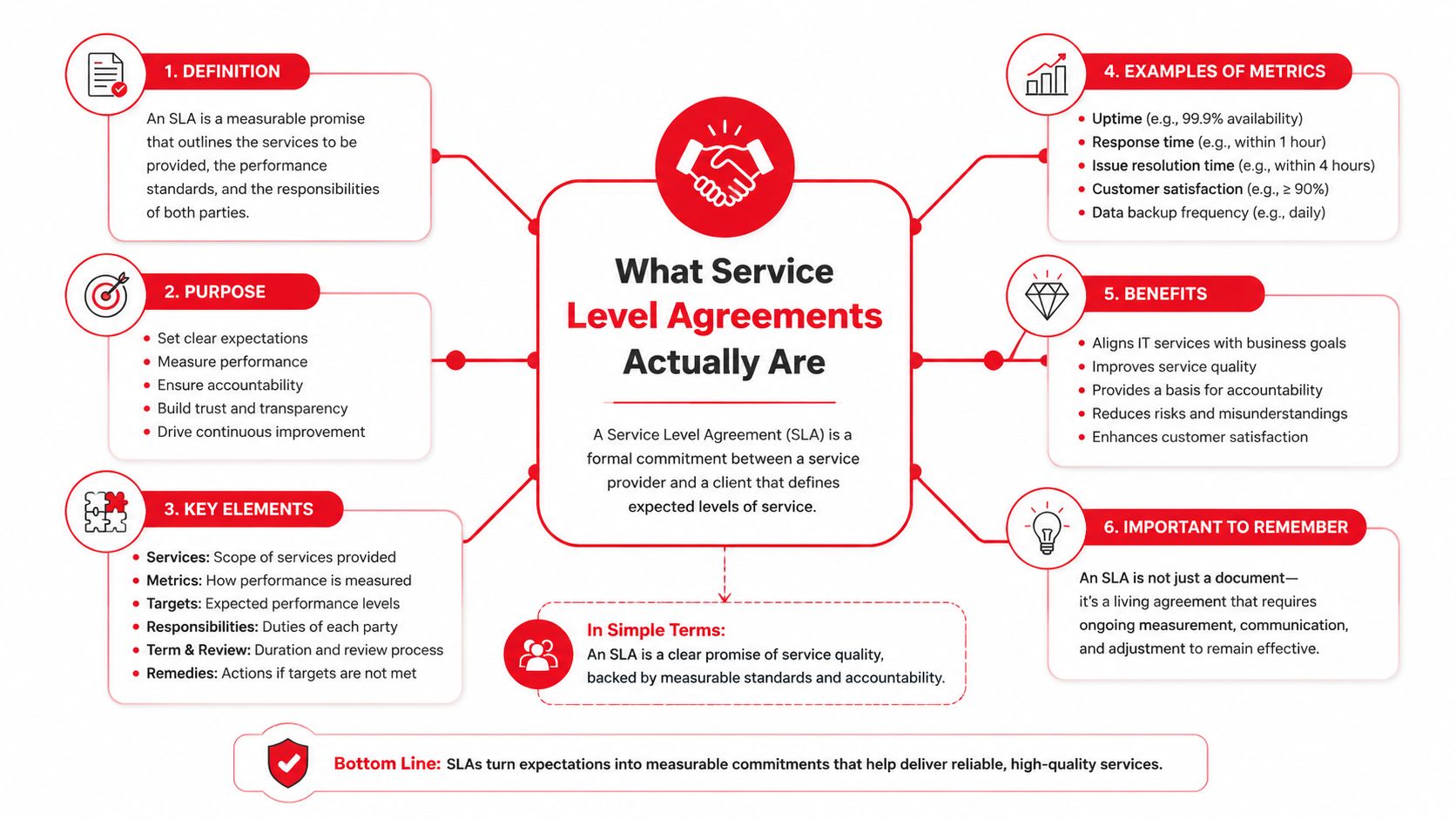
A service level agreement is a written agreement between a client and a service provider. It defines the service being supplied, the expected standard, the way performance will be measured, and the action required when delivery falls short.
For a kitchen manager, the simplest comparison is a recipe card. A recipe tells the team which ingredients to use, how much is required and what the finished dish should look like. An SLA does the same for a staffing service. It sets out the required “ingredients” of cover, the timing and the acceptable result.
A verbal promise such as “we'll do our best to find a chef” leaves too much open to interpretation. A useful agreement is more precise. It might define the time allowed to acknowledge a request, the evidence required before deployment, the acceptable experience level and the remedy if the chef doesn't attend.
The governance document behind the promise
UK public-sector practice treats SLAs as formal governance documents rather than informal service promises. A GOV.UK framework Service Level Agreement says an SLA should include measurable service definitions, reporting arrangements, review dates and SMART targets. It also recommends regular review so the agreement continues to match delivery needs.
A published GOV.UK Service Level Agreement for the Traffic Commissioners for Great Britain illustrates how these documents can carry an implementation date, a review cycle and a version history. That structure matters in hospitality because staffing needs change with menus, trading patterns, opening hours and site expansion.
A chef relief SLA should therefore contain more than a list of promises. It should show:
- The service scope, including relief, temporary or permanent recruitment support.
- The measurement method, including who records requests and attendance.
- The review arrangement, including when both sides examine results.
- The correction process, including rework, replacement and escalation.
- The current version, so managers know which terms apply.
The agreement also needs boundaries. A provider shouldn't be measured against an unrealistic standard that ignores location, notice period or specialist requirements. Equally, a provider shouldn't use difficult conditions as a blanket excuse for failing to communicate.
The useful distinction is simple. An SLA defines the external commitment. Internal service-level objectives can help the provider manage its own operation, while service-level indicators are the actual records, such as request time, response time and arrival time. The venue needs access to enough information to judge whether the commitment was met.
Why Service Level Agreements Matter for Hospitality Staffing
Hospitality businesses operate with a narrow margin for staffing error. One absent chef can affect prep, ticket times, food quality, team morale and the decision to keep accepting bookings. That exposure becomes sharper during summer trade, Christmas functions, weddings, sporting events and bank-holiday weekends.
The labour market adds pressure. UKHospitality told Parliament that sector vacancy rates were at least 10 per cent and could be as high as 16 per cent, representing roughly 210,000 to 336,000 unfilled roles in the evidence submitted, as recorded in its written evidence to Parliament. Separate BBC and UKHospitality reporting cited around 132,000 vacancies in late 2023, with vacancies still 48 per cent above pre-pandemic levels. These figures describe a commercial problem managers already recognise, finding dependable chefs when every nearby venue is competing for the same people.
Hope isn't a service level
Without an SLA, agency reliability often depends on the individual relationship with one consultant. That may work until the consultant is away, the request arrives outside office hours, or several venues need cover at the same time.
A useful agreement protects the operation in practical ways:
- Short-notice sickness: The venue knows how to submit an urgent request and who will own it.
- Seasonal demand: The provider receives advance forecasts and agrees how priority requests will be handled.
- Chef cancellations: The replacement route starts immediately rather than after a manager complains.
- Quality concerns: The venue can reject an unsuitable placement against defined criteria.
- Multiple sites: The group gets consistent reporting across Devon, Berkshire, Wales or other regions.
The point isn't to pretend that every vacancy can be filled instantly. A realistic SLA separates standard requests from critical gaps and records the limits that apply to each. Short-notice cover may need a different commitment from a planned placement beginning next week.
A good SLA doesn't remove uncertainty from hospitality. It stops uncertainty becoming someone else's excuse.
For a restaurant in Bristol, the key issue may be speed during a weekend rush. For a hotel in Berkshire, it may be continuity across a long booking. For a yacht or private villa, it may be matching a chef to dietary expectations and a very specific working environment. The service standard must reflect the operation, not the wording of a generic agency contract.
Key Components and KPIs in a Chef Relief SLA
The strongest chef relief agreements measure the parts of staffing that affect service directly. They don't bury managers under irrelevant reporting. They define the request, the clock, the chef standard and the remedy.
Response and fulfilment
Response time measures how long the staffing partner takes to acknowledge a request and confirm ownership. Fulfilment time measures the period between the request and the chef starting work. Keep those measures separate. An agency can answer quickly without providing cover.
UK service standards demonstrate why the distinction matters. The Financial Conduct Authority's service-standard data says it aims to answer email, web form and webchat enquiries within two working days, and letters within five working days. It achieved substantive responses within two working days 94.5 per cent of the time and within five working days 99.3 per cent of the time. Those are not hospitality targets, but they show how service commitments can be defined and audited.
NHS England Digital's HSCN incident tables use tighter operational tiers for critical incidents, including a 20-minute incident response time for Severity 1 and Severity 2 incidents. Hospitality staffing isn't a clinical network, but the principle transfers. Urgent problems need a faster acknowledgement route than routine recruitment.
For chef cover, a practical service-level objective may be:
| Measure | Working definition | Example objective |
|---|---|---|
| Request acknowledgement | Confirmation that the request has been received and assigned | Within two hours |
| Chef start time | Confirmed chef begins the agreed placement | Within 48 hours for planned cover |
| Short-notice gap | Escalated urgent request | Separate critical-response route |
| Update interval | Contact while the request remains open | Agreed in the SLA |
The response-time and start-time targets are useful planning objectives, not guarantees that every specialist or short-notice request can be filled. The venue should agree exclusions for remote locations, unusual qualifications and requests made with very limited notice.
Vetting and capability
Vetting must be evidenced, not implied. The SLA should state whether the provider confirms right-to-work status, references, identity, relevant checks and competency before deployment. If a venue requires a DBS check for a particular setting, the agreement should say who requests it, who reviews it and whether the chef can start before it's complete.
Competency needs a kitchen definition. “Experienced chef” is too vague. Specify the environment, such as high-volume breakfast, banqueting, pastry, fine dining, pub food, yacht service or private household work.
Quality, replacement and escalation
Track attendance, punctuality, station capability, food-safety conduct, communication and manager feedback. A satisfaction score can help, but it shouldn't replace a written incident record when a chef is late, leaves early or cannot perform the agreed role.
Include an immediate replacement process, an escalation contact and a remedy period. The service quality assurance approach should connect the chef's performance with the venue's operational standard, not just whether somebody turned up.
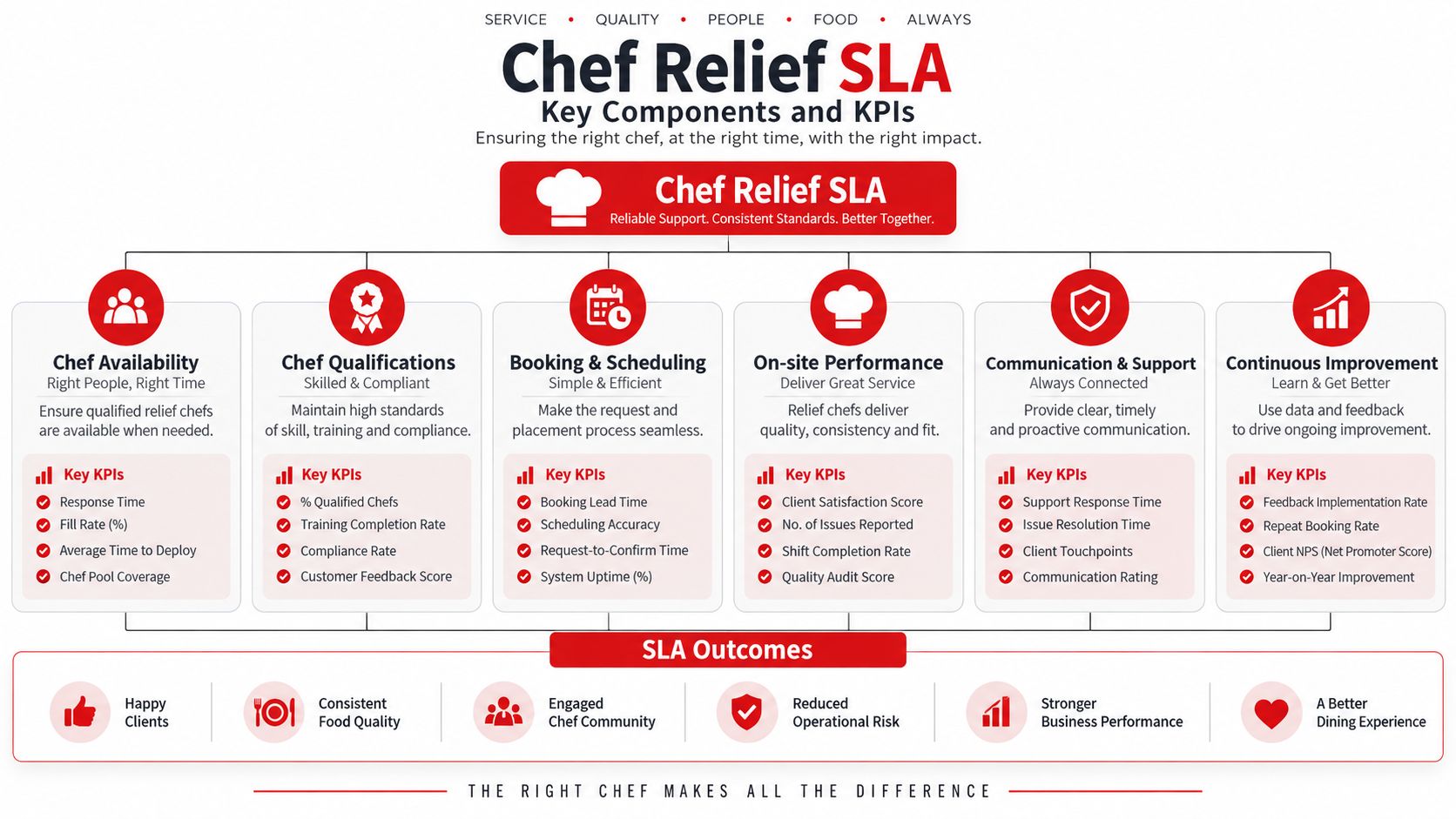
Finally, add review dates. A winter hotel SLA may need different priorities from a summer venue in Dorset or Devon. Review the data, remove measures nobody uses and tighten the terms that protect service.
Sample SLA Clauses and Template for Chef Relief Services
The following framework is designed for a venue and staffing partner to adapt. It isn't legal advice or a finished contract. Have the final wording checked against the commercial arrangement, employment model and insurance position.
Service scope
The provider will supply relief or temporary chefs matching the role, experience, location, shift pattern and start date stated in each approved cover request.
The request should identify the station, expected covers, menu style, equipment requirements, uniform arrangements and named venue contact. This prevents a disagreement later about whether a chef was “suitable”.
Core clauses
Response commitment: The provider will acknowledge each request within the agreed response window, confirm whether it can be progressed and name the person responsible for updates.
Fulfilment commitment: For accepted requests, the provider will confirm the chef, arrival details and start time within the agreed period. The clause should distinguish planned cover from short-notice emergency requests.
Vetting confirmation: Before deployment, the provider will confirm the checks agreed by both parties, including right-to-work verification, references and competency assessment. Any venue-specific requirement must be listed rather than assumed.
Performance reporting: The provider will supply agreed reporting at the selected frequency, showing requests, response times, fulfilment outcomes, cancellations, replacements and recorded issues.
Replacement guarantee: If the chef fails to attend, cancels, or doesn't meet the agreed competency standard, the provider will begin replacement action within the defined period. The venue should state whether the remedy is a replacement, fee adjustment or another agreed outcome.
Escalation procedure: The venue contacts the account lead first. Unresolved issues move to senior management after the stated remedy period. Material and persistent breaches may trigger contractual remedies or termination rights.
Review clause: Both parties review the SLA at agreed intervals, examine the evidence and record any amendment with a new version date.
Example KPI schedule
| KPI | Evidence | Agreed threshold | Remedy if missed |
|---|---|---|---|
| Acknowledgement | Time-stamped request and reply | Agreed response window | Escalation to account lead |
| Fulfilment | Chef confirmation and attendance record | Agreed start-time target | Replacement process |
| Vetting | Documented pre-deployment checks | Complete before start | No deployment until resolved |
| Suitability | Manager feedback against role brief | Meets agreed competency | Replacement or review |
| Reporting | Monthly or quarterly service report | Delivered on agreed date | Written corrective action |
Penalty clauses need care. A fee credit may feel attractive, but it doesn't restore a ruined service or compensate for lost trade. In volatile hospitality, a reliable replacement and a clear escalation path often protect the business more effectively than a small financial remedy.
Set different terms for a small café, a Slough pub, a rural Dorset venue, a hotel group or a private yacht. The location, notice period and role complexity should influence the commitment.
Negotiating, Monitoring and Escalating Your SLA
Negotiate around the failures that threaten service first. For a busy venue, that usually means acknowledgement speed, chef suitability, attendance and replacement cover. Reporting can remain lighter if the staffing partner provides useful updates during an open request and both sides hold a scheduled management review.
Put a measurement behind every promise. “Response within two hours” needs a defined start point, approved communication channel and clear meaning of response. An automated receipt confirms delivery, not ownership. The venue should know when a named person has accepted responsibility and what happens next.
Keep a working record
A shared spreadsheet works if managers update it after every request. Record:
- Request details: Date, time, site, role, shift and notice period.
- Response evidence: Time acknowledged, contact name and action agreed.
- Fulfilment result: Chef confirmed, arrival time and whether the placement started.
- Quality outcome: Station performance, attendance, conduct and manager feedback.
- Remedy: Replacement requested, escalation made and final resolution.
Review the record each month. That exposes repeated late confirmations, unsuitable placements or weak handovers while the relevant details remain available. A peak-season failure should lead to a change in the process, not just another apology.
Escalate without emotion
Keep every breach factual. State the clause, the event, its effect on the operation and the remedy required. Send the record to the primary contact, set a response deadline consistent with the agreement, then use the escalation chain if the issue remains unresolved.
Mainstream SLA templates often focus on measurable definitions, reporting, review dates and SMART targets. That structure is useful, but it was largely designed for IT and public-sector arrangements. Hospitality needs thresholds that reflect volatile demand, rapid-response cover and chef-specific measures. The GOV.UK framework SLA guidance provides a starting framework, not a universal contract. Adjust the measures to the role, notice period, site and operational risk.
Management habit: Review the scorecard when the kitchen is calm, not while the pass is under pressure.
Record venue-side failures with the same discipline. A changed shift, missing access information or late request for a specialist chef can affect the result. Mark it as an exception, agree the operational consequence and avoid treating every missed target as supplier failure. Fair accountability makes the SLA more credible and gives both parties evidence for improving the service.
Legal Considerations and How Relief Chefs UK Delivers
Legal compliance belongs in the operating model, not a footnote. Under the Agency Workers Regulations 2010 guidance, agency workers receive the same basic employment and working conditions as directly recruited staff after a 12-week qualifying period in the same job with the same hirer. Pay, annual leave, rest breaks, night work and overtime parity may all apply.
ACAS states that agency workers must receive at least the National Minimum Wage or National Living Wage, be paid on time and receive 5.6 weeks' paid holiday for each leave year while on assignment. Its agency worker employment rights guidance also covers a maximum average 48-hour week, a 20-minute rest break after more than six hours, 11 hours' daily rest and one day off each week.
The SLA should name who tracks assignment length, supplies pay and working-condition information, and handles concerns. Include employment-law guidance for temporary staff in the compliance process. Clarify insurance responsibilities, including public liability, employer's liability and incidents during the placement.
Relief Chefs UK, established in 2013, aligns its service with these operational requirements. It provides relief chefs, temporary chefs, permanent recruitment, yacht chefs, villa chefs and wider hospitality staffing support. Chefs are vetted, right-to-work checked and insured. The business offers 24/7 support, subject to availability, and flexible cover for independent pubs, hotels and groups, quoted based on the role, location and dates.
It serves more than 400 venues nationwide, according to the supplied business information, and offers transparent pricing without hidden agency fees. For a Devon hotel, Bristol restaurant, Welsh venue or multi-site group across Berkshire, Windsor, Reading and Slough, the practical value is measurable staffing delivery, not informal assurances.
Relief Chefs UK can build an SLA around response times, vetting, replacement and account management. Visit Relief Chefs UK to discuss dependable cover for a kitchen, yacht, villa, pub, restaurant or hotel, including urgent staffing and seasonal reinforcement.
Call the team.
Office 01392 715474 · info@reliefchefs.co.uk