

Friday night in Leeds. Two chefs call in sick, the pass is backing up, and the duty manager is scrolling through agency websites instead of plating food. The question isn't whether there are recruitment agencies in Leeds. There are plenty. The question is whether one can put a compliant, capable chef in your kitchen on time, at an agreed cost, with a process that protects your business.
Leeds has a large and competitive recruitment market, but choice creates work for the buyer. You need to define the role, test the agency's promises, verify the worker and compare the full commercial terms. This guide treats chef recruitment as a procurement decision, not a directory search, so you can build a shortlist that works during sickness, seasonal demand and difficult service periods.
Why Leeds Hospitality Can't Treat Recruitment as a Search Problem Anymore
A Google search will give you names. It won't tell you whether an agency can answer at 10pm, distinguish a competent sous chef from an inexperienced CDP, or confirm right to work before a candidate arrives. It won't show whether the quoted rate includes holiday pay, travel, weekend premiums or a replacement if the chef doesn't turn up.
That distinction matters because hospitality staffing failures are operational failures. A missing chef can force a reduced menu, delay tickets, increase pressure on the brigade and damage guest experience. A poor permanent hire can destabilise the kitchen for weeks. A temporary worker with incomplete compliance records can create an avoidable employment risk.
Operator's rule: Don't ask an agency whether it can supply chefs. Ask it to prove how it will supply your specific chef, by your specific deadline.
Start with a written specification. State the section, skill level, cuisine, equipment familiarity, service style, shift times, dress requirements, rate and start date. “Chef needed urgently” is not a brief. “Experienced CDP for a busy hotel banqueting service, available for an evening shift, confident on pastry and able to work independently” gives the supplier something measurable to act on.
Then set verification requirements before the first name is sent. You should know who completes the right-to-work check, who holds insurance evidence, how references are obtained and what happens when a chef cancels. Ask for response and replacement commitments in writing, not just during a friendly phone call.
The right buyer mindset is simple:
- Define the risk: Is this cover for sickness, a wedding, a seasonal spike or a permanent vacancy?
- Set the standard: Decide what “suitable” means before reviewing candidates.
- Test the promise: Ask for examples of response times, compliance records and replacement procedures.
- Compare the total cost: A cheap hourly rate is useless if the chef arrives late or can't run the section.
- Review the outcome: Record attendance, skill match, communication and service performance.
Leeds operators don't need more names. They need a supplier they can hold accountable when the kitchen is under pressure.
The Real Shape of the Leeds Recruitment Market
Leeds is a significant UK recruitment hub. RevenueBase identifies 416 recruitment agencies headquartered in Leeds as of September 2026, while a separate Leeds agency directory lists 164 recruitment agencies in the city. Those figures come from different directories and shouldn't be treated as a single audited total, but together they show a substantial and concentrated local market. See the Leeds recruitment and jobs market data for the underlying directory context.
The market is also fragmented. A broad directory lists 164 Leeds agencies and 253 when the search is widened to Leeds overall, while its catering-specific coverage represents only a smaller hospitality subset. That means a venue can easily mistake local visibility for relevant capability. An office in LS1 doesn't prove that the agency has chefs available in North Leeds, Bradford, Wakefield or across wider West Yorkshire.
Leeds Recruitment Market at a Glance
| Agency Segment | Estimated Active Count | Typical Coverage |
|---|---|---|
| Broad Leeds recruitment market | 164 city listings, with 253 on a wider Leeds search | Multi-sector recruitment, often permanent and temporary |
| Leeds-headquartered agencies | 416 identified by RevenueBase | Generalist and specialist recruitment across local sectors |
| Hospitality and catering specialists | Smaller subset of the wider market | Chefs, front of house, banqueting and temporary kitchen cover |
| Chef-focused partners | Specialist cluster within hospitality recruitment | Relief chefs, permanent kitchen recruitment and urgent cover |
The important number for a venue isn't the size of the directory. It's the number of agencies that can meet your actual brief. Screen by sector first, then by contract type. Some firms focus on permanent placement, others handle temporary work, and a smaller group understands chef deployment, service pressure and kitchen hierarchy.
Density also creates practical risks. Several agencies may approach the same candidate, producing overlapping availability or double-booking. Generalist consultants may use inconsistent right-to-work processes. Quote structures can vary so much that two apparently similar hourly rates aren't comparable.
Geography needs attention too. A supplier serving Leeds city centre may not offer the same dispatch speed to a site near the Bradford or Wakefield boundary. Ask where candidates are based, how far the agency routinely covers and who manages transport issues when a shift starts early.
Leeds also has marked local labour variation. The referenced Leeds directory records unemployment rates ranging from 7.3% in the Northeast to 2.3% in the Northwest, showing that labour supply can differ sharply within the same city. That makes broad claims about “the Leeds candidate pool” unhelpful. Your agency must understand the labour market around your venue, not just its postcode.
Temp, Permanent or Niche Hospitality Agencies Compared
The correct agency model depends on the risk you're buying down. A temporary supplier protects tonight's service. A permanent recruiter builds the brigade. A niche hospitality specialist is useful when you need both urgency and a credible skills match.
Temporary agencies
Temporary agencies are designed for speed and flexibility. They suit short-notice sickness, event surges, holiday cover and periods when your own recruitment pipeline hasn't caught up with demand. You'll usually pay a shift or hourly rate, and the total cost is easier to forecast when the agreement is clear.
The trade-off is cultural fit. A temp may be competent but unfamiliar with your recipes, ordering system, section setup or service rhythm. Give a temporary chef a concise brief and a named contact on arrival. Don't expect a stranger to solve a badly organised kitchen.
Permanent recruiters
Permanent agencies work better for head chefs, sous chefs and long-term brigade development. They can spend more time on career history, leadership style, references and the reasons a candidate is leaving. The process usually takes longer because the candidate and venue are making a more significant commitment.
Some permanent recruiters use contingency terms, while others work on retained searches. The plan notes for this guide refer to fees commonly quoted as 15% to 25% of salary, but every fee must be confirmed in the agency's written terms before you proceed. Ask about replacement periods, rebate structures and whether the fee applies to additional earnings.
Niche hospitality specialists
A specialist chef agency understands the difference between a CDP, sous chef, chef de partie and head chef in practical terms. It should know what a banquet operation requires, why a pastry chef isn't automatically suitable for a high-volume grill section and how to assess independence during service.
| Model | Typical Fee | Fill Speed | Screening Depth | Best Use Case |
|---|---|---|---|---|
| Temporary agency | Hourly or shift-based charge | Usually faster for immediate cover | Depends heavily on the supplier | Sickness, peaks and short-term gaps |
| Permanent agency | Often a percentage of salary, confirm the written terms | Slower than temporary placement | Typically deeper for long-term fit | Head chef, sous chef and brigade building |
| Niche hospitality agency | Specialist rate, confirm the full schedule | Designed for urgent sector-specific needs | Culinary, reference and compliance focus | Urgency where standards can't be compromised |
My decision rule is direct: use temporary recruitment for immediate operational risk, permanent recruitment for your talent pipeline, and a specialist chef partner when speed and standards both decide the booking.
The Vetting Checklist That Actually Protects Your Kitchen
A CV is not a compliance file. Before a chef works a shift, you need an auditable verification workflow covering identity, eligibility, experience and contractual responsibility.
The Home Office right-to-work employer guidance requires checks before employment begins. The Institute of Hospitality hiring toolkit recognises manual checks, the online Home Office service and identity document validation technology through an identity service provider. It also states that, from 1 October 2022, British and Irish workers must be checked face to face or digitally through an IDSP. The requirement applies to agency temps as well as directly hired workers.
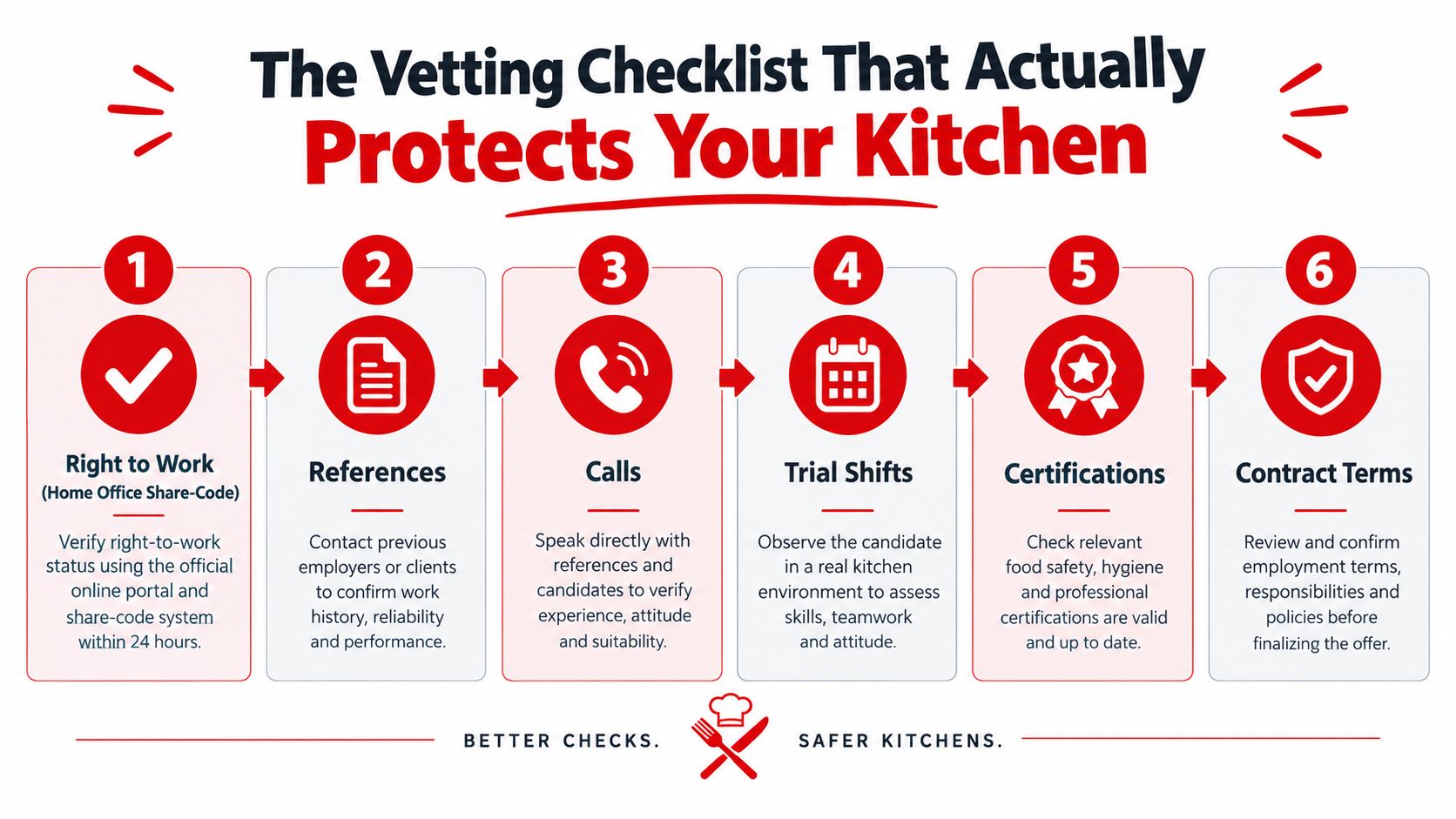
Six checks to complete before deployment
- Right to work: Ask who performs the check, how the share code is retrieved and where the evidence is stored. Don't accept “the agency has checked” without knowing the process.
- Recent references: Request references from kitchens where the chef performed comparable work. A reference should address attendance, section ability and conduct, not just dates of employment.
- Insurance: Confirm public liability and employer's liability cover and establish whether the worker is covered under the agency's policy. If a contractor is sent under a different arrangement, ask who carries the risk after an accident.
- Paid trial or sample service: For a permanent hire or important temporary booking, use a paid trial in your own kitchen. Watch prep discipline, communication, speed, hygiene and how the chef reacts when the plan changes.
- Food safety and allergen evidence: Request current Food Hygiene and Allergen certificates where relevant to the role. Certificates don't replace supervision, but missing evidence is a warning.
- PAYE and contract status: Confirm whether the chef is paid through PAYE by the agency or supplied through another arrangement. Don't let a casual “freelance” label transfer unclear tax and employment obligations to your venue.
A missing right-to-work record can expose an employer to a civil penalty. Inadequate insurance can leave you exposed after a burn or slip. A poorly defined self-employed arrangement can create tax and employment risk that the original quote never made clear.
A specialist partner should have most of this evidence organised before presenting a chef. You can also review the employment verification process when setting your own supplier requirements.
Pricing, SLAs and Hidden Margins in Agency Quotes
Compare agency quotes like a kitchen cost sheet. The worker's take-home pay isn't the same as your invoice rate, and the headline number may exclude costs that appear only after the booking is confirmed.
For temporary chef cover, the plan for this guide identifies a typical margin range of 25% to 45% on chef cover. Treat that as a negotiation prompt, not a universal tariff. Ask the agency to explain what sits between the chef's pay and your invoice, including holiday accrual, employer costs, administration, insurance and margin.
A low rate can conceal travel time, minimum-shift uplifts, weekend premiums, after-midnight charges or last-minute cancellation fees. These items matter in Leeds, where a venue may need to move staff between the city centre, North Leeds and surrounding West Yorkshire locations.
Agency Quote Comparison for Temp Chef Cover in Leeds
| Line Item | What It Usually Looks Like | What to Ask |
|---|---|---|
| Basic hourly charge | Agreed rate for standard shift hours | Is this inclusive of holiday pay, employer costs and agency margin? |
| Minimum booking | A minimum number of paid hours may apply | What is the minimum shift, and does it apply if service finishes early? |
| Travel | May be included, excluded or charged separately | Is travel time paid, and are mileage or parking costs added? |
| Unsocial hours | Weekend, bank holiday or late-night premiums may apply | Which hours trigger an uplift, and is it shown on the quote? |
| Cancellation | Charges can apply close to the shift | What notice period avoids a fee, and what happens if the chef cancels? |
| Replacement | May be promised verbally | Is replacement guaranteed, within what response time, and at what cost? |
Service-level language needs the same scrutiny. If an agency claims a response time in minutes, ask whether that means acknowledgement, candidate contact or confirmed arrival. If it states a fill rate of 85% to 95%, ask how it defines a filled shift, the period measured and whether unsuitable or cancelled bookings are included. Those figures are only useful when the calculation is written into the agreement.
For a clear framework, use a documented service level agreement approach. Your negotiation questions should be blunt:
- What will I pay in total?
- Which costs are variable?
- Who pays if the chef fails to attend?
- How quickly will you contact me after a cancellation?
- What evidence supports your fill and response claims?
- What happens if the candidate's skill level doesn't match the brief?
Why a Specialist Chef Partner Wins for Urgent Cover
When service is tonight, a generalist agency often starts with a broad database and filters it after you call. A specialist chef partner starts with people who already work in kitchens, then matches the brief against practical experience, availability and location.
The first advantage is speed. A curated chef roster removes much of the early search work. The second is compliance. Right-to-work evidence, references, insurance and relevant certificates should be checked before you are deciding whether the chef suits your section. The third is quality. A specialist understands that “chef” isn't a sufficient skill description.
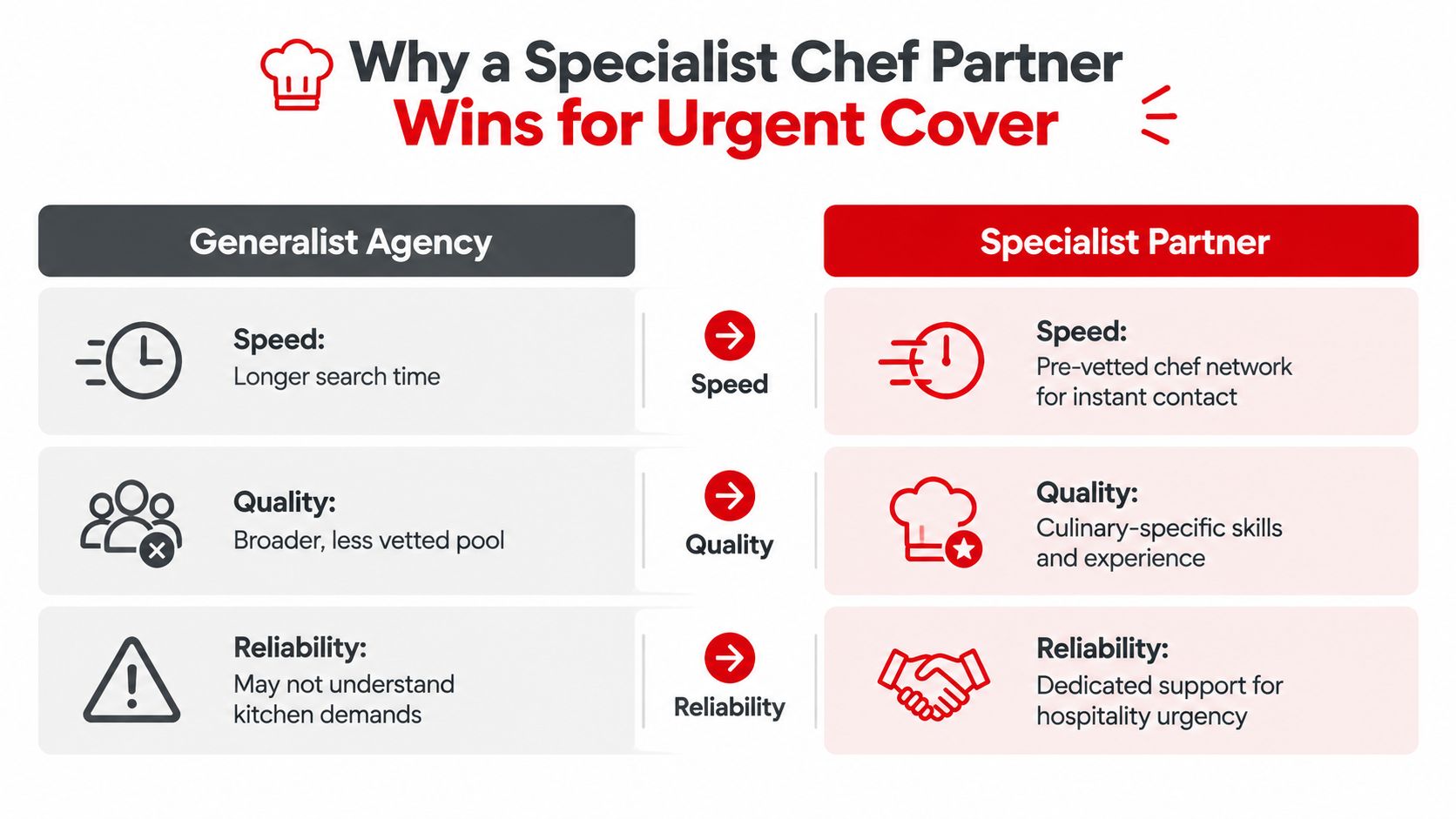
A specialist may charge more on the headline rate. That can still be the cheaper operational choice when the alternative is a failed shift, a delayed service, wasted prep and a manager pulled away from guests. Don't compare only the invoice. Compare the cost of an unsuitable placement.
The volume objection also deserves testing. Generalists can appear attractive for large events, but volume doesn't solve a skills mismatch. A banquet operation needs chefs who can follow production plans. A restaurant needs people who can manage service pace. A hotel may need someone comfortable moving between breakfast, prep and evening service. The supplier must understand those differences before it confirms availability.
Ask one uncomfortable question: “If this chef fails the brief during the first service, what exactly will you do, and how quickly?”
For Leeds venues, Relief Chefs UK is one specialist option. It provides temporary and permanent chef recruitment across the UK, including relief chefs and wider hospitality staffing support. Its service range also includes yacht chefs and villa chefs, which may suit operators managing private hospitality work alongside restaurant, pub or hotel requirements.
The same logic applies beyond Leeds. Kitchens in Devon, Bristol, Wales, Berkshire, Windsor, Reading, Slough and Dorset face similar pressure when sickness or seasonal demand arrives at short notice. A nationwide chef partner can be useful when a group needs one operating standard across several regions.
Watch the comparison before you make the call:
A Practical Shortlist Plan and Clear Next Steps
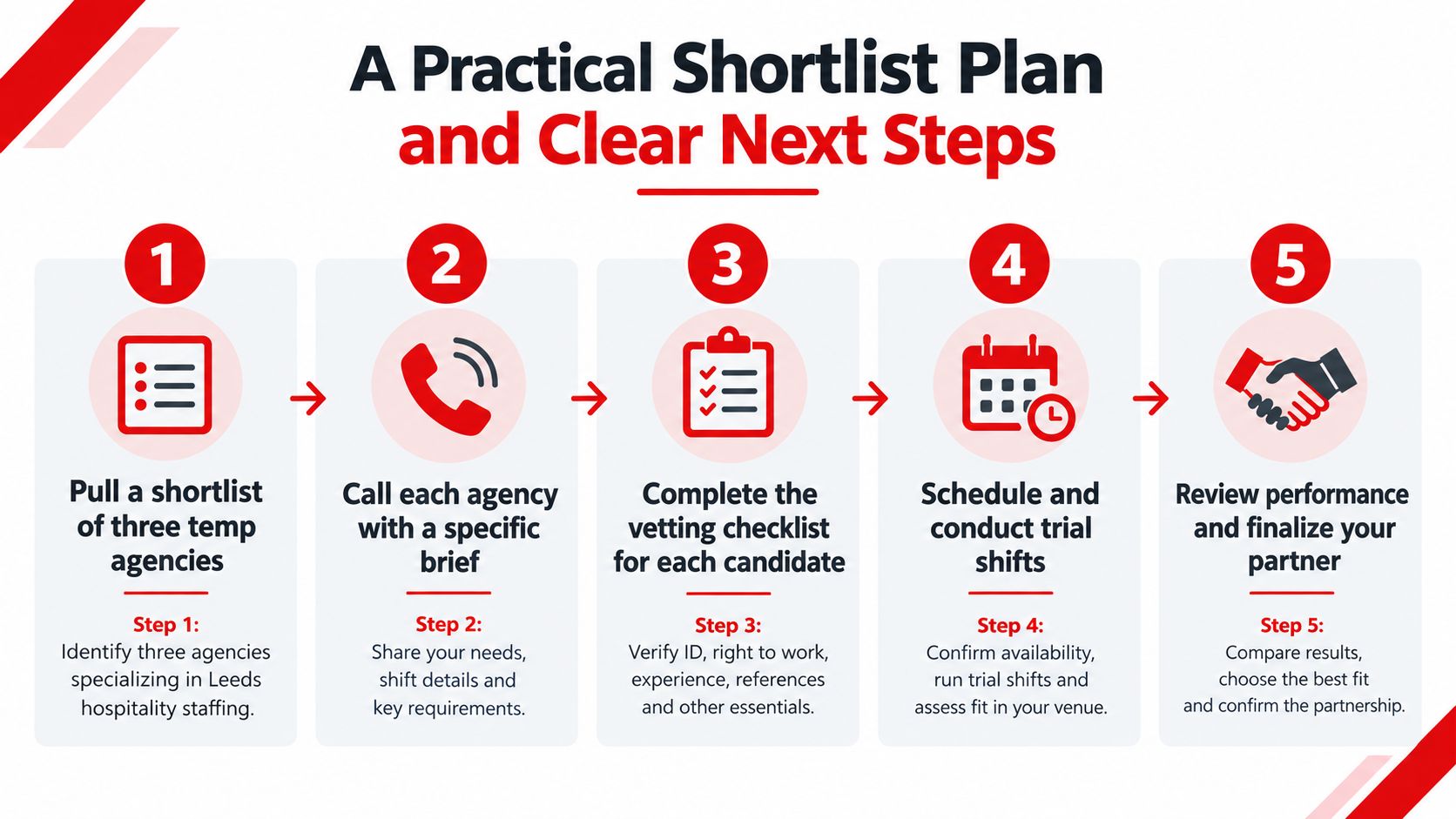
Run this process before the next difficult service, not after it.
- Build the shortlist: Pull three temporary agencies, three permanent recruiters and one specialist chef partner from your contacts, Leeds hospitality groups and trade directories.
- Issue one written brief: Give every supplier the same role, hours, start date, pay band, location and compliance requirements. Identical briefs make the replies comparable.
- Demand the evidence: Ask each agency to complete the vetting checks before any chef is approved. No evidence, no booking.
- Score the commercial offer: Use the quote grid to compare margin, holiday accrual, travel, cancellation terms, replacement cover and SLA response times.
- Test the strongest candidates: Book a paid trial shift or paid sample service with the two best matches before committing to a longer arrangement.
Use the guide to recruitment agencies across the UK as a starting point, then judge every supplier against your own operating brief. A directory can help you find names. It can't validate whether those names will protect your kitchen.
If you need urgent Leeds chef cover, contact Relief Chefs UK and give the team the exact shift brief, section and start time. The nationwide service, established in 2013, covers relief chefs, temporary chefs, permanent chef recruitment and wider hospitality staffing support, so visit Relief Chefs UK to request a verified chef rather than another untested name.