
Friday service is booked, the pass is hot, and at 6.15pm your CDP calls in sick. You ring three numbers while the head chef starts covering two sections, the sous chef stops prep, and the manager wonders how many dishes can leave the kitchen before standards collapse. In London, that scramble is no longer an occasional nuisance. It's an operating risk.
Temporary work is a normal part of the UK labour market. Between January and March 2024, 1.12 million people were in temporary employment, representing 3.6% of everyone in work, across agency, casual, seasonal and fixed-term roles, as recorded in UK temporary staffing data. For hospitality operators, the question isn't whether temporary cover belongs in the staffing plan. It's whether the agency supplying it understands kitchens well enough to protect service.
Why London Kitchens Now Depend on a Specialist Temping Agency
A general recruiter can send a CV. A specialist hospitality agency should be able to tell you whether that person can run a section during a slammed Friday service.
That difference matters in London, where a single absence can push the head chef onto the line, delay prep, increase overtime and leave the rest of the brigade working beyond safe limits. The government recorded 146,000 hospitality vacancies in the three months to January 2023, with a 6.6% vacancy rate, the highest of the sectors covered in the relevant ONS data. Hospitality vacancies were also 49% above pre-pandemic levels, according to the government's Hospitality Strategy update.
London's demand is particularly concentrated. ONS-linked job-ad data recorded 10,460 hospitality adverts in London in December 2022, compared with 8,280 in December 2019, as reported in the same government source. That makes a reliable London temping agency more than a backup telephone number. It's part of the kitchen's infrastructure, alongside refrigeration engineers, pest contractors and maintenance suppliers.
The generalist recruiter problem
A high-street recruiter may cover warehouse staff, office administrators, waiting staff and kitchen workers from one broad database. They may know whether a candidate is available, but that doesn't tell you whether the candidate can close a section, manage allergens or recover when the pass backs up.
A hospitality-only agency speaks the language of the kitchen. It understands the difference between a commis and a CDP, knows why a pastry chef needs a different brief from a grill chef, and asks about the venue's menu before offering a name.
Operator rule: Don't ask an agency how many people it has on its database. Ask how many chefs it can call who are suitable for your cuisine, section and shift pattern.
Venues in central London, Canary Wharf, Kensington, Richmond and the wider Greater London area all face different travel, menu and service pressures. A chef who works well in a high-volume hotel kitchen may not suit a small gastro-pub with a tight brigade. Your supplier needs to understand that distinction.
Treat cover as planned purchasing, not an emergency favour. Build a relationship with one accountable London hospitality recruitment agency, share your regular shift patterns and give clear feedback after every booking. Operators who wait until the rota has already failed lose money on every shift. Operators who plan a dependable cover route book staffing with the same calm discipline they use to order produce.
What a Hospitality Temping Agency Actually Does
A proper hospitality temping agency supplies temporary chefs to a venue for a defined assignment. That might mean one relief shift, a run of weekend services, several weeks covering sickness, or a longer interim placement while you recruit permanently.
The agency normally employs and pays the temporary chef. The venue controls the service itself, including the menu briefing, station allocation, uniform, allergens and site procedures. That division only works when both sides understand their responsibilities before the chef arrives.
Roles and skills should match the brief
A specialist agency should be able to discuss more than “kitchen staff”. You should be able to request a:
- Kitchen porter for washing-up, cleaning and basic kitchen support.
- Commis chef who can follow recipes, maintain mise en place and work safely under supervision.
- Demi chef de partie or CDP with proven section experience.
- Sous chef who can organise the brigade, control service and support the head chef.
- Head chef or relief chef who can take operational responsibility during an absence.
- Pastry chef or specialist chef matched to the production, cuisine or dietary requirements of your venue.
The brief should cover cuisine, service style, section, covers, start time, finish time, transport expectations and whether the chef must supervise others. “Need a chef tomorrow” isn't a brief. “Need a CDP for larder and starters, modern British menu, early prep, Friday dinner service, central London venue” is.
The operating model separates specialists
A serious agency maintains a live pool filtered by role, cuisine, location and availability. It checks whether a chef can realistically reach your site, rather than forwarding the first person who answers a message.
The coordinator should understand terms such as pass, prep list, HACCP, section handover and allergen control. If a chef fails to arrive, you need an escalation route, not an automated email. The agency should own payroll administration, National Insurance, holiday accrual and replacement arrangements. You still own the site induction, menu information, uniform expectations, allergen briefing and day-to-day supervision.
Ringing a specialist should feel like calling a trusted supplier. You give the operating detail, the agency gives you a suitable person and takes responsibility for the handover.
That's the practical value of hospitality staffing support in London. You're buying an organised staffing process, not access to a pile of untested CVs.
Legal and Compliance Duties London Operators Must Understand
The agency may employ the chef, but your venue still has duties once that person enters your kitchen. Don't treat agency cover as a way to outsource every compliance decision.
Start with right to work. The agency should complete the formal employer checks, while the venue should confirm what evidence has been checked, retain the relevant record for the assignment and make sure the person supplied is the person who was vetted. Ask how the agency handles share codes, identity checks and changes in immigration status before the first booking, not after a problem appears.
Understand agency worker rights
Agency workers receive important protections from day one. They must receive at least the National Minimum or Living Wage, paid holiday and protection from discrimination. They're also entitled to information about vacancies with the hirer.
After 12 weeks in the same role with the same hirer, the worker qualifies for equal pay and working conditions with directly employed staff, including relevant working-time arrangements. The London agency worker rights guidance explains the rule and the day-one protections.
That threshold affects rota design and cost. If you repeatedly book the same chef into the same role, your agency must track continuity accurately. Breaks, overtime, holiday, tips and venue policies can all affect the practical calculation. Don't let a consultant tell you that a temporary booking is automatically outside equal-treatment obligations.
Kitchen-specific checks still sit with you
For each booking, confirm that the chef's qualifications suit the role. Ask for:
- Food hygiene certification appropriate to the work.
- Allergen awareness, with a clear briefing on your menu and controls.
- HACCP awareness, including your own site procedures.
- Site induction, covering fire procedures, equipment, reporting lines and local requirements.
- Break and working-time arrangements, especially for long services or split shifts.
The agency should also provide evidence of employer's liability and public liability insurance. Confirm that cover applies while the chef works on your premises and request the certificate before the first shift. Keep the document with your supplier records, rather than assuming insurance exists because the agency has a professional website.
For a practical employer-side reference, use this guide to employment law for temporary staff before signing a supply agreement.
Vetting and Quality Checks to Demand From Any Agency
Your vetting standard should be higher than “the chef has worked somewhere before”. Hospitality failures usually appear in the details: poor knife control, weak allergen knowledge, unreliable transport, an inability to work a section or a bad attitude under pressure.
Demand evidence, not reassurance.
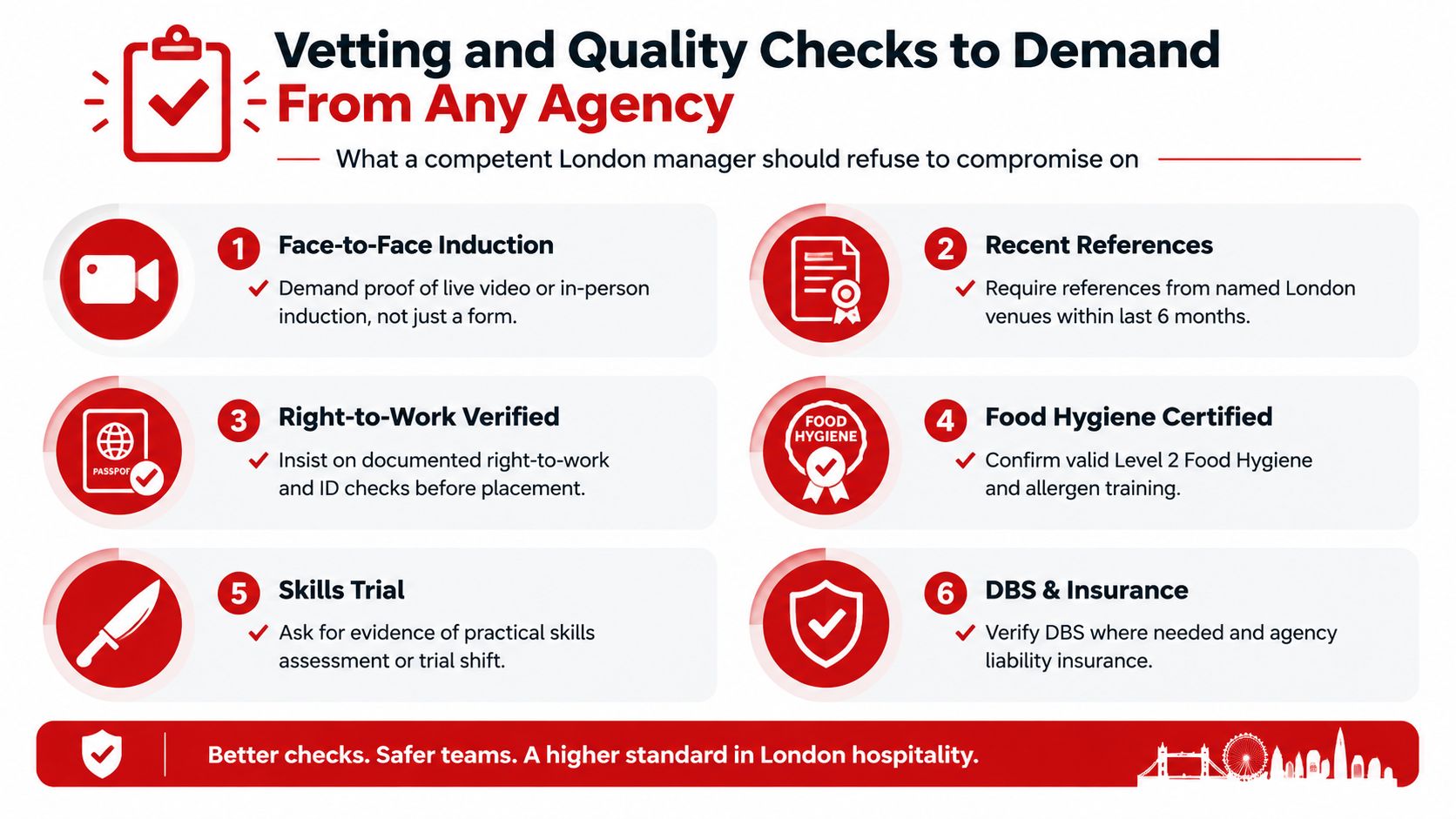
Your minimum due-diligence list
Live induction: Require proof of a face-to-face or live-video induction. A completed online profile doesn't show how the agency tested communication, presentation or kitchen understanding.
Recent references: Ask for references from named London venues. The agency should tell you when the references were taken and what they covered, including punctuality, section competence and conduct.
Right-to-work evidence: Make sure checks are documented before placement. Share codes and other evidence can expire or change, so the agency should confirm status at booking stage rather than relying only on an old onboarding record.
Food safety training: Confirm a valid Level 2 Food Hygiene certificate and current allergen training. Ask how the agency refreshes certificates and stores the evidence.
Trade assessment: Require a practical skills check covering knife work, mise en place and section competence. For a CDP, ask what station the chef has run, not which job title appears on the CV.
DBS and insurance: Verify an Enhanced DBS where the assignment requires it, then request current employer's and public liability insurance certificates.
The agency should also give you a named consultant and a written replacement commitment. A 24-hour replacement guarantee is a sensible standard for planned assignments, although same-day emergencies need a separate response promise.
Refuse vague accountability. If nobody owns the booking, nobody owns the failure.
Ask to see the complaints log process. You don't need private candidate details, but you do need to know how poor performance is recorded, reviewed and blocked from future bookings. Online profile reviews aren't a substitute for references, trade tests or documented compliance.
For another view of the checks a London venue should demand, use this specialist hospitality staffing service as a benchmark when comparing suppliers.
The following video can help managers structure a practical screening conversation:
Pricing, SLAs and What Monthly Plans Should Include
Price comparisons become useless when agencies describe different grades, hours and conditions under the same label. Compare the actual chef level, total shift cost, cancellation terms, travel expectations, payroll treatment and replacement support.
The rate itself isn't the only commercial issue. A cheap booking that arrives late, lacks the required skill or leaves you without cover creates a larger operational bill through overtime, waste and lost service capacity.
Compare the structure, not just the headline
| Plan Type | Hourly Band | Weekend Uplift | Response SLA |
|---|---|---|---|
| Ad hoc CDP-equivalent cover | £18 to £26 | 10% to 25% | Confirm in writing |
| Senior sous or head chef cover | £28 to £40 | 10% to 25% | Confirm in writing |
| Same-day emergency booking | Agreed quote | May apply | Inside two hours may carry a premium |
| Monthly support plan | Negotiated rate | Agreed in contract | Stated priority dispatch |
These figures are planning bands, not a universal tariff. The final price depends on grade, location, shift length, cuisine, notice and the agency's employment costs. Treat any supplier that gives you one flat number for every chef and every service with caution.
Find the costs hidden in the small print
Check for:
- Admin fees: Ask whether they're included in the hourly rate.
- Mileage or travel charges: Clarify whether London travel creates an extra line item.
- Uniform charges: Confirm who supplies chef whites, safety footwear and personal equipment.
- Cancellation windows: A short late-cancellation period can turn a flexible booking into a full charge.
- Minimum shift blocks: Don't pay for a longer block than the service needs without understanding why.
- Overtime rules: Establish how late finishes, extra prep and extended service are approved.
A monthly plan should buy something tangible. Look for a discounted hourly rate, a held rota slot, priority dispatch, one account contact and a clear process for unused hours. If a plan doesn't improve availability, communication or cost control, it's only a subscription.
Write the SLA into the agreement. It should state response time, expected fill process, replacement speed after a no-show and the escalation route outside normal office hours. A two-hour response window is a useful London benchmark for urgent cover, but define whether that means an acknowledgement, a shortlist or a confirmed chef.
Hiring Checklist and Interview Questions for Temp Chefs
A temp chef still needs a quality gate. The fact that the shift starts soon doesn't justify booking someone you haven't screened.
Start with the venue's needs, then test the candidate against them. A five-minute call can prevent an expensive mismatch if you ask direct questions and listen to the answers.
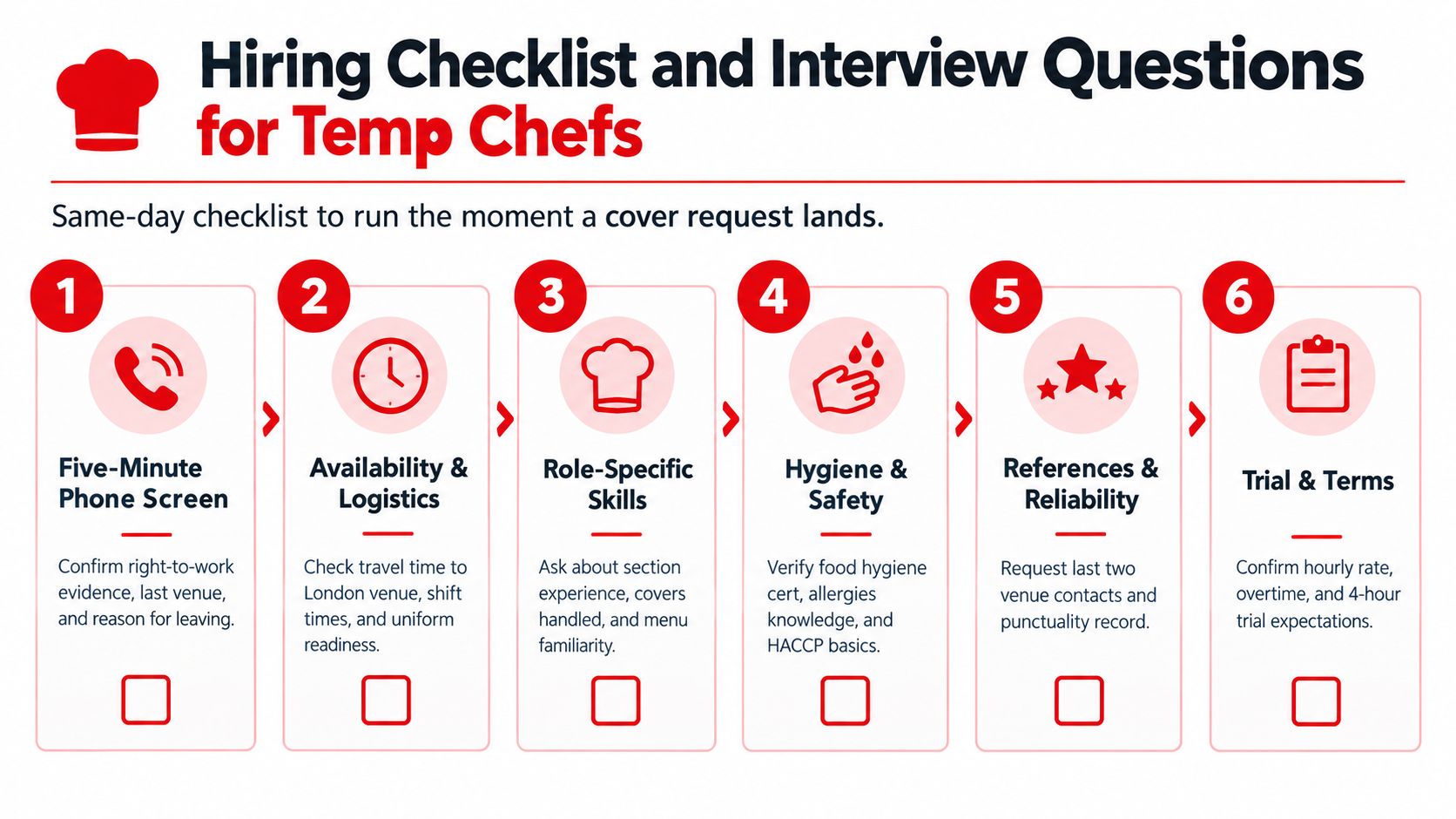
Run this screen before confirming the shift
Identity and availability come first. Confirm right-to-work evidence, the chef's last venue, the reason they left and whether they can cover the full shift window. Ask where they'll travel from and whether they've planned the journey to your site.
Then test the actual job:
- Section competence: “Which section have you run without supervision, and what did your prep list include?”
- Service pressure: “You're on a three-ticket pass and your section is behind. What do you reset first?”
- Allergens: “You suspect a dish leaving your section contains an allergen. What do you do before it reaches the guest?”
- Kitchen culture: “How do you handle a correction from a sous chef during service?”
- Menu transfer: “Tell me how you'd learn an unfamiliar menu before the first ticket.”
- Practical readiness: “Do you have your knife kit, uniform and safe footwear with you?”
Vague answers are warning signs. So are unnamed references, unexplained gaps in kitchen history and refusal to produce certificates on the morning of a booking.
Own the final quality decision
Ask the agency for a brief station test or practical assessment where appropriate. A candidate might describe strong larder experience, but you still need to know whether they can portion accurately, label prep correctly and keep the station clean during pressure.
Set the terms before arrival. Confirm rate, overtime approval, breaks, start time, dress standard, parking or travel arrangements and the person who'll meet the chef at reception. Your agency should provide the core information, but your duty manager must deliver the site briefing.
After the shift, record performance in the agency portal or supplier log. Note punctuality, technical ability, communication, cleanliness and whether you'd rebook the chef. Block repeat bookings for anyone who underperforms, and share positive feedback for people who strengthen the brigade.
The temp interview isn't a courtesy call. It's the last quality control point before your guests experience the result.
How Relief Chefs UK Meets Every Requirement Above
Relief Chefs UK was established in 2013 as a chef recruitment and staffing partner, with a model built around hospitality experience rather than generalist recruitment. That matters because the agency's value should be judged against the checks set out above, not against the size of its candidate database.
The company's stated operating model includes chef-led vetting, right-to-work checks, trade assessments and reference calls. It supplies temporary and relief chefs for London venues while also supporting permanent chef recruitment, so an operator can deal with an immediate gap without abandoning the longer-term staffing plan.
Requirement against delivery
| Operator Requirement | Relief Chefs UK Delivery |
|---|---|
| Hospitality-specific screening | Chef-run vetting focused on practical kitchen suitability |
| Right-to-work compliance | Right-to-work-checked chefs supplied for assignments |
| Fast response | Response within two hours for cover requests |
| Short-notice availability | Chefs can start within 24 to 48 hours, subject to role and availability |
| Insurance | Employer's and public liability cover |
| Ongoing account ownership | Dedicated account support and 24/7 support |
| Recurring staffing | Flexible Starter, Growth and Premium monthly plans |
| Replacement protection | Replacement guarantees within applicable service terms |
| Permanent recruitment | Permanent chef recruitment alongside temporary staffing |
| Broader hospitality needs | Relief chefs, temporary chefs, yacht chefs, villa chefs and hospitality staffing support |
The two-hour response promise is useful only if the agency explains what happens next. Ask how quickly you'll receive a shortlist, who confirms suitability, what happens if the chef declines and how the replacement process works after a no-show.
The same principle applies to monthly plans. A plan should help independent pubs, cafés, restaurants, boutique hotels and multi-site groups manage recurring cover without hidden charges or disconnected consultants. It should also support venues outside London, including operators in Devon, Bristol, Wales, Berkshire, Windsor, Reading, Slough and Dorset, where specialist kitchen cover can be harder to source at short notice.
Relief Chefs UK also works with private households and yacht operators, offering yacht chefs and villa chefs alongside mainstream restaurant and hotel staffing. That breadth is relevant when an operator needs one staffing partner across different hospitality environments.
Next Steps and How to Book Cover Fast
The fastest booking starts with a complete brief. Before you contact an agency, write down:
- Shift details: Date, start time, finish time and whether the service may run late.
- Role level: Kitchen porter, commis, CDP, sous chef, head chef, pastry chef or specialist.
- Cuisine and station: Menu style, section, equipment and production expectations.
- Venue location: Full address, public transport information and access instructions.
- Service pressure: Expected covers, event requirements, private dining or normal service.
- Non-negotiables: Food hygiene level, allergen knowledge, language, supervision and uniform.
- Commercial terms: Approved rate, overtime process, cancellation terms and booking contact.
Don't send a message that only says, “Can you find me a chef tomorrow?” That forces the consultant to ask questions while the clock runs. A sharp brief lets the agency search its pool properly and reject unsuitable candidates before they reach your manager.
Use one clear booking route
Contact Relief Chefs UK through its short online form or phone line and provide the full shift brief. Ask for the response time, chef shortlist, compliance confirmation and interview window. If the requirement is recurring, ask about a monthly plan rather than repeatedly negotiating individual emergency bookings.
For a venue with regular absences, seasonal demand or a thin brigade, keep a pre-agreed staffing profile on file. That should include accepted chef grades, cuisine preferences, site instructions, uniform standards and managers authorised to book. The next sick call then triggers a known process instead of a frantic search.
The wider market makes that discipline necessary. Parliament recorded 95,000 hospitality vacancies in the three months to September 2024, equal to 3.6 vacancies per 100 workers, compared with 2.6 across all industries, as shown in its hospitality labour market briefing. Chef shortages are also material. UKHospitality reported 132,000 vacancies and chef shortages ranging from 10% for head chefs to 21% for production chefs in its workforce information.
That's why the right question isn't just which temping agency in London can send a body. It's which partner can supply a competent chef, verify the paperwork, respond quickly and take responsibility when service becomes difficult.
Relief Chefs UK provides vetted relief chefs, temporary chefs and permanent chef recruitment for London venues, alongside yacht chefs, villa chefs and wider hospitality staffing support. Visit Relief Chefs UK with your shift brief or contact the team for fast cover and a practical plan for recurring kitchen gaps.