
Boost Bristol Hospitality: Find Vetted Relief Chefs
17 April 2026

Friday evening in Bristol. Bookings are stacked, walk-ins are building, the pass is already backed up, and then your CDP rings in sick. If you run a pub on the Harbourside, a restaurant in Clifton, or a boutique hotel near the centre, you already know what happens next. The head chef stretches too thin, standards slip, prep gets cut, and the dining room feels the wobble before service is halfway through.
That’s the problem in bristol. It isn’t just filling a rota gap. It’s protecting service, revenue, team morale, and guest confidence in a city that expects good food and notices when you miss.
Bristol’s population is approximately 479,000, with 91 languages spoken and two universities hosting over 54,000 students, which helps create a demanding, competitive food scene where last-minute staffing gaps hit hard, as noted in Britannica’s Bristol summary. In practice, that means you’re not just competing for covers. You’re competing for capable chefs who can walk into a busy kitchen and keep control.
The Bristol Hospitality Challenge Keeping You Up at Night
You don’t lose sleep over a quiet Tuesday. You lose sleep over the Friday when the bookings are real, the weather turns in your favour, and one missing chef threatens the whole shift.

A Bristol kitchen failure rarely stays in the kitchen. Front of house feels it within minutes. Ticket times drift. The menu gets restricted. Guests who came out expecting a proper meal and sharp service don’t care that someone phoned in sick. They only see what lands on the table.
What makes bristol less forgiving
Bristol has a strong independent streak. That’s good for guests, but it puts pressure on operators. Diners compare venues closely, teams move around quickly, and standards can’t dip just because the rota has fallen apart.
In a city with varied neighbourhood trade, student demand, hotel pressure, events, and a broad mix of cuisines, the cost of one weak shift adds up fast. It shows up in waste, overtime, refunds, exhausted supervisors, and regulars deciding not to rush back.
Practical rule: If one absence forces your head chef onto every section, you don’t have a staffing plan. You have a gamble.
The gap that hurts most
The hardest gap to fill isn’t always your senior vacancy. It’s the sudden operational hole. The chef who was meant to run garnish. The breakfast chef who knows the hotel pace. The solid pair of hands who can land on prep, own a section, and keep the brigade calm.
What doesn’t work is wishful thinking. Asking your sous to “just get through it” works once. After that, fatigue sets in and better people start looking elsewhere.
A proper relief chef arrangement isn’t a luxury purchase. It’s a continuity tool. That matters even more in bristol because guests have options, your competitors aren’t standing still, and service failures travel quickly through word of mouth.
Why Standard Recruitment Fails in Bristol's Dynamic Market
The usual fixes sound sensible until you try to use them under pressure.
Job boards are too slow for live operations. A social media post may get attention, but attention isn’t the same as a chef turning up capable, legal to work, and suited to your kitchen. Generic temp agencies often send availability, not fit. In bristol, that gap matters.
Why broad-brush hiring falls apart
A Clifton restaurant, a Wapping Wharf kitchen, a Bedminster pub, and a harbour events operation don’t need the same chef. The pace, menu style, prep systems, and service expectations are different. Standard recruitment tends to flatten all of that into one bad assumption: a chef is a chef.
That assumption costs money.
If the person arrives and can’t handle your pass, your prep style, or your volume, you still carry the risk. The team closes ranks, stronger chefs cover the damage, and management pays twice. Once for the booking, again in disrupted service.
Here’s what usually fails:
- Job board urgency: Good for planned hiring. Useless when Saturday service is in danger.
- Friends-of-friends hiring: Sometimes it gets you through a shift. Sometimes it drops an unknown chef into a fragile kitchen with no accountability.
- Generalist agencies: They can fill a body-shaped gap. They often can’t fill a standards gap.
- Last-minute social posts: They attract noise, not dependable cover.
The local issue most operators overlook
The bristol labour picture also has deeper pressure points. In BS13, entrenched poverty and an annual hospitality staff turnover of 25% compared with a UK average of 18% create acute staffing gaps for local pubs and restaurants, according to reporting on South Bristol and BS13. For operators, that means traditional recruitment methods miss part of the underlying problem. The talent pipeline is uneven, retention is harder, and some areas face barriers that a standard advert won’t solve.
That’s why many operators end up changing approach. They stop treating chef cover as a one-off panic and start treating it as an operational system, often alongside specialist support such as hospitality recruitment services.
A weak agency match doesn’t just waste a shift. It unsettles your permanent team, who then have to carry someone they don’t trust.
What works better
Operators in bristol usually get better results when they define the actual need before they book. Not “need chef ASAP”. More like this:
| Situation | What you actually need |
|---|---|
| Friday sickness | A chef who can step into an active section with minimal hand-holding |
| Holiday cover | Someone steady enough to hold consistency across several shifts |
| New opening pressure | Temporary support while permanent recruitment catches up |
| Event trade | A chef comfortable with bursts, short menus, and tight production windows |
That level of clarity is what standard recruitment often misses. And when it misses in bristol, service pays for it.
Your Playbook for Booking Vetted Bristol Chefs Fast
Speed matters, but blind speed creates more problems than it solves. The best operators move quickly and precisely.
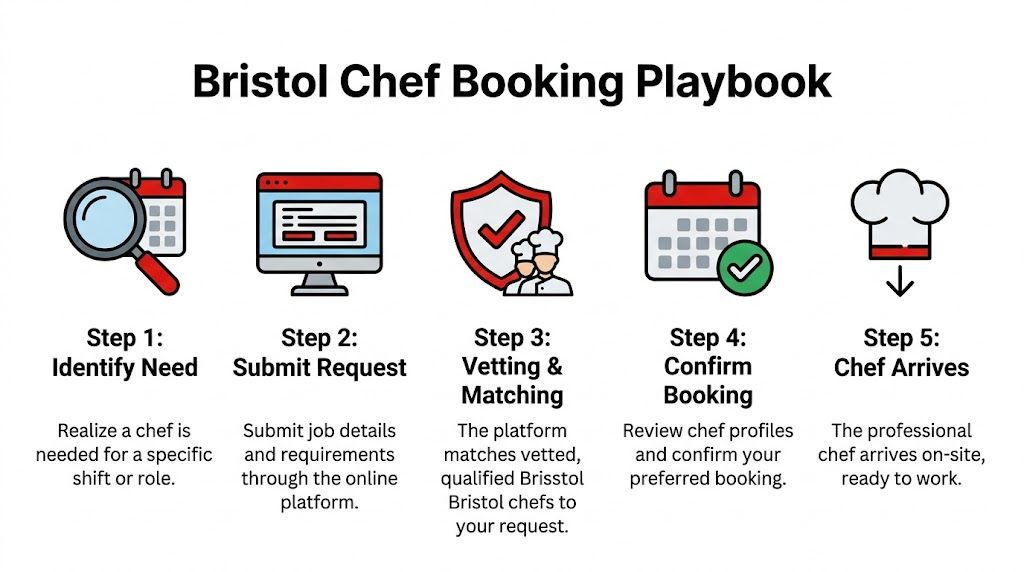
Bristol’s hospitality demand has sharpened further. With a 30% rise in luxury yacht moorings and 12 new boutique hotels opening in the last year, the city has seen a 22% increase in temporary chef requests, especially for short-notice event cover, as outlined in this Bristol analysis. That’s exactly why you need a clear booking process, not a scramble.
Step one, define the gap properly
Start with the service risk, not the job title.
If your senior sous is off, do you need a leader, or do you need someone to stabilise prep so your sous can run the pass? If a yacht event needs cover, do you need a chef who’s polished with guests and can work in a compact galley? If a boutique hotel is short on breakfast, can a strong all-rounder solve it?
Write down five things before you make any call:
Shift pattern
Dates, start time, finish time, and whether it’s one shift or a run of cover.Section or responsibility
Grill, pastry, breakfast, events, banqueting, prep-heavy support, or pass-led supervision.Service style
Rosette-led, premium casual, pub volume, hotel breakfast, private household, yacht, or villa.Pressure points
Allergy management, speed of service, large prep list, small team, open kitchen, guest interaction.Kitchen essentials
Uniform expectations, knives, parking reality, access times, induction needs.
Step two, brief like an operator
A vague brief slows everything down. A clean brief gets better matches.
Use a short format the chef can read quickly:
- Who you are: Venue type and rough service style.
- What you need: Relief, temporary, or a route into permanent cover.
- Where the risk sits: Busy lunch, event prep, reduced brigade, menu launch.
- Who they report to: Head chef, GM, sous, or owner-operator.
- What good looks like: Hold section, support prep, lead service, train junior staff.
Specialist support earns its keep. A service such as South West agency chef cover can work from a practical brief rather than a generic vacancy note. Relief Chefs UK, established in 2013, handles relief chefs, temporary chefs, permanent chef recruitment, yacht chefs, villa chefs, and wider hospitality staffing support across the UK.
A quick visual summary helps if you’re briefing multiple stakeholders.
Step three, judge fit before availability
Availability is only the first filter. Fit is what protects service.
Ask practical questions, even when the booking is urgent:
- Can they walk into this level of service?
- Have they worked similar volume or similar food?
- Do they need heavy direction, or can they own a section?
- Are they comfortable with your setup, such as hotel breakfast, yacht galley work, or a tight independent kitchen?
Kitchen test: The right relief chef reduces noise in the kitchen within the first hour. The wrong one creates more of it.
Step four, prepare the handover before they arrive
Managers often lose time here. They secure cover, then forget the arrival plan.
Set the chef up to work, not to guess. Have this ready:
| On arrival | Why it matters |
|---|---|
| Prep list | Stops wasted time and repeat questions |
| Menu spec or dish photos | Protects consistency and plate standards |
| Allergen process | Keeps compliance tight from minute one |
| Key contacts | Avoids confusion during peak service |
| Section map | Helps them settle into your line quickly |
A relief chef should get enough information to become useful fast, but not so much paperwork that they lose an hour before touching a pan.
Step five, review the shift commercially
After service, don’t just say “that went fine”. Look at the outcome.
Did the chef hold their section? Did your core team finish in better shape? Did the kitchen avoid menu cuts, complaints, or drag on ticket flow? Those are the key measures.
If the answer is yes, keep the relationship warm. The operators who handle bristol best usually build a bench of trusted cover before the next problem lands. That matters for pubs, boutique hotels, private households, and especially harbour-led work where timing can tighten quickly.
Managing Costs and Maximising Value with Flexible Staffing
Owners often ask the wrong question first. They ask what a relief chef costs. The better question is what an uncovered shift costs.

A thin brigade doesn’t just slow service. It pushes out labour elsewhere. Supervisors stay later. senior chefs step down into basic tasks. Menus get simplified at the worst moment. Guests receive a lesser version of what they booked.
The real cost of trying to save money
Cutting corners on chef cover usually creates hidden spend:
- Lost covers: You cap bookings or stop walk-ins because the kitchen can’t cope.
- Team fatigue: Good chefs burn out when every crisis becomes their problem.
- Inconsistent standards: The dish goes out, but not at the level your guests expect.
- Management drag: GMs and owners end up firefighting instead of running the business.
That’s why flexible staffing works best when it’s viewed as protection for revenue and standards. Not as an emergency luxury.
Different businesses need different staffing shapes
A small independent pub in Bedminster doesn’t need the same arrangement as a central hotel or a multi-site operator. One may need ad hoc weekend cover and the option for a replacement if the match isn’t right. Another may need a steadier pipeline, recurring temporary chefs, and permanent chef recruitment support behind the scenes.
The practical trade-off is simple:
| Option | What usually happens |
|---|---|
| Cheap, unstructured cover | Lower confidence, more supervision, inconsistent service |
| Planned flexible staffing | Better continuity, less disruption, stronger team retention |
| Permanent-only strategy | Good when it works, exposed when sickness or spikes hit |
The cheapest shift on paper can become the most expensive shift in the week if service goes off line.
What operators should look for in pricing
Transparent pricing matters more than headline promises. You need to know what’s included, what happens if a chef has to be replaced, and whether support is still there when the booking changes late.
That’s also where a regular arrangement can help. Some kitchens need occasional cover. Others need more regular cover because they run multiple sites or complex schedules. A sensible operator chooses flexibility based on risk, not pride.
Before agreeing anything, compare the booking against your wider labour picture. A useful benchmark is your broader cost of employing kitchen staff, including overtime pressure, recruitment admin, lost management hours, and the effect on retention when your permanent team keeps carrying the gaps.
The best value usually comes from using temporary support in a targeted way. Protect the busiest shifts. Support known weak spots. Keep your strongest people doing the work only they can do.
Future-Proofing Your Kitchen for Bristol's Seasonal Peaks
Reactive cover keeps the doors open. Planned cover keeps the kitchen stable.
Bristol has always been commercially resilient. The city consistently ranked among the top three English cities for tax receipts after London from the 13th to 18th centuries, according to the history of Bristol. That long pattern matters because the same lesson still applies now. Strong operators prepare for peaks instead of acting surprised by them.
Build cover around your calendar
Every bristol venue has pressure points. Harbour events. Summer weekends. Christmas trade. Student movement. Private bookings that land together. Hotel occupancy shifts. You don’t need exact certainty to prepare well. You need a realistic calendar and a staffing partner who can support it.
A useful planning rhythm looks like this:
- Map your known peaks: Put likely busy periods in the diary early.
- Flag fragile sections: Breakfast, pastry, grill, banqueting, and prep-heavy roles often crack first.
- Protect your core brigade: Use temporary chefs to absorb pressure before your permanent team starts fraying.
- Decide what must not fail: Sunday lunch, event menus, tasting nights, and festive bookings usually sit at the top.
Use temporary support as a retention tool
Managers sometimes think relief cover is only about plugging holes. It’s also one of the simplest ways to stop your permanent chefs from resenting the business.
If your best people work every double, every holiday rush, and every emergency because there’s nobody else, they won’t thank you for the loyalty speech. They’ll leave. Planned temporary support gives your core team breathing room, helps maintain standards, and gives head chefs a chance to lead rather than constantly patching sections.
Strong kitchens don’t only recruit well. They also recover well when the week goes sideways.
Think beyond the city boundary
The Bristol market doesn’t exist in isolation. Operators across Devon, Dorset, Wales, Berkshire, Windsor, Reading, and Slough deal with the same pattern in different forms: seasonal pressure, chef shortages, unpredictable absences, and high guest expectations. The lesson is consistent across those regions. Kitchens that build flexible support into the operation cope better than kitchens that rely on goodwill and overtime.
If you know your site gets squeezed during harbour traffic, holiday trade, or event weeks, get ahead of it. The smartest staffing move is often made before the rota breaks.
Your Questions Answered on Bristol Chef Staffing
Can you get a chef into my bristol venue at short notice
Yes, short-notice cover is often the whole point of using specialist support. The key is giving a precise brief quickly, including section, service style, dates, and who the chef will report to. The better the brief, the better the match.
What types of venues need relief chefs most often
Independent pubs, restaurants, boutique hotels, private households, yachts, and villas all use temporary chef support. The trigger is usually the same: sickness, holiday cover, a vacancy that hasn’t been filled yet, or a demand spike the existing brigade can’t absorb safely.
What should I send before the chef arrives
Keep it practical. Send the rota details, menu style, section expectations, start and finish time, dress code, parking or access notes, allergen procedure, and the contact for the shift lead. A short prep brief is usually more useful than a long operations pack.
Can temporary cover help while I recruit permanently
Yes. That’s one of the most commercially sensible uses of it. Temporary chefs protect service while you run a proper hiring process, instead of rushing a permanent hire because the kitchen is already under strain.
What checks should I expect from a serious chef staffing partner
Expect right-to-work checks as standard. Depending on the role and setting, DBS checks may also be requested. You should also expect clear communication on experience, availability, and what kind of kitchen the chef is suited to.
Can you help with specialist roles such as yacht chefs and villa chefs
Yes, but the brief needs to be even tighter. Those roles often require more than kitchen skill alone. You may need discretion, guest-facing confidence, flexibility with space, and the ability to work calmly in a more self-contained environment.
Do you only cover central bristol
No. Most operators need support across wider Bristol and the South West, and many also need cover further afield. If you run sites outside the city, say so at the start. It makes matching easier and avoids wasted time.
Is temporary chef cover only for emergencies
No. Emergencies are common, but planned use is often more effective. Holiday cover, peak-week support, launch periods, event prep, and transition cover between permanent hires are all sound reasons to book.
How do I know if a relief model is right for my site
If one absence causes menu cuts, long ticket times, management panic, or immediate pressure on your strongest chefs, your site is a good fit for flexible cover. If your operation is stable even when someone is off, you may only need occasional support.
If your kitchen in bristol is one sickness call away from a bad weekend, it’s time to fix the system rather than absorb another hit. Relief Chefs UK works with pubs, restaurants, boutique hotels, private households, yachts, and hospitality groups across the UK, providing relief chefs, temporary chefs, permanent chef recruitment, and wider staffing support. Make an enquiry now if you need urgent cover, planned seasonal support, or a stronger long-term chef pipeline.
Call the team.
Office 01392 715474 · info@reliefchefs.co.uk