
Chef Agency Bristol: Hire Relief Chefs Seamlessly
18 April 2026
A Bristol kitchen can go sideways fast.
It’s 4.30pm on a Saturday. Your senior chef has called in sick. Bookings are heavy, prep is half-finished, the team is already stretched, and the front of house manager is asking whether you need to cap covers. If you run a pub in Clifton, a hotel near the centre, or a busy neighbourhood restaurant, you already know the issue isn’t one absence. It’s what that absence exposes. No depth in the rota. No reliable backup. No margin for error.
That’s why a chef agency bristol search usually starts in panic. It shouldn’t.
The strongest operators in this city don’t treat agency chefs as a last-ditch rescue. They treat external staffing as part of their operating model. That means having a shortlist ready, knowing what good vetting looks like, and understanding which agencies can protect service when the pressure lands.
Your Guide to Finding a Reliable Chef Agency in Bristol
Bristol rewards venues that stay consistent. Guests forgive the odd delay. They don’t forgive a bad plate, a reduced menu with no explanation, or a service that feels under control one week and chaotic the next.
A relief chef can keep service moving, but only if the agency behind them is solid. A weak agency sends whoever is available. A good one sends someone who can walk into your kitchen, read the section, respect your standards, and avoid creating more work for your team.
What a reliable agency changes on the ground
When a venue gets this right, the difference is immediate:
- Service stays open: You don’t need to cut tables or strip back the menu blindly.
- Your core team avoids burnout: Good cover stops one absence turning into three more next week.
- Standards hold up: Guests see continuity, not improvisation.
- Managers get time back: You stop spending the afternoon ringing around old contacts.
A chef who can cook is only half the answer. You need one who can slot into your kitchen without dragging your team off the line.
The practical move is to build a relationship with an agency before you need one. Operators looking across the region often start with agencies that already understand the South West pace of trade, the mix of pubs, hotels and care settings, and the realities of short-notice cover. For venues reviewing local options, this overview of agency chefs in the South West is a useful starting point.
What Bristol venues should expect
At minimum, any agency you use should be able to answer four basic questions quickly:
- Who exactly are you sending?
- What checks have you completed?
- Have they worked in my type of venue before?
- What happens if they’re not right?
If the answers are vague, move on.
The rest of this guide is built for venue owners, hotel managers, head chefs and operations teams who want a proper framework. Not marketing talk. Not promises. Just the checks that matter when your kitchen has to perform tonight.
Why Bristol's Hospitality Market Demands a Better Staffing Strategy
A Friday lunch service in Bristol can go wrong before the first docket lands. One chef calls in sick, a second is already covering prep for a vacancy you have not filled, and by 11am the choice is ugly. Cut the menu, drag a tired senior chef onto another double, or bring in outside cover and hope they can cope.
That pressure is sharper in Bristol because the market stays active across independents, groups, hotels and contract catering at the same time. Good chefs have options. Agencies know it. Candidates know it. Venues that treat staffing as a last-minute admin job usually end up paying more for weaker cover.
According to chef jobs data for Bristol on Caterer, average chef salaries in the area are £26,999 annually, with listed ranges from £20,999 to £32,499 depending on role and experience. The same source notes that Bristol hoteliers raised concerns in 2023 after the Migration Advisory Committee did not recommend adding hospitality roles to the UK skills shortage list. For operators, the message is clear. Recruitment pressure is local, immediate and tied directly to margin.
Why normal hiring tactics stop working
The old fixes break down quickly in this kind of market. A job ad might help with a long-term hire. It does nothing for Saturday's service. Asking around your own network can work once or twice, but those favours dry up fast, and they rarely solve repeat gaps across holidays, sickness, attrition and busy trading periods.
Bristol venues usually run into four predictable pressure points:
- Short-notice absence: prep gets disrupted before service is even organised
- Peak trading periods: summer weekends, December, events and bank holidays expose thin rotas
- Expansion pressure: extra covers, longer opening hours or new sites outpace recruitment
- Team fatigue: repeated overtime keeps the kitchen open short term, then quality, morale and retention drop
Independent pubs feel this first because there is less slack in the system. No spare sous chef. No floating team from another site. No extra management layer to absorb a bad week.
That is why a better staffing strategy is not just about finding bodies quickly. It is about reducing operational risk. Any chef agency in Bristol can promise availability. The better ones can explain how they judge suitability, how they brief chefs before shift, and what happens when a placement is wrong for the section, the pace, or the standard required.
A sensible model is mixed. Permanent chefs give continuity, standards and culture. Relief support protects service during gaps that are expensive to leave uncovered. The core commercial question is not whether to use agency support. It is whether the agency has a clear enough vetting process to send someone who helps your kitchen rather than slows it down.
The Essential Vetting Checklist for Any Bristol Chef Agency
Saturday, 10:30am. Your lunch prep is behind, one chef has called in sick, and an agency says they can get someone to site by noon. At that point, speed matters, but judgement matters more. A relief chef who cannot hold the section, follow your allergen controls, or work with your team will cost more than the gap you were trying to fill.
That is why Bristol operators need a vetting standard, not just a phone number. Use this framework with any agency you are considering. If they answer clearly and specifically, keep talking. If they stay vague, move on.
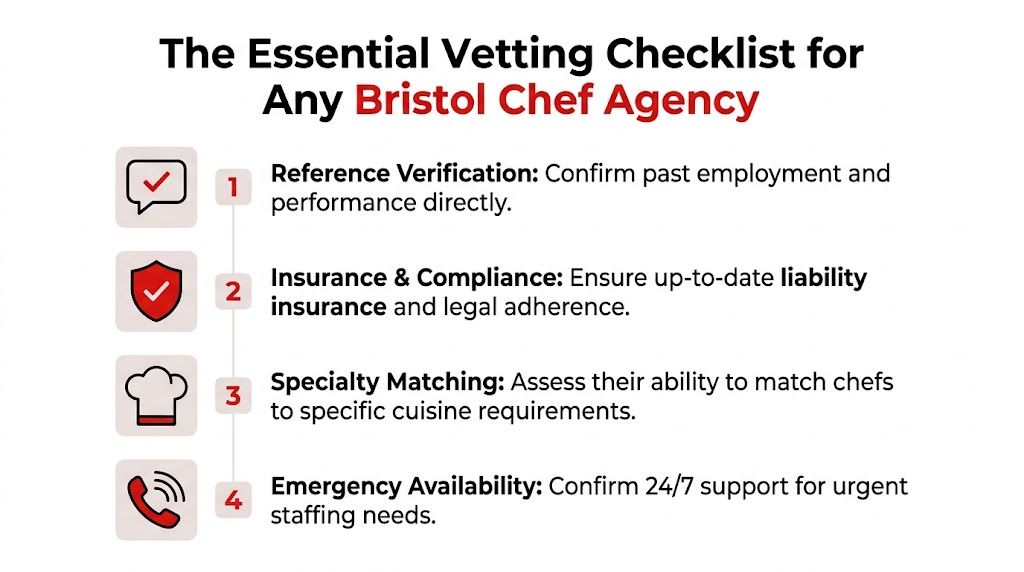
Core vetting checks
Start with the basics, then push past them. Any agency can say a chef is experienced. What matters is how they prove it.
- Right-to-work checks: Ask whether right-to-work status is verified before a chef is offered out for shift. If the answer sounds casual, treat that as a warning.
- References with useful detail: A decent reference should tell you more than dates of employment. It should confirm reliability, section level, pace, and how the chef handled pressure in service.
- Food safety and role-specific compliance: If your site needs Food Hygiene certification, allergen awareness, DBS clearance, or care-sector background, ask what evidence the agency holds and how recently it was checked.
- Insurance cover: Get a clear answer on employer's liability, public liability, and what happens if there is a dispute or incident on shift.
- Recent, relevant kitchen work: Past experience only counts if it is still current. A chef who last worked a busy pass two years ago is a different proposition from someone doing it every week.
Match the chef to the site
Weak agencies are exposed. They fill the gap on paper, but they do not match the kitchen properly.
A strong CV does not travel cleanly between every operation. A chef who thrives in a large hotel brigade may slow down in a small Bristol pub where they need to prep, organise, and communicate without layers of support. Equally, a chef who is excellent at independent sites may struggle in a tightly specified branded kitchen where consistency matters more than improvisation.
Ask direct questions about fit:
| What you need matched | What to ask |
|---|---|
| Cuisine and menu style | Have they worked with this style of food and this level of finish recently? |
| Service intensity | What sort of covers, pace, and peak periods are they used to? |
| Team structure | Can they run a section alone, support a head chef, or slot into an established brigade without fuss? |
| Site type | Have they worked in the kind of environment you run, whether that is a pub, hotel, care home, private household, yacht, or villa? |
Questions that expose weak operators quickly
Good agencies welcome detail because detail helps them place well. Poor agencies try to get the booking confirmed before you ask too much.
Use these questions early:
- Who checked their references, and what did those references confirm?
- What documents do you hold before they start work?
- What similar kitchens have they worked in recently?
- What is your process if the chef is not right for the shift?
- How do you record and apply venue feedback after service?
The answers tell you a lot. “They’ll be fine” is not a process. “We last placed them in two high-volume pub kitchens and had good feedback on section control and punctuality” is.
Practical rule: Buy on suitability first, availability second. The cheaper shift often becomes the expensive one once waste, complaints, overtime, and management distraction are added up.
Standards you can compare agencies against
Better agencies tend to operate in a consistent way. They ask sharp questions before confirming cover. They are honest about where a chef fits and where they do not. They keep records, act on feedback, and stop sending chefs into sites where the match is poor.
That is the benchmark Bristol venues should use. Relief support only works commercially when the agency saves management time, protects service, and reduces hiring risk. The same logic applies when you compare temporary cover with the wider cost of employing hospitality staff. A cheap decision at 9am can become an expensive one by close if the vetting was lazy.
If an agency cannot explain its checks in plain English, assume the checks are thin.
Decoding Pricing Structures and Contractual Red Flags
Agency pricing confuses people because some firms keep it confusing on purpose.
One quote looks cheap until the invoice lands. Another sounds expensive until you compare it with the full employment cost of trying to hire directly and carrying the gap while you wait. The issue isn’t only price. It’s transparency.

The common pricing models
Most chef agencies work in one of these ways:
- Shift or hourly margin model: common for relief chefs and short-term temporary cover
- Placement fee model: used for permanent chef recruitment
- Monthly support plans: suited to operators who need regular access to staffing support rather than one-off emergencies
None of these are automatically good or bad. The problem starts when the agency won’t explain what sits inside the fee.
A useful benchmark for operators weighing direct employment against agency support is to understand the wider cost of employing hospitality staff. The cheapest-looking decision often stops looking cheap once admin time, payroll burden, holiday costs and recruitment disruption are added in.
Red flags in the small print
Read terms like an operator, not like a buyer skimming a utility bill.
Watch for these warning signs:
- Hidden extras: admin charges, late booking surcharges, transfer fees you weren’t warned about
- Long lock-ins: restrictive terms that tie you to poor service
- No replacement clarity: if a chef doesn’t fit, you need to know what happens next
- Vague invoicing: if you can’t tell what you’re paying for, dispute becomes likely
- Punitive cancellation terms: sometimes fair, often abused
If an agency is evasive about fees before the first booking, they won’t become clearer once your kitchen depends on them.
What fair commercial terms look like
A trustworthy agreement is plain. You know the charge basis. You know the notice requirements. You know the route for replacement if a shift goes wrong. You know who to call outside office hours.
That matters for small pubs and bigger hotel groups alike. A single-site business needs cost control. A multi-site group needs consistency across locations. In both cases, transparency is a good signal that the agency expects repeat business rather than one desperate booking.
From Emergency Call to Seamless Service How to Integrate a Relief Chef
The booking is only half the job. The handover decides whether the shift works.
A good relief chef can rescue service, but they still need a kitchen that’s prepared to receive them properly. If your brief is vague, your prep is disorganised and nobody owns the handover, even a strong chef will spend the first hour decoding your operation instead of helping it.
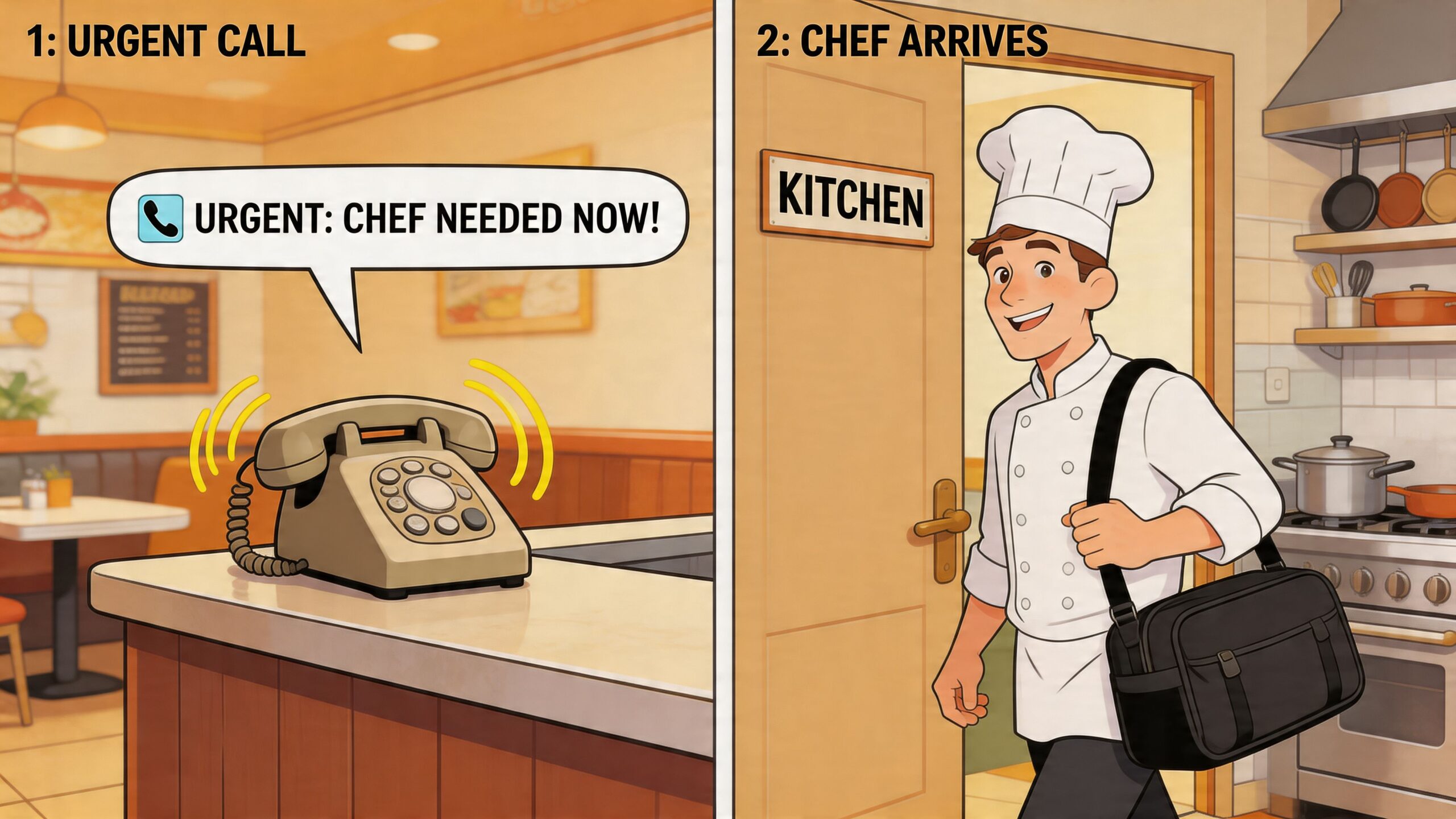
According to The Chef Tree’s chef hire process, top-tier agencies in the South West achieve a 99% chef cover success rate for last-minute requests through an efficient process that starts with a clear venue brief, matches from a vetted chef pool, and uses post-shift feedback to improve future placements. The lesson for venues is straightforward. Better inputs produce better cover.
Before you make the call
Get the brief right first.
Write down the role you need covered, not the one that sounds neat on paper. There’s a big difference between needing “a chef” and needing someone who can run grill for a busy Saturday dinner while keeping standards on allergen control.
Give the agency these details:
- Shift timing and urgency: when they need to arrive and how critical the gap is
- Section and responsibility: prep support, service lead, pass support, breakfast, banqueting, pastry
- Menu style: pub classics, hotel breakfast, small plates, fine dining elements, care catering
- Site realities: parking, access, uniform expectations, team size, EPOS or ordering quirks if relevant
The first 15 minutes matter most
When the chef arrives, don’t leave them to figure it out by osmosis.
Use a quick, disciplined handover:
- Show them the kitchen layout.
- Walk them through the section.
- Flag allergens, specials and service pressure points.
- Introduce the key person they report to.
- Confirm break policy, finish time and who signs them out.
That handover can be done quickly. What matters is that someone owns it.
A relief chef doesn’t need a full induction pack. They need the right facts, in the right order, before the first ticket prints.
How to avoid wasting the shift
Most failed temporary cover happens because the venue expected mind-reading.
Don’t say “everything’s straightforward” if the menu has awkward customisation, a temperamental combi, or a split prep setup across two areas. Don’t bury the allergen folder. Don’t assume your section names mean the same thing in every kitchen.
If you use emergency cover often, it’s worth keeping a one-page temp chef brief ready at all times. That’s especially useful when your management team is under pressure. Operators dealing with frequent last-minute gaps often benefit from putting a simple crisis process in place, similar to the practical steps covered in this guide to emergency relief chef booking for kitchen disasters.
After the shift
Always give feedback to the agency. Specific feedback.
Not “good” or “not great.” Tell them whether the chef was punctual, calm, technically capable, clean, communicative and suitable for your style of kitchen. The agencies worth keeping will use that information to improve future matches. The weak ones will ignore it and send another gamble next time.
Your Next Step Towards a Stable and Profitable Kitchen
Bristol isn’t a market where you can wing staffing and get away with it for long. The venues that stay profitable are usually the ones that protect service before the crisis starts. They know who to call. They know what checks matter. They know the difference between agency cover and dependable agency cover.
That's the takeaway. A chef agency bristol search shouldn’t end with the first person who says yes. It should end with a partner who can prove standards, communicate clearly, and supply chefs who fit your site rather than filling a hole in the rota.
What strong operators do differently
The commercially minded approach looks like this:
- They pre-vet agencies before the emergency
- They insist on transparent terms
- They brief properly
- They review performance after each shift
- They use temporary and permanent hiring together, not as opposing choices
For independent pubs, boutique hotels, restaurants, private households and higher-end specialist settings, the principle is the same. Stability protects revenue. It also protects your team. Kitchens don’t become resilient by accident.
If your current approach still relies on favours, last-minute social posts and ringing old contacts at awkward hours, it’s time to tighten the system. Build the relationship before the next no-show, resignation or peak weekend lands. That’s how you keep standards up and firefighting down.
Bristol Chef Agency FAQs
How quickly can a chef agency in Bristol usually help?
In Bristol, speed depends on three things. How strong the agency’s live book is, how clear your brief is, and whether you need a general pair of hands or a chef who can step straight into a specific section. Short-notice cover can happen. Good cover still requires proper matching.
A weak agency will promise a body in whites within minutes. A good one will ask enough questions to avoid sending the wrong chef into a busy service.
Is using an agency more expensive than hiring direct?
Sometimes on paper, yes. In practice, the comparison is rarely that simple.
Direct hiring costs management time, trial shifts, rota pressure, payroll setup and the risk of lost revenue while the kitchen runs short. Agency cover often makes better commercial sense when the problem is immediate, seasonal, or too specialised for a rushed permanent hire.
What if the chef turns up and isn’t right for the kitchen?
Ask this before the first booking, not after a bad shift.
Any agency worth keeping should explain what happens if the chef is late, underpowered, or clearly wrong for the section. You want a straight answer on replacements, charges, and who takes the call when service is already under strain. If the response is vague, that usually tells you how problems will be handled on the day.
Can agencies help with more than emergency pub cover?
Yes, and this is one of the best tests of whether you are dealing with a serious operator.
Some agencies only react to panic bookings. Stronger ones can cover relief chefs, short-term placements, permanent recruitment and harder-to-fill hospitality roles across different environments. That matters if you run more than one type of site, or if your group covers restaurants, hotels and private settings with very different standards.
Should I use one agency or several?
For most venues, one primary agency and one backup is the practical setup.
Using five random contacts usually creates noise, not resilience. A primary supplier who knows your menu style, pace of service, staffing pressure points and site rules will usually place better chefs over time. Keep a second option in reserve, but judge both against the same vetting standards. That is the point of a proper framework. It stops you buying on panic and price alone.
What should I send an agency before the first booking?
Send the details that affect performance from the first hour. Site address, access notes, parking, start and finish times, section, service style, menu level, dress code, kit provided, and any food safety or allergen requirements.
Add the points chefs usually only discover on arrival. Is there prep support. Who runs the pass. What time does the first ticket hit. Is the menu tight and repeatable, or broad and labour-heavy. Better briefs produce better shifts.
What questions should I ask before opening an account with an agency?
Keep it direct. Ask who vets the chefs, what right-to-work checks are completed, how references are handled, who to call out of hours, how replacements work, and what happens if the chef is unsuitable.
Then ask one more question that operators often miss. How many of their chefs are people they know and place regularly, and how many are being sourced ad hoc when your call comes in. That answer tells you a lot about control, consistency and risk.
If you need dependable chef cover without the usual guesswork, Relief Chefs UK is a practical place to start. Established in 2013, they support pubs, restaurants, boutique hotels, private households, yachts and villas across the UK with relief chefs, temporary chefs, permanent chef recruitment and wider hospitality staffing support. Their model is built for operators who need a fast response, clear vetting, transparent pricing and chefs who can hold service together. If your Bristol kitchen needs emergency cover now, or you want a stronger long-term staffing plan, contact Relief Chefs UK through their online enquiry form or call directly to get the process moving.
Call the team.
Office 01392 715474 · info@reliefchefs.co.uk