
Boost Your Team: Mastering Catering Careers UK 2026
10 April 2026

Friday lunch is fully booked. A wedding tasting is due at three. Your sous chef calls in sick, a junior chef is already on notice, and the last agency CV you saw looked strong until service exposed the gaps. That is the point where most operators search “catering careers uk” and get content written for jobseekers, not for the people trying to keep a kitchen open.
That mismatch matters.
If you run an independent pub in Devon, a boutique hotel in Dorset, a dining room in Bristol, or a busy site in Windsor, Reading or Slough, chef hiring is not just a recruitment task. It is an operations problem. It affects menu range, service pace, hygiene confidence, staff morale and guest spend. A weak hire does not stay on paper. It lands on the pass.
The employers who cope best in 2026 are not the ones posting more ads. They are the ones who understand how chefs now think about work, movement, pay, progression and flexibility. Once you see the market properly, decisions get sharper. You stop hiring for an ideal that rarely exists and start building a kitchen structure that can survive no-shows, seasonality and short-notice pressure.
Why Understanding Catering Careers Is Your Key to Solving Staff Shortages
A lot of kitchen instability starts with a false assumption. Managers see many chef vacancies online and conclude that supply must be healthy. It is not. The UK catering services industry supports 7,099 businesses in 2025, and revenue is projected to grow at a 10.0% CAGR through 2025-26, yet the sector is operating with a persistent 10% labour shortage in hospitality according to IBISWorld’s UK catering services industry data.
That gap changes how you should think.
If demand is growing while labour remains tight, a vacancy is not just a vacancy. It becomes a commercial risk. One missing chef can force a smaller menu, weaker prep discipline, rushed ordering and longer ticket times. The kitchen often covers for a while, then standards slip in ways guests notice before managers do.
Why job adverts alone stop working
Posting another ad can still help. It just cannot be your whole plan.
Good chefs are weighing more than salary. They look at rota quality, commute, accommodation options, management stability, menu seriousness, shift patterns and whether they will be set up to succeed. If your advert says “must thrive under pressure” but the kitchen is understaffed, the fridges are disorganised and the handover is poor, strong candidates usually spot the risk.
Common hiring mistakes include:
- Overselling the role: Calling a damaged kitchen “an exciting opportunity” attracts the wrong match.
- Hiring on desperation: A rushed decision often pushes the problem into service instead of solving it.
- Ignoring chef motivation: Some candidates want progression. Others want clean short-term placements, seasonal intensity, or specialist work.
- Treating all vacancies the same: Replacing a breakfast chef, a pub all-rounder and a hotel sous chef requires different screening.
A staffing shortage rarely starts with recruitment. It usually starts with a kitchen model that assumes every chef wants the same career path.
What a better response looks like
A stronger approach starts with a practical question. What does this kitchen need over the next quarter?
Not every site needs another permanent full-time chef immediately. Some need relief cover to protect service while they recruit properly. Some need a seasonal chef for coastal trade. Some need a stronger second chef to steady standards before replacing a head chef. Some need a specialist for private households, yachts or villas where discretion matters as much as cooking.
Managers who understand the current shape of catering careers uk make better calls because they stop chasing generic applicants and start matching role, timing and environment more carefully.
The Modern UK Catering Career Map Explained
The old kitchen ladder still exists, but it no longer explains the whole talent market. Chefs still move from junior prep and section work into broader responsibility. What has changed is the route. More chefs now move sideways, pause permanent roles, pick up seasonal contracts, or specialise earlier than operators expect.
That matters because the “perfect permanent candidate” is often not missing. They may be working differently.
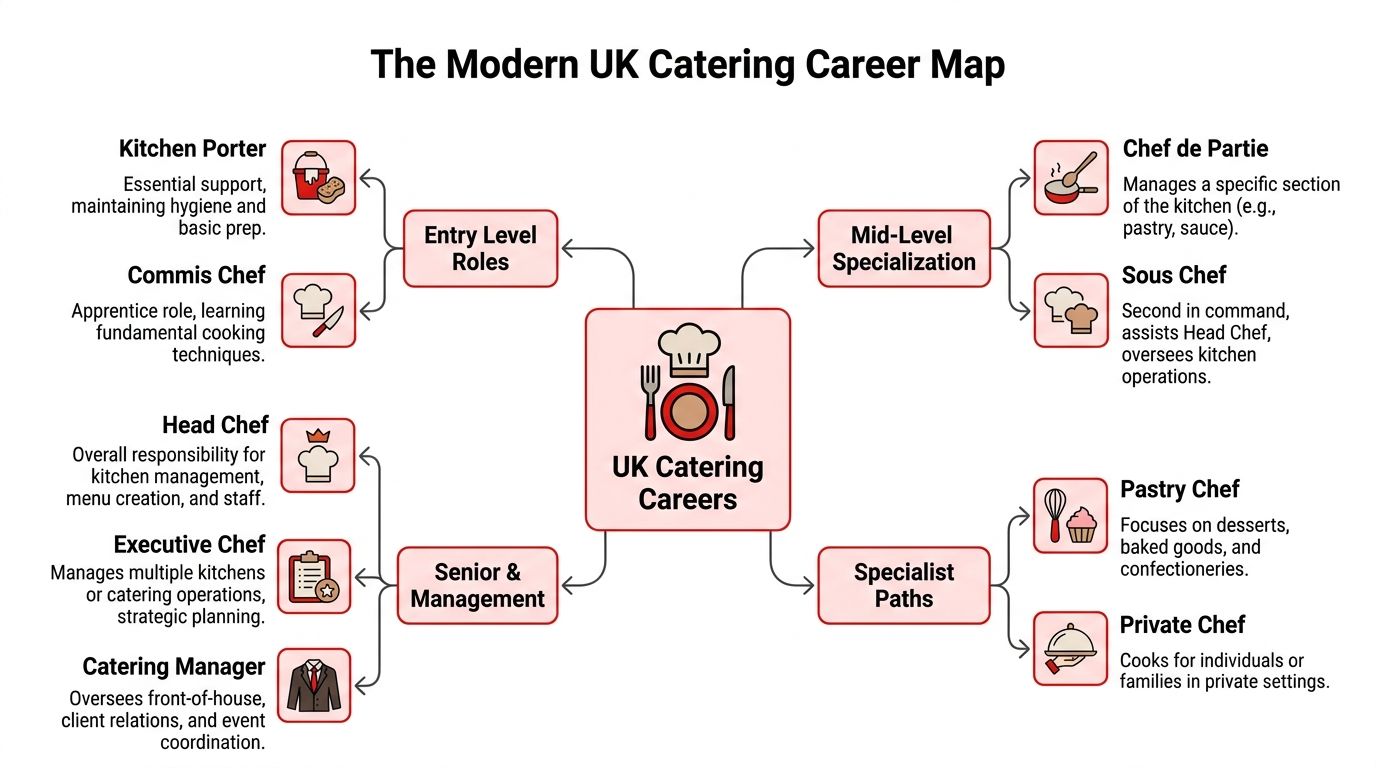
Entry level roles that hold the kitchen together
A kitchen porter and a commis chef are not interchangeable support roles. They affect service in different ways.
A kitchen porter protects hygiene flow, wash-up discipline, rubbish movement and basic prep support. When that role is weak, chefs start doing non-chef tasks. Labour cost may look lower on paper, but production capacity drops.
A commis chef is still learning pace, consistency and section habits. Strong commis chefs can become useful quickly if they get structure. Weak ones create drag because senior chefs spend all shift correcting basics.
For employers, the lesson is simple. If you underhire at the bottom, your senior team carries hidden operational weight every day.
Mid-level chefs decide whether service feels controlled
At this stage, many kitchens either stabilise or wobble.
A chef de partie should own a section without needing constant rescue. They need prep discipline, section timing and enough confidence to flag problems before they hit the pass. In a busy pub, hotel or events kitchen, this is often the role that keeps standards consistent when senior chefs are pulled elsewhere.
A sous chef is different. This role is not just “good at cooking”. A proper sous can brief the team, manage handover, check prep, hold standards and protect service when the head chef is off site or tied up with ordering, staffing or functions.
If your kitchen keeps losing shape on days off, the issue may not be motivation. It may be that your second chef is not really operating at sous chef level.
Senior roles have changed more than many operators admit
A head chef still owns menu, team standards, ordering and cost control. But in 2026, many strong head chefs also expect influence over rota design, supplier quality, recruitment decisions and how realistic the menu is for the labour available.
An executive chef or multi-site lead is less common in smaller independents, but the principle applies. Once one person is responsible across sites, staffing resilience becomes central. One weak placement can affect several kitchens, not one.
A catering manager may sit outside the classic chef line, but in many operations this role shapes event delivery, labour planning and communication between kitchen and client-facing teams. If that bridge fails, chefs absorb the confusion.
Specialist paths are no longer niche
Specialist work used to look like a side route. It is now part of the mainstream map.
Private chefs, yacht chefs, villa chefs, pastry chefs and event specialists all sit within the wider catering careers uk picture. These chefs often choose their path because they value variety, privacy, travel, schedule control or a different style of client relationship.
That has two implications for employers:
- You are competing with more than local restaurants. A strong chef in Berkshire may compare your offer with private household work or yacht placements, not just the pub down the road.
- Flexibility becomes a hiring tool. If a candidate does not want a fixed year-round role, that does not make them unsuitable. It may make them ideal for the right period or site.
The modern career map is not a straight ladder. It is a network. Employers who hire as if every chef wants a single long-term role lose good people before the interview starts.
Qualifications That Matter in Your Kitchen
A polished CV can create false confidence. Kitchens do not run on formatting. They run on competence, habits and reliability under pressure.
The right qualifications still matter, but only when you connect them to service reality.

What credentials deserve your attention
There is a useful baseline in the market. Progression from Catering Assistant at £13,000 to £20,000 to Head Chef at £30,000 to £40,000 is tied to experience and qualifications such as NVQ Level 3, and formal food hygiene certificates can improve employability by 20-30% in competitive markets, as outlined in Reed’s guide to jobs in the catering industry.
That does not mean every certificate predicts performance equally.
The credentials that usually have the most practical value are:
- Food hygiene qualifications: Not glamorous, but essential. They reduce your compliance risk and tell you the candidate takes kitchen discipline seriously.
- NVQ or equivalent practical cookery training: Useful because it often signals exposure to method, standards and repetition.
- Allergen awareness and structured food safety habits: These matter in every modern kitchen, especially where menus move quickly or teams are mixed in experience.
- Documented progression through real sections: A candidate who has worked larder, garnish, sauce or pastry with clear responsibility usually gives you more confidence than one with broad but vague claims.
Managers who want a clearer view of useful credentials should also review practical benchmarks such as chef qualifications that matter in working kitchens.
What paper cannot tell you
A CV does not show whether a chef can walk into a strained Saturday service and make life easier.
Use interview and trial questions that reveal operating habits:
- Ask how they set up a section. Good chefs answer in sequence, not slogans.
- Ask what they do when prep is behind. Weak candidates talk about working harder. Strong candidates talk about reprioritising and protecting service.
- Ask how they hand over. This reveals whether they think like part of a brigade.
- Ask what they check first in a new kitchen. You want answers around standards, stock, labels, equipment and flow.
What works and what does not
A common error is overweighting chef school prestige and underweighting repeatable kitchen behaviours.
What usually works:
- Reference checks focused on service behaviour
- Short practical trials with real mise en place
- Verification of right to work before pressure builds
- Role-specific testing, not generic “can cook” assumptions
What usually does not:
- Hiring off personality alone
- Treating years served as proof of standard
- Assuming a senior title means leadership skill
- Ignoring gaps in hygiene confidence because the candidate is available quickly
The best qualification is still trust earned in service. Certificates open the door. Habits decide whether the chef should stay.
Decoding Chef Salaries and Regional Pay Variations
Salary conversations go wrong when operators rely on broad national averages and ignore local conditions. A chef considering Bristol is not weighing the same pressures as a chef looking at rural Wales. A seasonal site in Devon is not competing in the same way as a year-round property in Slough.
That is why pay strategy needs context, not guesswork.
What shapes regional pay
Three pressures come up repeatedly.
The first is cost of living and travel. South East candidates often look hard at commute time, parking, late finishes and whether a wage still feels worth the week once transport is accounted for.
The second is seasonality. Coastal and destination-led businesses in Devon and Dorset can attract chefs who want an intensive season, but they also need offers that make sense when hours, housing and contract length are examined together.
The third is local competition for the same talent pool. In hubs such as Bristol, chefs can compare independent restaurants, hotels, event caterers and private roles quickly. That tends to sharpen candidate expectations around shift quality and progression, not just headline pay.
A practical benchmark table for 2026 planning
Use salary tables as planning guides, not guarantees. The right offer still depends on standard, section strength, rota demands and what kind of site you run.
| 2026 UK Chef Salary Benchmarks by Role and Region (Annual) | London / South East | South West (Devon/Dorset) | Major Cities (Bristol/Manchester) | Wales / Rural UK |
|---|---|---|---|---|
| Kitchen support and junior roles | Higher expectation where travel and housing bite | Often shaped by seasonal demand and staff accommodation | Competitive where city movement is high | More variable by site and transport access |
| Chef de Partie | Strong competition from restaurants, hotels and private employers | Can rise fast in peak season or destination sites | Often pushed by fast-moving city labour markets | Depends heavily on venue reputation and shift pattern |
| Sous Chef | Usually requires a serious package if the rota is heavy | Good candidates look for stable seasons and sensible support | Competitive where progression options are visible | Strong sites can attract talent with lifestyle and autonomy |
| Head Chef | Package quality matters as much as salary | Best offers often balance lifestyle with operational control | Market is active where operators invest properly | Retention often depends on backing, not only pay |
For role-by-role earnings context, a useful starting point is this breakdown of how much chefs make.
Budgeting beyond the wage line
Many operators under-budget because they focus only on annual salary.
A realistic cost view should include:
- Rota pressure: A cheaper hire on paper becomes expensive if they drive overtime elsewhere.
- Accommodation or travel support: In seasonal and rural markets this can decide whether a role is workable.
- Management bandwidth: Hard-to-settle chefs consume leadership time.
- Service protection: A temporary chef at the right moment can be cheaper than a poor permanent hire that destabilises the kitchen.
When flexible staffing is financially smarter
There are periods when a permanent hire makes complete sense. There are also periods when it does not.
If you run a pub with sharp summer peaks in Dorset, a hotel with event spikes in Berkshire, or a Bristol site with irregular trade bursts, carrying year-round permanent cost for a short-term labour problem can trap margin. In those cases, temporary chef cover gives you a cleaner cost structure. You add proven labour when demand rises, then reset when trade normalises.
That is not a compromise. It is disciplined labour planning.
The Rise of the Flexible Chef How to Utilize a Modern Career Path
One of the biggest hiring mistakes operators still make is treating flexible chefs as a last resort. In practice, many of the most useful chefs in the market have chosen flexibility on purpose.
They are not drifting. They are selecting variety, cleaner rota control, broader experience, shorter commutes at the right times of year, or specialist placements that suit their life better than one permanent site.

The demand side supports this shift. The UK hospitality sector is forecast to generate 500,000 new jobs by 2027, and the sector had a projected 12% job growth for 2025, according to Calderdale College’s overview of catering and hospitality trends. In practical terms, more jobs and ongoing shortages create more room for chefs to choose how they work.
Why chefs choose flexible work
Managers often assume flexibility is mainly about money. It can be, but it is rarely only that.
Common motivations include:
- Better control of time: Some chefs would rather work intense blocks and recover properly than stay locked into weak rotas.
- Varied kitchens: Short-term placements can build breadth faster than one static role.
- Seasonal preference: A chef may love high-season coastal trade but not want a quiet winter in the same site.
- Lifestyle fit: Private households, villas and yachts attract chefs who value a different service rhythm and guest relationship.
- Career reset: Good chefs leaving unstable kitchens often move flexibly before committing again.
That means the flexible market contains both stop-gap workers and highly capable professionals who prefer a different model.
How employers should use that market
The best operators use flexible chefs for defined outcomes.
A few examples:
- A Devon hotel heading into wedding season needs extra strength for prep and banqueting.
- A Bristol restaurant loses a sous chef and needs immediate cover while it hires carefully.
- A Berkshire private household wants discreet chef support for a fixed period.
- A Dorset coastal pub needs a strong all-rounder through holiday trade.
- A yacht or villa operation requires a chef who can handle standards, privacy and adaptation.
The key is to define the assignment properly. Do not just ask for “a chef”. Specify service style, shift pattern, volume, accommodation if relevant, section expectations and whether the chef must steady the team or increase capacity.
What flexible hiring solves better than permanent hiring
Flexible staffing is particularly effective when the problem is operational timing rather than long-term structure.
It helps with:
- Short notice sickness
- Holiday cover
- Menu launches or events
- Seasonal peaks
- Gaps during permanent recruitment
- Trial periods before committing to a longer arrangement
A lot of managers resist this because they worry relief cover will be inconsistent. That concern is valid if the screening is weak. It is much less valid when the chef has been vetted properly and the brief is clear.
A short explainer below highlights how modern chef cover fits today’s labour market.
The trade-off you need to manage
Flexible staffing is not magic. It still requires strong site management.
If your induction is poor, your prep lists are vague and your kitchen relies on unwritten habits, even a good relief chef will need time to decode the operation. Flexible staffing works best when the kitchen itself is organised enough to receive support quickly.
If a relief chef keeps failing in your site, review the handover before blaming the model. Good temporary labour still needs clear systems.
For employers, the key advantage is resilience. A modern kitchen does not have to choose between a full permanent brigade and chaos. It can build a stable core and use flexible chef talent to absorb pressure without letting standards collapse.
Your Playbook for Recruiting and Retaining Top Kitchen Talent
The most expensive chef vacancy is the one you treat as normal.
Many operators have accepted a cycle of ad, interview, compromise, disappointment and repeat. That cycle drains time and weakens service. It also hides costs because the damage appears across payroll, stock, complaints, management fatigue and team turnover rather than in one obvious line.
Mainstream career guidance does not help much here. It ignores the operational and financial burden of emergency staffing and offers no meaningful data on average revenue loss from kitchen downtime or the true time-to-hire gap between traditional recruitment and emergency cover, as noted by the National Careers Service overview of catering and hospitality careers.
Start with a role brief that reflects the kitchen you run
Bad job descriptions waste everyone’s time.
If the site is a food-led pub with fresh prep, say so. If the role includes breakfast, functions and ordering support, say so. If accommodation is available, mention it. If the rota is tough during peak months, be honest. Chefs usually accept hard work faster than they accept being misled.
A useful brief should cover:
- Service type: Pub, hotel, events, private household, yacht, villa.
- Shift reality: Split shifts, straights, breakfast starts, late finishes.
- Menu style: Fresh, branded, banqueting-heavy, seasonal, premium casual.
- Operational pressure points: Volume spikes, weddings, holiday trade, staff accommodation, driving requirement.
- Success profile: Section independence, leadership, speed, calmness, stock control.
Interview for behaviour, not theatre
A confident interview performance can hide a disorganised chef. Keep interviews grounded in service reality.
Ask direct questions such as:
- What does your section setup look like before a busy service?
- What do you do if deliveries arrive wrong on a high-pressure day?
- How do you brief a junior chef who is slowing service?
- What information do you need when walking into a new kitchen?
Then listen for specifics. Good chefs answer with sequence and judgement. Weak candidates speak in clichés.
Retention often fails long before resignation
Good kitchens lose chefs for predictable reasons.
Not always pay. Often because the rota is chaotic, standards are uneven, promises are broken or managers tolerate poor behaviour from the wrong people because they are scared of losing bodies. Once the stronger chefs decide the site is unfair, your recruitment problem becomes permanent.
Retention improves when you do ordinary things well:
- Publish rotas with enough notice
- Keep ordering and prep systems organised
- Deal with underperformance quickly
- Give second chefs real responsibility
- Avoid menu ambition that the labour model cannot support
If your best chef spends half the week covering structural gaps, they are already looking elsewhere.
Know when DIY recruitment stops being efficient
There is a point where self-managed hiring becomes false economy.
If you are spending management time sifting weak applications, backfilling trial shifts, checking documents, chasing references and still ending up exposed on service, the process is not saving money. It is moving cost into a less visible place.
That is where a specialist hiring partner earns its place. For venues that need a faster route to temporary cover or a stronger permanent shortlist, a dedicated chef recruitment service can remove delay, reduce screening risk and give operations teams breathing room.
The practical test is simple. Ask whether your current hiring process protects service. If it does not, it needs changing.
Frequently Asked Questions for Hospitality Managers
How quickly should I act when a chef resigns or goes off sick
Immediately.
Do not wait a week hoping the rota can absorb it. Most kitchens can cover briefly, but service quality usually starts to fray fast. Put temporary cover in place first if needed, then decide whether the long-term answer is permanent recruitment, a restructure, or a mix of both.
Is a temporary chef only useful for emergencies
No.
Emergency cover is important, but temporary chefs also help with holiday gaps, weddings, menu changes, staff turnover, private events, coastal peak seasons and trial periods before a permanent appointment. The best use of flexible labour is planned resilience, not panic buying.
What should I send before a temporary chef starts
Send the basics that protect service.
Include start time, dress code, address, parking details, service style, sample menu, section expectations, allergens process, who they report to, and whether accommodation or meals are included. A clean handover saves hours of friction.
How do I know if a candidate is right for my site, not just technically sound
Match the chef to the environment, not only the job title.
A chef who works well in a structured hotel may dislike a fast-moving independent pub. A strong banqueting chef may not enjoy a small à la carte kitchen. Ask whether the candidate has handled your type of pace, menu and team culture before.
Should I hire permanently or use relief cover first
That depends on the problem.
If the role is central to long-term stability, permanent hiring is often right. If you are in peak season, reorganising the brigade, or unsure what shape the role should be, relief cover buys time and protects standards while you make a better decision.
What causes most bad chef hires
Usually one of three things.
The brief is vague. The interview focuses on personality instead of behaviour. Or the site hires in desperation and ignores obvious fit issues because service pressure is high. All three are avoidable with tighter screening and a more honest role definition.
Do specialist roles like yacht chefs and villa chefs require different vetting
Yes.
Those placements usually need stronger checks around discretion, adaptability, self-management and guest-facing judgement. The cooking standard matters, but so does how the chef handles privacy, travel, presentation and changing client requests.
What is the best way to make my kitchen more attractive to good chefs
Run a kitchen that feels organised and fair.
Good chefs look for clear rotas, realistic menus, clean standards, strong handovers and managers who deal with problems early. Sites that offer those basics well often compete better than venues that try to compensate for operational chaos with a slightly higher wage.
If your kitchen needs dependable cover, permanent chef recruitment, or specialist support for pubs, restaurants, boutique hotels, private households, yachts or villas, contact Relief Chefs UK. Established in 2013 and run by chefs, not recruiters, Relief Chefs UK supports hospitality businesses nationwide with vetted, right-to-work-checked chefs, fast response times, and practical staffing support that keeps service moving when it matters most.
Call the team.
Office 01392 715474 · info@reliefchefs.co.uk