
Find Cover: Your Chef-Agency-Devon Manager’s Guide
6 May 2026
Friday lunch is booked out. The weather has turned. Walk-ins are coming. Then your head chef rings in sick, your sous is already covering prep, and your KP can’t suddenly run a section. If you operate a pub, hotel, restaurant or coastal venue in Devon, that scenario isn’t unusual. It’s part of the job.
That’s why choosing the right chef-agency-devon partner matters so much. This isn’t about filling a rota box with any available body in whites. It’s about keeping service moving, protecting standards, and avoiding the kind of rushed staffing decision that creates more problems than it solves.
Managers usually feel the pain in the same places. Short notice sickness. Seasonal surges. Agency chefs who arrive late, can’t handle the pace, or need too much hand-holding. Bills that look one way on the phone and another on the invoice. Devon adds another layer because venues aren’t all in one tight city centre. Cover for a hotel in Torquay, a pub in Exeter, or a business in Exmouth doesn’t work the same way operationally.
Good operators treat chef agency support as part of kitchen resilience. Not a panic button.
Why a Chef Agency is Essential in Devon
A staffing gap in Devon is rarely just a staffing gap. It can become a service problem inside an hour, then a revenue problem by the end of the shift. A missing chef during a bank holiday weekend can force menu cuts, slow tickets, pressure the pass, and leave front of house apologising to tables that were expecting a full offer.
Devon makes that risk harder to manage than many operators expect. The county is spread out. Travel times are not uniform. Coastal demand spikes hard in season, while city and year-round sites still need reliable cover for core trading periods, breakfast operations, events, and private functions. A venue in Torquay, Exeter or a rural part of the county is dealing with a different labour pool, different commute realities, and different pressure points on the rota.
That is why agencies matter. A good chef agency gives you access to cooks who can step into a live operation with minimal disruption, hold a section, follow spec, and keep standards where they need to be. The value is operational continuity and margin protection.
Managers often get the timing wrong.
They wait until the rota has already failed, then start ringing around for whoever is available. That usually leads to weak briefing, poor fit, inflated rates, or a chef who is technically present but not commercially useful in your kitchen. The better approach is to assess agencies before the pressure hits, while you still have time to check how they vet chefs, how quickly they confirm cover, and what happens if the first placement falls through.
A chef agency earns its place in Devon in a few clear scenarios:
- Short-notice cover: sickness, family emergencies, no-shows, and sudden departures
- Seasonal pressure: summer trade, school holidays, event weekends, and weather-led surges
- Recruitment gaps: keeping service stable while permanent hiring runs its course
- Specialist support: chefs who can handle hotel breakfast, banqueting, high-volume pub service, or more niche venue requirements
Used properly, agency support is part of kitchen risk control. It gives operators time to make better staffing decisions instead of expensive emergency ones.
Why Standard Recruitment Fails in Devon's Market
The old model was simple. Advertise the role, wait for applicants, interview a few, offer the job, and hope they start. In Devon, that model often breaks down long before you reach the offer stage.
The first issue is skill shortage. According to the UK hospitality employer skill survey, chef shortages, particularly for sous chefs, are the most widely reported technical skill deficit across the sector (UK hospitality employer skill survey case study). That lands hardest on independent pubs, restaurants and boutique hotels because they usually don’t have surplus labour or internal bench strength.
Devon is not one easy hiring market
Recruitment in Plymouth is different from recruitment in Exeter. Both are different again from filling a shift in a rural pub or a seasonal coastal site. Travel time matters. Staff accommodation matters. Start times matter. Weekend trade patterns matter.
That’s why standard recruitment fails. It assumes a chef can commit to a fixed role, fixed route, and fixed pattern. Many can’t, or won’t, particularly when the market is tight and venues are competing for the same level of experience.
The same pattern shows up in other hospitality hotspots such as Dorset and Bristol. Good candidates have options. Slow operators lose them.
Why flexible cover makes commercial sense
If you need a chef now, the cost of waiting is rarely shown on a P&L line. It appears elsewhere:
| Operational issue | What it does to the business |
|---|---|
| Head chef covering gaps | Pulls leadership off ordering, standards and training |
| Reduced menu | Limits spend per head and frustrates guests |
| Burnt-out team | Increases mistakes and staff turnover |
| Last-minute panic hire | Creates compliance, quality and cost risk |
That’s why a good agency relationship is more than temporary labour. It gives you variable staffing capacity when permanent hiring can’t move quickly enough.
A slow hire process might look cheaper on paper. It often costs more once service quality drops and the kitchen starts firefighting.
What works better
The practical alternative is a pre-vetted talent pool and an agency that understands Devon geography, service patterns and kitchen expectations. Agencies that specialise in relief chefs, temporary chefs and permanent chef recruitment are built around this exact problem. They can also help when the requirement is more niche, such as yacht chefs, villa chefs or wider hospitality staffing support.
What doesn’t work is ringing a generalist recruiter and hoping they understand the difference between a busy food-led pub service and a boutique hotel kitchen with breakfast through dinner coverage.
Your Vetting Checklist for Evaluating Any Chef Agency
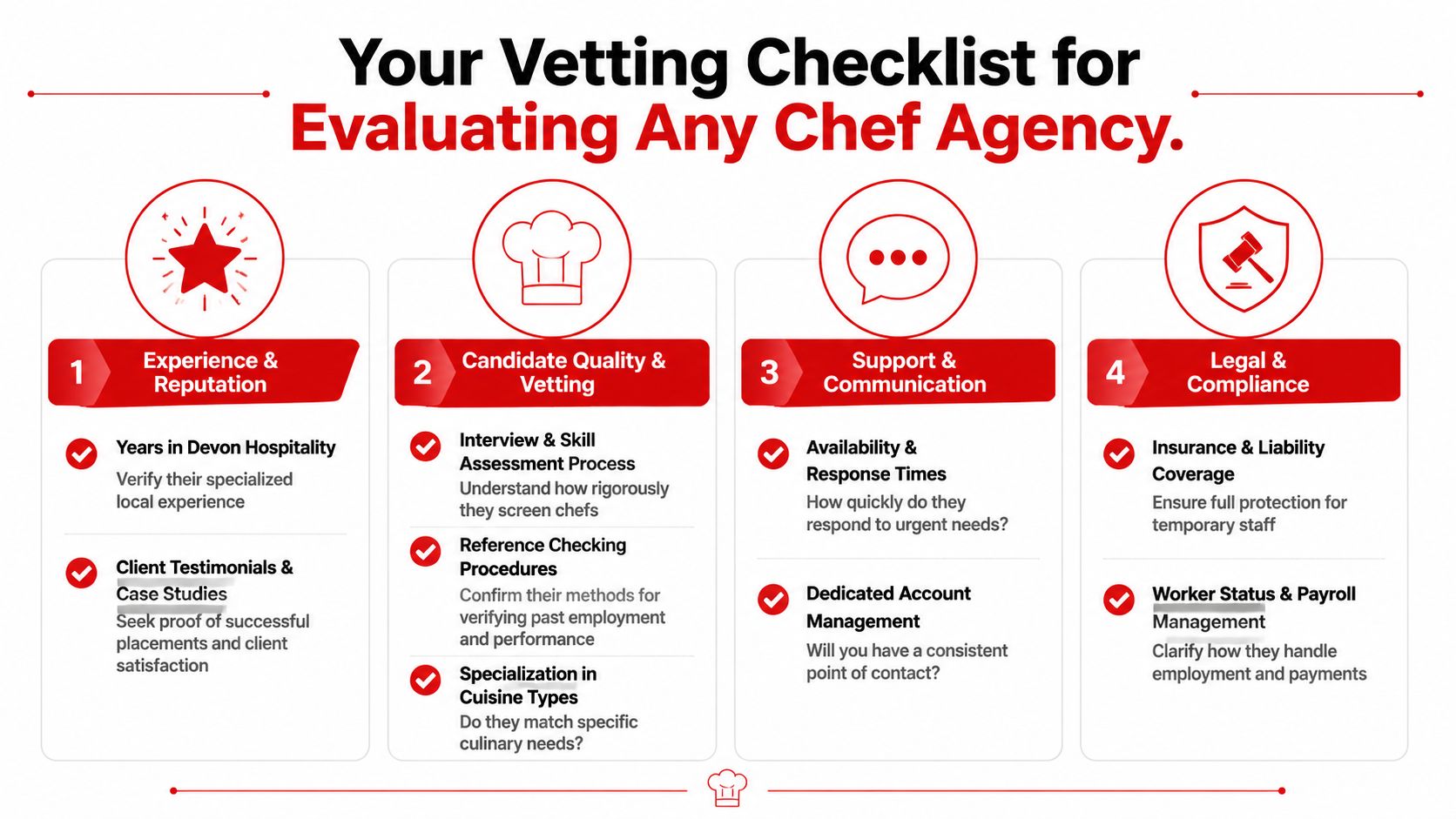
Most agencies sound competent on the phone. The problem is that kitchens don’t run on sales language. They run on reliability, compliance, judgement and speed. If you’re assessing any chef-agency-devon option, use a checklist that tests what happens in service, not what looks good in a brochure.
The Devon market is competitive, with agencies including Chef Zone and Relief Chefs UK serving areas such as Plymouth and Torquay. The same market context notes that reputable agencies draw on 60+ years combined experience, can provide vetted chefs at short notice, subject to availability, and that 400+ venues across the UK rely on that model (Devon chef agency market context). That gives you a clear benchmark for what credible operational capability looks like.
Check the vetting process, not just the CV
Ask how the agency screens chefs before they ever reach your rota. “Fully vetted” should mean something specific.
Look for these signs:
- Right to Work checks: You need confirmation that legal work status is checked before deployment.
- Reference process: Agencies should be able to explain how they verify previous roles and performance.
- Kitchen suitability: A chef who works well in a fresh-food gastropub may not suit banqueting, volume breakfast or private household work.
If the answer is vague, that’s your answer.
Test their response model under pressure
A good chef on Monday morning is useful. A good chef on Friday afternoon is what proves the agency can support operations.
Ask what happens from first contact to chef arrival. Who takes the booking? How quickly do they confirm? What information do they need from you? What happens if your requirement changes halfway through the day?
One practical benchmark is whether the agency can explain its operational process clearly. For example, employment agencies for chefs should be able to set out how they handle candidate matching, right-to-work compliance, availability checks and deployment support without speaking in generalities.
If an agency can’t describe its booking process step by step, it probably doesn’t have a reliable one.
Review support and accountability
The true nature of weak agencies often becomes apparent. They may have names on a spreadsheet, but no proper cover process if something goes wrong.
Use this quick decision frame:
| What to ask | What a solid answer sounds like |
|---|---|
| Who do I call out of hours? | A named process for evening and weekend support |
| What if the chef cancels? | A clear replacement procedure |
| Who owns the issue? | One accountable contact, not a chain of excuses |
Don’t ignore local fit
Devon isn’t just a postcode on a CRM. Coastal routes, rural travel, split shifts, and service style all affect whether a placement works. A chef who is technically capable but logistically unsuitable is still the wrong booking.
That’s why local knowledge matters. Not in a marketing sense. In a practical one. Can the agency judge whether a chef can realistically get to site, start on time, and perform in your environment?
Decoding Pricing Models and Spotting Hidden Costs
Most operators don’t mind paying a fair agency rate. What they mind is getting hit with extras that were never properly explained. That’s where bad agency relationships usually become expensive.
The biggest mistake is comparing headline rates without checking what sits behind them. Some businesses hear an hourly number, approve it, then discover later that the final cost includes layers they didn’t budget for.
What to look for in the commercial terms
Transparent pricing matters because labour decisions in hospitality are made at speed. If the model is unclear, your margin takes the hit.
Industry context in this area shows that traditional recruitment agencies often add markups and hidden fees that can inflate final staffing costs by 30-45%, while clear pricing matters particularly for venues operating on 3-7% net margins typical of UK pub operations (hidden fee pressure in chef staffing).
Read the agreement with these points in mind:
- What is included in the quoted rate: Ask whether payroll handling, insurance and support are already built in.
- When extra charges apply: Travel, premium shifts, emergency cover and specialist roles should be defined upfront.
- What happens on temp-to-perm: Check whether there is a transfer or finder’s fee if you later hire the chef directly.
- What sits behind cancellation terms: You need to know what happens if you cancel and what happens if the agency side fails.
The invoice test
A simple way to vet any pricing model is to ask for a sample invoice before you commit. Not a rate card. An invoice.
If the agency can’t show you how charges appear in practice, assume the paperwork will become painful once you’re under pressure. This matters even more for independent venues that don’t have a finance team picking through agency billing line by line.
A useful reference point is this guide on the hidden cost of bad chef cover and emergency relief chef booking, because it reflects the underlying issue most managers face. The rate itself is only part of the cost. Failed cover, poor fit and disrupted service are usually far more expensive.
Cheap cover isn’t cheap if the chef can’t hold the section, the team has to carry them, and guests feel the difference.
Pricing models that usually work better
For many venues, the most workable arrangements are the ones that are easy to budget and easy to explain internally. That may be a simple temporary staffing rate, or a tiered monthly support model if you use agency chefs regularly.
What matters is clarity. If the model is hard to understand before first booking, it won’t get easier during a staffing emergency.
Critical Questions to Ask Before You Commit
Friday, 4:30pm. Your sous chef has gone off sick, covers are full for dinner, and the venue is 35 minutes from the nearest town. That is the point where a weak agency gets exposed.
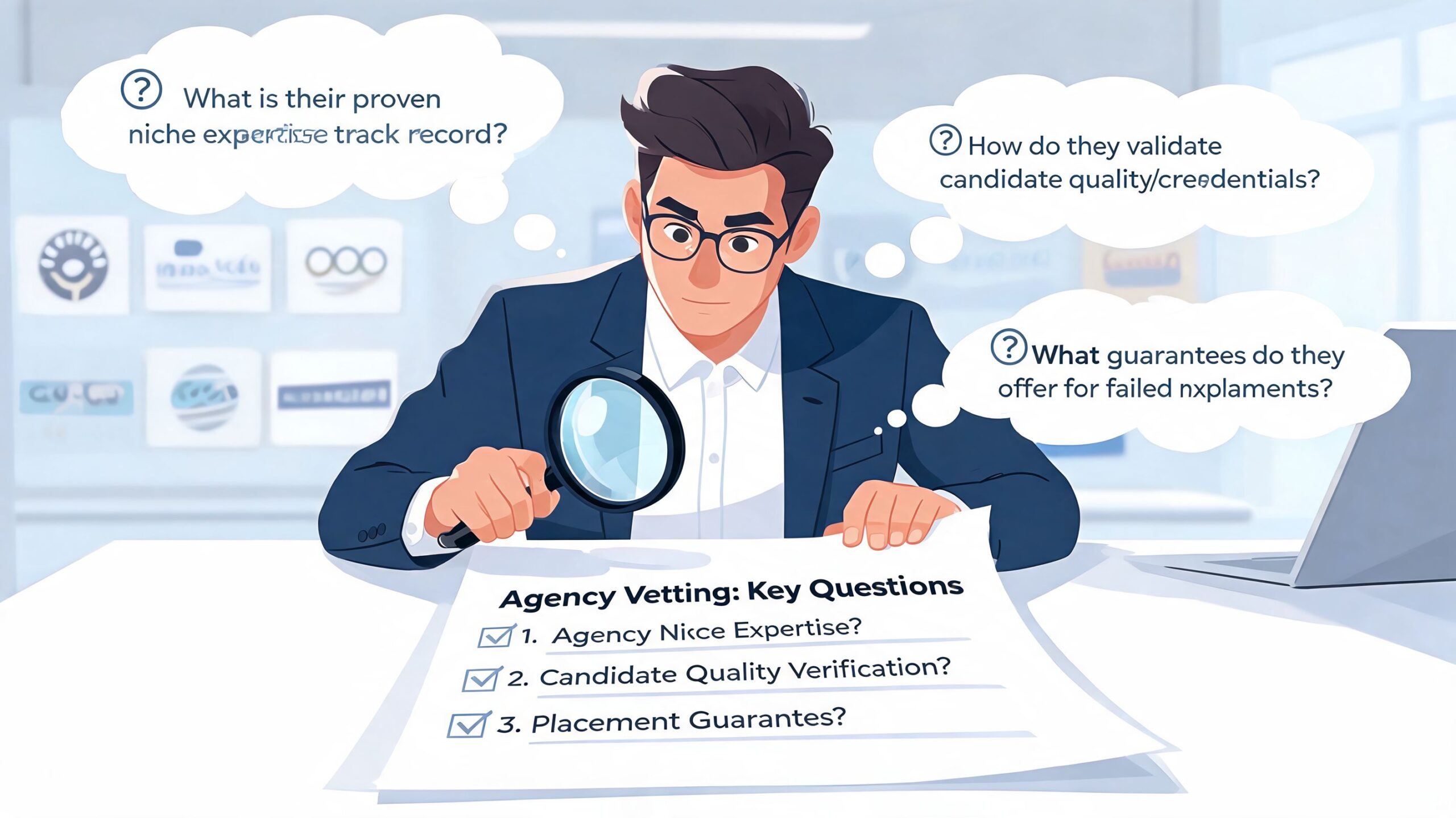
Devon rewards agencies that can handle distance, seasonality and awkward briefs. It also exposes agencies that rely on a rate card and a large database. Before you commit, push the conversation into live operational detail. If they cannot answer clearly, they will struggle when service is under pressure.
A useful benchmark is whether they can explain how they handle relief chef cover across Devon in real terms. Ask how they assess travel time, start times, accommodation needs, split shifts and replacement cover for rural or coastal sites. The quality of that answer tells you far more than a polished sales pitch.
Questions that expose weak agencies
Start with how they qualify chefs before names ever reach you.
- Talk me through your vetting process from first contact to first shift.
- How do you check right to work, references, section history and level of responsibility?
- Who signs off whether a chef is suitable for a food-led pub, hotel breakfast operation, events kitchen or private household?
- What information do you collect from the venue before matching a chef?
Then test the booking workflow itself.
- What happens in the first 30 minutes after I call with a staffing request?
- Who owns the booking on your side, and who updates me if timings change?
- At what point do you confirm travel, arrival time and section capability?
- If your first chef drops out, what replacement process starts and who makes that call?
Good agencies answer these without hesitation. Poor ones stay vague, talk about being flexible, and avoid naming who is responsible.
Ask about geography, season pressure and awkward briefs
Devon is not one trading pattern. A central Exeter shift is one thing. A Saturday dinner service near Salcombe, a breakfast start on Dartmoor, or a summer weekend in a coastal town is another.
Ask questions that reflect the work you need covered.
- How do you decide whether a chef can realistically get to my site on time?
- Do you screen for chefs who are willing to work rural locations, late finishes or split shifts?
- What changes in your process during bank holidays, school holidays and peak summer weeks?
- Can you cover specialist briefs if my requirement shifts from relief support to private dining, events or a longer interim post?
Managers in Devon lose money. The wrong agency says yes to every brief. The better agency pushes back on impractical requests, flags risk early, and gives you options before the problem lands in your kitchen.
Here’s a useful reference point on response expectations and how kitchens think about staffing continuity:
Questions about accountability
You are not buying introductions. You are buying delivery.
| Ask this | Why it matters |
|---|---|
| Who is responsible if the chef is late, unsuitable or leaves mid-booking? | You need one named decision-maker, not a shared inbox |
| What support is available outside office hours? | Problems usually hit before service, after service, or at weekends |
| What replacement commitment do you offer in practice? | A promise only matters if the process is clear and fast |
| How do you record and act on venue feedback after each shift? | Strong agencies improve matching. Weak ones repeat the same mistakes |
| What happens if my brief changes after day one? | Menus, covers and section pressure shift quickly in live operations |
One final test helps. Ask for a recent example of a difficult booking they filled in Devon, what made it difficult, and what they had to do to get it over the line. A serious operator can explain the constraints, the compromise, and the result. If the answer sounds too polished, assume the support will be thinner than advertised when you need it most.
How to Onboard an Agency Chef for a Smooth Service
Friday, 5pm. The rail is about to fill, a relief chef has just walked in, and your head chef is already tied up with prep, suppliers, and a late menu change. That first ten minutes decides whether the shift settles quickly or turns into constant firefighting.
Good onboarding protects service. It also protects margin, because a capable agency chef still loses time if they have to guess your systems, your standards, or who is in charge. In Devon, where many venues run lean teams, remote locations, and sharp seasonal swings, you do not get much room for error.
Start before the chef arrives. Send a short written brief with the booking confirmation so the agency chef knows what they are walking into. Keep it to one page and make it usable in a live kitchen:
- Service format: pub, hotel, events, private dining, holiday park, wedding venue
- Section and level: grill, larder, sauce, pastry, breakfast, prep support
- Menu pressure points: key dishes, pace of service, known bottlenecks, allergen risk
- Kitchen rules: stock rotation, wastage expectations, cleaning close, uniform, break policy
- Site realities: parking, staff entrance, poor mobile signal, travel timing for rural locations
That last point matters more in Devon than many operators admit. A chef covering a city-centre site works differently from one driving into a coastal venue for a breakfast start after summer traffic.
When they arrive, give them a focused handover. Five minutes is usually enough if the brief was done properly.
Show the section, pass, fridges, dry store, allergen folder, cleaning materials, fire exits, and the prep list for the shift. Confirm who is calling service and who they report to if there is a problem. Agency chefs cope well with pressure. They struggle when nobody gives them a clear line of command.
Use one point of contact. Usually that is the head chef, sous chef, or duty manager. Shared responsibility creates delays, mixed instructions, and avoidable mistakes.
If you regularly bring in cover, it helps to benchmark your process against how specialist relief chefs in Devon are typically deployed across pubs, hotels, event sites, and other seasonal businesses.
Brief the rest of the team as well. FOH needs to know who is covering, what can and cannot be changed during service, and where questions should go. Junior chefs need to know whether the agency chef is running a section alone or supporting production. That avoids the familiar problem where a temporary chef is treated like a spare pair of hands when you booked them to hold a key station.
One more point gets missed. Check the basics of access and kit. Logins for ordering tablets, prep sheets, label printers, temperature records, and alarm codes can all slow a shift down if nobody has thought about them. The same applies to knives, whites, and whether the section is set for the menu you expect to serve.
Good agency cover is not just about who turns up. It is about whether your kitchen can absorb that chef quickly, use them properly, and keep standards steady through service.
FAQs About Using a Chef Agency in Devon
Can an agency really cover remote Devon venues?
Sometimes yes, sometimes no. The honest answer depends on travel practicality, start time, duration of booking and the type of chef needed. A serious agency won’t just say yes to win the booking. It will tell you whether the placement is realistic and what changes might improve the chance of success.
What’s the difference between a relief chef and a standard temp?
A relief chef is usually booked to protect service in a live operational setting. That means you need someone who can adapt quickly, read the kitchen, and work with minimal settling-in time. A generic temp model often focuses on availability first and kitchen fit second. That’s where many placements go wrong.
Do I need to sign a long contract?
Not always. Some venues only need occasional emergency cover. Others want an ongoing staffing relationship because they know their seasonal pressure points. The right setup depends on how often you need support, how much notice you usually have, and whether you also need permanent chef recruitment or specialist staffing.
What if the chef’s style doesn’t fit my kitchen?
That’s exactly why agency vetting and your own briefing matter. A chef can be capable and still not be right for your pace, menu or structure. Good agencies should be open about this and have a process for resolving it, including replacement support where agreed.
Can agencies help beyond pubs and restaurants?
Yes. Some can also support boutique hotels, private households, yacht chefs, villa chefs and wider hospitality staffing support. The important point is to check whether they understand those environments, not just whether they list them on a page.
Is chef-agency-devon support only for emergencies?
No. The smartest operators use agency support before a crisis lands. They use it to cover holidays, bridge recruitment gaps, steady seasonal trade and protect the core team from burnout. That’s a far better use of agency staffing than waiting until service is already exposed.
If you need dependable kitchen cover, permanent chef recruitment, or specialist support for pubs, hotels, private households, yachts or villas, contact Relief Chefs UK. Run by chefs and established in 2013, the business supports hospitality operators across Devon and the wider UK with vetted relief chefs, temporary chefs and practical staffing support built around real service pressures.
Call the team.
Office 01392 715474 · info@reliefchefs.co.uk