
Fast Relief & Temporary Chef Cover /chef-agency-bristol
7 May 2026

Friday evening. Bookings are full. Deliveries are checked in. Prep is halfway there. Then your sous chef rings in sick, your CDP is already covering another section, and your head chef is deciding whether to cut the menu, delay service, or close a station and take the hit.
That’s the moment most Bristol operators realise staffing isn’t just an HR issue. It’s an operations risk.
If you’re searching for /chef-agency-bristol, you probably don’t need theory. You need chef cover that turns up, can handle your kitchen, and won’t create a compliance problem while solving a staffing one. You also need a supplier that understands the difference between filling a shift and protecting a service.
The Real Cost of an Empty Chef Jacket in Bristol
A missing chef rarely stays a staffing problem for long. It becomes a service problem within minutes.
A Bristol restaurant manager on a busy Friday doesn’t just lose a pair of hands. They lose pace on prep, control on the pass, confidence in the brigade, and often the ability to serve the menu they advertised. If the absence hits early enough, they may still salvage service. If it lands late, they’re suddenly making commercial decisions under pressure.

What a no-show actually costs
When a venue can’t open because of chef absence, the loss is rarely minor. The content gap analysis for Bristol hospitality highlights average revenue losses of £2,000 to £5,000 per service when independent pubs and restaurants are unable to open due to chef absence, and points to the value of rapid-response models with a two-hour response and placement within 48 hours through Bristol staffing context from Vivid Hospitality.
That figure matters, but it still doesn’t cover the full damage. Operators also deal with:
- Menu reduction that disappoints regulars and weakens spend per head
- Refunds and goodwill gestures after long waits or cancelled bookings
- Team fatigue when remaining chefs stretch beyond a safe or sensible workload
- Reputation drag when one bad night turns into poor online feedback
- Lost future trade from private bookings, repeat diners, and local recommendation networks
Operational reality: Most businesses don’t fail on one bad service. They get weakened by repeated compromised services.
The hidden cost is often worse than the wage cost. A relief chef fee is visible. Damage to guest trust isn’t.
Why emergency cover needs to be planned before the emergency
A lot of operators still treat chef cover as something to sort out after the call comes in. That’s backwards. The right approach is to build emergency staffing into your cost control and continuity plan, in the same way you budget for maintenance, cleaning contracts, or utilities.
If you’re comparing in-house hiring against flexible cover, it’s worth reviewing the wider cost of employing kitchen staff rather than looking only at headline hourly rates.
The venues that cope best aren’t always the ones with the biggest teams. They’re the ones with a clear route to immediate, competent cover when the rota breaks.
Why Standard Recruitment Fails Bristol Hospitality
Traditional recruitment assumes you have time. Bristol hospitality usually doesn’t.
A general manager can post a job, wait for applications, arrange interviews, trial a candidate, check references, and make an offer. That works if you’re replacing a long-term leaver with notice periods on both sides. It does nothing for next weekend, tomorrow’s breakfast shift, or the chef who leaves halfway through festival season.
The Bristol market moves faster than old recruitment models
Agency chef pay in Bristol averages £16.03 per hour, which is 12% above the national UK average, according to Indeed salary data for agency chef roles in Bristol. That tells you two things straight away.
First, demand is strong. Second, good chefs already have options.
Independent pubs, boutique hotels, restaurants in the city centre, and operators covering Bristol, Devon, Wales, Berkshire, Windsor, Reading, Slough, and Dorset are all competing in the same broad labour market. When good chefs are available, they don’t sit still for long. Slow hiring processes lose them.
What breaks with standard hiring
The common assumptions sound sensible on paper. In live operations, they fail.
- “We’ll advertise and see who comes in.” You may attract applicants, but not the right level, not the right speed, and not the right reliability.
- “The head chef can cover for now.” That works for a day or two. It doesn’t work when admin slips, ordering gets rushed, standards drop, and burnout starts creeping in.
- “We’ll ask the team to dig deep.” Teams can stretch during a crisis. They can’t live in crisis mode.
- “A friend of a friend can help.” Informal cover often creates new problems around punctuality, standards, paperwork, and accountability.
Slow recruitment is expensive because it pretends urgency doesn’t exist.
Why specialist staffing wins where generic recruitment doesn’t
Kitchen staffing isn’t just about finding a cook. It’s about matching section skill, service style, volume tolerance, and attitude under pressure.
A pub pushing Sunday roasts needs a different chef from a boutique hotel with breakfast, events, and room service. A branded multi-site business wants consistency. A private household, yacht chef booking, or villa chef placement needs discretion as much as technical ability.
That’s why standard recruitment often falls short in hospitality. It looks for availability first. Good operations look for suitability first.
How Our Bristol Chef Agency Process Works
When a kitchen is under pressure, a vague promise isn’t useful. The process has to be simple, quick, and predictable.
A specialist chef agency should remove decision fatigue, not add to it. The point isn’t to bury you in forms. The point is to get the brief right fast, match the right chef, and reduce the risk of a failed service.
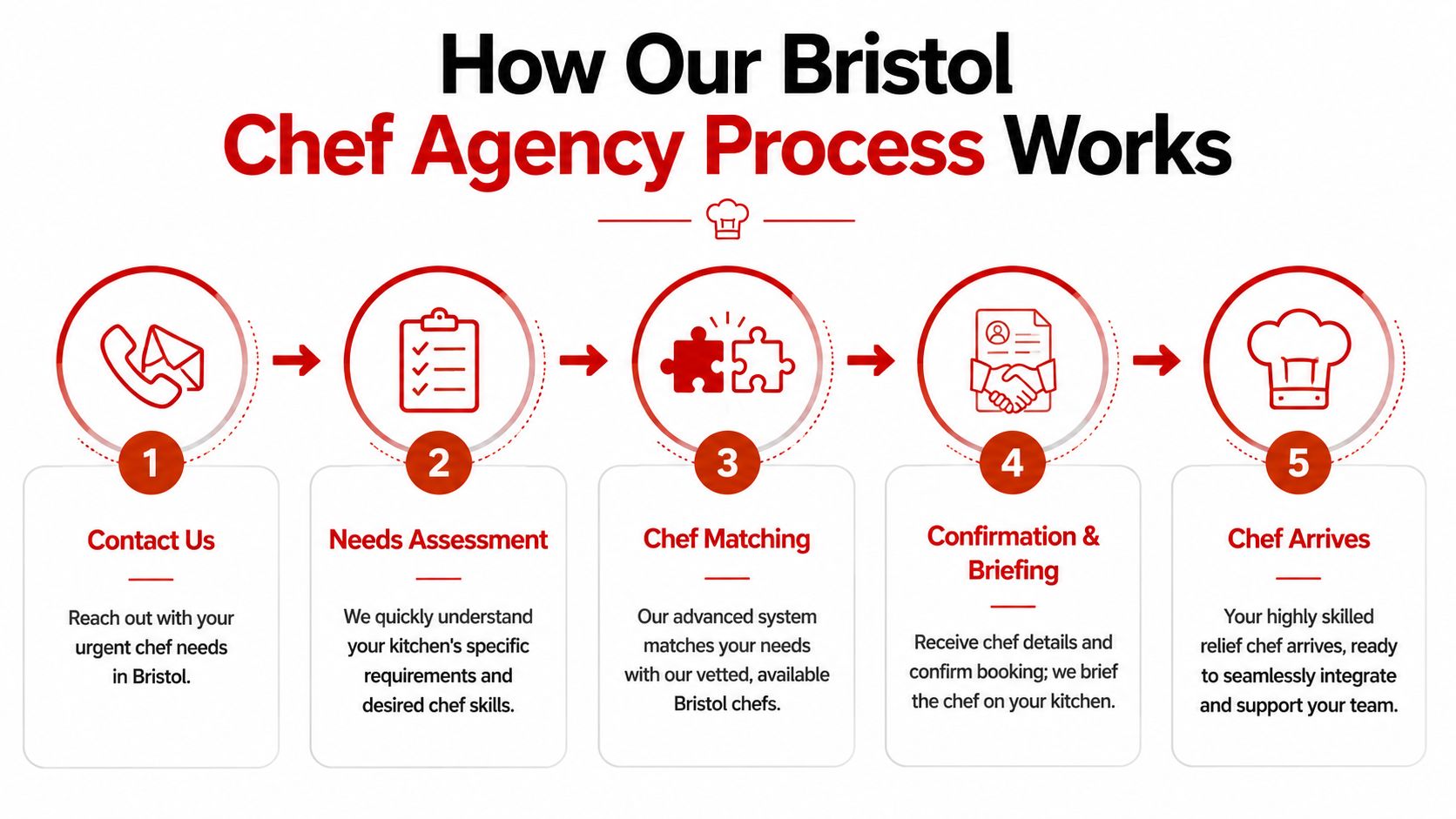
Step one through step three
Make contact quickly
Phone is usually best when service is close. A short form also works when the need is urgent but not immediate. You should be able to state the basics fast: venue type, shift times, section, level required, start date, and whether it’s emergency cover, temporary support, or a longer-term gap.Clarify the brief properly
This matters more than many operators realise. “Need a chef” is too broad. A proper brief includes service style, team structure, expected covers, accommodation if relevant, allergens, menu focus, and whether the role needs grill strength, pastry competence, banqueting experience, breakfast pace, or all-rounder flexibility.Match the chef to the kitchen
Poor agencies often get exposed by this. Sending any available chef isn’t staffing. It’s gambling. The better approach is to match capability and temperament to the site.
Step four and step five
A specialised chef agency can reduce kitchen downtime by 25 to 30% during peak periods because it can deploy chefs within 48 hours, helping venues avoid operational halts that may cost £500 to £1,200 in daily revenue, as noted in Indeed’s Bristol chef agency vacancy context.
That result depends on process discipline:
Confirmation and briefing
Once the match is made, the venue should get clear confirmation of who’s arriving, what level they are, and what they’re walking into. The chef should also be briefed properly before they step on site.Arrival ready to work
The chef shouldn’t need half a shift to settle. They need enough information to slot into service, follow your systems, and support the existing brigade.
For operators needing round-the-clock cover routes, 24/7 chef recruitment support is often the difference between a controlled fix and a frantic scramble.
A relief booking works best when the venue is honest about the job. Overselling a shift creates the wrong match and wastes everyone’s time.
What you need ready before you call
The fastest bookings usually happen when the venue has these details prepared:
- Shift pattern and likely duration of cover
- Kitchen style such as pub, hotel, events, fresh food restaurant, or private household
- Station need such as sous, CDP, breakfast chef, pastry, or head chef relief
- Site specifics including parking, accommodation, live-in options, and uniform requirements
That turns an urgent request into an actionable one.
Vetted and Verified Chefs You Can Trust
Speed matters. But speed without vetting is how operators inherit bigger problems than the one they started with.
When a chef walks into your kitchen, you’re trusting them with food safety, team dynamics, guest experience, stock discipline, and your brand. If they’re not right for the job, the damage happens quickly.

Vetted means more than a CV scan
A decent CV can hide a lot. Operators have all seen it. Good formatting, big claims, thin delivery.
What matters in chef staffing is whether the person can function in a live commercial kitchen. That means checking work history properly, understanding where they’ve worked, and assessing whether their background matches the pace and standards of your site.
Many Bristol agencies talk about “vetted” chefs but say very little about employment compliance. The gap analysis for the local market notes that many Bristol chef agencies fail to discuss post-Brexit right-to-work compliance, while emphasis on fully vetted, right-to-work-checked chefs directly addresses that risk for venues, as outlined in this Bristol hospitality compliance discussion.
Why right-to-work checks matter more now
Post-Brexit, smaller operators can’t afford to be casual about paperwork. If a venue assumes an agency has checked everything when it hasn’t, that mistake can become a legal, financial, and reputational problem.
The safest approach is simple:
- Ask how right-to-work is checked
- Ask whether references are verified
- Ask whether chefs are matched by skillset, not just availability
- Ask who takes responsibility if there’s a problem
For local operators wanting Bristol-focused support, chef cover in Bristol should come with that level of clarity.
A quick look at the wider conversation around kitchen professionalism helps too:
Compliance rule: If an agency can’t explain its vetting process plainly, don’t put its chef on your rota.
Trust is operational, not marketing
A trustworthy chef agency doesn’t earn confidence through slogans. It earns it by sending chefs who arrive prepared, respect the brigade, understand hierarchy, and don’t create drama in a pressured service.
That standard matters whether you need a temporary breakfast chef, a senior kitchen leader to steady a struggling site, a permanent chef recruitment partner, or specialist support for private households and high-expectation settings.
The Right Chef Cover for Your Specific Venue
Not every venue needs the same type of help. That’s where many staffing conversations go wrong.
A lot of agencies talk as if all kitchens are interchangeable. They aren’t. A harbourside pub in Bristol, a boutique hotel in Clifton, a coastal business in Devon, and a group site covering Wales all have different pressure points, different guest expectations, and different tolerance for disruption.
Pubs, restaurants, and hotel kitchens
Take the independent pub model first. The biggest pressure often lands around weekends, functions, and heavy roast trade. The issue isn’t just filling a rota gap. It’s protecting consistency when volume spikes and regulars expect the same plate every time.
A city restaurant has a different risk profile. There, the damage from a weak temporary chef usually shows up in timing, section control, and standards on the pass. The food may still go out, but it won’t go out cleanly.
Boutique hotels need something else again. Breakfast can’t fail unnoticed. Events don’t move because a chef is off. Room service, dietary requests, and guest expectation all keep moving whether the rota is healthy or not.
Multi-site groups and specialist placements
The Bristol chef agency market is large enough that one local agency has been reported at nearly $3 million in annual revenue, operating under NAICS 72 and SIC 736, according to this Bristol agency revenue profile. That scale reflects how many operators rely on flexible staffing to keep kitchens trading.
For multi-site groups, the need usually goes beyond one emergency shift. They need a repeatable staffing route that supports:
- New openings where the launch team is stretched
- Holiday cover across more than one site
- Problem branches that need stronger temporary leadership
- Consistency across locations when one absence creates a domino effect
Then there are specialist roles. Yacht chefs and villa chefs need technical skill, but also discretion, presentation, and the ability to work in close quarters. Private households often want someone who can adapt style, manage preferences discreetly, and operate without fuss.
One chef can be excellent in a gastro pub and completely wrong for a private villa. Matching matters more than availability.
Where Relief Chefs UK fits
For operators who need a mix of relief chefs, temporary chefs, permanent chef recruitment, and specialist placements such as yacht chefs, villa chefs, and wider hospitality staffing support, Relief Chefs UK provides nationwide coverage established in 2013, with chefs matched for short-term gaps and longer-term hiring needs.
The commercial point is simple. The more specific your venue’s needs, the more dangerous generic staffing becomes.
Transparent Pricing Plans Built for Bristol Businesses
Most operators don’t mind paying for cover. They mind paying for uncertainty.
That’s why pricing structure matters as much as the booking itself. If a staffing arrangement looks cheap upfront but brings weak matching, hidden fees, poor communication, or no replacement route when something goes wrong, it isn’t cheap at all. It’s unstable.
What good pricing should actually do
A useful pricing model should help you buy the level of support your business needs without forcing you into the wrong arrangement.
For a smaller café or independent pub, that may mean occasional access to temporary cover and a simple route to help when the rota breaks. A growing restaurant group may need more regular support, faster prioritisation, and smoother account handling. Hotel groups and multi-site businesses often need the most structured relationship because staffing problems tend to hit more than one site at once.
The practical difference between entry-level and higher-support plans usually comes down to:
- Response priority when demand is tight
- Replacement protection if a booking changes or fails
- Account handling for operators managing more than one site
- Visibility on costs so finance teams aren’t chasing surprises
Relief Chefs UK Services at a Glance
| Feature | Occasional cover | Recurring cover | Multi-site cover |
|---|---|---|---|
| Best suited to | Smaller venues with occasional cover needs | Busy sites with recurring staffing pressure | Multi-site groups, hotels, and high-dependency operations |
| Booking pattern | Ad hoc or lighter regular use | More frequent temporary chef support | Ongoing operational staffing support |
| Response handling | Standard booking support | 24/7 recruitment team | Experienced recruitment team available 24/7 |
| Replacement cover | Replacement support available | Stronger replacement protection | Most robust replacement protection |
| Account management | General account support | More hands-on support | Experienced recruitment team |
| Commercial fit | Cost control with flexibility | Balance of speed and continuity | Stability, oversight, and reduced disruption |
Transparent pricing isn’t about being the cheapest option. It’s about knowing what problem you’re paying to prevent.
How to choose the right cover
If your venue only suffers occasional disruption, a lighter plan usually makes sense. If you’re repeatedly patching holes, the more expensive mistake is often underbuying support and paying for the fallout later.
A simple test helps:
- Count how often kitchen staffing issues affect service quality
- Look at how much management time gets burned fixing them
- Decide whether you need transactions or continuity
If the answer is continuity, a structured monthly arrangement is often the cleaner commercial decision.
Your Bristol Chef Agency Questions Answered
What if the chef isn’t the right fit
Raise it immediately. Don’t wait until the end of the booking and hope it improves. A good agency can only act on what it knows, and the faster you flag a mismatch, the faster it can correct it.
Be specific. Say whether the problem is skill level, pace, attitude, communication, or section suitability.
What if a chef cancels or doesn’t turn up
This is one of the first questions you should ask before opening an account. Serious operators need to know what replacement process exists and who they contact outside office hours.
If the answer is vague, that’s a warning sign. Emergency cover only works if there’s a realistic backup route.
Can you provide specialist chefs
Yes, where the agency understands the difference between specialist roles. That can include senior cover, breakfast chefs, banqueting support, pub chefs, restaurant chefs, yacht chefs, villa chefs, and chefs for private households.
The brief matters. The more accurate your description of the role, the better the match.
Are temporary chefs only for emergencies
No. Emergency cover is one use case, but many operators use temporary chefs to cover holidays, recruitment gaps, menu changes, event periods, refurb transitions, new openings, and busy seasonal trade.
Some businesses also use temporary support while deciding whether a permanent hire is really the right move.
How does invoicing usually work
It varies by agency, but the cleanest setup is one where the agency handles the administration clearly and invoices in a way your finance team can follow without chasing for details. Ask upfront how timesheets, rates, payment terms, and any extras are handled.
When should I get in touch
Before you’re desperate, if possible. The best emergency staffing outcomes usually come from operators who set up the relationship early, share their site details in advance, and make the call as soon as a problem appears.
The worst time to assess an agency is during the hour you’re deciding whether to cancel service.
If your kitchen can’t afford another compromised service, speak to Relief Chefs UK about relief chef cover, temporary chefs, permanent chef recruitment, and specialist hospitality staffing support across Bristol and the wider UK. Whether you need urgent cover, a stronger long-term staffing plan, or chefs for pubs, restaurants, hotels, yachts, villas, or private households, make the enquiry before the next rota gap becomes a trading problem.
Call the team.
Office 01392 715474 · info@reliefchefs.co.uk