
Chef Agency Devon: Recruit Top Talent Now
12 April 2026

Friday afternoon before a bank holiday is when weak staffing decisions get exposed.
A sous chef goes off sick. The bookings board is full. Your head chef is already covering prep gaps. Front of house is asking whether the reduced menu is coming back, and guests still expect the same standard at 7pm as they did last month. In Devon, that isn’t a minor rota issue. It’s an operations problem with cash, reputation, and team fatigue attached to it.
That’s why searching for a chef agency devon shouldn’t start and end with whoever answers the phone first. In this market, the agency you use needs to understand kitchens, rural logistics, compliance, and the difference between a chef who can cook and a chef who can walk into service cold and hold a section without causing damage.
Why Finding the Right Chef Agency in Devon Is Mission-Critical
A Devon venue rarely gets staffing pressure one problem at a time.
You get short-notice sickness, holiday cover, tourist spikes, and a team that’s already stretched after a long run of service. The primary risk isn’t only the empty shift. It’s what follows. Slower tickets. Poor prep. Waste. Burnout. Complaints. A senior chef who starts looking elsewhere because they’re tired of carrying the kitchen.

Devon doesn’t give you much room for error
The staffing backdrop is already tight. The South West has a 25% vacancy rate in hospitality roles, and that pressure is made worse by a 15% year-on-year increase in visitors to areas such as Exmouth and Dartmoor, which makes dependable seasonal cover far more important for operators in the region (ONS Labour Market Overview).
That’s the commercial reality behind the panic call to an agency.
If you run a hotel in Torquay, a gastropub near Totnes, or a coastal restaurant in Salcombe, you’re not buying labour in the abstract. You’re buying continuity. You need someone who can arrive, read the kitchen quickly, respect your systems, and protect service.
Operational truth: bad chef cover costs more than an expensive shift. It costs consistency.
A generic recruiter often misses that. They’ll focus on CV keywords, availability, and whether someone says they’ve worked in “busy kitchens”. A chef-run operation will usually ask better questions. What section can they own? Have they handled volume? Are they solid on hygiene? Can they work with an established brigade without turning the pass into chaos?
The wrong agency usually creates a second problem
When the first placement fails, the burden lands back on your team.
Now your head chef is firefighting. Your KP is dragged into jobs they shouldn’t be doing. Menus get trimmed. Standards slip. If you’ve ever had to readjust a whole service because a temp couldn’t cope, you already know the hidden cost isn’t theoretical. It’s exactly why many operators end up reading pieces like the hidden cost of bad chef cover and emergency relief chef booking after they’ve already paid for the mistake.
Here’s the practical takeaway. In Devon, agency cover isn’t a backup plan. It’s part of risk management.
A reliable agency helps you protect peak weekends, keep your permanent team steadier, and avoid desperate hiring decisions. An unreliable one gives you the illusion of cover right up until the first tickets land.
The Ultimate Vetting Checklist for Any Devon Chef Agency
If an agency can’t answer basic operational questions cleanly, don’t use them.
A proper vetting process should feel structured, not improvised. The benchmark is straightforward. A strong chef screening process includes right-to-work checks, hygiene certification verification, and skills assessments. Top agencies can achieve over 90% short-notice fill rates during peak seasons, while 40% of generic agency placements can fail on the first shift because pressure-handling skills weren’t properly verified (Agency Central commis chef recruitment page).
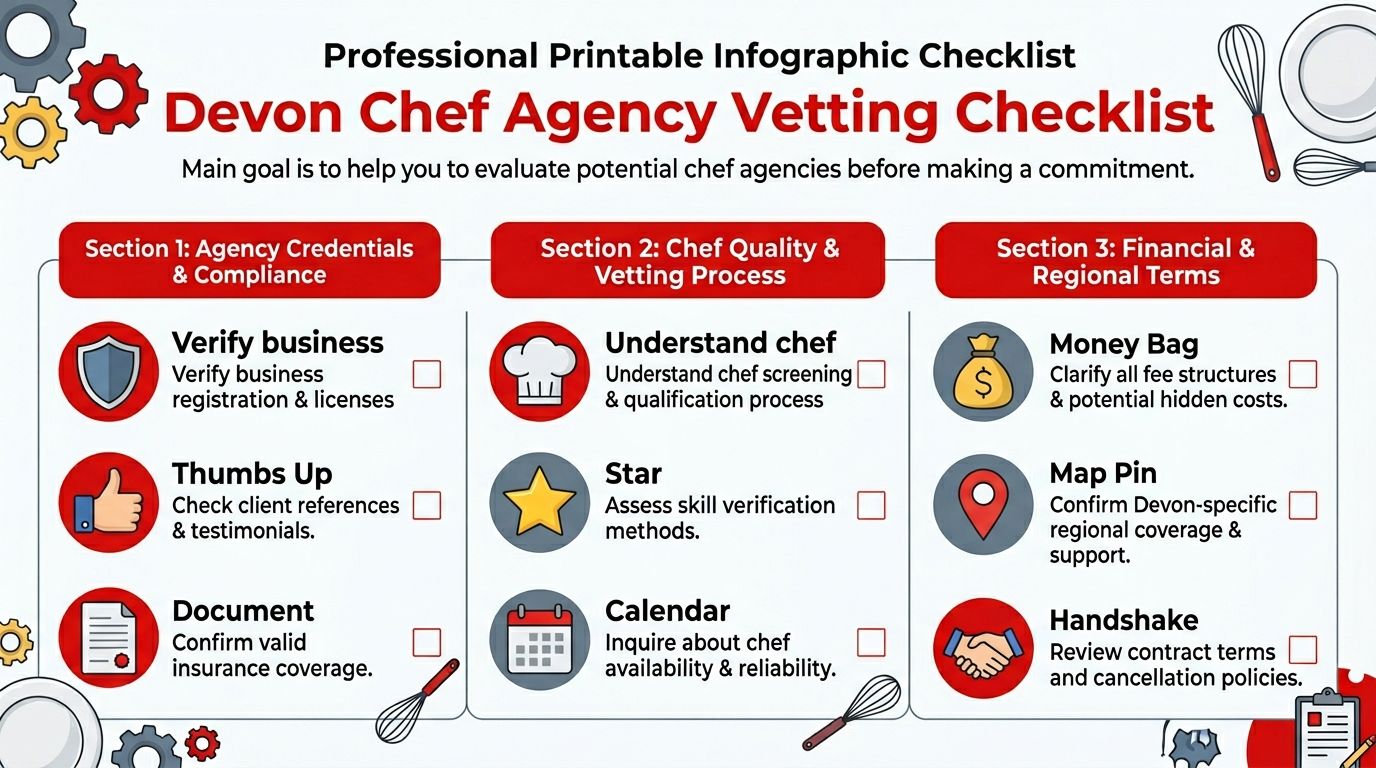
Print this checklist and use it before you agree to anything.
Compliance and legal diligence
This is the first filter. If an agency is loose here, it’ll be loose elsewhere.
Right to work checks
Ask whether they verify documents before a chef is offered out, not after arrival. If the answer sounds vague, treat that as a warning.Hygiene certification
A relief chef doesn’t get a pass on food safety because the booking is urgent. You need confirmation that certificates are checked and current.Insurance cover
Ask what cover is in place and what it includes. “Fully insured” is easy to say. It’s more useful when they can explain the detail.Terms in writing
Make sure cancellation terms, invoicing arrangements, and replacement procedures are documented before the shift starts.
Chef quality and competence
Weak agencies usually get found out here.
A CV can tell you where someone has worked. It can’t tell you whether they can step into your kitchen, read your prep list, and hold standard when the printer doesn’t stop.
Use a practical lens:
Role matching
A chef suited to banqueting isn’t automatically right for a tight, high-pressure restaurant pass. Ask how the agency matches skill to venue style.Section strength
Don’t ask whether they’re “experienced”. Ask whether they can run garnish, sauce, grill, breakfast, pastry, or a small all-rounder kitchen on their own.Pressure handling
Good agencies probe for this. They’ll know whether a chef has worked volume, covered alone, or slotted into short-notice service.
A placement only counts as successful if your team would book that chef again.
- References and real-world checks
Ask whether they rely on paperwork only, or whether they verify references and take feedback after placements.
Reliability and performance
An agency can look organised until the first emergency call lands.
What matters is how they work when your need is awkward. Rural pub. Last-minute accommodation issue. Split shift. Breakfast start after a late finish. That’s where systems matter.
Use this quick review table when comparing suppliers:
| Area | What good looks like | What to avoid |
|---|---|---|
| Response | Clear answer times and realistic updates | “We’ll see who’s about” |
| Cover process | Named steps from request to arrival | No process beyond texting chefs |
| Replacement policy | Fast action if a chef isn’t right | Blame-shifting or silence |
| Regional understanding | Knows Devon travel and seasonality | Treats Exeter and rural Dartmoor as the same job |
| Client fit | Can cite similar venue types | General claims with no operational detail |
The simplest test
Ask the agency to walk you through the last urgent booking they handled for a venue like yours.
If they describe checks, matching, briefing, travel planning, and follow-up, you’re dealing with a grown-up operation. If they jump straight to “we’ve got plenty of chefs”, keep looking.
Key Questions to Ask Before You Sign Anything
Most agencies sound fine until you ask exact questions.
That’s useful. Broad sales language hides weak process. Specific questions expose it quickly. If you run a serious operation, your job isn’t to be impressed. It’s to test whether the agency can protect service when things get messy.
Start with the parts that directly affect risk.
Ask questions that force detail
These are the questions I’d want answered before any temp chef crossed the back door.
How do you verify documents?
Ask whether they inspect original right-to-work evidence or rely on copies sent over casually.What do you check apart from paperwork?
A useful answer mentions hygiene, references, and kitchen capability. A poor answer circles back to the CV.How do you judge whether a chef can handle pressure?
This matters in a packed coastal venue on a sunny Saturday. “They’ve worked in busy places” isn’t enough.How do you match chefs to different kitchens?
A pub serving strong classics, a boutique hotel, a wedding venue, and a yacht all need different profiles.What happens if the chef isn’t a fit?
You want a direct explanation of replacement steps, response times, and who owns the issue.
Ask this plainly: “If I call at short notice with a service-critical gap, what happens in the next hour?”
That single question tells you a lot.
Strong agencies describe a process. Weak ones describe hope.
Test whether they understand hospitality, not just recruitment
You also want to hear how they think about team dynamics.
A relief chef can be technically sound and still damage service if they arrive with the wrong attitude, resist house systems, or unsettle junior staff. Ask how the agency assesses temperament and adaptability, especially for short-notice placements.
A specialist hospitality recruiter should also be able to talk credibly about relief chefs, temporary chefs, permanent chef recruitment, yacht chefs, villa chefs, and wider hospitality staffing support without sounding as if every job is interchangeable. If you want an example of that specialist model, this chef recruitment agency page shows the sort of service mix worth comparing against the market.
A short video can also help you judge whether the operation sounds like hospitality people or pure sales.
Listen for what they don’t say
A few replies should make you cautious straight away:
“We can usually sort something.”
Usually isn’t a system.“All our chefs are experienced.”
Experienced in what, exactly?“We’ve never had any issues.”
That often means they’re avoiding the question, not answering it.“We cover all of Devon.”
Fine. Ask how they handle a remote site, an early start, or accommodation pressure in peak season.
The aim isn’t to catch anyone out for sport. It’s to avoid buying uncertainty dressed up as confidence.
Demystifying Agency Pricing Models and Contract Terms
Price matters. Predictability matters more.
A cheap rate on paper can become an expensive booking once surcharges, cancellations, travel, and poor fit are added back in. That problem is getting sharper, not softer. The National Living Wage is set to rise by 11.4% in April 2026, and unpredictable agency pricing is already a barrier for 42% of South West hospitality businesses (UK Government National Living Wage publication). Clear, upfront quotes help avoid the hidden fees some traditional recruiters add.
The pricing models you’ll see
Most chef agencies fall into one of three camps.
Traditional mark-up model
The agency adds a margin to the chef’s hourly or daily rate.
This can work if the terms are clean and the cover is strong. It can also become murky very quickly if the invoice includes extra costs that weren’t properly explained at booking stage.
Watch for:
- Travel add-ons
- Accommodation uplift
- Late changes penalties
- Admin charges buried in terms
Flat-fee arrangements
Some operators prefer a simple day rate or booking fee because it’s easier to forecast.
That simplicity helps, but only if you know what is and isn’t included. Flat-fee pricing is only transparent when the small print matches the sales call.
Quotes based on your needs
For venues with repeat cover needs, monthly structures can make commercial sense.
This is often more useful for independent pubs with regular gaps, hotels with seasonal pressure, and groups that need an ongoing pipeline. The key advantage is budget control. You’re not renegotiating from scratch every time someone goes off sick or leaves.
What to check in the contract
Before signing, review these points carefully.
| Contract point | Why it matters |
|---|---|
| Cancellation terms | Last-minute changes happen in hospitality. The terms need to be workable. |
| Minimum booking length | Short cover and longer assignments should both be possible if your trade pattern changes. |
| Travel and accommodation | In Devon, these can become material costs if they aren’t agreed upfront. |
| Replacement policy | If a chef is unsuitable, the contract should say what happens next. |
| Invoice structure | You want one clear invoice, not layered charges appearing later. |
The best pricing model is the one your operations team can forecast without unpleasant surprises.
One practical example is Relief Chefs UK, which quotes based on the role, location and dates across relief chef cover, temporary placements, permanent chef recruitment, yacht chefs, villa chefs, and wider hospitality staffing support. The useful part of that model isn’t branding. It’s that different venue types can get cover that fits occasional ad-hoc needs, seasonal pressure, or multi-site support without guessing where the extra fees will appear.
If an agency gets evasive when you ask for examples of final invoice scenarios, assume the invoice will be worse than the pitch.
Planning for Devon-Specific Logistics and Seasonal Peaks
A chef agency devon search should never stop at vetting and price.
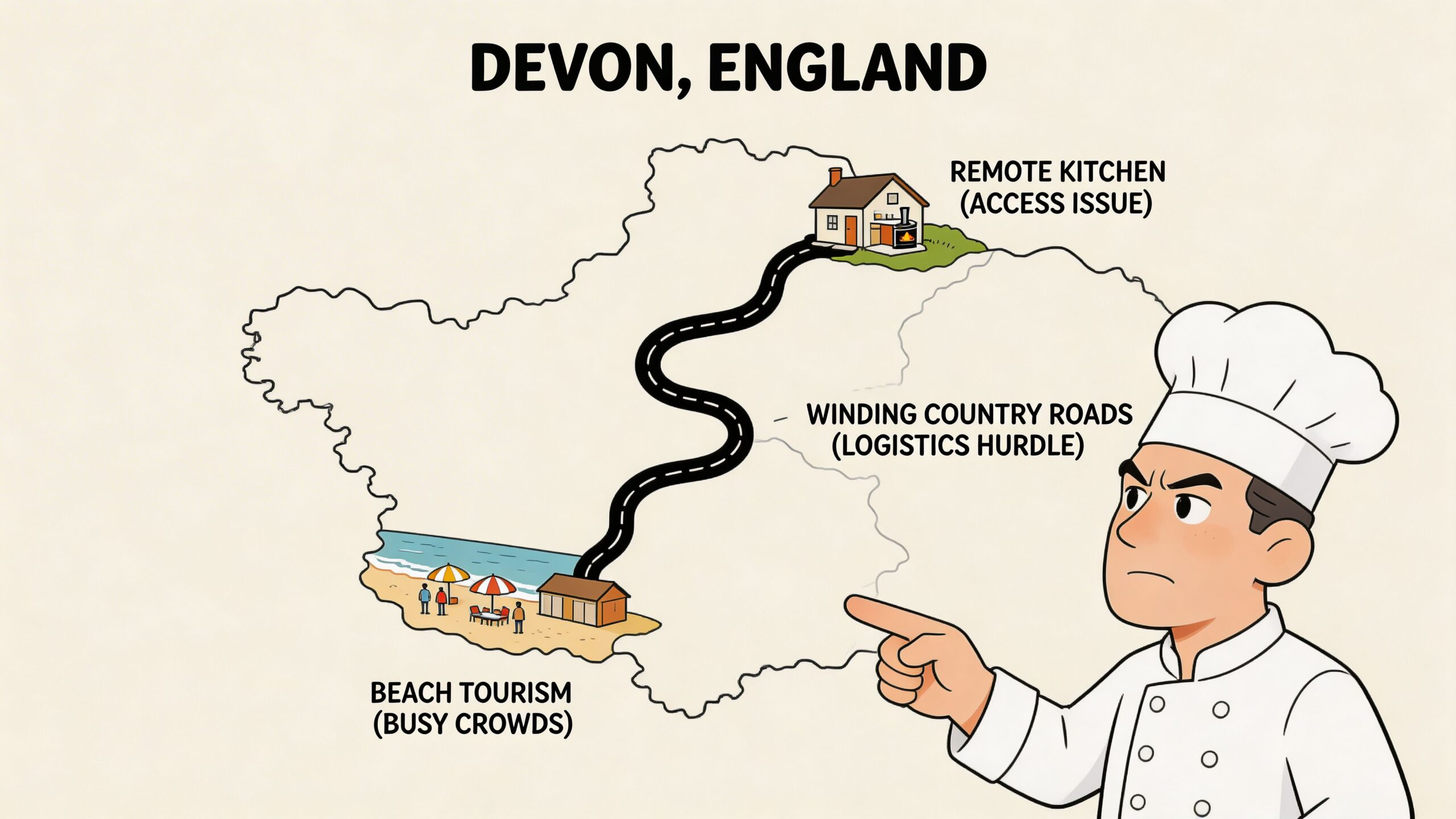
Devon has practical issues that look small on paper and become serious in live service. Travel times stretch. Coastal towns tighten up in peak season. Rural sites look accessible on a map and awkward in reality. If the agency doesn’t think through logistics early, you’ll be sorting avoidable problems on the day.
Rural placements need proper planning
A relief chef for central Exeter is one thing. A relief chef for a remote gastropub on Dartmoor is another.
The booking needs a fuller brief. Start times, finish times, parking, public transport reality, and whether the chef needs to stay over all matter. Leaving that vague nearly always lands the pressure back on the venue.
Use this as a minimum booking brief for harder locations:
Exact site access
Don’t assume sat nav and postcode are enough.Shift pattern
Split shifts and closes followed by breakfast starts need honest discussion.Staff meal and break setup
Small details affect whether a chef can sustain the shift properly.Accommodation plan
If there’s even a chance it’ll be needed, decide early.
Coastal seasonality changes the booking risk
Summer in places such as Salcombe, Dartmouth, and parts of North Devon changes how staffing works.
Rooms disappear. Roads slow down. Demand stacks up fast. An agency that covers Devon well should build this into the booking conversation instead of acting surprised by it later.
If your venue is hard to reach in August, it isn’t a normal booking. Treat it that way from the first call.
The same logic applies to other seasonal markets such as Dorset and Cornwall. The lesson is simple. Regional cover only works when the agency plans the job as a location-specific assignment, not a generic temp request.
What operators should agree upfront
A short pre-agreement removes a lot of friction.
- Travel time expectations
- Who covers accommodation if required
- Kitchen handover notes
- Menu complexity for the shift
- Whether the chef needs prep support or can work more independently
In Devon, stable staffing often comes down to whether someone thought about the practicalities before the van left the car park.
How to Get Vetted Chef Cover in Devon at Short Notice
When the gap is urgent, speed matters. Structure matters more.
The quickest route to safe cover is to give the agency enough operational detail to match properly from the start. That means venue type, shift pattern, section needs, menu style, start date, and whether the job has any travel or accommodation complications.
The process that works
A specialist chef-run model can move fast without cutting corners. The benchmark many operators look for is a prompt response and vetted chefs on-site at short notice, subject to availability, a model trusted by over 400 UK venues and used to help offset Devon’s 20% skilled staff shortfall during peak periods (Devon Good Food Strategy 2023 to 2028).
The practical sequence is simple:
Send the brief clearly
Phone or form both work, as long as the job details are complete.Confirm essential requirements
Right to work, hygiene, insurance, and kitchen fit should be checked before the chef is put forward.Brief the chef properly
Service style, team size, menu level, and site logistics shouldn’t be left to chance.Keep support live after placement
Problems are easier to solve early than halfway through service.
If you need a route for urgent cover, 24/7 recruitment solutions is the kind of service framework worth looking for.
Don’t wait until the rota is already broken beyond repair. The earlier you book, the better the fit usually is.
Frequently Asked Questions About Using a Chef Agency in Devon
What if the temporary chef isn’t right for our kitchen
That should be addressed in the agreement before the booking starts.
A serious agency will explain the replacement process clearly and act quickly if the chef isn’t suitable. If they dodge that question, assume the problem will become yours to manage.
Do we pay the chef directly
Usually, the cleaner setup is a single invoice from the agency.
That reduces payroll admin and keeps the booking terms in one place. It also makes disputes over hours, costs, and replacements easier to handle.
Can we book for one shift only
Many venues need flexibility rather than fixed-length commitments.
Good agencies can usually support anything from very short emergency cover to longer temporary runs, seasonal reinforcement, or permanent recruitment support.
Do chef agencies only help pubs and restaurants
No. The stronger operators work across different hospitality settings.
That can include boutique hotels, private households, yachts, villas, and multi-site groups, provided the agency understands that each environment needs a different kind of chef and a different brief.
Is a specialist chef-run agency worth it over a general recruiter
If your kitchen is service-led, usually yes.
The value is in better matching, better screening, and fewer avoidable surprises on shift. That matters more in Devon, where seasonality and logistics punish weak planning quickly.
If you need dependable kitchen cover, permanent chef recruitment, or seasonal staffing support, contact Relief Chefs UK and get your brief moving before the next gap turns into a service problem.
Call the team.
Office 01392 715474 · info@reliefchefs.co.uk