
Friday dinner service is full. The pass is stacking up. Grill is coping, but garnish is behind, sauces are tightening in the pan, and the junior chef on larder is waiting for instructions that never come. The head chef steps in, then the sous chef gets pulled away by a supplier issue, and suddenly one weak section starts dragging the whole kitchen down.
That's the moment the chef de partie either holds the line or service starts to wobble.
For most operators, chef de partie duties get described too narrowly. They're often written up as if the role is just about cooking one part of the menu well. In practice, a strong CDP is the person who protects standards, controls prep, directs junior staff, and stops one section's problems becoming everyone's problems. In a period where kitchens are still dealing with sickness, agency inconsistency, seasonal spikes, and ongoing chef shortages, that matters more than ever.
If you're hiring, restructuring a brigade, or trying to work out why service feels harder than it should, the answer is often sitting in the middle layer of the team. Get the chef de partie role right and the kitchen becomes steadier, faster, and easier to manage.
Why Your Kitchen Stability Depends on the Chef de Partie
A kitchen rarely collapses because every section fails at once. It usually starts with one section losing control.
The fish arrives late onto the pass. The garnish is inconsistent. The prep list wasn't realistic for covers. The commis chef has been left to guess. None of that sounds dramatic on its own, but over one service it creates refunds, wasted product, stressed staff, and a head chef who spends the whole shift firefighting instead of leading.
That's where chef de partie duties matter operationally, not just on paper.
In a stable brigade, the CDP is the person who owns a section properly. They know what needs prepping, what can wait, what must be remade, and where a junior chef needs support before mistakes start reaching guests. They don't just cook. They control flow.
What a weak middle layer looks like
You can usually spot it fast:
- Prep without priorities means the section looks busy but key items aren't ready.
- Junior chefs without direction keep asking questions during service instead of pushing plates.
- No clear handover leaves the next shift fixing avoidable problems.
- The head chef gets dragged into basics and loses oversight of the rest of the kitchen.
That's expensive, even before you factor in the wider cost of employing kitchen staff, rota pressure, and the risk of losing good people because every service feels harder than it should.
A strong chef de partie gives the head chef breathing room. A weak one takes it away.
Why this role becomes critical under pressure
This is even sharper in busy pubs, boutique hotels, and restaurants dealing with rota gaps. If somebody calls in sick in Bristol, a weekend event lands in Windsor, or a coastal venue in Devon gets hit with sudden seasonal demand, the CDP often becomes the first line of defence.
When the role is covered by someone organised, standards hold. When it isn't, the whole brigade feels fragile.
Defining the Chef de Partie Role in the UK Kitchen
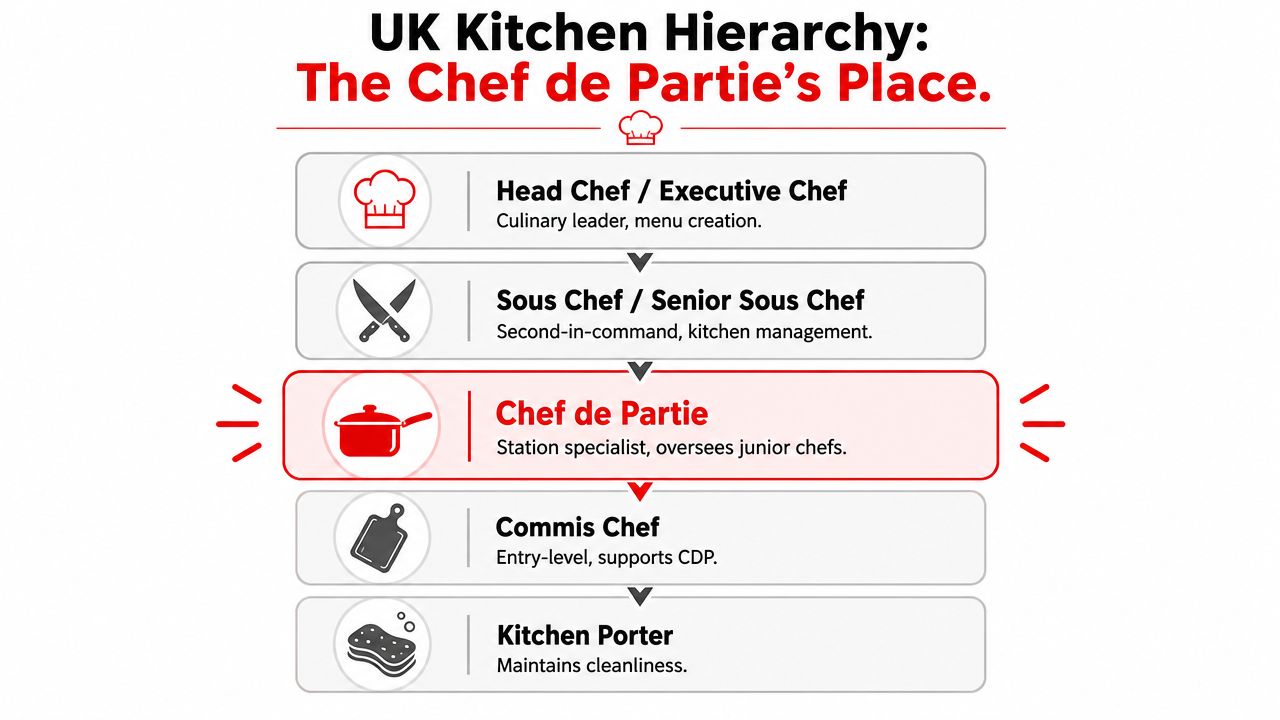
In the UK kitchen hierarchy, the chef de partie is the station lead for one section of the kitchen, positioned above commis chefs and below sous chefs, with duties that typically include preparing, cooking, and presenting dishes in their speciality, training junior staff, supporting menu development, and enforcing food hygiene and health and safety standards, according to UK chef de partie role guidance from Select.
Where the chef de partie sits
The easiest way to explain the role is this. The head chef sets the standard. The sous chef manages the wider kitchen. The chef de partie makes that standard happen on a live section.
They are the kitchen's section leaders. Not senior enough to run the whole brigade, but too important to be treated as line cooks with a better title.
A proper CDP should be able to:
- Own one station fully such as sauce, pastry, fish, larder, or veg
- Run prep with discipline so service starts ready, not hopeful
- Supervise commis chefs and correct problems early
- Maintain consistency from first ticket to last
- Report issues upward before they become service failures
Why the role is structurally important
The head chef can't stand on every section all night. The sous chef can't coach every junior chef at once. Someone has to hold standards in the middle.
That's why chef de partie duties are about more than technical cookery. They combine execution and control. A CDP who plates well but can't organise people leaves a gap. So does a CDP who talks well but can't maintain pace on service.
Operational view: Think of the CDP as the section's owner for the shift. If the station succeeds, they've usually done their job. If it fails, the problem often started before first orders even came on.
What separates a real CDP from a promoted commis
Titles get handed out too quickly in some kitchens. The difference shows under pressure.
| Role level | Main focus | Typical problem if under-skilled |
|---|---|---|
| Commis chef | Learning and supporting | Needs constant instruction |
| Chef de partie | Running a section | Loses control of prep, pace, or juniors |
| Sous chef | Running multiple sections | Gets dragged into one station too often |
If you're building a brigade, this distinction matters. Promote too early and your sous chef spends service covering basic section management. Hire well and the whole line becomes calmer.
A Chef de Partie Daily Shift Checklist
A chef de partie's shift should follow a pattern. When it doesn't, service usually pays for it later.
The UK occupational standard makes this clear by defining the role as responsibility for a production section such as pastry, larder, butchery, fish, sauce, or vegetables, including supervision through receiving, storing, preparing, cooking, and finishing food items, which is why station control sits at the core of the role in the national occupational map.
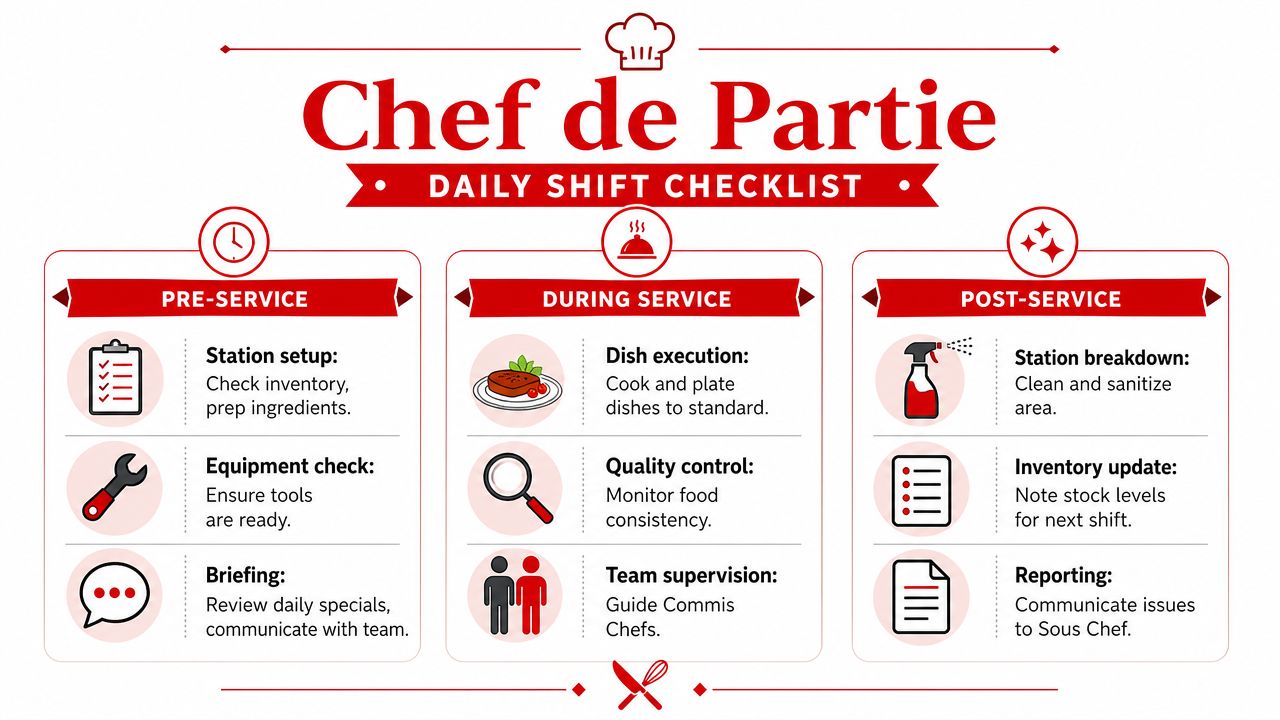
Before service
A CDP should arrive thinking about control, not just cooking.
Use this pre-service checklist:
- Check the section handover. What stock is left, what prep is missing, what issue from the previous shift still needs sorting.
- Inspect storage and product condition. Look at dates, quality, and what needs using first.
- Write a realistic prep list. Not an ideal list. A service-ready one based on bookings, menu mix, and staffing.
- Set up the section properly. Knives, pans, trays, labels, cloths, probes, garnishes, backup containers.
- Brief the junior chef or commis. Give direct jobs in order of importance. Don't assume they know your priorities.
- Flag shortages early. If you're light on a key ingredient, the sous chef needs to know before the rush.
A common failure point is silent optimism. The section looks tidy, but the backup prep isn't there and nobody's mentioned it.
During service
At this stage, chef de partie duties become visible to everyone else.
The CDP should be doing three things at the same time:
- Cooking and finishing dishes to standard
- Watching pace and ticket flow
- Directing whoever is working with them
A calm CDP doesn't just answer tickets. They control sequence. They know what can be fired now, what needs holding, and what can be delegated safely.
If a commis chef is asking basic questions in the middle of peak service, the briefing was too weak or the section is being run reactively.
Practical service checks include:
- Plate consistency across every cover
- Clear calls to the pass when timing slips
- Fast corrections when something is over, under, or missing
- Waste control on remakes and over-portioning
- Clean-as-you-go discipline so the station doesn't deteriorate by the second sitting
After service
Close-down tells you a lot about a CDP's standards.
A proper finish should include:
- Safe storage and labelling
- Rotation of usable stock
- Waste notes and shortages logged
- Section cleaned and reset
- Prep requirements for the next shift recorded clearly
The handover doesn't need to be long. It needs to be useful. “Need more garnish tomorrow” isn't a handover. “Low on blanched greens, one litre chicken jus left, dessert garnish prepped for first sitting only” is.
Key Duties by Common Kitchen Stations
Chef de partie duties change with the station. The core responsibility stays the same, but the pressure points are different. A head chef writing rotas or job specs needs to reflect that.
Sauce and sauté section
This station usually exposes technical weakness first. Timing, reduction, seasoning, pan control, and coordination with protein sections all sit here.
A strong sauce CDP will:
- Build and maintain base prep such as stocks, reductions, and sauce mise en place
- Control finishing speed so dishes don't wait at the pass
- Watch consistency closely because one split sauce or over-reduced pan changes the whole plate
- Manage burners and pan turnover without losing organisation
This station suits chefs who stay composed under pressure. It doesn't suit people who improvise their way through service.
Larder and cold section
Larder can be underestimated, especially in pubs and hotels where cold starters look simple on paper. In reality, it often carries high garnish detail, buffet support, desserts in smaller venues, and much of the visible finesse of the menu.
The CDP here should focus on:
- Prep accuracy because cold sections expose sloppy knife work fast
- Presentation consistency on starters, salads, charcuterie, and plated cold dishes
- Storage discipline for delicate product
- Fast assembly under pressure when ticket flow jumps suddenly
In banquet-heavy hotels around Berkshire or Reading, this section can also become central to event service.
Pastry section
Pastry demands a different temperament. You can't wing it. Recipes, timings, temperatures, and set-up all matter.
Typical pastry chef de partie duties include:
| Pastry duty | Why it matters |
|---|---|
| Producing desserts to spec | Guests notice variation immediately |
| Managing baked items and bases | Miss prep windows and the whole service shifts |
| Maintaining measured recipes | Pastry punishes guesswork |
| Organising ahead for functions | Events often depend on pre-planned sequencing |
This role often works best with chefs who are methodical and strong on prep planning, not just creativity.
Vegetable and garnish section
In many kitchens this station carries more pressure than expected. It affects every plate and often gets loaded with jobs when the brigade is short.
The CDP needs to manage:
- Batch prep without quality drop
- Cooking times across multiple accompaniments
- Communication with grill, fish, and sauce
- Portion discipline so cost drift doesn't creep in
For a broader comparison of where section leadership hands over into wider kitchen management, this guide on the duties of a sous chef is useful when you're mapping brigade structure.
How CDP Duties Adapt to Your Venue Type
The same job title can mean very different things depending on the business.
Public job descriptions often miss that point. In smaller pubs, cafés, and boutique hotels, the role becomes far more hands-on and one person may cover both production and supervision, as noted in this UK overview of chef de partie work across venue types.
In a pub or café
In a busy Bristol pub or a seasonal Devon food-led inn, the CDP may run hot section, help with desserts, receive deliveries, and train the junior chef all in one shift.
That changes the job significantly. The role becomes broader and more physical. You need someone versatile, fast to adapt, and practical about prep. A highly specialised chef who only wants one narrow station often struggles here.
In a boutique or larger hotel
A hotel kitchen usually gives the role more defined edges. One CDP may own breakfast prep and garnish. Another may control banqueting pastry. Another may sit squarely on sauce or larder.
That sharper structure helps with standards, but only if covers, events, and staffing levels are planned properly. In Dorset, Windsor, or Wales, hotel kitchens often swing between quiet periods and sudden event pressure. A CDP in that setting must switch from routine production to volume control without losing consistency.
The bigger the venue, the more a chef de partie needs discipline in communication. The smaller the venue, the more they need versatility.
In yachts and private households
This is a different operating model again. Space is tighter. Storage is limited. Provisioning errors hurt quickly. The chef has fewer people around them and less room for mistakes.
For yacht chefs and villa chefs, chef de partie duties often merge into wider all-round responsibility. The chef may need to prep, serve, store, clean, and replan menus around guest changes without the support structure of a hotel brigade. That requires calm organisation, not just good food.
A Sample Chef de Partie Job Description Template
When a job advert is vague, you attract vague candidates. When it's too broad, you get applicants who want the title but not the responsibility.
A workable chef de partie job description should sound like a real kitchen, not an HR placeholder.
Blue Arrow's UK specification describes the role as preparing, cooking, and presenting high-quality dishes, managing food hygiene, health and safety, portion and waste control, kitchen standards, and training commis chefs, while also listing at least 1 year of relevant experience and NVQ Level 2 or equivalent among the typical benchmarks in its chef de partie job description.
Copy-ready template
Job title
Chef de Partie
Role summary
We are looking for a chef de partie to run a designated section of the kitchen and maintain high standards of prep, service, cleanliness, and team support. The role requires strong organisation, solid cooking ability, and the confidence to supervise junior chefs during busy services.
Key responsibilities
- Run your section daily and ensure it is fully prepared for service
- Prepare, cook, and present dishes in line with the business's menu standards
- Supervise commis chefs and provide clear direction during prep and service
- Monitor portion control, wastage, and stock use within your section
- Maintain food hygiene, health and safety, and cleaning standards
- Support menu changes, specials, and seasonal updates as required
- Report shortages, equipment issues, and service concerns to the sous chef or head chef
- Complete close-down, storage, labelling, and handover duties accurately
Skills and attributes to ask for
Essential
| Requirement | Why include it |
|---|---|
| Relevant section experience | Helps filter out title-only applicants |
| Professional cookery training or equivalent | Useful where consistency matters |
| Understanding of food safety | Non-negotiable in any live kitchen |
| Ability to train junior staff | The role includes supervision |
| Calm under pressure | Service performance matters as much as prep |
Desirable
- Experience in fresh food service
- Banqueting or hotel background
- Flexibility across sections
- Strong communication with front and back of house
Hiring rule: If your advert doesn't say what section they'll run, what standards they'll own, and who they'll supervise, don't be surprised when the wrong CVs come in.
If you need longer-term support while recruiting, a dedicated permanent chef recruitment service can sit alongside temporary cover so standards don't slip during the hiring period.
Handling Gaps When You Need Cover Now
Most staffing problems don't arrive neatly.
A CDP calls in sick before a booked Saturday. A trial shift doesn't show. A chef walks after payday weekend. A hotel in Berkshire suddenly needs breakfast and banqueting support at the same time. Those situations aren't unusual. They're normal operating risks.
Public vacancy boards in 2026 still showed demand for flexible, seasonal, and short-notice kitchen cover, including 50+ English-language chef de partie vacancies on 10 May 2026 on Indeed's chef de partie listings, which lines up with what operators already know from day to day: when teams are understaffed, chef de partie duties expand fast.
What works when the rota breaks
The best short-notice response is usually simple:
- Protect the critical section first. Not every gap has the same operational risk.
- Use a chef who can walk into an existing system rather than someone who needs coaching all shift.
- Adjust the menu if needed before service, not halfway through it.
- Give one person clear authority on the affected section so the rest of the brigade knows where decisions sit.
What doesn't work is hoping the sous chef can absorb everything, or splitting one unattended section between three already-busy chefs.
Practical cover options
Operators usually have a few choices. Cross-train internal chefs where possible. Keep a shortlist of dependable freelancers. Use a specialist temporary staffing route when the risk to service is bigger than the cost of cover.
For venues that need short-notice kitchen continuity, temporary agency chef cover is one route used across pubs, hotels, restaurants, villas, and yachts. Relief Chefs UK, established in 2013, provides relief chefs, temporary chefs, permanent chef recruitment, yacht chefs, villa chefs, and wider hospitality staffing support across the UK.
Frequently Asked Questions About the Chef de Partie Role
What is the next step after chef de partie
The usual progression is into a junior sous chef or sous chef role, then on to head chef level. The jump only works if the chef has already learned section leadership, not just section cooking.
A chef who can run one station well may still need development in rota planning, stock control, wider kitchen communication, and managing multiple sections.
What should you measure in a chef de partie
The most useful indicators are practical ones:
- Section consistency across service
- Prep readiness before opening
- Waste and portion discipline
- Clean handovers
- Development of commis chefs
- Ability to stay organised during pressure
If your review process only talks about food quality, you'll miss half the job.
What is the average salary for a chef de partie in the UK
Salary varies widely by region, venue type, live-in arrangements, and whether the role is seasonal, permanent, or part of a hotel group. In practice, rates in London and premium destinations often differ from those in smaller towns, and private households or yachts can operate on a different basis again.
For that reason, it's better to benchmark against your local market and the actual scope of the role rather than use one national figure.
What is the difference between a demi chef de partie and a chef de partie
A demi chef de partie is usually a step below a full chef de partie. They support a section and may take on part of the station, but they don't normally carry the same level of ownership.
A full CDP should be able to organise prep, manage the section in service, and supervise junior staff with less day-to-day intervention.
If your kitchen needs stable section cover, permanent chef hiring support, or flexible staffing for pubs, restaurants, hotels, villas, or yachts, contact Relief Chefs UK. A clear brief and the right chef at the right level can keep service on track when the rota doesn't.