
Friday afternoon. Eighty covers on the books, a private dining room turning for a wedding tasting, and your sous chef rings in sick. Then the agency sends someone who says they can run service, but spends the first hour asking where you keep the basic mise en place.
That's the moment most operators start searching for recruitment agencies for events. Not because they enjoy using agencies, but because the alternative is worse. Cancel bookings, drag your salaried team into another punishing double, or let standards slip in front of paying guests.
The problem is that “agency” can mean almost anything. One firm is a call centre with a database. Another knows events, but not kitchens. Another understands chefs, compliance, transport, and what a busy Saturday in Windsor or a wedding weekend in Devon looks like on the ground.
If you run a hotel, pub, restaurant, catering business, private household, yacht programme, or multi-site group, you don't need a vague promise of cover. You need a staffing model that protects service, margin, and reputation. That means knowing which type of provider you're dealing with, what they can realistically deliver, and how to spot the difference between quick fill and proper kitchen stability.
The Problem with Event Staffing and The Agency Promise
The usual staffing crisis doesn't arrive neatly. It lands all at once.
A banqueting chef gets food poisoning the night before a function. Two casuals don't confirm. Your head chef is already firefighting prep for a corporate event, and front of house is asking whether canapés need reducing because the kitchen can't cope. At that point, speed matters, but so does judgement. A bad placement can be more disruptive than no placement at all.
This pressure sits inside a labour market that's already stretched. The UK's accommodation and food service sector employed around 2.3 million people in 2024, and around 6 in 10 hospitality employers reported vacancies, which is why flexible cover has become an operational necessity rather than a luxury, according to UK hospitality employment and vacancy data referenced here.
That's why recruitment agencies for events have become a normal part of running hospitality businesses. Hotels use them for weddings and conference peaks. Restaurants use them when key chefs walk out or take holiday at the wrong time. Pub groups use them to hold consistency across sites when one kitchen suddenly drops below safe staffing.
Practical rule: If your event staffing plan starts when someone calls in sick, you're already late.
The agency promise sounds simple. One phone call, one chef, problem solved.
Sometimes that works. Often it doesn't. The central issue isn't whether to use outside staffing support. It's whether the provider understands the difference between filling a shift and protecting a service. For event-led kitchens, that distinction is the whole game.
Understanding Different Types of Event Recruitment Agencies
Most operators lump all outside labour into one bucket. That's a mistake. Different providers solve different problems, and using the wrong one usually shows up in the kitchen first.
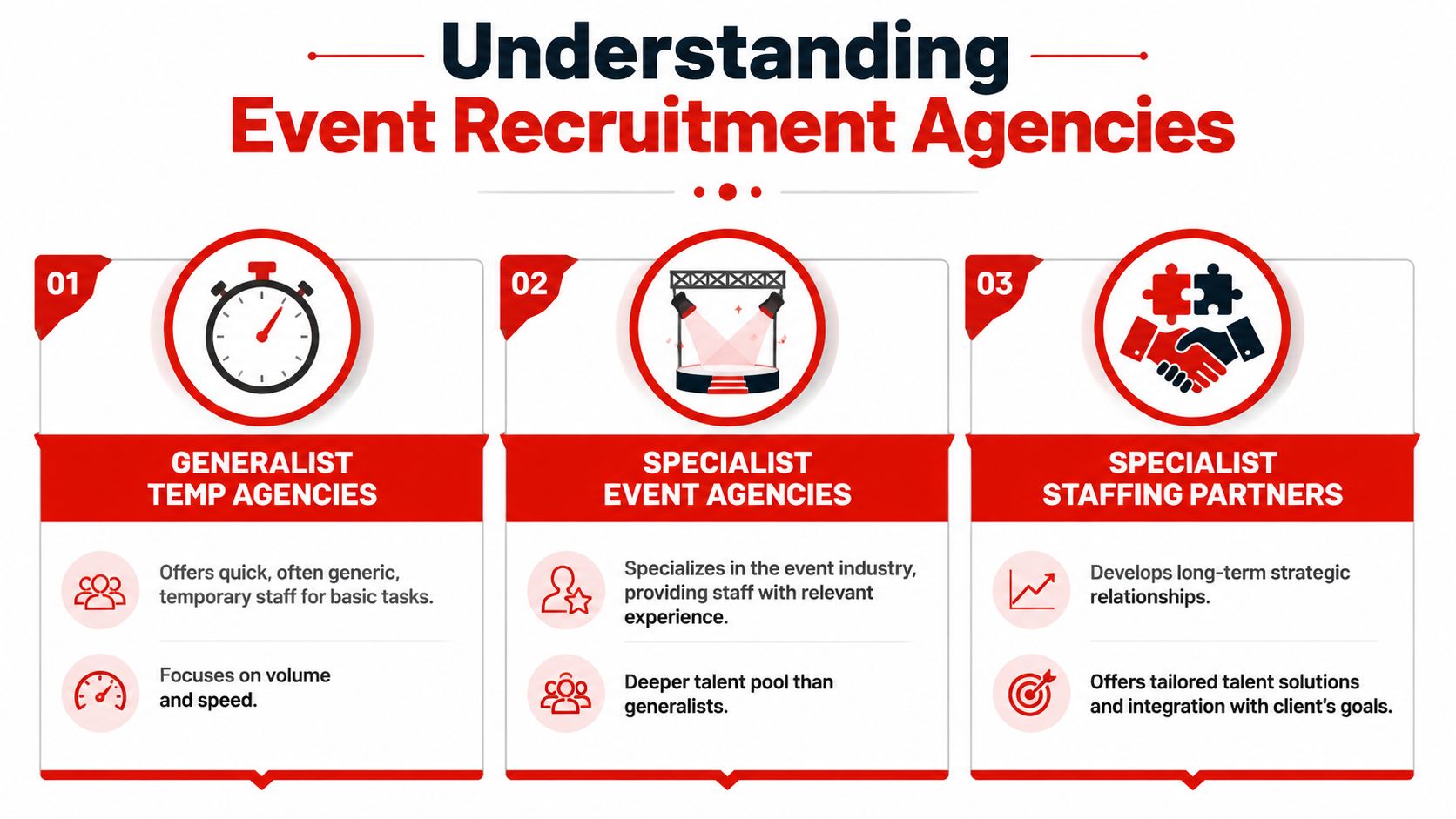
Generalist temp agencies
These firms are built for coverage at volume. They can often move quickly and may supply porters, waiting staff, basic kitchen assistants, warehouse staff, cleaners, or drivers from the same desk.
That broad reach is useful if you need hands, not specialist judgement.
The trade-off is obvious. A generalist agency may understand availability, but not brigade structure. They might send someone labelled “chef” without properly testing whether that person can run a section during a wedding service, manage allergens under pressure, or step into a hotel breakfast operation without hand-holding.
Specialist event agencies
These agencies usually know live events better. They're often stronger on front-of-house teams, logistics crews, promo staff, registration teams, and sometimes catering support linked to venues, festivals, conferences, match days, and private functions.
They're more relevant than generalists if your operation is event-heavy.
But they still may not be kitchen-first. If your biggest risk sits on the pass, in banqueting prep, or in the absence of a capable CDP or sous chef, you need to ask whether they recruit chefs or whether kitchen cover is just one line in a wider offer.
For operators comparing models, this overview of different recruitment agency approaches in the UK helps frame what each type is built to do.
Specialist chef and kitchen agencies
This is the category most hospitality operators need when service quality is on the line.
A specialist chef provider should understand section fit, menu style, service volume, transport realities, kit familiarity, and how to place someone who can walk into a busy kitchen in Bristol, Berkshire, Dorset, or rural Wales and function from the first briefing.
The right kitchen cover doesn't just arrive. It lands, gets changed, reads the board, and starts contributing without destabilising your team.
Think of it this way:
| Provider type | Good for | Risk if misused |
|---|---|---|
| Generalist temp agency | Basic shift coverage and broad labour needs | Weak kitchen fit |
| Specialist event agency | Event crew, FOH, logistics, mixed venue staffing | Kitchen depth may be limited |
| Specialist chef provider | Relief chefs, temp chefs, permanent chef hiring, kitchen stability | Narrower focus, but that's often the point |
If your risk sits in food production, don't buy a broad service when you need deep judgement.
The Pros and Cons of Using Traditional Agencies
Friday, 11:30am. Your banqueting chef has called in sick, prep is behind, and 180 covers are due out that evening. A traditional agency can be useful in that moment because it gives you a chance of getting a body into the kitchen fast. For a general manager under pressure, that speed has value.
That is why agencies remain part of the hospitality staffing mix.
Where traditional agencies do help
Speed is the obvious advantage. If a rota falls apart, an established agency can start working its contact list straight away. That can protect a breakfast shift, a lunch service, or a large event build where you need cover in place.
Breadth matters too. Traditional agencies usually carry a wider book of workers across multiple job types, which helps if your staffing gaps are varied rather than highly specialised. If you need porters, waiting staff, kitchen assistants, and basic chef cover in the same week, one supplier can be administratively convenient.
There is also a commercial case for using them in lower-risk roles. If the job is straightforward, the menu is simple, and your senior kitchen team can absorb some supervision, agency labour can be a practical short-term fix.
Where the model starts to break down
The weakness is not that agencies are useless. The weakness is that the standard model is transactional.
Many traditional agencies are built to fill shifts, not protect kitchen performance. That difference matters. A CV that looks acceptable at 2pm can still produce a poor service at 8pm if the chef cannot handle your volume, your equipment, or your way of working.
I have seen this repeatedly. One temp chef saves the weekend. The next one slows prep, misses standards, and leaves the head chef firefighting instead of leading service.
The pattern is usually easy to spot:
- Shallow role matching: The consultant asks for a job title and rate, but not what service is under pressure, what section needs support, or whether the shift is banqueting, prep, pastry, grill, or volume production.
- Weak briefing: Start time gets confirmed, but site access, kit, allergens, reporting line, transport, and handover discipline stay vague.
- Candidate volume over candidate fit: The pitch focuses on how many people are on the database, not who is right for this kitchen tonight.
That last point catches operators out. A large database sounds reassuring. In practice, an ill-matched chef can cost more than an unfilled shift.
The costs that do not show on the rate card
The invoice is only one part of the decision.
The bigger cost often sits inside the operation. Your sous chef stays late to supervise. Prep gets redone. Waste goes up because someone over-produces or mishandles stock. Service slows, complaints rise, and your permanent team takes the strain on a week when they were already stretched.
That is the trade-off operators need to judge properly. Traditional agencies can reduce the immediate pain of being short-staffed, but they often push risk downstream into service quality, team fatigue, and margin.
For front-of-house event crews or broad temp support, that compromise may be acceptable. For kitchens, it is usually expensive. Food operations punish weak fit faster than almost any other part of hospitality.
A generalist agency sells access to labour. A specialist staffing partner is judged on whether the kitchen holds together. That is why operators with serious food-led risk usually move away from a pure agency model and toward specialist chef support such as Relief Chefs UK, where the focus is stability, section fit, and service quality rather than merely filling the booking.
The Modern Alternative A Specialist Staffing Partner
The better model isn't just faster supply. It's better operational fit.
A specialist staffing partner works differently from a transactional agency. The aim isn't to sell a shift. The aim is to keep the kitchen functioning at the required standard, even when the plan breaks.
What changes in practice
A partner asks different questions from the start. Not just “What chef do you need?” but “What service is at risk?”, “Who leads the shift?”, “Is this banqueting, breakfast, fine dining, pub volume, or private household work?”, and “What does success look like by the end of the booking?”
That matters because event staffing usually breaks on mobilisation, not sourcing. Qualified candidates can be identified and screened in 24 to 48 hours, but onboarding can still take 1 to 3 days for consultant-style assignments and typically 1 to 3 weeks end-to-end depending on interview and decision speed, according to industry staffing guidance on mobilisation timelines. In hospitality terms, that means pre-vetted pools, digital onboarding, and repeatable briefing systems are what reduce friction when a kitchen needs help quickly.
A proper staffing partner builds around that reality. They maintain people who are already checked, already briefed on expectations, and easier to mobilise when notice is short.
Why kitchen-first knowledge matters
Kitchen staffing isn't interchangeable with general event staffing. A relief breakfast chef for a boutique hotel in Berkshire is not the same booking as a volume event chef for a race-day weekend, and neither is the same as a villa chef, a yacht chef, or a permanent head chef search for a coastal property in Devon.
That's where specialist support earns its keep. A kitchen-focused provider should understand:
- Brigade fit: Can the chef slot into your existing structure without pulling others off task?
- Service style: Rosette dining, golf club banqueting, pub food, private household, and yacht work all demand different habits.
- Reliability under pressure: The test isn't whether someone can cook. It's whether they can join a team and steady it.
One example in the market is Relief Chefs UK, established in 2013, which supplies relief chefs, temporary chefs, permanent chef recruitment, yacht chefs, villa chefs, and hospitality staffing support across the UK.
The commercial upside of partnership
The best staffing relationships lower operational drag.
If the provider already knows your site, your menu level, your accommodation position, your parking constraints, and your standards, each booking gets easier. You spend less time repeating yourself. Your head chef spends less time babysitting. Your guests notice less disruption.
This matters whether you run a wedding venue in Dorset, a city hotel in Bristol, a country house in Wales, or a restaurant near Reading that gets hit by private event spikes.
A stronger partner also helps with planned stability, not just emergencies. That might mean temporary chefs for holiday periods, relief chefs for sickness and walkouts, or permanent chef recruitment when you need to stop patching the rota and rebuild the core team properly.
A short explainer below gives a useful feel for how chef staffing support fits event operations.
The real buying decision isn't agency versus no agency. It's transactional cover versus operational continuity.
Your Checklist for Vetting Any Staffing Provider
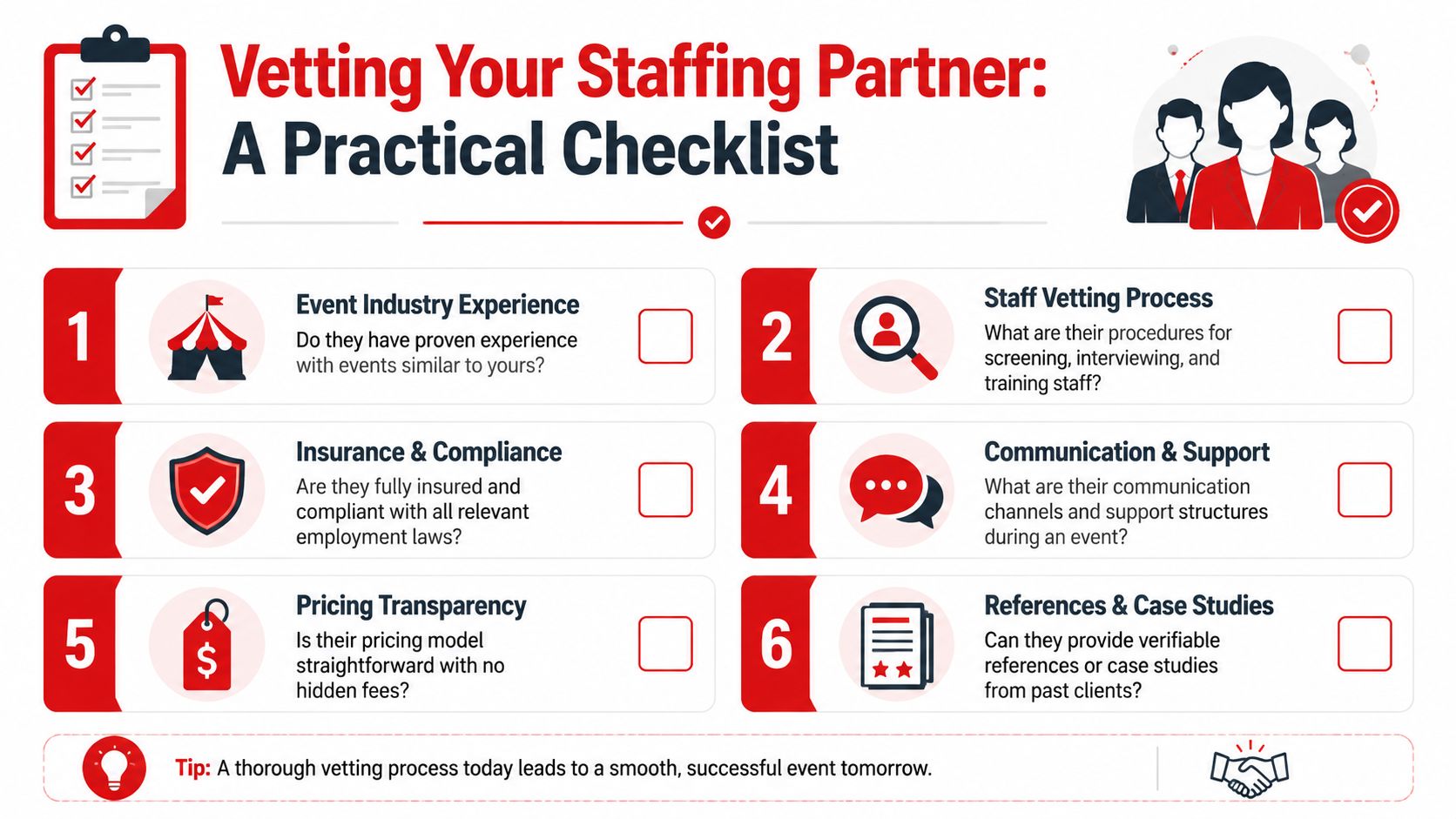
If you're speaking to recruitment agencies for events, don't start with rates. Start with risk. The cheapest cover becomes expensive very quickly when it fails in service.
Ask about specialisation before availability
The first question is simple. “What kind of kitchens do you staff most often?”
If they answer with broad categories and generic reassurance, keep digging. You want specifics. Hotels, pubs, event caterers, fine dining, schools, private households, yachts, holiday parks, banqueting venues. A provider that knows chef staffing should be able to explain where their network is strongest and where it isn't.
Useful follow-up questions include:
- Role fit: Do you regularly place CDPs, sous chefs, head chefs, pastry chefs, breakfast chefs, and event chefs?
- Regional coverage: Can you cover both major towns and harder-to-fill rural sites?
- Operational context: Do you understand split shifts, live-in roles, wedding volume, and short-turnaround functions?
Test the vetting process properly
Many providers say they vet. That word covers a lot of sins.
Ask what checks happen before a chef is offered to you. You're looking for a process that includes right to work, relevant experience checks, references, and practical suitability for the level of work required. If the answer sounds improvised, assume the process is weak.
A useful way to pressure-test this is to ask, “How do you decide whether a chef is suitable for a high-pressure event kitchen rather than a quieter prep role?”
If they can't answer clearly, they're probably placing CVs, not solving staffing problems.
Compliance is not optional
This part gets overlooked until there's an issue with pay, assignment length, or liability.
Under the Agency Workers Regulations 2010, temporary staff gain rights to equal treatment after 12 weeks in the same role, so any provider handling repeat assignments needs effective tracking and admin systems. That's why it's worth asking exactly how they manage AWR, as outlined in this explanation of AWR requirements for temporary staffing.
Use this quick red-flag screen when reviewing any provider:
| Question | Good sign | Red flag |
|---|---|---|
| How do you track assignment length? | Clear AWR process | Uncertain answer |
| Are workers insured? | Immediate confirmation | Vague wording |
| What happens if the chef is wrong for the role? | Replacement process exists | “We'll see what we can do” |
| Who supports us during the shift? | Named contact | No clear ownership |
If a provider gets uncomfortable when you ask about compliance, that's your answer.
Check communication and commercial clarity
Good staffing support is operationally precise. You should know who confirms the booking, who briefs the chef, who handles changes, and who answers the phone if the shift goes wrong at the worst possible time.
Also ask for the fee structure in plain English. Not “industry standard”. Not “we'll outline later”. Plain English.
Look for:
- Transparent rates: What exactly is included in the quoted charge?
- Travel and accommodation clarity: Are these separate, included, or conditional?
- Cancellation terms: What happens if your event changes?
- Temp-to-perm terms: If you want to hire the chef permanently, what applies?
A serious provider won't dodge those questions. They'll expect them.
Managing Costs and Contracts Without Hidden Surprises
Agency invoices go wrong in familiar ways. The day rate looked acceptable. Then transport appeared as an extra, accommodation was billed separately, the booking window triggered a surcharge, and the cancellation terms turned out to be tighter than your event contract with the client.
That's why operators need to read staffing terms as commercial documents, not admin paperwork.

Common pricing models
Most staffing providers use one of a few structures.
Some quote a daily or hourly temp rate. That can work well for short relief bookings if the scope is clear.
Others charge a permanent placement fee when you hire directly. That may be reasonable for a successful long-term appointment, but only if rebate terms and replacement terms are spelled out.
Some providers also use temp-to-perm arrangements. Those can be useful when you want to try a chef in service before committing, but the conversion terms need to be transparent from the outset. This guide to contract employment agencies and staffing models is useful if you're comparing temporary and longer-term routes.
Where hidden cost usually creeps in
Problems usually sit in the edges of the contract, not the headline price.
Watch for these points:
- Travel charges: Especially relevant for rural venues, islands, remote parts of Wales, and seasonal coastal sites.
- Accommodation assumptions: If live-in is required, confirm who provides it and on what standard.
- Unsociable hour premiums: Late finishes, split shifts, and event over-runs can alter cost if the agreement allows for it.
- Replacement terms: If the chef doesn't turn out to be suitable, what do you get?
Contract points worth reading twice
A decent staffing agreement should answer three things clearly. Who carries what liability, what happens if the booking changes, and how disputes are handled.
Read the cancellation clause carefully. Event business changes fast. If your client reduces numbers or moves dates, you need to know whether your staffing provider gives you any room to adapt.
Then read the exclusivity language. Some contracts discourage or restrict direct hiring, multi-agency use, or side arrangements. That may be fair in some cases, but only if it was explicit and commercially sensible from the beginning.
Good contracts don't remove all risk. They make the risk visible before you sign.
Frequently Asked Questions About Event Chef Staffing
What's the difference between a temp chef and a relief chef
On a busy event week, that distinction matters because it affects how you brief the supplier and what standard of cover you should expect.
In day-to-day operations, the terms overlap. Operators usually use relief chef for short-notice or short-term cover that keeps service running through sickness, holiday gaps, no-shows, and event pressure. A temp chef is a broader label. It can include relief cover, but it also covers fixed short-term assignments such as seasonal peaks, pre-opening support, project work, and trial periods before a permanent hire.
If the brief is vague, the results are usually poor. Ask for the level, section, style of service, prep expectations, and whether the chef is there to steady the pass or just fill a hole on the rota.
How much notice do I need for an emergency booking
As much notice as you can give. In reality, event kitchens often need help the same day or the night before.
Speed depends on four things. The role level, the venue location, whether accommodation is available, and how clear the brief is. A supplier with access to pre-checked chefs can move far faster than a general agency still ringing around after you call.
This is the practical difference between an agency and a staffing partner. An agency takes the order. A staffing partner already knows who can step into that kitchen, handle the menu, and arrive ready to work.
Do you need agency support even if you're trying to hire permanently
Usually, yes.
Permanent recruitment and temporary cover solve different problems. Permanent hiring builds the team you want in six months. Event chef cover protects this weekend's service, keeps standards in place during notice periods, and buys time to recruit properly instead of rushing into the wrong hire.
That is why many operators use both. The better model is not repeated spot-buying from whichever recruitment agencies for events answer the phone first. It is working with a specialist provider that understands your kitchen, your service style, and the commercial cost of getting a booking wrong.
Can event chef cover work outside major cities
Yes, but only if the provider can staff the logistics as well as the shift.
Remote hotels, wedding venues, golf clubs, private estates, yachts, and seasonal coastal businesses are harder to cover well. Travel time, late finishes, ferry links, live-in standards, and last transport options all affect whether the booking is realistic. Good suppliers will tell you early if the brief needs to change. Weak ones will say yes, then struggle later.
For a practical view of the job from the chef side, see what working at events actually involves for chefs.
What should I ask before confirming an event chef booking
Ask questions that reduce service risk, not just cost.
Confirm the chef's level, event background, section strength, travel plan, start time, finish time, and who covers if they drop out. If the event is premium, ask whether they have worked in high-volume banqueting, private dining, or multi-day event production. A generic CV summary is not enough when 180 covers are due at 7pm.
Is the cheapest agency rate usually the best option
Rarely.
A lower rate can still cost more if the chef arrives late, cannot handle the menu, needs too much supervision, or has to be replaced halfway through a run of events. The key measure is service protection. Good cover reduces waste, overtime, complaints, and management distraction. That is where specialist staffing partners usually outperform transactional agencies.
If you keep calling around for event chef cover every time the rota breaks, the process itself is part of the problem. Build a shortlist of suppliers who understand kitchens, brief properly, and can support both emergency cover and longer-term stability.
If you need reliable chef cover for an event, a sudden kitchen gap, or a longer-term hiring plan, contact Relief Chefs UK. They support hospitality businesses across the UK with relief chefs, temporary chefs, permanent chef recruitment, yacht chefs, villa chefs, and practical staffing help for real service pressure.