
Saturday service is ten hours away, the head chef has just called in sick, and the bookings board is still full. The prep list isn't finished, the pass needs someone who knows the menu, and the manager is already deciding which sections can survive with less firepower. That's the point where a chef on hire stops being a nice-to-have and becomes the difference between keeping the kitchen open and calling guests to apologise.
For a Bristol gastropub, a Dorset hotel, a Reading restaurant, or a Windsor venue with a busy events diary, the question isn't whether temporary cover looks tidy on paper. It's whether the next chef can walk in, understand the system, and keep service moving without turning the first night into a rescue operation. Used properly, relief chefs, temporary chefs, permanent chef recruitment, and even specialist yacht chefs or villa chefs are different tools for different pressure points.
When the Only Chef Calls Off Before Service
The phone goes at night, and the news is blunt. The head chef is down with a sickness bug, tomorrow's Saturday is fully booked, and the prep that should've been finished is still on the boards. In a Bristol gastropub, that usually means the manager ends up on the pass, the FOH supervisor starts answering questions they shouldn't have to answer, and the team spends the whole shift reacting instead of cooking.
That's the moment a chef on hire matters. Not as a luxury hire, but as a continuity tool that buys the kitchen time to breathe, serve, and stay open while the permanent rota is repaired. A good booking doesn't just replace hands, it replaces decision-making under pressure.
Practical rule: if one absence would force you to cut a section, trim the menu, or send staff into overtime, you need cover that can start as fast as the business breaks.
The right agency model should solve a same-day problem first, then protect the longer-term rota. That might mean one relief chef for a single shift, a temporary chef for a seasonal gap, or a longer placement where the kitchen needs time to recruit properly.
Relief Chefs UK works in that space as a nationwide chef staffing partner established in 2013, with a chef-led approach and rapid booking response. If you're dealing with a rota collapse, a seasonal gap, or a replacement that's already late, the useful question is simple, can the cover arrive in time and run the section properly?
For a venue under strain, that's the thread that runs through everything else, the type of cover, the vetting, the handover, the timing, and the cost of leaving the pass exposed. If any of those fail, the booking fails too. For emergency planning, see 7 kitchen disasters that show why emergency relief chef booking matters.
What a Chef on Hire Actually Does
A chef on hire is not one thing. Operators often use the same phrase for very different cover models, and that's where bookings go wrong. A one-night sickness cover in a pub, a six-week summer block in a Dorset coastal hotel, and a three-month replacement in a boutique kitchen all need different levels of lead time, vetting, and commitment.
The four models venues most often confuse
| Model | Typical duration | Lead time | Best fit |
|---|---|---|---|
| Relief cover | 1 to 14 days | Same day to very short notice | Sickness, notice periods, sudden absences |
| Temporary chef | Weeks to months | Short to moderate | Seasonal demand, projects, bridging gaps |
| Contract chef | Fixed term, often months | Planned start | Structured cover with defined end date |
| Permanent recruitment | Longer-lead placement | Weeks to months | Long-term replacement and team building |
Relief cover is the fast option. It suits venues that need someone in the building quickly, usually to stabilise service while the team handles absence, recruitment, or an unexpected rush. Temporary chefs suit longer pressure windows, especially where the menu, volume, or opening pattern changes with season.
Contract chefs sit between the two. They're often used where the venue wants a defined commitment, clear dates, and a known handover point. Permanent recruitment is different again, because the main aim is to build the team, not just protect this week's service.
A useful booking starts with the shift pattern, not the job title. The kitchen doesn't need a label, it needs the right section covered.
The practical test is simple. If you've got one service to save, you need relief cover. If you've got a busy season to survive, temporary chefs make more sense. If the gap is structural and ongoing, permanent recruitment is the better route.
The wrong choice creates friction. A permanently minded search for a same-day sickness gap wastes time, while a one-shift solution for a three-month gap leaves the venue back in the same hole a week later. The model has to match the commercial problem.
Why UK Kitchens Need Flexible Cover
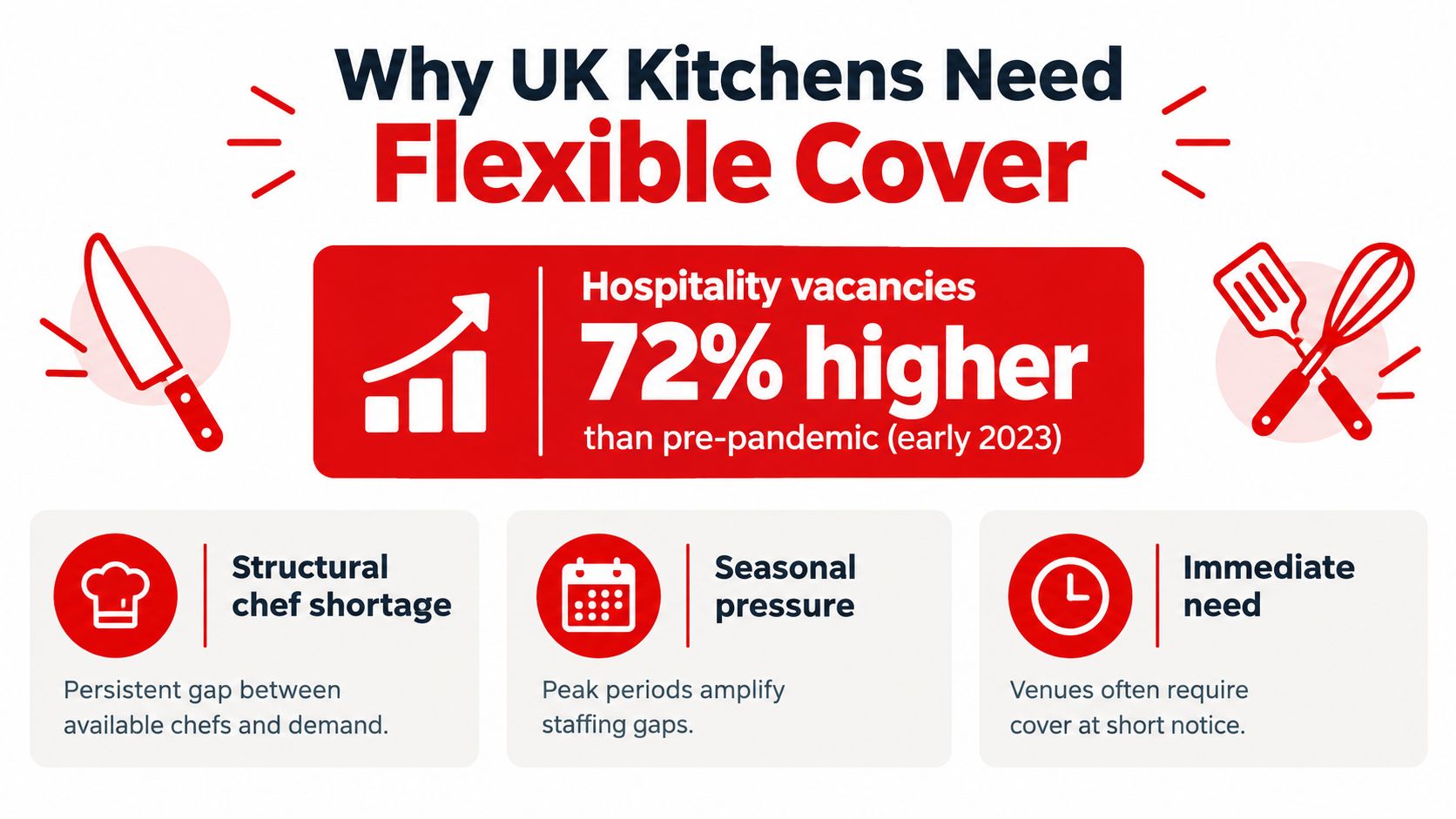
UK hospitality hasn't been dealing with a normal vacancy cycle. A government review published in March 2023 found that hospitality vacancies in November 2022 to January 2023 were 72% higher than in January to March 2020, against a 42% rise across the wider economy, and chefs made up 60% of hospitality visa applications reviewed in that review. The review makes the shape of the shortage plain, this wasn't just a temporary gap, it was a structural problem.
The pressure points that hit kitchens first
The COVID period showed how quickly capacity could fall away. Before the pandemic, about 3.2 million people worked in UK hospitality, and by April 2021 employment was 355,000 lower than a year earlier, according to ONS figures cited by the BBC's report on the sector. That loss didn't stay abstract, it turned into harder-to-fill vacancies, lost sales, and thinner teams on the pass.
The same pattern kept showing up later. Parliamentary evidence recorded nearly 180,000 hospitality vacancies between January 2020 and March 2022, and by April 2022 hospitality had about 2.5 million jobs. During autumn 2021, businesses said 17% of sales were being lost because they couldn't secure the right staffing levels, which is exactly why flexible chef cover matters in commercial terms, not just staffing terms. BBC reporting on the sector captures the operational strain that followed.
A later industry snapshot added fresh pressure. Hospitality payrolled employment fell from 2,111,898 in April 2025 to 2,100,827 in May 2025, and vacancies dropped from 82,000 to 79,000 over the three months to May 2025, while vacancies were down 19% year on year. Restaurant Online's reporting suggests some operators were not replacing departures.
For kitchens, that means the pressure doesn't come from one source. Sickness, seasonal peaks, recruitment lead time, and chef turnover all hit at once. Flexible cover isn't a convenience, it's a buffer that keeps service standards from collapsing when the rota slips.
Vetting, Handover and Pre-Service Checks
A relief chef can be fully experienced and still be the wrong fit if the handover is loose. That's the failure mode operators underestimate. The venue assumes “vetted” means ready to go, but the site-specific realities of allergens, equipment, recipes, and service rhythm still need to be transferred before the first ticket drops.
What must be checked before the chef takes the pass
- Right-to-work status: confirm the legal basics before shift start, not after the chef is already in the building.
- Food-hygiene and allergen competence: UK guidance says every food handler must receive this training before starting work, and the business remains responsible for accurate allergen information and safe allergen management throughout the cover arrangement. Government food safety guidance
- Role level: make sure the booking is for commis, section, sous, head, or kitchen manager level, not a vague “chef”.
- Menu and section fit: verify whether the chef can handle grill, pastry, banqueting, breakfast, or multi-service prep.
- References: look for evidence of reliability, not just a polished CV.
The practical handover starts before service. The venue should share the allergen matrix, current menu, recipes, supplier notes, prep status, par levels, kitchen quirks, and escalation contacts. If the chef doesn't know where the emergency cutlery sits, which fridge is running warm, or who signs off a menu change, service slows down.
A strong relief chef still needs a proper induction. Speed doesn't remove the need for clarity, it increases it.
For operational teams, the cleanest approach is a one-page pre-service pack. Include the rota gap, site contact, keyholder access, uniform or PPE requirements, menu printout, allergen sheet, and the service brief for that day. If the kitchen uses a strict HACCP routine, the new arrival needs to see it before the first prep task.
The best handovers don't try to cover everything. They cover the things that stop a chef working safely, independently, and at speed. That's why proper handover documentation matters more than most venues expect.

Matching the Right Cover to Your Setting
Different venues need different levels of flexibility, and the mistake is usually trying to buy the same cover for every setting. A pub kitchen with one section lead out sick needs something very different from a boutique hotel running breakfast, lunch, and event service, or a private household that wants a discreet chef who can work around family routines.
Where each model fits best
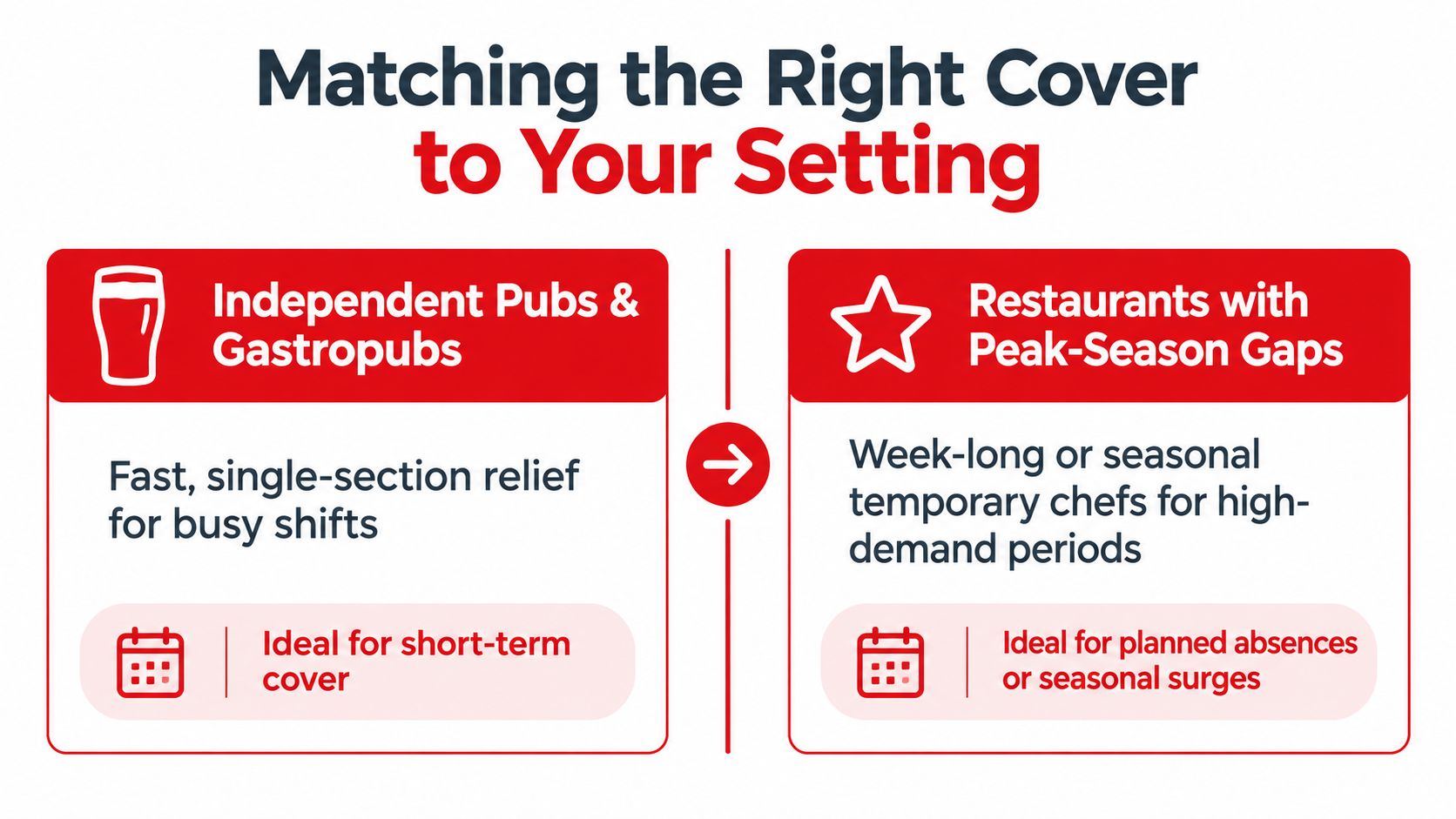
Independent pubs and gastropubs usually need fast, single-section relief. A grill or sauce section going uncovered can slow the whole board, so short-term cover is often the right answer when the issue is sudden sickness or a missed start. The booking has to be simple, the chef has to slot in fast, and the handover has to be tight.
Restaurants facing peak-season gaps often need week-long or seasonal temporary chefs. These venues feel the strain when covers rise, menus stretch, and the permanent team starts to fatigue. A temporary chef can protect ticket times and stop the core brigade from burning out.
Boutique hotels tend to need multi-outlet cover, cross-functional chefs, or support across breakfast and events. The operational test is broader, because the chef may need to move between service styles in one shift. That calls for stronger vetting and a cleaner brief.
Private households need discretion, adaptability, and an ability to work in someone else's kitchen without friction. The chef may be cooking family meals, entertaining guests, or adjusting to changing dietary preferences, so trust and presentation matter as much as technique.
Yachts bring a different set of demands. Smaller vessels may need a chief-cook style operator who can manage provisioning, menu planning, and cooking in a tight footprint, while larger yachts need a chef who can work around travel, guest schedules, and marine routines. Some placements also require specialist compliance such as STCW or ENG1 medicals, depending on the vessel and route.
Villas often mean short seasonal blocks and live-in arrangements. In practice, that can suit guests who want a private dining rhythm for a holiday stay, but it also means the chef has to be comfortable with proximity, shopping, and daily flexibility.
If the same gap keeps returning every week, relief cover is probably the wrong answer. At that point, the venue needs a permanent hire or a more structured staffing pipeline.
For operators who want one partner across these settings, Relief Chefs UK also places temporary chefs, permanent chef recruitment, yacht chefs, villa chefs, and broader hospitality staffing support. The useful distinction is simple, not every venue needs the same service, and not every service should be sold as emergency cover.
Booking Timelines and What to Prepare
The fastest bookings are the ones where the venue has already done the thinking. A good agency process usually starts with a short form or phone call, then a quick response window, then profile matching, a confirmation step, and a clear pre-arrival brief. When the chef is already in the region, same-day starts can work, but only if the kitchen has its side of the handover ready.
The typical next 48 hours
- Initial enquiry. Give the shift date, venue type, section needed, and any menu or allergen risks.
- Response and matching. Review the chef profile, and if needed, make a quick reference call.
- Confirmation. Lock in the booking, the start time, access details, and any uniform or travel notes.
- Preparation. Line up the rota gap, print the menu, share allergens, and brief the team lead.
- Day-of-service briefing. Walk the chef through the pass, the prep list, and who handles escalations.
A practical response target helps everyone plan. Relief bookings should move fast, and where the chef is available locally, a start within 48 hours is a realistic expectation for many temporary cover needs. Premium support usually buys priority handling, replacement cover if the first match doesn't work, and a more hands-on account contact.
The venue side matters just as much. If keyholder access isn't arranged, the chef can't start cleanly. If the menu isn't printed, the team burns time clarifying dishes. If allergens are still sitting in someone's inbox, the pass starts on the back foot.
For busy operators in Berkshire, Windsor, Reading, Slough, Devon, Dorset, Bristol, and Wales, that timeline is usually the difference between a controlled cover and a messy one. Tourism-heavy coastal areas, event weeks, and commuter-belt peaks all tend to expose the same weak point, a shortage that arrives before the venue is ready for it.
Cost, Value and the Case for Relief Cover
The wrong comparison is day rate against salary. The better comparison is the cost of an uncovered shift against the cost of restoring stability quickly. When a chef is missing, the venue loses labour and also risks lost covers, overtime for the existing team, food waste, manager time spent on last-minute fixes, and service drift that later shows up in reviews.
BDO's 2025 Hotel Britain report recorded a hospitality workforce shortage of 132,000 workers in 2023 and vacancies 48% above pre-pandemic levels, which underlines the wider point. That report supports what kitchen operators already know, an unfilled rota costs revenue in lost covers, overtime and food waste.
What the break-even question looks like
If one missing chef forces you to close a section, the daily loss usually matters more than the agency fee. If the team has to work through the gap, overtime and burnout become the hidden costs that keep repeating. If the kitchen lowers quality to keep going, the damage can outlast the booking itself.
Transparent pricing matters. You need to know what is included, whether travel or accommodation assumptions apply, and how minimum bookings are handled. A cheap headline rate with bad matching can cost more than a higher rate with a chef who can run the shift.
The lowest-cost cover is the one that lets the venue serve properly, not the one with the smallest invoice.
The question for operators is whether relief cover saves more than it costs by protecting revenue, standards, and team energy. In many cases, the answer is yes, especially when the alternative is reduced service or a full service cut.
For venues comparing options, Relief Chefs UK's pricing guidance helps frame that decision against the cost of delay, replacement risk, and operational strain.
Regional Cover and How to Book
Demand doesn't land evenly across the country. In Devon and Dorset, summer pressure and tourism flows tighten the market fast. In Bristol, festival weeks and city-centre trade can stretch a brigade hard. In Berkshire, Windsor, Reading, and Slough, commuter-belt density and event traffic create sharp spikes that don't wait for a convenient recruitment cycle. Wales brings its own coastal and hospitality rhythms, where seasonal business can rise quickly while the local labour pool stays limited.
That's where a chef-led staffing partner earns its keep. Relief Chefs UK has operated since 2013, works nationwide, and books from short notice through to longer placements with fully vetted, right-to-work-checked chefs. The agency model is built around quick response, with a short-form or phone enquiry, a rapid matching process, and cover that can start within 48 hours when the chef is already available locally.
The useful part for operators is flexibility. A small pub can ask for a single relief chef. A hotel can build a wider kitchen pipeline. A household, yacht manager, or villa operator can ask for the specific type of chef that suits the setting instead of settling for a generic profile.
If you need same-day relief, seasonal reinforcement, or a permanent chef pipeline, contact Relief Chefs UK and give the team the date, the venue, the section, and the urgency. The clearer the brief, the faster the match.
FAQ
What affects the cost of a chef on hire?
The main factors are the type of cover, the notice window, the level of chef needed, travel, any accommodation requirement, and whether the booking is for a single shift or a longer placement.
How fast can onboarding happen?
If the chef is already vetted and local, cover can often start quickly, but the venue still needs to send the menu, allergens, access details, and briefing before service.
Can you help with yacht and villa cover?
Yes. Those bookings usually need more specific screening around discretion, adaptability, and the practical conditions of the vessel or property.
What should we do if sickness hits out of hours?
Call as soon as the gap is clear, share the shift details, and prepare the handover pack straight away, because the quickest bookings are the ones where the venue already knows what the chef needs.
If you need a relief chef, a temporary chef, or support with a longer-term placement, Relief Chefs UK can help you keep service moving without gambling on the wrong fit. Visit Relief Chefs UK to request cover, outline your rota gap, and get the right chef lined up for the next service.