

Basic relief chef rates in the UK typically range from £16 to £25 per hour, depending on seniority. The true comparison must also include the £2,600+ annual overhead of permanent hires and the hidden agency fees that generalist recruiters may add.
It's Friday morning, the head chef has called in sick, and the bookings are already full. The sous chef is asking whether to cut the menu, the general manager is checking the rota, and every minute spent searching for cover increases the chance of a damaged service.
That's the practical answer to “how much do the relief chefs cost?” The hourly rate matters, but it's only one part of the decision. The full cost includes cancelled covers, reduced menus, wasted stock, overtime, recruitment delays, and the risk of putting an unsuitable chef into a pressured kitchen.
The Real Cost of Emergency Chef Cover
A last-minute chef walkout creates two separate problems. The first is operational, keeping the pass moving. The second is financial, deciding whether the cost of cover is lower than the cost of reducing service or closing a section.
For a typical UK pub, basic relief chef cover may sit within the £16 to £25 per hour range. A commis or junior chef can provide useful support with preparation, breakfast service, simple sections, and kitchen porter relief. A chef de partie can often stabilise a section during a busy service. A sous chef or head chef commands more because the role carries responsibility for menu execution, ordering, team direction, allergens, and service control.
The right question isn't, “How much do the chefs cost?” It's, “What level of chef prevents the greatest operational loss?”
Match the chef to the problem
If your chef de partie is absent, paying for an executive head chef may be unnecessary. A capable chef de partie with experience in your menu could restore the rota at a lower cost and integrate more quickly.
If the head chef is unavailable, a junior temp may fill a body-shaped gap without solving the problem. You may still be left with no one to manage prep, supervise hygiene, brief the team, or make decisions when service pressure rises.
Practical rule: Buy the level of responsibility you need, not the most impressive job title available.
Location affects the practical cost too. A village pub in Devon may need a chef who can work independently with limited support, while a city-centre Bristol restaurant may need someone familiar with faster ticket times and a larger brigade. A coastal Dorset hotel facing seasonal demand has a different requirement from a Berkshire gastro-pub managing a regular local trade.
Use a proper cost of employing a chef guide to compare the hourly cover rate with the cost of overtime, lost service, and permanent payroll. A reliable chef who arrives on time and can work the section may cost more per hour than an untested option, but the cheaper booking can become the expensive one if it causes food waste or forces you to turn guests away.
Emergency cover should therefore be assessed against the value of keeping service open. If a relief chef protects the dinner service, preserves bookings, and gives the permanent team a workable shift, the rate is an operating investment rather than an isolated labour charge.
Hidden Fees and the True Payroll Shock
The advertised hourly rate rarely tells the whole story. A permanent chef's wage becomes a wider employment cost once employer National Insurance, holiday pay, pension contributions, payroll administration, training, uniform, recruitment time, sickness cover, and replacement risk are included.
UKHospitality says payroll typically represents 25% to 35% of net turnover, while the average full-time worker costs employers over £2,600 more in 2025/26 than in the previous year. The same sector evidence reported that 83% of businesses saw higher front-of-house staff costs and 81% saw higher back-of-house costs. UKHospitality also linked approximately 69,000 hospitality job losses to policy-driven cost pressure between October 2024 and May 2025. These figures are set out in its response to the Low Pay Consultation.
That changes the calculation for a general manager. A permanent hire gives you continuity, but you carry the cost during quiet periods and still need contingency cover when that employee takes annual leave, reports sick, resigns, or cannot work a particular service.
Compare the full commitment
| Cost Factor | Permanent Chef Hire | Specialist Relief Chef |
|---|---|---|
| Basic labour | Ongoing salary or hourly wage | Agreed hourly cover rate |
| Employer costs | National Insurance, holiday pay and pension contributions | Included or clearly itemised in the agreed rate |
| Recruitment | Advertising, interviews and management time | Candidate matching handled by the staffing partner |
| Absence risk | The business still needs replacement cover | Cover can be booked for the required shift |
| Quiet periods | Payroll continues regardless of demand | Use cover when operationally necessary |
| Replacement risk | A failed hire can restart the recruitment process | A specialist partner can provide an alternative chef |
| Budget control | Costs can expand through overtime and administration | Transparent pricing supports shift-level budgeting |
Generalist agencies can create another layer of uncertainty. A low headline rate may be followed by registration charges, payroll processing costs, minimum booking periods, replacement penalties, or unclear margins. That makes it difficult to compare a quote with the true cost of an employee.
Before accepting any booking, ask for the complete price in writing. Check whether the rate includes holiday pay, agency margin, travel expectations, administration, VAT where applicable, and the process if the chef is unsuitable.
A clear explanation of net and gross pay for chefs can help managers understand what a chef receives compared with what the venue pays. The most profitable option isn't always the one with the lowest hourly figure. It's the option that gives you a predictable cost and the fewest expensive surprises.
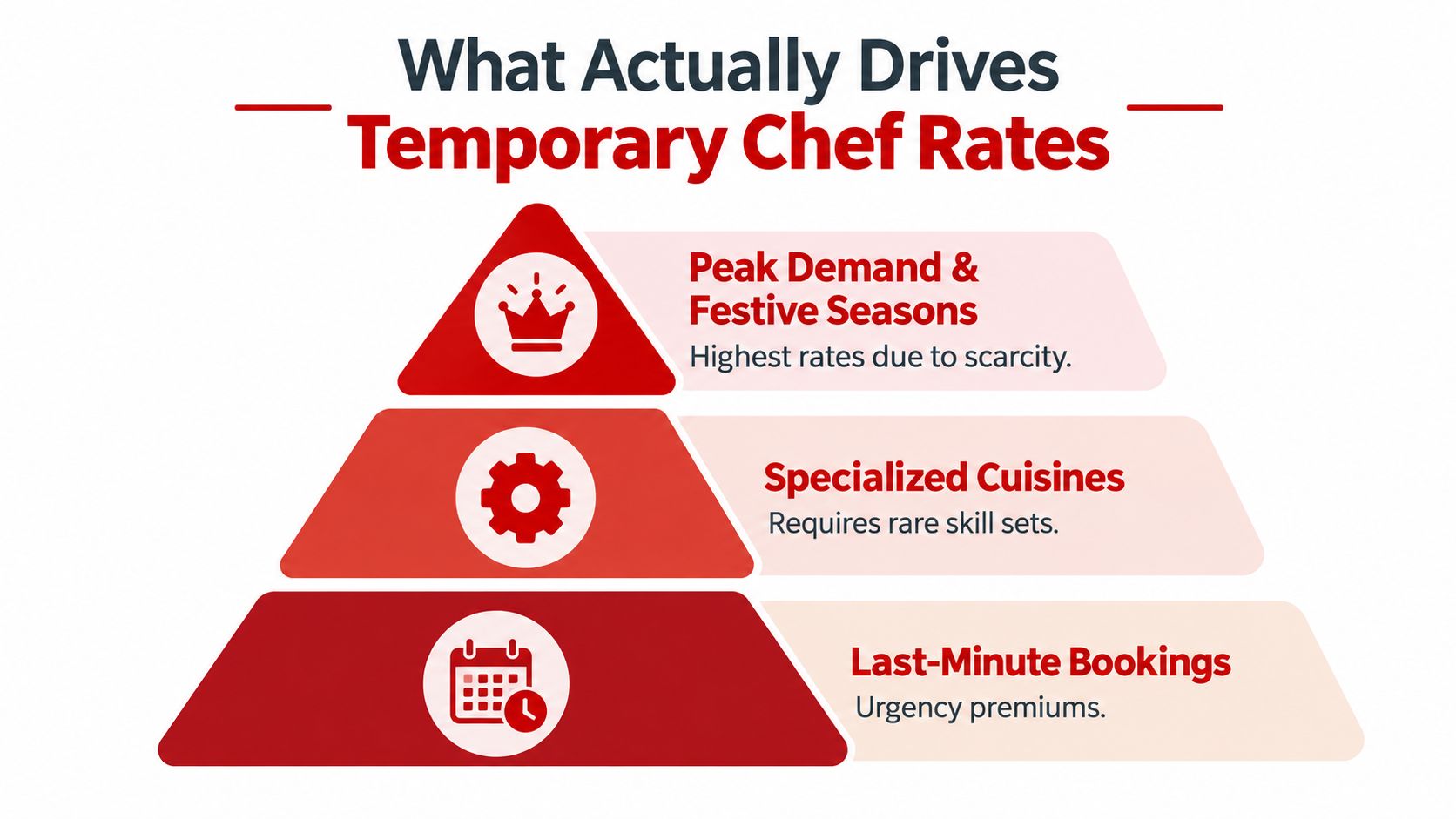
What Actually Drives Temporary Chef Rates
Temporary chef rates move according to the job, the venue, and the urgency. A local pub requiring competent support for a straightforward menu is a different assignment from a hotel needing a senior chef to lead a brigade, maintain standards, and manage a complex service.
Seniority changes the responsibility
A chef de partie may be the right answer when one section needs support. A sous chef becomes more appropriate when the kitchen needs coordination, prep planning, or supervision. A head chef is justified when the absent person normally controls the whole kitchen, manages ordering, sets standards, and carries responsibility for compliance.
Over-specifying the role wastes money. If the brief says “head chef” but the actual need is to run the grill section for one service, you may pay for leadership you don't require. Under-specifying the role creates the opposite problem, placing a junior chef into a kitchen that needs someone to make rapid operational decisions.
Cuisine and setting matter
Specialist skills narrow the available pool. Pastry, fine dining, Asian cuisine, large-scale production, dietary compliance, and seafood preparation may require a chef with experience that a general kitchen temp doesn't have.
The setting can be just as important. A yacht chef must work within a different environment from a pub chef. A villa chef in Cornwall may need private-household experience, menu flexibility, and the confidence to deal directly with guests. A hotel head chef in Windsor or Reading may need to handle banqueting, breakfast, events, and multiple service points.
Notice and geography affect availability
Last-minute sickness cover is harder to source than a planned booking. Festive services, weddings, festivals, and summer trade can also reduce availability, particularly in Devon, Dorset, Wales, East Anglia, and other seasonal hospitality areas.
Send a focused brief. Include the service dates, shift times, menu style, equipment, team structure, expected covers, accommodation requirements, and the exact level of responsibility. A precise brief helps the agency offer a suitable chef rather than defaulting to the most senior available candidate.
That approach protects both standards and margin. You're paying for the capability that stabilises your operation, not for unnecessary experience.
Scaling Cover with Flexible Monthly Plans
Pay-as-you-go staffing works for an isolated absence. It becomes less effective when the same venue repeatedly faces sickness, seasonal surges, recruitment gaps, or several sites competing for the same kitchen staff.
A monthly staffing plan gives the operations team a different way to manage risk. Instead of starting from zero every time a chef is unavailable, you establish the type of support you need, the likely booking pattern, and the response expectations before the next crisis arrives.
Start with your recurring pressure points
Review the rota and identify where the business loses stability. Is the problem breakfast cover at a hotel? Weekend service at an independent pub? Holiday periods in Devon? Event work across Bristol, Berkshire, and Slough? Or a permanent recruitment pipeline for several sites?
Then divide demand into three categories:
- Known demand, such as Christmas services, weddings, festivals, holidays, and planned annual leave.
- Likely demand, such as regular sickness, vacancies, or a weak section in the brigade.
- Emergency demand, such as a same-day absence or unexpected resignation.
A Starter plan may suit a smaller pub or café with occasional requirements. A Growth plan can make sense for a busy hotel, restaurant group, or multi-site operator. A Premium plan may be more appropriate where priority support, a dedicated account manager, and replacement arrangements are important to service continuity.
Build a plan without overcommitting
A flexible arrangement should reflect the business rather than force every venue into the same staffing pattern. Discuss the minimum support you need, how bookings are approved, whether unused capacity can be redirected across sites, and how seasonal peaks are handled.
For example, an independent hotel in Dorset may need regular assistance through the summer but very little relief in quieter months. A group operating in Windsor, Reading, and Slough may benefit from a shared staffing process, allowing cover to move between locations when demand changes.
A monthly plan works when it turns repeated emergencies into an agreed operating process.
Ask whether the plan includes replacement support, account management, out-of-hours contact, and transparent pricing. The aim isn't to fill every shift with temporary labour. It's to protect the permanent team from overload and give managers a dependable option when the rota changes suddenly.
Use permanent chef recruitment for roles that need long-term ownership. Use temporary chefs and relief chefs where flexibility protects margins. The strongest staffing strategy usually combines both rather than treating one as a universal answer.
Why Vetted Reliability Protects Your Margins
The cheapest chef on paper can become the most expensive person in the kitchen if they can't cope with your service. A temp who arrives late, misunderstands the menu, mishandles allergens, or needs constant supervision can put pressure on every other member of the brigade.

The visible cost is the hourly rate. The hidden cost is the ruined service. That can include remade dishes, wasted ingredients, complimentary meals, delayed tickets, staff overtime, management intervention, and guests who decide not to return.
A vetted chef should arrive with the right-to-work checks completed, the relevant experience assessed, and a clear understanding of the assignment. Skill alone isn't enough. Kitchen temperament matters too. The chef needs to communicate under pressure, accept direction, protect standards, and integrate with the existing team without creating friction.
Reliability is a service control
A specialist staffing partner should ask practical questions before recommending anyone:
- What the chef will do: Section work, prep, breakfast, banqueting, kitchen leadership, or full operational control.
- What the kitchen expects: Menu type, equipment, service volume, dietary requirements, and brigade structure.
- What could go wrong: Accommodation, transport, location, shift length, missing mise en place, or limited supervision.
- What happens if plans change: Replacement support, escalation contact, and communication outside normal office hours.
Relief Chefs UK is a nationwide chef recruitment agency established in 2013. Its staffing support includes relief chefs, temporary chefs, permanent chef recruitment, yacht chefs, villa chefs, and wider hospitality staffing support, with chefs matched to short-term and longer-term operational requirements.
The venue should still brief the chef properly. Send the menu, arrival instructions, parking information, uniform expectations, allergen procedures, and the name of the person responsible for the shift. A well-prepared arrival reduces the time needed to bring someone into the operation.
The principle is simple. A dependable chef protects the service before the service starts.
The following video illustrates the level of professional kitchen execution venues should expect when selecting cover:
Navigating the UK Hospitality Labour Shortage
A kitchen can have applicants for front-of-house roles and still lack the chef needed to run service. The pressure falls hardest on positions carrying operational responsibility, including prep, section management, and production kitchen leadership.
UKHospitality reported 132,000 hospitality vacancies, 48% above pre-pandemic levels. Its member evidence recorded chef shortages ranging from 10% for head chefs to 21% for production chefs. The figures show why a rota can look nearly complete while one missing senior chef still threatens service. The source is available through UKHospitality workforce evidence.
The government's shortage review found that chefs represented 60% of hospitality applications in the immigration system, 10 percentage points higher than their share of total employees across the five hospitality occupations examined. That proportion reflects the industry's dependence on chefs to replenish staffing, particularly when migration routes or pay conditions change. The detail appears in the government hospitality and construction shortage review.
Skills matter more than headline vacancy counts
A lower vacancy total does not make recruitment straightforward. The government's hospitality and tourism workforce report found that skilled trades such as chefs had 39% of vacancies classified as hard to fill because skills were difficult to find, compared with a 17% sector average. For a general manager, that distinction affects the cost decision. Hiring a permanent chef may appear cheaper from the hourly rate alone, yet salary commitments, employer costs, recruitment time, onboarding, and the expense of covering absence can turn a vacant post into a larger payroll shock. A specialist relief chef agency can make the immediate cost easier to forecast by quoting for defined cover rather than leaving the venue to absorb every consequence of an unsuccessful hire. Read the hospitality and tourism workforce report.
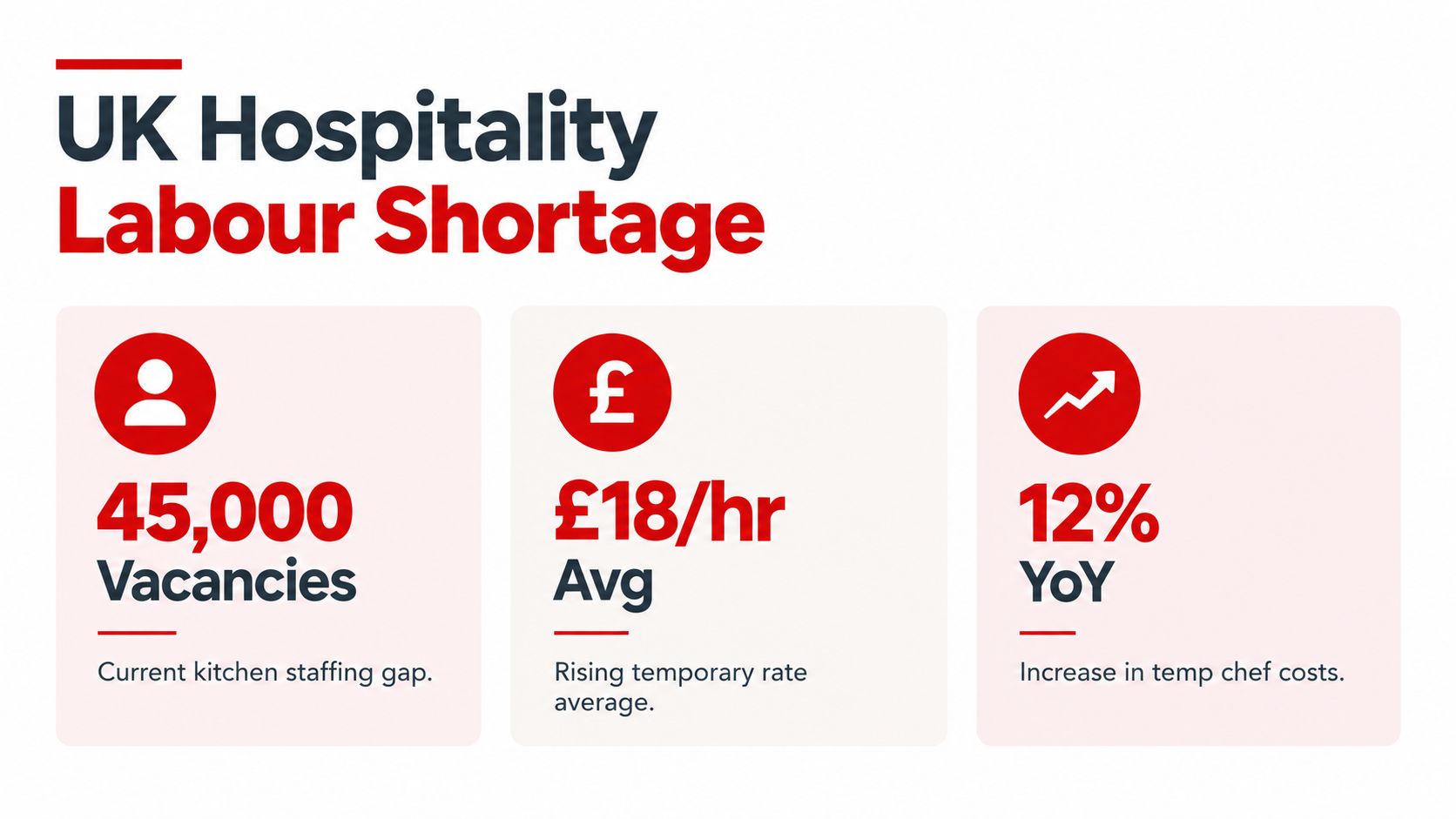
For a pub in Wales, a hotel in Devon, or a restaurant group in Bristol, targeted resilience protects the trading plan. Establish a staffing relationship before an absence occurs and agree which kitchen roles require rapid cover.
That approach gives the staffing budget a clear purpose. The spend protects service continuity when a key role becomes vacant without warning, while transparent agency pricing helps prevent hidden costs from eroding already tight margins.
Securing Transparent Cover for Your Kitchen
Start by calculating the cover you need. Don't send an agency a vague request for “a chef” and expect a useful price. Give the operational facts that determine suitability.
- Describe the venue. State whether you run a pub, hotel, restaurant, café, yacht, private villa, or events kitchen.
- Define the role. Explain whether you need a commis chef, chef de partie, sous chef, head chef, pastry chef, yacht chef, or villa chef.
- List the dates and shifts. Include start and finish times, handover requirements, and whether the booking is one shift or recurring.
- Explain the service. Provide the menu style, likely covers, equipment, dietary requirements, and brigade size.
- State the location clearly. A venue in coastal Dorset may have different transport and accommodation considerations from one in central Bristol or Slough.
- Ask for the complete price. Confirm the hourly rate, minimum booking, travel expectations, VAT, replacement process, and any other charge before confirming.
A short, accurate brief makes it easier to compare temporary cover with overtime or a permanent hire. It also prevents a common failure, booking a chef whose experience looks suitable on paper but doesn't match the kitchen's pace or responsibilities.
For businesses that need regular cover, discuss whether a monthly plan would smooth demand across the year. For an isolated absence, request a shift-specific quote. A transparent pricing model for chef cover should make the cost understandable before the chef arrives, not after payroll closes.
Frequently asked questions
How much do relief chefs cost in the UK?
Basic relief chef rates typically range from £16 to £25 per hour, depending on seniority, location, cuisine, notice period, and responsibility. A specialist or senior chef may cost more where the role requires leadership or scarce technical skills.
Is a temporary chef cheaper than a permanent hire?
Not necessarily on the hourly figure. Temporary cover can be more cost-effective when the business needs flexibility because it avoids committing to ongoing employer costs during quiet periods. A permanent hire may be the right choice where the role is consistently required and the business needs long-term ownership.
Can I book a chef at short notice?
Short-notice availability depends on location, role, date, and the current supply of suitable chefs. Give the agency the fullest possible brief and contact it as soon as the absence is known, especially for Friday and Saturday services or seasonal demand.
What should I ask before accepting a quote?
Ask what the rate includes, who handles replacement cover, whether the chef has been right-to-work checked, what experience has been assessed, and whether there are administration, travel, minimum booking, or other additional charges.
Relief Chefs UK provides nationwide relief chefs, temporary chefs, permanent recruitment, yacht chefs, villa chefs, and hospitality staffing support for pubs, restaurants, hotels, private households, and multi-site operators. Visit Relief Chefs UK to request dependable kitchen cover and discuss a transparent staffing option before your next absence becomes a service crisis.